
Authenticated Encryption: How Reordering can Impact Performance
Basel Alomair Network Security Lab (NSL)
University of Washington [email protected]
Abstract. In this work, we look at authenticated encryption schemes from a new perspective. As opposed to focusing solely on the“security”implications of the different methods for constructing authenticated encryption schemes, we investigate the effect of the method used to construct an authenticated encryption scheme on the“performance”of the construction. We show that, as opposed to the current NIST standard, by performing the authentication operation before the encryption operation, the computational efficiency of the construction can be increased, without affecting the security of the overall construction. In fact, we show that the proposed construction is even more secure than standard authentication based on universal hashing in the sense that the hashing key is resilient to key recovery attacks.
1 Introduction
There are three different methods to generically compose an authenticated encryption scheme by combining an encryption algorithm with a message authentication code (MAC) algorithm: Encrypt-and-MAC (E&M), Encrypt-then-MAC (EtM), or MAC-then-Encrypt (M tE). Although significant efforts have been devoted to analyzing the security implications of different generic compositions (see, e.g., [11, 12, 22, 27, 49, 52]), little effort has been devoted to the study of the performance implications of different generic compositions [7]. Of particular interest to this work is the performance aspect of generic compositions when the encryption algorithm is blockcipher based and the MAC algorithm is universal hash-function family based. (We focus on such constructions since blockciphers are the building blocks of choice for constructing secure encryption algorithms [44] and since universal hash families based MACs are the fastest method for message authentica-tion [66]).
In a typicalEtMcomposition, the plaintext is broken into blocks. Each block is processed with a blockci-pher, resulting in a ciphertext block. The resulting ciphertext blocks are then authenticated using a MAC based on a universal hash-function family (in the Carter-Wegman style [23, 24]). One of the most recent authenti-cated encryption schemes is the current National Institute of Standards and Technology (NIST) standardized Galois/Counter Mode (GCM) of authenticated encryption [30]. The GCM standard is based on the Carter-Wegman Counter (CWC) blockcipher mode of authenticated encryption proposed by Kohno et al. in [46]. The GCM and CWC modes of operations give high-performance authenticated encryption by combining the counter mode of encryption with a universal hash-function family for authentication.
Recently, there has been increasing attention in the design of secure and efficient authenticated encryption algorithms. Following a long tradition of focused competitions in symmetric cryptography,1 a new NIST-funded competition, CAESAR, is now calling for standardized authenticated ciphers. The AES competition is generally viewed as having provided a tremendous boost to the cryptographic research community’s un-derstanding of blockciphers, and a tremendous increase in confidence in the security of some blockciphers. Similar comments apply to eSTREAM and to the SHA-3 competition, and are also expected to apply to CAE-SAR [16].
The OKH solution.In this work, we investigate the performance implications of the order in which the two
operations, encryption and authentication, are performed. We describe the Odd Key Hashing (OKH) mode of authenticated encryption. The OKH mode is motivated by the current NIST standard (the Galois/Counter Mode (GCM) of authenticated encryption [30]) and the CWC mode of authenticated encryption proposed by Kohno et al. [46]. However, unlike the GCM and the CWC schemes, the order of encrypt-then-authenticate is reversed in the OKH mode. That is, as opposed to applying the hashing operation on the ciphertext, it is applied on the plaintext, before blockcipher encryption.
Earlier results in the security of authenticated encryption systems show that, when combining a secure encryption algorithm2and a secure MAC algorithm3, only theEtM composition guarantees the construction of a secure authenticated encryption system [12, 22, 49]. Such early results are perhaps the main reason for adopting theEtM composition as a standard. However, more recent results show that the M tE and the
E&M can indeed construct secure authenticated encryption systems [7, 52]. The main objective of this work is to highlight the possible performance advantages of theM tEand theE&Mcompositions, hoping to pave the road for more efficient standards (especially with the ongoing NIST-funded competition to standardize authenticated encryption algorithms [16]).
The main result of this study is to show that, while the hash family used to construct a MAC in theEtM
compositionmust be universal, this need not be the case in theM tEcomposition.4The performance impli-cation of this result is that, since the hash family need not be universal, it can be computed faster than the fastest universal hash family in the cryptographic literature. The theoretical significance of this result is that relaxing the security requirements on the MAC algorithm does not affect the provable security of the overall authenticated encryption composition. In fact, we show thatM tE compositions are even more secure than theirEtM counterparts in the sense that they are secure against the key-recovery attacks discovered in [39]. We emphasize that the main purpose of this work is not the design of most efficient authenticated encryption algorithm. Rather, laying down the theoretical basis for the design of more efficient authenticated encryption algorithms is the main purpose of this work.5
Versions.An extended abstract of this paper appeared in the10thInternational Conference on Applied Cryp-tography and Network Security–ACNS’12 [2]; this is the full version. We note here that the preliminary version of OKH appeared in [2] has a vulnerability when the integer representation of the last blocks in the forgery attempt are equal to2n−1. This vulnerability has appeared in [67] and it has been fixed in this manuscript.
Organization.In Section 2, we give a brief background and discuss related work. In Section 3, we give some preliminaries. In Section 4, we describe theOKhash family. In Section 5, we describe the construction of the proposed OKH authenticated encryption scheme. In Section 6, we state and prove the authenticity and privacy theorems of the proposed scheme. In Section 7, we summarize the basic ideas behind the proposed mode of operation and provide performance discussions. In Section 8, we conclude the paper.
2 Background and related work
There are two main approaches to design an authenticated encryption system: a generic approach and a ded-icated approach. In the generic approach, an encryption primitive for data privacy is combined with a MAC primitive for data integrity to construct an authenticated encryption system. Examples of the generic con-structions include, but are not limited to, SSH [72], IPsec [28], SSL [33], CWC [46], and GCM [30]. In the
2
Secure in the sense that it provides indistinguishability under chosen plaintext attacks 3
Secure in the sense that it provides unforgeability under chosen message attacks 4
Although the same result can be shown for theE&Mcomposition, we restrict our discussion to theM tEcomposition for brevity. 5It might be worth mentioning here that the ideas presented in this work are the basis for the design ofAVALANCHE[3], one of
dedicated approach, an authenticated encryption primitive is designed as a standalone system. The first dedi-cated scheme is the PCBC of Gligor and Donescu [34]. The formal notion of authentidedi-cated encryption systems was introduced independently by Katz and Yung in [45], and by Bellare and Rogaway in [13]. Since then, many dedicated authenticated encryption schemes have been proposed, such as, RPC of Katz and Yung [45], XECB of Gligor and Donescu [35], IAPM of Jutla [43], OCB of Rogaway et al. [60], and EAX of Bellare et al. [14]. A noteworthy point is that all secure dedicated authenticated encryption primitives are blockcipher based. That is, although stream cipher based authenticated encryption primitives have been proposed, e.g., in [32, 69], such stream cipher based proposals have been analyzed and shown to be vulnerable to differential cryptanalysis [54, 56, 57, 70].
The use of universal hash-function families to construct MAC algorithms is due to Carter and Wegman [23, 24]. Compared to blockcipher based MACs, such as [9, 18, 29, 41], and cryptographic hash function based MACs, such as [8, 21, 58, 65], universal hashing based MACs lead to faster message authentication [17, 38, 47, 59]. The security of MACs based on universal hashing has been extensively studied (see, e.g., [4, 5, 39]
The speed of a universal hash family based MAC relies mainly on the speed of the used universal hash family. Consequently, significant efforts have been devoted to the design of fast universal hash families. In [47], Krawczyk introduced the cryptographic CRC which hashes in about6cycles/byte, as shown by Shoup in [62]. In [59], Rogaway proposed the bucket hashing which was the first hash family explicitly targeted for fast software implementation; it runs in about1.5−2.5cycles/byte [17]. In [42], Johansson described bucket hashing with smaller key size. In [38], Halevi and Krawczyk proposed theMMHfamily, which hashes at about
1.2−3cycles/byte. In [31], Etzel et al. proposed the square hash, anMMH-variant that can be more efficient thanMMHin certain settings [17]. In [15], Bernstein proposed floating-point arithmetic based hash function that achieves a peak speed of2.4 cycles/byte. In [1], Afanassiev et al. described an application of hashing based on polynomial evaluation over finite fields. In [55], Nevelsteen and Preneel study the performance of several universal hash functions proposed for MACs. The speed champion of universal hash functions directed for software implementation is theNHfamily of Black et al. proposed in [17]. TheNHfamily is an extension to theMMHfamily of [38]. The speed improvement comes from eliminating the non-trivial modular reduction required by theMMHfamily. The novelty ofNHfamily is that it uses arithmetic modulo powers of two or, as the authors call it, “computations that computers like to do [17].” TheNHfamily hashes at about 0.34
cycles/byte for2−32probability of message collision.
Recently, Alomair and Poovendran showed that, in contrast to theEtM composition, one can utilize the
E&M and M tE compositions to increase the efficiency of the system by eliminating the last blockcipher call [6, 7]. In this work, we take the idea of utilizing the E&M andM tE compositions one step further. That is, while the use of universal hash functions was necessary for the security of the schemes in [6, 7], the scheme proposed here need not use universal hash functions, thus increasing the speed of the system, while maintaining the required provable security.
3 Notations and Preliminaries
In this section we state our assumptions and describe the notations and definitions that will be used for the rest of the paper.
3.1 Notations
The following notations will be used throughout the rest of the paper.
- Ifsis a binary string,|s|denotes the length ofsin bits.
- Ifbis a bit andβis a positive integer, we denote bybβ the concatenation ofbwith itselfβtimes.
- For a non-empty setH, we denote byh ← H$ the selection of a member ofHuniformly at random and assigning it toh.
- Ifxandnare positive integers so that0≤x <2n, we denote bytostr(x, n)the binary representation of
xas ann-bit string (in a big-endian format).
- If sis a binary string, we denote by toint(s) the unsigned integer representation ofs(in a big-endian format).
- Ifsis a binary string and`is a positive integer, we denote by setlen(s, `) the truncation ofsinto its`
most significant bits. If|s|< `, thensetlen(s, `)denotes the`-bit long strings||0`−|s|.
3.2 Universal Hash-Function Families
A family of hash functionsHis specified by a finite set of keysK. Each keyk∈ Kdefines a member of the familyHk ∈ H. As opposed to thinking ofHas a set of functions fromDtoR, it can be viewed as a single
functionH:K × D → R, whose first argument is usually written as a subscript. A random elementh← H$
is determined by selecting ak ← K$ uniformly at random and setting h ← Hk. There are many classes of universal hash families, depending on their probability of message collision (see, e.g., [23, 38, 47, 48, 63, 68]). We give below a formal definition of one class of universal hash families called-almost universal.
Definition 1. LetH = {h : D → R}be a family of hash functions and let ≥ 0be a real number.His
said to be-almost universal, denoted-AU, if for all distinctM, M0 ∈ D, we have thatPrh←H
h
h(M) =
h(M0)i≤.His said to be-almost universal on equal-length strings if for all distinct, equal-length strings
M, M0 ∈ D, we have thatPrh←H
h
h(M) =h(M0)i≤.
3.3 Blockciphers
LetF :K × D → Rbe a family of functions fromDtoRindexed by keysK. We useFK(D)as shorthand forF(K, D).F is a family of permutations (i.e. a blockcipher), ifD=RandFK(·)is a permutation onD for eachK ∈ K. IfF is a family of permutations, we useFK−1(·)to denote the inverse ofFK(·)and we use
F−1(·,·)to denote the function that takes as input(K, D)and computesFK−1(D).
We adopt the notion of security for blockciphers formalized in [10]. LetPerm(K,D)denote the set of all
possible blockciphers (permutations) with key spaceKand domainD. Then, the notationπ ←$ Perm(K,D)
corresponds to selecting a random block-cipher. Given a family of functions E : K × D → D and a key
K∈ K, define the related-key oracleERK(·,K)(·)as an oracle that takes two arguments, a functionφ:K → K
and an elementM ∈ D, and that returnsEφ(K)(M).
The functionφis the related-key-deriving (RKD) function or the key transformation function. LetΦbe a set of functions mappingK to K. Then Φ is called the set of allowed RKD functions, or allowed key-transformations.
LetE :K × D → Dbe a family of functions and letΦbe a set of RKD functions overK. LetAbe an adversary with access to a related-key oracle, and restricted to queries of the form(φ, m)in whichφ∈Φand
m∈ D. Then,
Advprp-rkaΦ,E (A) = Pr
h
K ← K$ :AERK(·,K)(·)= 1
i
−PrhK ← K$ ;π←$ Perm(K,D) :AπRK(·,K)(·)= 1
i
denotes the prp-rka-advantage of Ain distinguishing a random instance of E from a random permutation usingΦ-restricted related keys. We say thatE is a secure pseudorandom permutation (prp) against related-key-attacks (rka) if the prp-rka-advantages of all adversaries using reasonable resources is small.
A blockcipher is said to be strong pseudorandom permutation (sprp) if it is indistinguishable from a random permutation even if the adversary is given an oracle access to the inverse function. Then,
Advsprp-rkaΦ,E (A) = Pr
h
K← K$ :AERK(·,K)(·),E
−1
RK(·,K)(·)= 1
i
−PrhK← K$ ;π ←$ Perm(K,D) :AπRK(·,K),π
−1
RK(·,K) = 1
i
(2)
denotes the sprp-rka-advantage ofA in distinguishing a random instance ofE from a random permutation usingΦ-restricted related keys.
3.4 Authenticated Encryption Schemes
The authenticated encryption model that we use is similar to the one in [46, 60]. A nonce-using, symmetric authenticated encryption schemeAE = (K,SE,VD)consists of three algorithms: the key generation algo-rithm(K), the signed encryption algorithm(SE), and the verified decryption algorithm(VD).AEis defined over some key spaceKeySp, some nonce spaceNonceSp = {0,1}nl, for a positive integernl, and some
message spaceMsgSp={0,1}∗. We require that membership inMsgSpcan be efficiently tested and that if
M, M0 are two strings such thatM ∈MsgSpand|M|=|M0|, thenM0∈MsgSp.
The randomized key generation algorithm K returns a key K ∈ KeySp. The deterministic signed en-cryption algorithmSE takes as input a keyK ∈ KeySp, a nonceN ∈ NonceSp, and a payload message
M ∈ MsgSp, and returns a ciphertext σ ∈ {0,1}∗. The deterministic verified decryption algorithm VD takes as input a keyK ∈ KeySp, a nonce N ∈ NonceSp, a stringσ ∈ {0,1}∗, and outputs a message
M ∈ MsgSp or the special symbol INVALID on error. We ask for the basic validity requirement that if
σ=SEK(N, M)then it must be the case thatVDK(N, σ) =M.
3.5 Adversarial Model
We adopt the standard adversarial model used in authenticated encryption schemes. The adversary is given oracle access to the signed encryption algorithmSEK(N, M). The adversary can call theSEoracle on nonce-message pairs(N, M)of her choice and observing the outputs. After calling the SE oracle forq times, the adversary attempts a forgery by calling the verified decryption algorithmVDK(N, σ)for an(N, σ)pair of her choice. Note that the adversary does not see the secret keyK. If the verified decryption oracle returns theINVALIDsymbol, the adversary is considered unsuccessful; otherwise, the forgery attempt is said to be successful.
A standard assumption in authenticated encryption schemes is that the adversary is nonce-respecting. An adversary is said to be nonce-respecting if she never repeats a nonce. That is, after calling the signed encryption oracle on(N, M), the adversary never asks its oracle a query (N, M0), regardless of the oracle responses. We emphasize, however, that the nonce used in the forgery attempt may coincide with a nonce used in one of the adversary’s queries.
To model the privacy of the authenticated encryption scheme, consider an adversaryAwho has one of two types of oracles: a real encryption oracle and a fake encryption oracle. The real encryption oracleEK(·,·)takes as input a pair(N, M)and returns a ciphertext C ← EK(N, M). Assume that the length of the ciphertext depends only on the length of the plaintext, that is,|C|= l(|M|). The fake encryption oracle,$(·,·), takes
encryption scheme OKH= (K,SE,VD), define
AdvprivOKH[BC,OK](A) = PrhK← K$ :ASEK(·,·) = 1
i
−PrhA$(·,·)= 1i (3)
to beA’s advantage of breaking the privacy of the authenticated encryption scheme usingBCas a blockcipher andOKfor hashing.
To analyze the integrity of the proposed system, fix an authenticated encryption scheme OKH= (K,SE,VD)
and run an adversaryAwith an oracleSEK(·,·)for some key K. We adopt the standard definition of exis-tential unforgeability under chosen message attack, modeled by the following game
Game 1 (EU-CMA game)
1. A random string,K, is selected as the shared secret.
2. SupposeAmakes a signed encryption query on a nonce-message pair(N, M). Then the oracle computes the integrity aware ciphertextσ=SEK(N, M)and returns it toA.
3. After calling the signed encryption oracle a polynomial number of times,Amakes a verified decryption query(N, σ). The oracle computes the decisiond=VDK(N, σ)and returns it toA.
The adversary,A, successfully forges ifAis nonce-respecting,Aoutputs a pair(N, σ)whereVDK(N, σ)6= INVALID, andAmade no earlier query(N, M)which resulted in the responseσ. Let
AdvauthOKH[BC,OK](A) = PrhK ← K$ :ASEK(·,·)forges
i
(4)
beA’s advantage of successful forgery against the scheme OKH that usesBCas a blockcipher for encryption and theOKfamily for hashing when given oracle access to theSEK(·,·)algorithm.
3.6 Properties of Odd Integers
We state here two lemmas about odd integers in the finite integer ringZ2nthat will be used for the remainder of the paper.
Lemma 1. For any nonzero integersαandβ inZ2n,2n dividesαβonly if bothαandβ are even integers. Formally, the following one-way implication must hold:
αβ≡0 ⇒ α≡β≡0 mod 2. (5)
Proof. Observe that for any odd integerd,gcd(d,2n) = 1; and for any integerdsuch thatgcd(d,2n) = 1,d must be odd. Therefore, for any integerd∈Z2n,d∈Z
∗
2n if and only ifdis odd. Now, letαandβbe nonzero elements and let
αβ≡0 (6)
but assume, without loss of generality, thatα is an odd integer. Then, the multiplicative inverse ofα in the ringZ2ndoes exist. Multiplying both sides of equation (6) byα−1implies thatβis the zero element inZ2n, and the lemma follows by contradiction.
Lemma 2. LetXbe the random variable representing the experiment of drawing a numberxfrom the set of integers0,1,2,· · · ,2n−1 uniformly at random. Then, for any odd integerk∈Z2n, the random variable
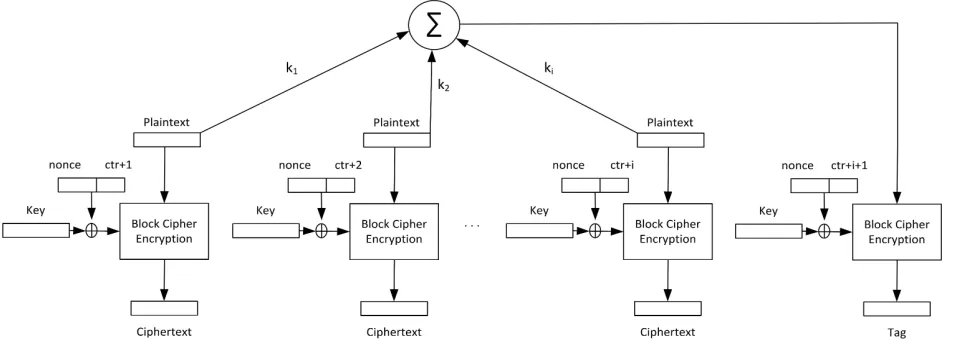
Fig. 1.A block diagram depicting the proposed OKH authenticated encryption. Plaintext blocks are multiplied by the keys of theOK
hash family, theki’s; the resulting products are summed modulo2n; and the result is processed with the block cipher to produce the
tag. Note that the nonce-counter concatenation is XORed with the key, not the plaintext block. Therefore, given a nonce-respecting adversary, the encryption key of each block is different than all other blocks of the same message and different than all other blocks of different messages due to the use of nonce-counter concatenation. This observation is critical for the security of the proposed scheme.
Proof. This is a direct consequence of the fact that every odd integer is invertible inZ2n. To formally prove the lemma, it suffices to show that for everyy ∈
0,1,2,· · · ,2n−1 , there exists anx∈
0,1,2,· · ·,2n−1
that satisfies the equation
y=k·x mod 2n, (7)
and that thisxis unique. Fix anyy∈
0,1,2,· · ·,2n−1 and anyk∈Z
∗
2n. Sincek∈Z ∗
2n, by B´ezout’s lemma [64], there exists k−1∈Z∗2nso thatk−1k≡1 mod 2n, and multiplying both sides byygives(yk−1)k≡y mod 2n. Hence,
x=yk−1 mod 2nsatisfies equation (7). Therefore, there exists anx ∈
0,1,2,· · · ,2n−1 that satisfies equation (7).
To show that thisxis unique, letx06=xalso satisfies equation (7). Then,
x0k≡y mod 2n. (8)
Multiplying both equations (7) and (8) byk−1givesx≡yk−1 mod 2n, andx0 ≡yk−1 mod 2n.Therefore,
x ≡ x0 mod 2n and, hence, the x in0,1,2,· · · ,2n −1 that satisfies equation (7) for any fixed y ∈
0,1,2,· · ·,2n−1 is unique, and the lemma follows.
Lemmas 1 and 2, along with the fact that there is a one-to-one correspondence betweenn-bit strings and the integer ringZ2n, will be used to establish the results of this paper.
4 The Odd Key Hash Family
In this section, we give a description of theOKhash family that will be used in the construction of our OKH authenticated encryption. Fix an integern ≥ 1 (the “block size”) and an integer b ≥ 1 (the “number of blocks”). We define the family of functionsOK[n, b]as follows. The domain isD={0,1}n∪ {0,1}2n∪ · · · ∪ {0,1}bnand the range isR={0,1}n. Each function inOK[n, b]is defined by theb-tupleK = (k
1,· · · , kb), whereki ∈Z∗2n fori= 1,· · ·, b. A random function inOK[n, b]is given by drawing theki’s at random from the multiplicative groupZ
∗
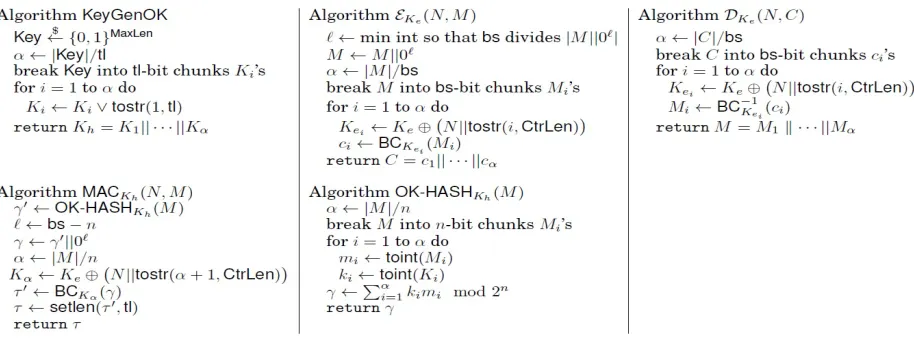
Fig. 2.Pseudocodes of the key generation (K), signed encryption (SE), and verified decryption (VD) algorithms.
For an input message M ∈ D, view M as a sequence of n-bit blocks, i.e., M = m1· · ·m`, where
`≤b, and write each block in its unsigned integer representation inZ2n (in a big-endian format). Then, the compressed image ofMis given by
OKK(M) =
`
X
i=1
kimi mod 2n. (9)
When the values ofnandbare known, we will writeOKinstead ofOK[n, b]to simplify the notations.
5 Description of the OKH Authenticated Encryption
As mentioned earlier, the key idea allowing for more efficient authentication over the GCM and CWC modes of operation is advancing the hashing phase to be applied on the plaintext instead of the ciphertext. The mode of operation used for encryption is similar to the counter mode (CTR) but with the the requirement that the plaintext is to be processed by the blockcipher. A block diagram depicting the proposed OKH mode of authenticated encryption is shown in Figure 1. Plaintext blocks are multiplied by the keys of theOKhash family, theki’s; the resulting products are summed modulo2n; and the result is processed with the blockcipher to produce the tag. Note that the nonce-counter concatenation is XORed with the key, not the plaintext block. Therefore, given a nonce-respecting adversary, the encryption key of each block is different than all other blocks of the same message and different than all other blocks of different messages due to the use of nonce-counter concatenation.6This observation is critical for the security of the proposed scheme.
As in previous authenticated encryption schemes, such as IAPM [43] and OCB [60], we require the block-cipherBCto be a strong pseudorandom permutation (many blockciphers, such as AES [25], are believed to be strong pseudorandom permutations [44]). LetBC:{0,1}kl× {0,1}bs→ {0,1}bsbe the used blockcipher,
whereklandbsare the key length and block size of the blockcipher, respectively. The authenticated encryp-tion usingBCfor encryption and theOKfamily for hashing, OKH= (K,SE,VD), is defined as follows. The message spaces are
MsgSp=
n
M ∈ {0,1}∗:|M| ≤MaxLeno, (10)
KeySp=n(Ke, Kh)∈ {0,1}kl× {0,1}MaxLen
o
, (11)
NonceSp=nN ∈ {0,1}∗ :|N| ≤kl−log2MaxLeno, (12)
whereMaxLenis the message maximum length. The size of the counter,CtrLen, in the mode of operation of Figure 1 is at leastlog2MaxLen. The concatenation of the nonce and the counter is of lengthkl-bits.
6
Fig. 3.Pseudocodes of theKeyGenOK,E,D,MAC, andOK-HASHalgorithms.
First, the plaintext message is appended with1||0∗||1as its least significant bits. As can be seen in Algo-rithmSEK(·,·)in Figure 2, the number of zeros will depend on the length of the message and is chosen so that the message length is divisible bynand the least significant bit of the last message block is ‘1’. Informally speaking, the authentication tag is computed by dividing the plaintext message into blocks ofn-bit long, hash it according to equation (9) using a member of theOKfamily, and encrypt the resultingn-bit hashed image (as shown in theMACalgorithm of Figure 3). The size of the hashing images,n, is less than or equal to the blockcipher size,bs. The encryption part is done the natural way (as shown in Figure 3).
Remark 1. There are two important points to note about theOKfamily. First, theOKfamily is defined over the domain D only. This issue, however, can be easily solved with an appropriate padding. Second, and more important, as in universal hash families, theOKfamily as described in Section 4 can only be used to authenticate equal-length messages. For example, a message block consisting of all zeros will not contribute to the value of the hashed image. Hence, it is easy to come up with two distinct messages that collide and, eventually, achieve a successful forgery. However, there are known techniques to make the hash function applicable to arbitrary-length messages. For instance, in [17] the authors proposed appending the length of the message at the end. In our case, it suffices to append the sequence ‘1||0∗||1’ as an end-of-message (EOM) sequence (both the most significant ‘1’ and the least significant ‘1’ of EOM will play pivotal roles in the security of the algorithm, as will be detailed in the proof of Theorem 2).
Another important remark is related to the message length. For a message that is longer thanMaxLen, it is treated as multiple chunks of lengthMaxLenor less and the corresponding tags are concatenated. That is, arbitrary long messages can be authenticated using the same fixed-length hashing key (this is actually the case for any universal hashing based MAC, not just the proposed one [17]). Typically, MaxLen is set to some proper value that is not too short for maximum message length and not too long for the key to be infeasible. Note, however, that this is not a major design challenge as one is often dealing with reasonably short messages. For instance, about one-third of the messages on the backbone of the Internet are only 43 bytes [60]. For the rest of the paper, we will assume messages of lengthMaxLenor less for simplicity.
Formally, The OKH’s key generation (K), signed encryption (SE), and verified decryption(VD) algo-rithms are as defined in Figure 2.
6 Theorem Statements and Proofs
6.1 Security of Encryption
In this section, we show that the privacy of the proposed scheme is provably secure assuming the used block-cipher is a pseudorandom permutation secure against related-key attacks.
Theorem 1. LetOKH[BC;OK]be the authenticated encryption scheme described in Section 5 using theOK hash family for compression and the blockcipherBCfor encryption. Then given a nonce-respecting adversary, A, againstOKH[BC;OK], one can construct an adversaryBagainstBCsuch that
AdvprivOKH[BC;OK](A)≤Advprp-rka⊕,BC (B), (13)
whereAdvprivOKH[BC;OK](A)is as defined in equation (3) andAdvprp-rka⊕,BC(B)denotes the adversary’s advantage of breaking the prp-rka-security of the blockcipher when given access to oracle with keys related by the xor operation. Furthermore, the experiment forBtakes the same time as the experiment forAand, ifAmakes at mostqoracle queries totaling at mostµbits of payload data, thenBmakes at mostµ/`+qoracle queries.
Theorem 1 states that, ifBCis a pseudorandom permutation secure against related-key attacks, then the proposed authenticated encryption scheme provides data privacy.
Proof (of Theorem 1).LetB be an adversary againstBCthat uses adversary Aand that has oracle access to the blockcipher. AdversaryB runs A and replies to A’s encryption oracle queries using its own oracle BCRK(·,K)(·)for the blockcipher used in the construction of the authenticated encryption scheme describe in
Section 5. AdversaryBreturns the same bit thatAreturns. Then,
Pr
h
K← K$ :ASEK(·,·)= 1
i
= Pr
h
K ← K$ :BBCRK(·,K)(·) = 1
i
, (14)
since each block in the mode of operation of Figure 1 is encrypted with a different key. Furthermore,
Pr
h
A$(·,·)= 1
i
= Pr
h
K ← K$ ;π←$ Perm(K,D) :BπRK(·,K)(·) = 1
i
(15)
sinceBreplies to all ofA’s oracle queries with independently selected random strings. Consequently,
AdvprivOKH[BC;OK](A) = PrhK← K$ :ASEK(·,·)= 1i−PrhA$(·,·)= 1i
= PrhK← K$ :BBCRK(·,K)(·)= 1
i
−PrhK← K$ ;π ←$ Perm(K,D) :BπRK(·,K)(·)= 1
i
=Advprp-rka⊕,BC (B),
and the theorem follows.
6.2 Security of Authentication
We give here information-theoretic bounds on the authenticity of the scheme of Section 5 assuming the use of a true random permutation,Perm(`), for encryption.
Theorem 2. Fix anOK[n, b]hash family and letPerm(`) :{0,1}` → {0,1}`be a true random permutation and lettlbe the desired tag length. LetAbe a nonce-respecting adversary that asksqqueries and then makes its forgery attempt against theOKHof Section 5. Then,A’s advantage of successful forgery is bounded by
AdvauthOKH[Perm(`),OK
[n,b]](A)≤2
−n+ 2−tl,
whereAdvauthOKH[Perm(`),OK
[n,b]](A)is as defined in equation (4).
It is standard to pass a complexity-theoretic analog of Theorem 2, but in doing this one will need access to aBC−1 oracle in order to verify a forgery attempt, which translates into needing the strong pseudorandom permutation assumption. One gets the following. Fix anOK[n, b]hash family and a blockcipherBC : K × {0,1}`→ {0,1}`. LetAbe a nonce-respecting adversary that asksqqueries totaling at mostλbits of payload and then makes its forgery attempt. Then, there is an adversaryBattacking the blockcipher in which
AdvauthOKH[BC,OK](A)≤Advsprp-rka⊕,BC (B) + 2−n+ 2−tl.
Furthermore, adversaryBtakes the same time adversaryAtakes and makes at mostλ/`+qoracle queries. Before we proceed with the security analysis, we give the intuition behind the choices of theOKhash family and the mode of encryption in Figure 1. First, observe that theOK family is not a universal hash family. To see this, let theOKfamily be defined over the ringZ2n. LetM = m1||m2 be a message of two
n-bit blocks (for the rest of the paper, we overloadmito denote both then-bit binary string of theithmessage block and its integer representation as an element ofZ2n in a big-endian format; the distinction between the two representations will be omitted as long as it is clear from the context). Consider now the message
M0 =m01||m02 =m1+ 2n−1||m2+ 2n−16=M. Then,
k1m01+k2m02 =k1 m1+ 2n−1
+k2 m2+ 2n−1
(16)
≡k1m1+k2m2 mod 2n, (17)
where equation (17) holds since bothk1 andk2are odd integers by design.
Remark 3. Equation (17) implies that theOKfamily, unlike universal hash families, cannot be used to con-struct standard MACs since forgers can easily find two colliding messages. However, one key idea of the proposed OKH is that finding two messages that collide does not translate into a successful forgery (since the adversary must also predict the correct ciphertext corresponding to the colliding messages). The other key idea behind the design of OKH is that the effect of modifying an observed ciphertext block will result in modifying its corresponding plaintext block randomly (assuming the blockcipher is a strong pseudorandom permutation).7 For that, the following lemma addresses the adversary’s chances of causing a collision in the hashing phase by modifying the ciphertext.
Lemma 3. Fix anOK[n, b]hash family and letPerm(`) :{0,1}` → {0,1}`be a true random permutation. LetC6=C0be any two distinct ciphertexts and letM 6=M0be the plaintext messages corresponding toCand
C0, respectively. Then, assuming the use ofPerm(`)for block encryption,Pr
h←$OK[n,b]
h
h(M) = h(M0)i≤
2−n.
7
Proof. Letci andc0i denote the ith blocks of CandC0, respectively. Similarly, letmi andm0i denote the ith blocks ofM andM0, respectively. SinceM 6=M0, they must be different in at least one block. AssumeM
andM0 differ in a single block only. Without loss of generality, letm01 = m1 + 6=m1 and the rest of the blocks are the same. Then, sincek1 is an odd integer, by Lemma 1,k1·6≡0 mod 2n and the probability Pr
h←$OK[n,b]
h
h(M) =h(M0)
i
= 0.
Assume now thatM andM0 differ by more than one block. Writem0i =mi+i 6=mi for each blocki in which the two messages differ. SincePerm(`)is used for encryption, even ifc0idiffers withciby a known
constant,iwill be a random element ofZ2n. Therefore, by Lemma 2,Pr
h←$OK[n,b]
h
h(M) =h(M0)
i
= 2−n,
and the lemma follows.
Remark 4. Lemma 3 illustrates the significance of restricting the hashing keys to the set of odd integers. To see this, let the keys be drawn fromZ2nas opposed toZ∗
2n. Assume thatki, for somei, happened to be equal to2n−1. Then, using the fact that the used blockcipher can be modeled as a strong pseudorandom permutation, any modification of theithciphertext block will go undetected with a probability1/2. This is because·2n−1
is congruent to zero modulo2nfor any even. Similarly, ifki, for somei, happened to be equal to2n−2then any modification of theithciphertext block will go undetected with a probability1/4. This is because·2n−2
is congruent to zero modulo2nfor anythat is divisible by4. In general, ifkiis equal to2n−`, for any positive integer` < n, then any modification of theithciphertext block will go undetected with a probability1/2`.
With Remark 3 and Lemma 3 in hand, we proceed with the formal proof of Theorem 2. But before we do so, we define the two possible adversarial strategies for successful forgery.
• ForgeM: Given a plaintext message M, an adversary may attempt to produce a valid f(M), τ pair, wheref is a function of the adversary’s choice andτ is the authentication tag.
• ForgeC: An adversary may attempt to forge a valid(C, τ)pair, whereCis a ciphertext of the adversary’s choice andτ is the authentication tag, regardless of the plaintext corresponding toC.
ForgeMimplies that the adversary is attempting to produce a valid authentication tag for a specific plain-text message that is meaningful to the adversary.ForgeCimplies that the adversary is attempting to produce a valid authentication tag for some ciphertext regardless of its corresponding plaintext, even if the plaintext turns out to be gibberish. Note that an adversary may either attempt to forge messages of her choice (i.e.,ForgeM), or some random messages (i.e.,ForgeC). Hence, these two strategies span the entire attack vector.8
Proof (of Theorem 2).AssumeAhas madeqqueries
n
N1, M1,· · · , Nq, Mq
o
, whereNi 6=Nj for any
i6=j, and recorded the sequence
S =n N1, M1, C1, τ1
,· · · , Nq, Mq, Cq, τqo
. (18)
Athen calls the verify oracle with N, C, τ
, where N, C, τ
6
= Ni, Ci, τi
for anyi= 1,· · ·, qsince oth-erwiseAdoes not win by definition (note, however, that by the definition of the nonce-respecting adversary,
N can be equal to one of the recordedNi’s). We aim here to bound the probability that N, C, τ
will be accepted as valid.
LetM be the plaintext message corresponding to the decryption ofC, i.e., the decryption of the ciphertext in the attempted forgery. We aim to bound the probabilities of the two possible strategies for forgery: 1. the adversary attempts to forge a valid nonce-ciphertext-tag tuple for a plaintext of her choice (ForgeM); or 2. the adversary attempts to authenticate a nonce-ciphertext-tag tuple regardless of their corresponding plaintext (ForgeC).
BOUNDING THE PROBABILITY OFForgeM. AssumeAattempts to falsely authenticate a message of her
choice. There are two possibilities:
1. N 6=Ni: letN 6= Ni for any i = 1,· · ·, q and recall that the authentication tag is computed as τ =
F N,counter, h(M)
. Therefore, sinceF is a random permutation, ifN 6=Ni for anyi, the probability of predicting a valid tag is bounded by2−tl.
2. N =Ni: letN = Ni for somei ∈ {1,· · ·, q}. IfM = Mi then only (N, C, τ) = (Ni, Ci, τi)will be validated and the adversary does not win by definition. Now, letM 6=Miand consider the two following scenarios: |M| = |Mi|and|M| 6= |Mi|. Assume that|M| = |Mi|and letmdbe a block in whichM differs thanMi (there must be at least one such block sinceM 6= Mi). Letcdbe the ciphertext block corresponding tomd. Then, for successful forgery, the forger must predict the correct value ofcd. Recall, however, that by the nonce-respecting property, the adversary could not have called the oracle with the same nonce andmdto recordcd. Therefore, the probability of forgery is bounded by2−`, the probability of predicting a random ciphertext block.
Now, assume that|M| 6=|Mi|and consider the two following scenarios:MandMihave the same number of blocks, orM andMihave different number of blocks. LetM andMihave the same number of blocks and recall that the message is appended with the ‘1||0∗||1’ as an EOM sequence. In such scenario, the position of the most significant bit of the EOM sequence inM must be different than its position inMi. Letcd be the ciphertext block corresponding to the plaintext block ofM in which the most significant ‘1’ of the EOM resides. Then, similar to the previous scenario, the probability of successful forgery is bounded by2−`, the probability of predicting the correctcd.
Finally, assume thatM andMi have different number of blocks. LetMi hasα number of blocks while the plaintext in the attempted forgery, M, has β number of blocks. Then, τi is encrypted with the key
Ke⊕ N||tostr(α+ 1,CtrLen)
while forτ to be validated it should be the encryption of the keyKe⊕
N||tostr(β+ 1,CtrLen)
. Sinceα6=β, the two keys are different and, sinceτi =F Ni, α, h(Mi)
and
τ =F N, β, h(M), whereF is a random permutation,τ cannot be correlated toτi. Furthermore, recall that, by design, the least significant bit of the EOM must be the least significant bit of the last message block. Therefore,τmust be a function ofkβ, which is unknown to the forger. Hence,τcannot be correlated to any of the ci’s, the ciphertext blocks of the observed Ci. Therefore, the adversary’s probability of successful forgery is bounded by2−tl.
Therefore, from the above two cases, the probability ofForgeMis bounded by
maxn2−tl,2−`o= 2−tl,
sincetlis, by assumption, smaller than`.
BOUNDING THE PROBABILITY OFForgeC. LetMandMibe the plaintext messages corresponding toC andCi, respectively. Denote byCollthe event thath(M) =h(Mi)for somei∈ {1,· · ·, q}; i.e.,Mcollides with one of the recordedMi’s. Also, letColldenotes the complement ofColl.
Obviously, there are two possible scenarios here: eitherM will collide with one of theMi’s or it will not. IfM collides withMi for ani∈ {1,· · ·, q}, then C, τi
6
= Ci, τi
will pass the integrity check. However, by Lemma 3, the probability that a collision will occur by modifying the ciphertext is:
PrhColli= Prhh(M) =h(Mi)i≤2−n. (19)
Assume now that M does not collide with any of the Mi’s. If no collision has occurred, then the ad-versary’s probability of successful forgery is bounded by the probability of predicting the plaintext message corresponding toc, or the probability of guessing the valid authentication tag corresponding toc. That is,
By equations (19) and (20), it follows that the probability ofForgeCcan be written as
Pr
h
ForgeC
i
= Pr
h
ForgeC|Colli·Pr
h
Coll
i
+ Pr
h
ForgeC|Colli·Pr
h
Coll
i
(21)
≤PrhColli+ PrhForgeC|Colli (22)
≤2−n+ 2−tl. (23)
Hence,A’s probability of successful forgery for the verify query is at most
maxnPr[ForgeM],Pr[ForgeC]o= maxn2−tl,2−n+ 2−tlo= 2−n+ 2−tl, (24)
and the theorem follows.
6.3 Security Against Key-Recovery Attack (KRA)
Recently, Handschuh and Preneel [39] showed that, compared to block cipher based, MACs based on universal hash functions have a key-recovery vulnerability. In principle, a small probability of successful forgery on authentication codes is always possible. However, the work in [39] demonstrates that, for universal hash functions based MACs, once a successful forgery is achieved, subsequent forgeries can succeed with high probabilities. The main idea in their attack is to look for a collision in the message compression phase. Once two colliding messages are known, they can be used to extract partial information about the hashing keys. Using this key information an attacker can forge valid tags for fake messages.
For example, although theOKfamily cannot be used to construct secure MACs in the standard setup, assume it has been used for the sake of illustrating the attack. Let an adversary call the signing oracle on
(N, M =m1||m2)to obtain its authentication tagτ. The adversary now can call the verification oracle with (N, M1 =m2||m1)and the same tagτ. Obviously, the verification will pass ifk1 ≡k2 mod 2n(in which casek1m1+k2m2 ≡k2m1+k1m2 mod 2n).
Although the verification will pass with a small probability, the adversary can continuously call the verification oracle with (N, Mi = m2||αim1), for different αi’s until the message is authenticated. Let
(N, M0 = m2||αm1) be the message that passes the verification test, for someα ∈ Z2n. Then, the rela-tionk1 ≡βk2 mod 2n, whereβ= (αm1−m2)(m1−m2)−1is exposed. With this knowledge, a man in the
middle can always replace the first two blocks,m1||m2, of any future messageMwithβ−1m2||βm1without violating its tag. This is becausek1(β−1m2) +k2(βm1) =k2m2+k1m1regardless of values ofm1andm2. Handschuh and Preneel [39] defined three classes of weak keys in universal hash functions. Each class can be exploited in a way similar to the one discussed in the above example to substantially increase the probability of successful forgery after a single collision. This attack is shared by all universal hash based MACs [39]. As per [39], the recommended mitigation to this attack is to use the less efficient block cipher based MACs, or not to reuse the same hashing key for multiple authentication.
However, MACs inM tE compositions inherit a security against key-recovery attacks (KRA) from the encryption algorithm. Let
AdvkraOKH[BC,OK](A) = Pr
h
K ← K$ :ASEK(·,·)recovers
i
beA’s advantage of successfully recovering the hashing keys ofOKfamily whenBCis the block cipher used to construct OKH, one gets the following.
Theorem 3. Fix an OKhash family. LetBCbe an sprp-rka-secure block cipher used withOKto construct theOKHof Section 5. LetAbe an adversary launching key-recovery attacks against theOKH. Then, there is an adversaryBattacking the block cipher in which
Table 1.Performance comparison of theMMHhash family of Halevi and Krawczyk [38], the polynomial-evaluation (POLY) hash family of Bernstein [15], theNHhash family of Black et al. [17], and the proposedOKfamily.
MMH family POLYfamily NHfamily OKfamily Collision probability 2−30 2−96 2−64 2−64
Hashed image (bits) 32 128 128 64
Speed (cycles/byte) 1.2 2.4 0.87 0.27
Proof. Recall that, while the tag is a function of the plaintext, the verify oracle takes a ciphertext-tag pair as an input, as opposed to message-tag pair in standard MACs. Let(N, C, τ) be a valid nonce-ciphertext-tag tuple and assume the adversary calls the verify oracle with(N, Ci, τ), for differentCi’s, until the verifica-tion is granted. By the sprp-rka-security of the underlying block cipher, the ciphertext cannot be correlated to the plaintext by computationally bounded adversaries. Therefore, even though the plaintextsM andMi corresponding toC andCi, respectively, caused a collision, no information aboutMiis revealed to the com-putationally bounded adversary. Therefore, unless the adversary can break the sprp-rka-security of the used block cipher to infer information aboutMi, no information about theOKhashing key can be inferred, and the theorem follows.
7 Design and Performance Discussions
In this section, we discuss the main design ideas behind the proposed OKH scheme and compare its perfor-mance to other authentication codes in the cryptographic literature. The comparison is not meant to show that the proposed OKH is the fastest in the literature; its main purpose is to show that the ideas presented here can be a promising direction for potential designs. In fact, as mentioned earlier, the basic ideas presented here are the basis for the design ofAVALANCHE[3], one of the candidates still standing in the onging competition for authenticated ciphers.
7.1 Design Rationale
First, note that there is a one-to-one correspondence between the set ofn-bit sequences and the integer ring Z2n. Hence, the integer ringZ2nis the natural choice when performing arithmetic on binary sequences. From a computational-efficiency point of view, the integer ringZ2nhas an advantage over other finite integer rings in that modular reduction can simply be realized by truncating what is beyond the nth bit (no nontrivial modular reduction is required). From a mathematical point of view, the integer ringZ2npossesses the unique property that an elementa ∈ Z2n is invertible if and only if it is an odd integer. That is, the multiplicative groupZ∗2n consists of all odd integers less than2n, and nothing else. Consequently, for a random number
drawn uniformly from Z2n and an odd key k, the value of ·k mod 2n is uniformly distributed over Z2n (by Lemma 2). This fact, along with the fact that blockciphers can be realized as strong pseudorandom permutations, are the main principles behind the design of the OKH authenticated encryption composition. That is, by advancing the hashing phase to be applied to the plaintext, before blockcipher encryption, and restricting the hashing keys to the set of odd integers, one can show that a successful forgery by causing a collision in the hashing phase can only occur with a negligible probability (by Theorem 2).
7.2 Comparison with Universal Hash Functions
We give here a detailed performance comparison between the OK family and the NH family of Black et al. [17], the fastest universal hash family in the literature directed for software implementations. Comparison with other known hash families is summarized in Table 1. As before, letM be a message to be authenticated and writeM as a sequence ofn-bit strings; i.e.,M =m1|| · · · ||m`, where|mi|= n. Similarly, let the key
K=k1|| · · · ||k`be the hashing key. LetNHKbe a random member of theNHfamily determined by the key
K. Then, the compressed image ofM is computed as
NHK(M) =
`/2
X
i=1
(k2i−1+m2i−1 mod 2n)·(k2i+m2i mod 2n) mod 22n. (25)
On the other hand, the hash image ofM as computed by theOKfamily is
OKK(M) =
`
X
i=1
ki·mi mod 2n. (26)
That is, when the block size isn, theOKcomputations are performed overZ2n while theNHcomputations are performed over the larger integer ringZ22n.
To give a numerical example, letn= 64bits. Then, theOKfamily requires64-bit computations while the NHfamily requires128-bit computations. When using a64-bit machine, this implies thatNHcomputations must be split over two registers, whileOKcomputations are performed using a single register. Splitting op-erations over two registers can slow down the speed by about63%. More importantly, in standard compilers, there is no integer data type of size 128-bit. Therefore, to multiply two 64-bit integers, one needs to split each integer into two32-bit parts and multiply with appropriate shifts. Using a64-bit machine with 3.00GHz Intel(R) Xeon(TM) CPU running on UNIX operating system, theNHfamily runs at 0.87 cycles/byte while theOKfamily runs at0.27cycles/byte.9
7.3 Comparison with Current NIST Standard
In this section, we briefly compare the proposed OKH with the Carter-Wegman Counter (CWC) of Kohno et al. [46] and its standardized version the Galois/Counter Mode (GCM) of authenticated encryption [30]. In the comparison, we will focus on the authentication part since all the schemes require similar blockcipher encryption.
As mentioned earlier, both the GCM and the CWC modes first encrypt the plaintext and then authenticate the ciphertext using a universal hash family. The main difference between GCM/CWC and the proposed OKH is in the hashing phase. In both GCM and CWC, the used hash family is based on the POLY family of Bernstein [15]. As can be seen in Table 1, theOKhash family, being non-universal, is faster than the fastest universal hash family in the literature, including the POLY family used in the authentication part of the GCM and the CWC.
7.4 Comparison with Dedicated Authenticated Encryption Schemes
In this section, we compare the proposed OKH with two of the prominent dedicated authenticated encryption schemes, the IAPM of Jutla [43] and the OCB of Rogaway et al. [60]. First, we note that, as stated in [46], the speed of the CWC is comparable to IAPM and OCB in which the CWC can outperform them in some set-tings and they outperform the CWC in different setset-tings. The main reason for that is because both the IAPM
9
and OCB require pre-processing (whitening) plaintext blocks before blockcipher encryption. This whiten-ing process is actually a universal hash function. In particular, IAPM requires the generation of pair-wise differentially-uniform sequences namedsi. Eachsi is generated by performing modular multiplication over the finite fieldZp(similar to the multiplication of theMMHfamily in Table 1 but with larger primes).10In the OCB mode of operation, each message block,M[i], is whitened using a string the authors denoted asZ[i]. The computation of eachZ[i]requires the generation of a Gray codeγi (in which eachγi andγi+1 have a
Hamming distance of one), multiply two polynomials over the field GF(2n), and then take the reminder after dividing the multiplication result by a fixed irreducible polynomial. These polynomial operations are similar to the POLY family of Bernstein listed in Table 1.
Another advantage of the proposed OKH is that all blockcipher calls can be performed in parallel, as can be seen in Figure 1. On the other hand, IAPM and OCB, although parallelizable, require at least three sequential blockcipher calls. This is because the second through second-to-last blockcipher calls depend on the output of the the first blockcipher call; and the last blockcipher call depends on the outputs of all previous blockcipher calls.
7.5 Key Scheduling Effect
It is worth mentioning here that unlike the aforementioned schemes, the proposed OKH requires that the key of each blockcipher is different. Depending on the used blockcipher, due to different key scheduling mechanisms, changing the key can affect the performance of the entire operation. However, key scheduling differs heavily from one blockcipher to another. Even within the AES family itself the key scheduling of AES-128 is different than AES-192 which is, in turn, different than AES-256, let alone other AES candidates. Furthermore, with the fast spreading deployment of mobile and pervasive devices, there is an increasing effort to design new blockciphers suitable for computationally constrained devices (see, e.g., [19, 20, 26, 37, 40, 50, 53, 61, 71]) and, in some of them, light key scheduling is a major design goal. For instance, in the Light Encryption Device (LED) blockcipher there is no key scheduling [37]. Therefore, one will need to provide performance comparisons with multiple blockciphers to see the exact effect of key scheduling. Furthermore, as mentioned earlier, if key rescheduling is an expensive operation, one might resort to tweakable blockciphers instead. However, the main goal of this manuscript is to provide the theoretical basis of the possible advantages of MAC-then-Encrypt compared to the standardized Encrypt-then-MAC constructions. That is, the work is meant to be as independent as possible of the used blockcipher. Therefore, we omit detailed comparison of the effect of key scheduling.
8 Conclusion
In this paper, we proposed the OKH authenticated encryption scheme. By advancing the hashing phase before block cipher encryption, we showed how a hashing function that is not universal can be used without affecting security of authentication. Since the hash function does not have to be universal, it can be computed faster than universal hash function in the literature of cryptography. It was also shown that hashing the plaintext instead of the ciphertext can secure the hashing keys against key recovery attacks.
References
1. V. Afanassiev, C. Gehrmann, and B. Smeets. Fast message authentication using efficient polynomial evaluation. InProceedings of the 4th International Workshop on Fast Software Encryption – FSE’97, volume 1267 ofLecture Notes in Computer Science, pages 190–204. Springer, 1997.
10
2. B. Alomair. Authenticated Encryption: How Reordering can Impact Performance. Inthe 10th International Conference on Applied Cryptography and Network Security – ACNS’12, volume 7341 ofLecture Notes in Computer Science, pages 84–99. Springer, 2012.
3. B. Alomair. AVALANCHEv1. Inhttp://competitions.cr.yp.to/round1/avalanche-corr.pdf. 2014. 4. B. Alomair. Universal hash-function families: From hashing to authentication. InProgress in Cryptology–AFRICACRYPT’14,
pages 459–474. Springer, 2014.
5. B. Alomair, A. Clark, and R. Poovendran. The power of primes: security of authentication based on a universal hash-function family.Journal of Mathematical Cryptology, 4(2):121–147, 2010.
6. B. Alomair and R. Poovendran. Efficient Authentication for Mobile and Pervasive Computing. IEEE Transactions on Mobile Computing, 13(3):469–481, 2014.
7. B. Alomair and R. Poovendran. E-MACs: Towards More Secure and More Efficient Constructions of Secure Channels. IEEE Transactions on Computers, 63(1):204–217, 2014.
8. M. Bellare, R. Canetti, and H. Krawczyk. Keying hash functions for message authentication. InProceedings of the 16th Annual International Cryptology Conference – CRYPTO’96, volume 1109 ofLecture Notes in Computer Science, pages 1–15. Springer, 1996.
9. M. Bellare, R. Guerin, and P. Rogaway. XOR MACs: New methods for message authentication using finite pseudorandom functions. InProceedings of the 15th Annual International Cryptology Conference – CRYPTO’95, volume 963 ofLecture Notes in Computer Science, pages 15–28. Springer, 1995.
10. M. Bellare and T. Kohno. A theoretical treatment of related-key attacks: Rka-prps, rka-prfs, and applications. InProceedings of the 22nd International Conference on the Theory and Application of Cryptographic Techniques – EUROCRYPT’03, Lecture Notes in Computer Science, pages 491–506. Springer, 2003.
11. M. Bellare, T. Kohno, and C. Namprempre. Breaking and provably repairing the SSH authenticated encryption scheme: A case study of the Encode-then-Encrypt-and-MAC paradigm.ACM Transactions on Information and System Security, 7(2):241, 2004. 12. M. Bellare and C. Namprempre. Authenticated encryption: Relations among notions and analysis of the generic composition
paradigm.Journal of Cryptology, 21(4):469–491, 2008.
13. M. Bellare and P. Rogaway. Encode-then-encipher encryption: How to exploit nonces or redundancy in plaintexts for efficient cryptography. InProceedings of the 7th International Conference on the Theory and Application of Cryptology and Information Security – ASIACRYPT’00, volume 1976, pages 317–330. Springer, 2000.
14. M. Bellare, P. Rogaway, and D. Wagner. The EAX mode of operation. InProceedings of the 11th International Workshop on Fast Software Encryption – FSE’04, volume 3017 ofLecture Notes in Computer Science, pages 389–407. Springer, 2004. 15. D. Bernstein. Floating-point arithmetic and message authentication. Unpublished manuscript, 2004. Available athttp:
//cr.yp.to/hash127.html.
16. D. Bernstein. Cryptographic competitions.http://competitions.cr.yp.to/index.html, 2013.
17. J. Black, S. Halevi, H. Krawczyk, T. Krovetz, and P. Rogaway. UMAC: Fast and Secure Message Authentication. InProceedings of the 19th Annual International Cryptology Conference – CRYPTO’99, volume 1666 ofLecture Notes in Computer Science, pages 482–499. Springer, 1999.
18. J. Black and P. Rogaway. A block-cipher mode of operation for parallelizable message authentication. InProceedings of the 21st International Conference on the Theory and Applications of Cryptographic Techniques – EUROCRYPT’02, volume 2332 ofLecture Notes in Computer Science, pages 384–397. Springer, 2002.
19. A. Bogdanov, L. Knudsen, G. Leander, C. Paar, A. Poschmann, M. Robshaw, Y. Seurin, and C. Vikkelsoe. PRESENT: An Ultra-Lightweight Block Cipher. InProceedings of the 9th International Workshop on Cryptographic Hardware and Embedded Systems – CHES’07, volume 4727 ofLecture Notes in Computer Science, pages 450–466. Springer, 2007.
20. J. Borghoff, A. Canteaut, T. G¨uneysu, E. Kavun, M. Knezevic, L. Knudsen, G. Leander, V. Nikov, C. Paar, C. Rechberger, et al. PRINCE–A Low-Latency Block Cipher for Pervasive Computing Applications. InAdvances in Cryptology–ASIACRYPT 2012, pages 208–225. Springer, 2012.
21. A. Bosselaers, R. Govaerts, and J. Vandewalle. Fast hashing on the Pentium. InProceedings of the 16th Annual International Cryptology Conference – CRYPTO’96, volume 1109 ofLecture Notes in Computer Science, pages 298–312. Springer, 1996. 22. H. Canetti and H. Krawczyk. Analysis of Key-Exchange Protocols and Their Use for Building Secure Channels. InProceedings
of the 20th International Conference on the Theory and Application of Cryptographic Techniques – EUROCRYPT’01, volume 2045 ofLecture Notes in Computer Science, pages 451–472. Springer, 2001.
23. J. Carter and M. Wegman. Universal classes of hash functions. InProceedings of the 9th ACM Symposium on Theory of Computing – STOC’77, pages 106–112. ACM SIGACT, 1977.
24. L. Carter and M. Wegman. Universal hash functions.Journal of Computer and System Sciences, 18(2):143–154, 1979. 25. J. Daemen and V. Rijmen.The design of Rijndael: AES–the Advanced Encryption Standard. Springer Verlag, 2002.
26. C. De Canniere, O. Dunkelman, and M. Kneˇzevi´c. KATAN and KTANTANa family of small and efficient hardware-oriented block ciphers. InCryptographic Hardware and Embedded Systems–CHES’09, pages 272–288. Springer, 2009.
27. J. Degabriele and K. Paterson. On the (in)security of IPsec in MAC-then-encrypt configurations. InProceedings of the 17th ACM Conference on Computer and Communications Security – CCS’10, pages 493–504. ACM SIGSAC, 2010.
29. M. Dworkin. Recommendation for block cipher modes of operation: The CMAC mode for authentication. National Institute of Standards and Technology (NIST) Special Publication 800-38B, 2005.
30. M. Dworkin. Recommendation for Block Cipher Modes of Operation: Galois/Counter Mode (GCM) and GMAC. National Institute for Standards and Technology (NIST) Special Publication 800-38D, 2007.
31. M. Etzel, S. Patel, and Z. Ramzan. Square hash: Fast message authentication via optimized universal hash functions. In Pro-ceedings of the 19th Annual International Cryptology Conference – CRYPTO’99, volume 1666 ofLecture Notes in Computer Science, pages 234–251. Springer, 1999.
32. N. Ferguson, D. Whiting, B. Schneier, J. Kelsey, and T. Kohno. Helix: Fast encryption and authentication in a single cryptographic primitive. InProceedings of the 10th International Workshop on Fast Software Encryption – FSE’03, volume 2887 ofLecture Notes in Computer Science, pages 330–346. Springer, 2003.
33. A. Freier, P. Karlton, and P. Kocher. The SSL Protocol Version 3.0. Internet Engineering Task Force (IETF), 2011.
34. V. Gligor and P. Donescu. Integrity-Aware PCBC Encryption Schemes. InProceedings of the 7th International Workshop on Security Protocols – SP’99, volume 1796 ofLecture Notes in Computer Science, pages 153–168. Springer, 2000.
35. V. Gligor and P. Donescu. Fast Encryption and Authentication: XCBC Encryption and XECB Authentication Modes. In Pro-ceedings of the 9th International Workshop on Fast Software Encryption – FSE’01, volume 2355 ofLecture Notes in Computer Science, pages 1–20. Springer, 2002.
36. S. Goldwasser and S. Micali. Probabilistic encryption* 1.Journal of computer and system sciences, 28(2):270–299, 1984. 37. J. Guo, T. Peyrin, A. Poschmann, and M. Robshaw. The LED block cipher. InCryptographic Hardware and Embedded Systems–
CHES’11, pages 326–341. Springer, 2011.
38. S. Halevi and H. Krawczyk. MMH: Software message authentication in the Gbit/second rates. InProceedings of the 4th International Workshop on Fast Software Encryption – FSE’97, volume 1267 ofLecture Notes in Computer Science, pages 172–189. Springer, 1997.
39. H. Handschuh and B. Preneel. Key-Recovery Attacks on Universal Hash Function Based MAC Algorithms. InProceedings of the 28th Annual International Cryptology Conference – CRYPTO’08, Lecture Notes in Computer Science, pages 144–161. Springer, 2008.
40. D. Hong, J. Sung, S. Hong, J. Lim, S. Lee, B. Koo, C. Lee, D. Chang, J. Lee, K. Jeong, H. Kim, J. Kim, and S. Chee. HIGHT: A New Block Cipher Suitable for Low-Resource Device. InProceedings of the 8th International Workshop on Cryptographic Hardware and Embedded Systems – CHES’06, volume 4249 ofLecture Notes in Computer Science, pages 46–59. Springer, 2006. 41. T. Iwata and K. Kurosawa. omac: One-key cbc mac. InProceedings of the 10th International Workshop on Fast Software
Encryption – FSE’03, volume 2887 ofLecture Notes in Computer Science, pages 129–153. Springer, 2003.
42. T. Johansson. Bucket hashing with a small key size. InProceedings of the 16th International Conference on the Theory and Application of Cryptographic Techniques – EUROCRYPT’97, volume 1233 ofLecture Notes in Computer Science, pages 149– 162. Springer, 1997.
43. C. Jutla. Encryption modes with almost free message integrity.Journal of Cryptology, 21(4):547–578, 2008. 44. J. Katz and Y. Lindell.Introduction to modern cryptography. Chapman & Hall/CRC, 2008.
45. J. Katz and M. Yung. Unforgeable Encryption and Chosen Ciphertext Secure Modes of Operation. InProceedings of the 7th International Workshop on Fast Software Encryption – FSE’00, volume 1978 ofLecture Notes in Computer Science, pages 25–36. Springer, 2001.
46. T. Kohno, J. Viega, and D. Whiting. CWC: A high-performance conventional authenticated encryption mode. InProceedings of the 11th International Workshop on Fast Software Encryption – FSE’04, volume 3017 ofLecture Notes in Computer Science, pages 408–426. Springer, 2004.
47. H. Krawczyk. LFSR-based hashing and authentication. InProceedings of the 14th Annual International Cryptology Conference – CRYPTO’94, volume 839 ofLecture Notes in Computer Science, pages 129–139. Springer, 1994.
48. H. Krawczyk. New hash functions for message authentication. InProceedings of the 15th Annual International Cryptology Conference – CRYPTO’95, volume 921 ofLecture Notes in Computer Science, pages 301–310. Springer, 1995.
49. H. Krawczyk. The order of encryption and authentication for protecting communications(or: How secure is SSL?). In Proceed-ings of the 21st Annual International Cryptology Conference – CRYPTO’01, volume 2139 ofLecture Notes in Computer Science, pages 310–331. Springer, 2001.
50. G. Leander, C. Paar, A. Poschmann, and K. Schramm. New lightweight DES variants. InFast Software Encryption–FSE’07, pages 196–210. Springer, 2007.
51. M. Liskov, R. Rivest, and D. Wagner. Tweakable block ciphers. InAdvances in Cryptology–CRYPTO’02, pages 31–46. Springer, 2002.
52. U. Maurer and B. Tackmann. On the soundness of authenticate-then-encrypt: formalizing the malleability of symmetric encryp-tion. InProceedings of the 17th ACM Conference on Computer and Communications Security – CCS’10, pages 505–515. ACM SIGSAC, 2010.
53. A. Moradi, A. Poschmann, S. Ling, C. Paar, and H. Wang. Pushing the limits: a very compact and a threshold implementation of AES. InAdvances in Cryptology–EUROCRYPT’11, pages 69–88. Springer, 2011.
55. W. Nevelsteen and B. Preneel. Software performance of universal hash functions. InProceedings of the 18th International Conference on the Theory and Application of Cryptographic Techniques – EUROCRYPT’99, volume 1592 ofLecture Notes in Computer Science, pages 24–41. Springer, 1999.
56. S. Paul and B. Preneel. Near Optimal Algorithms for Solving Differential Equations of Addition with Batch Queries. In Proceedings of the 6th International Conference on Cryptology in India – INDOCRYPT’05, volume 3797 ofLecture Notes in Computer Science, pages 90–103. Springer, 2005.
57. S. Paul and B. Preneel. Solving systems of differential equations of addition. InProceedings of the 10th Australasian Conference on Information Security and Privacy – ICISP’05, volume 3574 ofLecture Notes in Computer Science, pages 75–88. Springer, 2005.
58. B. Preneel and P. Van Oorschot. MDx-MAC and building fast MACs from hash functions. InProceedings of the 15th Annual International Cryptology Conference – CRYPTO’95, volume 963 ofLecture Notes in Computer Science, pages 1–14. Springer, 1995.
59. P. Rogaway. Bucket hashing and its application to fast message authentication.Journal of Cryptology, 12(2):91–115, 1999. 60. P. Rogaway, M. Bellare, and J. Black. OCB: A Block-Cipher Mode of Operation for Efficient Authenticated Encryption.ACM
Transactions on Information and System Security, 6(3):365–403, 2003.
61. K. Shibutani, T. Isobe, H. Hiwatari, A. Mitsuda, T. Akishita, and T. Shirai. Piccolo: an ultra-lightweight blockcipher. In Crypto-graphic Hardware and Embedded Systems–CHES’11, pages 342–357. Springer, 2011.
62. V. Shoup. On fast and provably secure message authentication based on universal hashing. InProceedings of the 16th An-nual International Cryptology Conference – CRYPTO’96, volume 1109 ofLecture Notes in Computer Science, pages 313–328. Springer, 1996.
63. D. Stinson. Universal hashing and authentication codes.Designs, Codes and Cryptography, 4(3):369–380, 1994. 64. J. Tignol.Galois’ Theory of Algebraic Equations. World Scientific, 2001.
65. G. Tsudik. Message authentication with one-way hash functions.ACM Computer Communication Review, 22(5):38, 1992. 66. H. van Tilborg.Encyclopedia of cryptography and security. Springer, 2005.
67. P. Wang, W. Wu, and L. Zhang. Cryptanalysis of the okh authenticated encryption scheme. InInternational Conference on Information Security Practice and Experience–ISPEC’13, volume 7863 ofLecture Notes in Computer Science, pages 353–360. Springer, 2013.
68. M. Wegman and J. Carter. New classes and applications of hash functions. InProceedings of the 20th Annual IEEE Symposium on Foundations of Computer Science – FOCS’79, pages 175–182. IEEE Computer Society, 1979.
69. D. Whiting, B. Schneier, S. Lucks, and F. Muller. Phelix – fast encryption and authentication in a single cryptographic primitive. ECRYPT Stream Cipher Project, Report 2005/020,www.ecrypt.eu.org/stream, 2005.
70. H. Wu and B. Preneel. Differential-linear attacks against the stream cipher Phelix. InProceedings of the 14th International Workshop on Fast Software Encryption – FSE’07, volume 4593 ofLecture Notes in Computer Science, pages 87–100. Springer, 2007.
71. W. Wu and L. Zhang. LBlock: a lightweight block cipher. InApplied Cryptography and Network Security–ACNS’11, pages 327–344. Springer, 2011.

![Table 1. Performance comparison of the MMH hash family of Halevi and Krawczyk [38], the polynomial-evaluation (POLY) hashfamily of Bernstein [15], the NH hash family of Black et al](https://thumb-us.123doks.com/thumbv2/123dok_us/7903299.1312079/15.612.158.450.103.153/performance-comparison-halevi-krawczyk-polynomial-evaluation-hashfamily-bernstein.webp)
