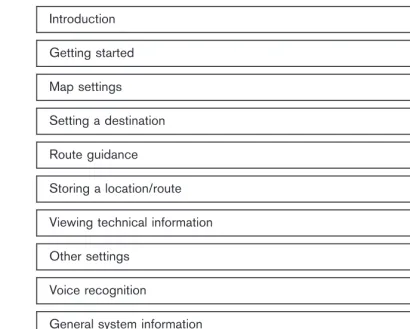
Table of
Contents
Getting started
2
Setting a destination
4
Other settings
8
Map settings
3
Route guidance
5
Storing a location/route
6
General system information
10
Troubleshooting guide
11
Viewing technical information
7
How to use this manual . . . 1-2 For safe operation . . . 1-2 Reference symbols . . . 1-2
Safety information . . . 1-3 Laser product. . . 1-4
This manual uses special words, symbols and icons, organized by function.
Please refer to the following items and familiarize yourself with them.
WARNING
This is used to indicate the presence of a hazard that could cause death or serious personal injury. To avoid or reduce the risk, the procedures must be followed precisely.
CAUTION
This is used to indicate the presence of a hazard that could cause minor or moderate personal injury or damage to your vehicle. To avoid or reduce the risk, the procedures must be followed carefully.
NOTE:
This indicates an item to help you under-stand and maximize the performance of your vehicle. If ignored, it may lead to a malfunction or poor performance.
REFERENCE SYMBOLS
INFO:
This indicates information that is necessary for efficient use of your vehicle or accessories.
Reference page:
This indicates the title and page that you should refer to.
<>:
This indicates a button on the control panel.
[ ]:
This indicates a key/item displayed on the screen.
Voice Command:
This system is primarily designed to help you reach your destination, and it also performs other functions as outlined in this manual. However, you, the driver, must use the system safely and properly. Information concerning road conditions, traffic signs and the availability of services may not always be up-to-date. The system is not a substitute for safe, proper and legal driving.
Before using the navigation system, please read the following safety information. Always use the system as outlined in this manual.
WARNING
. When the driver wants to operate
the navigation system or use the multi-function controller, first park the vehicle in a safe location and set the parking brake. Operating the system while driving can dis-tract the driver and may result in a serious accident.
. Do not rely on route guidance
alone. Always be sure that all driving maneuvers are legal and safe in order to avoid accidents.
. Do not disassemble or modify this
system. If you do, it may result in accidents, fire or electrical shock.
. If you notice any foreign objects in
the system hardware, spill liquid on the system or notice smoke or a smell coming from it, stop using the system immediately and contact a NISSAN dealer. Ignoring such con-ditions may lead to accidents, fire or electrical shock.
CAUTION
. Do not use this system if you notice
any malfunctions such as a frozen screen or the lack of sound. Con-tinued use of the system may result in accidents, fire or electrical shock.
. Some states/provinces may have
laws limiting the use of video screens while driving. Use this system only where it is legal to do so.
. Extreme temperature conditions
[below −48F (−208C) and above
1588F (708C)] could affect the per-formance of the system.
NOTE:
Do not keep the navigation system running with the engine stopped. Doing so may discharge the vehicle battery. When you use the navigation system, always keep the engine running.
This navigation system is certified as a Class 1 laser product.
The navigation system complies with DHHS Rules 21 CFR Chapter 1, Subchapter J.
WARNING
. Do not disassemble or modify this
system. There are no user service-able parts in this navigation sys-tem.
. If maintenance, adjustments and
2 Getting started
Control buttons and functions . . . 2-2 Control panel . . . 2-2 Multi-function controller . . . 2-3 Steering switch. . . 2-3 Start-up screen . . . 2-4 Navigation system status screen . . . 2-5 Functions disabled while driving . . . 2-6 Menu screen and how to operate. . . 2-7 Menu screens and their purposes . . . 2-7 Using controls to adjust values, levels, etc.. . . 2-8 List screen . . . 2-9 Touch panel operation . . . 2-10 Example of touch panel operation . . . 2-10 Map menu screen . . . 2-11 Current location map screen . . . 2-11 Scrolled location map screen . . . 2-12
CONTROL PANEL
&
1 <STATUS>:Push to display the current status of the air conditioner, radio, audio, vehicle information (driveable distance and average fuel econ-omy) and navigation systems.
&
2 <DEST>:Push to enter a destination. Various methods for entering a destination are available.
&
3 <ROUTE>:Push to access guidance control functions (guidance cancellation, route priority, way-point setting on the route, etc.).
&
4 Multi-function controller:Push to highlight an item on the screen, select the highlighted item, move on the map, etc.
&
5 <INFO>:the navigation information, such as GPS and version information, etc.
&
6 <DAY/NIGHT OFF> :Push to switch between the day screen (bright) and the night screen (dark). Push and hold to turn off the display. Push again to turn on the display.
&
7 <SETTING>:Push to access the system settings.
&
8 <VOICE>:Push to repeat voice guidance for a guide point.
&
9 <BACK>:Push to return to the previous screen. In a settings screen, this button can also be used to apply the setting.
In a character input screen, this button can also delete the characters that have been entered.
&
10 <MAP>:&
11 <ZOOM IN>,<ZOOM OUT>:Push to switch to the zoom mode to change the map scale.
INFO:
If <BACK> needs to be pushed to apply the setting in a settings screen, this manual will explicitly include a step for this procedure. Otherwise, pushing <BACK> returns you to the previous screen.
MULTI-FUNCTION CONTROLLER
&
1 <ENTER>:Push to select the highlighted item on the screen.
If this button is pushed while a map is
displayed, the map menu screen is dis-played.
&
2 Main directional buttons:Use to move across the map, highlight an item on the screen or adjust a setting (volume, brightness, etc.).
&
3 Additional directional buttons:Use to move across the map or highlight an item on the character input screen.
&
4 Center dial:Turn to highlight an item on the screen or adjust a setting.
Turn the center dial on the map screen. The map scale is displayed. Use the center dial to adjust the map scale.
STEERING SWITCH
&
1 <VOL>:Use to adjust the volume. This button have the same function as that of the volume knob. Refer to the vehicle Owner’s Manual.
&
2 <TALK> :Push to start the voice recognition mode. Push and hold for 1 second to cancel voice commands when in the voice recognition mode.
&
3 Tuning switch:Use to operate the audio system. Refer to the vehicle Owner’s Manual.
&
4 :Push to end a call when in the phone mode. Use to switch the audio mode (source). Refer to the vehicle Owner’s Manual.
1. The navigation system starts when the ignition switch is turned to the ACC or ON position.
2. As the start-up screen is displayed, read the precautions carefully, highlight [OK] and push<ENTER>or touch [OK].
INFO:
If you do not push<ENTER>for more than 30 seconds, the status screen will be displayed. P u s h < D E S T >, < M A P >, < R O U T E >,
<INFO>, <SETTING>, <STATUS> or
By pushing <STATUS> while the current location map screen is displayed, you can display the current status of the navigation system.
Each time <STATUS> is pushed, displayed information is switched in the order of audio, air conditioner, vehicle information and navigation route information.
INFO:
There are different status screens displayed depending on various factors, such as the currently active mode, whether a destination has been set or not, etc.
When a route to the destination is set and the audio system is on, a screen similar to the one above appears.
&
1 Turning direction at the next intersection&
2 Distance to the next intersection&
3 Remaining time to the destination&
4 Name of the next streetWhen a route to the destination is not set and the audio system is off, a screen similar to the one above appears.
To ensure safe driving, some functions cannot be operated while driving.
The on-screen functions that are not available while driving will be “grayed-out” or muted. In some cases, certain text will not be displayed on the screen.
MENU SCREENS AND THEIR
PUR-POSES
Push <DEST>, <ROUTE>, <PHONE>,
<INFO>or<SETTING>to display the corre-sponding menu screen.
How to select a menu item
Example:<DEST>screen1. Turn the center dial clockwise or counter-clockwise or push the up or down button of the main directional buttons. An item is highlighted accordingly.
2. To select the preferred menu item, highlight the item and push <ENTER>. The next screen is displayed.
3. Push <BACK> to return to the previous screen without applying any changes. Push <MAP> to return to the current location map screen without applying any changes.
INFO:
. Some items in the menu contain further details, which are displayed on the right side of the screen when the menu item is highlighted. This allows you to preview details of the item. These details appear only on the menu screen displayed by pushing<DEST>.
. Depending on the menu selected, push-ing<MAP>may not return you to the current location map screen.
USING CONTROLS TO ADJUST
VA-LUES, LEVELS, ETC.
There are four main methods you can use to control the navigation system: the center dial, the main directional buttons and the touch panel. Use these controls to adjust the volume of phone and voice guidance, the display brightness, etc.
How to adjust
1. Highlight the preferred setting item and push <ENTER>. The color of the corre-sponding adjustment item changes. 2. Use one of the controls, and the value or bar
indicating levels increases or decreases accordingly.
3. Push<ENTER>or<BACK>to apply the setting.
INFO:
This same adjustment can also be made by the touch panel operation.
LIST SCREEN
After searching for a point of interest, a list screen is displayed.
Depending on the list displayed, it can be sorted.
Items displayed in a list
&
1 Highlight the preferred item from the list and push<ENTER>to select it.If a location or facility name is not completely displayed (due to length), highlight the item
and push the right button of the main directional buttons to show the hidden part of the name.
You can also display the hidden part of the name by touching .
&
2 Distance from the current location&
3 Direction to the point of interest&
4 If the entire list cannot be displayed on the screen, the system displays the total number of items in the list and the entry number ofthe selected item. Turn the center dial or push the up or down buttons of the main directional buttons to scroll the list.
&
5 Highlight and push<ENTER> to sort the list by shortest distance.&
6 Highlight and push<ENTER> to sort the list in the original order.With this system, the same operations as those for the multi-function controller are possible using the touch panel operation.
This manual describes the operations using the multi-function controller.
For the operations that differ from those of the multi-function controller and for useful methods for using the touch panel operation, refer to each section.
EXAMPLE OF TOUCH PANEL
OPERA-TION
Here, the operation examples performed with the touch panel operation are described.
Selecting the item
When the item is touched, the following screen is displayed.
Adjusting the volume and others
Touch [+] or [−] located on the right and left of the bar graph to perform the adjustment.
Scrolling the message or list
Touching [UP] or [DOWN] allows you to scroll the message or list.
Inputting letters and numbers
1. Touch the letter or number.
Push<ENTER>while the current location map screen or a scrolled map screen is displayed to display the menu corresponding to that screen. This menu allows you to quickly use helpful functions, such as setting a destination easily and searching for Points of Interest nearby. To select a menu item, use the method described in “Menu screen types and how to operate”.
INFO:
With the touch operation, the same screen can be displayed by touching [Map Menu] located on the map screen.
CURRENT LOCATION MAP SCREEN
If <ENTER> is pushed while the current
location map screen is displayed, the following options are available.
. Store Location:
Allows you to store the current vehicle location in the Address Book. The stored location can be retrieved as necessary to set it as a destination (waypoint).
“STORING A LOCATION” (page 6-2)
. Nearby:
Allows you to search for points of interest near the current vehicle location, such as restaurants and gas stations, etc.
“SETTING A NEARBY PLACE” (page 4-14)
. Map Settings:
Performs the map operations such as the switching of map type and the setting of map orientation and scale.
“OTHER SETTINGS FOR THE MAP SCREEN” (page 3-12)
. Landmark Icons:
Allows you to display certain points of interest near the current vehicle location on the map, such as restaurants and gas stations, etc.
“DISPLAYING LANDMARK ICONS” (page 3-19)
. Store Tracking:
Allows you to store in the Address Book the route that you have travelled from the starting point to the current location.
“STORING A TRACKED ROUTE” (page 6-6)
. Guide Screen:
Set the default display screen for route guidance.
“Visual guidance settings” (page 5-19)
SCROLLED LOCATION MAP SCREEN
If <ENTER> is pushed while a scrolled map screen is displayed, the following options are available.
. New Dest.:
Allows you to set the destination to the location where you pushed<ENTER>. If a destination is already set, the location will be set as the new destination.
“SETTING FROM MAP” (page 4-23)
. Add to Route:
Allows you to set the location where you pushed <ENTER> as the destination or a waypoint.
This is available only when the suggested route is already set.
“Setting a destination or waypoint” (page 5-8)
. Nearby:
Allows you to search for points of interest near the location where you pushed
<ENTER> and set it as a destination or waypoint.
Use the same search method as the one for POI.
“SETTING A NEARBY PLACE” (page 4-14)
. Store Location:
Allows you to store the location where you pushed <ENTER> in the Address Book. The stored location can be retrieved to set it as a destination or waypoint.
“STORING A LOCATION” (page 6-2)
. Delete:
Allows you to delete a stored location, destination or waypoint. To delete it, place the cross pointer over the corresponding icon.
. Incident Details:
Can be selected only when the traffic information icon is displayed.
Displays the details of the traffic information icon that is being displayed.
Place the cross pointer over the icon you desire to check.
HOW TO STORE YOUR HOME
If your home location is already stored in the Address Book, it can be easily retrieved to set the route to your home.The procedure to store your home location is the same as for storing any other location.
“4. Setting a destination”
As an example, the procedure for storing your home location by searching for a destination by address is described here.
2. Highlight [Home Location (Add New)] and push<ENTER>.
3. A confirmation message is displayed. Con-firm the contents of the message, highlight [Yes] and push<ENTER>.
4. Highlight [Street Address] and push
<ENTER>. A character input screen is displayed.
5. Enter the address of your home, highlight [OK] and push<ENTER>.
The map screen is displayed.
“SETTING A STREET ADDRESS” (page 4-4)
6. Pushing the directional buttons, adjust your home location if necessary.
7. A f t e r a d j u s t i n g t h e l o c a t i o n , p u s h
<ENTER>.
8. A message is displayed and your home location is stored.
9. Push <MAP> to return to the current location map screen.
INFO:
You can also perform the same setting by pushing <SETTING> and selecting [Naviga-tion].
“STORING A LOCATION BY SEARCH-ING” (page 6-2)
SEARCHING FOR A DESTINATION
As an example, the method for setting an airport as the destination using [Points of Interest] is described here.1. Push<DEST>.
2. Highlight [Points of Interest] and push
<ENTER>.
3. Highlight [Travel] and push<ENTER>.
5. Highlight [By Name] and push<ENTER>. A character input screen is displayed.
6. Highlight [List] and push<ENTER>. A list screen is displayed.
INFO:
You can enter the city name and facility name to narrow down your search. The number of narrowed down points are displayed in the “Matches” column.
7. Highlight the preferred airport from the list and push<ENTER>.
INFO:
. By selecting [By Dist.], you can sort the list by the shortest distance.
. The position of the selected location is displayed in the preview on the right side of the screen.
8. The selected destination is displayed at the center of the map. Highlight [Start] after confirming the location of the displayed destination, and push<ENTER>.
INFO:
. The system sets the destination to the selected location and starts calculating a route.
. Even after setting a destination, you can adjust the location of the destination, store the route, etc. if necessary.
STARTING ROUTE GUIDANCE
After setting the destination and performing route calculation, the suggested route is dis-played.
1. Highlight [Start] and push<ENTER>.
2. Once route guidance is started, the system navigates you through the guide points using visual and voice guidance.
3. When approaching a guide point, the system automatically changes to the split screen and shows an enlarged view of the intersection in the left screen.
Push <MAP> to switch to the full map screen.
4. When arriving at the destination, route guidance automatically ends.
DELETING A ROUTE
To delete a route already set, use the following procedure. If you delete a route, the destination is also deleted.
1. Push<ROUTE>.
2. Highlight [Cancel Route] and push
3. A confirmation message is displayed. High-light [Yes] and push<ENTER>.
INFO:
If a route is cancelled, [Cancel Route] changes to [Resume Route].
Highlight [Resume Route] and push<ENTER>
to reactivate the cancelled route.
This is available only until a new route is set.
HOW TO VIEW MAP SCREEN
The navigation system displays various informa-tion on the map screen.
Screen information
&
1 Vehicle icon:Indicates the current vehicle location and the direction that you are traveling.
&
2 Starting point:Displays the vehicle location, with which the route is set, as the starting point.
&
3 Guide point:&
4 Waypoint:Displays the locations that you travel past when going to the destination. A maximum of 5 waypoints can be set.
&
5 Destination:Indicates the destination location of the route guidance.
When the map scale is 300 ft or less in Plan View, or 1/4 mile or less in Birdview: The name is displayed on the map screen.
&
6 Suggested route:Appears in bold yellow during route gui-dance.
&
7 Map Menu icon:Touch the icon to display the Map Menu screen.
“MAP MENU SCREEN” (page 2-11)
&
8 / Direction indicator: Indicates the direction of the map.Touch the icon to switch the direction of the map.
“SETTINGS OF HEADING/LONG RANGE MAP VIEW” (page 3-14)
&
9 Scale indicator: Indicates the scale of the map.Touch the icon to display the scale bar. This allows the map scale to be adjusted.
“OPERATING WITH THE TOUCH OP-ERATION” (page 3-10)
&
10 Street name:Displays the name of the street that you are currently driving on.
TURNING VOICE GUIDANCE ON/OFF
You can activate or deactivate voice guidance and adjust the volume.1. Push<ROUTE>.
2. Highlight [Guidance Settings] and push
3. Highlight [Guidance Voice] and push
<ENTER>. The indicator illuminates if voice guidance is activated.
Other settings
You can also activate or deactivate voice guidance using the following procedure.
1) Push<SETTING>.
2) Highlight [Volume and Beeps] and push
<ENTER>.
3) Highlight [Guidance Voice] and push
<ENTER>.
ADJUSTING VOICE GUIDANCE
VO-LUME
You can adjust the volume of voice guidance.
1. Push<SETTING>.
2. Highlight [Volume and Beeps] and push
<ENTER>.
3. Highlight [Guidance Vol.] and push
<ENTER>.
INFO:
You can also adjust the volume by turning the audio system volume knob or tilting<VOL>on the steering switch while voice guidance is being announced.
CHARACTER (letter and number) INPUT
SCREEN
You will have to enter alphanumeric characters when setting a destination, searching for a facility or editing the stored locations, etc.
1. Use the touch panel, center dial, main directional buttons or additional directional buttons to highlight a character on the displayed keyboard.
3. Push <BACK>, or highlight [Delete] and push<ENTER>to delete the last character entered.
Push and hold <BACK> to delete all the characters entered.
Highlight [Space] and push <ENTER> to enter a space.
INFO:
. You can push<BACK>on the control panel to return to the previous screen, but only after deleting all the characters entered.
. When you touch [BACK] on the screen, the screen returns to the previous screen even when characters have been entered.
. When the character that you have entered can only be followed by one other character, that character is en-tered automatically.
. When you have entered text and nar-rowed down the matching list items to a number that will fit on the screen, the list screen appears automatically.
. Symbol keys are displayed by high-l i g h t i n g [ S y m b o high-l s ] a n d p u s h i n g
<ENTER>. Alphabet keys are displayed by highlighting [A-Z] and pushing
<ENTER>.
Symbol input screen
PHONE NUMBER INPUT SCREEN
You can enter a phone number as a search method to look for a point of interest.INFO:
Only the locations included in the database in the map data can be searched by the phone number.
1. Use the touch panel, center dial, main directional buttons or additional directional buttons to highlight a number on the displayed keyboard.
3. Push <BACK>, or highlight [Delete] and push <ENTER> to delete the last number entered.
Push and hold <BACK> to delete all the numbers entered.
4. After finishing the entry, highlight [Map] and push<ENTER>.
INFO:
. You can push <BACK> on the control panel to return to the previous screen, but only after deleting all the numbers entered.
. When you touch [BACK] on the screen, the screen returns to the previous screen even when numbers have been entered.
NISSAN Voice Recognition allows hands-free operation of the navigation system and other systems equipped on this vehicle, such as the display, audio, climate control and phone.
INFO:
For the voice commands for the audio, air conditioner and other systems (except naviga-tion system), refer to the vehicle Owner’s Manual.
CONFIRMING VOICE COMMANDS
If you are controlling the system by voice commands for the first time or do not know the appropriate voice command, confirm the voice command lists.Example: Displaying the navigation command list 1. Push<INFO>.
2. Highlight [Others] and push<ENTER>. 3. Highlight [Voice Recognition] and push
<ENTER>.
4. Highlight [Command List] and push
<ENTER>.
5. Highlight [Navigation] and push<ENTER>.
6. Highlight the preferred item and push
<ENTER>. Available items:
. Destination:
Allows you to set a destination.
. Search:
Allows you to search for a location.
. Map:
Allows you to change the map settings.
. Route:
Allows you to set a route in detail.
. Others:
Allows you to store locations or set the route guidance.
7. You can confirm the list by scrolling the screen using the up and down switches of the main directional buttons or the center dial.
8. Press <BACK> to return to the previous screen.
For further details about the displayed command list, refer to section 9.
“Command List” (page 9-3)
BEFORE STARTING
To get the best recognition performance out of NISSAN Voice Recognition, observe the follow-ing:
. Wait until the tone sounds before speaking a command. Otherwise, the command will not be recognized properly.
. Speak in a natural conversational voice without pausing between words.
. If the air conditioner is set to “Auto”, the fan speed is automatically lowered so that your commands can be recognized more easily.
VOICE COMMAND EXAMPLES
To use the voice recognition function, speaking one command is sometimes sufficient, but at other times it is necessary to speak two or more commands.
As examples, some additional basic operations by voice commands are described here.
Example 1: Switching the map to the
Plan View mode
1. Push <TALK> located on the steering switch.
2. The system announces, “Please say a command”.
“Plan View Map”.
4. Voice feedback will be provided when the command is accepted, and the map is displayed in Plan View.
Example 2: Setting a destination using a
nearby place
2. The system announces, “Please say a command”.
3. After the tone sounds and the icon on the screen changes from [ ] to [ ], speak “Destination nearby places”.
4. Voice feedback will be provided when the command is accepted, and the list of POI categories appears.
5. After the tone sounds and the icon on the screen changes again, speak “Three”.
6. If a route is already set, choose “Along Route” or “Nearby”.
7. After the tone sounds and the icon on the screen changes again, speak “Along Route”.
8. Voice feedback will be provided when the command is accepted, and the list of Points of Interest in the category specified in the previous step appears.
9. After the tone sounds and the icon on the screen changes again, speak “Three”.
10. Voice feedback will be provided when the command is accepted, and the system starts calculating a route to the selected facility.
Example 3: Setting a destination by a
street address
2. The system announces, “Please say a command”.
3. Speak “Destination street address”.
4. Speak the name of the state, “California”.
5. Speak the name of the city, “Gardena”.
6. Speak the name of the street, “South figueroa street”.
INFO:
. Only the official street names stored in the map data can be recognized by the system.
. You need to speak the street name precisely including boulevard, way, north, south, etc. In this case, you cannot speak “Figueroa street” or “Fig-ueroa”.
7. Voice feedback will be provided when the command is accepted, and the list of street names appears.
9. Speak the house number.
“How to speak numbers” (page 9-10)
INFO:
If you do not know the house number, speak “No house number”.
3 Map settings
Map types . . . 3-2 Plan view . . . 3-2 BirdviewTM. . . 3-3 Building graphics . . . 3-3 Returning to the current vehicle location . . . 3-4 Operating with the touch operation . . . 3-5 Moving a map . . . 3-5 Plan view . . . 3-5 BirdviewTM. . . 3-7 Changing the scale of a map . . . 3-9 Operating with the buttons on the control panel . . . . 3-9 Operating with the center dial . . . 3-10
Two types of map views are available: Plan View and BirdviewTM.
PLAN VIEW
Plan View displays the map in a 2-dimensional environment similar to a road map.
Screen information
&
1 Vehicle icon:Indicates the current vehicle location and the direction that you are traveling.
&
2 Guide point:Indicates a guide point on the route.
&
3 Remaining time and distance to the destination:Indicates the approximate remaining time and distance to the destination or waypoint. This indicator will appear when you set the destination or waypoint and start route guidance.
When you are not driving on the suggested route, the screen displays the direction to the destination and the distance to the destination from the current vehicle position.
&
5 / Direction indicator: Indicates the direction of the map.Touch the icon to switch the direction of the map.
&
6 Scale indicator: Indicates the scale of the map. Touch the icon to display the scale bar. This allows the map scale to be adjusted.&
7 Arrow:Indicates the distance to the next guide point and the turning direction at that guide point.
&
8 Stored location:Displays the locations that are stored in the Address Book. You can change the icons according to your preferences.
&
9 Avoid Area:Displays the areas to avoid that are stored in the Address Book with green or blue icons. During the route search, the route guidance is performed by searching for a route that avoids those areas.
&
10 Street name:Displays the name of the street that you are currently driving on.
&
11 Traffic indicator:Displays the reception condition of traffic information transmitted from the provider. Green: Reception condition is good. Gray: Reception condition is not good. No mark: Subscription to XM®NavTrafficTM
service is not detected.
Birdview
TMBirdviewTM displays the map from an elevated perspective. In BirdviewTM, it is easy to recog-nize an image of the route because it provides a panoramic view over a long distance.
INFO:
About the BirdviewTMdisplay
. “BirdviewTM” is a registered trademark of Xanavi Informatics Corporation.
. The map in BirdviewTMalways appears with the current forward direction facing up.
BUILDING GRAPHICS
In the area where the building graphics are stored in the map data, the building graphics are displayed when the map is zoomed in. On the Plan View display, these are called “Building footprint graphics”, and on the BirdviewTM display, these are called “3D building graphics”. How to look at the map is the same for Plan View and BirdviewTM.
3D building graphics (BirdviewTM)
INFO:
In the area where the building graphics are not stored in the map data, the normal map is displayed even when the map is zoomed in.
The basic map screen displays the current location (the position where the vehicle mark is located). The current location can be displayed again even after the map is moved, or after the menu screen or the guide screen is displayed. Push<MAP>. The current location map screen is displayed.
INFO:
Depending on the menu selected, pushing
<MAP> may not return you to the current location map screen.
Setting by voice command
1. Push <TALK> located on the steering switch.
OPERATING WITH THE TOUCH
OP-ERATION
Touch [BACK] on the map screen to display the current location map screen.
The operations for moving across the map are different between Plan View and BirdviewTM.
PLAN VIEW
Operating with the multi-function
con-troller
Push one of the main directional buttons or additional directional buttons corresponding to the direction that you want to move across the map. Hold down the button to continuously move across the map in that direction. Once you start moving across the map, the
cross pointer appears.
If the map scale is set to 1/8 mile (200 m) or less, the cross pointer will blink in pink when positioned on a street, and the street name will be displayed.
Screen information:
&
1 Cross pointer&
2 Distance from the current location to the cross pointer&
3 Street nameOperating with the touch operation
1. Touch the screen.
Displays the cross pointer, and the touched position is set as the center of the screen.
2. Touch the direction you desire to scroll to. The map continues to scroll while the screen is touched.
INFO:
When the operation is performed during driving, the scrolling is stopped after the screen scrolls to the touched direction for a specified amount. If the map screen is set to the building footprint graphics, the map cannot be scrolled while driving.
Fine-adjusting the cursor position:
1. Touch [Slow].
Displays the 8-directional key.
2. Touch the 8-directional key to adjust the cross pointer position.
Touch [BACK] to end the adjustment.
INFO:
Birdview
TMOperating with the multi-function
con-troller
The main directional buttons and additional directional buttons allow movement in the following ways.
Hold down one of the main directional buttons or additional directional buttons to continue to rotate or move across the map in that direction.
Rotates the map clockwise.
Rotates the map counterclockwise.
The cross pointer moves in the direc-tion of the arrow.
Once you start moving on the map, the cross pointer appears.
Screen information:
&
1 Cross pointer&
2 Distance from the vehicle position to the cross pointer&
3 Street nameOperating with the touch operation
1. Touch the screen.
2. Touch the direction you desire to scroll to. The map continues to scroll while the screen is touched.
3. Touch [ ] or [ ] to change the
direction of the map.
:Rotates the map clockwise.
:Rotates the map counterclockwise.
INFO:
OPERATING WITH THE BUTTONS ON
THE CONTROL PANEL
Push<ZOOM IN>or<ZOOM OUT>. A scale appears on the left side of the screen.
To view the map in detail, push<ZOOM IN>. To view a wider area, push<ZOOM OUT>. The scale will automatically disappear when neither<ZOOM IN> nor<ZOOM OUT>has been pushed for several seconds.
If the scaling operation is not performed for a specified period of time, the scale display disappears.
INFO:
Free zoom:
Once the Free Zoom is set in the setting screen, the scale can be changed in smaller steps when you push and hold <ZOOM IN>or <ZOOM OUT>than when you briefly push the button. If you briefly push the button, the operation returns to normal.
OPERATING WITH THE CENTER DIAL
1. Turn the center dial on the map screen. The map scale is displayed.
2. Use the center dial to adjust the map scale.
&
1 Clockwise: Zoom in&
2 Counterclockwise: Zoom outINFO:
Free zoom:
Depending on the setting, using the center dial to change the map scale may adjust the scale normally, or it may engage the free zoom (finer scale adjustment in smaller steps).
“NAVIGATION SETTING” (page 8-4)
OPERATING WITH THE TOUCH
OP-ERATION
1. Touch .
Displays the scale.
INFO:
Free zoom:
Once the Free Zoom is set in the setting screen, the scale can be changed in smaller steps when you push and hold [ZOOM IN] or [ZOOM OUT] than when you briefly push the button. If you briefly push the button, the operation returns to normal.
Setting by voice command
1. Push <TALK> located on the steering switch.
2. After the tone sounds, speak a command. To change the map scale:
“Zoom In” “Zoom Out”
“<1, 2, 5, 8, 32, 400> mile Scale” “<1/8, 1/4, 1/2> mile Scale” “<150, 300> feet Scale” “<75, 150> feet Building Scale”
MAP SCALE
The following scales are available depending on the map view.
. In Plan View:
Widest (1/51,200,000) to the most detailed (1/2,500)
. In BirdviewTM:
Widest (1/20,480,000) to the most detailed
(viewpoint height at 1/3,000)
Scale level of the Plan View display
Map scale Actual distance
Normal Map
1:51.2 million 400 miles (640 km)
1:5.12 million 32 miles (64 km)
1:1.28 million 8 miles (16 km)
1:800,000 5 miles (10 km)
1:320,000 2 miles (4 km)
1:160,000 1 mile (2 km)
1:80,000 1/2 mile (1 km)
1:40,000 1/4 mile (500 m)
1:20,000 1/8 mile (200 m)
1:10,000 300 ft (100 m)
1:5,000 150 ft (50 m)
Building footprint graphics
1:5,000 150 ft (50 m)
1:2,500 75 ft (25 m)
Example: The most detailed level
Scale level of the Birdview
TMdisplay
Map scale Distancebe-tween grids
Normal Map
1:20.48 million 160 miles (256 km)
1:5.12 million 32 miles (64 km)
1:2.56 million 16 miles (32 km)
1:1.28 million 8 miles (16 km)
1:640,000 4 miles (8 km)
1:320,000 2 miles (4 km)
1:160,000 1 mile (2 km)
1:80,000 1/2 mile (1 km)
1:40,000 1/4 mile (500 m)
1:25,000 1/6 mile (250 m)
3D building graphics
1:6,000 180 ft (60 m)
1:3,000 90 ft (30 m)
Example: The most detailed level
Example: The widest level
INFO:
The traffic information icons are not displayed on the map screen when the map scale is set to 1/4 mile (500 m) or higher in Plan View, to 1 mile (2 km) or higher in BirdviewTM, to the building footprint graphics (Plan View), or the 3D building graphics (BirdviewTM).
“Traffic information can be displayed in the
Other settings are also available for the map screen, such as switching the map view, changing the map direction, splitting the screen, etc.
SWITCHING THE MAP VIEW
The map view can be changed between Plan View and BirdviewTM. The map can also be displayed in the split screen mode.
2. Highlight [Map Settings] and push
<ENTER>.
3. Highlight [Change View] and push the right button of the directional buttons.
4. Highlight the preferred map view and push
<ENTER>. The indicator of the selected map view illuminates.
5. Push <MAP> or touch [Back to Map] to return to the current location map screen.
Available views
. Plan View:
Switches to Plan View.
. BirdviewTM:
Switches to BirdviewTM.
. Split (Plan View):
Changes to the split screen mode and both halves display maps in Plan View.
. Split (BirdviewTM):
Changes to the split screen mode and the left half displays the map in Plan View and the right half displays the map in BirdviewTM.
INFO:
. When you select [Split (Plan View)] or [Split (BirdviewTM)], [Left Settings] and [Right Settings] become available. This is used to operate the left/right screen.
“OPERATION WITH SPLIT SCREEN DISPLAY” (page 3-18)
. If [Split (Plan View)] or [Split (BirdviewTM)] is selected, the normal map scrolling and scale adjustment are set in the right screen. However, if you touch an icon before adjusting the map direction or scale, then each screen can be adjusted independently.
Split (Plan View)
Other settings
You can also set the map view using the following procedure.
1) Push<SETTING>.
2) Highlight [Navigation] and push<ENTER>. 3) Highlight [Map Settings] and push
<ENTER>.
Setting by voice command
1. Push <TALK> located on the steering switch.
2. After the tone sounds, speak a command.
. To display a map in Plan View: “Planview map”
. To display a map in BirdviewTM: “Birdview map”
. To display a split map in Plan View: “Planview Split Map”
. To display a split map in BirdviewTM: “Birdview Split Map”
SETTINGS OF HEADING/LONG
RANGE MAP VIEW
You can change the map direction (orientation) in Plan View or change the position of the vehicle icon to view a wider area in the traveling direction.
These settings are available only in the Plan View or Split (Plan View) mode.
1. Push<ENTER> while the current location map screen is displayed.
2. Highlight [Map Settings] and push
<ENTER>.
4. Highlight the preferred map orientation and push <ENTER>. The indicator of the selected map orientation illuminates.
5. Push <MAP> to return to the current location map screen.
Available map orientations
. North Up:
North is set at the top of the map.
. Heading Up:
The traveling direction is set at the top of the map.
. Long Range Map View:
The vehicle icon is located slightly lower than the center of the screen. This offers a wider view in the traveling direction.
. Map Scale:
A scale appears on the left side of the screen. This changes the scale of a map.
. BirdviewTMAngle:
This changes the BirdviewTMangle.
INFO:
. [Long Range] is displayed only when you select [Heading Up].
. [Birdview Angle] is displayed only when the map view is set to the Birdview or Split (Birdview) mode.
North Up
Heading Up
Long Range Map View
INFO:
If the map orientation is switched, the icon displayed in the lower left corner is also switched.
:North Up
Other settings
You can also set the orientation of the map using the following procedure.
1) Push<SETTING>.
2) Highlight [Navigation] and push<ENTER>. 3) Highlight [Map Settings] and push
<ENTER>.
4) Highlight [Settings] and push<ENTER>.
INFO:
Touching the icon on the map can also change the direction of the map.
Setting by voice command
1. Push <TALK> located on the steering switch.
2. After the tone sounds, speak a command. To charge the map direction:
“North Up” “Heading Up”
CHANGING THE Birdview
TMANGLE
This changes the BirdviewTMangle.
This setting is available only in the BirdviewTMor Split (BirdviewTM) mode.
1. Push <ENTER>while the current location map screen is displayed.
2. Highlight [Map settings] and push
3. Highlight [Settings] and push<ENTER>.
4. Highlight [Birdview Angle] and push
<ENTER>.
5. Adjust the Birdview angle by moving the cursor in the direction of or .
6. Push <MAP> to return to the current location map screen.
Other settings
You can also set the Birdview angle using the following procedure.
1) Push<SETTING>.
2) Highlight [Navigation] and push<ENTER>. 3) Highlight [Map settings] and push
<ENTER>.
4) Highlight [Settings] and push<ENTER>. 5) Highlight [Birdview Angle] and push
OPERATION WITH SPLIT SCREEN
DISPLAY
When the split screen is displayed, you can operate the left/right screen.
1. Push <ENTER>while the current location map screen is displayed.
2. Highlight [Map Settings] and push
<ENTER>.
3. Highlight [Left Settings] or [Right Settings] and push<ENTER>.
4. Highlight the preferred map view and push
<ENTER>. The indicator of the selected map view illuminates.
5. Push <MAP> to return to the current location map screen.
Available map orientations
. North Up:
North is set at the top of the map.
. Heading Up:
The traveling direction is set at the top of the map.
. Long Range:
The vehicle icon is located slightly lower than the center of the screen. This offers a wider view in the traveling direction.
. Map Scale:
A scale appears on the left side of the screen. This changes the scale of a map.
. BirdviewTMAngle:
Other settings
You can also change the scale of the left screen using the following procedure.
1) Push<SETTING>.
2) Highlight [Navigation] and push<ENTER>. 3) Highlight [Map Settings] and push
<ENTER>.
4) Highlight [Left Settings] or [Right Settings] and push<ENTER>.
You can display icons on the map and view information about destinations or landmarks.
DISPLAYING LANDMARK ICONS
This allows you to display or hide the landmark icons by type.Landmark icons that can be displayed
. Restaurant
. Gas Station
. Hotel
. ATM
. Rest Area
1. Push <ENTER>while the current location map screen is displayed.
2. Highlight [Landmark Icons] and push
<ENTER>.
LOOKING AT INFORMATION ON
3. Highlight the preferred icon and push
<ENTER>. The icon display setting toggles on and off each time you push<ENTER>. The indicator of the selected icon illumi-nates.
4. Push <MAP> to return to the current location map screen. The activated landmark icons are displayed on the map.
Other settings
You can also set the landmark icons using the following procedure.
1) Push<SETTING>.
2) Highlight [Navigation] and push<ENTER>. 3) Highlight [Landmark Icons] and push
<ENTER>.
INFO:
The landmark icons are not displayed on the map screen when the map scale is set to 1/4 mile (500 m) or higher in Plan View, or to 1 mile (2 km) or higher in BirdviewTM.
Setting by voice command
1. Push <TALK> located on the steering switch.
2. After the tone sounds, speak a command.
. To display all of the landmark icons: “Landmark Icons”
. To display the landmark icons of the specified POIs:
Landmark Icons <POI Category>”
MAP SCROLLING INFORMATION
Information about the location, on which the center of the cross pointer is placed by scrolling on the map, can be set to be displayed. 1. Push<SETTING>.3. Highlight [Map Scrolling Information] and push<ENTER>.
4. Highlight the preferred information item and push <ENTER>. The indicator of the selected information item illuminates. Available information items:
. Address Book Icons
. Destination/Waypoint Icons
. Building Names
. Latitude/Longitude Info.
5. Push <MAP> to return to the current location map screen.
MAP SYMBOLS
Road color
The road types are differentiated by colors. Freeway: Pink with red border
Main road: Amber Narrow street: Gray
Road with incomplete map data: Dark green
Traffic information on map
With a subscription to XM®NavTrafficTM service, traffic information is displayed.
“VIEWING AVAILABLE TRAFFIC IN-FORMATION” (page 7-3)
Free Flow: Green arrow Moderate traffic: Yellow arrow Heavy traffic: Red arrow
Section affected by serious traffic event: Purple dashed arrow
Traffic information icons: Accident
Closed road
Information
Road work
Slippery road
Weather
4 Setting a destination
Destination screen. . . 4-2 Basic operation . . . 4-2 Changing the region . . . 4-3 Setting a Street Address . . . 4-4 Setting a point of interest. . . 4-5 Setting your home . . . 4-13 Setting from Address Book . . . 4-13 Setting a nearby place . . . 4-14 Setting a previous destination . . . 4-16 Setting the previous starting point . . . 4-17 Setting from stored routes. . . 4-17 Setting by phone number . . . 4-18
Setting a freeway entrance/exit. . . 4-19 Setting an Intersection . . . 4-21 Setting a City Center . . . 4-22 Setting from map . . . 4-23 Operations after setting a destination. . . 4-24 Available setting items . . . 4-25 Adjusting the location of the destination . . . 4-25 Adding additional destinations to a route . . . 4-26 Storing a location . . . 4-26 Viewing information about the searched
There are several methods you can use to set your destination. Understand the advantages of each method and select the best method for finding and setting your destination.
BASIC OPERATION
1. Push<DEST>.
2. Highlight the preferred destination setting method and push<ENTER>.
Available setting items
. Street Address:
Searches for a destination by address.
. Points of Interest:
Searches for a destination from various categories of businesses or locations.
. Home:
Searches for a route from the current location to the previously stored home destination.
. Address Book:
Searches for a destination from the list of the stored locations.
. Nearby Places:
Searches for a business or location near your vehicle.
. Previous Dest.:
Searches for a destination from the previous destinations.
Available setting items (Next page
screen)
. Previous Starting Point:
Sets the previous starting point as the destination.
. Stored Route: Selects a stored route.
. Phone Number:
Searches for a POI destination by the telephone number.
INFO:
It will not search for residential phone numbers.
. Freeway Entrance/Exit:
Searches for a destination from a freeway entrance/exit.
. Intersection:
Searches for a destination from intersec-tions.
. City Center:
CHANGING THE REGION
When setting a destination, you can narrow down the place by specifying the region or city.
Specifying the region
1. Push<DEST>.
2. Highlight [Change Region] and push
<ENTER>.
3. Highlight the preferred region and push
<ENTER>.
Available setting items
. US1: CA, NV
. US2: AZ, CO, ID, MT, NM, OR, UT, WA, WY
. US3: IA, KS, MN, MO, ND, NE, SD
. US4: AR, LA, MS, OK, TX
. US5: IL, IN, MI, WI
. US6: DC, DE, KY, MD, OH, PA, VA, WV
. US7: CT, MA, ME, NH, NJ, NY, RI, VT
. US8: AL, FL, GA, NC, SC, TN
. US9: AK
. US10: HI
. Canada
INFO:
. It is also possible to select a region by touching the map on the right side of the screen.
. It is not possible to search for a route from the continental United States to Hawaii.
Specifying the city
When searching for a destination with “Street Address”, “Points of Interest”, “Freeway En-trance/Exit”, “Intersection” or “City Center”, you can narrow down the search by specifying the city.
1. Select [City] on input screen and push
<ENTER>.
2. Enter the name of the city, highlight [List] and push<ENTER>.
A list screen is displayed.
INFO:
Highlight [Last 5 Cities] and push
3. Highlight the city of the destination from the list and push<ENTER>.
INFO:
In some cases, when a city name has been entered, the number of matching destinations in the “Matches” column may be different from the number displayed on the list screen. If this occurs, enter more characters to further reduce the number of matches.
SETTING A STREET ADDRESS
If you know the address of your destination, use this method to enter the address and then have the system calculate a route. You can also search for a location near the preferred destina-tion by entering the house number if the map data contains the relevant data.
1. Push<DEST>.
2. Highlight [Street Address] and push
<ENTER>. A character input screen is displayed.
3. Enter the house number, highlight [OK] and push <ENTER>. If you do not know the house number, highlight [No House #] and
push <ENTER>. A street name input
screen is displayed.
4. Enter the name of the street. After finishing the entry, highlight [List] and push
<ENTER>. A list of cities is displayed.
5. Highlight the correct city of the destination from the list and push<ENTER>.
INFO:
the list screen. If this occurs, enter more characters to further reduce the number of matches.
6. The selected destination is displayed at the center of the map. Highlight [Start] after confirming the location of the displayed destination, and push <ENTER>. The system sets the destination to the selected location and starts calculating a route.
INFO:
Even after setting a destination, you can adjust the location of the destination, store the route, etc.
“OPERATIONS AFTER SETTING A DESTINATION” (page 4-24)
Setting by voice command
1. Push <TALK> located on the steering switch.
2. After the tone sounds, speak a command.
. To set the destination from street address: “Destination Street Address”
. To set the destination from state name: “Destination Street Address <State>”
. To set the destination from last state: “Destination Street Address Last State”
. To set the destination from last city: “Destination Street Address Last City”
INFO:
When using a voice command to set a street name, the complete street name must be stated. Examples:
Correct input – North Elm Street East Jefferson Boulevard Incorrect input – Elm Street
East Jefferson
SETTING A POINT OF INTEREST
This allows you to find a facility by type, and then have the system calculate a route to that destination. Specify the region and city of the destination to find it more quickly.NOTE:
Locations and business hours of facilities are subject to change, which may not be reflected in the map data. Double-check this information before you go to an emergency facility to ensure that you can receive the proper support. Otherwise, you may not receive emergency help even when you arrive at the destination. A confirmation message also appears on the navigation screen. Follow the dis-played instructions and check the items required.
2. Highlight [Points of Interest] and push
<ENTER>.
3. Select whether to search by directly input-ting the facility name, or by selecinput-ting from the landmark category.
Search by inputting a landmark name
1. Highlight [By Name] and push<ENTER>. A character input screen is displayed.
2. Enter the name of the destination facility.
3. After finishing the entry, highlight [List] and push<ENTER>. A list screen is displayed.
4. Highlight the preferred destination facility from the list and push<ENTER>.
INFO:
. By selecting [By Dist.], you can sort the list by the nearest distance.
The position of the selected location is displayed in the preview on the right side of the screen.
INFO:
By selecting [By Cat.], you can display the list that summarizes the entered names into categories. Select the category to narrow down the search.
5. The selected destination is displayed at the center of the map. Highlight [Start] after confirming the location of the displayed destination, and push<ENTER>.
The system sets the destination to the
selected location and starts calculating a route.
INFO:
Even after setting a destination, you can adjust the location of the destination, store the location, etc.
“OPERATIONS AFTER SETTING A DESTINATION” (page 4-24)
Search by selecting from the landmark
category
1. Highlight the main category and push
<ENTER>.
2. Highlight the subcategory and push
<ENTER>.
3. Set the narrow down conditions for the landmarks.
Narrow down conditions:
. Nearby POI
“Narrowing down with Nearby POI” (page 4-8)
. By Name
. By city
“Specifying the city” (page 4-3)
Narrowing down with Nearby POI:
1. H i g h l i g h t [ N e a r b y P O I ] a n d p u s h
<ENTER>. A list screen is displayed.
2. Highlight the preferred destination from the list, and push <ENTER>. The position of the selected location is displayed in the preview on the right side of the screen.
INFO:
By selecting [Sort], you can sort the list in the original order.
3. The selected destination is displayed at the center of the map. Highlight [Start] after confirming the location of the displayed destination, and push <ENTER>. The system sets the destination to the selected location and starts calculating a route.
INFO:
Even after setting a destination, you can adjust the location of the destination, store the route, etc.
“OPERATIONS AFTER SETTING A DESTINATION” (page 4-24)
Narrowing down with By Name:
1. Highlight [By Name] and push<ENTER>. A character input screen is displayed.
2. Enter the name of the destination facility. 3. After finishing the entry, highlight [OK] and
4. Highlight the preferred destination facility from the list and push<ENTER>.
INFO:
. By selecting [By Dist.], you can sort the list by the nearest distance. The position of the selected location is displayed in the preview on the right side of the screen.
. In some cases, when a POI name has been entered, the number of matching
destinations in the “Matches” column may be different from the number dis-played on the list screen. If this occurs, enter more characters to further reduce the number of matches.
INFO:
By selecting [New Cat.], you can perform a search from another category.
5. The selected destination is displayed at the center of the map. Highlight [Start] after
confirming the location of the displayed destination, and push <ENTER>. The system sets the destination to the selected location and starts calculating a route.
INFO:
Even after setting a destination, you can adjust the location of the destination, store the location, etc.
Category list:
Restaurant
Restaurant all
African, American, Austrian, Balkan, Barbecue/Southern, Belgian, Bistro, Bohemian, Brewpub, British isles, Cajun/Caribbean, Californian, Canadian, Chinese, Continental, Dutch, East European, Fast food, Filipino, French, German, Greek, Grill, Hawaiian/Polynesian, Hungarian, Indian, Indonesian/ Malaysian, International, Italian, Japanese, Jewish/Kosher, Korean, Latin American, Maltese, Mexican, Middle Eastern, Oriental, Other, Pizza, Polish, Portuguese, Russian, Sandwich, Scandinavian, Seafood, Soul food, South American, South-western, Southeast Asian, Spanish, Steak house, Swiss, Thai, Turkish, Vegetarian, Vietnamese
Shopping
Grocery store
Convenience stores
Convenience stores all
7-Eleven, AM PM, Casey’s General Store, Circle K, Convenient Food Stores, Cumberland Farms, Dairy Mart, Dominion stores, Holiday Station Store, JR Food store, Kash-N-Karry, Loblaw, Miracle Mart, Others, Pantry, Steinberg, Stop-N-Go, Uni Mart Inc., White Hen Pantry
Shopping (others)
Auto service
Auto dealerships
Automobile club
Gas station
Gas station all
Amoco, Arco, Beacon (Valero), BP, Chevron, Citgo, Conoco, Diamond Shamrock, Esso, Exxon, Fina, Getty, Gulf, Husky, Marathon, Mobil, Mohawk, Others, Petro-Canada, Phillips 66, Pioneer, Shamrock, Shell, Sinclair, Speedway, Sunoco, Superamerica, Texaco, Ultramar USA, Ultramar (Valero), Unocal 76, Valero
Rental car agency
Auto service & maintenance
NISSAN dealer
Travel
Airport
Border crossing
Bus station
Commuter rail station
Ferry terminal
Hotel
Hotel all
America Inn & Suites, Amerihost (Cendant), Amerisuites, Baymont Inn & Suites, Best Western, Candlewood Suites, Clarion, Country Hearth Inn, Country Inn Suites (Carlson Group), Courtyard by Marriott, Crossland Motel, Crowne Plaza, Days Inn, Double Tree (Hilton Group), Drury Inn/Pear Tree by Drury, Econo Lodge, Embassy Suites, Extended Stay, Fairfield Inn, Four Seasons, Hampton Inn, Hawthorn Suites, Hilton, Hilton Garden Inn, Holiday Inn, Holiday Inn Express, Homestead, Homewood, Howard Johnson, Hyatt, Intercontinental, Jameson Inns/Signature Inns, Knights Inn (Cendant), La Quinta Inn, Leows Hotels, Mainstay Suites (Choice), Microtel Inn & Suites, Motel 6/Studio 6, Others, Park Inn (Carlson Group), Quality, Radisson, Ramada Inn, Red Roof Inn, Relax Inns, Renaissance (Marriott), Residence Inns, Ritz Carlton, Rodeway Inn (Choice), Scottish Inn, Sheraton, Shilo Inn, Shoney’s Inn, Sleep Inn (Choice), Spring Hill Suites (Marriott), St Regis (Starwood), Staybridge Suites, Studio Plus, Super 8, TownePlace Suites (Marriott), Travelodge, Village (Cendant), W Hotels, Westin, Wingate Inn (Cendant), Wyndham
Automobile club
Rental car agency
Rest area
Ski resort
Tourist attraction
Tourist information
Train station
Banking ATM Bank
Hospital
Community City hall, Community center, Convention/Exhibition center, Court house, Historical monument, Hospital, Library, Marina, Museum, Police station, Park/Recreation area, School, Sports center, Sports complex, Performing arts, Higher education
Leisure Amusement park, Bowling center, Casino, Movie theater, Convention/Exhibition center, Golf course, Historical monument, Ice skating rink, Marina, Museum, Nightlife, Park/Recreation area, Ski resort, Sports center, Sports complex, Performing arts, Tourist attraction, Tourist information, Winery
Parking
Parking lot
Park & Ride
Parking garage
SETTING YOUR HOME
This allows you to set your home as the destination and have the system calculate a route. It is useful especially when you are searching for a route to return to your home.
1. Push<DEST>.
2. Highlight [Home] and push<ENTER>.
3. A confirmation message is displayed, and the system sets your home as the destina-tion.
INFO:
If you have not stored your home yet, the system will automatically display a screen for storing it.
“STORING A LOCATION” (page 6-2)
4. Your home is displayed at the center of the map. Highlight [Start] after confirming the location of the displayed destination, and
push <ENTER>. The system sets the
destination to the selected location and starts calculating a route.
Setting by voice command
1. Push <TALK> located on the steering switch.
2. After the tone sounds, speak a command. To set your home as the destination:
“Destination Home”
SETTING FROM ADDRESS BOOK
This allows you to set the destination to a location stored in the Address Book and have the system calculate a route. To utilize this function more effectively, destinations that you often travel to should be stored in advance.1. Push<DEST>.
2. Highlight [Address Book] and push
<ENTER>. A list screen is displayed.
and push<ENTER>.
INFO:
. Selecting [Sort List] displays a list of various sort functions.
To use the sort functions, stored loca-tions must be set in advance.
“EDITING THE STORED HOME AND LOCATION” (page 6-9)
. Select [Play All] to play back the stored voicetag.
INFO:
&
1 Sort by number:The Address Book entries are displayed in ascending numerical order.
&
2 Sort by name:The Address Book entries are displayed in alphabetic order.
&
3 Sort by icon:By selecting a particular icon, a list that contains only the Address Book entries associated with that icon is displayed.
&
4 Sort by group:By selecting a particular group (family, friends, leisure, etc.), the selected group is displayed at the top of the list.
4. The selected destination is displayed at the center of the map. Highlight [Start] after confirming the location of the displayed destination, and push <ENTER>. The system sets the destination to the selected location and starts calculating a route.
INFO:
Even after setting a destination, you can adjust the location of the destination, store the route, etc.
“OPERATIONS AFTER SETTING A DESTINATION” (page 4-24)
Setting by voice command
1. Push <TALK> located on the steering switch.
2. After the tone sounds, speak a command.
. To set the destination from the Address Book:
“Destination Address book”
. To set the destination from a voicetag: “Destination <voicetag>”
SETTING A NEARBY PLACE
This allows you to set the destination to a facility located near the current vehicle location or another location that you move to by scrolling the map, and then have the system calculate a route.
If there is any particular Points of Interest type that you intend to use frequently, you can store it in the list of nearby Points of Interest.
1. Push<DEST>.
2. Highlight [Nearby Places] and push
<ENTER>.
3. Highlight the preferred destination Points of Interest and push<ENTER>.
A list screen is displayed.
4. Highlight the preferred destination from the list, and push<ENTER>.
The position of the selected location is displayed in the preview on the right side of the screen.
INFO:
. If the suggested route is already set, by highlighting [Show Along Route] and pushing<ENTER>, the system displays only the facilities located along the route.
. A maximum of 100 facilities can be displayed on the list screen.
5. The selected destination is displayed at the center of the map. Highlight [Start] after c o n f i r m i n g t h e l o c a t i o n a n d p u s h
<ENTER>. The system sets the destination to the selected location and starts calculat-ing a route.
INFO:
If the route is already set, the selected location becomes a waypoint.