Private Large-Scale Databases with
Distributed Searchable Symmetric Encryption
Yuval Ishai1?, Eyal Kushilevitz2?, Steve Lu3?, and Rafail Ostrovsky4? 1
Technion and UCLA,[email protected] 2 Technion,[email protected] 3
Stealth Software Technologies, [email protected] 4 UCLA,[email protected]
Abstract. With the growing popularity of remote storage, the ability to outsource a large private database yet be able to search on this encrypted data is critical. Searchable symmetric encryption (SSE) is a practical method of encrypting data so that natural operations such as searching can be performed on this data. It can be viewed as an efficient private-key alternative to powerful tools such as fully homomorphic encryption, oblivious RAM, or secure multiparty computation. The main drawbacks of existing SSE schemes are the limited types of search available to them and their leakage. In this paper, we present a construction of a private outsourced database in the two-server model (e.g. two cloud services) which can be thought of as an SSE scheme on a B-tree that allows for a wide variety of search features such as range queries, substring queries, and more. Our solution can hide all leakage due to access patterns (“metadata”) between queries and features a tunable parameter that provides a smooth tradeoff between privacy and efficiency. This allows us to implement a solution that supports databases which are terabytes in size and contain millions of records with only a 5×slowdown compared to MySQL when the query result size is around 10% of the database, though the fixed costs dominate smaller queries resulting in over 100×relative slowdown (under 1 second actual).
In addition, our solution also provides a mechanism for allowing data owners to set filters that prevent prohibited queries from returning any results, without revealing the filtering terms. Finally, we also present the benchmarks of our prototype implementation. This is the full version of the extended abstract to appear at CT-RSA 2016.
Keywords: Searchable Symmetric Encryption, Secure Databases, Private Cloud Comput-ing
1
Introduction
In order to protect a large database (e.g. for cloud storage), one would like to apply encryption on the database so that only those with the proper keys can decrypt. However, for ordinary semantically secure encryption, this precludes any ability to perform useful operations on this data other than decryption. The ability to perform limited searches or other operations on ciphertexts would greatly enhance the utility of the encrypted database. This topic has motivated researchers to study the problem from many different angles, and has lead to cryptographic solutions such as Private Information Retrieval (PIR) [10,23], Oblivious RAM [17,26,27,19], Encrypted Keyword Search [4,28,14], Deterministic and Order-preserving encryption [1,3,2], Fully Homomorphic Encryption [15,5], and more.
One of the promising approaches for searching on encrypted data is known as Searchable Symmetric Encryption (SSE). This approach has been the subject of a long line of research starting with Song et al. [29]. An SSE scheme allows the data to be encrypted using only private-key primitives that allow it to be searched upon at a very low cost, while attempting to minimize the correlation between queries. The latter information is commonly referred to asquery leakageoraccess pattern leakage. An important improvement of obtaining a sublinear time solution was introduced in Curtmola et al. [11]
?
and the notion of SSE was subsequently generalized to Structured Encryption by Chase and Kamara [9]. Recent works including that of Cash et al. [7] and Fisch et al. [13] present highly scalable SSE schemes supporting exact match queries and keyword searches, and also more complex Boolean formulas of these queries, and extended query types such as range queries.
Our motivation of building a large, scalable SSE scheme is similar to that of [7,13], but our approach and conclusions diverge from these works. Our aim is to build a light-weight solution that supports a variety of natural string-search queries. However, unlike their work, we insist on eliminating all leakage about the access pattern except an upper bound on the size of the individual matches, which must be leaked regardless of any efficiency requirements. Our solution builds on a B-tree data structure whose choice is natural as B-trees are ubiquitous, serve a variety of queries, and are more suitable for our cryptographic subprotocols compared to other string data structures like tries or n-grams.
We state a high level summary of our secure construction. At the heart of our construction is the ability for a client to privately search on a remotely held, encrypted B-tree such that 1) the client learns only the matching indices and nothing else about the entries in the tree, and 2) neither the client nor the remote parties learn which path was taken. Consider how a tree is travesed in the clear: starting from the root, a node is fetched, then the query is compared to the contents of the node which results in the pointer to a node in the next level, and this repeats until the leaf level is reached. We create cryptographic parallels to be able to perform this traversal while satisfying our security requirements. In order to privately fetch a node from a level, PIR or even Symmetric PIR (SPIR, where the client does not learn anything beyond the query) does not fully guarantee our needs. There are two reasons for this: PIR still returns the node in the clear to the client, and the client must input a location to fetch. However, since the client should not learn which path was taken, nor the contents of the nodes, this information must be hidden. In order to account for this, we introduce a functionality known as shared-input-shared-output-SPIR orSisoSPIRthat takes as input secret-shared values between the client and remote parties, and outputs a secret-shared node. This way, nodes can be fetched without the client learning the location or contents of the node. We will see later that the construction is reminiscent of the “indirect indexing” techniques due to Naor and Nissim [25]. Then, in order to compute on the secret-shared node against the query, we employ lightweight MPC that effectively computes ab-way comparison gate, wherebis the branching factor of the tree, and returns a secret-shared result. With this idea in mind, we are then able to build securely queryable B-trees, which then leads to range queries, substring queries, and more. Our paper takes a formal treatment of these concepts as a composition of cryptographic functionalities, each of which is easy to analyze, and their combined security follows from standard secure composition theorems (e.g. Canetti [6]). We propose realiziations to these functionalities, and also implement them and benchmark our results. Our code has been independently tested to scale to terabytes in size and millions of records, and we present our own timings that show that our solution is around 5×slower compared to MySQL when querying around 10% of the database, though the fixed costs dominate smaller queries resulting in over 100×relative slowdown (under 1 second actual).
1.1 Related Work
As noted above, the problem of searchable encryption, and that of private database management in general, can be solved using powerful general techniques such as Oblivious RAM, secure multiparty computation, and FHE. Our aim is to focus on practical solutions that have as little overhead as possible compared to an insecure solution. One of the interesting aspects of our construction is that we use highly efficient variants of Oblivious RAM, PIR, and MPC and apply them as sub-protocols only ondramatically smaller portionsof the database.
and the data owner,S1, in which case non-collusion is for free (of course, this would mean the client would have to store the index data that would have been held by the primary server, but this is less data than what is held by the “helper” server that has the encrypted payloads). We obtain different string-type searches as opposed to boolean formulas on exact matches obtained by [7], and our leakage definitions are similar to those of [11,9,7] (though the type of leakage allowed by our solution is much more limited).
We do pay a price in the non-collusion assumption and efficiency compared to existing schemes, but we believe this tradeoff provides an interesting contrast since we achieve less leakage and offer an alternative construction in achieving these types of search queries like those in existing SSE schemes while maintaining a practical level of efficiency.
1.2 Our Contributions
In this work, we introduce the notion ofdistributed searchable symmetric encryption. We define it in terms of an ideal three-party functionality, where there is a querying client, a data owner, and a helper server.
We outline our main result as follows: there is a data ownerS1that holds a database D that wants to outsource the bulk of the work of querying to a helper serverS2such that a clientCcan perform queriesqagainstDby interacting withS1andS2(but mostlyS2). The data owner wants the guarantee that only the results of the query is revealed to theCand no additional information aboutD, and only queries that satisfy the query policy listPwill return any results. On the other hand,Cdoes not want any additional information to be revealed aboutq to eitherS1or S2. We can define a functionality FSSEwith two phases:SetupandQuerysuch that during the setup phase,S1inputsDandPtoFSSE,
which returns a leakage profileLi
Setup to partyi∈S2,C,S1. During the query phase,Cinputs a query
q(range, substring, etc.) toFSSEand the functionality checks thatqsatisfiesPand returns the results
toCif it conforms, while sending a leakage profileLi
Query to playeri∈S2,C,S1.
Main Theorem (Informal). There is a sublinear communication protocol realizing the above SSE functionalityFSSEwhere the leakage profiles only reveal minimal size information (no information about
access patterns and intersection of queries or results across multiple queries). The protocol achieves 1-privacy in the semi-honest (honest-but-curious) model, i.e. any adversary corrupting a single party in the protocol can be simulated in the ideal model, and uses a logarithmic number of communication rounds in the size of the database.
In order to construct an efficient realization of this ideal functionality, we define and construct a few intermediate sub-protocols that may be of independent interest. One new concept is that of privacy preserving data structures, which can be thought of as a more general variant of Oblivious Data Structures [30]. Other concepts include efficient realizations of shared-input-shared-output variants of cryptographic primitives such as pseudorandom functions and private information retrieval.
1.3 Roadmap
In Section 2 we describe background and our model. In Section 3 we provide a high-level overview of our new scheme and provide the detailed construction and proofs for our main technical functionality
SisoSPIRin Section 4. We construct a full-fledged distributed SSE using this functionality in Section 5. We show how to reduce various query types into range queries in Appendix C.
We describe our benchmark results in Appendix B. Finally, Appendix D discusses possible applications of our solution.
2
Background and Model
We consider a system of three parties: the client C, the server S1, and “helper server” S2. When considering adversarial behavior, we restrict our attention to the case of semi-honest (honest-but-curious) adversaries with the presence of an honest majority, i.e. only one party may be corrupted. Due to the low communication complexity, we automatically have some guarantees even against a malicious
C. The assumption that the data owner server and the helper server are semi-honest and do not collude are reasonable if, for example, the helper server is a neutral cloud service.
take on some set of allowed values (e.g. string, date, enum, etc.). Each recordr ∈D then takes the formr= (x1, . . . , xt, y) with eachxi∈Aidenoting a searchable field value, andy∈ {0,1}` (for some
length parameter`) being the payload. We make the simplifying assumptions that there is only one payload field (WLOG), the database schema is known to all parties, as well as the total number of records. All fields and records are padded up to the same length, and we assumeA1 to be a unique ID field, denoted byid(r) for recordr.
Arangequeryqon a fieldAiis of the formx≺bora≺xora≺x≺b, where≺can be either<or
≤. The query returns all recordsr satisfying the inequality on fieldi. We focus on range queries and describe other query types and how to reduce them to range queries in Appendix C.
We also consider simple query authorization policiespthat take as input a queryq and output 0 or 1. As long aspis efficiently computable via a Boolean formula, we can use general MPC to evaluate and enforce only queries satisfyingpapplied toqis 1 in our system. For example, our current implementation allows us to deny queries that are not of a particular query type, or column, or value.
3
Overview of Our Construction
In this section we include a high level overview of our solution. A formal description of the various sub-protocols and their security proofs will be given in Section 4 and Section 5. In this section only, for the sake of simplicity, we focus our description on just performing a range query on a binary tree. We first consider the scenario where we do not need to hide the data owner’s information from the client
C. Recall that protocols such as PIR or ORAM allow queries of the form “fetch locationi” from a data arrayD to obtain D[i] to be performed in a randomized fashion without leaking any access pattern information: even identical repeated queries look the same to everyone but the querier.
First, let us focus on a single column (say, ‘Name’) with entriesx1, . . . , xn (with duplicity). During
initialization, these are stored in a balanced B-treeT, and letTidenote thei-th level of the tree, and
Ti[j] denote thej-th node on that level. On the leaves, we additionally store pointers (along with the
xi) that point back to the original rows of the DB. In order to perform a range query (say, fetch all
records where ‘Name’>‘Bob’), the clientCuses fetches the node in rootT0 of the tree. If the value in the node is larger than ‘Bob’ the client wants to go right, otherwise left. This determines which nodej1 to traverse to in levelT1 of the tree.Cthen uses a private fetching algorithm (such as PIR or ORAM) to fetch the nodeT1[j1], and then determines whether to go left or right again, which will result inj2 for level 2 of the tree. This proceeds untilC reaches a leaf, whereupon it will also privately fetch all subsequent leaves (since this is a>query). Since these leaves contain pointersi1, . . . , ikto the original
DB,Ccan also privately fetch these pointers.
In our full solution, much of the complexity arises when we do not want the clientCto learn the contents of the databasenot returned by the query. We therefore introduce a secret-shared variantSisoSPIRto ensure the location and node are secret shared, and then apply secure multiparty computation to determine whether to go left or right, where the choice is also secret-shared. We explain at a high level how this is done. WheneverCis about to receive a result of privately fetching a node, the serverS1will mask it with a random valueRnode. This renders the result node hidden, since nowCcannot use this
randomly masked value to determine whether to go left or right. Now, to determine which way to go,C
invokes an MPC protocol withS1that computesquery≥value ? right:left. We do not wantCto know where it is exactly in the tree, so ‘left’ and ’right’ are absolute pointers that are blinded. A common technique for this is to virtually shift the array by some random amountr, and offset the pointer byr. In order to handle policies, we incorporate a “killswitch” into the MPC where a non-compliant query will always lead the client down to a “no results found” leaf.
4
Formal Description
In this section we formally define and analyze the building blocks of our solution. All functionalities and protocols involve 3 parties: ServerS1, ClientC, and Helper ServerS2.
sets of inputs. Since we only consider security against semi-honest adversaries, parallel composition holds in general (we can run many simulators in parallel since the inputs cannot be modified by a semi-honest adversary to depend on the transcript). We define the main functionality we are trying to achieve, the distributed SSE functionalityFSSE in Figure 1.
FunctionalityFSSE
Setup. S1inputs a databaseDand policyPtoFSSE. LeakLi
Setup(which is implementation defined) to party
i∈S2,C,S1.
Query. Cinputs a queryq. Checks thatqsatisfiesPand returns the results of the query toCif it conforms. Leak a leakage profileLi
Queryto playeri∈S2,C,S1.
Fig. 1.The Privacy Preserving Data Structure functionality.
Protocols.To simplify the presentation of the protocols, we do not explicitly describe the authentica-tion mechanism used for preventing attacks by the network. Security against the network is achieved via a standard use of encryption and MACs. This does not affect the security of the protocols against semi-honest insiders. We also simplify notation by letting parties pick their own randomness. We follow the standard convention of including in theviewof each party only its internal randomness and the
incomingmessages. The outgoing messages are determined by the inputs, randomness, and incoming messages. Finally, we omit “Done” messages in the end of protocols, under the understanding that whenever a party finishes its role in a (sub)protocol, it sends a “Done” message to all other parties.
Security. We consider asymptotic (vs. concrete) security parameterized by a security parameter k. Security is defined with respect to families of polynomial-size circuits. Whenever we use a pseudoran-dom function (PRF) or a pseudoranpseudoran-dom generator (PRG) we will instantiate these primitives using a standard block cipher such as AES with seed size equal to the standard key length of the block cipher. The correctness of some protocols assumes that the number of queries is smaller than 2k. Concretely,
the number of queries scheduled is polynomial ink, and the correctness requirement should hold for all sufficiently largek. We use the real/ideal simulation paradigm when discussing security of our pro-tocols. Namely, we use the following standard definition for security (see e.g. Canetti [6] or Goldreich’s Book [18]):
Definition 1. We say a protocolπ 1-privately realizesFin the semi-honest model if for every semi-honest (semi-honest-but-curious) PPT adversary A corrupting a party in a real protocol π, there exists a PPT simulatorS playing the role of A that only interacts with the idealF, such that on all inputs,S
produces a simulated transcript that is computationally indistinguishable from the view ofA. The view ofAincludes the transcript of messages thatA sees during the execution of the protocol as well as its internal randomness.
We say that the protocol has perfect correctness if the output ofπalways matches the output ofF.
4.1 Technical Overview
We provide a technical overview of our construction at a high level. The goal of our construction is to build a protocol that 1-privately realizes the functionalityFSSE. In order to build an efficient protocol,
In our solution, the way a client performs a query is done roughly in two parts: first, the client interacts withS1andS2to traverse a B-tree to retrieve indexes matching the query, then interacts withS2to retrieve the actual records at those indices. For the latter part, we introduce a primitive called weak distributed oblivious permutation Symmetric Private Information Retrieval orwSPIRfor short, and its range-query variantrSPIR, that does the following: given a set of indices, the client can look them up from theS2without revealing anything about the set of indices nor learning anything beyond that set of indices. This is accomplished by having the data randomly permuted and the client learning only the permuted indices.
The drawbacks ofwSPIRis that once an element is looked up, it must be cached, and a more subtle point is that the indices must be known. During the traversal of the B-tree, we do not want any party to learn the path traversed by the query, and so this alone is insufficient. Therefore, we introduce another primitive, shared-input-shared-output SPIR,SisoSPIR which is a gadget that the input is a secret sharing of an index to an array (between the client andS2) and the output is a secret sharing of the indexed array element. We give two instantiations ofSisoSPIR, a simple linear-time instantiation
SisoLinSPIRand a more complex sublinear-time instantiation SisoSublinSPIRthat we describe in Ap-pendix A The simplicity of the linear-time instantiation makes it faster than the sublinear-time version in the implementation for most realistic database sizes, though it is slower asymptotically.
Finally, the last ingredient is a general secure multiparty computation (MPC) scheme. The way we then combine all of our ingredients is as follows. The data ownerS1sets up a PPDS B-tree to store the index data, which points to the records of the actual database, then treats each level of the B-tree as an array to be used forSisoSPIRand the main database will be set up to be used forrSPIR. When the client wants to make a query, it starts at the root where it has a trivial secret sharing withS2and invokesSisoSPIRto obtain a secret shared version of the root node (which is different each time a query is made). It then uses general MPC to compute comparisons to obtain a secret sharing of the index to the next level of the B-tree. With this, it can then invokeSisoSPIRfor the next level, and continues down until the leaf level. ThenS2sends the leaf shares to the client whereupon it can reconstruct the index information, and then usesrSPIRto retrieve the records corresponding to the query.
4.2 Privacy Preserving Data Structures (PPDS)
We can think of a (static) data structure for some data setD(consisting of (key, value) pairs) as being two algorithmsDS= (Setup,Query). The setup algorithm takes as input some datasetDand outputs the initial state and sizes of the memory arraysM1, . . . , Mk. The query algorithm takes as input some
queryxand produces a sequence of memory probes of the formq`= (i, j) and gets thej-th entry of
Mi, i.e.Mi[j]. The sequence can be adaptive in the sense thatq`+1 may depend onq1, . . . , q` as well
as all theMi[j] for allqk= (i, j).
We take a modular approach and say that since PIR can hide the actualjwithin a memory arrayMi,
a PPDS need only “hide” the access pattern across the memory arrays. That is to say, there exists a simulator that can simulate the sequence of memory arrays being accessed (though it need not simulate which element in that memory array). Note that in the extreme case where each memory array is treated as a single element, the definition flattens into that of oblivious data structures as defined in [30]. We formalize this concept as a functionalityFDS
PPDS, relative to some data structureDS = (Setup,Query),
that leaks toS2only the sizes of the memory arrays in Figure 2.
FunctionalityFPPDS
Setup. The functionality receives as input (Setup, D), whereDis some dataset, from the server. The functionality runs
SetuponDand outputs to the server a sequenceM1, . . . , Mk, where the length of the data stored inMiis`i. It outputs{|Mi|}, k,{`i}to the clientCandS2.
Query. The functionality receives from the client as input (query, x), wherexis a query. The functionality runsQuery
and returns the probe resultsMi[j] and locationspm= (i, j) to the client. It outputs toS2only theis corresponding to thepmprobes.
Fig. 2.The Privacy Preserving Data Structure functionality.
the result to the client and “leaks” the memory array locationsitoS2. We say that some data structure is privacy preserving ifπDSis a 1-private (against a dishonestS2) implementation of the functionality FPPDSDS .
Observe that many data structures are well-suited for privacy-preserving data structures. Hash tables, Bloom filters, trees, and sorted arrays with binary search can all be converted to privacy-preserving ones. For the remainder of the paper, we will fix balanced B-trees as our PPDS, and focus on building a secure way to search on these B-trees.
4.3 General MPC
Some of our protocols will employ general secure multiparty computation (MPC) for simple function-alities with short inputs. In particular, the circuit complexity of functionfunction-alities we realize via general MPC will always be sublinear in the database sizeN. To abstract away the details of the underlying general MPC protocol we use, we will cast protocols that invoke it in theMPC-hybrid model. That is, we will assume the availability of a trusted oracle which receives inputs and delivers the outputs defined by the functionality. We will similarly use other hybrid models that invoke specific functionalities which we have already shown how to realize.
The implementationΠMPCof anMPCoracle will use an efficient implementation of Yao’s protocol [31]
applied to a boolean circuit representing the functionality. To efficiently implement each 1-2 String OT in Yao’s protocol, we use the 3 parties as follows: In an offline phase,S1 generates a random OT pair (s0, s1) and (b, sb), sends (s0, s1) toS2(acting as OT sender) and (b, sb) toC(acting as OT
receiver). In the online phase, we consume the precomputed random OTs via a standard, perfectly secure reduction from OT to random OT. Thus, the entire implementation ofΠMPC uses an arbitrary
PRF as a black box, and does not require the use of public-key primitives. We omit further details about the implementation ofΠMPC and treat it from here on as a black box. Finally, we will usesisoMPCto
denote a shared-input-shared-output variant ofMPC, where the inputs and outputs are secret-shared between the parties (typicallyCandS2).
4.4 Weak distributed oblivious permutation SPIR
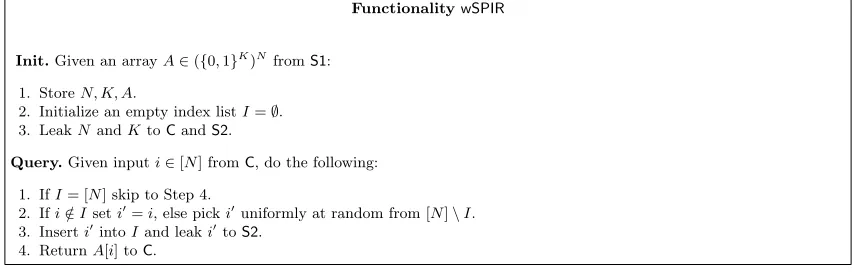
We define our lowest level ideal functionality, which we refer to as Weak-distributed-oblivious-permutation-SPIR (wSPIR). This functionality, described in Figure 3, is used for allowing Cto efficiently retrieve entries in an array generated byS1. In higher level protocols which callwSPIR, the array will be ran-domly permuted byS1. The main difficulty is in ensuring thatS2does not learn the access pattern of repeated queries made byC. This is captured by leaking toS2a random unqueried location whenever a query repeats itself. When the database is randomly permuted,S2learns nothing at all about the queries made byCandConly learns the access pattern but not the actual (non-permuted) locations.
FunctionalitywSPIR
Init.Given an arrayA∈({0,1}K)N fromS1:
1. StoreN, K, A.
2. Initialize an empty index listI=∅. 3. LeakNandKtoCandS2.
Query.Given inputi∈[N] fromC, do the following:
1. IfI= [N] skip to Step 4.
2. Ifi /∈Iseti0=i, else picki0uniformly at random from [N]\I. 3. Inserti0intoIand leaki0toS2.
4. ReturnA[i] toC.
Fig. 3.Ideal functionality for Weak-distributed-oblivious-permutation-SPIR (wSPIR)
Figures 4 and 5 describe (respectively) the initialization phase and query phase of a protocolΠwSPIR
ProtocolΠwSPIR.Init
Global parameters and functions.
– Computational security parameter 1k.
– Pseudorandom generator (PRG)Gwith seed lengthk. The output length ofGwill be determined by the context.
– Pseudorandom function (PRF)Fr:{0,1}k→ {0,1}k, wherer∈ {0,1}k.
– Notation: WriteFrsr(x) to denoteFr(Fs(Fr(x))) wherexis padded to a length-kstring.
Init.S1.On input (N, K, A), the ServerS1does the following:
1. Pick two random and independent PRF keysr, s∈ {0,1}k . 2. LetBbe the array defined byB[i] =A[i]⊕G(Frsr(i)). 3. SendN, K, B, stoS2andN, K, rtoC.
Init.C.Store the valuesN, K, rreceived fromS1, and initialize an index historyIH=∅and PRF historyP H=∅.
Init.S2.Store the values ofN, K, B, sreceived fromS1.
Fig. 4.The initialization phaseΠwSPIR.Initfor the functionalitywSPIR
ProtocolΠwSPIR.Query
Query.C.On inputi∈[N]
1. If|IH|=N, skip to Step 4.
2. Ifidoes not occur inIHseti0=i, else picki0uniformly at random from [N]\I. 3. Sendi0toS2and get backB[i0]. Insert (i0, B[i0]) intoIH.
4. Setmsg=Fr(i).
5. Ifmsgdoes not occur inP Hsetmsg0=msg, else pickmsg0at random from{0,1}k . 6. Sendmsg0toS2and get backFs(msg0). Insert (msg0, Fs(msg0)) intoP H.
7. Fetch (i, b) fromIHand (msg, z) fromP H. 8. Returnoutput=b⊕G(Fr(z)).
Query.S2.Upon receivingi0fromC, send backB[i0]. Upon receivingmsg0fromC, send backFs(msg0).
Fig. 5.The query phaseΠwSPIR.Queryfor the functionalitywSPIR
Lemma 1. Protocol ΠwSPIR realizes wSPIR with perfect correctness (i.e. the output of the protocol always matches the output of the functionality) and with computational security against a single semi-honest party.
Proof Sketch.For correctness, consider an invocation ofΠwSPIR.Queryon inputi. In the end of Step 3,
the pair (i, B[i]) must appear inIH(this is also the case when|IH|=N). In the end of Step 6, the pair (msg=Fr(i), Fs(msg)) must be inP H. Thus, after Step 7 we haveb=B[i] andz =Fs(Fr(i)), and
the output computed in Step 8 satisfiesoutput=b⊕G(Fr(z)) =B[i]⊕G(Frsr(i)) =A[i] as required.
Next, we present a simulator for each party in an invocation ofΠwSPIR.Initand subsequent invocations
ofΠwSPIR.Query.
Simulator for S1.SinceS1does not receive any messages its simulation is trivial.
Simulator for S2.To simulateΠwSPIR.Init.S2, obtainN, Kfrom the ideal leakage, pickB uniformly
at random from ({0,1}K)N, ands uniformly at random from {0,1}k and execute ΠwSPIR.Init.S2with
these values ofN, K, B, s. This simulation is computationally indistinguishable from the real execution ofΠwSPIR.Init.S2becauseS2does not have Fr. Queries from the client invocations of ΠwSPIR.Query.C
are perfectly simulated by repeatedly invoking the query phase ofwSPIRand observing the leakage to
S2. Themmessagesmsgj0 received fromCin Step 6 are simulated by picking uniformly random and
independent strings from{0,1}k.
Simulator for C.To simulateΠwSPIR.Init.C, invokewSPIR.Init, obtainN, Kfrom the leakage, pickr
LetI = (i1, . . . , im) be the sequence of inputs ofCin these invocations, and letO= (o1, . . . , om) be
the corresponding outputs ofwSPIR. (Note that the indicesij are not necessarily distinct.) We start
by simulating the sequence ofm messagesz1, . . . , zm received fromS2in Step 6. Since the messages
msg0jsent toS2in Step 6 are all distinct (except with at mostm
2
/2k failure probability), and sinces is unknown toC, we can simulate all these messageszj=Fs(msg0j) by picking uniformly random and
independent ˆzj∈ {0,1}k. The remaining messages in Step 3 can be simulated similarly, keeping track
of whatChas seen. ut
4.5 Shared-Input Shared-Output SPIR
A disadvantage ofwSPIRis that it requiresCto know the query locationsij, and in particular learn
when a query is repeated. However, when these queries are obtained by traversing a data structure (rather than originating fromC), it is desirable to hide the query locations and query results fromC. To this end we define and implement a stronger primitive which receives the query locationsij in a
secret-shared form and produces the output in a secret-shared form. We refer to this functionality as
shared-input shared-output SPIR(SisoSPIR).
We present two flavors ofSisoSPIR. The first has linear computational complexity in the size of the database for each query, but it is relatively lean and simple. The second implementation achieves sublinear computation via a light form of oblivious RAM. We will use the first implementation to fetch entries from the top levels of the tree-based data structure and the second to fetch entries from the bottom-most (and largest) level.
Both variants will use the following non-reactiveshared-input shared-output PRF(SisoPRF) functional-ity. Loosely speaking, this functionality computesfr[x+y] and secret shares it asQandQ⊕fr[x+y],
wherer is a secret key to a PRFf and xandyare a secret sharing of an input, andQis a random mask. See Figure 6 for a description. We will use two different implementations of this functionality: in the linear solution we will realize it via a 2-server PIR protocol applied to a precomputed table of function values, and in the sublinear solution we will implement it via the general MPC protocolπMPC
applied to a circuit representation ofF.
FunctionalitySisoPRF
Global parameters and functions.
– Computational security parameter 1k.
– Positive integersN, Kreceived fromS1and leaked to all parties.
– Pseudorandom functionFr:ZN→ {0,1}K, wherer∈ {0,1}k.
Functionality.On inputr∈ {0,1}kfromS1,x∈ZN fromC, andy∈ZN fromS2:
1. Pick a randomQ∈ {0,1}K. 2. ReturnQtoC.
3. ReturnQ⊕fr[x+y] toS2.
Fig. 6.Ideal functionality for shared-input-shared-output-PRF (SisoPRF)
4.6 Linear implementation
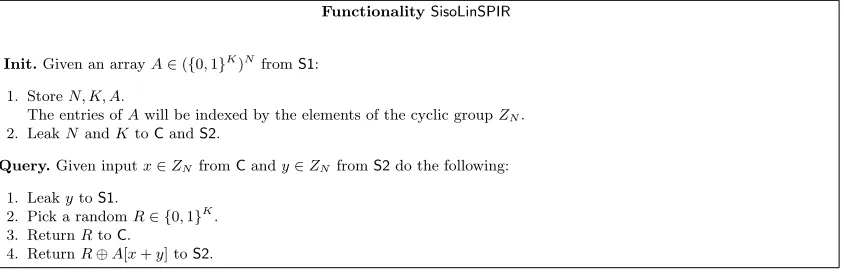
Figure 7 defines the functionality realized by the linear implementation of SisoSPIR, referred to as
SisoLinSPIR, and Figures 8 and 9 describe (respectively) the initialization phase and query phase of a protocolΠSisoLinSPIRrealizingSisoLinSPIR. Note that the functionality leaks the inputyofS2toS1. This
leakage is harmless, because in the higher level protocolsywill always be random and independent of the inputs.
Lemma 2 (Main Technical Construction of LinearSisoSPIR).ProtocolΠSisoLinSPIRrealizesSisoLinSPIR
FunctionalitySisoLinSPIR
Init.Given an arrayA∈({0,1}K
)N fromS1:
1. StoreN, K, A.
The entries ofAwill be indexed by the elements of the cyclic groupZN. 2. LeakNandKtoCandS2.
Query.Given inputx∈ZN fromCandy∈ZNfromS2do the following:
1. LeakytoS1.
2. Pick a randomR∈ {0,1}K . 3. ReturnRtoC.
4. ReturnR⊕A[x+y] toS2.
Fig. 7.Ideal functionality for linear shared-input-shared-output-SPIR (SisoLinSPIR)
ProtocolΠSisoLinSPIR.Init
Global parameters and functions.
– Computational security parameter 1k.
– Pseudorandom functionFr :{0,1}∗→ {0,1}∗, wherer∈ {0,1}k. The input and output length will be understood from the context.
Init.S1.On input (N, K, A), the ServerS1does the following:
1. Pick a random PRF keyr∈ {0,1}k .
2. Generate the masked arrayBdefined byB[i] =A[i]⊕Fr(i) fori∈ZN. 3. SendN, K, BtoS2andN, KtoC.
Init.C.Store the valuesN, Kreceived fromS1.
Init.S2.Store the values ofN, K, Breceived fromS1.
Fig. 8.The initialization phaseΠSisoLinSPIR.Initfor the functionalitySisoLinSPIR
ProtocolΠSisoLinSPIR.Query
1. S2sendsytoS1.
2. S2andS1locally generate a virtual databaseB←ydefined byB←y[i] =B[i+y]. 3. Cpicks a randomR∈ {0,1}K.
4. Cpicks a random subsetTS1⊆ZN and letsTS2=TS1⊕ {x}.
5. CsendsRandTS1toS1andTS2toS2.
6. S1locally computesZS1=Li∈TS1B
←y[i] andS2computesZ
S2=Li∈TS2B ←y[i].
7. S1sends toS2the stringZS10 =ZS1⊕R.
8. Parties invoke theSisoPRForacle with inputs (N, K, r) fromS1, inputxfromC, and inputyfromS2. LetYCandYS2
denote the outputs.
9. CoutputsR⊕YCandS2outputsZS2⊕Z0S1⊕YS2.
Fig. 9. The query phaseΠSisoLinSPIR.Queryfor the functionalitySisoLinSPIRin theSisoPRF-hybrid model
Proof. Recall from Figure 9 the definition ofTS1, TS2andZS1, ZS2. Since the only difference betweenTS1
andTS2is thatxis a member of one and not of the other, we haveZS1⊕ZS2=B←y[x] =B[x+y]. By the
definition ofSisoPRFwe haveYC⊕YS2=Fr(x+y). HenceYC⊕(ZS2⊕ZS1⊕YS2) =B[x+y]⊕Fr(x+y) =
A[x+y] and the pair of outputs (R⊕YC, ZS2⊕ZS1⊕R⊕YS2) is distributed identically to (R, A[x+y]⊕R),
as required by the functionality.
Simulator for S1.To simulate the view ofS1, pick a random PRF keyr∈ {0,1}k (randomness of
S1inΠSisoLinSPIR.Init), a random mask R∈ {0,1}K, and a random subsetTS1⊆ZN (messages from C
in Step 5 ofΠSisoLinSPIR.Query). Together with the leakedy, this perfectly simulates the view ofS1, even
when considered jointly with the outputs ofCandS2. This follows from the fact that the output ofC
in the protocol is masked with a randomQ(fromSisoPRF) which is picked independently of the view ofS1. Thus, conditioned on the view ofS1in the real protocol the output ofCis uniformly distributed, as in the ideal world. Since the output ofS2 is determined by the inputs and the output of C, the simulation is perfect.
Simulator for C.The simulator is given leakageN, Kand the outputOC. It simulates the randomness
ofCby pickingR∈ {0,1}K andTS1⊆ZNat random. It simulates the message received fromSisoPRF
by lettingYC=R⊕OC. SinceRis independent of the randomnessQused bySisoPRF, the value ofOC
in the real protocol is independent ofR. Thus, the simulated view conditioned onOC is distributed as
in the real protocol. Finally, since the output ofS2is determined by the inputs andOC, the simulation
is perfect also when considered jointly with the output ofS2(recall thatS1has no output).
Simulator for S2.The simulator is given leakageN, Kand the outputOS2. It simulates the messageB
fromS1by picking a randomB∈({0,1}K
)N. It simulates the messageTS2by picking a random subset
ofZN and the messageZS0 by picking a random string from{0,1} K
. Finally, it simulates the message fromSisoPRFbyYS2=OS2⊕ZS2⊕ZS10 whereZS2is computed from the simulatedB andTS2 as in the
protocol. To argue the correctness of the simulator, consider a hybrid experiment in which the protocol is executed with a truly random function Fr. This experiment is computationally indistinguishable
from the real experiment by the pseudorandomness of F. In this case, the values B, TS2, ZS10 , YS2 in
the real protocol are uniformly and independently distributed, andOS2=ZS2⊕ZS10 ⊕YS2. Thus, the
joint distribution of the view ofS2 and its output in the hybrid experiment is identical to the joint distribution of the simulated view and the output ofS2in the ideal model. Since the output ofCis determined byOS2and the inputs, the simulator emulates the real protocol even when considering the
output ofC. ut
5
Full SSE and Range Queries
5.1 Weak distributed oblivious permutation Range SPIR
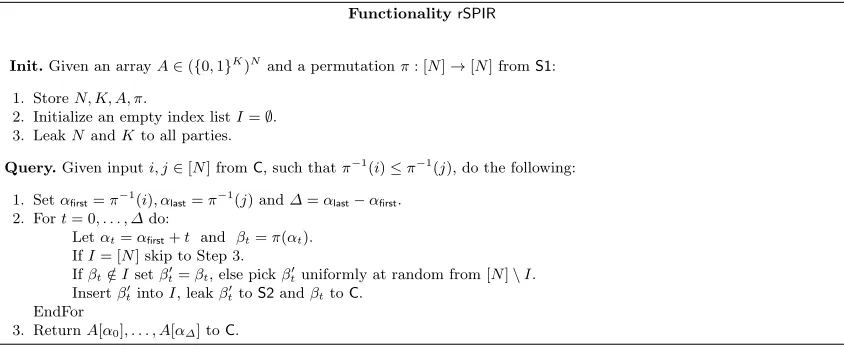
Figure 10 defines our next (low-level) ideal functionality, referred to as Weak-Distributed-oblivious-permutation-Range-SPIR functionality (rSPIR). This functionality allowsCto retrieve a range of entries from a permuted array generated byS1. Namely,Cwill obtain the entriesα0, α0+1, . . . , αnof the array,
corresponding to two permuted endpoints:i=π(α0) andj =π(αn). This is done without revealing
the permutationπtoCorS2. Moreover,S2should be unable to observe overlaps between the retrieved ranges across queries. Such an overlap should look for him as accessing a random fresh location in the array which, when the database is randomly permuted, ensures thatS2learns nothing about the access pattern ofC.
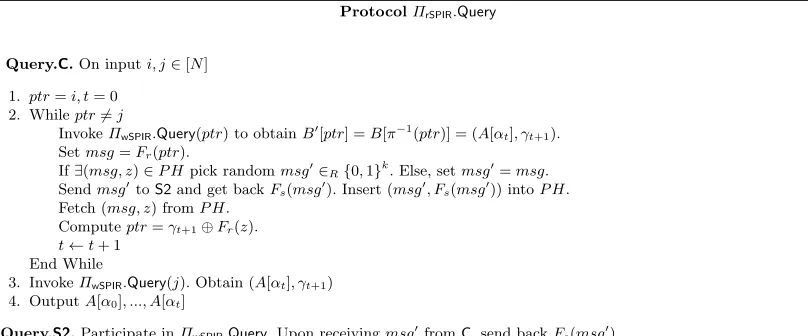
Figures 11 and 12 describe (respectively) the initialization phase and query phase of a protocolΠrSPIR
which realizesrSPIRwith security against a single semi-honest party.
Lemma 3. ProtocolΠrSPIR realizesrSPIR with perfect correctness and computational security against a single semi-honest party.
Proof Sketch.The proof proceeds similarly to thewSPIRproof.
5.2 FindEndpoints
FunctionalityrSPIR
Init.Given an arrayA∈({0,1}K
)N and a permutationπ: [N]→[N] fromS1:
1. StoreN, K, A, π.
2. Initialize an empty index listI=∅. 3. LeakNandKto all parties.
Query.Given inputi, j∈[N] fromC, such thatπ−1(i)≤π−1(j), do the following:
1. Setαfirst=π−1(i), αlast=π−1(j) and∆=αlast−αfirst.
2. Fort= 0, . . . , ∆do:
Letαt=αfirst+t and βt=π(αt). IfI= [N] skip to Step 3.
Ifβt∈/Isetβt0=βt, else pickβt0uniformly at random from [N]\I. Insertβ0tintoI, leakβ
0
ttoS2andβttoC. EndFor
3. ReturnA[α0], . . . , A[α∆] toC.
Fig. 10.Ideal functionality for Weak-Distributed-oblivious-permutation-Range-SPIR (rSPIR)
ProtocolΠrSPIR.Init
Global parameters and functions.
– Computational security parameter 1k.
– Pseudorandom function (PRF)Fr:{0,1}k→ {0,1}k.
Init.S1.On input (N, K, A, π), the ServerS1does the following:
1. Pick two random and independent PRF keysr, s∈ {0,1}k .
2. LetBbe the array defined byB[i] = (A[i], π(i+ 1)⊕Frsr(π(i))) andB0=π(B). 3. InvokeΠwSPIR.Init(N, K, B0).
4. SendstoS2andrtoC.
Init.S2.Participate inΠwSPIR.Init. Store the valuesreceived fromS1.
Init.C.Participate inΠwSPIR.Init. Store the valuesreceived fromS1, and initialize a PRF historyP H=∅.
Fig. 11.The initialization phaseΠrSPIR.Initfor the functionalityrSPIR
Figure 13 defines the ideal functionality FindEndpoints. This functionality allows C to find, given a query on fieldfieldof type type, the two endpoints of the range of matches inside an arrayLfield,type. The exact content of these arrays will be defined shortly.
The implementation of the FindEndpoints functionality is based on B-tree data-structures.S1, given each of the sorted arrays L = Lfield,type (for each supported pair (field,type)), builds a B-tree with branching factorbas follows: in the leaf layer, partition the elements ofL into groups of b elements each (in order). That is, for each such group, there is a leaf node (i.e., thei-th element of the array Lbelongs to thebi/bc) leaf node). We will also need to append the valueito thei-th element in the leafs. Finally, we create a leftmost “trap” node that contains−∞and a rightmost “trap” node which contains +∞values. Non-leaf nodes will contain belements of the form (il−value, ir−value, ptr), where
the value of all elements inside the subtree pointed to byptris in the (closed) interval [il−value, ir−value].
Again, each of these internal layers (excluding the root layer) will contain a leftmost and rightmost “trap” nodes. Finally, in the initialization we invokeSisoLinSPIR.Init for each such layer (which results inS2having an “encrypted” form of the layer).
ProtocolΠrSPIR.Query
Query.C.On inputi, j∈[N]
1. ptr=i, t= 0 2. Whileptr6=j
InvokeΠwSPIR.Query(ptr) to obtainB0[ptr] =B[π−1(ptr)] = (A[αt], γt+1). Setmsg=Fr(ptr).
If∃(msg, z)∈P Hpick randommsg0∈R{0,1}k
. Else, setmsg0=msg. Sendmsg0toS2and get backFs(msg0). Insert (msg0, Fs(msg0)) intoP H. Fetch (msg, z) fromP H.
Computeptr=γt+1⊕Fr(z).
t←t+ 1 End While
3. InvokeΠwSPIR.Query(j). Obtain (A[αt], γt+1) 4. OutputA[α0], ..., A[αt]
Query.S2.Participate inΠwSPIR.Query. Upon receivingmsg0fromC, send backFs(msg0).
Fig. 12.The query phaseΠrSPIR.Queryfor the functionalityrSPIR
FunctionalityFindEndpoints
Global parameters.List of pairs (field,type) such thatS1supports queries of typetypeto fieldfield.
Init.For each pair (field,type) in the list,S1provides an arrayLfield,type∈({0,1}K)N.
1. Store each arrayLfield,type.
2. Leak the correspondingNandKto all parties.
Query.Given queryqfromC, do the following:
1. Letileftbe the minimal element ofLfield,typethat matchesq, orileft= +∞if no such element exists. 2. Letirightbe the maximal element ofLfield,typethat matchesq, oriright=−∞if no such element exists. 3. Returnileft, irighttoC.
Fig. 13.Ideal functionality forFindEndpoints
permutationτ : [N+δ]→[N+δ] (which in particular hides the information on which of the entries is a dummy entry and which is a real entry). Moreover, we will update according toτ all the pointers into the array, to reflect the new random order (and the increased size). We will applySisoSublinSPIR.Init to this array, withΓ ={τ(N), . . . , τ(N+δ−1)}.
Figure 14 describes the initialization phase of protocolΠFindEndpoints which realizesFindEndpoints with
security against a single semi-honest party.
ProtocolΠFindEndpoints.Init
Global parameters and functions.List of pairs (field,type) such thatS1supports queries of typetypeto fieldfield.
Init.S1.For each pair (field,type) in the list,S1is given an input arrayLfield,type∈({0,1}K)Nfield,type
. It does the following:
1. Construct a B-treeTfield,type, as described above, for the (field,type) pair. 2. SendNfield,type, K, Tfield,typetoS2andNfield,type, KtoC.
Init.S2.Participate inSisoSublinSPIR.Init. Store the valuesNfield,type, K, Tfield,typereceived fromS1.
Init.C.Participate inSisoSublinSPIR.Init. Store the valuesNfield,type, Kreceived fromS1.
ProtocolΠFindEndpoints.Query
Global parameters and functions.MPC Protocols for the following functionalities:
– The functionalityfind-leftgets as input (additive) shares for the content of the current nodevin the B-tree (C-node
andS2-node), a queryqfromCand a pointerleft-trapfor a trap node. It returns shares of a pointer (C-ptr,S2-ptr) to the leftmost (direct) child ofvthat satisfies the queryq, or toleft-trapif no such child exists. The functionality
find-rightis defined similarly for finding the rightmost child that satisfiesq.
– The functionality ExtractEndpoints gets as input shares C-l-leaf,S2-l-leaf of the leftmost node satisfying q and
C-r-leaf,S2-r-leaf of the rightmost node satisfying q. The first node is of the form (x, ileft, irealleft) and the sec-ond is (x0, iright, irealright). The functionality returnsileft, iright toC, except ifirealleft = +∞or irealright = −∞or
irealleft> irealrightorqdoes not satisfy the policy; in all of these cases returnileft= +∞, iright=−∞.
Query.On inputq∈ {0,1}K forC:
1. depth=dlogbNe,C-ptr=root,S2-ptr= 0 2. Dodepthtimes:
InvokeΠSisoLinSPIR(C-ptr,S2-ptr) to obtainC-node,S2-node.
InvokeMPCoracle forfind-left(C-node,S2-node, q,left-trap) to obtainC-ptr,S2-ptr. End Do
3. InvokeΠSisoSublinSPIR(C-ptr,S2-ptr) to obtain shares of left leafC-l-leaf,S2-l-leaf.
4. C-ptr=root,S2-ptr= 0 5. Dodepthtimes:
InvokeΠSisoLinSPIR(C-ptr,S2-ptr) to obtainC-node,S2-node.
InvokeMPCoracle forfind-right(C-node,S2-node, q,right-trap). ObtainC-ptr,S2-ptr. End Do
6. InvokeΠSisoSublinSPIR(C-ptr,S2-ptr) to obtain shares of right leafC-r-leaf,S2-r-leaf.
7. InvokeMPCoracle forExtractEndpoints(C-l-leaf,S2-l-leaf,C-r-leaf,S2-r-leaf).
Fig. 15.The query phaseΠFindEndpoints.Queryfor the functionalityFindEndpointsin the (SisoPRF,MPC)-hybrid model
Next, we describe howFindEndpoints.Query is actually implemented. The idea is to traverse the B-tree searching for the given value in the tree. This starts from the root, and at each step proceeds from the current node to one of itsbchildren, maintaining the invariant that the value that we search for is always betweenil−valueandir−valueof the current node (this includes the possibility of these values being−∞ or +∞, in case that we search for a value that is smaller or bigger, respectively, than all values inL). This search is performed jointly betweenS2who knows the B-tree, and the client C who knows the queryq. At each stage, they hold shares for the pointer to the current node (C-ptr,S2-ptr, respectively) as well as shares for the content of that node (C-node,S2-node, respectively). They compute a shared value of the next pointer via a MPC protocol that allows them maintaining all their information secret, followed by a shared-input shared-output SPIR that allows them to obtain the shares of the content. Recall that we have several versions ofSisoSPIR; we employ the linear version for the internal nodes of the B-tree and the sub-linear version for the leafs level which is, of course, the largest. The latter is more efficient but its security limited to δ invocations; see discussion earlier (also, the shares for
SisoSublinSPIRare inZN+δ rather than justZNin the standardSisoSPIR, whereN stands for the size
of the relevant array). Finally, the leaf nodes contain triplets of the form (xi, πfield,type(i), i), from which
the endpoints will be extracted given that some basic requirements are met (e.g., thatq satisfies the policy). Figure 15 describes the query phase of protocolΠFindEndpoints.
Next, we consider the following outer protocol OuterFindEndpoints, that serves as an interface to
FindEndpoints by applying a few additional permutations. Its setup phase consists of preparing all the arrays thatFindEndpointswill utilize. It turns out that rather than keeping one array (for each field and query type), with entries of the form (xi, ptri), it is convenient to keep two arraysL[i] = (xi, i) and
B[i] =ptri (all sorted according toxi). Then, those arrays will be appropriately mixed, by applying
FunctionalityOuterFindEndpoints
Init.S1is given databaseD∈({0,1}K )N.
It picks a random permutationσ: [N]→[N]. Then, for each fieldfieldand query typetypethatS1supports, it does the following:
1. Compute arraysLfield,type[i] = (x
i, i), Bfield,type[i] =ptri (of lengthNfield,type). 2. Pick a random permutationπfield,type: [Nfield,type]→[Nfield,type].
3. LetL0field,type[i] = (xi, πfield,type(i)) andB0field,type[i] =σ(ptri). 4. InvokerSPIR.InitusingB0field,typeandπfield,typeas inputs. 5. InvokeFindEndpoints.InitusingL0field,typeas input.
InvokewSPIR.InitusingD0=σ(D) (a randomly permuted version of databaseD) as input.
Query.Given queryqof typetypeto fieldfieldfromC, do the following:
1. InvokeFindEndpoints.Queryusing arrayL0field,typeand queryq.
Obtainileft andirightwhich are equalπfield,type(irealleft) andπfield,type(irealright), respectively. Ifileft= +∞then Return ∅toC.
2. InvokerSPIR.Queryusingileftandirightas inputs.
Obtain all elements inB0[(πfield,type)−1(ileft), . . . ,(πfield,type)−1(iright)] (that is,B0
[irealleft, . . . , irealright]).
3. Each of these values is of the formσ(ptrj), for someptrjwhich is a pointer to a record that actually matches the query
q.Cinvokes the functionalityΠwSPIR.Queryon each valueσ(ptrj) to obtain the recordsD0(σ(ptrj)) =D[σ−1(σ(ptrj))] =
D[ptrj].
Return records toC.
Fig. 16.Ideal functionality forOuterFindEndpoints
Remark.We discuss how to handle query policies: we augment the FindEndpoints functionality to take as input a policy from the server, and if it is not satisfied by the policy, it setsileft= +∞and iright=−∞.
5.3 Putting it All Together
Theorem 1 (Main Theorem.).TheOuterFindEndpointsprotocol is a sublinear communication pro-tocol realizing the distributed SSE functionalityFSSE where the leakage profiles only reveal the sizes of
the objects (no information about access patterns and intersection of queries or results across multiple queries). The protocol achieves 1-privacy in the semi-honest model and uses a logarithmic number of communication rounds in the size of the database.
Proof. We describe how to construct a simulator for all the parties in the protocol implementing
OuterFindEndpoints.
Simulator for S1.For the initialization phase, the simulator mimics the serverS1proceeds as it does in the protocol, except it uses the simulator forrSPIR.InitandFindEndpoints.Initfor all fields and query types, and finallywSPIR.Initfor the main database. This generates the transcript for the initialization step.
During a query, the simulator generates the view forS1by running the simulator forFindEndpoints.Query
followed by the simulator for rSPIR.Query. Finally, it invokes the wSPIR.Query simulator (which is trivially empty forS1).
Simulator for S2.For the initialization phase, the simulator forS2requires invoking the simulator forrSPIR.InitandFindEndpoints.Initfor all the fields and query types. Finally, it runs the simulator for
wSPIR.Initfor the main database.
During a query, the simulator generates the view forS2by running the simulator forFindEndpoints.Query
followed by the simulator forrSPIR.Query. Finally, it invokes thewSPIR.Querysimulator.
Simulator for C.For the initialization phase, simulating the clientCis similar to simulatingS2: we run the simulator forrSPIR.InitandFindEndpoints.Initfor all the fields and query types. Finally, it runs the simulator forwSPIR.Initfor the main database.
During a query, the simulator generates the view forCby running the simulator forFindEndpoints.Query
trap representations, otherwise they are set to the range to be returned (as the result of the query). The simulator also maintains a list of previously seen pointers and chooses a random pointer for each never-before-seen location, or reusing an old one previously seen. Finally, it invokes thewSPIR.Query
simulator which just returns the result toC. ut
6
Conclusion
In this paper, we presented a solution for large-scale private database outsourcing via an SSE-style construction on B-trees. We formalized a model for our two-server SSE, and provided an abstract scheme along with an efficient realization of the scheme as our solution. The solution has sublinear overhead and leaks no access pattern information up toδqueries. Finally, we implemented a prototype and provided benchmarked results for our solution, which is only 5×slower compared to MySQL when querying around 10% of the database, with smaller queries resulting in over 100×relative slowdown due to fixed costs.
References
1. Rakesh Agrawal, Jerry Kiernan, Ramakrishnan Srikant, and Yirong Xu. Order-preserving encryp-tion for numeric data. InSIGMOD Conference, pages 563–574, 2004.
2. Mihir Bellare, Alexandra Boldyreva, and Adam O’Neill. Deterministic and efficiently searchable encryption. InCRYPTO, pages 535–552, 2007.
3. Alexandra Boldyreva, Nathan Chenette, Younho Lee, and Adam O’Neill. Order-preserving sym-metric encryption. IACR Cryptology ePrint Archive, 2012:624, 2012.
4. Dan Boneh, Giovanni Di Crescenzo, Rafail Ostrovsky, and Giuseppe Persiano. Public key encryp-tion with keyword search. InEUROCRYPT, pages 506–522, 2004.
5. Zvika Brakerski and Vinod Vaikuntanathan. Efficient fully homomorphic encryption from (stan-dard) LWE. InFOCS, pages 97–106, 2011.
6. Ran Canetti. Security and composition of multiparty cryptographic protocols. Journal of Cryptol-ogy, 13(1):143–202, 2000.
7. David Cash, Stanislaw Jarecki, Charanjit S. Jutla, Hugo Krawczyk, Marcel-Catalin Rosu, and Michael Steiner. Highly-scalable searchable symmetric encryption with support for boolean queries. InCRYPTO (1), pages 353–373, 2013.
8. Yan-Cheng Chang and Michael Mitzenmacher. Privacy preserving keyword searches on remote encrypted data. InACNS, pages 442–455, 2005.
9. Melissa Chase and Seny Kamara. Structured encryption and controlled disclosure. InASIACRYPT, pages 577–594, 2010.
10. Benny Chor, Oded Goldreich, Eyal Kushilevitz, and Madhu Sudan. Private information retrieval. InFOCS, pages 41–50, 1995.
11. Reza Curtmola, Juan A. Garay, Seny Kamara, and Rafail Ostrovsky. Searchable symmetric en-cryption: improved definitions and efficient constructions. InACM CCS, pages 79–88, 2006. 12. Jonathan Dautrich and Chinya Ravishankar. Combining ORAM with PIR to minimize bandwidth
costs. InACM CODASPY, pages 289–296, 2015.
13. Ben Fisch, Binh Vo, Fernando Krell, Abishek Kumarasubramanian, Vladimir Kolesnikov, Tal Malkin, and Steven M. Bellovin. Malicious-client security in blind seer: A scalable private dbms.
IACR Cryptology ePrint Archive, 2014:963, 2014.
14. Michael J. Freedman, Yuval Ishai, Benny Pinkas, and Omer Reingold. Keyword search and oblivious pseudorandom functions. InTCC, pages 303–324, 2005.
15. Craig Gentry. Fully homomorphic encryption using ideal lattices. InSTOC, pages 169–178, 2009. 16. Eu-Jin Goh. Secure indexes, 2003.
17. Oded Goldreich. Towards a theory of software protection and simulation by oblivious RAMs. In
STOC, pages 182–194, 1987.
18. Oded Goldreich. Foundations of Cryptography: Basic Tools. Cambridge University Press, Cam-bridge, UK, 2001.
19. Oded Goldreich and Rafail Ostrovsky. Software protection and simulation on oblivious RAMs. J. ACM, 43(3):431–473, 1996.
21. Seny Kamara and Charalampos Papamanthou. Parallel and dynamic searchable symmetric en-cryption. InFinancial Cryptography, pages 258–274, 2013.
22. Kaoru Kurosawa and Yasuhiro Ohtaki. Uc-secure searchable symmetric encryption. InFinancial Cryptography, pages 285–298, 2012.
23. Eyal Kushilevitz and Rafail Ostrovsky. Replication is not needed: Single database, computationally-private information retrieval. InFOCS, pages 364–373, 1997.
24. Travis Mayberry, Erik-Oliver Blass, and Agnes Hui Chan. Efficient private file retrieval by com-bining ORAM and PIR. InNDSS, 2014.
25. Moni Naor and Kobbi Nissim. Communication preserving protocols for secure function evaluation. InSTOC, pages 590–599, 2001.
26. Rafail Ostrovsky. Efficient computation on oblivious RAMs. InSTOC, pages 514–523, 1990. 27. Rafail Ostrovsky. Software Protection and Simulation On Oblivious RAMs. PhD thesis,
Mas-sachusetts Institute of Technology, 1992., Dept. of Electrical Engineering and Computer Science, June 1992.
28. Rafail Ostrovsky and William E. Skeith III. Private searching on streaming data. InCRYPTO. 29. Dawn Song, David Wagner, and Adrian Perrig. Practical techniques for searches on encrypted
data. InIEEE Symposium on Security and Privacy, pages 44–55, 2000.
30. Xiao Shaun Wang, Kartik Nayak, Chang Liu, T.-H. Hubert Chan, Elaine Shi, Emil Stefanov, and Yan Huang. Oblivious data structures. InACM CCS, pages 215–226, 2014.
31. Andrew Chi-Chih Yao. Protocols for secure computations (extended abstract). InFOCS, pages 160–164, 1982.
32. Jinsheng Zhang, Qiumao Ma, Wensheng Zhang, and Daji Qiao. KT-ORAM: A bandwidth-efficient ORAM built on k-ary tree of PIR nodes.IACR Cryptology ePrint Archive, 2014:624, 2014.
A
Sublinear Realization of
SisoSPIR
The sublinear implementation ofSisoSPIRwill apply light oblivious RAM machinery for making the computation sublinear without revealing the access pattern to eitherCor S2. Specifically, the imple-mentation is similar to that ofwSPIR except that the inputs and outputs of the PRFs need to be secret-shared betweenCand S2(as captured by theSisoPRFfunctionality) and the history lists also need to be secret-shared between Cand S2. Since realizing SisoPRF is expensive and may form an efficiency bottleneck, we would like to minimize the number of calls to this functionality. To this end we add dummy entries to the database whose (pseudorandom) locations are known toC. In each sub-sequent invocation, a new dummy entry is consumed in order to conceal the access pattern fromS2. We use a parameterδ, set byS1, to determine the number of dummy entries. Afterδinvocations of the protocol, when all the dummy entries are consumed, one can re-initialize the database with new dummy entries, yielding a solution with amortized ˜O(√N) complexity. Alternatively, one can start revealing the access pattern toS2once the dummy entries are consumed. In the current implementation we opt for the latter option.
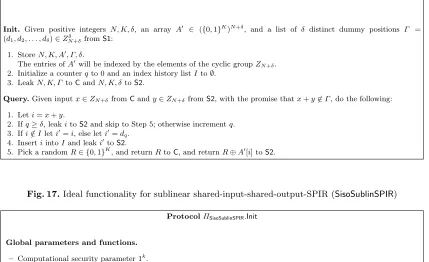
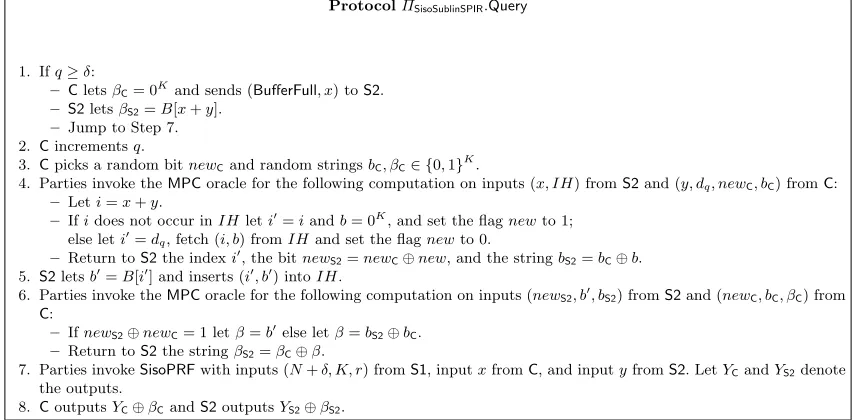
Figure 17 defines the functionality realized by the sublinear implementation ofSisoSPIR, referred to as
SisoSublinSPIR, and Figures 18 and 19 describe (respectively) the initialization phase and query phase of a protocolΠSisoSublinSPIRrealizingSisoSublinSPIR. Note that the functionality leaks the positions of the
dummy entries toCand the position of the queried entry toS2, where repeated entries are replaced by dummy entries. This leakage will be harmless, because the higher level protocol will randomly permute the concatenation of the actual databaseAwith theδ dummy entries. We also note that in the actual usage ofSisoSublinSPIR, the sharesxandyof the queried position will never point to a dummy entry. We therefore obtain the following lemma.
Lemma 4. ProtocolΠSisoSublinSPIRrealizesSisoSublinSPIRin the(SisoPRF,MPC)-hybrid model with per-fect correctness and computational security against any single semi-honest party.
Proof. In the firstδqueries, Step 4 creates secret sharing betweenCandS2of a flagnewwhich is set to 1 if and only if this is the first occurrence of the indexi=x+y. (Note that, given the promise that x+y6∈Γ, the flagnewis always set to 1 upon the first occurrence ofi.) Step 4 also creates a sharing of the fetched stringb=B[i] in caseihas occurred before. Step 6 uses the flagnewto select between the fetchedband the valueb0=B[i0] known toS2, yielding a sharing ofβ=B[i]. Finally,βis unmasked byFr[i] in Step 8 to yield output shares ofA0[x+y], as required.
After more thanδqueries, Step 1 guarantees that the valueβshared betweenCandS2is equal to the masked database entryB[x+y], which in Step 8 is unmasked withFr[x+y] to yield output shares of
A0[x+y], as required.
FunctionalitySisoSublinSPIR
Init. Given positive integers N, K, δ, an array A0 ∈ ({0,1}K
)N+δ, and a list of δ distinct dummy positions Γ = (d1, d2, . . . , dδ)∈ZδN+δfromS1:
1. StoreN, K, A0, Γ, δ.
The entries ofA0will be indexed by the elements of the cyclic groupZN+δ. 2. Initialize a counterqto 0 and an index history listIto∅.
3. LeakN, K, ΓtoCandN, K, δtoS2.
Query.Given inputx∈ZN+δfromCandy∈ZN+δfromS2, with the promise thatx+y6∈Γ, do the following:
1. Leti=x+y.
2. Ifq≥δ, leakitoS2and skip to Step 5; otherwise incrementq. 3. Ifi /∈Ileti0=i, else leti0=dq.
4. InsertiintoIand leaki0toS2. 5. Pick a randomR∈ {0,1}K
, and returnRtoC, and returnR⊕A0[i] toS2.
Fig. 17.Ideal functionality for sublinear shared-input-shared-output-SPIR (SisoSublinSPIR)
ProtocolΠSisoSublinSPIR.Init
Global parameters and functions.
– Computational security parameter 1k.
– Pseudorandom functionFr :{0,1}∗→ {0,1}∗, wherer∈ {0,1}k. The input and output length will be understood from the context.
Init.S1.On input (N, K, δ, A0, Γ), the ServerS1does the following:
1. Pick a random PRF keyr∈ {0,1}k .
2. Generate the masked arrayBdefined byB[i] =A0[i]⊕Fr(i) fori∈ZN+δ. 3. SendN, K, δ, BtoS2andN, K, δ, ΓtoC.
Init.C.Store the valuesN, K, δ, Γreceived fromS1. Initialize a counterqto 0.
Init.S2.Store the values ofN, K, δ, Breceived fromS1. Initialize listIHto∅.
Fig. 18.The initialization phaseΠSisoSublinSPIR.Initfor the functionalitySisoSublinSPIR
Simulator for S1. Since S1does not get any messages (in the hybrid model), simulating S1is
trivial.
Simulator for C. Other than learningN, K, Γ (which are allowed by the leakage),Clearns nothing:
the message it receives from theSisoPRForacle in Step 7 is uniformly distributed, independently of its input and randomness.
Simulator for S2. In the initialization phase, S2gets a PRF-masked copy of the database A0.
Given the leakageN, K, δthis can be simulated (up to computational indistinguishability) by picking a random database. In theq-th invocation of the query phase, 1≤q≤δ,S2learns in Step 4 an index i0 which either satisfiesi0=x+yifx+yoccurs for the first time as the sum of the inputs, or i=dq
otherwise. This is precisely the leakage of the ideal functionality. Starting from invocationδ, Step 1 reveals toS2the inputxofC, which is also allowed by the leakage of the ideal functionality. All other
messages received byS2in Steps 4,6,7 are random. ut
B
Implementation and Benchmarking
ProtocolΠSisoSublinSPIR.Query
1. Ifq≥δ:
– CletsβC= 0Kand sends (BufferFull, x) toS2.
– S2letsβS2=B[x+y].
– Jump to Step 7. 2. Cincrementsq.
3. Cpicks a random bitnewCand random stringsbC, βC∈ {0,1}K.
4. Parties invoke theMPCoracle for the following computation on inputs (x, IH) fromS2and (y, dq, newC, bC) fromC:
– Leti=x+y.
– Ifidoes not occur inIHleti0=iandb= 0K, and set the flagnewto 1; else leti0=dq, fetch (i, b) fromIHand set the flagnewto 0.
– Return toS2the indexi0, the bitnewS2=newC⊕new, and the stringbS2=bC⊕b.
5. S2letsb0=B[i0] and inserts (i0, b0) intoIH.
6. Parties invoke theMPCoracle for the following computation on inputs (newS2, b0, bS2) fromS2and (newC, bC, βC) from
C:
– IfnewS2⊕newC= 1 letβ=b0else letβ=bS2⊕bC.
– Return toS2the stringβS2=βC⊕β.
7. Parties invokeSisoPRFwith inputs (N+δ, K, r) fromS1, inputxfromC, and inputyfromS2. LetYCandYS2denote
the outputs.
8. CoutputsYC⊕βCandS2outputsYS2⊕βS2.
Fig. 19.The query phaseΠSisoSublinSPIR.Queryfor the functionalitySisoSublinSPIRin the (SisoPRF,MPC)-hybrid model
communication. Our tests were run on a desktop machine running inside a Ubuntu 12.04 LTS virtual machine with 8GB of RAM and 4 cores of an Intel i7-2600K 3.4GHz CPU assigned to it. Our testing focused on testing each of the cryptographic components of our solution, as well as the overall solution. We tested the main components: Oblivious Transfer, Shared-input-shared-output PIR, and secure node search, in both their online and offline (when applicable) phases. We also tested our setup phase for building the main database. We summarize our results as follows:
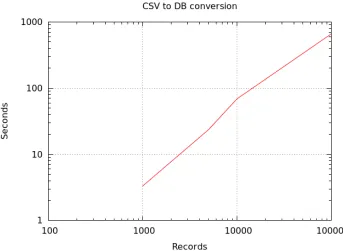
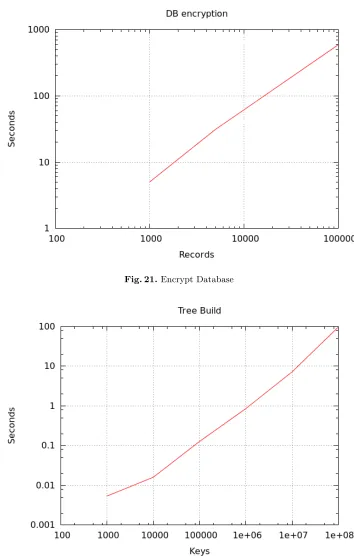
Processing a database from CSV to our format takes roughly 6ms per record, and then another 6ms to encrypt. Building the PPDS B-tree is much quicker, taking around 1 microsecond per record for each indexable column.
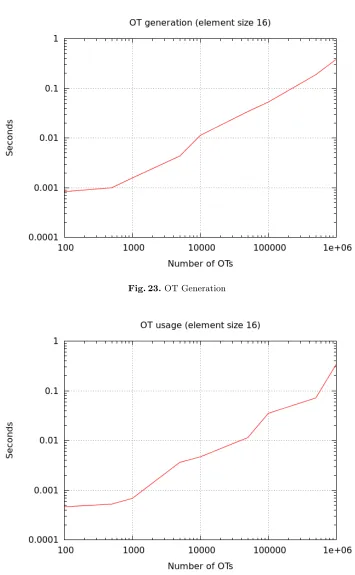
For online processing, we find that the dominant cost is in the usage of PIR. The generation of PIR instances can be done independent of the data size, only the number of elements, but the consumption of PIR depends on the data size. For 64-bit data and 64-bit pointers, a single instance PIR takes roughly 0.9 seconds when accessing something on the order of the leaf layer of a B-tree (100 million divided by the branching factor), though generating such an instance only takes 3.5 milliseconds (again, due to the fact that PIR generation is data-size independent). For OTs, since we only use them to transmit keys, we test them on fixed sizes of 128 bits though varying the number of instances. It takes a few microseconds to both produce and consume an instance of OT. Finally for secure nodesearch, we see that as the element size grows the nodesearch time grows linearly, corresponding to roughly 100 microseconds per bit of the data elements (and using 64-bit pointers). Overall it still takes much less than a second to evaluate for all tested data sizes.
B.1 Offline Processing
CSV to DB. We start with a flat table in CSV format using records with typical personal data (Name, DOB, etc.) and a medium sized payload field of 1 megabyte each and convert it into our internal representation in Figure 20.
Encryption of DB.Once we have a formatted database, we then encrypt each record so that we have an encrypted DB that will be sent toS2. Again, we run them on various collections of records in Figure 21.
B.2 Online Processing
Oblivious Transfer.We time the generation of random OTs to be consumed. These are 1-out-of-2 OTs of strings of length equal to the size of an encryption key (AES key). We generateN of them in batch at a time. These tests are performed over TLS over localhost, and presented in Figure 23. We also time the consumption of these OTs in Figure 24. Again, they are consumed in batches of sizeN.
Shared-input-shared-output PIR.We time the generation of random PIRs to be consumed. Note that these pre-generated PIRs do not depend on the sizes of the data elements, only the number of elements. We generateN of them in batch at a time. Again, these tests are performed over TLS, and presented in Figure 25.
We also time the consumption of these PIRs. We run PIR on elements of size equal to that of a node in a B-tree, which is equal to two data elements and one pointer per branching factor: (2·64+64)·128 = 24576 bits. These are consumed one at a time, are performed over TLS, and presented in Figure 26.
Secure node search.We use an optimized Yao-style secure node search protocol. Here, we present the time for execution on instances of various data element sizes presented in Figure 27.
Actual Queries and Comparison to MySQL.We set up a database of 10 million records, where each record is roughly 0.5KB. We query the database using range queries that return roughly 1000, 10000, 50000, 100000, 250000, 500000, 750000, and 1 million records (which is 10% of the database). The raw times are presented in Figure 28. We consider the relative multiplicative overhead, which is presented in Figure 29. We see that although it starts off at over 100× due to fixed costs, it is approaching a factor of 5×for reasonably large queries, though it appears to have considerable overhead for smaller queries. It is apparent that this is due to our construction having additional fixed cost time that dominates small queries, and can easily be seen when plotting a trend between our times and the MySQL times. This is shown in Figure 30 along with the linear regression line showing a roughly 5× slope.
Fig. 21.Encrypt Database
Fig. 22.Build Privacy Preserving B-tree
C
Reduction to Range Queries
Other Query Types.Akeyword searchqueryqon a fieldAiconsists of a values. The query returns
Fig. 23.OT Generation
Fig. 24.OT Consumption
on a fieldAiconsists of a value s. The query returns all records rwhere its field elementxi contains
Fig. 25.PIR Generation
Fig. 26.PIR Consumption
a values. The query returns all recordsr where its field elementxi containss as an (initial, final, or
Fig. 27.Secure Node Search using Yao-based MPC
Fig. 28.Actual Query Times
Fig. 29.Relative Query Times
Fig. 30.Comparison To MySQL Trendline
then perform an equality search for the keyword or the stem of the keyword. For substring queries, we have three types of substrings: initial (q%), finalq%, and intermediate substrings (%q%).
We have some substring length boundC, and given a termx, we appendC−1 “initial” symbols and “terminal” symbols to the start and end of x. E.g. If the search term is “Alice”, and our substring bound is 4 then we make the term “###Alice$$$”. We then insert all sizeCsubstrings of that term into our data structure. Then, to perform an initial search on up toC characters on some queryq, we padqwith sufficiently many # at the start to reachCcharacters and do an equality search. Similarly, for a terminal search, we append $ at the end ofqand do an equality search. For an intermediate query, we perform a range search on [q0. . .0, q1. . .1] which is just the stringqappended with all zeroes or all ones at the end.
D
Discussion of Applications
The solution is applicable in any scenario for secure and private database search that is in a three-party setting, where one three-party acts as a “semi-trusted” third three-party helper server. We summarize a few possible applications:
Secure Search.The main application is secure search, where one party holds sensitive data (hotel reservations, “no-fly” list, etc.) and another party has sensitive queries against it. The third party in this scenario is a neutral party agreed upon by both the data and query holders.
Private Forensics.Different entities may want to compare notes on data they collected from their own internal security team (bugs, vulnerabilities, attack patterns, etc.). The third party can be a repository for all the data, and each entity can query against it.
Data Collaboration.Different entities may want to collaboratively perform operations on their joint data. Again, the third party can be a repository for all the data, and each entity can query against it.