1463 | P a g e
Performance Analysis and comparison
of Recurrent Network for Pattern Storage
and Recalling of Static Images
Raj Kumar Goel
1, Dr. Saurabh Srivastava
2, Ganesh Kumar Dixit
3 1Bundelkhand University, Jhansi, Uttar Pradesh (India)
2,3
BSA College Mathura, Uttar Pradesh (India)
ABSTRACT
Pattern storage and recalling is a problem of interest in field of pattern recognition till now, which is used to
mimic the human brain. Auto associative memory is an extensively used network for pattern storage and
recalling of patterns. Recurrent network like Hopfield is popularly known auto associative memory networks. In
this paper we present performance analysis and comparison analysis in term of storage and recalling
efficiency of Hopfield network. Our analysis is based on the storage capacity and recalled efficiency of the
pattern storage network for original images as well as distorted form of these images. For storage and
recalling, edge Dilation and SOM are the methods for feature extraction used here to evaluate the performance
of pattern storage network.
Keywords: Hopfield Neural Network, Pattern Recognition, Recurrent network,
I. INTRODUCTION
A Recurrent Neural Network (RNN) is a distinct class of Artificial Neural Networks (ANNs) that can be used to
process arbitrary sequences of inputs. RNNs are widely being used for pattern recognition task, because pattern
recognition mainly depends on pattern storage and pattern recalling. There are numerous machine learning
methods which have been used for pattern storage and retrieval. But, RNN has gained its own place due to its
wide applicability. Most widely used RNNs include Hopfield networks used to model the understanding of
human memory, though Hopfield networks were not designed to process sequences of patterns [1,
2]. Stochastic RNN based Boltzmann machine which is supposed to be a Monte Carlo version of Hopfield
networks is used to solve combinatorial problems. The results are elaborated in this paper. We have used weight
matrix calculation method. We have used the weight adjustment algorithm.
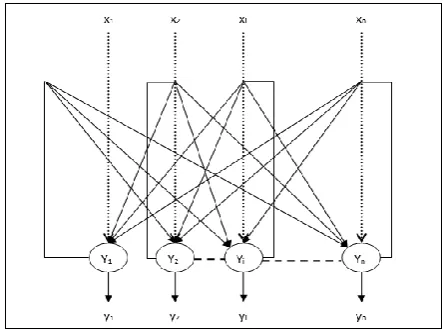
Hopfield Neural Network [1] has characteristic feature of dynamic feedback system. So the output of a direct
operation serves as an input for the next operation of a network as shown in Fig 1.These networks do not impact
the network's ability to act as a content-addressable associative memory system and have the capability to
initiate the retrieval of the most coherent behavior vector in the neural network. Both the auto-association and
hetero-association operations happen together. The network system represents a stable behavior and converges
at the single motionless point. When this point becomes an input to a dynamic system, we will have a
1464 | P a g e
Periodic cycles may occur in RNNs due to asymmetric weights and the network system may exhibit chaotic
behavior. This behavior is not generalized and it is limited to a relatively small segment of the phase space. It
has no negative impact on the network's ability to act as an associative array.
A Hopfield neural network can retrieve any of the learned patterns just by an exposure to only partial
information about the learned pattern. The Hopfield network has a tendency of stable pattern recognition
similar to human brain, usually, if there is more than one fixed point. The selection of starting point for the
initial iteration has a great effect on the network convergence [3]. The motionless points in the network are
called attractors. The vectors which are attracted to a particular attractor during the iterations represent the
"attraction area" or "attraction basin" of that attractor. The set of these motionless points of Hopfield's network
acts as a memory. Such a network operates as an associative memory [4]. The input vectors entering to the
sphere of attraction of some another attractor also gets connected to it. For example, a desirable image acts as an
attractor, then the area of attraction can be consisting of incomplete versions of this image. In such a case there
are good chances that images that vaguely recall to a desirable image may be remembered by the network
associated with this image.
Fig 1: Architecture of Binary Hopfield neural network
A discrete Hopfield networks with binary bipolar input and output pattern shown above in fig 1. The weight
matrix of integers which is symmetric by nature is represented by W =||wij||. The diagonal element of the weight
matrix is set to zero. Conventional matrix with multiplication is used to multiply the input vector X to a input
weight matrix W. for each input pattern X, the output pattern is calculated by feeding X to the corresponding
neurons in HNN. For asynchronous update, only one component of output pattern Y = [yj], is used. This
component is selected either randomly or by turn and pass to a threshold function for which output is bipolar (–
1, or +1), which replace the corresponding component in input vector to form new input vector for next
iteration. The termination of this update process take place when all input and output vectors become same. This
1463 | P a g e
II, ALGORITHM OF RECALL USING ASYNCHRONOUS UPDATES
At beginning an input vector X and weight matrix ||wij|| are applied to input neurons. It identifies the total input
signal at the jth neuron as yinj(x) and gets the outputs. These outputs of the neurons are worked as inputs for new
iteration by applying the following operations:
Components of an output vector yj,
yj= F( ni=1wijxi) (1)
Where
j = 1, 2, ..., n
F x = −1 ifx < 01 ifx > 0 ypreviousifx = 0
For asynchronous correction, i.e. [2–4]:
Step 1: to start the algorithm, define an input vector
(x1; x2; ...; xn)
Step 2: Calculate yj by eq. (1).
Step 3: replace component x1 by y1 in input vector
(x1 x2; ...; xn) as (y1; x1; x2; ...; xn) = Y and a feed Y back to input X.
. Step 4: this process will continue to find y2; y3, etc. and replace the corresponding input components.
Repeat steps 2 and 3 until the vector: Y = (y1; y2; ...; yn) ceases to change.
Calculate the value of communications energy E if at least one of outputs has changed:
E = 1/2 .n
i=1 nj=1wijxixj(2)
The vector will convey convergence to a motionless point if the energy E reduces. Zeros on a main diagonal of a
weight matrix W and asynchronous update guarantee that the energy function (2) will decrease with each step
[2, 5]. To ensure the convergence to a motionless point an asynchronous up dating is inevitable. In place of a
motionless point a network with periodic cycle can be developed as terminal state of an attractor if we permit
the input vector to get corrected in iteration.
III. FEATURE EXTRACTION
Feature extraction is an important step in the design of a sample organization. Its main goal is to extract the
appropriate information to characterize each class. Feature extraction techniques support a variety of image
processing applications. The characteristics describe the behavior of an image; they give you an idea of their
position in terms of storage space, efficiency in classification and time use [6, 7]. The self-organizing map is an
artificial neural network (ANN) that is trained using unsupervised learning to produce a low-dimensional
representation of the training patterns while retaining the topological characteristics of the input space. A
self-organizing map consists of a single-layered feed-forward network in which the outputs are arranged in the
low-dimensional grid. Each input is connected to all output neurons. A weighting vector of the same dimension as
the input vectors is attached to each neuron. The adaptation (training) algorithm uses competitive learning [8].
The edge detection is a kind of image segmentation techniques that determine the presence of an edge or a line
in an image and suitably outline it. The main cause of edge detection is to simplify the image data to minimize
1464 | P a g e
analysis and filter simulation using digital computers. In this paper we have taken 10 images of Greek symbol as
shown in figure 2. Thedifferent steps for preprocessing task in the Edge dilation method are shown in figure 3.
Fig 2: Static images of 10 Greek symbols.
RGB image
Gray image Binary
image
Edge of image
Dilation of image
Fig 3:Various stages of image processing for extracting features
IV. ANALYSIS OF RESULT
In this experiment the input stimuli for SOM network is presented in preprocessed form. We have taken features
for SOM via ED and FFT method of feature extraction. This pattern information of static images is passed in
HNN of 900 processing units. The pattern information in preprocessed form of static images is presented to
SOM network of 15 × 15 neighboring region. The SOM network produces a codebook for each method which
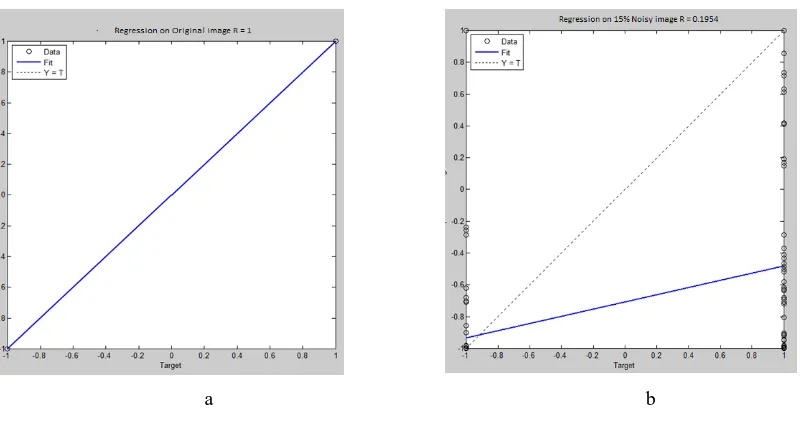
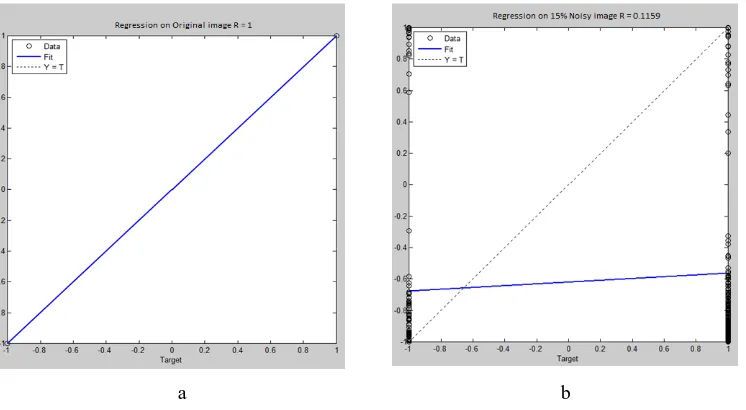
is used as pattern information for Hopfield Neural Network. The performance of recalling for the feature map of
original static images and erroneous images is presented in figure 4 for ED preprocessed features and in figure 5
for FFT preprocessed features respectively.
1465 | P a g e
c d
e
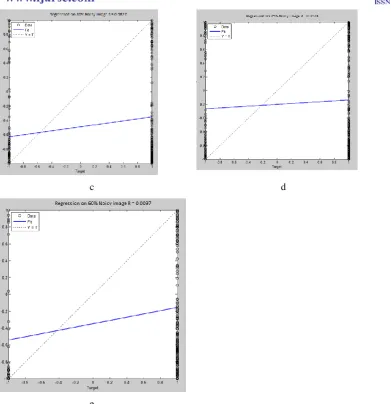
Fig 4: Regression line preprocessed from ED method. (a). For original image, (b). For 15 % error image, (c).
For 30 % error image, (d). For 45 % error image, (e). For 60 % error image,
1466 | P a g e
c d
e
Fig 5: Regression line preprocessed from FFT method. (a). For original image , (b). For 15 % error image, (c.)
for 30 % error image, (d). For 45 % error image, (e) For 60 % error image.
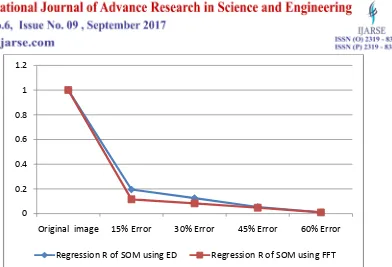
The Result of above regression line can be summarized as shown in below table no 1. The same is also shown in
graphical form via chart in figure 6.
Table 1. Performance Evaluation of Hopfield Neural Network for recalling using SOM method with ED and
FFT.
Methodology used Original
image
15%
Error
30%
Error
45%
Error
60%
Error
Regression R of
SOM using ED 1 0.1954 0.1252 0.0537 0.0107
Regression R of
1467 | P a g e
Fig 6: Regression line in graphical form for Performance of Hopfield neural network for SOM with ED and FFT
feature method for recalling.
V. CONCLUSION
It has been observed that since the error in original images is 30% and above, the performance of the callback
decreases rapidly. The experiments carried out in the present study were tested with two feature extraction
methods, namely Edge Dilation (ED) and Self Organizing Map (SOM). The hybrid learning rule has been
proposed to improve the storage and retrieval efficiency of the Hopfield network. The performance of Hopfield
network is better when the prototype samples presented to it are filtered by ED methods. The proposed hybrid
learning rule with considered feature extraction methods was used to evaluate the performance of Hopfield's
neural network for static original images and their defective or erroneous images.
The SOM was also performed with same efficiency and accuracy as the FFT and ED was performing in
recalling process but the poor performance of SOM is exhibit for noisy images with respect to other two
methods. The performance of SOM for preprocessed stimuli with ED exhibit more accuracy in recalling in
comparison to SOM with FFT. The performance of ED using SOM to prepare feature for pattern information
and storage in Hopfield Neural Network then recalling is found much better over the methods.
REFERENCES
[1] J.J. Hopfield. “Neural Networks and physical systems with emergent collective computational
abilities”. Proc. Natl. Acad. Sci. USA, 1982; 79, 2554—2558.
[2] Kumar, S., Singh, M. P., Goel, R., & Lavania, R., “Hybrid evolutionary techniques in feed forward
neural network with distributed error for classification of handwritten Hindi „SWARS‟ ”. Connection
Science, 2013, 25(4), 197–215.
[3] Smith, K.A., “Neural networks for combinatorial optimization: a review of more than a decade of
research” INFORMS Journal on Computing 1999, 11 (1), 15–34.
0 0.2 0.4 0.6 0.8 1 1.2
Original image 15% Error 30% Error 45% Error 60% Error
1468 | P a g e
[4] Hillar, C., Dickstein, J.S., Koepsell, K., “Efficient and optimal little-Hopfield auto associative memory
storage using minimum probability flow”, In 4th Neural Information Processing Systems (NIPS)
workshop on Discrete Optimization in Machine Learning (DISCML),.2012, arXiv:1204.2916,v1.
[5] Y.P. Zaychenko. Fundamentals of intellectual systems design. Kiev. Publishing House, Slovo. 2004;
pp. 352. (rus).
[6] Wang, X., & Paliwal, K. K. (2003). “Feature extraction and dimensionality reduction algorithms and their
applications in vowel recognition. Pattern Recognition”, Pattern Recognition, 2003, 36(10), 2429–2439.
http://doi.org/10.1016/S0031-3203(03)00044-X
[7] Goel Rajkumar, Srivastava Saurabh, (2017). “A Survey on the Use of Pattern Recognition”
International Journal on Recent and Innovation Trends in Computing and Communication 5(7) ,pp
258-262
[8] Singh, M. P., Dixit R.S, “Tolerance of Pattern Storage Network for Storage and Recalling of Compressed
Image using SOM”, International Journal of Computer Applications, 2013, 70(26), pp.35–46.
[9] W. Frei and C. Chen, "Fast Boundary Detection: A Generalization and New Algorithm," IEEE Trans.
Computers, Oct. 1977. , C-26(10), pp. 988-998,
[10] J. Canny, “A computational approach to edge detection,” IEEE Trans. Pattern Analysis and Machine