1370 | P a g e
Effectiveness of Conventional LOTO v/s IOT based
LOTO in Industrial Safety.
Sameer Kumar
1, S.M.Tauseef
21,2
Department of Health, Safety and Environment,
University of Petroleum & Engineering Studies, (India)
ABSTRACT
Safety has always been important part of the Industries. Many processes which use hazardous energies have been identified worldwide. Control of these hazardous energies ensures and enhances Safety. A very important Hazardous energy Control Program known as Lockout Tagout (LOTO) where hazardous energies like electrical, chemical, gravity, thermal, hydraulics etc. are handled with utmost precaution .As example- a physical lock is put on the electrical switch and key is kept with the service person so that no one can make the Switch ON while service person is working on electrical panel. Factories Act-India, OSHA (Occupational Safety and Health Administration, USA) & others has defined a very detailed LOTO procedure.
These detailed LOTO procedures are not able to result in zero accidents. Many Accidents has happened due to non-adherence of LOTO procedure. The LOTO procedure has many manual man dependent activities. With emergence of IoT (Internet of Things) these manual (man dependent) activities can be combined with automated activities without any compromise with safety.
The study aims to study the conventional LOTO procedure and IoT based LOTO procedure and find out the gaps between these two. The study has been divided in to understanding of conventional LOTO procedure, Analysis of accidents data, present IoT devices and possibilities of developing IoT based LOTO device.
Combining conventional LOTO procedure with IoT based LOTO device can be very efficient in safety enhancement and reduction in safety related incidents.
Keywords- Hazardous Energy, Internet of Things(IoT), Lock Out Tag Out( LOTO), Safety & Accident.
I. INTRODUCTION
We use energy in almost everywhere and everything. Industries also have many equipment and processes which
uses energy and some of the energy can be harmful [1]. We use different type of hazardous energy[2] like
electrical, pneumatics, hydraulics, chemical, potential etc. in our machines in Industries[3]. The person working
with or near to the machine must use hazardous energy control procedure or LOTO(Lockout Tagout)
procedure[4] to safeguard himself/herself from the risk, As per NCRB (National Crime Records Bureau, India )
Accident and Death Data in 2015, Accidents due to electrocution and other unnatural causes has increased[5].
II. BACKGROUND AND SIGNIFICANCE OF THE STUDY
OSHA (Occupational Safety and Health Association, USA)[6] and various other Safety organizations[7],[8] in
the world have well defined LOTO procedures. The person going to operate, repair or service of the equipment
1371 | P a g e The person may meet with an accident if the procedure is not followed[9].
III. REVIEW OF LITERATURE
An exhaustive literature review was done to understand the theoretical significance of the concept and a detailed review to
understand the theoretical significance of the concept. Present and Conventional LOTO devices[10] and IoT
based device for a modified lock out tag out (LOTO) ie Hazardous Energy Control Program.
3.1 OSHA specified LOTO procedure and The Factory Act 1948
OSHA (Occupational Safety and Health Association, USA) have well defined Control of Hazardous Energy
Program (Lock Out Tag Out or LOTO ) procedures[11]. As shown in Fig-1 The person going to operate, repair
or service of the equipment which has hazardous energy must follow these steps defined in OSHA Standard
Number 1910.147.App.A The Red star mark steps like notify employees,Attach Lockout Tagout Device and
Verify Lockout are the steps where the employees has the possibilities of not adhering or bypassing the
procedure.
Figure 1- OSHA defined LOTO Procedure, OSHA Standard Number 1910.147.App.A: Typical Minimal
Lockout Procedure
IV. SCOPE, STUDY, EXPERIMENT AND TRIALS
We have defined the scope limited to study and compare both conventional[12] and IoT based LOTO Processes.
We have studied a process flow where in an Electrician working in a substation notices line fault and follows
conventional Lockout Tagout Procedure (LOTO) and uses his padlock with key in his possession.
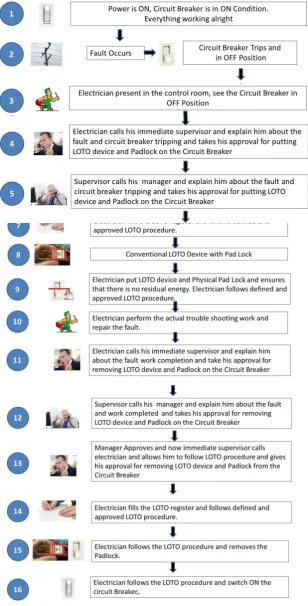
4.1 Process Flow Study of LOTO implementation with Conventional LOTO Device and
Padlock
Power is ON, Circuit Breaker is ON and Everything working all right
a. Fault Occurs, Circuit Breaker Trips and goes to OFF Position
b. Electrician present in the room, sees the circuit breaker in OFF Position
c. Electrician calls his immediate supervisor and explain him about the fault and circuit breaker tripping and takes his approval for putting LOTO device and Padlock on the Circuit Breaker
d. Supervisor calls his manager and explain him about the fault and circuit breaker tripping and takes his approval for putting LOTO device and Padlock on the Circuit Breaker
e. Manager Approves and now immediate supervisor calls electrician and allows him to follow LOTO procedure and gives his approval for putting LOTO device and Padlock on the Circuit Breaker f. Electrician fills the LOTO register and follows defined and approved LOTO procedure. g. Conventional LOTO Device with Pad Lock
h. Electrician put LOTO device and Physical Pad Lock and ensures that there is no residual energy. Electrician follows defined and approved LOTO procedure.
i. Electrician perform the actual trouble shooting work and repair the fault..
1372 | P a g e k. Supervisor calls his manager and explain him about the fault and work completed and takes his
approval for removing LOTO device and Padlock on the Circuit Breaker
l. Manager Approves and now immediate supervisor calls electrician and allows him to follow LOTO procedure and gives his approval for removing LOTO device and Padlock from the Circuit Breaker m. Electrician fills the LOTO register and follows defined and approved LOTO procedure
n. Electrician follows the LOTO procedure and removes the Padlock.
o. Electrician follows the LOTO procedure and switch ON the Circuit Breaker
Figure 2- Process Flow Study of LOTO implementation with Padlock
We have also studied and analyzed accident data from DGFASLI ( Director General Factory Advisory Services
and Labor Institutes, Govt. of India).[13] While analyzing the data from 2011-2012,Total 45 incidents were
analyzed, There were 29 Non-fatal incidents out of 45 incidents. 22 cases were related to electrical energy and
20 cases out of 22 were related to LOTO procedure and applying padlock.19 cases of non -fatal electrical
accident were recorded where padlocks were applied as LOTO procedure even then the accident took place.
Figure 3- Analysis of Various Accident related to LOTO
The study shows many limitations and challenges in conventional LOTO procedure using Padlock.
4.2 Limitations and Challenges of Conventional LOTO Procedure
Electrician has sole responsibility and decision making of Putting LOTO device and physical pad lock,
Electrician can bypass and lock or unlock the LOTO device and padlock.
Any other unauthorized person can lock/unlock the device or break the lock and only personal vigil can
avoid these mischiefs..
Supervisor and Manager Needs to visit, see and verify physical condition of actual Padlock at circuit
breaker.
LOTO procedure takes time and delays the actual trouble shooting, fault finding process.
Record Keeping is manual.
Mode of communication is phone call or physical discussion.
4.3 IOT (Internet of Things)
Many physical and smart devices (other than computers, phones and tablets) are being connected to the Internet.
This concept of connecting various things to the internet is being known as Internet of Things(IoT). In simple
words (Fig.4) we can connect any device with an ON and OFF switch to the internet and control them. We get
many data through many sensors and It becomes a very huge network of connected things[15]. The IoT can
work between things-things, people-people and people-things[16].
For LOTO, We need to have an IoT enabled device[14] which can communicate to different devices, actuate
1373 | P a g e from remote/any location and have the SMS/text message(digital) about the condition of LOTO
(Lock/Unlock/Tempered/Broken) and can take any pre-defined action[17].
Figure 4-Pictorial Illustration of IOT enabled Communication System
4.4 Trial of different IOT (Internet of Things) enabled kits
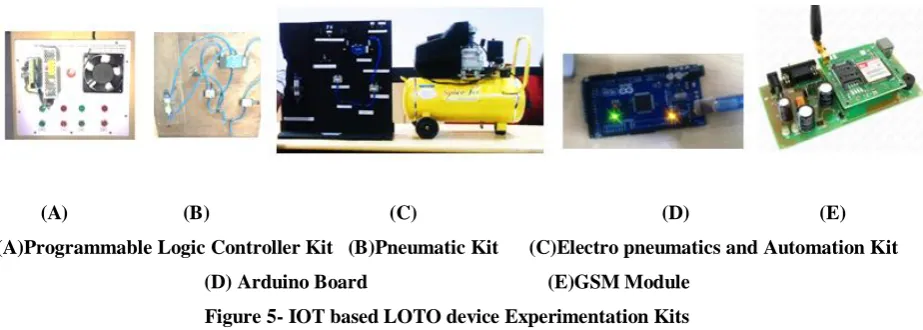
Different experiment kit (Fig.5) is being developed for experimenting different LOTO conditions. Some of the
trial kit developed for trial and experimentation are as below.
(A) (B) (C) (D) (E)
(A)Programmable Logic Controller Kit (B)Pneumatic Kit (C)Electro pneumatics and Automation Kit
(D) Arduino Board (E)GSM Module
Figure 5- IOT based LOTO device Experimentation Kits
(A) Programmable Logic Controller Kit[18] is being used in developing different logics of switching on/off the
switch. PLC has features to test various logics like it will give command if and if all the three approvers has
approved the locking/unlocking of the device and/or It will switch on/off as per pre-programmed and/or it
can display the message and/or it can do any programmed and defined operation.
(B) Pneumatic Kit is being used in experimenting different pneumatic actuator which provides mechanical
motions.
(C) Electro pneumatics and Automation Kit is being used for experimenting actuation with electrical and
pneumatic mediums.
(D) Arduino [19] Board is being used for experimenting different programmes and logics for switching on/off
with the help of phone or text message or through PC/Laptop.
(E) GSM module [20] is being used for experimenting different communication condition [21] with actuator,
controller and Kits [22].
1374 | P a g e 4.5 IOT based LOTO device implementation( proposed illustration)
1375 | P a g e 4.6 Proposed benefits and advantages of IOT based LOTO Procedure
IOT based LOTO device gets locked it’s own ( based on the pre-programmed flow) and send text messages
to defined person ( based on the pre-programmed approval authority) for example- LOTO device gets locked
and electrician, supervisor and manager gets text message.
Electrician can not bypass the LOTO procedure as any action by him will send an automatic text message to
his supervisor and manager.
Any other unauthorized person can not lock/unlock the device or break the IOT based LOTO device, as any
action by him/her will send an automatic text message to concerned electrician, supervisor and manager.
IOT based LOTO procedure in fast/instant and does not take much time and this fastens the actual trouble
shooting, fault finding process.
Record Keeping is digital/electronic.
Mode of communication is phone call, sms, system based and physical discussion.
V. CONCLUSION AND FUTURE SCOPE
An IoT based Lockout Tagout device can be developed. Trial to be taken and validated. This device can be
used in adherence of the LOTO procedure which will result in to reduction in accident cases.
REFERENCES
[1] E. Charlot, Sylvie Nadeau, Jean-Pierre Kenne, Optimal production, maintenance and lockout/tagout
control policies in manufacturing systems, International Journal of Production Economics, 107, 2007,435-450.
[2] National Institute for occupational Safe, Guidelines for Controlling Hazardous Energy During
Maintenance and Servicing, Bibilogov,(2013)
[3] Hajji, A. , Gharbi, A. , Kenne, J.P. and Hidehiko, Y., Production and changeover control policies of a
class of failure prone buffered flow-shops, Production Planning and Control, Vol. 20(8) ,2009,785-800
[4] Harvard campus Services, Fact Sheet Standard: Lockout Tagout, [online] www.ehs.harvard.edu (Mar
2013).
[5] NCRB, National Crime Records Bureau, Ministry of Home Affairs, Government of India, Accidental deaths and Suicides in India 2015,7-50
[6] Philip P Purpura, safety in the workplace-security and the loss prevention: an introduction,(Butterworth Hinemann, 2013)
[7] Edward V. Grund, Lockout/Tagout: The Process of Controlling Hazardous Energy (Occupational
Safety and Health), National Safety Council (1995)
[8] India, The Factories Act, 1948 (Act No 63 of 1948), Chapter IV Safety, Section 22 - Work on or near
machinery in motion. Section 24- Striking Gear and devices for cutting off power.
[9] Boulet, J.F. , Gharbi, A. and Kenne, J.P. , Multi-objective optimization in an unreliable failure-prone
1376 | P a g e Findings from the national machine guarding program: A small business Intervention: Lockout
Tagout, Journal, Journal of Occupational and Environmental Medicine, 58,2016, 61-68
[11] Mark M. Moron, Lockout/Tagout Program: A Complete Compliance Program (Osha Compliance),
Safetycertified.Com Inc; Reprint edition (1992)
[12] Charlot, E. , Kenne, J.P. and Nadeau, S. , “Optimal production maintenance and lockout/tagout control policies in manufacturing systems”, International Journal of Production Economics, 107(2),2007,435-450.
[13] Applications of National Safety Award 2014 & 2015, DGFASLI (Directorate General Factory
Advice and Labor Institute) Government of India,2015
[14] Philip P Purpura, Safety in the workplace-Security and the loss prevention: An Introduction,, (Butterworth Hinemann, 2013).
[15] Yingfeng Zhang, optimization of manufacturing systems using the internet of things (Academic Press,2016).
[16] Jan Holler, from machine to machine to the internet of things : introduction to a new age of intelligence(Academic Press,2014)
[17] Javier Lopez,Ruben Rios,Feng Bao and Guiln Wang, evolving privacy: from sensors to the internet of
things, Future Generation Computer Systems,75,2017,46-57.
[18] Ephrem Ryan Alphonsus & Mohammad Omar Abdullah . a review on the applications of
programmable logics controllers (PLCs),Renewable and sustainable energy reviews ,60,2016,1185-1205
[19] F.A.Candelas,G.J.Garcia,S.Punete,J.Pomares,CA..Jara,J.Perez,D.Mira and F.Torres, Experiences on
using Arduino for laboratory experiments of Automatic Control and Robotics ,IFAC-papers on line,,2015,48,105-110,
[20] Dan D. Koo,John J.Lee,Alexsi Sebastiani and Joonhoon Kim, an internet of things (IoT) system
development and implementation for bathroom safety enhancement, Prodedia Engineering,145,2016,396-403
[21] Byun, J. and Kim, D, Oliot EPCIS: New EPC Information Service and Challenges towards the Internet
of Things, 9th Annual IEEE International Conference on RFID 2015, San Diego, CA.2015
[22] M.U. Ahmed, M. Björkman, M. Lindén,A Generic System-Level Framework for Self-Serve Health
Monitoring System through Internet of Things (IoT), Studies in Health Technology and Informatics, 211