ANALYSIS OF TIMSS RESULTS (I): ANALYSIS OF THE INFLUENCE OF STUDENTS’ AFFECTIVE FACTORS ON THE INTERNATIONAL SCIENCE ACHIEVEMENT IN
KOREA Young Tae Kong
Department of Science Education, Chinju National University of Education, Jinju 660-756, Korea
Abstract
The purpose of this study is to investigate how Korean elementary students' affective attitudes towards science learning affect their scientific achievement. To look at students' affective attitudes, we investigated the following domains: ‘confidence in learning science’, ‘recognition of self-enjoyment in learning science’, ‘recognition of fun in studying science’, and ‘perception for science and math curricula’. The results from this study are as follows: First, the results regarding Korean students' affective attitudes towards science learning in TIMSS 2007 compared to the results in TIMSS 2003, have very positive response rates and show an overall improvement. Second, the improvement in all domains in affective attitudes shows a positive impact on the students' scientific achievement.
Key words: TIMSS survey, Affective attitude, Science achievement, Elementary student
1. INTRODUCTION
With the results of the last several international education surveys, a lot of concerns were voiced about the degradation of the Korean student’s achievement. To improve upon this issue and garner better results from the next survey, new reforms in the Korean education system are needed. PISA (The Programme for International Student Assessment) and TIMSS (Trends in International Mathematics and Science Study) are such surveys that are widely-known and respected for their assessments of international academic achievements in science (OECD 2010, Kim and Kim. 2010, Kim and Kim 2009, Lee and Hong. 2007).
Introduced in 2000 and managed by OECD, PISA survey targets 15-year-old students from all over the world and looks at their abilities in science, mathematics, and reading literacy every 3 years. TIMMS, however, looks closer into different national science curricula by looking at the trends of science and math achievements in 4th and 8th graders. Started in 1964, TIMMS has continued its research in 1995, 1999, 2003, 2007, and most recently in 2011 (Martin et al. 2008 & 2004 & 1997).
Much research analyzing various aspects of TIMSS 2003 and 2007 target almost exclusively middle school students in Korea, while almost no study that relates the TIMSS results to elementary school students’ scientific achievements exists (Ko 2011, Lee and Jung 2011, Ha 2011, Hong et al. 2010, Ju 2010, Kim and Kim 2010, Kim and Kim 2009, Kim 2008, Park 2008, Kwak and Jeong 2007, Lee and Hong 2007, Jeong et al. 2006, Shin et al. 2006, Hong et al. 2006, Ju 2005, Park et al. 2004, Lim 2010, Ryu 2010).
To fill this gap, this study looks at 4th graders in an Ulsan and southern Kyungsang province elementary schools in 2005 and 2009 using released items from the international TIMSS 2003 and 2007 survey. Although we lack the sufficient amount of items due to regulation forbidding full release of all TIMSS items, we were able to look at the types of conceptions and misconceptions about science that Korean students have, as well as their scientific achievements, from their response rates (Kong et al 2009, Kong 2011).
TIMSS also recognizes that students’ science achievement depends on many other factors on students’ extracurricular activities, family backgrounds, and affective attitudes towards science to see how those factors affect performances in science.
With the context of the results of the last three TIMSS surveys on Korean elementary school students, this study discusses how students' attitudes towards science learning and how that affects their science achievement. This study also aims to make predictions for the next TIMSS 2015 results and to serve as an effective tool for analyzing the changes that they present in Korean students' performances in science.
This study seeks to analyze the development of Korean students' attitudes towards science learning. Overall affective factors towards science learning is segmented into categories such as ‘self-confidence in learning science’, ‘self-enjoyment in learning science’, ‘recognition of fun in studying science’, and ‘perception of science and math courses’.
We look at how the developments of Korean students’ attitudes towards science learning affect their science achievement.
2. METHODOLOGY
2.1 Participants and materials
TIMMS 2003 survey in Korea was carried out in February 2005 with 300 4th graders from 13 elementary schools in southern Kyungsang province. We used 75 of the released items used for examination in TIMSS 2003. After translating them for the first time by researcher, the items were shown to one expert of science education and two elementary school teachers before revising the translations for use. We also translated the student questionnaire used in the international TIMSS 2003.
For TIMSS 2007 survey in Korea, we recruited 3000 4th-graders from 23 schools in Ulsan Metropolitan City and the southern Kyungsang province. We used 71 of the items used for examination in TIMSS 2007, which we translated before showing them to one expert of science education and two elementary schools for revision. We also translated and used the student questionnaire from TIMSS 2007.
We followed the standards of IEA (International Association for the Evaluation of Educational Achievement) and initiated the research after noting and informing the instructors. To insure that the students take the study seriously, we oriented a sample of students and instructors.
2.2 Data analysis
We only recorded complete answers and we complied with the revised TIMSS’s score assessment methods by using the scale average of 500 points and standard deviation to 100. For statistical analysis, we used SPSS 18.0 software. We used the data for recalculation from the report of TIMMS 1995 and international report (Martin et al. 1997).
2.3 Limitations
The scale average for Korean students’ scores do not exactly aligns with the international score from TIMSS 2003 and 2007, neither of which Korean students participated in. This study also only uses data from Korean students, so its results cannot be generalized to students of all cultures.
3. RESULTS AND DISCUSSION
3.1 Response rate for affective items towards science learning
TIMSS 2003 student questionnaire has 6 items (A~F) regarding affective attitudes towards science learning, while TIMMS 2007 has 8 items (A~H). <Table 1 and Figure 1> displays the response rates of each item with the scale of ‘strongly agree’ to ‘somewhat agree’ are categorized into ‘positive response’.
For TIMSS 2007, with positively-phrased items, the response rate of ‘I would like to learn more science at school’, is higher in our data (91.2% affirmative response rate) than in the international
average (74.0%) by 17 points, and that of ‘I enjoy learning science’, is also higher in our data (84.6%) than in the international average (83.0%) by 2 points. The pattern is same for the items ‘I learn things quickly in science’ (87.1% for Korean students; 78.0% for international average) and ‘I like science’ (86.3% for Korean students and 83.0% for international average).
In comparison, with negatively-phrased items, the response rate of ‘Science is harder for me than for many of my classmates’ is lower for Korean students (24.7% affirmative response rate) than for international average (35.0%) by 10 points and that of ‘I am just not good at science’ is also lower for Korean students (27.7%) than for international average (33.0%). The same pattern is presented for the item, ‘Science is boring’ (17.6% for Korean students; 25.0% for international average), however there was no significant change for the item, ‘I usually do well in science’ (85.7% for Korean students; 86.0% for international average).
Looking at the 6 items from both TIMSS 2003 and 2007 regarding the development of positive recognition of science, one can see that the scores for each item improved by 6-13 points. This shows that Korean students are having more positive attitudes towards science learning in TIMSS 2007 than in TIMSS 2003.
Looking at the results for Korean middle school students in the TIMSS 2007, however, the response rate of the Korean students (51.0% affirmative response rate) are lower than the international average (73.0%) by 23 points for ‘I would like to learn more science in school’ and by 28 points for ‘I enjoy learning science’ (45.0% for Korean students; 78.0% for international average). This pattern persists for ‘I like science’ (48.0% for Korean students; 75.0% for international average) (Kim, 2008). Although middle school students are also experience increase of positive response rate from TIMSS 2003 to 2007, their positive response rates are significantly lower than the international average and an even bigger gap exists between them and elementary school students.
Table 1. Positive response rate for affective items towards science learning (%)
Test Country
I usually do well in science
(A)
I would like to do more science in school
(B)
Science is harder for me than for many of my classmates
(C)
I enjoy learning science
(D)
I am just not good at science
(E)
I learn things quickly in science
(F)
Science is boring
(G)
I like science
(H)
TIMSS 2003
Korea 77.5 80.1 34.6 72.8 33.5 74.5 - -
Int’l
Avg. - - - -
TIMSS 2007
Korea 85.7 91.2 24.7 84.6 27.7 87.1 17.6 86.3
Int’l
Avg. 86.0 74.0 35.0 83.0 33.0 78.0 25.0 83.0
Figure 1. Diagram for positive response rate for affective items towards science learning in TIMSS 2003 and TIMSS 2007 in Korea.
3.2 Self-confidence in science learning
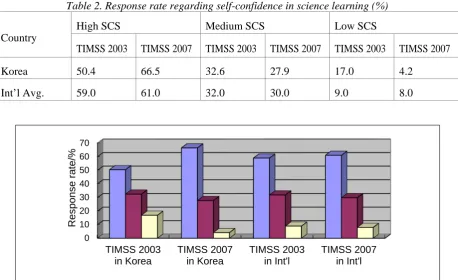
TIMSS 2007 measures the degree of self-confidence in science learning (SCS) by looking at the response rates in 4 items: ‘I usually do well in science’, ‘Science is harder for me than for many of my classmates’, ‘I am just not good at science’, and ‘I learn things quickly in science’. The confidence indices are organized by the recalculated averages rates of those four items; scores are classified as ‘high’ when the recalculated scores are above 3 point, ‘medium’ when between 2 and 3 point, and ‘low’ when below 2 point. When the confidences indices come out as ‘high’, the student has high confidence in science learning and the confidence rate decreases as the scores decrease. <Table 2 and Figure 2> shows the transitions of these indices from the last two TIMMS survey.
Table 2. Response rate regarding self-confidence in science learning (%)
Country
High SCS Medium SCS Low SCS
TIMSS 2003 TIMSS 2007 TIMSS 2003 TIMSS 2007 TIMSS 2003 TIMSS 2007
Korea 50.4 66.5 32.6 27.9 17.0 4.2
Int’l Avg. 59.0 61.0 32.0 30.0 9.0 8.0
Figure 2. Diagram for positive response rate for items of self-confidence in science learning in TIMSS 2003 and TIMSS 2007.
0 20 40 60 80 100
TIMSS 2003 TIMSS 2007
A B A
In TIMMS 2003, Korean students have lower rate of high indices (50.4%) than the international average (59.0%) by 8 points and lower rate of medium indices (32.6%) than the international average (32.0%) by 0.6 point. Meanwhile, the Korean students’ rate of low indices (17.0%) is higher than the international average (9.0%) by 8 points. From this result, one can infer that Korean students are less confident in their science studies than the rest of the world.
On the other hand, in TIMMS 2007, Korean students have a higher rate of high indices (66.5%) than international average (61.0%) by 6 points. Meanwhile, Korean students have a lower rate of medium (27.9% for Korean students; 30.0% with international average) and low indices (4.2% for Korean students; 8.0% for international average). The result of TIMMS 2007 is favorable for Korean students than TIMSS 2003.
In contrast, TIMSS 2007 survey for middle school students shows a lower rate of high indices with Korean students (24.0%) than with the international average (48.0%) by 24 points, while Korean students have a much higher rate of low indices (36.0%) than the international average (13.0%) by 23 points. Compared to their elementary school’s results, Korean middle school students are showing much less confidence in science learning.
We also delve into how confidence in science learning affects science achievement (see <Table 3>). First, with results from TIMSS 2003, the high-confidence-level group scored 529.6 points in scientific achievement, while medium level group scored 478.5 and low-level scored 453.5 points, respectively. We then performed one-way ANOVA analysis of the difference of scientific achievement between three different confidence-level groups which was statistically significant difference (p<.001).
Table 3. Results of one-way ANOVA analysis of the difference of scientific achievement between the different confidence-level groups in Korea
Test Scale average F p
High SCS Medium SCS Low SCS
TIMSS 2003 529.6
(85.3)
478.5
(96.5)
453.5
(84.8)
32.092 .000***
TIMSS 2007 517.6
(91.7)
467.3
(104.9)
449.5
(114.8)
197.042 .000***
Meanwhile, in TIMSS 2007, high-confidence-level group scored on average in 517.6 points in scientific achievement, which is higher by 50 points from medium level group and by 68 points from low-level group. The one-way ANOVA test between three groups also yielded a statistically significant different (p<.001). This study produced similar results as the international report which found that students higher in confidence in science learning get also perform better in science (Martin et al. 2008).
3.3 Self-enjoyment in science learning
Three items in TIMSS 2007 are concerned with measuring self-enjoyment in science learning (SES): ‘I enjoy learning science’, ‘Studying science is boring’, and ‘I like science’. <Table 4> organizes the indices of enjoyment in science learning from TIMSS 2007.
Korean students have similar rate of high indices for enjoyment in science learning (77.5%) than international average (77.0%) by 0.5 points and a higher rate of medium indices for enjoyment (14.5%) than international average (13.0%) by 1.5 points. Meanwhile, Korean students have a lower
rate of low indices (8.1%) than international average (11.0%) by 3 points. With this result, Korean students seem to have a positive outlook on science learning.
In contrast, TIMSS 2007 survey research shows that Korean middle school students had a lower rate of high indices (38.0%) than international average (65.0%) by 27 points. This issue of the dropping rate of self-enjoyment in learning as students ascend in their grade levels is not an issue that is exclusive to Korea; the huge 39-point difference between Korean middle school students and their international counterparts, however, is quite disconcerting and calls for further research on why this gap exists.
We then looked into the relationship between enjoyment in science learning and scientific achievement. In TIMSS 2007 research, the average scientific achievement score of students with high indices of enjoyment was 508.8 points, while those with medium indices scored on average 474.3 and those with low indices scored 461.3 points. A one-way ANOVA analysis of achievement scores between these three groups yielded a statistically significant result (p<.001). Overall, according to the international report, students with higher degree of self-enjoyment in science learning on average scored higher in scientific achievement (Martin et al. 2008).
Table 4. Results of one-way ANOVA analysis of the difference of science achievement between the different enjoyment-level groups in Korea
Test Scale average F p
High SCS Medium SCS Low SCS
TIMSS 2007 508.8
(95.7)
474.3
(107.9)
461.3
(108.3)
84.446 .000***
3.4 I enjoy learning science
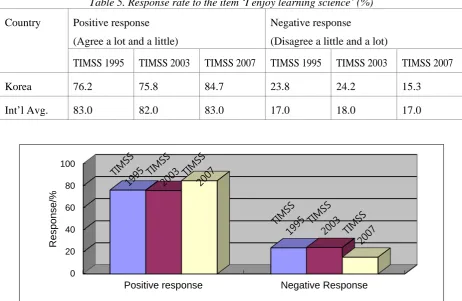
TIMSS 1995 presents the item ‘I enjoy learning science’ three times amidst its items on students’ attitudes towards science learning. <Table 5 and Figure 3> shows the response rate for this item.
The overall positive response rate regarding this item in TIMSS 1995 and 2003 were respectively 76.2% and 75.8%, each time lower than the rate of international average by 7 points which shows that Korean students do not enjoy science learning more than their international counterparts. In TIMSS 2007 research, however, Korean students gained a clear lead in the positive response rate of this item by 2 points (84.6% for Korean students; 83.1% for international average). With figures comparable to the international average, enjoyment of science studies in Korean students have improved in recent.
Meanwhile, Korean middle school students displayed a positive response rate of 40.0% in TIMSS 1995, 38.0% in TIMSS 2003, and 45.0% in TIMSS 2007, with each rate lower than the international average by 33-46 points (Kim, 2008). Although the effect of decreasing positive perception towards science learning is a universal phenomenon, this effect was especially substantial with Korean students.
We next looked at the relationship between the response rate to ‘I enjoy learning science’ item and science achievement. The four groups are organized by those who answered ‘Agree a lot’, ‘Agree a little’, ‘Disagree a little’, and ‘Disagree a lot’ for a one-way ANOVA analysis of the relationship.
In TIMSS 2003, those who answered ‘Agree a lot’ scored on average 520.8 points on science achievement, while those who answered ‘Agree a little’, ‘Disagree a little’, and ‘Disagree a little’, respectively scored on average 491.2, 478.2, and 449.8 points. The one-way ANOVA analysis of the difference of these scores between the four groups yielded a statistically significant result (p<.001).
In TIMSS 2007, those who answered ‘Agree a lot’ again had the highest science achievement score on average with 513.8 points, while those who answered ‘Agree a little’, ‘Disagree a little’, and ‘Disagree
a little’, respectively scored on average 495.5, 472.6, and 453.1 points. And again, the one-way ANOVA analysis of the difference of these scores between the four groups yielded a statistically significant result (p<.001). This led to a conclusion that a student with a more positive attitude towards science learning on average has a better score in science achievement.
Table 5. Response rate to the item ‘I enjoy learning science’ (%)
Country Positive response
(Agree a lot and a little)
Negative response
(Disagree a little and a lot)
TIMSS 1995 TIMSS 2003 TIMSS 2007 TIMSS 1995 TIMSS 2003 TIMSS 2007
Korea 76.2 75.8 84.7 23.8 24.2 15.3
Int’l Avg. 83.0 82.0 83.0 17.0 18.0 17.0
Figure 3. Diagram for response rate for ‘I enjoy learning science’ item in TIMSS 2003 and TIMSS 2007.
Table 6. Results of one-way ANOVA analysis of science achievement and responses to ‘I enjoy learning science’
Test
Scale average
F p
Agree a lot Agree a little Disagree a little
Disagree a lot
TIMSS 2003
520.8
(97.9)
491.2
(88.9)
478.2
(111.0)
449.8
(97.0) 9.942 .000***
TIMSS 2007
513.8
(96.2)
495.0
(98.1)
472.6
(105.0)
453.1
(112.9) 56.949 .000***
4. CONCLUSION
This study looks at the relationship between Korean student’s affective factors towards science learning and their science achievement with the data from the last TIMSS surveys. To measure student’s affective attitudes towards science learning, we look specifically at the items relating to
self-0 20 40 60 80 100
Positive response Negative Response
R
es
pons
e
/%
confidence in science learning and self-enjoyment in science learning. The conclusions from this are as follows:
The increase of Korean students’ positive response rate in TIMSS 2007 compared to that in 2003 is a clear sign of improvement of their affective attitudes towards science learning. Although TIMSS studies look at the development of international students’ science achievement, as well as the relationship between that and their affective attitudes towards science learning, their use of multiple-choice items causes them to not have as much attention as PISA studies. But with the Korean elementary students’ participation in TIMSS 2015, the Korean education system needs to look closely at its results, which come out in December 2016, to assess how Korean students compare in their science achievement and perception towards science learning to their international counterparts.
REFERENCES
Ha, YJ 2011, Constructing validity of affective measures in TIMSS 2007, Master thesis of Seoul National University.
Hong, MY Park, C Kim, SS 2001, An Analysis of Science Achievement of The Third International Mathematics and Science Study - Repeat (TIMSS-R), Journal of the Korean Association for Research in Science Education, vol. 21, pp. 328-341.
Hong, MY Jeong, EY Lee, MK Kwak, YS 2006, Analysis of Korean Middle School Student Science Achievement at International Benchmarks in TIMSS 2003, Journal of the Korean Association for Research in Science Education, vol. 26, pp. 246-257.
Hong, HJ Kim, DS Byun, JJ 2010, Relationship between student's born months and academic achievement: ‘monthly age effect' on students academic achievement, Korean Journal of Educational Research, vol. 48, pp. 99-124.
Jeong, EY Lee, MK Hong, MY 2006, Gender Differences in TIMSS 2003 Science Achievement, Journal of the Korean Association for Research in Science Education, vol. 26, pp. 492-501.
Ju, DB 2005, The Analysis of Variables influencing the Middle School Student` Science Academic Achievement: Evidence from TIMSS, Middle school education, vol. 53, pp. 1-26.
Ju, DB 2010, The Comparison Analysis between Korea and America of Variables influencing the Middle School Student' Science Achievement: Evidence from TIMSS, Korean Journal of Comparative Education, vol. 20, pp. 39-62.
Kim, JY 2008, Differences in Test Scores among Korean Middle Schools: Evidence from the TIMSS data, Economic study. vol. 1, pp. 53-77.
Kim, MY Kim, KH 2010, A Comparative Study of Science Textbooks in Korea, Singapore, and Taiwan -Focus on the field of Biology-, Journal of the Korean Association for Research in Science Education, vol. 30, pp. 498-518.
Kim, SH Kim KH 2009, Analysis of TIMSS 2007 Released Items Common with TIMSS 1999, 2003 on the View of Curriculum, The journal of educational research in mathematics, vol. 19, pp. 99-121.
Ko, YM 2011, A Comparative Study of Korea and Singapore Elementary Science Textbooks According to TIMSS:-Focused on the Revised 2007 Curriculum in 3rd and 4th Grade-. Master thesis , Seoul National University of Education.
Kong, YT 2011, Comparison on Elementary Science Achievement between Korea and Japan in TIMSS 2007, Korean Journal of the Japan Education, vol. 15, pp. 131-147.
Kong, YT Noh, MY Baek, NG 2009, Comparison on Elementary Science Achievement between Korea and Japan in TIMSS 2003, Korean Journal of the Japan Education, vol. 13, pp. 145-160.
Kwak, YS Jeong, EY 2007, An analysis of Earth Science Items and Achievement in TIMSS 2003, Journal of the Korean Earth Science Society, vol. 28, pp. 405-414.
Lee, MK Hong, MY 2007, Trends and an International Comparison of Korean Middle School Students` Attitudes Toward Science, Journal of the Korean Association for Research in Science Education, vol. 27, pp. 201-211.
Lee, HS Jung, JY 2011, An Analysis of the Influence of Teachers' Traits on Student Achievement - Focusing on Teachers' Efforts to Enhance Professionality in TIMSS 2007, The Journal of Korean Teacher Education, vol. 28, pp. 243-266.
Lim, CH Park, CS 2010, International Comparative Study on Elementary School Students' Science and Mathematics Performance Ability in TIMSS, THE RESEARCH OF SCIENCE MATHEMATICS EDUCATION, vol. 24, pp. 125-145.
Martin, OM Mullis, VS Beaton, AE Gonzalez, EJ Kelly, DL 1997, Science Achievement in the Primary School Years, IEA: Boston College.
Martin, MO Mullis, VS Gonzalez, EJ Chrostowski, SJ 2004, TIMSS 2003 International Science Report, IEA: Boston College.
Martin, MO Mullis, VS Foy, P 2008, TIMSS 2007 International Science Report. IEA; Boston College.
OECD 2010, PISA 2009 Results: What students know and can do, OECD: New York.
Park, C 2008, Effect of Educational Contextual Variables on Mathematics Achievement of the Different Ability Groups in Korea, Journal of Educational Evaluation, vol. 21, pp. 23-41.
Ryu, JH 2010, Analysing the Results of Physics - related Areas in the Third International Mathematics and Science Study - Repeat ( TIMSS - R ) for the Implications in the Curriculum Research, Journal of the Korean Association for Research in Science Education, vol. 21, pp. 752-772.
Shin, DH Kwon, ON Kim, HB 2006, Gender Differences in Content Analysis of TIMSS 2003 Released Items, Journal of the Korean Association for Research in Science Education, vol. 26, pp. 732-742.