464 | P a g e
AN ADAPTIVE ENCRYPTION ARCHITECTURE FOR
RECKONING OF COST AND PERFORMANCE OF
CLOUD DATABASE
Eluri Rathna Kumari
1, K Satya Sandeep
2 1Pursuing M.Tech (CS), 2 Working as Assistant Professor (CS), Nalanda Institute Of Engineering & Technology (NIET), Kantepudi(V),
Sattenpalli(M),Guntur(D, Andhra Pradesh (India)
ABSTRACT
Cloud computing is defined as a type of computing that relies on sharing computing resources rather than
having local servers or personal devices to handle applications we propose a new architecture for adaptative
encoding of public cloud database that provides an alternative to the trade-off among the needed information
security level tractability of the cloud database structure at conception time We exhibit the achievability and
execution of the proposed arrangement through a product model. Besides, we propose a unique expense
demonstrate that is arranged to the assessment of cloud database administrations in plain and encoded
occasions and that considers the variability of cloud costs and inhabitant workloads amid a medium-term
period
Index Terms: Cloud Computing, Confidentiality, Encoding, Adaptative, Cost Estimation Model
I. INTRODUCTION
1.1 Cloud Computing
The term Cloud refers to a Network or Internet. In other words, we can say that Cloud is something, which is present at remote location. Cloud can provide services over network, i.e., on public networks or on private networks, i.e., WAN, LAN or VPN Distributed computing is characterized as a sort of processing that depends on sharing registering assets as opposed to having neighborhood servers or individual gadgets to handle applications. Distributed computing is practically identical to lattice figuring, a sort of registering where unused preparing cycles of all PCs in a system are saddles to take care of issues excessively escalated for any stand-alone machine .Cloud Computing alludes to controlling, arranging, and getting to the applications on the web. It offers online information stockpiling, base and application.
The objective of distributed computing is to apply customary supercomputing, or superior processing force, ordinarily utilized by military and exploration offices, to perform many trillions of calculations every second, in purchaser situated applications such as Financial portfolios, to convey customized data, to give information stockpiling or to power vast, immersive online PC amusements.
465 | P a g e
common IT infrastructure contains vast pools of frameworks that are connected together. Regularly, virtualization procedures are utilized to amplify the force of distributed computing.The cloud computing paradigm is successfully convergingas the fifth utility [1], however this positive pattern is halfway constrained by worries about data secrecy [2] and indistinct expenses over a medium-long haul [3], [4]. We are keen on the Database as a Service worldview (DBaaS) [5] that represents a few exploration challenges as far as security and expense assessment from a occupant's perspective. Most results concerning encryption for cloud-based administrations [6], [7] are inapplicable to the database worldview. Other encryption plans, which permit the execution of SQL operations over scrambled information, either experience the ill effects of execution cutoff points (e.g., [8]) or they require the decision of which encryption plan must be embraced for every database segment and SQL operations (e.g., [9]).These recent recommendations are fine at the point when the arrangement of questions can be statically decided at outline time, while in this paper we are intrigued to other basic situations where the workload might change after the database outline. In this paper, we propose a novel structural planning for variousencryption of open cloud databases that offers an intermediary free different option for the framework proposed in [10].
The proposed structural planning ensures in a various way the best level of information privacy for any database workload, notwithstanding when the arrangement of SQL questions progressively changes. The various encryption plan, which was at first proposed for applications not alluding to the cloud, encodes each plain segment into different scrambled segments, and each quality is exemplified into distinctive layers of encryption, so that the external layers ensure higher privacy yet, bolster less calculation capacities with deference to the inward layers. The external layers are powerfully adjusted at runtime when new SQL operations are included to the workload. In spite of the fact that this various encryption building design is alluring since it doesn't require to characterize at outline time which database operations are permitted on each segment, it postures novel issues regarding practicality in a cloud setting, and stockpiling and system costs estimation. In this paper, we explore each of these issues and we achieve unique conclusions as far as model execution, execution assessment, and expense assessment.
We actualize the first intermediary free construction modeling for variousencryption of cloud databases. It doesn't restrict the accessibility, versatility and adaptability of a plain cloud database, on the grounds that simultaneous customers can issue parallel operations without going through some brought together part as in option architectures [10]. We assess the execution through this model usage by accepting the standard TPC-C benchmark as the workload and distinctive system latencies. Because of this testbed, we demonstrate that most execution overheads of adaptively scrambled cloud databases are veiled by system inactivity values that are very commonplace of a cloud situation. Other execution assessments conveyed out in [10] accepted a LAN situation and no system inactivity.
466 | P a g e
and can pick the best bargain between information classification and costs. This paper is organized as taking after. Area 2 inspects related answers for information privacy and taken a toll estimation in cloud database administrations, and looks at them against our proposition. Area 3 depicts the proposed various encryption structural engineering for cloud database administrations. Area 4 proposes the expository expense model for the estimation of database administration costs in a medium skyline where it is likely that cloud costs furthermore, workload change. Segment 5 presents trial assessments for diverse system situations, workload models and number of customers. Segment 6 reports the after effects of the expense model and technique connected to genuine cloud database suppliers over a three year skyline that is a run of the mill view for inhabitant's ventures. Segment 7 traces principle conclusions and conceivable bearings for further research.II. RELATED WORK
Enhancing the classification of data put away in cloud databases speaks to an essential commitment to the selection of the cloud as the fifth utility on the grounds that it addresses most client concerns. Our proposition is portrayed by two principle commitments to the cutting edge: construction modeling and cost model. In spite of the fact that information encryption appears the most natural answer for classification, its application to cloud database administrations is not minor, in light of the fact that the cloud database must have the capacity to execute SQL operations straightforwardly over encoded information without getting to any decoding key. Native arrangements encode the entire database through some standard encryption calculations that don't permit any SQL operation straightforwardly on the cloud. As an outcome, the inhabitant has two choices for any SQL operation: downloading the whole database, unscrambling it, executing the inquiry and, if the operation alters the databases, scrambling and transferring the new information; unscrambling briefly the cloud database, executing the inquiry, and re-scrambling it. The previous arrangement is influenced by enormous correspondence and calculation overheads, and expenses that would make the cloud database administrations very awkward; the recent arrangement does not ensure information secrecy on the grounds that the cloud supplier gets unscrambling keys.
467 | P a g e
This current occupant's segment, which intervenes every one of the co-operations between the customers and a potentially untrusted DBMS server, is fine for a privately conveyed building design, yet it can't be connected to a cloud setting. For sure, any unified part at the inhabitant side keeps the adaptability and accessibility that are among the most essential elements of any cloud utility administration. An answer for this issue was introduced in [9]: the proposed construction modeling permits various customers to issue simultaneous SQL operations to a scrambled database with no go-between trusted server, yet it accept that the arrangement of SQL operations does not change after the database plan. A first thought to incorporate versatile encryption plans with a proxyfree building design was proposed by the same creators in . This paper builds up the beginning outline through a model execution, novel trial results also, a unique expense model. Without a doubt, other than information secrecy, the expense is a further worry of conceivable cloud inhabitant associations. To address this issue, we propose a diagnostic expense model and an utilization estimation technique that permit an occupant to assess the expenses getting from cloud database administrations described by plain, scrambled and adaptively encoded databases over a medium-term skyline amid which it is likely that both the database workload and the cloud costs change.This model is another unique commitment of this paper, in light of the fact that past examination has a tendency to break down the expenses of cloud processing from a supplier's point of view (e.g., [16], [17]). For instance, the creators in layout the issues identified with the expense estimation of a cloud server farm, such as servers, force utilization, and foundations, however they don't propose an explanatory expense estimation model. CloudSim [18] can assist a supplier with estimating execution also, asset utilizations of one or different cloud server farm options.
This paper has an emphasis on database administrations and takes an inverse evaluating so as to bear the cloud administration costs froma inhabitant's perspective. This methodology is very unique on the grounds that past papers aremainly intrigued to assess the upsides and downsides of porting investigative applications to a cloud stage, for example, [4] concentrating on particular stargazing programming and a particular cloud supplier (Amazon), also, [3] exhibiting acomposable expense estimation model for a few classes of exploratory applications. Other than the attention on an alternate setting (experimental versus database applications), the proposed model can be connected to any cloud database administration supplier, and it considers that over a medium-term period the database workload furthermore, the cloud costs may differ
III. SYSTEM ARCHITECTURE
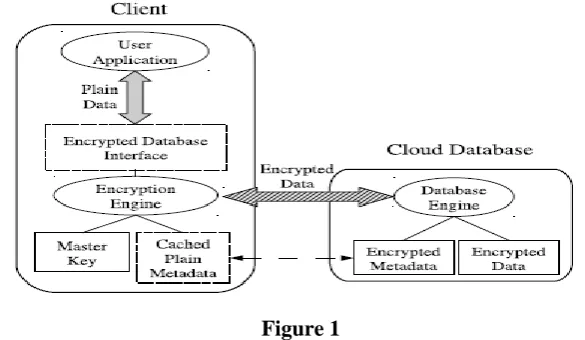
The proposed framework underpins versatile encryption systems for open cloud database administration, where disseminated what's more, simultaneous customers can issue direct SQL operations. By maintaining a strategic distance from a structural engineering in light of one [10] then again numerous halfway servers between the customers and the cloud database, the proposed arrangement ensures the same level of versatility and accessibility of the cloud administration. Figure 1 demonstrates a plan of the proposed structural planning where every customer executes an encryption motor that oversees encryption operations. This product module is gotten to by outer client applications through the encoded database interface. The proposed structural engineering oversees five sorts of data.
468 | P a g e
encoded information is put away in the cloud database;
plain metadata speak to the extra data that is important to execute SQL operations on encoded information; encoded metadata is the scrambled form of the metadata that are put away in the cloud database;
expert key is the encryption key of the scrambled metadata that is conveyed to authentic
Figure 1
All information and metadata put away in the cloud database are scrambled. Any application running on a honest to goodness customer can straightforwardly issue SQL operations (e.g., SELECT, Embed, UPDATE and DELETE) to the scrambled cloud database through the scrambled database interface. Information exchanged between the client application and the encryption motors are in plain arrangement, though data is constantly encoded before sending it to the cloud database.
At the point when an application issues another SQL operation, the encoded database interface contacts the encryption motor that recovers the encoded metadata what's more, unscrambles it through the expert key. With a specific end goal to enhance execution, the plain metadata are stored locally by the customer as an unstable data. After acquiring the metadata, the encryption motor has the capacity execute the SQL operation on encoded information, and afterward to decode the outcomes.
The outcomes are come back to the client application through the encoded database interface. As in related writing, the proposed structural planning ensures information classification in a security model in which: the system is untrusted; occupant clients are trusted, that is, they don't uncover data about plain information, plain metadata, and the expert key; the cloud supplier heads are characterized semi-legitimate or fair but curious , that is, they don't alter occupant's information and aftereffects of SQL operations, however they could be intrigued in getting to inhabitant's data put away in the cloud database. The remaining some portion of this area portray the various encryption plans the scrambled metadata put away in the cloud database , also, the fundamental operations for the administration of the scrambled cloud database
3.1 Encrypted Database Administration
469 | P a g e
parameters. These last are the most vital for this paper on the grounds that they incorporate the arrangement of onions to be connected with the segment, the beginning layer (indicating the genuine layer at creation time) and the field privacy of every onion. On the off chance that the executive does not indicate the classification parameters of a segment, then they are consequently picked by the customer as for an occupant's approach. Regularly, the default strategy accept that the beginning layer of every onion is set to its most grounded encryption calculation.3.2 Performance Evaluation
This area plans to check whether the overheads of versatile encryption speak to an adequate trade off
from the execution perspective for ensuring information privacy in cloud database administrations. To
this reason, we plan a suite of execution tests that permit us to assess the effect of encryption and
versatile encryption on reaction time and throughput for distinctive system latencies and for
expanding numbers of simultaneous customers. The TPC-C standard benchmark is utilized as the
workload model for the database administrations. The trials are done in Emulab , which gives us an
arrangement of machines in a controlled environment.
Each client machine runs the Python clientprototype of our architecture on a pc3000 machine having a single 3GHz processor, 2GB of RAMand
two 10,000 RPM 146GB SCSI disks. The server machine hosts a database server implemented in
PostgreSQL 9.1 on a d710 machine having a quad-core Xeon 2.4 GHz processor, 12GB of RAM and
a 7,200 RPM 500GB SATA disk. Each machine runs a Fedora 15 image.
The current version of the prototype supports the main SQL operations (SELECT, DELETE, INSERT and UPDATE) and the WHERE clause expressions. We consider three TPC-C compliant databases having ten warehouses and a scale factor of five.
• Plaintext (PLAIN) is based on plaintext data.
• Encrypted (ENC) refers to a statically encrypted database where each column is encrypted at design time
through only one encryption algorithm.
• Adaptively encrypted (ADAPT) refers to an encrypted database in which each column is encrypted with all the
onions supported by its data type
470 | P a g e
3.3 Cost Evaluation
In this segment we show the practicality of the proposed expense model by applying it on account of PLAIN, ENC and ADAPT setups for genuine cloud database administrations. We at first approve the use estimation procedure exhibited in Section 4.3. We then examine the varieties of expenses for diverse cloud suppliers and asset utilizations. We at long last assess inhabitant's expenses over a mid-term period equivalent to three years by considering practical asset utilization additions and value decreases
3.4 Analysis of Cloud Database Costs
We break down cloud database costs regarding diverse cloud supplier offers and distinctive stockpiling and system uses. We consider a charging period equivalent to one month, also, every minute of every day accessibility (730 uptime hours for every month). We at first gauge the month to month expenses of a cloud database administration in the PLAIN, ENC and ADAPT arrangements concerning a plaintext stockpiling use of 100 GB and a plaintext system use of 100 GB. In Table 4 we report the outcomes for the accompanying cloud examples: Small, Large, and High Memory: Double Extra Vast from Amazon RDS Premium P1 and Premium P2 from SQL Azure. The left a portion of Table 4 reports the unit stockpiling costs ps, the unit system costs pn, the aggregate uptime cost H, furthermore, the yearly reservation value R reported as month to month taken a toll. We watch that the stockpiling and system costs try not to change for diverse cases of the same cloud supplier, while the reservation cost R and the uptime
IV. CONCLUSION
We Conclude that information security referred by introducing a secure cloud database design the uses the adaptive encode scheme without any servers between them.This technique facilitate with the high level of security for any storage server/database work load that is probably to alter in medium -term period we inquire the feasibility and performance of the proposed design by a huge set of try out based on software model futher more we introduce a design and a method that provide the user to estimate the price of the data in cloud storage
REFERENCES
[1] R. Buyya, C. S. Yeo, S. Venugopal, J. Broberg, and I. Brandic, "Distributed computing and developing it stages: Vision, buildup, and reality for conveying registering as the fifth utility," Future Generation PC Systems, vol. 25, no. 6, pp. 599–616, 2009.
[2] T. Mather, S. Kumaraswamy, and S. Latif, Cloud security and protection: an endeavor viewpoint on dangers and consistence. O'Reilly Media, Incorporated, 2009.
[3] H.- L. Truong and S. Dustdar, "Composable expense estimation and checking for computational applications in distributed computing situations," Procedia Computer Science, vol. 1, no. 1, pp. 2175 – 2184, 2010, iCCS 2010.
471 | P a g e
[5] H. Hacig¨um¨us¸, B. Iyer, and S. Mehrotra, "Giving database as a administration," in Proc. eighteenthIEEE Int'l Conf. Information Engineering, Feb. 2002.
[6] G. Wang, Q. Liu, and J. Wu, "Progressive characteristic based encryption for fine-grained access control in distributed storage administrations," in Proc. seventeenth ACM Conf. PC and interchanges security. ACM, 2010, pp. 735–737.
[7] Google, "Google Cloud Platform Storage with server-side encryption," http://googlecloudplatform.blogspot.it/2013/08/ google-distributed storage now-provides.html, Mar. 2014. [8] H. Hacig¨um¨us¸, B. Iyer, C. Li, and S. Mehrotra, "Executing sql over encoded information in the
database-administration supplier model," in Proc. ACM SIGMOD Int'l Conf. Administration of information, June 2002.
[9] L. Ferretti, M. Colajanni, and M. Marchetti, "Dispersed, simultaneous, furthermore, free access to scrambled cloud databases," IEEE Trans. Parallel and Distributed Systems, vol. 25, no. 2, Feb. 2014. [10] R. A. Popa, C. M. S. Redfield, N. Zeldovich, and H. Balakrishnan, "CryptDB: ensuring privacy with
scrambled inquiry preparing," in Proc. 23rd ACM Symp. Working Systems Principles, Oct. 2011.
[11] . Upper class, "Completely homomorphic encryption utilizing perfect cross sections," in Proc. 41st ACM Symp.Hypothesis of figuring, May 2009.
[12] A. Boldyreva, N. Chenette, and A. O'Neill, "Request saving encryption returned to: Improved security examination and option arrangements," in Proc. Progresses in Cryptology – CRYPTO 2011. Springer, Aug. 2011.
[13] P. Paillier, "Open key cryptosystems in view of composite degree residuosity classes," in Proc. Progresses in Cryptology – EUROCRYPT99. Springer, May 1999.
[14] D. Melody, D. Wagner, and A. Perrig, "Viable systems for seeks on scrambled information," in Proc. IEEE Symposium on Security
AUTHOR DETAILS
EluriRathnaKumari pursuingM.Tech (CS) from Nalanda Institute Of Engineering & Technology(NIET) Kantepudi(V), Sattenpalli(M), Guntur Dist.522438
K SatyaSandeep working as Assistant Professor(CS) from Nalanda Institute Of
Engineering& Technology(NIET) Kantepudi(V), Sattenpalli(M), Guntur