Aided Analysis of the Handwriting in the Codex Seraphinianus. (Under the direction of Robert Rodman.)
The purpose of this study has been to present a new method of investigating an undeciphered writing system using a computer, by analyzing the written images as images instead of relying on a transcription scheme to map written characters to numbers. The computer can extract and organize hundreds of written images more quickly and reliably than a human can, while proper human supervision can turn this data into insights about the writing system, avoiding the problems potentially
by
Jeffrey Christopher Stanley
A thesis submitted to the Graduate Faculty of North Carolina State University
in partial fulfillment of the requirements for the Degree of
Master of Science
Computer Science
Raleigh, North Carolina 2010
APPROVED BY:
______________________ ________________________
Dr. James Lester Dr. Jon Doyle
BIOGRAPHY
Jeff Stanley graduated from Duke University in 2003 with high honors. His undergraduate degrees are in Linguistics and Computer Science, with a minor in Ancient Greek. His honors thesis in Linguistics, Tongues of Malevolence: A Linguistic Analysis of Constructed Fictional Languages with Emphasis on Languages
Constructed for “The Other”, is a multilayered linguistic analysis of made-up
languages in movies, books, and television. He also participated in the development of the Speech Accent Archive, an undertaking at George Mason University concerned with documenting online the phonological inventories and speech qualities of the world’s languages and speakers.
Since graduation, Jeff has worked as a software engineer at the Supreme Court of the United States, the Research Triangle Institute, and two video game companies. He remains a student of language and culture, with special interests in:
§ undeciphered languages
§ ancient languages
§ made-up languages
§ writing systems
§ phonology and sound symbolism
§ language universals
ACKNOWLEDGMENTS
TABLE OF CONTENTS
LIST OF TABLES ... vi
LIST OF FIGURES ... vii
DEFINITION OF TERMS ... 1
A NOTE ON APPROACH ... 1
INTRODUCTION ... 1
Decipherment and Transcription Schemes ... 1
Problems with Transcription Schemes ... 2
Computers and Transcription ... 2
The Role of Computers in Decipherment ... 4
A Problem of Computer-Aided Decipherment ... 4
Proposal to Solve the Problem ... 4
The Codex Seraphinianus: A Mysterious Writing System ... 6
Asemic Writing ... 8
Automatic Writing... 9
Statement of Thesis ... 11
Primary Thesis... 11
Secondary Aims ... 12
HISTORY OF SCHOLARSHIP ... 13
Computer-Aided Analysis of Undeciphered Writing Systems ... 13
Indus Script ... 13
Rongo-Rongo ... 15
Linear A... 17
Developing Methodology Using a Known Language ... 18
Computer Recognition of Written Images ... 21
Printed Character Recognition ... 21
Handwriting Recognition ... 23
Epigraphy ... 24
Automatic Handwriting ... 24
Glossolalia and Speaking in Tongues ... 26
Other Related Processes ... 27
Summary ... 27
MATERIALS ... 28
Hardware and Operating System ... 28
Development Environment ... 28
Third-Party Software ... 28
Corpus ... 29
METHODS AND RESULTS ... 30
Header Text (“Capital Letters”) ... 30
Extraction ... 31
Identification of Similar Tokens ... 32
Study 1: Consolidation into Types ... 34
Study 2: Search Engine ... 41
Body Text (“Lower Case Letters”) ... 48
Preparation for Extraction ... 48
Extraction ... 48
Study 1: Words Ordered by Length ... 50
Study 2: Search Engine ... 53
DISCUSSION OF RESULTS ... 58
Linguistic Observations on the Writing ... 58
Formulaic Headers ... 58
Free Variation within a Type ... 59
Non-repetition of Words ... 61
Summary ... 63
Methodological Observations on the Studies ... 63
Successes ... 63
Problems ... 64
CONCLUSION ... 65
Computer-assisted Decipherment ... 65
The Codex Seraphinianus... 65
Areas for Further Study ... 66
LIST OF TABLES
Table 1: Patterns in the codex headers. ... 37 Table 2: Types found in chapters 1-3, with suggested names and transcriptions. ... 37 Table 3: Words or parts of words made of common types in the headers which are
LIST OF FIGURES
Figure 1: The Codex Seraphinianus. ... 6
Figure 2: The Indus script. ... 13
Figure 3: The Rongo-rongo script. ... 15
Figure 4: Linear A. ... 17
Figure 5: Mlle. Smith’s Martian graphemes as collected by Flournoy. ... 25
Figure 6: Comparison of header tokens. ... 33
Figure 7: Applying a whitespace matrix to the last example from the previous figure. ... 34
Figure 8: Typing app showing results for the first three chapters of the codex. ... 36
Figure 9: Search results for the common sequence SFA. ... 43
Figure 10: As above but with Max Dist set to 1. ... 44
Figure 11: Example of an illustration page (13). ... 46
Figure 12: Unique pre-dash tokens appearing on illustration pages in chapter one dealing with similar plants. ... 46
Figure 13: Samples from page 12 of the codex showing text mixed with (a) diagrams, (b) tables, (c) two-line compartments, and (d) non-word strokes. ... 49
Figure 14: An application that displays all word instances on a page sorted by length, applied to page 13 of the codex. ... 51
Figure 15: Sorting the word instances on page 13 by length ... 52
Figure 16: Near the top of the word results are extraction errors. ... 53
Figure 18: Two tokens near the top of page 52 that are similar but are not detected by the search algorithm because they vary in length. ... 57 Figure 19: Tokens in the codex headers that appear to differ only by a loop near an
the letter A in the Latin alphabet) will be called a type, while an individual instance appearing in a written sample will be called a token. These terms are roughly equivalent to the idea of a grapheme and an allograph.
A NOTE ON APPROACH
It can be assumed with confidence at this point, to take Serafini at his word, that the writing in the Codex Seraphinianus does not encode a language. (This will be
discussed below.) However, in methodology this study will treat the writing as though the question is still unresolved, in order to remain relevant to the real-word
undeciphered writings that pose this issue, such as the Indus and Rongo scripts. On the other hand, when discussing the codex specifically, the study will consider its asemy.
INTRODUCTION
Decipherment and Transcription Schemes
Scholars can then easily keep track of these characters and share their ideas about the writing without describing or drawing the actual features of the writing.
Problems with Transcription Schemes
A transcription scheme, while useful, introduces a level of indirection between the writing and scholarship. When the tokens to be documented fall cleanly into a manageable set of types, like the twenty-six letters of the alphabet used for English, the transcription scheme provides a fast and easy way to represent them. In other cases, because it is created by people who do not yet understand what they are trying to represent, this intermediate layer can actually hinder research by providing an incorrect or limiting framework for studying the original script. In some cases the transcription scheme becomes a constant subject of debate, taking time away from the study of the original script. The transcription scheme for Rongo-Rongo, for example, is fraught with problems because of the fluid nature of the characters, which appear to morph and combine in ways that are not understood, hardly compatible with the rigid nature of a numeric mapping. Finally, sometimes transcriptions are made incorrectly, but these become widely used instead of the original text, because the original text is not widely available in good quality or simply because it is easier to manage, leading to misunderstandings that affect any scholars working with the transcribed material (cf. Pozdniakov 2007, Guy 2005, Sproat 2003).
Computers and Transcription
Unicode has emerged as the standard for representing the world’s scripts on the computer. In the past, scholars had to create their own fonts or find special-case fonts for the scripts they wanted to study, resulting in many small, isolated,
different scripts, including the Latin alphabet, Devanagari, Runic, and even Linear B, an ancient script of Crete that is only partially understood (Allen, 2009: 181).
Basically, Unicode provides a standard for representing the characters, but the end user must have a font capable of displaying the characters according to these
standards. It is the presence of the character linguistically, not the visual qualities of the original writing, that is important to applications that benefit from Unicode.
To illustrate this, consider Sanskrit (the Devanagari script), which is apparently composed of a finite set of distinct alphasyllabic types, but it is made graphically more complex by the connections between them. The vowels of Sanskrit are attached to the consonant they follow. When two or more consonants in Sanskrit are placed in sequence, they can combine to form a new graphical representation. Doubling of a character also modifies the representation (Coulson 1992: 4-19). These are only a few examples. However, none of these considerations present special problems in
computerized transcription. This is because it is the content that matters, not the actual graphical tokens that were written in some original manuscript. The software that interprets the transcription decides how to display it. Indeed, some fonts capable of displaying the script are able to display combined consonants (called ligatures) while others cannot (Chopde 2001).
The Role of Computers in Decipherment
Recently, computers are playing a significant role in the study of mysterious writing systems. Many scholars have approached the Indus script with computers; most recently Rao et al. performed extensive analysis of the Indus script to show that it shares some features with known languages (Rao 2009a). Sproat (2003) used a
computer to identify parallel sequences of tokens in the Rongo-Rongo corpus. See the section on previous scholarship for details on these studies. Corpora for undeciphered and semi-deciphered scripts are appearing online both in photographic and transcribed form, ready for computer analysis (Guy 2005; Younger 2010), so it may be expected that computers will continue to grow in this role. Furthermore, it can be expected that not all languages capable of being discovered have been yet, as a recently found Olmec script demonstrates (Rodríguez Martínez 2006).
A Problem of Computer-Aided Decipherment
With the advance of the computer in this field, the imperfections of the transcription scheme are potentially exploded many times through the myriad calculations made possible by technology, with no human supervisor; or if there is a human supervisor, the effort of checking each calculation is laborious. This may well explain why computers have not been embraced by more researchers.
Proposal to Solve the Problem
unreadable by humans. See the section on previous scholarship for details on these studies. This same technology should be applied to advance computers the next step in decipherment, leading to systems that are not more prone to error but far less prone to error than traditional systems. In summary, transcription schemes for unknown
The Codex Seraphinianus: A Mysterious Writing System
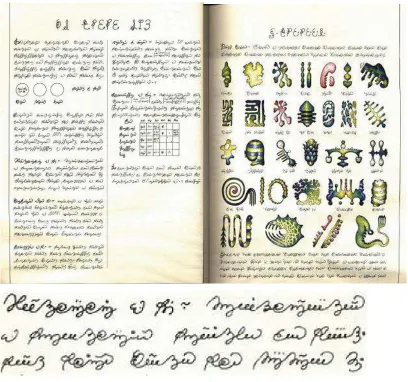
Figure 1: The Codex Seraphinianus.
Top: pages 12 and 13. Bottom: detail page 12.
Created in the 1970’s by Luigi Serafini, an Italian architect, the Codex Seraphinianus
strange physical and chemical reactions. On the cover of one popular edition, a copulating man and woman morph into an alligator.
The Codex is organized into eleven chapters. At the beginning of each chapter is a table of contents page. There are two types of content pages, one consisting mainly of text sometimes with small images or diagrams and one consisting mainly of
illustrations with captions, which this paper will refer to as text pages and illustration pages respectively. At the top of every page is a header written in the mysterious script. This header text is made of large disconnected tokens that are different from the connected, cursive-like text found in the body of the pages. However, some of the header tokens resemble some of the body tokens, especially the initial body tokens, leading people to refer to them as miniscule and majuscule letters (Derzhanski 2004).
Wechsler (1987) and Derzhanski (2004) independently deciphered the writing system used to number pages in the Codex, but studies of the header and body text remain speculative, with only a few linguistic observations possible, such as the classification into the capital and lower-case letters.
The writing in the Codex has been chosen for this study for several reasons, as a compromise between raw undeciphered artifacts and familiar, accessible written formats.
1. The symbols in the codex are not easily classified and appear to be formed in a composite manner reminiscent of Rongo-Rongo and some of the symbols in the Indus script and Linear A.
3. The text in the Codex is all compiled together in an organized format so that it can be referred to in a familiar way, by page number, chapter, and location on the page. This allows focus on the thesis without excessive discussion of the corpus. 4. The Codex can be obtained as a compilation of high-resolution color electronic
scans of the pages. Therefore it allows study of the original source material in a way that is organized, coherent and ready for computer analysis.
At the time of starting this research, the Codex presented a good example of a data set because of its organization, its length, and because, since its author is tight-lipped but still alive, there was a non-zero chance of one day verifying the results.
Asemic Writing
Expectations for this study changed in May 2009, when Serafini announced clearly at a talk to the Oxford Bibliophiles that the writing in the Codex Seraphinianus does not represent any language, known or secret. It is asemic. Rather than an undeciphered writing system, the study’s focus became an asemic writing system. This development actually revealed new reasons for using the Codex as a corpus.
1. By widening its range of interest, it has the potential to demonstrate the
technology’s value in areas other than linguistics: art or psychology for instance. 2. Because the writing encodes no language, the Codex effectively embodies a worst
case scenario. If the study can organize and analyze this pseudo-language, it can be expected to work for writings that are known to encode languages, as well as disputed writing systems like Rongo-Rongo and the Indus Script.
which you can’t read” (Alexander 2009(1)). Technically, no one can read true asemic writing, because it does not represent a language. However, while it cannot be read in a traditional sense, it can provide a similar experience: “. . . I’m trying to create things which are totally open in meaning, suggestive to a viewer, but without a privileged meaning” (Alexander 2009(1)). Another leader in the field, Michael Jacobson, known for creating an 89-page asemic work called The Giant’s Fence, similarly calls it “a code that is open to interpretation, with no fixed meaning.” He explains that one emerging poetic movement focuses on breaking writing down and that asemic writing breaks it down into the rudimentary features of texture and line. Jacobson believes that asemic writing could draw people back to literacy by contributing to a “multi-media” experience (Alexander 2009(2)).
To the Oxford Bibliophiles, Serafini expressed this sentiment. Since his talk was not recorded or published, the following is from notes by an attendee.
The book creates a feeling of illiteracy which, in turn, encourages
imagination, like children seeing a book: they cannot yet read it, but they realise that it must make sense (and that it does in fact make sense to grown-ups) and imagine what its meaning must be . . . The writing of the Codex is a writing, not a language, although it conveys the impression of being one. It looks like it means something, but it does not; it is free from the cage of a language and a syntax. It involves a visual process, not a linguistic process (Prodi 2009).
Automatic Writing
Additionally, Serafini stated that the experience of composing the writing in the Codex was similar to automatic writing (Prodi 2009). To create over 300 pages of purely artistic text carefully deliberated to appear to encode a language seems
Of The Giant’s Fence, Jacobson commented: “The main difficulty with writing [The Giant’s Fence] though, was to keep the style consistent over the 2 years it took to write the book. I don’t think I have the ability or the stamina to recreate a work like it” (Alexander 2009a). The Codex Seraphinianus is about four times as large (though the comparison is an inexact one), and was finished in a little over two years (Manetto 2007). In a 2007 phone interview for El País, Serafini described the Codex as water that gushed out of him. He made several claims about the language, implying not only that it was primarily artistic but also that “I realized I was leaving the pencil alone . . . I made it up suddenly. It is a vision, a dream language. The mystery, for me, is simply in the artistic act” (Manetto 2007, translated). It may be accepted, then, that he was able to manage such a work because composing the writing, for him, was some sort of automated task, requiring little or no conscious effort. The idea of writing resulting from a vision or dream is not new and will be addressed below.
automatically (channeled by spirit guides) are the Oahspe by Newbrough and The Aquarian Gospel of Jesus the Christ by Dowling. A Dweller on Two Planets by Oliver is only one of the many 19th century books supposedly written by former inhabitants of Atlantis seeking to impart knowledge of their destroyed civilization through the pens of the living.
However, there are also less lofty manifestations of automatic writing. Along with other unmediated processes, some Freudian psychologists use automatic writing to reveal the unconscious. It was first proposed in 1878 that what is ascribed to spiritual beings is really another self, dissociated. In a seminal case, Pierre Janet realized that, while his patient Lucie could not feel any sensation on her body, a personality that would write through her automatically when she was distracted, signing “Adrienne,” felt everything (Van der Hart 1989).
The third movement in which automatic writing finds its home is an artistic one. In his Surrealist Manifesto, André Breton emphasizes all forms of automatism,
especially automatic writing, as the “. . . true functioning of thought . . . in the absence of all control by reason . . .” (Breton 1972). Other well-known surrealists such as Alexander Brotchie and Benjamin Péret practice and recommend writing in the absence of controlled thought as a valuable exercise (Brotchie 2003). Today “free writing” is a popular writing exercise not just among surrealists.
Statement of Thesis
Primary Thesis
undeciphered writing systems without the potential problems of a transcription scheme.
Secondary Aims
In this case, the applications produced may shed light on the writing system of the
HISTORY OF SCHOLARSHIP
Computer-Aided Analysis of Undeciphered Writing Systems
Indus Script
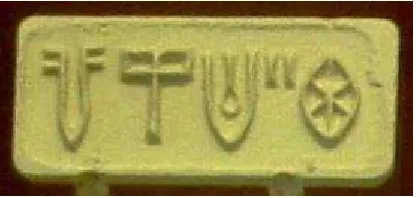
Figure 2: The Indus script.
Seal impression from the British Museum.
Rao et al. compared the Indus script to known scripts (most transcribed though Unicode), particularly with regard to conditional entropy, which is a measure of the flexibility in ordering of tokens. For instance, a system in which type B must always follow type A is rigid and has low entropy, whereas a system in which any type may follow type A with equal probability is flexible and has higher entropy. They calculate conditional entropy values for known linguistic and nonlinguistic systems to compare against the Indus script, and they find that the conditional entropy for the Indus script is similar to the conditional entropy of writing systems used to represent natural human languages (Rao 2009a). This agrees with the findings of Yadav et al. that the ordering of the signs is not random. This study was met with intense criticism on several counts, from bad source data to leaps in logic; the debate surrounding the Indus script is an acrimonious one. A slightly later study using a Markov model has been more successful. This study avoids comparing the Indus script to other known systems, as the claims involving these comparisons is what drew the most criticism (Patel 2010). From the Markov model, Rao et al. are able to confirm once more that the sequencing is not random and claim that the symbols appear to fall into functional equivalence classes. They suggest unpreserved signs from damaged texts using the model (Rao 2009b).
Rongo-Rongo
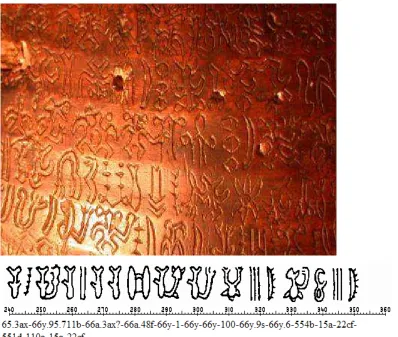
Figure 3: The Rongo-rongo script.
Top: detail from Tablet Q. Bottom: part of Barthel’s tracings of the tablet, with transcription.
or within the same tablet, where the same sequence or nearly the same sequence is repeated. In 2003, Richard Sproat, then at the University of Illinois at
Urbana-Champaign, used a computer to seek out these parallels, drawing from work on suffix arrays for string matching. Though this work was never published formally, it is freely available on his website and well known to Rongo-Rongo scholars. For input, Sproat used standard transcriptions of the tablets, based on Barthel and modified by the Rongorongo commission. Barthel’s transcription allocates 799 mappings for signs, with similar signs grouped together, though some of the mappings are left empty. Diacritics indicate combinations or concatenations of signs, and lower case letters denote certain sign-specific variations (Pozdniakov 2007; Guy 2005). Sproat drops these decorations to obtain an input composed strictly of numbers. In the results, he presents several sequences that are similar, though not necessarily the same, because of the distance of his input from the actual text. In his search for “approximate matches” this flexibility is desirable, as it leads to more results that can then be examined by humans. He does note, though, that in some places his research suffered without him even knowing about it at first because of gaps in the source data where transcription simply had not been completed.
identification of glyphs and their allographs in this paper has gathered some scholarly criticism. Because the method is not properly described, the counterexamples and arguments that critics are presenting cannot be checked against it (cf. Miller 2008).
Linear A
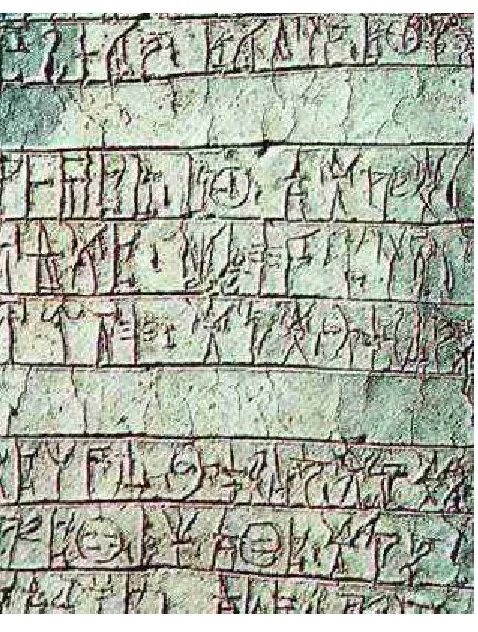
Figure 4: Linear A.
Detail on a tablet from Pylos.
are able to identify pictographic symbols for wine, grain, etc., as well as identify which symbols represent numeric values. However, Linear A does have unknown symbols (ones that do not match Linear B) as well as composite symbols (ligatures) that are not all fully understood (though many easily yield their components, others do not). These unknown symbols are referred to by standard enumerations just as in other unknown scripts. The problem with Linear A is not so much the values of the symbols as identifying what language it is supposed to represent. Scholars can sound out much of Linear A, but they do not know what the sounds mean. Most Linear A research has been concerned with comparing it to other early languages.
Packard (1974) was the first to publish a comprehensive computer analysis of Linear A, by calculating frequencies for each symbol, with one of his aims being to verify that the Linear B projections are reasonable. As in other decipherment studies, he uses the numeric transcription as input; but because of the unique situation of Linear A he is also able to analyze and present his results organized by phonetic sound. While frustrated by an undeveloped corpus at the time, his procedure was praised, and his results seem to favor the accepted assignments (Packard 1974;
Chadwick 1977). Packard also identified parallel sequences and performed some other analyses. Recently, Brent Davis has applied Packard’s procedure to a new aim: by calculating frequencies for symbols in the context of word position, to identify morphological suffixes. These morphological elements could be compared to other languages to try to identify Linear A’s language family (Davis 2010).
Developing Methodology Using a Known Language
a closely related language and writing system, the computer identified 29 of 30 letters and 60% of word meanings correctly (60% of those words that have cognates in Hebrew). For this study, rather than use an alphanumeric transcription scheme, a special system was developed to input Ugaritic symbols using a modern keyboard. This system is given only a mention in a news article; no details appear in the paper (Snyder 2010; Hardesty 2010).
Summary
While not many undeciphered languages still exist, those that do are receiving computer attention. Existing undeciphered languages have large symbol inventories and scattered corpora, and a computer can help organize and mine these extensive data sets. In addition, it can be expected that not all languages have even been discovered, as a recently found Olmec script demonstrates (Rodríguez Martínez 2006), as well as claims of a Pictish language (Lee 2010).
are merely examples to help illuminate the nature of the question. Many other references are available on these subjects.
1. Is it a language? (Sproat 2010; Rao 2009a; Rao 2009b; Lee 2010) a. Do its symbols follow rules found in known languages?
- Type number and frequency - Zipf’s Law
- Entropy
- Statistical models
2. What other languages is it most closely related to? (Packard 1974) a. What writing systems does it resemble graphically?
b. Can values be assigned to symbols in a way that appears to create words or structures found in some other language?
c. *Can rules or structures be identified that parallel rules or structures in some other language?
3. What are the types of the writing system? (Coe 1999)
a. *Do the types vary by context or are they consistent?
b. *Are the types distinct or can they be combined to create composites or ligatures? If composites exist, how do they break down?
4. Is it primarily alphabetic, syllabic, or ideographic? Which symbols are phonetic and which are ideographic? (Chadwick 2004)
a. How many types are found in the writing system? b. What ordering and placement rules do the types follow? 5. What is the morphological structure of the language?
a. Are any types most prominent in a particular position in words (usually beginning or end)? (Davis 2010; Rao 2009 b)
b. Are any types found commonly in conjunction with other types? c. *Are any common sequences found that differ by only one or two
6. Is the transcription scheme helpful?
a. Does it cover all of the types in the writing system? b. Does it cover variation in types?
c. Does it represent relationships between types that might be significant? d. Does it organize and communicate these features effectively?
Computer Recognition of Written Images
Printed Character Recognition
The first serious studies in optical character recognition took place in the 1960’s, and today the technology has reached such a level that a typed or printed English
document can be scanned and its linguistic content digitized with claimed accuracy of 97-99% (characters recognized correctly) (Mori 1999: xiii, 6, 7). Character recognition today generally follows three steps (Mori 1999; Cheriet 2007):
1. Preprocessing: The image is prepared for analysis.
2. Feature extraction: Identifying features of the character image are collected. One of the most important decisions in character recognition is which features to collect; researchers have explored optimizing the selection through
automated processes.
numerous. The crossing method, drawing lines at intervals through the image and recording how many times they cross the foreground, is a simple feature extraction technique. It involves fewer matches that are fast to perform, and it overcomes certain kinds of variation, but it encodes less information. The decision on which technique to use is therefore one that should be made carefully (Mori 1999: 21). The aim is not only efficiency but correct classification, and to this end all kinds of features have been tried to allow recognition despite token variation, to capture the essential shape of a type, especially contour and stream following, orientation matrices, and
mathematical descriptors. For more information see Mori (1999) and Cheriet (2007). Printed character recognition deals with basic problems found in all cases of computer recognition of writing, particularly extraction of words and characters and separation of text from graphics (cf. Fletcher 1988); but the source documents are generally cleaner and more regular than those used in handwriting recognition.
Most work to date on character recognition has been conducted on the English alphabet and Mandarin Chinese, although significant progress has been made on Indian scripts (Bhardwaj 2009; cf. Bruel 2009, Kompalli 2007).
Handwriting Recognition
The problem of handwriting recognition shares more features with the problem of undeciphered writings than does simple character recognition because it is more concerned with the original images on the manuscript, and of course most
undeciphered scripts are handwritten rather than typed. Handwriting is not necessarily consistent, meaning representations of the same type could vary substantially within the same document. Segmentation is of course more complicated than in printed character recognition, as tokens can connect or overlap, also in inconsistent ways (cf. Nicchiotti 2000, Yanikoglu 1998). A Markov model can be used to segment
handwriting at the same time as recognition (Cheriet 2007: 237). There are also approaches that avoid segmentation, such as matching against a lexicon, feasible for a limited domain (Cheriet 2007: 251).
Manmatha et al. show how to group handwritten words into an index without worrying about segmentation or recognition, a process they call word spotting. Once the words have been classified, the end-user can browse all the images of a particular word in a document or series of documents. Automated recognition is not performed; rather the words can be identified by a human after indexing. Manmatha and related scholars have tested many image comparison algorithms for word spotting. Euclidean distance mapping, their first and baseline attempt, takes as input the XOR result of the two images to be compared and measures the distance from each foreground pixel to a background pixel (Manmatha 1995; 1996). A recent success uses dynamic time
each other (Rath 2003). However, an even more recent attempt using corner detections is faster and almost as accurate (Rothfeder 2003). Up-to-date research on word
spotting can be found here: http://orange.cs.umass.edu/irdemo/hw-demo/wordspot_retr.html.
Epigraphy
Computers have been used for a long time in storing and propagating representations of ancient inscriptions, whether from photographs or from squeezes, which are popular tools for making impressions of inscriptions on paper. Techniques even exist for capturing three-dimensional information, from photographs taken at multiple angles (Meyer 2004), from squeezes scanned under multiple lightings (Barmpoutis 2009), and from more expensive laser scanning procedures (Bodard 2009). The computer can then be used to identify the separate elements. In a study of Greek inscriptions from Epidauros, the computer successfully segmented and clustered the tokens according to their graphical similarity, effectively creating an atlas of all the tokens by type. A high accuracy was achieved by making use of three-dimensional data from the squeezes. The clustering was then used to propose a dating scheme for the inscriptions
(Barmpoutis 2009). Another study has shown how Egyptian hieroglyphs can be indexed by their constituent Bezier curves (Meyer 2006), and it seems only a small step to automated recognition of hieroglyphs through pattern matching.
Automatic Handwriting
While there has been no scientific treatment of automatic writing, there have been intellectual inquiries into the mystic claims of automatic writing. These mystic
writings may be in a language known to the subject or may be in a mysterious
language. In a famous case, Professor Théodore Flournoy tracked the notable Hélène Smith, who claimed to be receiving correspondences in a Martian language. As she would translate them into French, he was able to conduct a study. He found certain resemblances to French; despite this, or even because of this, he remained convinced that it was not a purposeful ruse but a true unconscious phenomenon. The Martian phonemes are completely contained within the French phoneme inventory, for example, and the Martian graphemes also are mapped to the same sounds as French graphemes. Syntax is exactly the same as in French (Flournoy 1900: 246-251). Flournoy describes other instances of Mlle. Smith’s automatic writing in familiar (not Martian) characters (cf. Flournoy 1900: 288), but the Martian is relevant because it appears in a strange writing system, akin to the Codex Seraphinianus. It should be stressed that Serafini makes no mystic claims about the codex. Starting with Pierre Janet, psychologists have confirmed that the ability to write unconsciously does exist (Van der Hart 1989).
Glossolalia and Speaking in Tongues
There is a process closely related to automatic writing that has received attention in some circles: It is the phenomenon called “speaking in tongues” exhibited by some Christian spiritualists. It falls into a class of behaviors called glossolalia. Like
automatic writing, it is given to mysticism. (Mlle. Smith not only wrote in her Martian language but also spoke it.) The subject, often in the middle of prayer or worship, spontaneously babbles. In some cases, the babbling is claimed to be in a language unknown to the speaker but is recognized and understood by someone else. In other cases it is accepted as a “spiritual” language, unknown to anyone on earth (Cutten 1927: 116, 164, 165). Glossolalia occurs in other cultures and has occurred throughout history. Specifically with regard to the Christian practice, Lombard identified four types of glossolalia that could occur independently or blended: pre-vocalizations like groans, verbalization, pseudo-language, and speaking in foreign languages
(“xenoglossie”), and May later adapted these to apply to non-Christian instances (May 1956). As in automatic writing, something novel is produced with minimal conscious effort. Especially in the early twentieth century when it was becoming widespread, people studied speaking in tongues in a psychological context. The conclusions are brief and necessarily untested: that it results when the conscious self disintegrates, allowing the unconscious to control motor functions. In response to speaking
languages not known to the subject, these scholars bring up case studies to show that this could be enhanced (“exalted”) memory allowed to come forth in the absence of the conscious self: For instance a chambermaid in a fit spoke Latin and Greek, and it was found that in a past job she had swept while her master recited long passages in those languages (Cutten 1927: 176). While in the early twentieth century terms were used such as ecstasy and hysteria, by the 1970’s this kind of disintegration of
As a side note, it might be worth considering the cooing and babbling of human babies as a spontaneous and creative automatic process, based on the observations that all babies engage in at least the cooing stage, even babies of deaf parents, and that progress from one stage to the next does not require practice (Lenneberg 1967). If so, perhaps the mechanisms that produce glossolalia are left over from this early
development.
Other Related Processes
Similar processes have been studied more scientifically. Like automatic writing and glossolalia, musical improvisation creates something new, sometimes without conscious control (Nettl and Russell 1998: 82, 171, 339). Dreaming, as well, can be seen as the brain creating something new in the absence of conscious control. Brain scans and lesion studies of these processes suggest that a prefrontal area is inhibited while another prefrontal area, the area responsible for interest and curiosity, is excited (Limb 2008; Dietrich 2003; Solms 1997). This theory has been extended to scribbling as well (Sheridan 2002). The main idea is that the brain enters a state in which it is interested but not regulated. It then uses whatever resources are available to it (memory and symbolic rules) to manifest something concrete (Solms 1997).
Summary
MATERIALS
Hardware and Operating System
All of the procedures described in this paper were performed with a HP Pavilion (model dv6119us) with a 15 inch display, running Microsoft Windows XP Media Center Edition, Version 2002, Service Pack 3. The processor is AMD Turion(tm) 64 X2 Mobile, 803 MHz (960 MB RAM). This can be considered a low end machine compared to machines being offered today.
Development Environment
Applications were developed in Microsoft Visual Studio 2005 Professional Edition, Service Pack 2, using the C# language.
Third-Party Software
Corpus
The Codex Seraphinianus was acquired in Adobe Acrobat Reader format (PDF) and converted into 369 individual images, one per page, using PDF to Image Converter 1.0 by PDF-TIFF-Tools.com. The output images measure 1573 by 2169 pixels, with a resolution of 150 dpi and a bit depth of 24.
METHODS AND RESULTS
Header Text (“Capital Letters”)
For these implementations, the header tokens were extracted (“blobbed”) using the third-party software. A function was devised to measure the graphical similarity between tokens. In one implementation, the tokens in the first three chapters of the codex were then classified into types using a simple automated algorithm combined with human supervision. In another implementation, a search engine demonstrates the possibility of locating parallel sequences, a common task for analyzing undeciphered languages, based on graphical similarity alone.
Preparation for Extraction
When an image of one of the pages of the codex is first processed by the application suite developed in this study (described in the rest of the paper), three AForge.NET filters are applied to it. A GrayscaleRMY filter is used to convert it to 8bpp, the format that is required by the AForge.NET blobbing algorithms (see below for a description of blobbing). A Threshold filter increases the definition of the token lines to a black and white contrast. Thirdly, an Invert filter is used to get the tokens to be white on a black background so they can be properly blobbed. The AForge.NET default values were used for each of these filters.
Extraction
A blobbing algorithm is meant to separate foreground images from a background by identifying contiguous shapes. The result of blobbing is a collection of blobs that represent these shapes. In the case of the codex headers, a blob is produced for each token.
The AForge.NET BlobCounter class is used to determine the location and extent of actual tokens on the page. To extract the majuscule letters, the BlobCounter is set up with the following values:
FilterBlobs = true MinHeight = 20 MinWidth = 20 MaxHeight = 300 MaxWidth = 300
These settings yield only blobs that fall into the correct size range for the capital letters. Additionally, the implementation sorts the blobs by topmost first and considers only blobs that fall within a twenty pixel threshold of the topmost blob. This ensures that only the blobs in the header are considered (not blobs that might appear farther down the page in illustrations for example). Any blob that passes all of these filters is considered a valid capital letter token. Its page number, location, extents, and visual data are stored in an array that can be accessed by the application suite.
This technique does not work on pages in which the header is not near the top, including the title page and the landscape-oriented pages. These pages were discarded from the study.
Rarely, because of the integrity of the processed page, extraction failed on
were not properly extracted, with only part of the token being extracted. These failed extractions were disregarded.
Identification of Similar Tokens
The application suite compares two tokens using a simple whitespace count with jitter as described below. First it scales both images to the same size (70 x 70) using an AForge.NET ResizeBilinear filter (a practice called normalization). More information about the normalized size is below. It then takes the ratio of white pixels in the XORed image to the white pixels in both original images combined (the tokens are white on a black background because of the filters). Because the images are not necessarily lined up to begin with, jitter is used as described in Manmatha (1995) to find the best alignment between them. Specifically, one of the images is tested with x offsets of -4, -2, 0, 2, 4 and y offsets of -4, -2, 0, 2, 4, resulting in 25 different tests instead of one. (The AForge.NET CanvasMove filter was used to create the offset images.) The resulting float value is used as a measure of the similarity between the two images. This value can range from zero (if the two images match exactly) to one (if the images do not overlap at all). An alternative comparison algorithm was also tried, Euclidean distance mapping as described in Manmatha (1995). While it is demonstrated to give good results for handwritten words, it appeared to produce no significantly better results in this application, probably because of the relative shortness of these images (letters instead of words).
following caption below show the XOR comparison algorithm at work for two different tokens at large and small normalized sizes.
Figure 6: Comparison of header tokens.
The first token in the bottom row of each image is the target. In each case, the second token has been selected to show some comparison features of the tool. The leftmost box shows the selected token as it appears in the codex. The rightmost boxes show the target (on the left, stretched to a large square) and the selected (on the right, stretched to a large square) tokens side by side. The remaining box shows the result of the XOR operation. The tool also reports the most successful offset and allows the user to jitter the XORed image using the arrow buttons to verify this. In order: Target page 10 token 3, size 70x70; target page 10 token 3, size 20x30; target page 10 token 7, size 70x70; target page 10 token 7, size 20x30. (The isolated curve that appears in the results is an extraction error.)
The technique ultimately used to proceed with the study uses the 70x70 size with no additional considerations.
Figure 7: Applying a whitespace matrix to the last example from the previous figure. The rightmost numbers represent whitespace counts in each section of the matrix for the selected token. Notice that, while the results match the target closely with regard to whitespace balance, most of the results in the middle of the row appear to be of a different type.
Study 1: Consolidation into Types
Rationale: If the tokens of the writing system can be separated into a finite number of types, this number might indicate whether it is primarily alphabetic, syllabic, or ideographic. In addition, the identification of types is necessary for many forms of linguistic analysis including n-gram analysis and Markov modeling. However, it is important to note that to identify types is to enter into the limitations of a transcription scheme described in the introduction.
Because of the nature of the writing in the codex, no attempt was made to
measure the accuracy of the clustering scheme. Though some of the tokens definitely appear to be of the same type, the classification of many of the tokens is ambiguous. Since the writing is asemic, this is no surprise. It is clear that these decisions about the tokens cannot be made without human supervision.
Once the types are tentatively identified by the computer, the process of human supervision begins. An interface was developed to allow the human user to review the types, combine types, and easily move tokens among existing types or use them to create new types mainly by dragging and dropping. In addition, each token can be viewed in its original context on the page. This is an important stage during which the human user is at liberty to examine the tokens in these two contexts: similarity with other tokens and usage on the page.
Figure 8: Typing app showing results for the first three chapters of the codex.
The bottom pane shows the final 53 types. The top pane is showing all of the tokens of the first type.
Several observations surface just from the first few chapters. Chapter 1 (pages 10-43) shows dominance of a few types, and there are many types that only appear once. Chapter 2 (pages 46-103) provides by far the most tokens of the three chapters and introduces much more diversity of tokens. The 438 tokens could not be classified comfortably by the author at first glance into any fewer than 70 types, 34 of which contained only a single token. Chapter 3, with the fewest tokens, mostly fit into the classes already created from the previous chapters. When all three chapters were combined, there were 798 tokens classified into around 70 types. This limited number of types is the result of the author ignoring small variations between the tokens, such as a dot appearing inside the convexity, a loop appearing at an endpoint, and certain differences in curve contours. Otherwise there would be substantially more types.
would mean something like: “This is a unique identifier for this illustration page and serves no other purpose.” This relationship will be visited further in the discussion section. Discarding these unique tokens provided a final classification of 53 types.
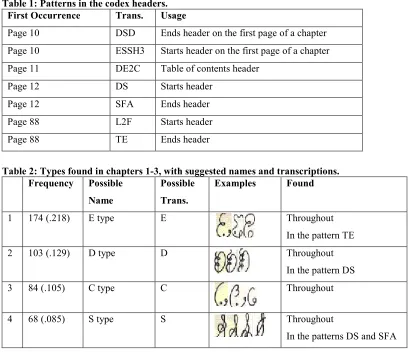
It is useful to point out here the templates or patterns that recur frequently in the page headers. This will make it easier to talk about where the types are found. It does not take a computer to notice these, but the typing application certainly helps highlight them since certain types appear mainly in these patterns. The usages for these patterns were solidified by the search engine application described in the next section. The transcriptions are based on the suggestions in the table for the types, which
immediately follows it. More will be said about the patterns later. Table 1: Patterns in the codex headers.
First Occurrence Trans. Usage
Page 10 DSD Ends header on the first page of a chapter
Page 10 ESSH3 Starts header on the first page of a chapter
Page 11 DE2C Table of contents header
Page 12 DS Starts header
Page 12 SFA Ends header
Page 88 L2F Starts header
Page 88 TE Ends header
Table 2: Types found in chapters 1-3, with suggested names and transcriptions. Frequency Possible
Name
Possible
Trans.
Examples Found
1 174 (.218) E type E Throughout
In the pattern TE
2 103 (.129) D type D Throughout
In the pattern DS
3 84 (.105) C type C Throughout
4 68 (.085) S type S Throughout
Table 2 (continued)
5 49 (.061) Phi type F Throughout
In the patterns L2F and SFA
6 48 (.060) P type P Throughout
7 29 (.036) 3 type A Mainly in the pattern SFA
8 28 (.035) 8 type B Mainly chapters 2-3
9 26 (.033) 3-knot type H3 Throughout
10 21 (.026) 3-leaf (trefoil)
type
T Mainly in the pattern TE
11 18 (.023) Hook type L2 Only in the pattern L2F
12 18 (.023) Double-E type E2 Throughout
13 16 (.020) 2-knot type H2 Throughout chapter 2
14 12 (.015) L type L Throughout chapters 1-2
15 10 (.013) PS type
(or Harp type)
P2 Throughout chapters 2-3
16 9 (.011) SC type
(or Half Harp)
S2 Throughout chapters 2-3
17 6 (.008) Triple-E type E3 Chapters 2-3
18 5 (.006) Dragon type J Chapter 2
19 5 (.006) Double-3 type A2 Chapter 2 and distorted on
page 25
20 5 (.006) Pi type N All chapters
21 4 (.005) Snail type G Chapters 2-3, only three
Table 2 (continued)
22 4 (.005) (Inverted)
Treble type
Bo Chapter 2
23 4 (.005) E8 type Eb Pages 108 and 109
24 4 (.005) Double-Y type Y2 Chapter 2
25 3 (.004) Snail-8 type Gb Pages 62 and 67
26 3 (.004) Y type Y Chapter 2
27 3 (.004) Pinwheel type X Page 18 and distorted on
page 71
28 3 (.004) L-Hook type Ll2 Pages 50 and 55
29 3 (.004) E-stick type Ei Pages 16 and 46
30 2 (.003) Y-8 type Yb Page 96
31 2 (.003) Curl-E type We Pages 122 and 123 (one
word)
32 2 (.003) Spring type
or Shrub type
I Pages 26 and 27
33 2 (.003) 3-bar type Ai Pages 70 and 71
34 2 (.003) R type R Pages 64 and 66
35 2 (.003) Dragon-L type Jl Page 87
36 2 (.003) L-8 type Lb Pages 19 and 93
Table 2 (continued)
38 2 (.003) E-L type El Pages 122 and 123 (one
word)
39 1 (.001) Trefoil-stick
type
Ti Page 120
40 1 (.001) C-D type Cd Page 96
41 1 (.001) Smoke type W Page 89
42 1 (.001) 2-knot-E type H2e Page 101
43 1 (.001) Left-8 type B2 Page 23
44 1 (.001) S-bar type Si Page 67
45 1 (.001) 6’s type O Page 57
46 1 (.001) 3-8 type Ab Page 19
47 1 (.001) Left 3-8 type Ab2 Page 69
48 1 (.001) Gears type Go Page 65
49 1 (.001) Phi-3 (Tree)
type
Fa Page 40
50 1 (.001) <none> Sy? Page 53
51 1 (.001) Spiral-stick
type
Oi Page 89
52 1 (.001) Phi-H type Fh Page 27
Study 2: Search Engine
Rationale: A large portion of effort on undeciphered languages is spent identifying parallel sequences of tokens throughout the corpus, on the expectation that the more contexts in which a sequence can be found the better understood it becomes. This application is meant as a proof of concept that these sequences can reasonably be found by searching the images.
Independent from the interface for identifying types, a search engine interface was produced, based on the same similarity value explained above. This is a fully visual search engine, not based on any sort of transcription or typing scheme. The user places image data on the Microsoft Windows clipboard (by copying a token or sequence of tokens from one of the pages of the Codex in any imaging program) and then starts the search. The application attempts to find token sequences that match the token
sequences on the clipboard by taking the average similarity between the sequence on the clipboard and each sequence in the page header. Any sequence satisfying the similarity threshold (< 0.65) is returned in the search results. For instance, if the sequence on the clipboard is two tokens long, the application will test this against each bigram in the header. It ignores empty space so that it does consider two tokens
separated by any distance of empty space as a valid bigram to test against. The user can easily recognize which results fit the search criteria best and click on these to view them in context on the page, ignoring the ones that do not.
The search runs on a separate thread so that the user can view the search results while the program is still performing analysis on remaining pages.
important clue for matching. When a small dot is scaled to 70 pixels square, for example, it may appear to the algorithm to be similar to a long vertical bar also scaled to 70 pixels square. On the other hand, it would be undesirable to miss valid matches simply because of small variations in size. For this reason, the search interface
provides the option to the user in the form of a “do not scale” checkbox to scale or not to scale the images used for comparison. Instead of scaling, the application creates a new image of the desired size and writes the token onto it, effectively padding it. (A bug to note is that tokens exceeding 70 pixels are clipped according to this padding scheme.) The user can fetch matches both with the box checked and then unchecked to obtain thorough results.
Figure 9: Search results for the common sequence SFA.
Thresholds: Individual = .55, All = .5. Max Dist (see below) is set to 0. The first three results are from pages 12, 16, and 24. The last result fully visible is from page 239.
Figure 10: As above but with Max Dist set to 1.
Many more results are returned, most of which are instances of the search string. The first three instances of SFE found are from pages 12, 14, and 16. The last fully visible instance of SFE is from page 78.
Additionally, this “max dist” feature allows matches that differ in one or more tokens from the target. Scholars seek such matches because they provide clues about which tokens might be interchangeable, either because they are orthographic variants of the same type or because of the morphological rules of the language. This is demonstrated through the search results shown above. The first three occurrences of SFE clearly begin with S-like tokens with two large overlapping loops at their
apparently exactly the same context, it would seem that these tokens are freely interchangeable.
We can also see variation in the token E. In almost every case it ends in a small loop, with one exception, page 78. Because the omission of a loop accidentally is not unlikely, and because it only occurs in one isolated case, this could be dismissed as a mistake.
It should also be noted that the search engine makes immediately evident the repeated use of the word throughout the codex headers, always in the same position. While this could easily be noticed by a human researcher, it would take longer to document each case.
Figure 11: Example of an illustration page (13). The header begins with a unique token and a dash.
Figure 12: Unique pre-dash tokens appearing on illustration pages in chapter one dealing with similar plants.
Initial results from the search engine suggested that apart from the obvious repeated words, recurrence in the header sequences is rare. This was briefly explored by searching for sequences composed of common types in the headers that might be expected to recur. Results can be seen below. Apart from the target and its
corresponding illustration page, the appearance of the word or sequence is unique. Table 3: Words or parts of words made of common types in the headers which are
nevertheless unique.
The left column shows the target and associated illustration page where it is often repeated. The right side shows some other search results. None of the search results are exactly the same sequence as the target. To the left are the page-numbers on which the headers occur.
Target sequence and illustration page Other finds 12
13
10 48 60 147 269 112
<Not on illustration page>
10 177 204 295 52
Body Text (“Lower Case Letters”)
For the body text, whole words were extracted (“blobbed”). A first implementation orders all words on a single page by length to allow for some initial impressions. Then a function was devised to measure the graphical similarity between words. A search engine demonstrates the validity and shortcomings of this function and allows for further observations concerning the distribution of words in the codex.
Preparation for Extraction
The body text was prepared for blobbing in the same way as the header text, with minor differences by trial and error. First an AForge.NET GrayscaleBT709 filter was applied, then a Threshold filter with a threshold value of 170, and lastly the Invert filter.
Extraction
Body text words were blobbed by AForge.NET in the same way as the header text characters. Table of contents and landscape orientation pages were discarded. Several techniques had to be implemented to mitigate the unpredictable layout of the body text. The complicating factors are:
1. words too close vertically 2. words squeezed in between lines
3. words running into the page margin or gutter shadow 4. words accidentally broken during preprocessing 5. dots and other diacritics appearing above words
8. illustrations
Figure 13: Samples from page 12 of the codex showing text mixed with (a) diagrams, (b) tables, (c) two-line compartments, and (d) non-word strokes.
To deal with these factors the following method was used.
1. Any blob that is taller than expected (> 40) and overlaps a blob below is reduced so that it does not overlap the blob below.
2. Any blob that is still taller than expected is a candidate for being split in half horizontally. The blackest row is found, and if the whitespace above and below this row is approximately equal (within 300) the blob is split on the row. This is to fix words that are too close vertically.
3. Blobs that are very close horizontally are merged. This is to fix words broken during preprocessing and to attempt to attach the extra blobs formed in step 2 to their proper owners. To do this, a box the length of the blob and 6 pixels high is drawn through the middle of the blob. It is then inflated 6 pixels on either side, and any intersection with any other blob results in a merge with that blob. Any blob taller than 40 pixels cannot be merged.
5. Blobs that are very close vertically are merged. This re-merges any extra blobs remaining from the split in step 2 and also helps combine the compartmentalized blobs so that they can be filtered out. The blob is compared against all other blobs; any blobs that intersect its bottom are merged if either (a) the blobs have exactly the same x position on the page or (b) if both blobs are thin (H < 15). As with the horizontal merge, any blob taller than 40 pixels cannot be merged.
6. Step 1 is repeated since new blobs have potentially been formed.
7. Any blobs that cannot be words due to height (< 20 or > 60), total size (H+W < 30), or aspect ratio (H/W > 1.2) are discarded. This hopefully eliminates most illustrations and stray page markings from consideration.
The end result is all words from portrait-oriented pages that do not intersect the page margin or gutter shadow, including single tokens, image captions and words found inside charts, and not including inline compartments as these are generally merged together and filtered out. The author is not prepared to verify its completeness. Certainly the stated words are missing, but there could easily be other losses as well. For this research it is not essential that every single word was captured.
Study 1: Words Ordered by Length
Rationale: Observation reveals that within a page of the Codex the same sorts of word shapes are repeated often, as though the words are cognates. Comparing them could lead to identification of morphological features.
Figure 14: An application that displays all word instances on a page sorted by length, applied to page 13 of the codex.
Figure 15: Sorting the word instances on page 13 by length
Figure 16: Near the top of the word results are extraction errors.
These are not actually words but rather pieces of illustrations. Further research could find a way to filter these out, possibly by black to white ratio.
Study 2: Search Engine
Ordering words by length provides a good initial look at word similarities on a page. Indexing the words across multiple pages should yield more exact results on a larger area of the corpus. As an initial step toward this word spotting, a corner matching technique was used, similar to, but simpler and faster than, Rothfeder (2003), to build a search engine. Gray intensities were not used, though there is certainly room for such an endeavor in future research. Rather the evaluation considers only the positions of the corner points. For this study the Susan corner detector algorithm was used because it is included in AForge.NET. Each corner point in the target image is
Rothfeder, this is multiplied by the total number of corner points in the target over the number of matches, to favor candidates with more matches. A potential problem was found in that if only one match pair was found but its distance was zero, this would result in a zero value. This is prevented by forcing the distance for match pairs to always at least .01.
In a search engine application, this algorithm demonstrated validity. As in the search engine for header tokens, it reads the Windows clipboard for a target. A target word on page 13 was chosen by the author because he knew of a very similar word nearby, differing mainly in line thickness and diacritic marks. The search engine found the target word and the similar word as the first and second matches respectively. Matches share the same general word shape as the target. This word shape includes diacritic marks. Future research could be conducted to remove the diacritic marks from the comparison or to compare them separately.
Figure 17: Demonstration of search engine for body text and close-up (bottom) of best matches, pages 10-48.
It is significant that there are only two instances of this word in the codex. The uniqueness of words is not limited to this case. While particular sequences clearly occur again and again even on the same page, and there are very short tokens which appear throughout the codex, recurrences of words seem rare at first glance.
Table 4: Table showing search engine results for a target word, pages 10-65.
The number preceding the image is the rank assigned by the search engine. Following the image is the page number and in parentheses the coordinates on the page. Only results resembling the target word are shown. Out of 131 results found by the search engine, these 18 resemble the target. Page 60 has 6 occurrences, while 36 and 52 each have 3; 62 has 2.
1. 52 (310, 472) (target) 85. 60 (480, 1076)
2. 52 (1474, 428) 86. 36 (715, 1367)
10. 60 (273, 461) 93. 24 (856, 455)
11. 62 (560, 407) 109. 60 (1019, 660)
12. 36 (122, 507)
36. 60 (117, 415)
39. 32 (1118, 144)
41. 40 (333, 105)
50. 62(1023, 711)
53. 52 (468, 1132)
59. 22 (1445, 402)
65. 60 (416, 1426)
70. 36 (682, 1566)
Based on the results above, the algorithm clearly could benefit from techniques researched by Rothfeder’s group. It should especially be noted that this algorithm does not seem to sort matches well in its present state for short words. Also it does not work for words that are similar but have been drawn to different lengths, such as the
following pair near the top of page 52. Further application of the algorithms explored in the word spotting papers could certainly help these problems.
DISCUSSION OF RESULTS
Linguistic Observations on the Writing
Formulaic Headers
he writes them, Serafini is creating a huge collection of unique tokens that draw their meaning, if they have one, from their particular usage. They had might as well not be there at all. He is establishing a practice for his writing system that results in more work without anything gained, that of making up a new token for any new set of items, even if that set of items resembles one that has already been assigned a token. This would make sense if the token were used somewhere else to refer to the items, but it is not. It should also be noted that the practice of making them unique is not sustainable, unless it is confined to the codex. Eventually the writing community would begin reusing tokens, either knowingly or unknowingly. For this reason it must be scoped to the current linguistic act (book, article, discussion, etc.).
This observation shows two things. First, if he intended a language, Serafini certainly made up the language or parts of the language as he wrote. Secondly, he was more concerned with the appearance or novelty of the language than its utility;
otherwise he would not have created more work for himself without any functional benefit.
Free Variation within a Type
It has been shown by tracking the sequence SFE through the codex that the type S can be written with ornate loops or without these loops. This distinction does not appear to be contextual, or it would be found in more than just the first three occurrences of this word in the codex. Rather it seems accidental (freely interchangeable). This
Figure 19: Tokens in the codex headers that appear to differ only by a loop near an endpoint.
Especially since the looped versions are rare, these could be freely interchangeable variations. While classifying, the author decided to make them of the same type, leading ultimately to 53 types.
This observation is interesting because the set of variations allowed seems well defined, so it is not completely unrestricted. If an ornament is added, it looks like it can only be of a few kinds, even across tokens. If the variations were completely interchangeable, there would be no need to restrict them in such a way.
Table 5: Kinds of variation in three of the header types. None
Loop
Overhang
Extension
Dot inside
Dot above
Hook
Other combinations
This observation is also interesting because in several cases the ornamented token and the unornamented token are found in the same header near each other. This
page 15
page 16
page 108 Figure 20: Ornamented and unornamented S tokens near each other on the same page. Similar examples can be found for the other types.
Of course it is possible that the variations are both freely interchangeable and strictly defined and that the author is choosing to use what he considers a healthy mix of all variations. If so, it simply emphasizes Serafini’s concern with the appearance of the language: By allowing free variation he enlivens the visual appearance, but by restricting the kinds of variation he maintains the appearance of linguistic rules.
Non-repetition of Words
While the headers observe formulae and there are certainly repeated short words (at first sight supposedly function words), there is a remarkable uniqueness of words in the codex, both in the headers and the body text. As far as the body text, it has been suggested and shown in a very limited sample that there may be several words that have similar features on a page but that are not exactly the same. This could easily be further verified by a lengthier exploration. A similar situation has been suggested for the headers: The words that are not fixed by the formulae appear not more than twice, once on a text page and once on the accompanying illustration page. No