876 | P a g e
Effect of some construction elements on the functional
performance of selected winter's men shirts fabrics
Ayman Elsid Ebrahim
1, Mostafa E. Al-Ebiary
21,2
Department of Textile, Spinning and Knitting, Faculty of Applied Arts, Helwan University,Egypt
ABSTRACT
Textile industry is a necessity for human existence, and it takes the lead among other consumer industries all over the world. Clothes is considered one of the most important textile products , it conform the largest section of this industry due to its importance for human being , that’s due to its role as protective product from weather changes during the year, and it indicates to the style of the wearers..
Keywords:Weave construction -double plain -lined weft -Thermal insulation - poly acrylic
1-INTRODUCTION:
Clothes are the transferable environment, or human first habitat, also known as human second skin, so the
clothes should express the following dimensions and appearances:
- Physiological aspect, (that is clothes relevance to their function).
-Psychological aspect.(1)
-Cultural aspect: that is where clothes are worn for several purposes such as decency, protection, identity
statement or self statement. (2)
The winter clothes protect wearers from cold temperatures, where the studies have proved the optimum
temperature at which human body is the most thermally comfortable.
The aim the present work is studying the effect of some construction elements on the performance of winter
clothes to achieve physiological comfort, liberty of movement and texture.
Research objectives could be summarized in the following three points:
1- Type of fabric that delivers the best functional performance when used for manufacturing male shirts .
2- Weave construction that is best for providing appropriate thermal isolation .
3- Weft threads density and its effect on the functional performance of fabrics being resea) rched(3.)
Thermal insulation and its effect on thermal comfort :-
The humidity management and the ability for it to transfer through weave material contribute to the comfort
877 | P a g e
Natural human activity cycle consist of work and rest , and the total of vital operation that provide energy forvital activity produce heat, this heat if increased would cause the body to try to decrease it through perspiring ,
that lead to humidity in the form of liquid next to skin, thus discomfort is due to the following reasons:
- The humidity next to skin.
-Less thermal insulation due to the accumulation of sweat and humidity in fabric pores.
Work clothes that are resistant to heat are usually worn in hot and humid conditions, for that reason materials
with high capability of sweat and moist absorbance are highly recommended(4).
To increase the function of absorbing sweat and humidity there are several ways
The hydrophilic preparation of fabric surface .
The usage of a hybrid made of fabric thread and a hygroscopic material thread to produce the required fabric(3)
Keeping in knowledge that controling fabric performance towards humidity is acheived through controling
complicated charactersitics such as absorption capacity , absorption rate , evaporation , and several others(5) .
Cotton fabrics gave the highest rate for residual water after applying vaborizing test on clothes made of them ,
also these fabrics gave the highest rate of cooling effect inspite the fact that they have highest humidity
absorption capacity and rate .
Air is considered a bad conductor of heat , thus being considered a natural insulator , if the product is air
provided it protects the wearer from cold and it retains body temprature . In order to use air as an insulator it
should be trapped to stand still among fabric threads to provide the required thermal insulation such as in the
case of wool (6).
Clothes usually retain air among its folds , but in hot weather the air is humidity saturated thus blocking the
vaborizing process or allowing it only on the outer surface of the clothes .
The lesser the area the clothes clinge to the body as a result for example to surface brushing , the lesser amount
of temperature leaked there for inducing wormth.
Shine degree has an effect on body awarness of comfort , the shine degree of synthetic threads can be controlled
generally by managing the cross section shape during weaving process. Despite that the regular circular shape of
the cross section delivers a high degree of shine , but the threads tend to cling to skin upon touch which increase
friction and in consequence discomfort for the wearer , for the lesser the proximity of clothes to the skin the
more the comfort , there for there is a new trend to develope synthetic fibers with irregular cross section which
results in less clinging and in the same time deliver the required shine and smoothness(7) .
Y.S Chen and J. Fan see that one of the important factors that affect thermal insulation , is garment fit or proper
size . For thermal insulation and resistance to humidity evaporation increase when the aerial pockets between the
body and the clothes are small(8) .
When these aerial pockets reach a confirmed value , thermal insulation and humidity evaporation resistance
lessen with the increase in the aerial pockets thickness . Thermal insulation and humidity evaporation resistance
878 | P a g e
properties , wind conditions , and garment fit , there for perfect fit is the most appropriate to retain body wormtemperature in windy conditions .
Thermal resistance of fabric ( thermal insulation ) is a the resistance to heat flow and it is inversely proportional
with heat conduct .
Fabric heat conduct does not depend only on surface area of threads composing the fabric , but it is also
dependable on the area of the cross section of trapped aerial pockets in between threads , and both the threads
and the trapped air have different heat conduct ability , for that reason fabric heat conduct depends on their
volume ratio that is in woven fabric with single layer . But in the case of multi layered , fabric heat transfer rate
in every single layer is equivalent to that of the other layers , so the sum of heat conduct resistance for multi
layered fabrics is the sum of heat resistance for each layer(7) (8) .
Heat resistance of fabrics decrease with the increase in clothes dampness , when the person perspires the water
fill in the space instead of air in the aerial pockets (10) .
For see that comfort feeling in clothes is connected to several factors , such as clothes light weight , their ability
to transfer water vapor , as well as their ability to absorb sweat and to remain dry . For example winter sports
wear should have the characteristic of water vapor transfer . Being comfortable while donning clothes made of
layered fabric depends on the traits of every layer and on the way they are aligned together to form the fabric.
The designer should pay attention to fibers choice , their nature , and their volume , as in designer choice of
microfiber threads , that have unique characteristics. Designer should attend to hydrophilic and hydrophobic
preparation of water resistant layered fabrics such as Gortex (9) .
Volkmar see that weather protective fabrics , also known as breathable fabrics , allow water vapor but does not
allow water . Despite the fact that hydrophilic prepared fabrics have high level of relative humidity on their
surface , but they have low resistance of water vapor(11) .
II PRACTICAL EXPERIMENTS AND LAB TESTS
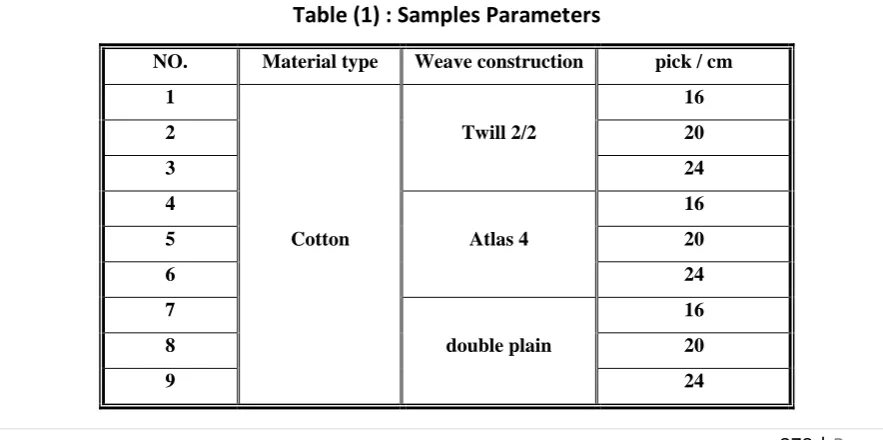
Table (1) : Samples Parameters
NO. Material type Weave construction pick / cm
1
Cotton
Twill 2/2
16
2 20
3 24
4
Atlas 4
16
5 20
6 24
7
double plain
16
8 20
879 | P a g e
10lined weft
16
11 20
12 24
13
polyester
Twill 2/2
16
14 20
15 24
16
Atlas 4
16
17 20
18 24
19
double plain
16
20 20
21 24
22
lined weft
16
23 20
24 24
25
poly acrylic
Twill 2/2
16
26 20
27 24
28
Atlas 4
16
29 20
30 24
31
double plain
16
32 20
33 24
34
lined weft
16
35 20
36
24
First stage / researched fabrics have been manufactured in a private textile factory
Constant factors involved in manufacturing research fabrics are :
- The number and type of used warp threads are 24/2 s cotton
- The density of weft threads in a single unit of measurment 22 threads /cm
- The weft thread number is 20/1 sand , its equivalent in other types of materials
Variable factors applied in samples production are :
880 | P a g e
- Weft densities( 16 -20 - 24 pick/ cm )- Four diffierent types of weave constructions ( Twill 2/2 - Atlas 4 - Plain Double - Lined Weft)
A table of fabric descriptions and sample numbers has been attached .Results and discussions :
III RESULTS AND DISCUSSIONS
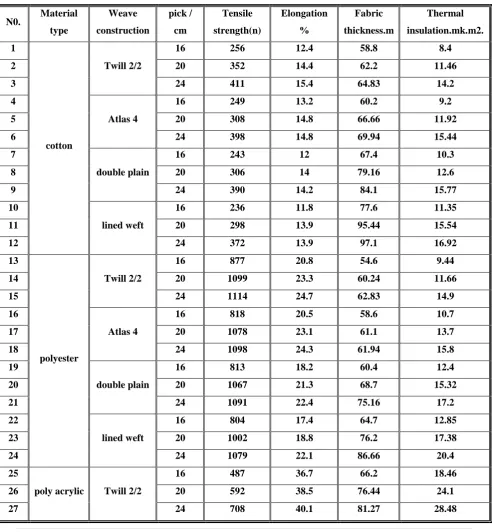
Table (2) shows the results of tests
N0. Material type Weave construction pick / cm Tensile strength(n) Elongation % Fabric thickness.m Thermal insulation.mk.m2. 1 cotton Twill 2/2
16 256 12.4 58.8 8.4
2 20 352 14.4 62.2 11.46
3 24 411 15.4 64.83 14.2
4
Atlas 4
16 249 13.2 60.2 9.2
5 20 308 14.8 66.66 11.92
6 24 398 14.8 69.94 15.44
7
double plain
16 243 12 67.4 10.3
8 20 306 14 79.16 12.6
9 24 390 14.2 84.1 15.77
10
lined weft
16 236 11.8 77.6 11.35
11 20 298 13.9 95.44 15.54
12 24 372 13.9 97.1 16.92
13
polyester
Twill 2/2
16 877 20.8 54.6 9.44
14 20 1099 23.3 60.24 11.66
15 24 1114 24.7 62.83 14.9
16
Atlas 4
16 818 20.5 58.6 10.7
17 20 1078 23.1 61.1 13.7
18 24 1098 24.3 61.94 15.8
19
double plain
16 813 18.2 60.4 12.4
20 20 1067 21.3 68.7 15.32
21 24 1091 22.4 75.16 17.2
22
lined weft
16 804 17.4 64.7 12.85
23 20 1002 18.8 76.2 17.38
24 24 1079 22.1 86.66 20.4
25
poly acrylic Twill 2/2
16 487 36.7 66.2 18.46
26 20 592 38.5 76.44 24.1
881 | P a g e
28Atlas 4
16 444 36.2 70.4 19.66
29 20 580 37.8 80.72 25.2
30 24 694 40 84.55 29.4
31
double plain
16 432 34.9 81.2 21.4
32 20 562 37.4 95.82 25.6
33 24 680 39.4 98.33 29.9
34
lined weft
16 387 34 99.7 22.9
35 20 540 36.2 112.66 37.6
36 24 644 39.2 116.11 39.4
The following analysis has been made to study the influence of different research variables :
1- Material type : cotton , polyester , poly acrylic
2- Weave construction : Twill 2/2 , Atlas 4 , double plain , lined weft
3- Weft thread density : 16 , 20 , 24 pick / cm
And the effect these variables have on measured characteristics ( elongation in weft direction , cloth thickness ,
thermal insulation ) in the produced fabric , keeping in notice that warp material is constant and so is the warp
threads density which is 22 thread/cm .
After analyzing the results for Tests.
After accomplishing the research with required variables , and applying functional characteristics related tests
for male winter shirts . The results have been listed in a table and so are the required statistics ،alongside
studying the coefficient of correlation among research variables , as follows ;
3-2 Effect of fabric constructions on tensile strength:
Tensile has an important place among fabric characterstics that are used for making clothes , tensile is affected
by several factors such as material type , weave costruction , clothe weight
0 500 1000 1500
16 20 24
Te
n
si
l s
tr
e
n
gt
h
Material - Weave- construction
cotton twill2/2 cotton atlas 4 cotton double plain cotton lined wefet polyester twill2/2 polyester atlas 4 polyester double plain polyester lined wefet poly acrylic twill2/2
882 | P a g e
3-2-1- different material effect on sample tensile towards weft :
Table (2 ) and figure (1) illustrate each material type on produced samples tensile , for instance , polyester made
materials gave results of highest tensile , that is due to the high ability polyester has for enduring tensile when
compared with cotton and poly acrylic, thus the fabrics made of it.
3-2-2 Change in weave construction effect on tensile :
When all other factors are constant , and the only variable is weave construction in researched samples , fabric
tensile increase , reaching its maximum with twill 2/2 , next to it Atlas 4 , then plain double and finally lined
weft .
3-2-3 Pick / cm effect on tensile :
Table (2) figure (1) show weft density effect on fabric tensile , where there is a direct correlation between weft
number increase and tensile , that is because a larger number of weft threads share the load of tensile the samples
subjected to it .(12)
3-3- Percentage of fabric elongation in weft direction :
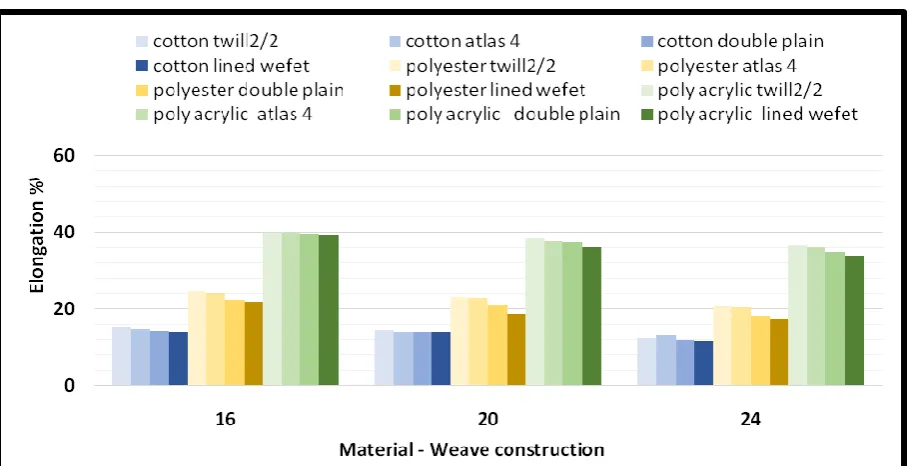
figure. (2):Effect of various factors on the elongation
3-3-1 material variation effect on elongation in the direction of weft :
Table (2) figure (2) show the effect of material type in the direction of weft on elogationpercentage ,. Poly
acrylic gave the highest elongation percentage , next came polyester then cotton made wefts , that is due to the
nature of these threads.
3-3-2 weave construction variation effect on elongation :
Table (2) figure (2) illustrate the strong connection between weave construction and elongation percentage ,
883 | P a g e
double and finally weft lined , that is because when the overlappings in the weave construction increase thenumber of overlappings decrease in single measuring unit so is the elongation percentage(13)
3-3-3 The effect of varying weft density on elongation :
Table (2) and figure (2) illustrates the strong connection between the number of wefts per centimeter and
elongation percentage . The increase in weft density per centimeter results in the increase in the number of
overlappings in single measuring unit , which strengthens the ties between threads and wefts , and increasing the
elongation percentage as a result
3-4- Fabric thickness :
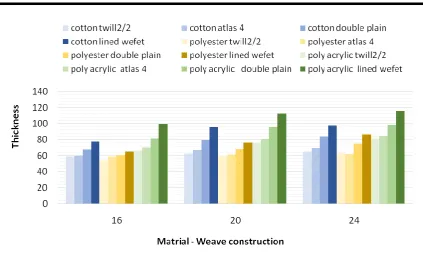
figure. (3): Effect of various factors on thethicknes
Fabric thickness has a direct impact on the different characteristics of the cloth ,specially on thermal insulation (
feeling warm)
3-4-1 Effect of different materials on fabric thickness:
Table (2) and figure (3) illustrate different material types effects on thickness , samples with poly acrylic wefts
have the thickest form , next comes polyester , then samples with cotton wefts . That is due to the poly acrylic
nature , that is being huge and occupies a great part of space , with a thickness more than other materials.(12)
3-4-2 Change in weave construction effect on fabric thickness :
Table (2) and figure (3) show the effect of different weave constructions on fabric thickness , where thickness
varied in twill 2/2 , Atlas , Double , and lined , despite the constant material type and constant density . It was
found that weft lined construction achieved the highest thickness , Double came next , then Atlas , and Twill 2/2
884 | P a g e
two layers of fabrics the thing that gives the fabric a thicker consistancy than that of Twill2/2 and Atlas 4.3-4-3
Different weft densities and its effect on fabric thickness :
Table (2) and figure (3) illustrate the relation between the increase in weft number per centimeter , and fabric
thickness , with other factors remaining constant . There is a direct correlation between weft numbers and fabric
thickness , that due to the following :
When weft number increase per centimeter , the number of overlappings increase in turn , where every
overlapping introducing a salience over the fabric surface , which increase the thickness .(14)
When the overlappings number per centimeter increase the percentage of Chips stored inside the threads
increase and so does the thickness.
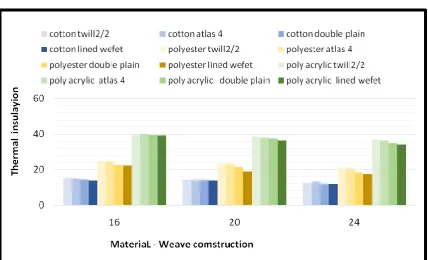
3-5- Thermal insulation of fabrics :
figure. (4):Effect of various factors on theThermal insulation
Fabric capability of thermal insulation is defined by several factors , such as material type , weave construction ,
square meter weight.
3-5-1- The change in material and its effect on thermal insulation :
Table (2 )figure ( 4) show the extent of the effect material type has on thermal insulation . Fabrics made of poly
acrylic scored the highest ability of thermal insulation , polyester made wefts came next and cotton made wefts
came last . That is because of the poly acrylic ability to lock still air inside thread anatomy , increasing their
ability on thermal insulation
.
885 | P a g e
Table (2) figure (4) , illustrate the effect of weave construction applied , on the thermal insulation of fabric whenall other fabrics are constant . Lined weft weave construction achieved the highest rate of thermal insulation ,
due to its abiity of trapping air inside it which inhibits temperature leakage to and from the body . Double plain
construction comes second , then Atlas and finally Twill 2/2 .(15)
3-5-3 Change in density and its effect on thermal insulation :
Table (2) and figure (4) show the direct correlation between weft number per centimeter and thermal insulation
,when all other factors are fixed . That due to increase in thread merging and thus the ability to trap air inside it
which lessen heat leakage through fabric.
IV RESEARCH SUMMARY
Product quality depends primarily on how suitable its basic characteristics to the requirement of its usage , and
how befitting it is to the function it was intended for , this function that is defined through careful study .
Designing and manufacturing clothes with specific purpose , like winter male shirts , depending during that on
a scientific basis to determine fabric characteristics , help to define the correct weave construction for these
fabrics .
This research aims at producing fabrics that provide the required comfort alongside providing thermal insulation
that suits their purpose as winter male shirts.
Within that frame , 36 samples have been produced using a single type of warp threads
( cotton 24/2 ) , and a single type of warp density ( 22threads /cm ) , and applying 3 different weft materials ,
these are cotton , polyester , and poly acrylic of number 20/1 or its equivalents .
Four different weave constructions for each material have been used , these are Twill2/2 , Atlas 4 , Double plain
, and weft line. With each weave construction 3 types of pickes have been applied , these are 16 , 20 , and 24
pick / cm . After the samples been produced , proper functional performance tests for winter fabrics have been
applied on them. These are tensile , elongation , fabric thickness , and thermal insulation .
The study has proved that there is a direct influence to material type , weave construction , and pick number per
centimeter , on the functional performance of the samples. Where samples with poly acrylic wefts gave the best
results in achieving thermal insulation and thickness , making them the best candidate , after wool , for making
winter fabrics , and the samples with polyester made wefts achieved best results in the field of tensile.
Considering the world wide development of weave and textile industry , where a diversity of manufacturing
processes and machinery are applied . And with the many assortments of materials that result in different fabrics
, this research aimed at studying the different possibilties in producing winter male shirts fabrics . That is
because of the change that came over the used materials and weave constructions. With the increasing prices of
natural wool material , which was essential to manufacturing winter clothes , it became necessary to study
substitute weave constructions that would provide warmth and proper comfort for the consumer , and would
deliver financial and practical content. This research presented several weave constructions , and three different
886 | P a g e
REFERENCES
[1]Lyle,D.S.and Brinkley j. (Contemporary clothing, Bennett and Mcknight publishing co ,Chicago Ilinois
1999.
[2] A. Z. Ismail " Determine the most appropriate textile structure combinations to achieve the physiological
properties of comfort to wear sports training in the Egyptian climatic conditions "Master's degree , Faculty
of Applied Arts, Helwan University, Egypt ,2008.
[3] P. Lennox- Kerr, High P eak- UK, Hollow Peek Fibers, Chemicai Fibers International . Voi.51 . June
2001.
[4] WL Gore and Associates.Garments 7 G loves That Brotectwearars, 136 The Indian Textile Journal . July (
2003 )
[5] Guo. Y. Li. Y, and Cokura . H. Impact of fabric moisture transport propertis on Physiological responses
When wearing Protective CLO thing. Textile Resarch Journal Vol 78 (12) , 2008 .
[6] MAKinen . H. Textile for Protection, firefighters protective CLOthing ., P 625 -646 , 2005.
[7] K. S. Aung "A study of the nature of fabric comfort design- oriented fabric comfort modle"503(5), 2004, 128
:135.
[8] Y .S. CHEN, J. FANAND X .Qian, Effect of Jarment fit on Thermal insulation and Avaporacive Resistance ,
Textile RES. J. 74 (8) , 742- 784 , (2004)
[9] Nockir. W, Seibert. J. Firefighter garments with non : Textileinsulacion.,Environmental Ergonomics, (
2005).
[10] Sadia Omar, Thesis, The Effect of Cover Factor Variation on Physical and Mechanical Properties of Jeans
Fabrics Which Suit its Performance as Garments , Depart of Textile, Faculty of Applied Arts, Helwan
University, Egypt, 1995.
[11] Chen, Y. S ., fan , J. , and Zhang , W. CLOthing Thermal Insulation During Sweating.Textile R. J., Vol.73 ,
No. 2, (2003).
[12] Yamini, J.; D. Gupta; V. K. Kothari; (2015). Comfort properties of plated knitted fabrics with varying fiber
type., Indian Journal of Fiber& Textile Research, Vol. 40, (March 2015), pp. 11-18
[13].Pınar, D.B.;B.R.E. Osman;(2006).Prediction of Strength and Elongation Properties of
Cotton/Polyester-Blended OE Rotor Yarns, fibers & textiles in Eastern Europe January / March 2006, Vol. 14, No. 1 (55)
[14] Li, B.R. (1984). Kapok (in Chinese), In "Encyclopedia Textile," Encyclopedia of China Publishing House,
Beijing,China, p. 195.
[15] Voumbo,M.L.;Wereme; Gaye; Adj. and Sissoko;(2010).Characterization of the Thermophysical Properties