125 | P a g e
HIDDEN CAMERA DETECTION
Vaishali Koul
1, Rakshita Macheri
2, RibhuVats
1,
Liya Baby
3, Poonam Bari
41,2,3,4
Department of Information Technology, Fr. Conceicao Rodrigues Institute of Technology (India)
ABSTRACT
This paper intends to aid in maintaining the safety and security of people by developing an application withthe
help of which spy cameras can easily be detected, also the location and the perpetrator’s identity would be sent
to the concerned authorities. It finds its application in courts and places where cameras are not allowed. The
camera retroreflects the light beam and then images are captured which are image processed to detect the
camera. The area to be protected is scanned by normal led light. At the end, colour segmentation is used to
identify the green component that represents the area where camera is present.
Keywords: Retroreflection, Overexpose, charged coupled device (CCD), Thresholding, Colour
Segmentation, Image Processing
I. INTRODUCTION
The issue of hidden cameras at public places is very paramount these days. These cameras are secretly put up in
changing rooms, theatres and many other places which pose a major threat to the privacy of people. Movie
shows as soon as they are released are recorded and put up for public use way before the actual legal CDs are
made available in the market leading to huge losses for the actual owners who don’t get their share of the
benefit. This project intends to aid in maintaining the safety and security of people by developing an application
with the help of which spy cameras can easily be detected. Also this project finds its application in courts and
places where cameras are not allowed. Some people might argue that cameras are easy to find and this proposal
is therefore unnecessary, but searching for covert cameras is no easier a job. Manually checking their presence
is almost impossible, this system will find its application at such places.
II. EXISTING SYSTEMS
A number of systems are already present which use different types of technologies to detect spy cameras at
different places. Few such technologies are as follows:
2.1 Hidden Camera Detector
Hidden Camera Detector analyses the magnetic activity in the surrounding area and in case a resemblance to a
camera is detected, an alarm is raised for further investigation for getting hold of the spy camera. It finds its
application in trial rooms, hotel rooms and places where cameras maybe hidden. This app can also detect
infrared lights. Also helps sharing of the location with friends easily. Radiation meter feature need to have
126 | P a g e
2.2 Glint finder-camera detector
An android user application based on the principle of retro reflection and is used mainly for hidden camera
lenses and dropped part of contact lenses. Basically it searches for the lens glint given off by the hidden camera
optics. Retroreflection is availed using a camera flash which shows up as hotspots in the output image. Flash
rate and duty cycles depend on the device’s capability.
2.3 The radio frequency detector of active cameras
It involves a circuitry consisting of a number of resistors, a few capacitors, some typical ICs and piezo-buzzer
which makes a sound when a camera is detected. The basic principle of this device is a disc capacitor to detect
the cell phone signal with frequency of 0.9 to 3 GHZ within a range of 1.5 meter radius. [1]
2.4 Pirate eye
The system constantly records the theatre and catches the recording camera and sends pictures to the authorities.
The pirate eye has a software built in which detects the camera and highlights the exact location of the recording
camera with a red circle around that portion and the pirates are caught red-handed in the act. It has a network
operation centre which sends an alarm to the theatre authorities. It is an invasion of privacy of the audience for
the sake of entertainment industry. It creates a sense of hostility in the minds of watchers as they are being
constantly watching. Sometimes innocent are caught in the act while they are not even involved.
III. METHODOLOGY
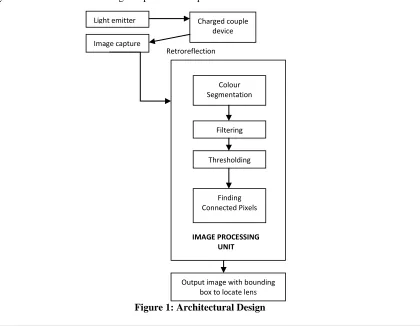
Architectural Block Diagram:
This system consists of the following components as explained before.
Figure 1: Architectural Design Light emitter
Image capture
Charged couple device
Colour Segmentation
Filtering
Thresholding
Finding Connected Pixels
Output image with bounding box to locate lens Retroreflection
rays
127 | P a g e
3.1 Retro reflection property of a camera
Camera retroreflects an incident beam of light back to the point of emission at an angle of 180 degrees. So it
sends back the beam to the source .Reroreflection is a property in cameras where it reflects back a beam of light
incident on it. The entire device is setup on the basis of this principle. [2]
3.2 Camera Detection
3.2.1Scanning
The entire area to be protected is scanned by using a beam of normal light.LED (green) is used for producing
them. The scanning beams sweep through the vertical and horizontal direction of the area, to ensure no camera
escapes from the device. [3]
3.2.2 Test image capture
The area being scanned by the light beams is simultaneously recorded. The preprocessing image being acquired
is called as the test image. The test image is obtained by use of high resolution camcorders. The camcorder
should have a wide angle of capture so that it covers the entire area. The retro reflected beams also have the
same properties of the original emitted beam. [3]
3.3 Image processing
3.3.1 Colour segmentation:
The image is taken in BGR format, we split the image into its Blue, green and red planes and extract the green
plane from the image.
3.3.2 Filtering:
Median filters and applied on the image in order the remove noise and gets a smoothened image for further
processing.
3.3.3 Thresholding:
The image in next step is thresholded to get the pixel in required range. Then we perform, morphological
closing along with flood fill to get the foreground image.
3.3.4 Finding connected pixels:
Then we find the connected pixels in the foreground image that are the potential lenses that are to be detected.
IV. FLOWCHART
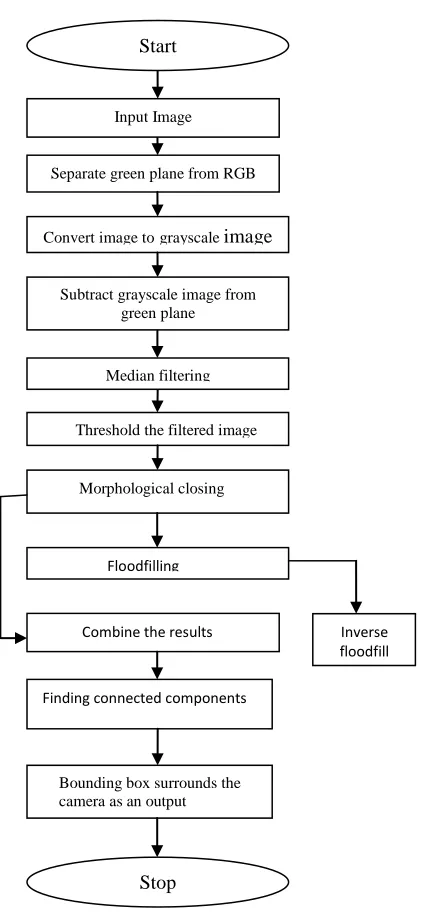
Figure 2 gives the flow of the image processing techniques that is done on the input image. First the image in
taken in colour format. Then it is split into RGB components and the Green plane is extracted followed by
conversion of the input image to grayscale image. The grayscale image is subtracted from the green plane to get
a sub image. Using median filtering, the image is smoothened. The filtered image is thresholded in a given
particular range, here 35 to 255. The morphological closing is done on the image to connect the small gaps that
are not connected. Then flood fill is done to perform to fill regions of the area of interest followed by an inverse
flood fill operation.
The results of closing and flood fill are combined to get the foreground pixels. Finally after identifying
128 | P a g e Figure 2: Image Processing Flowchart
V. CONCLUSION
Hidden camera detection would detect spy cameras in trial rooms, theatres and many other public places where
it is prohibited with immediate report to the authorities after the detection. Manually checking their presence is
almost impossible, the proposed system is an efficient method for camera detection because no matter how
small the lenses are, they can be easily detected. In confidential meeting rooms, even after heavy checking
people manage to skip the security and take cameras inside, record the conversations and use them for illegal
purposes. So this application would be of great help for camera restricted areas.
Input Image
Separate green plane from RGB
Convert image tograyscale image
Subtract grayscale image from green plane
Median filtering
Threshold the filtered image
Morphological closing
Bounding box surrounds the camera as an output
Stop Start
Floodfilling
Finding connected components
129 | P a g e
VI. ACKNOWLEDGEMENT
The authors gratefully acknowledge the contributions Dr. S.M.Khot, Principal of Fr. C. Rodrigues Institute of
Technology, Miss. Archana Shirke, H.O.D. of IT department, Miss Dhanashree Hadsul, Coordinator of IT
department and project coordinator, Miss Kalpana Wani, project coordinator and Miss Poonam Bari, project
guide for their work on the original version of this document.
REFERENCES
[1] Gayathri N.,T. Sivasakthi , “Presence of active mobile phones and Hidden camera detection”, International
journal of computing communication and information system Volume 8 2016
[2] Marc Roessler, “How to find hidden cameras”,25 March 2002
[3] K. Sonasri , K.Venkata Priyanka,”Detecting and disabling digital cameras using image processing”,