Status and perspective of FARCOS:
A new correlator array for nuclear
reaction studies
E.V. Pagano1,2, L. Acosta3,4, L. Auditore5, C. Boiano6, G. Cardella3, A. Castoldi7, M. D’Andrea3, D. Dell’aquila8,
E. De Filippo3, S. De Luca5, F. Fichera3, L. Francalanza8,
N. Giudice1,3, B. Gnoffo3, A. Grimaldi3, C. Guazzoni6,7, G. Lanzalone2,9, I. Lombardo8, T. Minniti11,12, S. Norella5,
A. Pagano3, M. Papa3, S. Pirrone3, G. Politi3, F. Porto1,2, L. Quattrocchi5, F. Rizzo1,2, P. Russotto3, G. Sacc´a3, A. Trifir`o5, M. Trimarchi5, G. Verde3,10 and M. Vigilante8
1Universit`a di Catania, Catania, Italy
2INFN - Laboratori Nazionli del Sud, Catania, Italy 3INFN, Sezione di Catania, Catania, Italy
4Istituto de F´ısica, Universidad Nacional Aut´onoma de M´exico, M´exico City, M´exico
5Dipartimento di Fisica e Scienze della Terra, Universit`a di Messina, INFN, gr. collegato di Messina, Messina, Italy
6INFN, Sezione di Milano, Milano, Italy
7Politecnico di Milano, Dipartimento di Elettronica, Informazione e Bioingegneria, Milano, Italy
8INFN, Sezione di Napoli, Dipartimento di Fisica, Universit`a di Napoli Federico II, Napoli, Italy
9Universit`a di Enna Kore, Enna, Italy
10Institute de Physique Nucl´eaire Orsay, Orsay, France 11CNR - Istituto per I Processi Chimico-Fisici, Messina, Italy 12ISIS Facility, Science and Technology Facilities Council, Rutherford
Fermi energy (20 MeV/u<E/A<200 MeV/u) is an active area in nuclear science [1]. In this energy region, an impressive range of physical phenom-ena occurs within large time-scales (from 10 to 1000fm/c) which are re-vealed through imprints on space-time and particle-particle correlations [2]. In particular, nuclear matter can experiences variation with respect to the saturation density ρ0 (≈ 0.17 nucleon/fm3) [3]. Exotic nuclei can be also produced and studied in close connection with nuclear astrophysics [4]. With the availability of new-generation radioactive ion-beam facilities (RIB), like for instance SPES at LNL, SPIRAL II at GANIL, FAIR at GSI or FRIB at MSU or the possible upgrade of the heavy ion CS facility in Catania, such studies assume renewed interest. Experimentally, large efforts has been devoted in the last two decades in order to achieve high energy and angu-lar resolution of dedicated detection systems [5]. In this paper we briefly describe the next-generation correlator FARCOS (Femtoscope ARray for COrrelation and Spectroscopy) for reaction and spectroscopic studies [6]. FARCOS is a modular array of telescopes arranged in a single cluster, each one consisting of three detection stages. The first two stages are two Double Sided Silicon Strip Detectors (DSSSD) of active area 6.4×6.4 cm2 with 32 vertical strips in the front side and 32 horizontal strips in the back side and are 300 μm and 1500μm thick respectively. The last stage consists of four CsI(Tl) crystals (3.2×3.2 cm2) of 6 cm of thickness read by a photodiode (18×18 mm2). We show in Fig. 1 a typical close assembling of one cluster. Particle identification is performed by ΔE/E, pulse shape(PSD) and Time of Flight (TOF) techniques. Portability and modularity are impor-tant characteristics making feasible the easy coupling with 4π detectors, other correlators and/or magnetic spectrometers. Digital Signal Acquisition (DSA) is also envisaged. We used, preliminary, in the electronic front-end, a preamplifier (PAC) derived from an improved versions of CHIMERA-type PACs developed to minimize the electronics noise and to optimize TOF performances [7]. So, the read-out of silicon strips was performed by
Figure 1: schematic view of a cluster of FARCOS
Figure 2: The INKIISSY experimental setup.124Xe+64Zn @ 35MeV/A was the studied reaction.
16FE)) allocating 32-channels PACs with low power consumption (<900 mW for 32 channels). FARCOS prototype was tested and coupled for the
first time with the 4π CHIMERA [8] in the INKIISSY (INverse KInematic
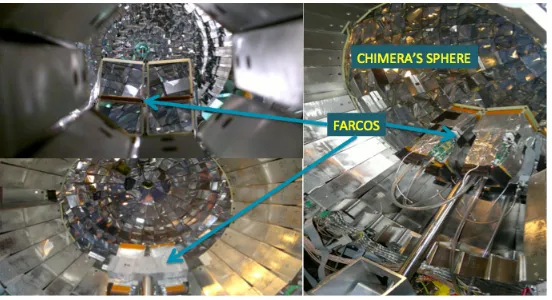
ISobaric System) experiment [9] in Catania on April 2013 with beams de-livered by INFN-LNS facility. FARCOS covered the range of polar and az-imuthal opening,θlab ≈16◦÷44◦ and Δφ≈75◦, respectively, corresponding to a solid angle coverage of ≈ 262msr (see Fig. 2). As a consequence, a portion of CHIMERA was shielded by FARCOS telescopes, thus giving the opportunity to investigate about the detection of neutrons [10].
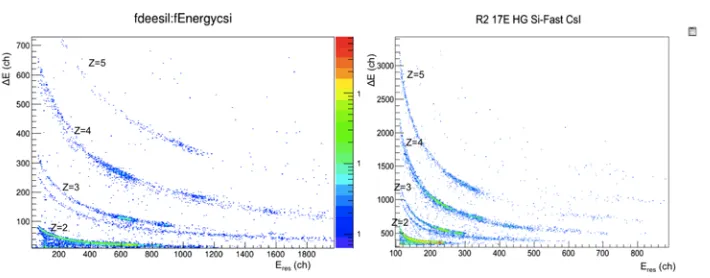
Figure 3: ΔE/E identification matrix of two strips between the first and the second DSSSD stages (INKIISSY experiment).
Figure 5: comparison between two ΔE/E identification matrix obtained in the reac-tion16C+12C @ 40 MeV/A (CLIR experiment) from two telescopes of CHIMERA detector of the ring two. Left: signals processed by GET. Right: signals processed by standard CHIMERA electronic
The GET (Generic Electronic for TPC) electronics for read-out and DAQ, was also tested. GET is an compact system designed to handle a very large number of independent electronic channels (more than 30kch). The innovative performances such as high versatility and compactness make the GET project a good candidate for FARCOS array (132 channels for each cluster allocated in a small volume, about 7x7x10 cm3). GET is based on one chip, AGET, processing 64 independent channels. Each channel con-sists of a preamplifier, a filter, a discriminator and an array of 512 capacitors having sampling frequency ranging from 1 to 100 MHz. Four AGET chips are allocated on a ASAD board for the digitalization of 256 channels. A block of four ASADs (1024 chs) can be read-out by a single CoBo. Up to
10 CoBo boards can be house in the μTCA crate. In this same crate, a
MUTANT card is used for triggering, synchronizing different CoBos and for managing inter-communications among different devices [11]. Silicon detec-tors and CsI(Tl) crystals were tested by comparing the CHIMERA and the GET DAQ systems (see Fig. 5). The result of this comparison is quite satisfactory.
construction at INFN-Laboratori Nazionali di Legnaro.
References
[1] Proceedings of the IWM-EC (2014), Catania, (Italy), Vol.108,
pub. by the Italian Physical Society, Bologna, Eds. B. Borderie,
R. Bougault, A. Pagano, S. Pirrone and G. Politi.
www.epj-conferences.org/articles/epjconf/abs/2015/07/contents/contents.html.
[2] S. Koonin, Phys. Lett. B 70 43 (1977)
[3] Bao-An Li et al., Phys. Rev. C 71044604 (2005)
[4] V. Baran, M. Colonna, V. Greco, M. Di Toro, Physics Reports, Volume 410, Issues 56, May 2005, Pages 335-466
[5] R.T. De Souza, N. Le Neindre, A. Pagano and K. H. Schmidt, Eur. Phys. J. A 3, 275-291 (2006).
[6] E. V. Pagano et al., EPJ Web of Conferences 88, 00013 (2015), and contribution in Proceedings ISTROS 2015 International Conference (in press).
[7] C. Boiano, et al., IEEE Trans. On Nucl. Science 51 1931 (2004)
[8] E. De Filippo, A.Pagano, European Physical Journal A50 (2014) 32, and reference therein.
[9] P. Russotto et al., Phys. Rev. C91, 014610 (2015).
[10] L. Auditore, et al., EPJ Web of Conferences88, 01001 (2015).