Western University Western University
Scholarship@Western
Scholarship@Western
Electronic Thesis and Dissertation Repository
8-12-2015 12:00 AM
Distractor Processing in Identity Negative Priming Tasks
Distractor Processing in Identity Negative Priming Tasks
Ahmed Shuriye
The University of Western Ontario
Supervisor Dr. Eric Buckolz
The University of Western Ontario Graduate Program in Kinesiology
A thesis submitted in partial fulfillment of the requirements for the degree in Master of Arts © Ahmed Shuriye 2015
Follow this and additional works at: https://ir.lib.uwo.ca/etd
Part of the Motor Control Commons
Recommended Citation Recommended Citation
Shuriye, Ahmed, "Distractor Processing in Identity Negative Priming Tasks" (2015). Electronic Thesis and Dissertation Repository. 3029.
https://ir.lib.uwo.ca/etd/3029
This Dissertation/Thesis is brought to you for free and open access by Scholarship@Western. It has been accepted for inclusion in Electronic Thesis and Dissertation Repository by an authorized administrator of
i
Distractor Processing in Identity Negative Priming Tasks
(Thesis format: Integrated Article)
by
Ahmed Adam Shuriye
Graduate Program in Kinesiology
A thesis submitted in partial fulfillment of the requirements for the degree of
Master of Arts
The School of Graduate and Postdoctoral Studies The University of Western Ontario
London, Ontario, Canada
ii
Abstract
With identity negative priming (INP) designs, subjects respond on the basis of a target stimulus’ identity and trials are presented in pairs; first the ‘prime’ and then the ‘probe’; with the target and/or to-be-ignored distractor objects appearing on either trial. The latency-based INP phenomenon reflects the fact that probe trial target reactions are
significantly slower when this target has just served as the prime distractor object, relative to when it was new. One explanation for the INP phenomenon is that the prime distractor event is inhibited and representations of this are stored so that they are retrieved when the probe trial is delivered and then participates in related processing on this trial. Its
participation produces inhibitory after-effects such as the INP effect. The specific
question here is what aspect of the prime distractor event is inhibited that causes the INP effect (i.e., locus question); its object (i.e., Object NP), its response (i.e., Response NP) or both?
iii
number-to-finger association strength (Practice Group), the other did not (No Practice Group).
The main findings of note and their implications were as follows: (i) as expected, prime trial distractor events were processed, seemingly to the point of the activation and subsequent inhibition of their related response (i.e., ‘conflict’ [assigned response] but not ‘neutral’ [no assigned response] probe distractors produced significantly elevated reaction times beyond that of the control condition, indicating that this latency elevation was due to the distractor response, likely because it caused a response conflict which took time to resolve), (ii) stored prime distractor response processing was retrieved and participated in ‘related’ probe trial processing (i.e., evidenced in the inhibitory after-effects they
produced), such as on ignored-repetition and distractor-response repeat trials. The nature of the probe trial inhibitory after-effects produced by the retrieved prime distractor
response was somewhat unexpected, however. Error rates were greater for those trials that required the prime distractor response on the probe trial, relative to the control condition error values. Presumably, this result reflects the execution resistance property of formerly inhibited distractor responses which, essentially, argues against using the correct
iv
nature, supporting Moore’s (1994) assertion that such a context is necessary for INP to manifest itself. The reason for this need remains unsettled.
v
Acknowledgements
I would first like to thank my parents, Adam Shuriye and Gadiga Jama, for providing me with all the love and support a child can ask for, and more. I would not be where I am today without your guidance and support over the years and I truly appreciate every bit of it. To my siblings: Mohamed, Shirka, Sagal, Abdi, Rizak, and Samra; each and every one of you were instrumental in the completion of my degrees. I am both proud and lucky to have an incredible family.
Special thank you to my lab mate Ben Kajaste. Your leadership (in and out of the lab), humour, and genuine camaraderie produced an environment conducive to success.
To Jacqui Saunders, Jen Plaskett, and Lindsay Stark: Since the first day I walked into the Kin Grad office, you have greeted me with open arms and a welcoming smile. Thank you for all the assistance over the past two years.
I would also like to thank my committee members, Dr. Craig Hall and Dr. Don Morrow, as well as my examination board members, Dr. Alan Salmoni, Dr. Angela Mandich, and Dr. Craig Hall. Thanks for all the guidance you all have provided.
vi
Co-Authorship
vii
Table of Contents
ABSTRACT ... ii
ACKNOWLEDGMENTS ... v
CO-AUTHORSHIP ... vi
TABLE OF CONTENTS ... vii
LIST OF TABLES ... viii
LIST OF SCHEMATICS ... ix
LIST OF APPENDICES ... x
INTRODUCTION ... 1
METHOD... 13
Participants ... 13
Apparatus ... 13
Procedure ... 13
Design ... 16
RESULTS & DISCUSSION ... 22
GENERAL DISCUSSION... 32
REFERENCES ... 40
GLOSSARY OF TERMS ... 45
APPENDIX A ... 47
APPENDIX B ... 49
viii
List of Tables
Table Description Page
1 Mean Reaction Times (RT, ms) for the Trial Type (IR, CO, DRR) and Probe Configuration (Conflict, Neutral, Distractor Absent) for No Practice Group (n =10). ... 23 2 Mean Reaction Times (RT, ms) for the Subset of Subjects of No Practice
Group Showing Effect for the Trial Type (IR, CO, DRR) and Probe Configuration (Conflict, Neutral, Distractor Absent) (n =7).... 27 3 Mean Reaction Times (RT, ms) for the Trial Type (IR, CO, DRR) and
ix
List of Schematics
Schematic Description Page 1 T= target, D= distractor, A= activation, I= inhibition, ER=execution
resistant, IAE= inhibitory after-effect, CO= control trial, IR= ignored- repetition trial. 1. Latency Based SNP = the probe target reaction time is greater when it arises at a former distractor location than when it appears at an unused prime location; 2. Error Based SNP = error rates are greater for probe trials that require the prime distractor response (e.g., IR, distractor-response repeat trials) relative to when a control response is needed; 3. Selection Bias: against former prime distractor responses on free choice probe trials where subjects have some freedom to choose the probe response; 4. Error Protection: prime distractor response when not required is used less often in error than is a control response. NOTE – all of the inhibitory after-effects are manifestations that the prime distractor response has been processed and retrieved during probe trial processing, and has had a processing impact in one way or
another………...………....4
2 Illustration of the ‘number (1-8) - manual response (keyboard button presses)’ mappings employed in the current experiment, along with a generic outline of a screen display. Keyboard button presses D, V, M, and L were assigned numbers 1&2, 3&4, 5&6, 7&8, respectively. Within the rectangle;
T= target stimulus, D= distractor………14
3 An illustration of the three probe trial types used in this experiment to index identity negative priming (INP) loci. These trial types occurred for all three kinds of probe distractor levels but are illustrated here for the conflict distractor level only. IR (Ignored-Repetition) trials, probe target stimulus (3) was the prime distractor object; DRR (Distractor-Response Repeat) trials, target stimulus (4) requires the prime distractor’s assigned response but prime trial distractor object was not repeated; CO (Control) probe trial target (7) and distractors differed from prime trial targets and distractors. Reaction time (RT) differences between IR and DRR measure the prime distractor object’s inhibitory after-effect (Object NP) while the DRR versus CO RT difference is a measure of the after-effect produced by the prime distractor response when used on the probe (Response NP). The RT difference between the IR and CO trials measure the INP phenomenon……..………17 4 An illustration of a prime-probe trial sequence shown for the three probe distractor trial types (panels 6, 7, & 8). This particular exemplar is for ignored-repetition trials only. In the prime trial, the target was the ‘1’ and
x
List of Appendices
Page
1
Introduction
Distractors are ubiquitous occurrences in our everyday environments; some are self-inflicted (i.e., cell phone use) while others are imposed on us via external (e.g., visible crowd motion behind a glass backboard during a free throw attempt in basketball, accompanied with loud noise, timed to coincide with a free throw shooters action) or internal (i.e., memory) sources. Concern regarding the presence of distractors exists partly because they threaten our ability to achieve goal-related behaviour. Accordingly, interest has centered upon delineating the nature of the processing afforded distractor events; both in an effort to understand why they pose the threat that they do, and to learn how some aspects of this processing acts to successfully attenuate or prevent distractor interference, with regard to error rates and/or target stimulus delays (e.g., Dagenbach & Carr, 1994; Gorfein & MacLeod, 2007; Tipper, 2001).
For the most part, early investigations presented the target stimulus and the
distractor item at the same time and so examined the concurrent interference generated by the latter. The Stroop test is probably the best known exemplar of this kind of interference (Stroop, 1935). With the Stroop test, subjects simply had to name the colour of a
presented item as quickly as possible. The item itself was irrelevant and in some cases could be either a nonsense shape or a colour word. Interference was evident in the form of a lengthened reaction time (RT) relative to the nonsense shape condition when the colour word (distractor) named a colour different from the one in which it was printed.
Presumably, the distractor colour word produced an incorrect response urge that
2
Supportive of this idea is the fact that when the word colour matched that of the ink it was printed in, no RT delay was observed, presumably because the response urge
produced by the distractor word was the same as the required output and so there was no need to inhibit a competing incorrect response tendency (e.g., Hintzman, Carre, Eskridge, Owens, Shaff, & Sparks, 1972).
More recently, interest has shifted from the concurrent interference a distractor might cause for target stimulus processing to the question of whether earlier distractor processing can produce interference at a later point in time for related processing (i.e., distractor-induced, ‘inhibitory after-effects’)? The basic method used to look into this question compares two trial types; one where the current target has just served as a distractor on the previous trial (i.e., ignored-repetition trial) versus where this same target was not involved on the prior trial (i.e., a control trial). By way of an illustration,
returning momentarily to the Stroop test, this would entail having the colour named by the distractor word on the first (prime) trial serve as the colour to-be-named on the second (probe) trial [ignored-repetition] compared to when this same probe colour was not involved on the prime trial (Control). The usual finding is that RT for ignored-repetition trials is significantly longer than that for control trials (Dalrymple-Alford, E. C., & Budayr, B., 1966), an inequality termed ‘negative priming’ (NP) by Tipper (1985). In general terms, the NP phenomenon reveals the presence of an inhibitory after-effect, showing that earlier (prime) distractor processing can impact later related (probe)
3
suppresseddistractor-related response, or both, generate negative priming; that is, cause the RT lengthening on ignored-repetition trials (i.e., the locus question)? The focus in this paper is to examinethe locus question for identity tasks where the salient feature of a target stimulus is its identity, such as with the Stroop test.
Before turning to the research that has examined the locus of identity negative priming (INP), we note that NP has also been extensively observed in location tasks where the location of a designated stimulus object is relevant to determining correct response selection. In this case, the reaction time for probe targets that appear at former distractor locations (ignored-repetitions) is significantly longer than the reaction time found when the probe target arises at a previously unoccupied location (Control) [e.g., Buckolz, Boulougouris, & Khan, 2002; Neill, Terry, & Valdes, 1994; Tipper, Weaver, Cameron, Brehaut, & Bastedo, 1991]. This spatial negative priming (SNP) effect is quite robust, appearing when the target and/or distractor events are presented visually (Neill et al., 1994), aurally (e.g., Mayr, Moller, & Buchner, 2014; Moller, Mayr, & Buchner, 2015) or cutaneously (Frings, Mast, & Spence, 2014); although all three seem to have a
different SNP loci. More importantly here, because the locus for the visual SNP effect seems to be better established than is the case for visual INP, we can benefit from a brief consideration of the locus literature for visual SNP tasks in that it will point to a
methodology that can be used when investigating the INP locus, and will also provide a theoretical account of distractor processing that might transfer to INP tasks.
Spatial Negative Priming (SNP): Prime Distractor Processing and Locus?
4
Schematic 1: T= target, D= distractor, A= activation, I= inhibition, ER=execution resistant, IAE= inhibitory after-effect, CO= control trial, IR= ignored-repetition trial. 1. Latency Based SNP = the probe target reaction time is greater when it arises at a former distractor location than when it appears at an unused prime location; 2. Error Based SNP = error rates are greater for probe trials that require the prime distractor response (e.g., IR, distractor-response repeat trials) relative to when a control response is needed;
3. Selection Bias: against former prime distractor responses on free choice probe trials where subjects have some freedom to choose the probe response;
4. Error Protection: prime distractor response when not required is used less often in error than is a control response.
5
that it renders the prime distractor response resistant to future execution (i.e., response takes on an execution resistant [ER] feature). The successful later use of this response requires that this execution resistance first be set aside, a time consuming act that delays responding on ignored-repetition trials, thereby causing SNP (i.e., a response locus) [e.g., Buckolz, Goldfarb, & Khan, 2004; Buckolz, Stoddart, Edgar, & Khan, 2014; Fitzgeorge, Buckolz, & Khan, 2011]. Because representations of this distractor response processing are stored (Fitzgeorge & Buckolz, 2008; Haworth, Buckolz, & Kajaste, 2014), they can be retrieved at the time of the presentation of appropriately constructed probe trials to impact current processing (i.e., create an SNP after-effect). All of this prime distractor processing is held to occur automatically, indicated not only because it occurs in spite of instructions/intentions not to do so, but, more emphatically, because the SNP after-effect arises when the prime display is successfully masked (Fitzgeorge, Buckolz, & Khan, 2011; Kajaste, Buckolz, Haworth, & Perry, 2013). In location tasks, masked prime distractors are rendered phenomenally invisible and so could not be processed volitionally.
6
influence on SNP production. Reaction time was significantly longer for DRR than for Control trials, showing that the use of a just-inhibited prime distractor response caused slowing (i.e., execution resistance override time; a response locus). Notably, RT (DRR) was significantly slower than RT for ignored-repetition trials, indicating that the prime distractor location had no RT slowing impact when it was re-occupied on the probe trial by the target stimulus (Buckolz, Edgar, Kajaste, Lok, & Khan, 2012; Guy, Buckolz, & Khan, 2006). With the second modification to the traditional SNP procedure, the task included instances where a single location was mapped onto two permissible responses (1: many location-response assignment), and the subject was allowed to freely choose either whenever the probe target arose at a 1:many location. Critically, on these probe free choice trials, subjects showed a significant aversion to selecting the prime distractor response when it competed with a control output, and when the distractor response was chosen, its reaction time was significantly delayed. Both of these results reflect the operation of the execution resistance feature of the prime distractor response and confirm its contribution of SNP generation (Buckolz, Lok, Kajaste, Edgar, & Khan, 2015;
Fitzgeorge et al., 2011).
7
not yet produced a definitive experimental answer to this uncertainty, even though much of the theoretical speculation includes the possibility of a response locus of some kind contributing to INP, provided the motivation for the present study.
The Locus of Identity Negative Priming
Object Locus. There seems to be a consensus that prime distractor objects are inhibited and slow responding when they serve as the target stimulus on
ignored-repetition trials (e.g., Fox, 1995; May, Kane, & Hasher, 1995; Neill, 2007). Often cited in this regard is a study reported by Tipper, McQueen, and Brehaut (1998), where subjects responded orally and then manually on successive prime and probe trial pairs,
respectively. Identity negative priming (INP) magnitude was comparable both when response modality remained the same and when it changed between trials. Clearly, ignored-repetition trial delays did not rely on the required use of the actual prime
distractor response, implying that INP was, in this instance, produced solely by the prime distractor object. These findings are, however, not definitive in this regard as it is possible that the prime distractor activated both of the vocal and manual responses assigned to it, which were then both inhibited (Houghton & Mari-Beffa, 2005). Consequently, even when the response mode changed, ignored-repetition trials would have always included the need to use a previously inhibited response, which could have produced INP.
According to Neill (2007), a more definitive indication of an object locus contributing to identity negative priming (INP) is to be found in a report by Buchner, Zabal, and Mayr (2003). These authors provided their subjects with eight different
8
animal or an instrumental sound. Most notable, a cross modal INP effect was observed. That is, reaction time to a visual stick figure (e.g., guitar) was slower if its sound had served as a distractor on the prime trial, relative to a control condition, where this same probe stick figure was preceded by a prime with a piano sound as its distractor. In both of these instances, the probe response category was the same (i.e., use the prime distractor response). Hence, it appears that not only might the actual prime distractor event be inhibited, but so too some of its connected representations (i.e., the sound of a guitar generates/retrieves a visual image of a guitar) [termed “Conceptual Effect” by Neill]. Hence, an object locus for INP can be extended to mean objects related to the prime distractor itself, and that the presentation of these objects can cause delays.
In any event, experimental work pointing to an object locus for identity negative priming is not extensive and is in need of further examination, which we will undertake here, even though testing a response locus is our major interest.
Response Locus. Both Lowe (1979) and Moore (1994) extensively examined the impact of probe trial response conflict upon the manifestation of identity negative priming (INP), hypothesizing the existence of a distractor response inhibition INP locus to explain their findings. Collectively, these authors utilized three kinds of probe
9
Schlaghecken, 1998), (b) ‘neutral distractor’ trials, where the presented probe distractor had no assigned experimental output (i.e., produced no response conflict), and (c) ‘distractor absent’ trials, where the probe trial target appeared alone (i.e., no response conflict). These probe trial types were either unpredictably mixed together in pairs, or they predictably fixed during a testing session.
The overall results were clear. Identity negative priming (INP) was observed on response conflict but not on distractor absent probe trials, irrespective of whether their presentations were mixed or fixed within a session. The findings for the neutral distractor trials were more complex. These trials produced an INP effect when they were coupled with conflict distractors, unless, according to Moore’s (1994) speculation, the distractor was easily discernible to be incapable of generating an actual response conflict. The INP phenomenon was also absent when neutral distractors were mixed with distractor-absent trials or when they were fixed.
10
trials, even if, as Moore (1994) suggests, subjects mistakenly treated them as conflict distractors. Presumably, the latter decision cannot manufacture a competing probe
response and so allow INP manifestation. In spite of this setback, a response locus for the INP phenomenon stills holds sufficient explicative powers over the response conflict impact on INP that it deserves further study as at least one source of INP production.
Shiu and Kornblum (1996) have reported findings more convincing of a response locus for identity negative priming (INP). They had their subjects’ associate new
11
Current Objectives and Some Predictions
The main aim of this investigation is to look for evidence of an object and/or response locus for the identity negative priming (INP) effect. Further, we will determine whether the manifestation of INP and/or its loci, particularly a response locus, are influenced by the response conflict status of the probe trial as Moore (1994) proposed.
To accomplish this goal, we will follow the lead of Guy et al. (2006) for spatial negative priming tasks and we will use the latency differences among ignored-repetition (IR), distractor-response repeat (DRR), and control (CO) probe trial types to index ‘object’ (i.e., RT[IR] vs. RT[DRR]) and ‘response’ (i.e., RT[DRR] vs. RT[CO]) loci for the identity negative priming (INP) effect (see Schematic 3, Method). Additionally, the probe trials will include either a ‘conflict’ or a ‘neutral’ distractor, or ‘no’ distractor at all as a means of manipulating probe response conflict.
Some predictions can be made, but they are mostly tentative because of limited previous work on the issues of interest here. First, given the work of Shiu and Kornblum (1996), and the evidence of a response locus for spatial negative priming tasks (SNP) [e.g., Buckolz et al., 2004; Buckolz, Edgar, et al., 2012; Buckolz, Lok, et al., 2015; Fitzgeorge et al., 2011; Guy et al., 2006], a response locus for identity negative priming (INP) seems more likely than not, as is an object locus contribution (Buchner et al., 2003). Second, if Moore (1996) is correct, INP and a response locus will be observed for conflict, but not for distractor-absent, probe trials. While not a prediction, it bears noting that neutral distractor, ignored-repetition trials might yield an INP effect; if so, it would signify that the neutral distractors had been viewed as distractor in nature and treated as such (Moore, 1994). Third, evidence indicative that a response conflict had been
12
13
Method
Participants
Eighteen undergraduate university students (13 males, 5 females) between the ages of 18 and 24 years with normal or corrected-to-normal vision participated in this experiment. All participants were unaware of the purpose of the experiment.
Apparatus
Participants were seated at a desk in a dimly lit room approximately 200 cm from a 53cm x 33cm computer monitor that contained the visual display for the experiment. The display consisted of a white fixation line (1 cm in width, 0.5 cm in height) in the centre of the computer monitor against a black background. While seated, participants placed his/her forearms on a desktop that contained a keyboard which was stabilized on the middle of the desktop. The keyboard buttons “D”, “V”, “M”, and “L” were assigned to the stimuli used in this experiment, numbers 1-8. The third digit and index finger on the left hand controlled buttons “D” (1,2) and “V” (3,4), while the same digits on the right hand were assigned to the “M” (5,6) and “L” (7,8) buttons (see Schematic 2). The number stimuli, whether presented as targets or distractors, both measured 1 cm in width and 1.5 cm in height. A single target appeared 1 cm above the white fixation line while two identical, to-be-ignored flanker distractor numbers,when they appeared with the target,were displaced 1 cm to the right and to the left of the target’s position. The horizontal display distance was approximately 4cm with a horizontal visual angle of about 1.15 degrees.
Procedure
14
D V M L
1,2 3,4 5,6 7.8
Fixation Line
T D
D
15
Both groups completed the same experimental phase.
Pre-experimental Practice Phase. In this phase, the Practice Group (n=8) was presented with a single number stimulus on each trial (1-8) and were required to respond as quickly and as accurately as possible using the manual keypress assigned. Each number stimulus appeared 10 times within a block of 80 trials, with each subject completing 4 of these blocks (i.e., 320 total trials). This pre-experimental practice took place a day or two before experimental participation.
A trial sequence began with a warning tone of 100 ms in duration, whose offset was followed by the display of the white fixation line that remained for the prime trial sequence. The prime trial target appeared 600 ms after the warning tone and remained visible for 200 ms. Once a correct prime trial target response was made, the white fixation line disappeared, the screen turned blank and a trial sequence delay of 1500 ms occurred, whose offset was followed by a warning tone that lasted for 100ms. This signified the start of another trial sequence. When an incorrect response was performed, the trial sequence paused until the correct response was executed. Following a completion of an 80-trial block (approximately every minute), participants were automatically offered a rest. If accepted, participation resumed when the subject indicated to the experimenter that they wished to do so, at which point the experimenter re-started the program.
16
occurred during the Experimental Phase.
Trials with response times less than 100 ms (anticipations) or greater than 1000 ms (insufficient vigilance), along with those where a button press error occurred,were excluded from the reaction time analyses.
Experimental Phase. In this phase, subjects completed an identity negative priming task, where trials are presented in pairs; first the “prime”, and then the “probe”. The salient feature of a defined target used to determine proper response selection is its identity. The prime trial always contained a target and a pair of to-be-ignoredflanker distractors. In addition to a target stimulus, probe trials included either conflict or neutral flanker distractor events, or no distractor at all (i.e., distractor-absent trial). These three possibilities constituted the levels of the Response Conflict main factor studied here. Conflict distractors have experimental responses assigned to them (here, numbers 1-8) while neutral distractors (a diamond shape) do not. Conflict distractors are held to retrieve their assigned responses (e.g., Eriksen & Eriksen, 1985; Coles, Morris, & O’Hara, 1985), which compete with the target generated required output, thereby generating a response conflict. The neutral distractor and distractor-absent trials are conflict-free.
17
Schematic 3: An illustration of the three probe trial types used in this experiment to index identity negative priming (INP) loci. These trial types occurred for all three kinds of probe distractor levels but are illustrated here for the conflict distractor level only. IR (Ignored-Repetition) trials, probe target stimulus (3) was the prime distractor object; DRR (Distractor-Response Repeat) trials, target stimulus (4) requires the prime distractor’s assigned response but prime trial distractor object was not repeated; CO (Control) probe trial target (7) and distractors differed from prime trial targets and distractors. Reaction time (RT) differences between IR and DRR measure the prime distractor object’s
18
repeated on the probe). On a control trial, neither the target nor the distractor events appeared on the prime trial. The RT(IR) vs. RT(CO) difference was used to index the identity negative priming phenomenon itself while the RT(IR) vs. RT(DRR) and the RT(DRR) vs. RT(CO) contrasts measured ‘object’ and ‘response’ loci, respectively. These loci measures follow from the fact that the IR and DRR trials use a common response category and differ only with regard to whether the prime distractor object was used on the probe (IR) or not (DRR), while the DRR and CO trials differ in that DRR but not the CO trial requires the use of the prime distractor response. Both trial types involve a new target stimulus not utilized on the prime. The terms ‘traditional NP’, ‘object NP’ and ‘response NP’ were used (Houghton & Mari-Beffa, 2005) to refer to the RT(IR) vs. RT(CO), RT(IR) vs. RT(DRR), and RT(DRR) vs. RT(CO) comparisons, respectively. Henceforth, we will utilize this terminology herein.
In sum, the basic design of the current study consists of the manipulation of two, within-subject factors; Response Conflict and Probe Trial Type, each with three levels. A trial began with a warning tone lasting 100 msec. whose offset was followed by the display of the white fixation line that remained present for the entire trial sequence (see Schematic 4). The prime trial target and distractor events appeared 600 msec. after the warning tone offset and remained visible for 200 msec. Once a correct prime trial target response was made, a probe onset delay of 900 msec.was initiated, culminating with the onset of the probe trial display which lasted for 200 msec. In addition to the prime target stimulus, the probe trial also contained a conflict or a neutral distractor or was distractor free. A correct response to the probe trial target caused the screen to go blank,
19
20
When an incorrect response was performed at any time during a prime-probe sequence, the trial sequence paused until the correct response was executed, at which point the sequence automatically resumed. While error frequencies were recorded for analysis purposes, the reaction times for these error trials, prime and/or probe, resulted in the reaction time data for the entire prime-probe pairing being excluded from the latency analyses.Similarly eliminated from analyses were reaction times of less than 100 msec. (anticipations) or greater than 1000 msec. (insufficient vigilance).
Following the completion of 100 prime-probe trial pairs (approximately every 6 minutes), participants were automatically offered a rest. Trials resumed when the subject pressed the space bar.
On prime trials, each number (1-8) appeared as a target stimulus with equal frequency and was always accompanied equally often by one of the possible conflict (number) distractors, with the restriction that the target stimulus and distractor object do not share the same assigned response. In other words, if the number “1” appeared as a target, it would not be accompanied by the number “1” or “2” as distractors because the distractors would be associated with the same response as the target. Thus, each of the 8 possible targets was accompanied by each of 6 possible conflict distractors, again with equal frequency. This produced a total of 48 distinct conflict prime trials.
21
Therefore, each distinct prime trial was followed by 16 possible conflict probe trials of which 4 were ignored-repetition, 4 were distractor-response repeat, and 8 were control in nature. Since there were 48 distinct prime trials, the total number of conflict probe trials encountered was 768; in turn consisting of 192 ignored-repetition trials, 192 distractor-response repeat trials, and 384 control trials. The same trial breakdown held for the neutral distractor probe and control trial. Accordingly, each subject experienced a total of 2304 prime-probe trial pairs, randomly delivered over the entire trial series (576 ignored-repetitions, 576 distractor-response repeat, 1,152 control, and, an equal number of conflict, neutral, distractor-absent trials). Experimental participation was completed over 6 sessions that spanned over 14 days.
22
Results and Discussion
Unless otherwise stated, the analyses of variance (ANOVA) calculations reported here utilized two main within-subjects factors; Probe Trial Type (ignored-repetition [IR], distractor-response repeat [DRR], control [CO]) and Response Conflict (conflict, neutral, distractor- absent). Newman-Keuls tests (p< 0.05) were used for post hoc testing.
No Practice Group
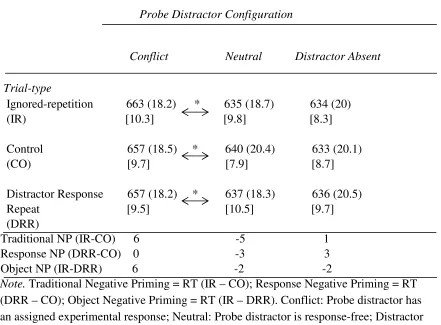
Utilizing within-subject mean reaction times (Table 1), the ANOVA calculations revealed that the only significant F-value was produced by the Response Conflict main effect, F(2,18)= 25.89, p< 0.01, MSE= 213; the remaining effects failing to do so (Probe Trial Type, F<1, and the interaction, F[4,34]= 1.99, MSE= 51, p= 0.12). The post hoc test applied to the Response Conflict factor showed that reaction time for the conflict
distractor probe trials (659 ms) significantly exceeded those obtained for the neutral (637 ms) and distractor-absent (635 ms) trials, whose latencies did not differ reliably from one another.
Looking at the button press error rates (Table 1), Probe Trial Type produced the only significant F-value, F(2, 18)= 4.05, MSE= 2.45, p< 0.05 (Response Conflict, F[2, 18]= 2.47, MSE= 2.74, p= 0.11; interaction, F[4, 36]= 1.71, MSE= 4.26, p= 0.17). The follow up post hoc test revealed that error rate was significantly greater only for the distractor-response repeat (9.9%) versus control (8.7%) trial contrast (ignored-repetition trial error rate= 9.5%).
23
Table 1
Mean Reaction Times (RT, ms) for the Trial Type (IR, CO, DRR) and Probe Configuration (Conflict, Neutral, Distractor Absent) for No Practice Group (n =10).
Probe Distractor Configuration
Conflict Neutral Distractor Absent
Trial-type
Ignored-repetition 663 (18.2) * 635 (18.7) 634 (20) (IR) [10.3] [9.8] [8.3]
Control 657 (18.5) * 640 (20.4) 633 (20.1) (CO) [9.7] [7.9] [8.7]
Distractor Response 657 (18.2) * 637 (18.3) 636 (20.5) Repeat [9.5] [10.5] [9.7]
(DRR)
Traditional NP (IR-CO) 6 -5 1 Response NP (DRR-CO) 0 -3 3
Object NP (IR-DRR) 6 -2 -2
Note. Traditional Negative Priming = RT (IR – CO); Response Negative Priming = RT (DRR – CO); Object Negative Priming = RT (IR – DRR). Conflict: Probe distractor has an assigned experimental response; Neutral: Probe distractor is response-free; Distractor Absent: No distractor appears on probe trial. ( ) = standard error (ms); [ ] = button press error percentage.
24
because it retrieved/activated its assigned response, which then competed with the correct, target required output. A responding delay for the probe target resulted because the incorrect response urge had to be inhibited. Further, the neutral probe distractors did not delay target responding (RT[neutral distractor] = RT[control]), reinforcing the idea that conflict distractors interfered with probe target responding because it produced a response conflict, and not because it prolonged target selection by cluttering the visual field.
Surprisingly, a latency based identity negative priming (INP) effect was not observed with this task (Table 1). Looking at the reaction time data, the null effect for INP was not created because the object and response NP loci had opposing
facilitation/interference influences, respectively. The lack of a traditional INP, and a Response NP, effect for the conflict distractor probe trials runs counter to Moore’s (1994) contention that INP has a response locus (i.e., caused by an inhibited prime distractor response), which will only manifest itself when the probe trial produces an actual (or perceived) response conflict. The findings here, highlighted above, indicated that the conflict distractors did generate probe response conflicts, that is, were processed to the point of response retrieval, which is consistent with Eriksen and Eriksen (1985); yet, probe response conflicts are no guarantee that the INP phenomenon will be observed.
Turning to the error rate findings, the fact that error rates were numerically greater when the prime distractor response was involved on the probe trial (i.e.,
25
spatial negative priming tasks (e.g., Buckolz, Edgar, et al., 2012; Fitzgeorge & Buckolz, 2008; Fitzgeorge et al., 2011). The contention was that the execution resistance feature of inhibited prime distractor responses sometimes caused individuals to choose not to utilize the (now correct) former distractor response on ignored-repetition trials, thereby
necessarily producing an error. Since this same execution resistance feature did not operate on control trials, the result was fewer errors for control than for ignored-repetition trials (Buckolz, Stoddart, & Khan, 2014).
So, we have mixed messages with regard to identity negative priming (INP) generation in this study; INP being indicated by the error rate data but not by the latency results. This independence between measures distractor-produced inhibitory after-effects, albeit reversed, has occurred in former spatial negative priming work (e.g., Buckolz, Avramidis, & Fitzgeorge, 2008) and so was not entirely unexpected here. In any event, the error rate findings are consistent with a response locus for error-based INP in that it is the execution resistance feature of the prime distractor response that causes the error-based INP after-effect. Of particular note is the fact that error rates were significantly higher for the distractor-response repeat trials where the prime distractor event was not repeated. Hence, the elevated distractor-response repeat error rate could not have been produced by the prime distractor object. Rather, the error increase would be in line with the idea that the execution resistance property of a prime distractor response discourages the use of the target-required response on ignored-repetition and distractor-response repeat trials, resulting in an output selection error.
It is not clear how the presence of an error-based INP effect, which arose irrespective of whether the probe contained a conflict or a neutral distractor, or no
26
production of a latency-based INP effect, which, unlike the error-based INP version, requires a response conflict probe distractor. The question would be how Moore would explain an error-based INP effect in the first place, and whether her viewpoint would allow for an error-based INP to be present irrespective of the response conflict type of the probe trial. There would have to be some reconciliation of the notion that the prime distractor response can, by itself, produce one inhibitory after-effect (i.e., error-based INP) but cannot do so in another instance (latency-based INP).
27
Table 2
Mean Reaction Times (RT, ms) for the Subset of Subjects of No Practice Group Showing Effect for the Trial Type (IR, CO, DRR) and Probe Configuration (Conflict, Neutral, Distractor Absent)(n =7).
Probe Distractor Configuration
Conflict Neutral Distractor Absent
Trial-type
Ignored-repetition 649 (22) * 622 (21.7) 622 (21.7) (IR) [9.7] [9.7] [9.1]
Control 639 (21.2) * 623 (21.2) 619 (23.6) (CO) [7.7] [7.6] [8.2]
Distractor Response 642 (22) * 625 (22.7) 623 (23.9) Repeat [8.9] [9.4] [7.6]
(DRR)
Traditional NP (IR-CO) 10* -1 3 Response NP (DRR-CO) 3 2 4
Object NP (IR-DRR) 7 -3 -1
28
Practice Group
Pre-experimental Practice
It is evident that the assignment here of numbers to finger keypress responses is an unnatural one, representing a low level of S-R association strength (Fitts & Seeger, 1953). Theoretically, a response locus for identity negative priming (INP) will not show up until the S-R association strength has been sufficiently strengthened such that the prime and probe distractor objects readily retrieve their assigned responses (e.g., Houghton & Mari-Beffa, 2005). Having the development of sufficient S-R association strength occur during the experimental phase of the experiment has the disadvantage of possibly masking a significant response locus effect, when the early null effects in this regard are combined with later trials where response locus effects were likely.
To possibly remove or at least attenuate this disadvantage, subjects in this
investigation were given a classic choice reaction time task whereby they were to provide the correct manual response to the single number presented (as in Moore, 1994). In this way, S-R association strength was practiced (and hopefully increased) without
concurrently affording the subjects practice with inhibition of the kind that would arise during experimental practice (e.g., inhibiting the prime and probe distractors). Mean subject reaction times were divided in to four blocks and these were submitted to a one-way ANOVA, which produced a significant main effect, F(3, 21)= 8.96, p< 0.01, MSE= 437. Newman Keuls tests showed a significant reaction time reduction between Blocks 1 (610 ms) and 2 (592 ms) relative to Block 3 (566 ms), which did not differ from Block 4 (564 ms) (asymptote). So, the pre-experimental practice here was sufficient to elevate S-R association strength, evidenced by the reliable quickening of reaction time that
29
achievement would facilitate the emergence of evidence of Response NP during the experimental trials for this group.
Experimental Participation
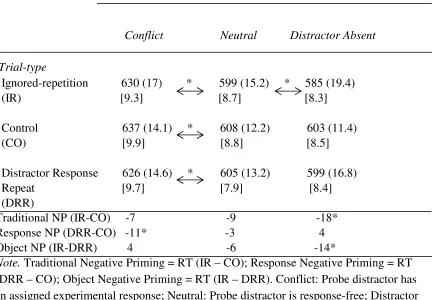
Using within-subject means reaction times, the ANOVA calculations revealed that Response Conflict, F(2, 14)= 80.97, p< ).01, MSE= 103, and its interaction with Probe Trial Type, F(4, 28)= 2.70, p= 0.05, MSE= 69, produced the only significant effects (Table 3). Post hoc tests revealed that probe conflict distractor trials produced
significantly longer reactions than did the neutral and distractor absent probe trials. The reactions for the latter two probe trial types did not differ from one another, except for the ignored-repetition trials. From another perspective, the reliable interaction here reflected the fact that there were some scattered significant reaction time differences for some of the paired contrasts between levels of the Probe Trial Type category (Table 3). In these instances, however, all of the denoted NP measures unexpectedly showed significant positive after-effects. For example, when the probe target appeared alone, its latency was significantly faster when it had just been the prime distractor object and when the needed response was the former prime distractor output.
There are two aspects of these findings that bear noting. First, the
30
31
Table 3
Mean Reaction Times (RT, ms) for the Trial Type (IR, CO, DRR) and Probe Configuration (Conflict, Neutral, Distractor Absent) for Practice Group.(n =8)
Probe Distractor Configuration
Conflict Neutral Distractor Absent
Trial-type
Ignored-repetition 630 (17) * 599 (15.2) * 585 (19.4) (IR) [9.3] [8.7] [8.3]
Control 637 (14.1) * 608 (12.2) 603 (11.4) (CO) [9.9] [8.8] [8.5]
Distractor Response 626 (14.6) * 605 (13.2) 599 (16.8) Repeat [9.7] [7.9] [8.4]
(DRR)
Traditional NP (IR-CO) -7 -9 -18* Response NP (DRR-CO) -11* -3 4
Object NP (IR-DRR) 4 -6 -14*
32
General Discussion
We set out to further investigate the locus of the identity negative priming (INP) phenomenon; that is, to determine whether INP is attributable to the processing
(inhibition) afforded the prime trial distractor object, its assigned response, or both. To make this assessment, we employed what we believed to be a new and improved method of locus measurement used with spatial negative priming tasks (e.g., Buckolz et al., 2004; Buckolz, Edgar et al., 2012; Guy et al., 2006). In addition to the INP locus, we further examined the assertion that the manifestation of INP (and its locus) requires a response conflict on the probe trial (Moore, 1994).
No Practice Group.
Overall, the results obtained were only marginally informative with regard to the identity negative priminglocus question; however, the findings, unexpectedly, did generate speculation related to several other theoretical issues which seem informative.
33
occurred on distractor-response repeat trials where the prime distractor event was not repeated on the probe, and hence it did not play a role in the production of this result. If foregoing interpretation is accurate, it means that the prime distractor was processed to the extent of the retrieval of its assigned response (e.g., Eriksen & Eriksen, 1985), which was then inhibited and stored, and was subsequently accessed when the probe trial was delivered. The involvement of the (former) prime distractor response then caused an inhibitory after-effect in the form of elevated button-press error rates when it was the required probe trial output (e.g., Buckolz, Stoddart et al., 2014).
Related in a tangential way to our error data is the claim by Houghton and Mari-Beffa (2005) that an object locus would develop before a response locus for an identity negative priming (INP) task and that the former would quickly dissipate due to
habituation, while the latter would persist. This persistence, indexed in latency measures, was only marginally tested because Houghton and Mari-Beffa used a limited number of experimental trials. In this study, we approximately tripled the number of prime-probe trial pairs used by Houghton and Mari-Beffa and still the error rate data showed the presence of a response locus for INP, consistent with its persistence and the idea that response inhibition and its after-effects do not diminish with practice (see Buckolz, Stoddart, et al., 2014 for support with spatial negative priming tasks).
34
types differed only in that the conflict distractor had an assigned response and therefore could produce a probe response conflict. This potential was seemingly realized, and hence the distractor processed, accounting for the significant target reaction time delay observed with the conflict, but not with the neutral, distractors. We assume that if the probe
conflict distractor was processed, so was that of the prime trial.
So, the prime distractor is processed. With this explanation eliminated, how is it then that an inhibited prime distractor response that is retrieved, and so participates in probe trial processing, significantly elevates error rates because of its execution resistance (ER) property, but does not require ER override time, thereby slowing target reactions on ignored-repetition trials and so causing identity negative priming (INP)? In addressing this question, a preliminary point of note is that negative priming (NP) after-effects are not always observed in either spatial (e.g., Buckolz, Edgar, et al., 2012; Fitzgeorge et al., 2011) or identity (Moore, 1994) NP tasks when certain taskconditions are met. Of possible relevance here is the fact that the spatial negative priming effect (SNP) is not observed when the probability of a probe conflict distractor is 0.25 or less (e.g., Buckolz, Boulougouris, & Khan, 2002; Fitzgeorge et al., 2011; Haworth et al., 2014). In this study, the Response Conflict trial typeswere intermixed in equal frequencies making the
35
same study whether probe distractor probability influences the appearance of an INP effect.
Incidentally, it is not clear why the low probability of a probe conflict distractor appearing motivates the removal of latency-based NP effects; nor is it clear how the NP removal is achieved, although one possibility suggested for SNP designs is that the retrieval of stored prime trial distractor processing is blocked (Fitzgeorge et al., 2011). This option does not seem to be the case for identity negative priming (INP); however, since, as we noted earlier, the error rate and Response Conflict results here indicated that the stored prime distractor processing representations were retrieved when the probe trial was delivered; yet no latency-based INP was noted overall.
Recall, though, that seven of the ten subjects in the Non-Practice Group collectively produced a significant identity negative priming (INP) effect that was
registered in the latency data. Two implications follow. One is that whether the execution resistance property of a just-inhibited prime distractor response requires time to set it aside, thereby producing a latency-based INP effect, is somewhat individual specific. This individuality should be examined and accommodated in future work on INP loci.
Nonetheless, even with this significant INP effect, no single locus was indicated; neither a significant ‘object’, nor a reliable ‘response’ NP effect was obtained for these subjects. Rather, the INP phenomenon was produced by their combined contributions.
36
task used by Houghton and Mari-Beffa, and the method they employed to determine locus contributions, were the same as in the current study. Nonetheless, there are two possible reasons for the discrepant locus results. One is that Houghton and Mari-Beffa used only conflict distractors, while the current intermixed three kinds of probe distractor contexts, which may have influenced the current findings (we made this point earlier). The other distinction is procedural in nature and has to do with the fact that it appears that each subject in the Houghton and Mari-Beffa study did not experience all possible trials, and, further, that all types of the possible trials were not represented in each of their trial Blocks, which were used to assess loci contributions over practice. One point of concern is that this resulted in within-hand versus between-hand finger competitions (formed by the positions of the probe target and distractor, being on the same hand or on different hands) not being equally represented in all conditions studied. If correct, this is
problematic because within-hand and between-hand finger competitions, themselves, can produce significant reaction time differences (e.g., see Alain, Buckolz, & Taktak, 1993) and so can distort locus and/or Block latency values.
The second implication of the identity negative priming effect seen in seven of the ten No Practice subjectsis that the INP effect was observed only for the response conflict probe trials, supporting the assertion that a response conflict probe context is necessary for INP manifestation (Moore, 1994).
37
just-inhibited prime distractor response, and a response that is activated by the probe distractor. The claim is that the prime distractor response would have been suppressed below a resting level of activation on the prime, and so would have been at an activation disadvantage relative the response activated by the probe conflict distractor, whose activation level would have been higher at the outset of probe trial delivery. The idea is that for the former prime distractor response to be correctly executed, its activation level must catch up to and surpass, by a sufficient amount, that of the response retrieved by the probe distractor. The added time cost needed for the ‘catch up’ and ‘surpass’ phases would result in ignored-repetition trial reactions to exceed those of a control trial (i.e., INP effect), where these times costs are not involved. The concern with this account is that it is not clear how it explains the fact that neutral distractor probe trials do, at times, produce an INP effect (Lowe, 1979; Moore). The explanation for this finding is that neutral distractors are viewed by the subjects as potentially conflict in nature and so cause INP. The question, though, is how neutral distractors produce an actual probe response conflict as it does not generate a competing response. Consequently, there is no basis for the slowing of the former prime distractor response on ignored-repetition trials (i.e., no ‘catch up – surpass’ time cost) and so no basis for the INP observed.
Practice Group
38
the question here was whether pre-experimental practice, engineered to improve S-R compatibility level before experimental trial engagement, would yield clearer evidence of a response locus than a No Practice Group. Presumably, the pre-experimental practice would reduce the error variance otherwise generated early in the experimental phase as S-R association strength developed there, during which time evidence of a response locus would be absent. While the subjects receiving pre-experimental practice did exhibit evidence of improved S-R compatibility degree in the form of significant reaction time reductions over practice, the expected enhancement of a response locus manifestation for INP (relative to the No Practice Group) did not materialize. In fact, surprisingly, the general impact of the pre-experimental practice was to produce positive rather than negative after-effects; repeated aspects of prime distractor processing produced probe reactions that were faster than control latencies, most evident for target-only probe trials (Table 3). Moore (1994) also provided some pre-experimental trial practice; however, this did not cause her results to exhibit positive after-effects. We have no explanation for the discrepancy between her study and the one reported here on this account, other than to point out that a major procedural difference between the two reports is that we mixed all three Response Conflict trials within a session, while Moore intermixed only two at a time. We have hypothesized earlier that this manipulation on our part may have been a factor in our failure to show time-based INP. Whatever the mechanism in this regard, it may too influence pre-experimental practice impact.
39
positive, as they were in the Practice Group. This is because a conflict distractor would still generate a response competition on the probe trial between the response it retrieved and the one retrieved and required by the probe target, thereby prolonging the latter’s production relative to the ‘no response conflict’ probe trials.
In Sum
The findings here for the No Practice Group support the view that prime distractor processing for identity (INP) and spatial (SNP) negative priming tasks has some
40
References
Alain, C., Buckolz, E. & Taktak, V. (1993). Same-hand and different-hand finger pairings in two-choice reaction time: Presence or absence of response competition. Journal of Motor Behavior, 25, 45-51.
Buchner, A., Zabal, A., & Mayr, S. (2003). Auditory, visual, and cross-modal negative priming. Psychonomic Bulletin & Review, 10, 917-923.
Buckolz, E., Avramidis, C., & Fitzgeorge, L. (2008). Prime-trial processing demands and their impact on distractor processing in a spatial negative priming task.
Psychological Research, 72, 235-248.
Buckolz, E., Boulougouris, A., & Khan, M. (2002). The influence of probe-trial selection requirements on the location negative priming effect. Canadian Journal of
Experimental Psychology, 56, 274-283.
Buckolz, E., Edgar, C., Kajaste, B., Lok, M., & Khan, M. (2012). Inhibited prime-trial distractor responses solely produce the visual spatial negative priming effect.
Perception & Psychophysics, 74(8), 1632-1643.
Buckolz, E., Goldfarb, A., & Khan, M. (2004). The use of a distractor-assigned response slows later responding in a location negative priming task. Perception &
Psychophysics, 66, 837-845.
Buckolz, E., Haworth, P., Kajaste, B. (2014) The role of probe distractors in the production/removal of the spatial negative priming effect. Journal of Cognitive Psychology, 26(4), 386-399.
41
Buckolz, E., Stoddart, A., & Edgar, C., Khan, M. (2014). The error protection impact of inhibitory after-effects in location-based tasks and their preservation with practice.
Perception & Psychophysics, 76(8), 1721-1728.
Chao, H-F. (2011). Dissociations between identity and location negative priming. Acta Psychologica, 136 (1), 81-89.
Dagenbach, D., & Carr, T. (Eds.) (1994). Inhibitory processes in attention, memory, and language. San Diego, CA: Academic Press.
Dalyrmple-Alford, E.C., & Budayr, B. (1966). Examination of some aspects of the Stroop color- word test. Perceptual and Motor Skills, 23, 1211-1214.
Eimer, M., & Schlaghecken, F. (1998). Effects of masked stimuli on motor activation: Behavioral and electrophysiological evidence. Journal of Experimental
Psychology. 24(6), 1737-1747.
Eriksen, B. A., & Eriksen, C. W. (1974). Effects of noise letters upon the identification of a target letter in a nonsearch task. Perception & Psychophysics, 16,143-149. Eriken, C. W., Coles, M. G. H., Morris, L. R., & O’Hara, W. P. (1985). An
electromyographic examination of response competition. Bulletin of the Psychonomic Society, 23, 165-168.
Fitts, P. M., Seeger, C. (1953). S-R compatibility: Spatial characteristics of stimulus and response codes. Journal of Experimental Psychology, 46, 199-210.
Fitzgeorge, L., & Buckolz, E. (2008). Spatial negative priming modulation: The influence of probe-trial target cueing, distractor presence and an intervening response.
European Journal of Cognitive Psychology, 20, 994-1026.
42
Perception and Psychophysics, DOI 10.3758/s13414-011-0125-7.
Fox, E. (1995). Negative priming from ignored distractors in visual selection. A review.
Psychonomic Bulletin & Review, 2, 145-173.
Frings, C., Mast, F., & Spence, C. (2014). Tactile spatial negative priming occurs without feature mismatch. Perception, & Psychophysics, DOI 10.3758/s13414-014-0721-4.
Gorfein, D. S., & MacLeod, C.M (Eds.) (2007). Inhibition in cognition. Washington, DC: American Psychological Association.
Guy, S., Buckolz, E., & Khan, M. (2006). The locus of location repetition latency effects. Canadian Journal of Experimental Psychology,60, 307-318.
Hintzman, D. L., Carre, F. A., Eskridge, V. L., Owens, A. M., Shaff, S. S., & Sparks, M. E. (1972). “Stroop” effect: Input or output phenomenon? Journal of Experimental Psychology, 95, 458-459.
Houghton, G. & Mari-Beffa, P. (2005). Dissociations between object- and response-based components of negative priming. Perception and Psychophysics. 67(8), 1423-143. Kajaste, B. Buckolz, E., Haworth, P. Perry, J. (2013, October). Automatic Processing is Both Inevitable & Flexible. Poster presented at the Canadian Society for Psychomotor Learning and Sport Psychology, Kelowna, British Columbia.
Lowe, D. G. (1979). Strategies, context, and the mechanism of response inhibition.
Memory & Cognition, 7, 382-389.
May, C. P., Kane, M. J., & Hasher, L. (1995). Determinants of negative priming.
Psychological Bulletin, 118, 35-54.
43
423-438
Moller, M., Mayr, S., & Buchner, A (2014). Effects of spatial response coding on distractor processing: Evidence from auditory spatial negative priming tasks with keypress, joystick, and head movement responses. Perception, & Psychophysics, 77, 293-310.
Neill, W. T. (2007). Mechanisms of transfer-inappropriate processing. In D. S. Gorfein & C. M. MacLeod (Eds.), Inhibition in Cognition (pp. 63-78). Washington D. C.: American Psychological Association.
Neill, W. T., Terry, K. M., & Valdes, L. A. (1994). Negative priming without probe selection. Psychonomic Bulletin and Review, 1, 119-121.
Shiu, L. P., & Kornblum, S. (1996). Negative priming and stimulus-response compatibility. Psychonomic Bulletin & Review, 3, 510-514.
Stroop, J. R., (1935). Studies of interference in serial verbal reactions. Journal of Experimental Psychology, 18, 643-662.
Tipper, S. P. (1985). The negative priming effect: Inhibitory priming by the ignored objects. Quarterly Journal of Experimental Psychology, 37(A), 571-590.
Tipper, S. P. (2001). Does negative priming reflect inhibitory mechanisms? A review and integration of conflicting views. The Quarterly Journal of Experimental
Psychology, 57(A), 321-343.
Tipper, S. P., & Cranston, M. (1985). Selective attention and priming: Inhibitory and facilitatory effects of ignored primes. Quarterly Journal of Experimental Psychology, 37(A), 591-611.
44
attention. Quarterly Journal of Experimental Psychology, 47(A), 809-840. Tipper, S. P., Weaver, B., Cameron, S., Brehaut, J. C., & Bastedo, J. (1991). Inhibitory
mechanisms of attention in identification and localization tasks: Time course and disruption. Journal of Experimental Psychology. Learning Memory And
45
Glossary of Terms
Identity Negative Priming (INP): Slower reaction times (RT) when the prime distractor
object (number) becomes the target stimulus on the probe (ignored-repetition [IR] trial) than when neither target nor the distract events in probe trial appeared on the prime trial (control [CO] trial).
Spatial Negative Priming (SNP): Slower reaction times (RT) when responding to a
target stimulus that arises at a location previously occupied by a distractor event (ignored-repetition [IR] trial) than when it appears at a recently unused location (control [CO] trial).
Ignored Repetition (IR): Prime distractor object (number) on the prime trial becomes
the target stimulus on the probe trial.
Distractor-Response Repeat (DRR): Prime distractor’s assigned response is required
but in response to a target identity that did not appear on the prime trial. (i.e., the prime trial distractor object was not repeated on the probe).
Control (CO): Probe trials where neither the target nor the distractor events appeared on
the prime trial.
Time-based Object NP: Delay in probe trial processing caused by the prime distractor
object (i.e., RT[IR] vs. RT[DRR])
Time-based Response NP: Delay in probe trial processing caused by the prime distractor
response (i.e., RT[DRR] vs. RT[CO]).
Error-based Response NP: Button press error rate differential on the probe trial where
46
Many-to-one (M:1): When two locations/stimuli are assigned to the same button-press
response.
One-to-many (1:M): A single location/stimulus is mapped onto two permissible
responses.
One-to-one (1:1): When one location/stimulus is assigned to one button-press response.
Execution Resistance (ER): A resistance to perform a just inhibited (distractor related)
response.
Inhibitory After-effects (IAE): Refer to those instances when a prior act of prime trial
47
Appendix A
49
Appendix B
50
Letter of Information
Project Title: Properties of Inhibitory After-effects.
Introduction
You are being invited to participate in a research study. The purpose of this letter is to provide you with the information you need to render an informed participation decision.
Purpose of the Study
The purpose of the study is to extend our understanding of the aspects of cognitive ‘inhibitory after-effects’, which refers to those occasions where a current act of inhibition results in interference effects (i.e. delayed response time, error production etc.) on future processing in which the previously inhibited events play a role.
Basic Procedures
If you agree to participate, you will be asked to respond as quickly and as
accurately as possible to visual stimuli presented on a computer screen while concurrently ignoring distractor events that may also be present. You will respond to the spatial
location and/or to the identity of the stipulated target stimuli by pressing designated computer keyboard buttons. Accuracy and reaction times associated with your manual button press responses will be recorded and analyzed.
Participation requires you to attend up to 6 testing sessions of approximately forty minutes each in laboratories located in. Normally these sessions will occur within 10 days of each other. Specific laboratory testing times will be arranged by you in consultation with the experimenter.
Risks Associated with Participation
There are no known or reasonably anticipated risks associated with participation in this experiment.
Benefits
No personal benefits will necessarily follow from your participation. However, it is possible that any discoveries that advance our understanding of inhibitory after-effects as a result of your participation may be viewed as beneficial.
Confidentiality
Efforts will be made to ensure that your data cannot be linked to you by anyone other than the experimenter. Code numbers assigned to your data files will not identify you directly but will be linked to your name on a master sheet kept by the experimenter on a password protected computer. Once experimentation has been completed the master sheet will be destroyed. Henceforth it will be impossible to associate any particular data with your identity.
51
for five years after ‘on-line’ publication and then deleted.
Participation
Participation in this study is voluntary. You may refuse to participate or withdraw from the study at any time without penalty. If you withdraw, any data collected to that point will be deleted and will not be used in the study.
Debriefing
Once all of the data collection has been completed, you may contact the experimenter by e-mail for an explanation of the purpose of the study along with the preliminary findings obtained. A debriefing session will also take place in class once all of the data have been collected. At that time information dealing with your participation will be discussed (i.e. study purpose, group results and their preliminary interpretation etc.).
Contact Information
If you have any questions about this study you may contact
If you have any questions about the conduct of this study or your rights as a research participant, you may contact the Office of Research Ethics at The University of Western Ontario.
You do not waive any legal rights by signing the consent form.