Volume 2011, Article ID 685219,22pages doi:10.1155/2011/685219
Research Article
Secure Rateless Deluge: Pollution-Resistant Reprogramming and
Data Dissemination for Wireless Sensor Networks
Yee Wei Law,
1Yu Zhang,
2Jiong Jin,
1Marimuthu Palaniswami,
1and Paul Havinga
3 1Department of Electrical and Electronic Engineering, The University of Melbourne, Parkville, VIC 3010, Australia 2School of Computer Science, Northwestern Polytechnical University, Xi’an, Shaanxi 710072, China3Pervasive Systems Group, Faculty of EEMCS, University of Twente, P.O. Box 217, 7500 AE Enschede, The Netherlands
Correspondence should be addressed to Yee Wei Law,[email protected]
Received 24 February 2010; Revised 22 June 2010; Accepted 19 July 2010
Academic Editor: Damien Sauveron
Copyright © 2011 Yee Wei Law et al. This is an open access article distributed under the Creative Commons Attribution License, which permits unrestricted use, distribution, and reproduction in any medium, provided the original work is properly cited.
A network reprogramming protocol is made for updating the firmware of a wireless sensor network (WSN)in situ. For security
reasons, every firmware update must be authenticated to prevent an attacker from installing its code in the network. While existing
schemes can provide authentication services, they are insufficient for a new generation of network coding-based reprogramming
protocols like Rateless Deluge. We propose Secure Rateless Deluge or Sreluge, a secure version of Rateless Deluge that is resistant to pollution attacks (denial-of-service attacks aimed at polluting encoded packets). Sreluge employs a neighbor classification system and a time series forecasting technique to isolate polluters, and a combinatorial technique to decode data packets in the presence of polluters before the isolation is complete. For detecting polluters, Sreluge has zero false negative rate and a negligible false positive rate. TOSSIM simulations and experimental results show that Sreluge is practical.
1. Introduction
There are occasions when new applications need to be installed, or when existing applications need to be modified
or patched in a WSN. Given the difficulty of physically
redeploying sensors, this requires the new firmware to be securely and remotely transmitted to all the nodes in the network.
In the core of a secure network, reprogramming protocol (also known as secure code update or secure code distri-bution in the literature) is a data dissemination protocol that distributes the new firmware to all the nodes in the network in an energy-efficient manner. In the beginning, the base station broadcasts a command (CMD) globally to announce the availability of the new firmware (which can be generalized as any data). The basic epidemic-like workflow established by SPIN [1] then takes place: (i) a node with the new firmware broadcasts an advertisement (ADV) locally; (ii) the receivers of the advertisement compare the advertised version number with their existing version number, and send requests (REQ) for the new firmware if their version number is lower; (iii) the advertiser starts sending data to the
requesters; (iv) the receivers of the data in turn become the advertisers. Starting from Deluge [2] (the classic benchmark protocol in the literature), the firmware is disseminated page by page. After successfully collecting a page, the page is written to a nonvolatile memory. After successfully collecting all the pages, a node’s next action depends on the semantics of CMD. For example, if the CMD is “disseminate,” the node’s job is done; if the CMD is “disseminate and reboot,” the node then reboots using the new firmware (these are two existing commands in TinyOS 2.x). The problem of securing the protocol boils down to authenticating the CMD, ADV, REQ, and data packets, and addressing the threat of denial-of-service (DoS) attacks in every step of the protocol. In this work, we are primarily concerned with the authentication of data packets and the mitigation of DoS attacks during the process.
Base station
Nodes
Component for pre-dissemination processing of firmware
· · ·
Component for CMD authentication Component for ADV/REQ authentication Component for DATA authentication Rateless deluge
Sreluge
Figure1: Components of Sreluge: shaded components are our contribution; unshaded components are drop-in replacements from the literature. For CMD authentication, Sreluge can utilize either Elliptic Curve Cryptography with the proper DoS countermeasure or a
multiple-time signature scheme (seeSection 2.1). For ADV/REQ authentication, Sreluge utilizes a pairwise key predistribution scheme—
either deterministic or probabilistic—to achieve authenticated local broadcast and authenticated local unicast (seeSection 5.2).
packets. The advantage of network coding-based protocols is that they are resilient to packet loss. For example, at a packet loss rate of 5%, Rateless Deluge transmits three times less data packets than Deluge does [5]. Resilience to packet loss is a much desirable feature in disruptive environments (e.g., marine environment) where loss of connectivity occurs fre-quently. There is hence much incentive in using protocols like Rateless Deluge for reprogramming in these environments. For reprogramming protocols that are not based on network coding, several security schemes have been proposed. The technique common to these proposals is the use of a hash function that binds a later packet to an earlier packet which ultimately leads to a digital signature signed by the base station, to facilitate authentication. This technique works on uncoded data packets, while in network coding-based reprogramming protocols, data packets are transmitted as random linear combinations of the original data packets. In other words, although this existing technique can be used to authenticateuncoded data packets, rogue nodes can pollute encoded data packets, thereby executing the kind of DoS attack known aspollution attackin the literature [6].
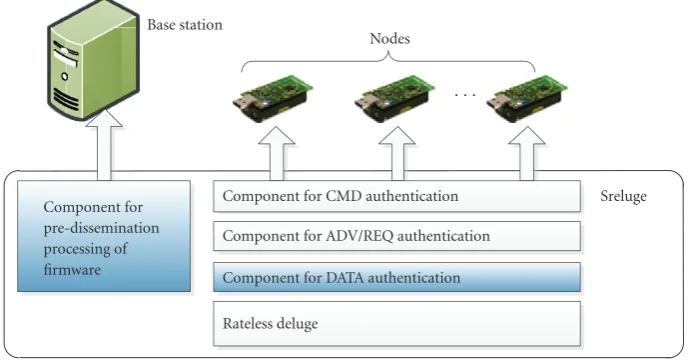
Our contribution is Sreluge, a security-enhanced version of Rateless Deluge that is resistant to pollution attacks. Figure 1 highlights our specific contribution in terms of the components that make up Sreluge. Sreluge employs a neighbor classification system and a time series forecasting technique to isolate attackers, and a combinatorial technique to decode data packets in the presence of attackers before the isolation is complete. TOSSIM simulations show that when 20% of the nodes in a 27-degree, 100-node network are pol-luters, using Sreluge, dissemination on average takes roughly twice as long to finish as when there is no attack; a node transmits twice as many REQ and data packets, and performs 50% more decoding per page. Experimental results using Crossbow IRIS motes show that the overhead of Sreluge in an 11-node network is insubstantial. Sreluge is equally useful
in cases where nonmalicious but faulty nodes “inadvertently” feed corrupted data packets to their neighbors.
This paper is organized as follows. Section 2 discusses related work.Section 3details the attacker model on which
this proposal is based. Section 4 describes the central
problem in a more formal setting. Sections5and6describe the algorithms of Sreluge in detail. Analysis is provided in Section 7. In Section 8, both simulation and experimental results are presented. Finally, we conclude inSection 9and list some future work.
2. Related Work
Our main contribution is in theauthentication of data packets under the threat of pollution attacks. For completeness, we also discuss related work for the authentication of CMD, ADV, and REQ packets. As Sreluge performs a limited form of intrusion detection and response during reprogramming, we also discuss some relevant work in this area.
2.1. Authentication of CMD Packets. A CMD packet contains a command, meta-information about the new firmware, cryptographic commitment for the ensuing data packets, and a signature of the packet itself. The CMD packet is authenticated by verifying the signature. There are two kinds of signature schemes as follows.
achievable at a ROM cost of 14.4 KB and a RAM cost of 1.6 KB on a modest MSP430F1611 MCU. An execution time in the order of seconds, however, means that an attacker can launch DoS attacks by generating random signatures that nonetheless need to be verified. One solution is Seluge’s message-specific puzzle [11,14], which provides “weak pre-authentication” of a signature. Tan et al. [15] propose a minor variation of message-specific puzzle.
Wang and Kulkarni’s scheme [16] uses message authen-tication codes, and so in principle can sign an unlimited number of messages, but it has the following problems: (i) the signature size increases with the network size; (ii) it only takes a small number of nodes to be captured to compromise a large proportion of the key pool.
(ii) Multiple-Time Signature Schemes. These schemes can only be used to sign a fixed number of distinct messages, but they use less code space and require less computation for signature verification. The disadvantage is that these schemes give longer signatures and their security is lower compared to ECC-based schemes. Notable examples are Krontiris and Dimitriou’s [17] and Ugus et al. [18,19].
Tan et al.’s scheme [20] can also be classified in this category. They propose using a separate one-way hash chain for each hop group (group of nodes with the same hop count from the base station), based on the assumption that all members of the same hop group receive the same messages at once. In practice, this assumption is difficult to uphold. Moreover, their scheme has the following disadvantages: (i) the network topology must be determined prior to deployment; (ii) uncertainties arise when the hop count of a node from the base station changes, as would happen when some nonleaf nodes fail or die of battery exhaustion.
Sreluge can utilize either kind of signature scheme.
2.2. Authentication of ADV/REQ Packets. To prevent external
attackers from forging ADV/REQ, Zhang et al. [21] has
specifically designed a scheme based on the Combined Public Key cryptosystem (international patent number WO/2006/074611), but it is computationally expensive and the security of the patented cryptosystem is uncertain.
There is a simpler approach. First, note that ADV packets should be sent in authenticated local broadcast channels whereas REQ packets should be sent inauthenticated local unicast channels. The best known way to achieve authenti-cated local broadcast is for a node to establish acluster key chain with its neighbors [22]. Establishing this cluster key chain can be done with most pairwise key predistribution protocols, which can be either deterministic (e.g., [22–24]) or probabilistic (e.g., [25–27]). Sreluge is compatible with either kind of pairwise key predistribution schemes. InSection 5.2, we will describe how we can use an example of either kind to establish a cluster key chain between a node and its neighbors. Authenticated local unicast is achieved by simply using the pairwise key between two neighboring nodes.
2.3. Authentication of Data Packets. Given a stream of data packets, we can authenticate each packet independently, for
example, by signing each packet. However, this approach tends to be inefficient. Instead of signing each packet, Itani et al. propose PETRA [28], a scheme that “authenticates” each packet independently using a Bloom filter. In PETRA, the base station registers all data packets with a Bloom filter, signs and broadcasts the Bloom filter (essentially a bit-vector) globally. Each node authenticates the Bloom filter and waits for subsequent data packets. Each incoming data packet is checked against the Bloom filter. The probability that a data packet has not been registered with the Bloom filter and yet passes the check is called the false positive rate. Contrary to their suggestion, the false positive rate is not negligible, especially at high data packet count.
Instead, the mainstream approach is based on Gennaro and Rohatgi’s algorithm [29]: given a stream of packets, every packet except the first is authenticated using the hash appended to the preceding packet, and the first packet is authenticated using a signed hash. Mathematically, let H
represents a one-way hash function, then the original packets
P1,. . .,Pnare transformed into Sig(h0),P1h1,P2h2,. . .,Pn (hi=H(Pi+1hi+1), for alli∈ {0,. . .,n−2};hn−1=H(Pn)) before dissemination. Lanigan et al.’s Sluice [7] uses this method to authenticate a stream of pages. The page is the basic unit of data transfer introduced by Deluge: data is divided into pages and a page is divided into packets. Dutta et al.’s [8] and Nilsson et al.’s [10] schemes are similar but operate on the packet level instead of the page level. These schemes require packets within a page to arrive sequentially. Using Deng et al.’s hash tree construction [9], the data packets within a page can arrive out of order, giving the advantage of shorter dissemination time. Instead of deriving a hash tree for each page, in Seluge, Hyun et al. [11] derive a Merkle hash tree only for the first page, and append the hash of the ith data packet of the jth page to the
ith data packet of the (j −1)th page. This represents an improvement over Deng et al.’s scheme in terms of overall communication overhead. Despite the progress in secure reprogramming, none of the aforementioned schemes can be used as is for network coding-based reprogramming because, in the aforementioned schemes, the packets of a page are transmitted as is without encoding.
The security issues of network coding have long been recognized. Among the so-called secure network coding schemes listed inTable 1, only the first two deal with recovery from pollution, so only these two are relevant. However, these two schemes assume an attacker can only inject its packets at a known and fixed low rate, while in reality, an attacker can inject its packets at a variable rate and at a rate that is comparable to the capacity of a receiver.
It is seen that by modifying the coding scheme itself— as secure network coding schemes do—little headway can be made against more powerful attackers. Later proposals focus on implementing cryptographic schemes on top of network
coding. Homomorphic signature [36] and homomorphic
hash function [37] are too resource-intensive for WSNs because they make extensive use of modular exponentiations.
Agrawal and Boneh’s homomorphic MAC [38] operates in
Table1: Secure network coding schemes.
Resilience to eaves dropping Pollution detection Recovery from pollution
Jaggi et al. [30] N N Y
Ngai and Yang [31] Y N Y
Ho et al. [32] N Y N
Tan and M´edard [33] Y N N
Cai and Yeung [34] Y N N
Lima et al. [35] Y N N
long for little security (e.g., 49 bytes for 8-bit security). Yu et al.’s scheme [39] detects pollution by attaching multiple authentication tags to a message which amount to considerable overhead. The scheme also allows polluted packets to travel a small number of hops before detection, which absolutely must not happen during reprogramming. We also add that the schemes mentioned in this paragraph are all about detection of pollution, and are not concerned with recovery from pollution.
The recent years have seen schemes that are not only more lightweight, but also include recovery mechanisms. Butty´an et al. [6] address the problem of recovering data from coding-based distributed storage systems that are subjected to pollution attacks. In their problem setting, however, downloading data has negligible cost, while in our case, to receive more data packets is costly. Dong et al.’s DART [40,41] emulates the delayed key disclosure mechanism of
μTESLA [42]. LikeμTESLA, DART requires the nodes to be time-synchronized. In theith time interval, a sender sends encoded packets to a receiver. In the (i+ 1)th interval, the sender sends a checksum generated and signed by the base station, corresponding to the earlier encoded packets, to the receiver. While time synchronization is not too stringent a requirement, in Sreluge, we take the shortcut approach of communicating the checksums (which in our case are cryptographic hashes) to the receivers in the beginning of the protocol, thus allowing us to avoid time synchronization and to use a signature only once. We acknowledge that DART addresses a more difficult problem where the total number of packets is not known in advance. Bohli et al. [43] address the problem of authenticating LT-coded data packets in Synapse [44]. LT codes [45], like random linear codes in Rateless Deluge, are also a kind of rateless codes. As it stands, Bohli et al.’s protocol is a direct competitor to Sreluge, just as Synapse is a direct competitor to Rateless Deluge. As their work is discovered after the completion of this paper, and as they cannot disclose their source code, we must defer a comparison of their protocol to Sreluge to a later work.
2.4. Intrusion Detection and Response. It has been suggested that reactive defense schemes (such as Sreluge) are a promis-ing approach to securpromis-ing network codpromis-ing-based protocols [46]. Reactive schemes are best exemplified by intrusion detection (and response) systems (IDS). An essential part of these systems is rating the reputation or trustworthiness of a node’s neighbors. Ganeriwal et al.’s RFSN [47] model reputation values as Beta-distributed random variables and
update the probability density function (pdf) of the random variables using Bayesian inference based on the outcome of binary events (e.g., neighbor either did or did not forward a packet as requested). Sun et al. [48] offer more alternatives for modelling trust. Many more schemes are described in Lopez et al.’s survey [49].
Due to the brief duration of reprogramming, it is an overkill to build an entire IDS into Sreluge. Rather, it is more beneficial to take the results of a reprogramming session as input to an enclosing IDS. InSection 6, we will give an example of such interaction.
3. Attacker Model
An attacker is computationally bounded. This is a standard cryptographic assumption, implying even if the attacker has access to supercomputers, its computing power is at most polynomial. Most key management schemes in the WSN literature are built on this assumption.
The base station is the only trusted entity in the network. An attacker may introduce its own nodes in a network, or it may capture, compromise, and reintroduce existing nodes in the network, as sensor nodes are generally not tamper-resistant. When a node is captured, its cryptographic keys may be exposed to the attacker. These cryptographic keys may allow the compromised nodes to rejoin the network later and become internal/insider attackers. These internal attackers can establish secure channels even with uncompromised nodes. We call internal attacker nodes that send out invalid data packets or corrupt data packets in transitpolluters.
Pollution attacks are the focus of this paper. Attacks on the physical layer (e.g., jamming), data link layer (e.g., smart jamming), or network layer (e.g., packet dropping) are not considered, because countermeasures against these attacks are considered complementary to this work.
4. Problem Description and Key Definitions
According to the attacker model, internal attackers may fabricate control packets (CMD, ADV, REQ) and/or data packets. Fake control packets waste bandwidth and energy whereas fake data packets can corrupt the whole page a recipient is decoding. Both represent a form of DoS attack, but a fake data packet can destroy a whole page of at least
Table2: List of frequently used symbols.
ψ Minimum number of packets to receive per page
(ψ >1)
Ψ Number of packets to receive for a page
(ψ≤Ψ≤Ψmax)
H(·) A collision-resistant hash function
αi Packet ID of theith encoded packet
f Packet ratio; seeDefinition 2
l Maximum bit-length of data payload
P Number of pages
| · | (i) Bit-length ofset· ·or (ii) number of elements in
w Number of hashes that can fit in a packet
{·}K Authenticated encryption of·using keyK
[·]K Message authentication code of·using keyK
Concatenation operator
S Set of suspected nodes
B Set of identified polluters
˙
s Set of prime suspect (|s˙| ≡1)
I Set of acquitted suspects
A Set of suspects investigation of which has beenabandoned
N Total number of nodes
τ Fraction of polluters among neighbors
potent form of DoS attack. This more potent kind of attacks, called pollution attacks, is the main topic of this paper. It is worth noting that energy-efficient link-layer jamming is another potent form of DoS attack, but it is a topic that we have already addressed at great length in [50]. For the definition of symbols in the ensuing discussion, please refer toTable 2.
In the original Rateless Deluge (and naturally in Sreluge), every page of packets are encoded before transmission. To send a page consisting of packetsX1,. . .,Xψ, the packets are
ID corresponding to Yi. By populating the matrix on the left-hand side with pseudorandom numbers, the matrix is rendered almost surely nonsingular. DecodingY1,. . .,Yψ to
X1,. . .,Xψis by means of Gaussian elimination. Denote byq
the size of the field whereXi,jandYi,jare defined, then the
probability of successful decoding is given by [5]
efficiency) inFigure 2, which shows thatψshould preferably
0.996078
Figure2: Probability of successful decoding versusψwithq=28.
be at least 6 for this field size. On the other hand, to limit computational overhead, it is best ifψ does not exceed 20 [5]. To summarize, 6≤ψ≤20 for practicality.
A receiver must receive at leastψ packets before it can decode the entire page, because otherwise the system of linear equations in (1) is unsolvable. If any of the received packets are polluted, the whole page becomes invalid. If the receiver knows which of its neighbors are polluters, then it only has to discard all the packets from them. The problem is when an invalid page is contributed by more than one neighbor, the receiver would not know which packets are invalid, let alone which senders are rogue.
Like most other security countermeasures, the solution proposed here starts with the evaluation of the severity of an attack. The metric to use in this case is the probability of page corruption. To derive this probability, we first formally define page-round,decode-round, andpacket ratio.
Definition 1. Apage-round transpires whenever a page is received and decoded. When a page has exactly ψ packets, exactly onedecode-roundis required to decode the page, if the page is actually decodable. When a page has more thanψ
packets, sayΨpackets, at least one but at mostΨψ
decode-rounds are required to decode the page, if the page is actually decodable.
Definition 2. Suppose that in the ith page-round, a node collectedΨi packets. Among theΨi packets, xi packets are
from neighboru, then thepacket ratioof neighboruin the
ith page-round, denoted by fu(i), is fu(i)=xi/Ψi.
The packet ratio should be understood as a random variable. DenoteAi as the event that the page is polluted in the ith page-round;Ψias the number of packets received for theith
In other words, besides trying to isolate the polluters, we should setΨi > ψ in the presence of polluters. SettingΨi> ψ potentially increases the number of decode-rounds, so it should be done with discretion. The objective isFi≥ψ/Ψior
Ψi≥ψ/Fi. By limitingΨitoΨi≤Ψmax, we have
ψ
Fi ≤Ψi≤Ψmax. (5)
RecallFiis the combined packet ratio of the good neighbors, hence 1−Fiis the combined packet ratio of the polluters. If we can findFT such thatFT ≥1−Fior 1/Fi ≤1/(1−FT), and setΨ=ψ/(1−FT), then (5) is satisfied.
To identify the polluters among the neighbors, there are
two opposing ways: one being the most memory-efficient
and the other the most time-efficient. In the most
memory-efficient approach, we use one buffer for decoding and
concentrate on one sender in one page-round. Whenever a page consisting of packets solely from the sender fails verification, the sender is labelled a polluter. In the most
time-efficient approach, we use n buffers for decoding
(assuming n is the number of neighbors), with each of
the buffers dedicated to a sender. When any of the buffers fills up, we decode the buffer and if the decoded page fails verification, we label the corresponding sender a polluter. Due to the resource limitation of a typical sensor node, and the fact that TinyOS 2.x deprecates the use of dynamic
memory allocation, we adopt the most memory-efficient
approach for Sreluge, that is, using only one buffer to identify one polluter in one page-round. We note though that it is possible to adopt a middle-ground approach where we use a fixed small number of buffers to identify several polluters in parallel, but this will be explored in a future work.
5. Sreluge: Predissemination
This section describes what happens prior to the dissemina-tion of a new firmware.
5.1. On the Base Station. The firmware to be disseminated is divided into pages (whose size is not necessarily the same as the page size of a Flash memory). For example, the Deluge implementation in TinyOS 2.x allocates 1024 bytes for each page. Sreluge allocateslψ bits per page, wherelis the maximum data payload size in bits andψis the number of packets per page. Pages are indexed from 1. From theith page, the hashhiis derived. The goal is to pack the hashes
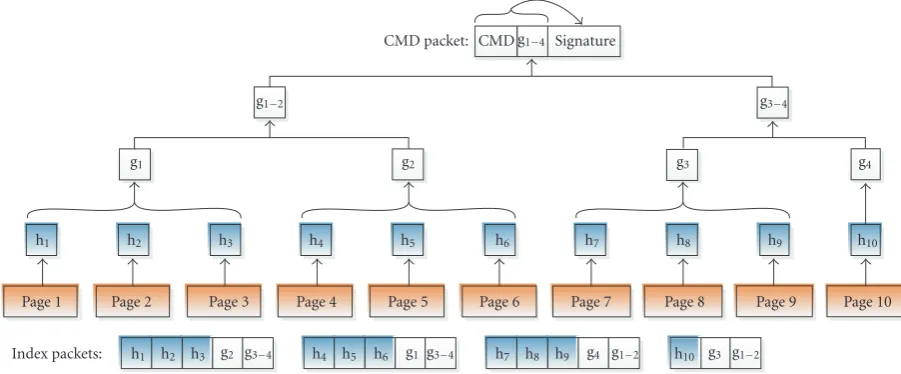
hi (i = 1,. . .,P) in as few packets as possible, with the added constraint that each of these packets is independently authenticable. Following Deng et al.’s naming convention [9], let us call these packetsindex packets. An example of how index packets are constructed from 10 pages is shown in Figure 3.
The key idea is constructing a Merkle hash tree [51] and determining the height of the tree. Denote byLthe height of the tree. Denote bywthe number of hashes that can fit in a packet, sow = l/|H(·)|. By inspectingFigure 3, we can see thatLis the minimum value such that 2L≥ ψ/(w−L).
The root of the tree is signed. This construction is identical
to Seluge’s [11], except that in our case the leaves are hashes of pages, not hashes of packets.
5.2. On the Nodes. In order for a node uto send authen-ticated messages to its neighbor v, u needs to establish a
pairwise key Kuv with v. A REQ from u to v is sent as
REQ[REQ]Kuv.
OnceKuvis established, setting up an authenticated local broadcast channel fromuto its neighbors is straightforward. First,u generates a cluster key chain Au,n,Au,n−1,. . .,Au,0,
where Au,i = H(Au,i+1). Then, u sends the key chain
commitment Au,0 to vencrypted withKuv. An ADV from
u to its neighbors is broadcast as ADVi[ADVi]Au,i.
Authentication is successful ifH(i−j)(Au
,i) = Au,j for some j < i, and [ADVi]Au,iis valid.
We now describe how either a deterministic key predis-tribution scheme called LEAP+ [22] or a probabilistic key predistribution scheme by Eschenauer and Gligor [25] can be used to establishKuv.
LEAP+. Before deployment, every node gets an initial key
KIN. At boot-up, every node ucomputes (i) an individual key Ku = [IDu]KIN; (Here, we are using a MAC, such as
CBC-MAC, as a pseudorandom function [52].), and (ii) a cluster key chainAu,n,Au,n−1,. . .,Au,0.uestablishesKuvwith v, for allv∈ {us neighbors}using the following protocol:
u−→ ∗: IDu
v: Kuv←−[IDu]Kv
v−→u: {IDv||IDu}Kuv
u: Kv←−[IDv]KIN, Kuv←−[IDu]Kv.
(6)
Some time after the above protocol, KIN is erased. This
scheme is only suitable for static networks.
Eschenauer-Gligor. Before deployment, every node gets m
keys randomly chosen from a key pool of n keys. During
neighbor discovery, every pair of neighbors can find at least one common key at a probability of 1−(n−mm)/(mn). Using
the common key(s), two neighbors can establish a pairwise key. If there is no common key between two neighborsuand
v,uandvcan go through a common neighborwwho has
common key(s) with bothuandv, to establish a pairwise key. This scheme is suitable for both static networks and networks with limited mobility.
CMD packet: CMD g1−4 Signature
g1−2 g3−4
g1 g2 g3 g4
h1 h2 h3 h4 h5 h6 h7 h8 h9 h10
Page 1 Page 2 Page 3 Page 4 Page 5 Page 6 Page 7 Page 8 Page 9 Page 10 Index packets: h1 h2 h3 g2 g3−4 h4 h5 h6 g1 g3−4 h7 h8 h9 g4 g1−2 h10 g3 g1−2
Figure3: Construction of individually authenticable index packets using the Merkle tree from 10 pages.
6. Sreluge: Dissemination
To start disseminating the new firmware, the base station sends a CMD packet consisting of the root of the Merkle hash tree and a signature of the root (Figure 3). The signature is used to authenticate the root, and the root in turn is used to authenticate the index packets. For example, when the first index packet ofFigure 3arrives, it is partitioned intoh1,
h2,h3,g2, and g3−4. IfH(H(H(h1h2h3)g2)g3−4) equals
the root, then the first index packet is authenticated. The
ith authenticated index packet is used to authenticate theith page later.
Following the index packets, the base station sends the pages in the form of encoded data packets. For each page, a minimum ofψ packets, encoded according to (1), are to be received. Pollution attacks happen when some of these encoded packets are maliciously modified. Note that unlike the index packets which are individually authenticable, these encoded packets are not. It is only by failing to verify a decoded page using its corresponding hash that we can deduce the presence of polluted encoded packets in the page. The core of Sreluge is a pollution detection engine that partitions the neighbors of a node into five sets:
(i)S: nodes that are suspected to be polluters; (ii)B: nodes that have been blacklisted as polluters; (iii)A: nodes that were suspected but investigation of
which has been abandoned because Sreluge timed out waiting for their packets;
(iv)I: innocent nodes that have been acquitted and are no longer suspected;
(v) Unclassified: nodes that do not belong to any of the above categories.
The basic idea (seeFigure 4) is that whenever a decoded page fails verification, the neighbors that contributed to that page are placed inS. Aprime suspect, defined as a single-element
set ˙s ⊆ S, is picked based on some criteria, and a page is solicited only from ˙s. If the page from ˙spasses verification later, then ˙sis put intoIand removed fromS. If however the page fails verification, ˙sis put intoBand removed fromS. If however after some timeout, the page expected of ˙sstill has not fully arrived, the investigation of ˙sis abandoned, that is,
˙
sis placed inAand removed fromS.
After the firmware is successfully received, Sreluge could pass the results, in the form ofB, to an enclosing IDS. For example, suppose the enclosing IDS is based on RFSN, then a neighbor is associated with two parameters:αandβ, which specify a Beta distribution function. The IDS will change (α,β) to (α,β+ 1) if the corresponding neighbor ∈ B, or to (α+ 1,β) if otherwise. This way, Sreluge does not cause the permanent isolation of a falsely identified polluter due to a small but finite false positive rate (seeSection 7.2.1).
Implementing Sreluge requires modifying the following components of Rateless Deluge: (i) the decode procedure, (ii) the data processing procedure—the procedure that processes incoming data packets, and (iii) the data request procedure— the procedure that sends REQ packets. These modifications are described in detail in the following subsections.
6.1. The Decode Procedure. Encoded data packets are col-lected in theΨmax-sizec-buffer, and decoded in theψ-size d-buffer. The proceduredecodeis invoked afterΨpackets have been collected. It is paramount to note that before any pollution is detected,Ψ=ψ, but once pollution is detected, Ψis varied betweenψ andΨmaxto satisfy (5). We will give more detail on the adjustment algorithm inSection 6.1.3.
The main task of decode (see Procedure1) is to decode each combination of ψ packets until one of the following happens:
Send packets
Page verification failed
Suspects
Choose prime suspect
Other packets filtered
Accept packets
Receives from prime suspect
Prime suspect chosen
Verification failed
Tim ed
out
Verifi catio
n
succ eeded
Polluter
Investigation abandoned
Acquitted
Case I Good nodeu Polluterv
Contributes
c-buffer: Packet 1 Packet 2 Packet 3
Packet 4
Packet 5
Case II Good nodeu Polluterv
Contributes
Packet 1
Packet 2 Packet 3 Packet 4 Packet 5
d-buffer: Packet 1 Packet 2 Packet 3
Packet 4
Packet 1 Packet 2 Packet 3 Packet 5
|senders1\senders2|=1
⇒polluter=senders1\senders2={v} Packet 2
Packet 3 Packet 4 Packet 5 |senders1|=1
⇒polluter=senders1={v}
Failed verification: senders1={u,v}
Successful verification: senders2={u}
Failed verification:
⇒senders1={v}
Figure4: (Top) A simplified view of neighbor classification upon detection of page pollution. (Bottom) Two ways of identifying a polluter,
withψ=4 andΨ=5 in this example.
(ii) decoding succeeds but verification fails, and there are not enough potentially intact packets left inc-buffer (lines 16−26);
(iii) decoding succeeds and verification succeeds (lines 27−35).
At the end of decode, the variable decodeStatus is
assigned one of three values. Depending on the value of
decodeStatus, Sreluge takes the following action.
LinearDependence. The linearly dependent packets
in d-buffer are discarded and more packets are set to be collected.
VerificationFailure. The algorithm is flowcharted
in Figure 5. The main idea is that if a polluter has been found, then a new prime suspect is chosen andΨis adjusted.
If a polluter has not been found, then more suspects are
added to S, before a new prime suspect is chosen and
Ψ is adjusted. The three procedures: findAddSuspects,
newPrimeSuspect,andadjustMaxNumPktsRecvdwill be
discussed in more detail later.
VerificationSucceess. The algorithm is
flowchar-ted inFigure 6. If there is already a prime suspect, the prime suspect is acquitted. Then, a new prime suspect is chosen and Ψis adjusted. If there has not been a prime suspect, Ψis simply set toψ, on the optimistic assumption that there will subsequently be no pollution. The verified page is written to the Flash memory.
Decode status
=veificationFailure
˙ s /=φ
No
|senders|=1 No
FindAddSuspects (senders) Yes
(polluter found)
Yes
(polluter found)
newPrimeSuspect ()
adjustMaxNumPktsRecvd()
˙ S /= φ
Yes
keep packets inc-bufferfrom ˙s and erase all others
End
clearc-buffer No
Figure5: Flowchart for handling the casedecodeStatus=verificationFailure. ˙sis the set of prime suspect. “senders” refer to the
senders of the packets inc-buffer.
DecodeStatus
=verificationSuccess
˙ s /=φ
No
Ψ←ψ Yes
I←s˙∪I
newPrimeSuspect ()
adjustMaxNumPktsRecvd ()
Start writing page to memory
End
Figure6: Flowchart for handling the casedecodeStatus=verificationSuccess. ˙sis the set of prime suspect.Iis the set of acquitted ex-suspects.
classified in S. Denote by senders the set of senders who contributed to a polluted page. Any member ofsendersthat is not already in eitherS,B,I, orAis admitted toS. If there
is no such member, then any member of senders that is
not already inS,B, orIbut maybe inAis added. Recall that A is the set of neighbors investigation of which had been abandoned due to Sreluge timing out waiting for their packets. We take the opportunity to reopen investigation of these neighbors here.
6.1.2. Procedure newPrimeSuspect. The purpose of this procedure (see Procedure3) is to pick a prime suspect among the suspects. The logic of the procedure revolves around the concept of the packet ratio (see Definition 2). To obtain a verdict on the prime suspect as soon as possible, we hope to getψpackets from it in the shortest time possible. Clearly, the higher the packet ratio of the prime suspect, the more
packets we can get from it within a fixed amount of time. Hence, the rationale of newPrimeSuspectis to choose the suspect with the highest packet ratiofor the next page-round. The problem is future packet ratios are not known in advance and thus must be forecast.
To cater for the possibility that the forecast might be wrong and the packet ratio might turn out to be zero, we need to set a time-out. Denote by f(i+ 1) the packet ratio of the prime suspect forecast for the (i+ 1)th page-round. If f(i + 1) is larger or equal to a threshold value
fT, then we will have to collect at most 1/ fT packets in order to receive the first packet from the prime suspect. In other words, if we set a timer (calledprobationTimer
in newPrimeSuspect) to 1/ fT, then the first packet from
the prime suspect should arrive before the timer fires. The
probationTimeris decremented for every packet received
CMD Root Signature
Page 1 Page 2 Page 3 · · · PageP
Tier 1
Tier 2
Figure7: Reduction of security proof.
Based on the analysis above, the challenges are (i) to forecast the suspects’ packet ratios for the next page-round, and (ii) to determine a suitable value for fT.
We first present the solution for challenge (i). The packet ratios of a sender are a discrete-valued stochastic process that depends on many factors, for example, the underlying medium access control protocol, the topology, the radio environment, the transfer rate of the Flash memory, and so forth. The complexity forbids the derivation of a comprehensive analytical model. However, with respect to the standard TinyOS 2.x protocol stack, the time series analysis and simulation-based study in Section 8.1suggest that the forecast f(i+ 1)= f(i) is good enough.
As the solution for challenge (ii), we need a suitable value for fT. A value for fT should be high enough so that we do not need to wait for too long before we collect enough of the prime suspect’s packets, but low enough so that we do not miss out actual polluters with low packet ratios. Simulation results inSection 8.2suggest that fT = 0.5 is a reasonable tradeoff.
6.1.3. ProcedureadjustMaxNumPktsRecvd. The purpose of this procedure is to adjustΨaccording to whether there is a prime suspect:
(i) When there is a prime suspect, packets will be received solely from the prime suspect, henceΨ←ψ.
(ii) When there is no prime suspect, packets will be received from polluters and nonpolluters alike. To satisfy (5), Ψ should be set to ψ/(1−FT), where
FT is at least as large as the combined packet ratio of the polluters. We set FT = |S∪A|fT, because (i) |S∪A|fT tends to overestimate the combined packet ratio of the polluters, thereby satisfying the requirement forFT; (ii) this facilitates a termination proof for Sreluge in the form ofProposition 1.
There are two special cases that need to be taken care of:
(1) whenψ/(1− |S∪A|fT)>Ψmax;
(2) whenψ/(1− |S∪A|fT)<0.
These cases happen when there are many suspects, in which case the necessary value forΨwould be too high. For these cases, we setΨ=ψ.
6.2. The Data Processing Procedure. Upon the reception of
a data packet, the procedure filterData is invoked. The
main tasks of filterData (see Procedure 4) are to filter packets from blacklisted polluters when there is no prime suspect (lines 1−4) and to filter packets not sent by the prime suspect when there is a prime suspect (lines 5−18).
6.3. The Data Request Procedure. Before a REQ is sent, the destination node has to be decided, and obviously, the destination cannot be any member of B. If there is a prime suspect, then the REQ is sent to the prime suspect. Otherwise, the REQ is sent to the neighbor with the highest forecast packet ratio that is not a member ofB. Due to the simplicity of the algorithm, the pseudocode of this procedure is omitted.
7. Analysis of Sreluge
A complete analysis would involve all the components in Figure 1, but it is only meaningful to focus on the components contributed by this work, that is, the compo-nent for pre-dissemination processing of firmware and the component for data authentication. The two components are analyzed together, and the analysis consists of two parts: cryptographic properties (Section 7.1) and noncryp-tographic properties (Sections7.2.1and7.2.2).
7.1. Cryptographic Properties. In informal terms, the security objective is to prevent an attacker from substituting a firmware page(s) with its own page(s). The security proof is reduced to the security proof of the signature schemes labelled Tier 1 and Tier 2 inFigure 7. In formal terms, the security objective is that both Tier 1 and Tier 2 signature schemes are existentially unforgeable under known-message attacks [54, Definition 1.5]. Usually, a signature scheme is required to satisfy a stronger security notion: existentially unforgeable under (adaptive) chosen-message attacks [54, Definition 1.6]. However, since the base station is trusted in the attacker model, an attacker cannot adaptively choose messages to sign, so an attacker can at most only launch known-message attacks.
1: //Precondition: packets have been collected in c-buffer
2: //Output: decodeStatus
3: senders 1← ∅;
4: senders 2← ∅;
5: decodeStatus←verifcationFailure
4:for i←1 toΨψ
do
7: Choose a fresh combination of ψpackets inc-buffer
8: Copy the packets fromc-buffertod-buffer
9: Decode the packets ind-buffer
10: ifdecoding failed due to linear dependencethen
11: x← |linearly dependent packets in d-buffer|
12: IfΨ−x < ψthen
13: decodeStatus←linearDependence
14: break
15: end if
16: else ifdecoding succeeded but verification failedthen 17: //Case II inFigure 4
18: senders1←senders of packets ind-buffer
19: if|senders1| = 1then
20: B←senders1 ∪B
21: x← |packets inc-buffernotfromsenders1|
22: if x < ψ then
23: decodeStatus←verificationFailure
24: break
25: end if
26: end if
27: else ifdecoding and verification succeededthen 28: //Case I inFigure 4
29: senders2←senders of packets ind-buffer
30: ifsenders1= ∅/ ;and|senders1\senders2|=1then
31: B ← |senders1\senders2| ∪ B
32: end if
33: decodeStatus←verificationSuccess
34: break 35: end if 36:end for
Procedure1: Decode.
candidates← senders\(S ∪B∪I ∪A)
if |candidates| = 0then
candidates← senders\(S ∪B ∪I)
S ←candidates ∪ S
end if
Procedure2: FindAddSuspects (senders).
If S= ∅and s˙ = ∅then
x ← member ofSwhose fx(i + 1) is the highest
if fx(i + 1) ≥ fT then
˙
s ← {x}
probationTimer← 1/ fT
S←S\s˙ end if end if
invalid for supersingular elliptic curves [56], the model is valid for the curves defined in the standard [57]. There are currently no formal security proofs for Krontiris and Dim-itriou’s [17] and Ugus et al.’s [18] multiple-time signature schemes.
As a candidate for the Tier 2 signature scheme, the Merkle tree has been proven existentially unforgeable under chosen-message attacks [58]. Therefore, it can be concluded here that if ECDSA is used at Tier 1 and the Merkle tree is used at Tier 2, then the component for pre-dissemination processing of firmware and the component for data authentication of Sreluge are provably secure.
7.2. Noncryptographic Properties. In terms of noncrypto-graphic properties, our main concern is the resilience of Sreluge against the following DoS attacks.
(i) DoS Attacks on the Index Packets. Since the index packets can be received out of order, they are more resilient to DoS attacks than if they have to be received in order such as in [9].
(ii) DoS Attacks on the Encoded Date Packets. As explained, pollution is a major threat due to the nature of network coding. Since Sreluge functions like an intrusion detection system during the
dis-semination phase, we are interested in the false
negative rateandfalse positive rateof the algorithm for identifying polluters. Another important goal is to prove thetotal correctnessof the algorithm. These three properties ensure that, provided the underlying cryptographic framework is secure, no polluter can escape detection and no polluter can cause Sreluge to execute indefinitely. The analysis of these properties is the focus of the remainder of this section.
7.2.1. False Negative and False Positive Rates. A false negative is when a node fails to identify a polluter whereas a false positive is when a node mistakes a good neighbor as a polluter.
Theorem 1. Sreluge has zero false negative rate and a false positive rate that is upper-bounded by
1−(1−BER)lmax(Ψ−ψ,ψ), (7)
where BER is the bit error ratio, and other symbols are as defined inTable 2.
Proof. There are two cases when a node is labelled as a polluter (seeFigure 4). We discuss these two cases separately.
Case I. This case is handled by line 31 of procedure decode. Denote bySbadthe set of packets that decode into a page that fails verification and bySgood the set of packets that decode into the correct page. Then, the packets inSbad\Sgoodmust be responsible for the pollution. Moreover, if all ofSbad\Sgood originated from a single sender, there are two possibilities: (i) either the sender is a polluter or (ii) the sender is good but some of its packets are unintentionally corrupted.
(i) The Sender Is Indeed a Polluter. Sreluge correctly identifies it as a polluter, so there is no false negative. (ii) The Sender Is Actually Good. Denoting by Ei the event that|Sbad\Sgood| =i; by BER the bit error ratio; bylthe number of bits in a data payload. Then, the probability of this false positive is
FPRI=
Ψ−ψ
i=1
Pr(Ei)1−Prpacket is intact|Eii
=
Ψ−ψ
i=1
Pr(Ei)1−(1−BER)li
≤1−(1−BER)l(Ψ−ψ)
Ψ−ψ
i=1 Pr(Ei)
=1−(1−BER)l(Ψ−ψ).
(8)
Case II. This case is handled by line 20 of procedure decode. Again, there are two possibilities as follows.
(i) The Sender Is Indeed a Polluter. Sreluge correctly identifies it as a polluter, so there is no false negative. (ii) The Sender Is Actually Good. Denoting by BER the bit error ratio and bylthe number of bits in a data payload, the probability of this false positive is
FPRII=1−Pr(packet is intact)ψ
=1−(1−BER)lψ.
(9)
Meanwhile, the combined false positive rate is
FPR=FPRI·Pr(Case I) + FPRII·Pr(Case II)
=(FPRI−FPRII)Pr(Case I) + FPRII. (10)
Since (10) is linear in Pr(Case I), the maximum of FPR
is either when Pr(Case I) = 0 or when Pr(Case I) = 1.
Therefore,
FPR≤max(FPRI, FPRII)=1−(1−BER)lmax(Ψ−ψ,ψ). (11)
The implication of the above analysis is that the false negative rate is zero, and the false positive rate is negligible in practice.
7.2.2. Total Correctness. An algorithm is said to satisfy total correctness if given a precondition, the algorithm is guaranteed to terminate and the resulting state satisfies the postcondition. In our case, the precondition is that after discounting polluters, a node is at least 1-connected to the base station whereas the postcondition is that a node eventually receives all the pages.
1:ifs˙= ∅then
2: if sender ∈ B then drop packet
3: else accept packet
4: end if
5:else
6: probationTimer ← probationTimer − 1// Dec. timer
7: if sender ∈ Bor sender ∈/s˙ then
8: drop packet
9: else if sender = s˙ then
10: accept packet
11: probationTimer ← 1/ fT // Reset timer
12: end if
13: if probationTimer = 0then
14: A ← s˙∪ A
15: clearc-buffer
16: newPrimeSuspect()
17: end if 18:end if
Procedure4: FilterData(packet).
node has one polluter among its neighbors, Proposition 1 says that Sreluge will eventually terminate with the node successfully receiving all pages. Proposition 1 depends on Definition 3.
Definition 3. The packet ratio f isoscillatory around fT if it can be represented by a two-state Markov process, with states
A:f ≥ fTandB: f < fT, and transition matrix
⎡
⎣Pr(A|A) Pr(B|A)
Pr(A|B) Pr(B|B)
⎤ ⎦=
0 1 1 0
. (12)
None of the packet ratio processes inFigure 9is oscilla-tory around any value of fT. We can safely assume that the packet ratio processes are generally not oscillatory around any reasonable value of fT. It istheoreticallyfeasible for an attacker to manipulate its packet ratio such that the packet ratio is oscillatory around a specific fT, but in practice this requires the attacker to have continuous and absolute influence on the packet ratios of the good neighbors, which is difficult to achieve.
Proposition 1. Suppose a node has one polluter among its neighbor and at least one good neighbor with positive transmission rate. Provided the packet ratio of the polluter is not oscillatory around fT, Sreluge will eventually terminate with all pages successfully received and verified.
Proof. For the proof, let us label the node running Sreluge
as v and the polluter as u. Figure 8 shows the finite
state automaton representing Sreluge. Sreluge would not terminate if it is trapped in some loop inFigure 8. We first note that the transitions candddo not contribute to any loop because in states 3 and 4, ˙sis eliminated from further consideration. We then note that there are three potential loops: (i)a-e-h, (ii)b-g, and (iii)a-e-h-b-g.
Consider first the possibility of infinite loop a-e-h. Transitione is triggered by the condition fu|5
2 < fT. After transitionh, in state 1, the condition fu= fu|5
2 < fT (recall that in Section 6.1.2, we defined fu to be the most recent value of fu) triggers transition b instead of a. Hence, the infinite loopa-e-his not possible. Using the same reasoning, the infinite loopb-gcan be shown to be impossible.
Consider now the possibility of infinite loopa-e-h-b-g. Given the packet ratio fuisnotoscillatory around fT, we can write the transition matrix of the Markov process describing
fuas
⎡
⎣Pr(A|A) Pr(B|A)
Pr(A|B) Pr(B|B)
⎤ ⎦=
⎡ ⎣π11 π12
π21 π22
⎤ ⎦,
π11+π12=1, π21+π22=1, π12π21<1,
(13)
where the statesAandBof the Markov process correspond to the conditions fu ≥ fT and fu < fT, respectively. The infinite loop a-e-h-b-g necessitates that the process alternates between states A andB. The probability of this happening indefinitely is limi→ ∞(π12π21)i, butπ12π21 <1⇒ limi→ ∞(π12π21)i=0, so while the loopa-e-h-b-gis possible, it cannot occur indefinitely.
The implication of the above analysis is that u will eventually be labelled as a polluter (in state 4), or abandoned (in state 5). In the former case, all polluted packets fromu
will be filtered and as long as the collective transmission rate of the good neighbors is nonzero, enough intact packets will be received. In the latter case, at leastψinΨpackets will be intact, and theψ packets can be decoded and successfully verified. Note thatu will never be labelled as innocent (in state 3) because according to Theorem 1, Sreluge has zero false negative rate.
Page pollution detected
0
findAddSuspects() 1
newPrimeSuspect() 2
˙ s← {u}
S←S\s˙
3 I←s˙∪I
4 B←s˙∪B
5 A←s˙∪A
6 ˙ s←φ
Ψ←ψ\(1−fT)
7
vdecodes and verifies page
a b
c d e
f g
h
a:fu≥fT b:S=φ∨fu< fT c:fu|3
2≥fTand verification succeeded d:fu|4
2≥fTand verification failed e:fu|5
2< fT
f:fu|7 6≤fT g:fu|1
6> fT h: none Definitions:
futhe forecast value of the nextfu fu|ijthe value offubetween statesiandj
Figure8: A finite state automaton for proving the total correctness of Sreluge, whereuis the polluter andvis the node running Sreluge.
its neighbors requires a more thorough proof using formal logic, which will be given in a later work.
8. Simulation and Experimental Results
Simulations are performed using TOSSIM Live [59] of
TinyOS 2.x. The advantage of using TOSSIM is that large scale network dynamics can be observed more easily, and the code can be ported to actual sensor nodes with little to no modification.
Two classes of polluters are simulated as follows.
(i) Basic polluters behave like normal nodes except that they send out invalid data packets. A Basic polluter can be implemented, for example, by capturing a normal node and setting the memory address of the outgoing data packet to an arbitrary value.
(ii) Aggressive polluters are more aggressive than Basic polluters, in that (i) they advertise the falsehood that they possess all the pages, and (ii) they reply to requests immediately with invalid data packets. Implementing an Aggressive polluter requires more effort from the attacker. Most likely, the attacker would need to program its own node, and copy the necessary cryptographic keys from a captured node to its own node. Basic polluters are significantly easier to implement than Aggressive polluters, so we deem Basic polluters a more prevalent threat.
50 and 100 nodes are distributed in a 40 m × 40 m
area in 12 random topologies and a 19-page firmware is disseminated. The networks with 50 nodes have an average network degree of 13 whereas the networks with 100 nodes have an average network degree of 27. Radio parameters (as
Table3: Radio parameters used in the simulations.
Path loss exponent 4.7
Shadowing s.d. 3.2
d0 1.0
PL(d0) 55.4
Noise floor −105.0
S11 0.9
S12 −0.7
S21 −0.7
S22 1.2
White Gaussian noise s.d. 4.0
defined in [60]) are configured as inTable 3. Sreluge-specific parameters are configured as such:ψ=8,Ψmax =1.5ψ(i.e.,
ψ ≤ Ψ ≤ 1.5ψ). ADV, REQ, and data packets are fixed in size and are 14, 10, and 29 bytes long, respectively. The three
casesτ =0%,τ =10%, andτ =20% are simulated. Four
performance metrics are used.
(i) Number of REQ Packets Transmitted per Page per Node. In the ideal case, and in the absence of attacks, a node sends 1/n
request packet per page.
(ii) Number of Data Packets Transmitted per Page per Node. A data packet is typically much longer than a request packet, hence this metric is necessary. In the ideal case, and in the absence of attacks, a node sendsψ/ndata packets per page.
−0.2
Figure9: (a)−(f) Six randomly sampled packet ratio processes plotted against page-round, after first-order differencing. (g)−(l) Histograms
of the differenced packet ratio processes appear Gaussian for most cases. The best ARIMA models for the processes are found to
be ARIMA(6,1,2), ARIMA(0,1,1), ARIMA(0,1,3), ARIMA(0,1,0), ARIMA(0,1,1), and ARIMA(0,1,1), respectively; chosen among the
candidates ARIMA(p,1,q),p,q∈ {0,. . ., 6}, based on Akaike’s information criterion.
Figure10: Forecast results of the six randomly sampled packet ratio processes fromFigure 9. The top and bottom rows are based on models ARIMA(0,1,1) and ARIMA(0,1,0), respectively. Solid lines represent the original time series whereas dashed lines represent the results of
real-timeforecasting with a forecast horizon of 1. Root mean square errors between the actual time series and the forecast time series are given above each graph.
Table4: Comparison of Sreluge to Rateless Deluge (“R.D.”) whenτ=0%. Figures are mean values.
50 nodes 100 nodes
R.D. Sreluge R.D. Sreluge
REQ/page/node 1.47 1.47 0.82 0.80
Data/page/node 3.59 3.56 2.01 1.97
Decoding/page/node 1.00 1.01 1.00 1.00
0 0.5 1 1.5 2
N
u
mber
of
REQ
p
ack
ets/page/node
N=50,τ=0.1 N=50,τ=0.2 N=100,τ=0.1 N=100,τ=0.2
(a)
0 1 2 3 4 5
N
u
mber
of
D
A
T
A
pac
kets/page/node
N=50,τ=0.1 N=50,τ=0.2 N=100,τ=0.1 N=100,τ=0.2
(b)
0 0.4 0.8 1.2
N
u
mb
er
of
de
co
de-r
ounds/page/no
de
N=50,τ=0.1 N=50,τ=0.2 N=100,τ=0.1 N=100,τ=0.2
ARIMA(0,1,1) ARIMA(0,1,0)
(c)
0 50 100 150 200
Disse
minatio
n
time
(s)
N=50,τ=0.1 N=50,τ=0.2 N=100,τ=0.1 N=100,τ=0.2
ARIMA(0,1,1) ARIMA(0,1,0)
(d)
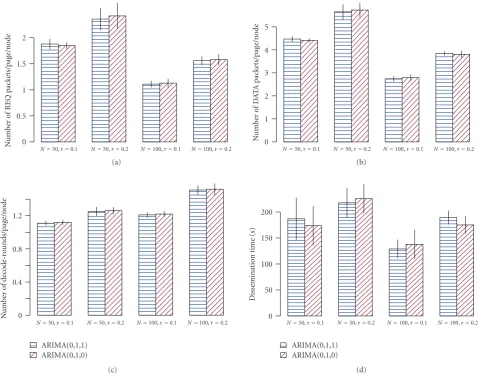
Figure11: Comparison of forecast models for packet ratios.fT=0.5.
(iv) Dissemination Time . This metric considers the amount of time in seconds required for the disseminated firmware to reach all the nodes in the network, but does not take into account the time required for the nodes to reboot themselves using the new firmware. Note that the timing results here are only rough estimates as TOSSIM does not simulate computation delay.
For the simulations, key predistribution and distribution of index packets are not implemented; 10-byte-long hashes derived from the pages are hard-coded. Assuming both Rateless Deluge and Sreluge implement the same key pre-distribution scheme and index packet scheme, then the overhead for both Rateless Deluge and Sreluge in this regard would be the same, and the comparison between the two protocols given here would not be far off.
When τ = 0%, Sreluge behaves like Rateless Deluge,
as evidenced by Table 4. This confirms that Sreluge does not incur unnecessary overhead when there is no attack. Table 4 also shows that higher network density quickens dissemination in a pollution-free network. In the ensuing subsections, results will be given
(1) to compare forecast methods of the packet ratio, assuming Basic polluters;
(2) to compare different values of fT, assuming Basic polluters;
(3) to compare Sreluge with a prescient countermeasure called Prescient Sreluge, assuming Basic polluters;
(4) to compare the effects of Basic and Aggressive
polluters on the performance of Sreluge.
Experimental results using Crossbow IRIS motes will also be given.
8.1. Comparison of Forecast Methods of the Packet Ratio.
In procedure newPrimeSuspect, packet ratios need to be
0
Figure12: Comparison of different values offT. ARIMA(0,1,0) is used as the forecast model for packet ratios.
moving average, MA(1). For the ensuing discussion, we
employ the standard notation ARIMA(p,d,q) to denote the autoregressive integrated moving average time series, f(t), defined by the following [61]:
φp(B)(1−B)df(t)=μ+θq(B)t (14)
Bis called the lag operator andμis called the deterministic trend term whend≥1. Using this standard notation, we say that for half of the randomly sampled packet ratio processes in Figure 9, the best model is found to be ARIMA(0,1,1). While it is inconclusive whether ARIMA(0,1,1) is the best model for the majority of packet ratio processes besides these six, it is beyond the capability of standard sensor nodes to perform real-time model selection as well as parameter estimation for high-order ARIMA models.
Reusing the packet ratio processes from Figure 9, we further compare ARIMA(0,1,1) to ARIMA(0,1,0) in terms of their accuracy in forecasting packet ratios in real-time.
When the model is ARIMA(0,1,1), we use themethod of moments [62, page 125] for parameter estimation and the
innovations algorithm[62, page 115] for forecasting. We use these algorithms instead of the higher-accuracy Kalman filter because the latter is much more resource-intensive.
When the model is ARIMA(0,1,0), we first write down the equation for the model:
f(t)−f(t−1)=μ+t, (16)
which is essentially a first-order autoregressive process,
AR(1). We then apply the Wiener-Kolmogorov prediction
formula[61, page 80] for AR(1):
which means the forecast for the next sample is simply the current sample. We must note that the Wiener-Kolmogorov prediction formula is based on an infinite number of obser-vations, so it is only used for asymptotic approximation.
0
Figure13: Comparison of Sreluge with Prescient Sreluge. For regular Sreluge, ARIMA(0,1,0) is used as the forecast model for packet ratios;
fT=0.5.
any practical difference in the four performance metrics. Consequently, we adopt the simpler ARIMA(0,1,0) as the model, and in the interest of resource conservation,f(i+1)=
f(i) as the forecast formula.
8.2. Comparison of Different Values of fT. In procedure
newPrimeSuspect,fT is used as the threshold for choosing
a prime suspect. A suitable value is chosen via simulations. For the simulations, 11 values ranging from 0.0 to 1.0 are
used. When fT = 0.0, the procedure newPrimeSuspect
always finds a prime suspect. When fT =1.0, the procedure almost never finds a prime suspect. The results inFigure 12 show that the number of REQ/data packets and the dissem-ination time generally manifest a downward trend against
fTwhereas the number of decode-rounds generally increases with fT. As such, fT =0.5 presents a reasonable tradeoff.
8.3. Comparison with Prescient Sreluge. Sreluge is a reactive countermeasure that tries to identify polluters. If the good nodes knew in advance which neighbors of theirs are polluters, then the overhead could be drastically reduced. With this prescience, the nodes will drop all ADV and data from the polluters. We call this prescient countermeasure Prescient Sreluge. This is not a realistic protocol, but as a
comparison to Sreluge, it sheds light on how close Sreluge is to a solution with prior information.Figure 13shows that, in the worst case (100 nodes with 20% polluters), Sreluge requires 100% more REQ packets, 50% more data packets, 50% more decode-rounds, and 100% more dissemination time.
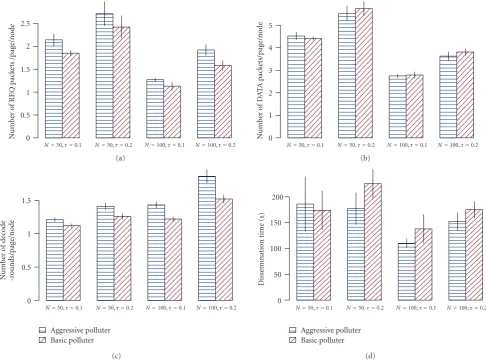
8.4. Comparison of Basic and Aggressive Polluters. Figure 14 shows that Aggressive polluters make Sreluge send more REQ packets and perform more decoding. However, Aggressive polluters neither make Sreluge send more data packets, nor make Sreluge spend more time on dissemination. This surprising outcome can be explained by the fact that as the Aggressive polluters start polluting data earlier than the Basic polluters do, they tend to be blacklisted earlier than the Basic polluters do as well. With pollution blocked earlier, the session can finish earlier. Since the Aggressive polluter does not cause more “damage” than the Basic polluter does for the amount of effort that is required of the attacker, the Basic polluter should be considered a more prevalent threat.
0
Figure14: Comparison of the effects of Basic and Aggressive polluters on the performance of Sreluge. ARIMA(0,1,0) is used as the forecast
model for packet ratios.fT=0.5.
pkts/page/node Number of DATApkts/page/node Number of decode-rounds/page/node Disseminationtime (1k sec)
Sreluge (no polluters) Prescient sreluge (2 polluters) Sreluge (2 polluters)
Figure 15: Experimental results comparing Sreluge to Prescient Sreluge in the presence of polluters, and to Sreluge in the absence of polluters
8.5. Experimental Results. The objective of the experiments is to compare the performance of Sreluge under attack, and Sreluge not under attack as well as the performance of Prescient Sreluge under attack. For the experiments, 11
Crossbow IRIS motes running Sreluge on top of the CVS version of TinyOS 2.x are used—one of which serves as the base station, five of them are placed one hop away from the base station, and the remaining five are placed two hops from the base station. All nodes in the same hop distance from the base station are interconnected. Packet length is set to 33 and the transmission power is set to the minimum to minimize interference and the area of the network. A TinyOS image of 191 pages is disseminated by the base station.
To simulate attacks, two Basic polluters (τ = 20%, not
counting the base station) are placed in the first hop of the network. For each scenario, the experiment is carried out five times. The results are shown inFigure 15. Note that due to practical constraints, this experimental network is much sparser than the simulated networks, and hence the results here are not directly comparable to the simulation results in the previous sections.