R E S E A R C H
Open Access
Periodic solutions for complex-valued
neural networks of neutral type by combining
graph theory with coincidence degree theory
Zhengqiu Zhang
1and Jinde Cao
2**Correspondence:
2School of Mathematics, Southeast University, Nanjing, China Full list of author information is available at the end of the article
Abstract
In this paper, by combining graph theory with coincidence degree theory as well as Lyapunov functional method, sufficient conditions to guarantee the existence and global exponential stability of periodic solutions of the complex-valued neural networks of neutral type are established. In our results, the assumption on the boundedness for the activation function in (Gao and Du in Discrete Dyn. Nat. Soc. 2016:Article ID 1267954,2016) is removed and the other inequality conditions in (Gao and Du in Discrete Dyn. Nat. Soc. 2016:Article ID 1267954,2016) are replaced with new inequalities.
Keywords: The periodic solutions; Exponential stability; Complex-valued neural networks of neutral type
1 Introduction
Because in a lot of practical applications complex signals often occur and the complex-valued neural networks are preferable and practical, hence, up to now, there has been increasing research interest in the stability of equilibrium point and periodic solutions of complex-valued neural networks, for example, see [2–17] and the references therein.
On the other hand, time delays have been extensively studied in last decades due to their potential existence in many fields [12,13,18–20]. Up to now, the dynamical behaviors of neural networks of neutral type have been extensively investigated and a lot of interesting results on the global asymptotic stability and global exponential stability of equilibrium point and periodic solutions for neural networks of neutral type have been published, for example, see [18,21–28] and the references therein.
But so far, very few studies have been reported on the dynamical behaviors of complex-valued neural networks of neutral type with time delays [1, 29]. This motivates us to carry out a study on dynamical behaviors of complex-valued neural networks of neu-tral type. Recently, in [1], the authors discussed the existence and exponential stability of periodic solutions for the following delayed complex-valued neural networks of neutral type:
d[Knzn(t)]
dt = –dn(t)zn(t) +
l
j=1 bnj(t)Fj
zj(t)
+
l
j=1 enj(t)Gj
zj
t–τnj(t)
+Pn(t), (1)
wheren∈L={1, 2, . . . ,l},lis a positive integer,
Knzn(t) =Knun(t) +iKnvn(t),
Knun(t) =un(t) –cnun(t–τ),
Knvn(t) =vn(t) –cnvn(t–τ),
τ,cn∈Rwith|cn| = 1,dn(t)≥0 is the self feedback connection weight, andenj(t),bnj(t) are
complex-valued connection weights,Fj(zj) andGj(zj) :C→Care the activation functions
of the neurons.Pn(t)∈Cis the external input,τnj≥0 corresponds to the transmission
delays withτnj ≤σ< 1,τnj≤σ∗.
In [1], first, by means of using coincidence degree theory and the a priori estimate method of periodic solutions, under the assumptions that the activation functions were bounded, a sufficient condition on the existence of periodic solutions was established for system (1). Then, by constructing an appropriate Lyapunov functional, a sufficient condi-tion to guarantee the global exponential stability of periodic solucondi-tions to system (1) was obtained.
In recent years, graph theory has been applied to studying global asymptotic stability of discrete-time Cohen–Grossberg neural networks with finite and infinite delays [30] and the existence and global stability of periodic solutions for coupled networks [31–35]. Some sufficient conditions on the existence and global stability of equilibrium point and periodic solutions for some neural networks and coupled networks have been established [30–36]. Recently, without applying the a priori estimate method of periodic solutions, we have established some criteria to guarantee the existence of periodic solutions for neural net-works with time delays by combining coincidence degree theory with Lyapunov functional method or linear matrix inequality method [14,15,37].
However, so far, the results on the existence and global exponential stability of periodic solutions for delayed complex-valued neural networks of neutral type have not been ob-tained by combining coincidence degree theory with graph theory as well as Lyapunov functional method.
The objective of this paper is to establish new criteria to guarantee the existence and global exponential stability of periodic solutions of system (1) by removing the assumption on the boundedness for the activation functions in [1] and replacing inequality conditions in [1] with new inequality conditions, by combining coincidence degree theory with graph theory as well as Lyapunov functional method.
Thus the contribution of our paper lies in the following two aspects: (1) Combination of coincidence degree theory with graph theory as well as Lyapunov functional is introduced to study the existence and exponential stability of periodic solutions for delayed complex-valued neural networks of neutral type; (2) Novel sufficient conditions to guarantee the existence and global exponential stability of periodic solutions for system (1) are derived by removing the limitation on the boundedness for the activation functions in [1] and replacing inequality conditions in [1] with new inequality conditions.
2 Preliminaries
Let zn(t) = un(t) +ivn(t), Fj(zj(t)) =FjR(uj(t),vj(t)) +iFjI(uj(t),vj(t)), Gj(zj(t –τnj(t))) =
GRj(uj(t –τnj(t)),vj(t – τnj(t))) + iGjI(uj(t – τnj),vj(t –τnj(t))) = GRj(utj,vtj) + iGIj(utj,vtj),
uj(t–τnj(t)) =utj,vj(t–τnj(t)) =vtj, bnj(t) =bRnj(t) +ibInj(t),enj(t) =eRnj(t) +ieInj(t), Pn(t) =
PR
n(t) +iPnI(t). After separating each state variable, the connection weight, the activation
function, and the external input into its real and imaginary parts, then system (1) can be rewritten as follows:
The initial values of system (2) are
un(s) =φn(s), vn(s) =ψn(s), s∈[–σ, 0],σ=max
Bnj∗ =bRnjkjR+kjI+bI nj
ljR+lIj+eRnjqIj+qRj+eI nj
qRj +qIj,
Enj=eRnjqRj +eInjpjR+eRnjpIj+eInjqIj, Fnj=eRnjqIj+eInjpIj+eRnjpRj +eInjqRj,
Unj=bRnj
lRj +kjI+bI nj
kjR+lIj, Vnj=bRnj
lIj+kjR+bI nj
kjI+lRj.
Throughout this paper, we always assume that (h1) There exist positive constants lR
n, lIn, kRn, knI, qRn, qnI, pRn, pIn such that, for
∀(x1,y1), (x2,y2)∈R×R,n∈L,
FR
n(x1,y1) –FnR(x2,y2)≤lRn|x1–x2|+lnI|y1–y2|,
FnI(x1,y1) –FnI(x2,y2)≤knR|x1–x2|+kIn|y1–y2|, GRn(x1,y1) –GRn(x2,y2)≤qRn|x1–x2|+qIn|y1–y2|, GIn(x1,y1) –GIn(x2,y2)≤pRn|x1–x2|+pIn|y1–y2|.
(h2) dn(t),bRnj(t),bInj(t), eRnj(t),eInj(t), PRn(t), PIn(t)(n∈L) are all continuousω-periodic
functions. (h3) (1 +|cn|)(Unj+
Enj
1–σ) <
2dj
l –
|cj|
l dj–Ajn–|cj|Bjn.
(h4) (1 +|cn|)(Vnj+ Fnj
1–σ) <
2dj
l –
|cj|
l dj–A∗jn–|cj|B∗jn.
Lemma 2.1(Gaines and Mawhin [38]) Suppose that X∗ and Z∗are two Banach spaces and L∗:D(L∗)⊂X∗→Z∗is a Fredholm operator with index zero.Moreover,⊂X∗is an open bounded set and N∗:→Z∗is L∗-compact on.If the following conditions hold:
(a) L∗u=λN∗u,∀u∈∂∩D(L∗),∀λ∈(0, 1), (b) QN∗u= 0,∀u∈∂∩KerL∗,
(c) degB(J∗QN∗,∩KerL∗, 0)= 0,
where J∗:ImQ→KerL∗is an isomorphism,then the equation L∗u=N∗u has a solution on∩D(L∗).
Definition 2.1 (Graph theory [39]) A directed graph g = (U,K) contains a set U = {1, 2, . . . ,n}of vertices and a setKof arcs (i,j) leading from initial vertexito terminal ver-texj. A subgraphofgis said to be spanning ifandghave the same vertex set. A sub-graph is unicyclic if it is a disjoint union of rooted trees whose roots form a directed cycle. For a weighted digraphg withlvertices, we define the weight matrixB= (b∗ij)n×n
whose entryb∗ij> 0 is equal to the weight of arc (j,i) if it exists, and 0 otherwise. A digraph
gis strongly connected if, for any pair of distinct vertices, there exists a directed path from one to the other. The Laplacian matrix of (g,B) is defined asL= (qij)l×l, whereqij= –b∗ijfor
i=jandqij=
k=ib∗ikfori=j.
Lemma 2.2([39]) Suppose that l≥2and c∗kdenotes the cofactor of the kth diagonal ele-ment of the Laplacian matrix of(g,B).Then
l
k,h=1
c∗kb∗khGkh(xk,xh) =
Q∈
W(Q)
(k,h)∈K(CQ)
where Gkh(uk,uh)is an arbitrary function,Q is the set of all spanning unicyclic graphs of
(g,B),W(Q)is the weight of Q,CQdenotes the directed cycle of Q,and K(CQ)is the set of
arcs in CQ.In particular,if(g,B)is strongly connected,then c∗k> 0for1≤k≤l.
Remark1 If (u1(t),u2(t), . . . ,ul(t),v1(t),v2(t), . . . ,vl(t))Tis anωperiodic solution of system
(2), then (z1(t),z2(t), . . . ,zl(t))T, wherezn(t) =uRn(t) +ivIn(t), n= 1, 2, . . . ,l, must be an ω
periodic solution to system (1). Thus, in order to show the existence of periodic solutions of system (1), we only need to show the existence of periodic solutions of system (2). For proving the global exponential stability of periodic solutions of system (1), we only need to prove the global exponential stability of periodic solutions of system (2).
Lemma 2.3(Lemma 2.1 [40]) If|cn|< 1,n= 1, 2, . . . ,l,then the inverse of difference
opera-tor Bndenoted by B–1n exists and
B–1n ≤ 1
1 –|cn|
.
3 The existence of periodic solutions
Lemma 3.1 For anyλ∈(0, 1),we are concerned with the following system:
d[Knun(t)]
dt =λ
–dn(t)un(t) + l
j=1
bRnj(t)FjRuj(t),vj(t)
–
l
j=1
bInj(t)FjIuj(t),vj(t)
+
l
j=1
eRnj(t)GRjutj,vtj–
l
j=1
eInj(t)GIjujt,vtj+PRn(t)
,
d[Knvn(t)]
dt =λ
–dn(t)vn(t) + l
j=1
bRnj(t)FjIuj(t),vj(t)
+
l
j=1 bI
nj(t)FjR
uj(t),vj(t)
+
l
j=1
eRnj(t)GIjutj,vtj+
l
j=1
eInj(t)GRjujt,vtj+PIn(t)
.
(3)
Then the periodic solutions of system(3)are bounded and the boundary must be indepen-dent of the choice ofλunder assumptions(h1)–(h4)if the periodic solutions of system(3) exist.Namely,there exists a positive constant M such that
u(t),v(t)T=u1(t),u2(t), . . . ,ul(t),v1(t),v2(t), . . . ,vl(t)
T≤
M,
where
u(t),v(t)T=
l
m=1
max
t∈[0,ω]
Proof From (h3) and (h4), it follows that there exists a positive numberδsuch that
Then we have, along with the solutions of system (3),
+
By using (h5) and (h6), from (7), it follows that We construct the following Lyapunov function for system (3):
From Lemma2.2, it follows that
l
n=1
l
j=1
c∗nbnjGnj
u2n(t),u2j(t)=
Q∈
W(Q)
(n,j)∈K(C) Gnj
u2n(t),u2j(t), (13)
l
n=1
l
j=1
c∗nb∗njG∗njvn2(t),v2j(t)=
Q∈
W(Q)
(n,j)∈K(C)
G∗njv2n(t),v2j(t). (14)
By substituting (10) into (13) and substituting (11) into (14), it follows that, from the fact
W(Q) > 0,
l
n=1
l
j=1
c∗nbnjGnj
u2n(t),u2j(t)
=
Q∈
W(Q)
(n,j)∈K(C) pj
u2j(t)–pn
u2n(t)≤0 (15)
and
l
n=1
l
j=1
c∗nb∗njG∗njv2n(t),v2j(t)
=
Q∈
W(Q)
(n,j)∈K(C)
p∗jv2j(t)–p∗nv2n(t)≤0. (16)
Substituting (15) and (16) into (12) gives
dV(t)
dt ≤λ
l
n=1 c∗n
l
j=1
–δ u2n(t) +vn2(t)+N. (17)
Integrating (17) from 0 toωgives
ω
0
l
n=1
c∗nδ u2n(s) +v2n(s)ds≤ωN
l
n=1
c∗n. (18)
Integrating (17) from 0 totgives
V(t)≤V(0) + t
0
l
n=1
c∗nlδ u2n(s) +v2n(s)+Nds
≤V(0) + ω
0
l
n=1
c∗nlδ u2n(s) +v2n(s)+Nds. (19)
Substituting (18) into (19) gives
V(t)≤V(0) + 2lωN
l
n=1
From (20) and the definitions ofVn(t) andV1n(t), we have l
n=1
c∗n un(t) –cnun(t–τ1)
2
+ vn(t) –cnvn(t–τ1
2
≤V(0) + 2lωN
l
n=1
c∗n. (21)
Letting|un(ξ)|=maxt∈[0,ω]|un(t)|,|vn(η)|=maxt∈[0,ω]|vn(t)|, then from (21), it follows that l
n=1
c∗n1 –|cn|
2
u2n(ξ) +v2n(η)≤V(0) + 2lωN
l
n=1 c∗n.
Hence there exists a positive constantMsuch that(u(t),v(t))T ≤M. This completes the
proof of Lemma3.1.
Theorem 3.1 Assume that(h1)–(h4)hold and|cn|< 1.Then system(2)has at least oneω
periodic solution.
Proof We will prove the existence of periodic solutions of system (2) by means of using Lemma2.1. We are concerned with the Banach spaces:X∗=Z∗={(u(t),v(t))T∈C(R,R2l) :
u(t+ω) =u(t),v(t+ω) =v(t)} with the norm(u(t),v(t))T=l
n=1maxt∈[0,ω](|un(t)|+
|vn(t)|). Set L∗ : DomL∗ ⊂ X∗ → X∗, L∗(u(t),v(t)) = (d[K1dtu1(t)],d[K2dtu2(t)], . . . ,d[Kldtul(t]), d[K1v1(t)]
dt , d[K2v2(t)]
dt , . . . , d[Klv1(t)]
dt ) Tand
N∗u(t),v(t)=f1(t),f2(t), . . . ,fl(t),f1∗(t),f2∗(t), . . . ,fl∗(t)
,
where, forn∈L,
fn(t) = –dn(t)un(t) + l
j=1
bRnj(t)FjRuj(t),vj(t)
–
l
j=1
bInj(t)FjIuj(t),vj(t)
+
l
j=1
eRnj(t)GRjutj,vtj–
l
j=1
eInj(t)GIjujt,vtj+PnR(t),
fn∗(t) = –dn(t)vn(t) + l
j=1
bRnj(t)FjIuj(t),vj(t)
+
l
j=1
bInj(t)FjRuj(t),vj(t)
+
l
j=1
eRnj(t)GjIutj,vtj+
l
j=1
eInj(t)GRjujt,vtj+PnI(t).
ThusKerL∗={u= (u(t),v(t))T∈X∗:u∈R2l},ImL∗={w∈Z∗:0ωw(t)dt= 0}is closed in
Z∗andDim KerL∗= 2l=Codim ImL∗. Hence, the operatorL∗is a Fredholm mapping of index 0. We construct the projectorsP∗:X∗∩DomL∗→KerL∗andQ∗:Z∗→Z∗as
P∗u= 1 ω
ω
0
u(t)dt, u∈X∗;
Q∗w= 1 ω
ω
0
Therefore, LmP∗=KerL∗,LmL∗=KerQ∗=Im(I–Q∗). Moreover, the generalized in-verseKpofL∗is given asKp= (L∗)–1(
t
0w(s)ds). Since|cn|< 1, from Lemma2.3, it is not
difficult to show thatN∗ isL∗-compact on. The concrete form of the operator equa-tionL∗(u,v) =λN∗(u,v), (u,v)T∈X∗,λ∈(0, 1) is system (2). From Lemma3.1, for every
periodic solution (u(t),v(t))T = (u1(t),u2(t), . . . ,u
l(t),v1(t),v2(t), . . . ,vl(t))T of system (2),
there exists a positive constantMsuch that(u(t),v(t))T<M. We set={(u(t),v(t))T∈
X∗:(u(t),v(t))T<M}, M>
2Nlln=1c∗n
min1≤n≤l{c∗n}. Then, for each (u(t),v(t))
T ∈∂∩DomL∗,
L∗(u(t),v(t))=λN∗(u(t),v(t)), λ∈ (0, 1). Hence, condition (1) in Lemma 2.2 is satis-fied. Secondly, we will show that when (u(t),v(t))T∈∂∩KerL∗,Q∗N∗(u(t),v(t))= 0. Since (u,v)T ∈∂∩KerL∗, (u,v)T is a constant vector with (u,v)T=M, then when
(u,v)T ∈∂∩KerL∗, Q∗N∗(u,v) = (f
1(ξ1),f2(ξ2), . . . ,fl(ξl),f1∗(ξ1),f2∗(ξ2), . . . ,fl∗(ξl)), where
ξi(i= 1, 2, . . . ,l)∈[0,ω]. When (u,v)T∈∂∩KerL∗, we have
[un–cnun,vn–cnvn] Q∗N∗(u,v)n
T
= [un–cnun,vn–cnvn]
fn(ξn),fn∗(ξn)
T
= (un–cnun)
–dn(ξn)un+ l
j=1
bRnj(ξn)FjR(uj,vj)
–
l
j=1
bInj(ξn)FjI(uj,vj) + l
j=1
eRnj(ξn)GRj(uj,vj) – l
j=1
eInj(ξn)GIj(uj,vj) +PRn(ξn)
+ (vn–cnvn)
–dn(ξn)vn+ l
j=1
bRnj(ξn)FjI(uj,vj)
–
l
j=1
bInj(ξn)FjR(uj,vj) + l
j=1
eRnj(ξn)GIj(uj,vj) – l
j=1
eInj(ξn)GRj(uj,vj) +PnI(ξn)
+ 0. (22)
It is obvious that
0 =|cn|
l
j=1
Bnjδ+δ2PRn
u2n–u2n+1 +|cn| 1 –σ
l
j=1 Enj
u2j–u2j
+|cn|
l
j=1
B∗njδ+δ2PnI
v2n–v2n+1 +|cn| 1 –σ
l
j=1 fnj
v2j–v2j. (23)
Substituting (23) into (22) gives
[un–cnun,vn–cnvn] QN(u,v)n
T
= [un–cnun,vn–cnvn]
fn(ξn),fn∗(ξn)
T
≤(un–cnun)
–dn(ξn)un+ l
j=1
bRnj(ξn)FjR(uj,vj) – l
j=1
Substituting (26) into (25) gives
l
n=1
c∗n[un–cnyn,vn–cnvn]Q∗N∗(u,v)n
T
≤–min
1≤n≤l
c∗nM 2
2 +Nl
l
n=l
c∗n< 0. (27)
Thus when (u,v)∈∂∩KerL∗,Q∗N∗(u,v)= 0. Thus, condition (b) in Lemma2.1is sat-isfied.
Thirdly, we show that when (u,v)T∈∂∩KerL∗,deg{J∗Q∗N∗,∩KerL∗, 0} = 0. We construct a mappingH(u,v,μ∗) by setting
Hu,v,μ∗= –μ∗(d1u1,d2u2, . . . ,dlvl,d1v1,d2v2, . . . ,dlvl)
+1 –μ∗f1(ξ1),f2(ξ2), . . . ,fl(ξl),f1∗(ξ1),f2∗(ξ2), . . . ,fl∗(ξl)
,
where ∀(u,v,μ∗)∈∂∩KerL∗×[0, 1]. If when (u,v,μ∗)∈∂∩KerL∗ =R2l∩KerL∗,
H(u,v,μ∗) = 0, then forn∈L,
0 = –μ∗dnun+
1 –μ∗fn(ξn) (28)
and
0 = –μ∗dnun+
1 –μ∗fn∗(ξn). (29)
From (28) and (29), we have
0 = (un–cnun) –μ∗dnun+
1 –μ∗fn(ξn)
+ (vn–cnvn) –μ∗dnvn+
1 –μ∗fn∗(ξn)
≤–(1 –cn)μ∗dnu2n– (1 –cn)
1 –μ∗dnu2n+un
l
j=1
bRnj(ξn)FjR(uj,vj)
–
l
j=1
bInj(ξn)FjI(uj,vj) + l
j=1
eRnj(ξn)GRj(uj,vj) – l
j=1
eInj(ξn)GIj(uj,vj) +PRn(ξn)]
– (1 –cn)μ∗dnv2n– (1 –cn)
1 –μ∗dnv2n+vn
l
j=1
bRnj(ξn)FjI(uj,vj)
+
l
j=1
bInj(ξn)FjR(uj,vj) + l
j=1
eRnj(ξn)GIj(uj,vj) + l
j=1
eInj(ξn)GRj(uj,vj) +PIn(ξn)
≤ – (1 –cn)dnu2n+ (1 –cn)
1 –μ∗|un|
l
j=1
bRnjFjR(uj,vj)
+
l
j=1
bInjFjI(uj,vj)+ l
j=1
eRnjGRj(uj,vj)+ l
j=1
eInjGIj(uj,vj)+PRn
– (1 –cn)dnv2n+ (1 –cn)
1 –μ∗|vn|
l
j=1 bR
njGIj(uj,vj)
+
l
j=1 bI
njF R
j(uj,vj)+ l
j=1 eR
njG I
j(uj,vj)+ l
j=1 eI
njG R
j(uj,vj)+PIn
. (30)
By the same proofs as those in (7)–(17), from (30), we obtain
–(1 –cn)dnu2n+ (1 –cn)
1 –μ∗|un|
l
j=1
bRnjFjR(uj,vj)
+
l
j=1
bInjFjI(uj,vj)+ l
j=1
eRnjGRj(uj,vj)+ l
j=1
eInjGIj(uj,vj)+PRn
– (1 –cn)dnv2n+ (1 –cn)
1 –μ∗|vn|{ l
j=1 bR
njFjI(uj,vj)
+
l
j=1 bI
nj|FjR(uj,vj) + l
j=1 eR
njGIj(uj,vj)+ l
j=1 eI
njGRj(uj,vj)
< 0. (31)
Equation (31) contradicts (30), henceH(u,v,μ∗)= 0 when (u,v,μ∗)∈∂∩R2l∩KerL∗.
Hence,L∗(u,v,μ∗) is a homotopic mapping. Thus, we have
degJ∗Q∗N∗u,v,μ∗,∂∩KerL∗, (0, 0, . . . , 0)
=degH(u,v, 0),∂∩KerL∗, (0, 0, . . . , 0)
=degH(u,v, 1),∂∩KerL∗, (0, 0, . . . , 0)
= 0.
Thus condition (c) in Lemma2.1is satisfied. Hence the proof of Theorem3.1is
com-plete.
4 Exponential stability
Theorem 4.1 Let the conditions in Theorem3.1be satisfied.Then the uniqueω-periodic solution of system(2)is globally exponentially stable.
Proof According to Theorem3.1, system (2) has anω-periodic solution. Let
u∗(t),v∗(t)T=u∗1(t),u∗2(t), . . . ,u∗l(t),v∗1(t),v∗2(t), . . . ,v∗l(t)T
be anω-periodic solution. From (h3) and (h4), it follows that there exist two positive num-bersδ∗andαsuch that
(h7) (1 +|cn|)(Unj+ Enjeασ∗
1–σ ) < 2
dj
l –
|cj|
l dj–Ajn–|cj|e
ατB
jn–δ∗–αl[eατ(1 +c2n) + 1 +|cn|].
(h8) (1 +|cn|)(Vnj+ Fnjeασ∗
1–σ ) <
2dj
l –
|cj|
l dj–A∗jn–|cj|eατB∗jn–
α
l[e
ατ(1 +c2
Let (u(t),v(t))T= (u1(t),u2(t), . . . ,u
l(t),v1(t),v2(t), . . . ,vl(t))Tbe an arbitrary solution of
system (2). We define the following Lyapunov functional:Vn(t) =V1n(t) +V2n(t),n∈L,
V1n(t) =eαt
KnXn(t)
2
+eαtK nYn(t)
2
,
V2n(t) =|cn|
t t–τ
eα(s+τ)
l
j=1
BnjX2n(s)ds
+(1 +|cn|) 1 –σ
l
j=1 Enj
t t–τnj(t)
eα(s+σ∗)X2j(s)ds
+(1 +|cn|) 1 –σ
l
j=1 Fnj
t t–τnj(t)
eα(s+σ∗)Yj2(s)ds
+|cn|
t t–τ
eα(s+τ)
l
j=1
B∗njYn2(s)ds
+α t
t–τ
1 +c2neα(s+τ)Xn2(s)ds
+α t
t–τ
1 +c2neα(s+τ)Yn2(s)ds,
whereXn(t) =un(t) –u∗n(t),Yn(t) =vn(t) –v∗n(t). Then we can get, along with the solutions
of system (2),
dV1n(t)
dt =e
αt
Xm(t) –cnXn(t–τ)
–dn(t)Xn(t)
+
l
j=1
bRnj(t) FjRuj(t),vj(t)
–FjRu∗j(t),v∗j(t)
–
l
j=1
bInj(t)FjIuj(t),vj(t)
–FjIu∗j(t),v∗j(t)
+
l
j=1
eRnj(t) GRjutj,vjt–GRjuj∗t,v∗jt
–
l
j=1
eInj(t) GjIutj,vjt–GjIuj∗t,v∗jt
+ Yn(t) –cnvn(t–τ)
–dn(t)Yn(t)
+
l
j=1
bRnj(t) FjIuj(t),vj(t)
–FjIu∗j(t),v∗j(t)
+
l
j=1
bInj(t) FjRuj(t),vj(t)
From (36)–(38), using the same proofs as those of (7)–(17), we have
dV(t)
dt ≤e
αt l
n=1
l
j=1
–c∗nδ∗ u2n(t) +v2n(t)< 0.
The rest of the proof is similar to that of the corresponding part in global exponential stability in [1] and it is omitted.
Whencn= 0, system (1) and system (2) reduce, respectively, to the following
complex-valued neural networks with time delays and real-complex-valued neural networks with time delays:
zn(t) = –dn(t)zn(t) + l
j=1 bnj(t)Fj
zj(t)
+
l
j=1
enj(t)Gj(zj
t–τnj(t)
+Pn(t) (39)
and
d[un(t)]
dt = –dn(t)un(t) +
l
j=1
bRnjFjRuj(t),vj(t)
–
l
j=1
bInjFjIuj(t),vj(t)
+
l
j=1
eRnj(t)GRjutj,vtj–
l
j=1
eInj(t)GIjujt,vtj+PRn(t),
d[vn(t)]
dt = –dn(t)vn(t) +
l
j=1
bRnjFjIuj(t),vj(t)
+
l
j=1
bInjFjRuj(t),vj(t)
+
l
j=1
eRnj(t)GIjutj,vtj+
l
j=1
eInj(t)GRjujt,vtj+PIn(t).
(40)
From Theorem4.1, we can obtain the following corollary.
Corollary 1 Assume that(h1)and(h2)hold.Further assume that
(h9)
Unj+
Enj
1 –σ < 2dj
l –Ajn.
(h10)
Vnj+
Fnj
1 –σ < 2dj
l –A
∗
jn.
Then system(39)or system(40)has anω-periodic solution which is globally exponentially stable.
coincidence degree theory, LMI method, and Lypunov functional method. In our paper, by combining graph theory with coincidence degree theory to study periodic solutions, we establish new sufficient conditions to guarantee the existence and global exponential stability of periodic solutions for complex-valued neural networks. Hence, a new study method of periodic solutions for neural networks is introduced in our paper.
Remark3 In [1], the activation functions were assumed to be bounded, but in our paper, the activation functions are not bounded; hence, our results of exponential stability of pe-riodic solutions for complex-valued neural networks of neutral type are less conservative than those obtained in [1].
Remark4 Up to now, the results of exponential stability of periodic solutions for neural networks with time delays have not been published by means of graph theory. Hence, our work to study periodic solutions of neural networks by applying graph theory are novel in comparison to those obtained by using only coincidence degree theory or fixed point theorems.
Remark5 So far, coincidence degree theory has been widely applied to investigate the ex-istence of periodic solutions for neural networks. In recent years, combination of graph theory with coincidence degree theory has been applied to studying the existence of peri-odic solutions for coupled networks [31–35]. Recently, we have established some sufficient conditions for the existence and global stability of periodic solutions for neural networks by combining coincidence degree theory with Lyapunov functional method [14,15,37]. However, the results on the existence and global stability of periodic solutions for neural networks have not been obtained by combining coincidence degree theory with graph the-ory as well as Lyapunov functional method. Hence, our results on the existence and global exponential stability of periodic solutions for neural networks by using graph theory are novel and complementary to the existing papers.
Remark6 So far, the existence result of periodic solutions has been different from that of global exponential/asymptotic stability for dynamical systems and differential equations by using coincidence degree theory or fixed point theorems in the existing papers. In our paper, by combining coincidence degree theory with graph theory as well as Lyapunov functional method, by constructing the same Lyapunov functionals in the proofs of the existence of periodic solutions and global exponential stability of periodic solutions, we can obtain novel identical sufficient conditions for the existence of periodic solutions and global exponential stability of periodic solutions. Hence, our study method of periodic solutions is new and our result of global exponential stability for neural networks is concise and easy to verify.
5 Numerical examples
In this section, we give an example for showing our results.
Example 1 We consider the neutral-type system (2) with the following parameters:
n= 1, 2,cn= –0.1,l= 2,dn(t) = 10 + 0.5sin5t,bRnj(t) =bInj(t) =eRnj(t) =eInj(t) =PRn(t) =PIn(t) =
0.01 + 0.09sin5t, τnj(t) = 0.1(2 +sin5t), FjR(uj(t),vj(t)) =FjI(uj(t),vj(t)) =GRj(uj(t),vj(t)) =
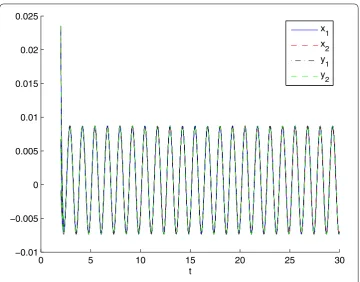
Figure 1Global exponential stability of periodic solutions in Example1
cn= –0.1,n= 1, 2,l= 2, dj= 10.5,dj= 9.5,bRjn=bIjn=eRnj=eInj= 0.1,lRn=lIn=kRn=kIn=
qRn=qIn=pnR=pIn= 0.01,σ= 0.1,σ∗= 0.1.
Since the activation functions in [1] are bounded, while the activation functions in Ex-ample1are not bounded, hence the global exponential stability of periodic solutions for Example1cannot be verified by the result in [1].
It is easy to verify that
1 +|cn|
Unj+
Enj
1 –σ
= 1.1(0.004 + 0.0044) = 0.00924,
2dj
l –
|cj|
l dj–Ajn–|cj|Bjn= 9.5 – 0.525 – 0.008 – 0.0008 = 8.9662,
1 +|cn|
Vnj+
Fnj
1 –σ
= 1.1(0.004 + 0.0044) = 0.00924,
2dj
l –
|cj|
l dj–A
∗
jn–|cj|B∗jn= 9.5 – 0.525 – 0.008 – 0.0008 = 8.9662.
Hence
1 +|cn|
Unj+
Enj
1 –σ
<2dj
l –
|cj|
l dj–Ajn–|cj|Bjn,
1 +|cn|
Vnj+
Fnj
1 –σ
<2dj
l –
|cj|
l dj–A
∗
Namely (h3) and (h4) in Theorem4.1are satisfied. Thus all the conditions in Theorem4.1 are satisfied; therefore, by Theorem4.1, system (2) in Example1has a unique 2π
5 periodic
solution which is globally exponentially stable.
The global exponential stability of periodic solutions of the neutral-type complex-valued neural networks in Example1is shown in Fig.1.
6 Conclusion
By combining graph theory with coincidence degree theory as well as Lyapunov functional method, by constructing the same Lyapunov functionals in the proofs of the existence of periodic solutions and global exponential stability of periodic solutions, novel identical sufficient conditions on the existence of periodic solutions and global exponential stability of periodic solutions for neutral-type complex-valued neural networks are established. In our results, the assumption on the boundedness for the activation functions in [1] is removed and the inequality conditions in [1] are replaced with new inequalities. Hence, our results are less conservative than those obtained in [1] and easy to verify. In near future, we will study nonlinear control of delayed systems [19,20].
Funding
This work was jointly supported by the project supported by the Innovation Platform Open Fund of Hunan Province of China Grant No. 201485, and the Jiangsu Provincial Key Laboratory of Networked Collective Intelligence under Grant No. BM2017002.
Competing interests
The authors declare that they have no competing interests.
Authors’ contributions
All authors contributed equally and significantly in writing this article. All authors read and approved the final manuscript.
Author details
1College of Mathematics and Econometrics, Hunan University, Changsha, China.2School of Mathematics, Southeast University, Nanjing, China.
Publisher’s Note
Springer Nature remains neutral with regard to jurisdictional claims in published maps and institutional affiliations.
Received: 10 April 2018 Accepted: 17 July 2018
References
1. Gao, S., Du, B.: Global exponential stability of periodic solutions for neutral-type complex-valued neural networks. Discrete Dyn. Nat. Soc.2016, Article ID 1267954 (2016)
2. Du, B.: Stability analysis of periodic solution for a complex-valued neural network with bounded and unbounded delays. Asian J. Control20, 881–892 (2018).https://doi.org/10.1002/asjc.1608
3. Song, Q.K., Yu, Q.Q., Zhao, Z.J., Liu, Y.R., Alsaadi, F.E.: Dynamics of complex-valued neural networks with variable coefficients and proportional delays. Neurocomputing275, 2762–2768 (2018)
4. Gong, W., Liang, J., Cao, J.: Matrix measure method for global exponential stability of complex-valued recurrent neural networks with time-varying delays. Neural Netw.70, 81–89 (2015)
5. Zhang, Z.Q., Yu, S.H.: Global asymptotic stability for a class of complex-valued Cohen–Grossberg neural networks with time delays. Neurocomputing171, 1158–1166 (2016)
6. Tu, Z., Cao, J., Alsaedi, A., Alsaadi, F.E., Hayat, T.: Global Lagrange stability of complex-valued neural networks of neutral type with time-varying delays. Complexity21, 438–450 (2016)
7. Song, Q.K., Yan, H., Zhao, Z., Liu, Y.: Global exponential stability of complex-valued neural networks with both time varying delays and impulsive effects. Neural Netw.79, 108–116 (2016)
8. Shi, Y., Cao, J., Chen, G.: Exponential stability of complex-valued memristor-based neural networks with time-varying delays. Appl. Math. Comput.313, 222–234 (2017)
9. Rakkiyappan, R., Velmurugan, G., Li, X., Regan, D.: Global dissipativity of memristor-based complex-valued neural networks with time-varying delays. Neural Comput. Appl.27, 629–649 (2016)
10. Li, X., Rakkiyappan, R., Sakthivel, N.: Non-fragile synchronization control for Markovian jumping complex dynamical networks with probabilistic time-varying coupling delay. Asian J. Control17, 1678–1695 (2015)
12. Huang, C., Cao, J., Xiao, M., Alsaedi, A., Hayat, T.: Bifurcations in a delayed fractional complex-valued neural network. Appl. Math. Comput.292, 210–227 (2017)
13. Liu, D., Zhu, S., Sun, K.: New results for exponential stability of complex-valued memristive neural networks with variable delays. Neurocomputing275, 758–767 (2018)
14. Zhang, Z.Q., Li, A.L., Yang, L.: Global asymptotic periodic synchronization for delayed complex-valued BAM neural networks via vector-valued inequality techniques. Neural Process. Lett. (2018).
https://doi.org/10.1007/s11063-017-9722-3
15. Zhang, Z.Q., Zheng, T.: Global asymptotic stability of periodic solutions for delayed complex-valued
Cohen–Grossberg neural networks by combining coincidence degree theory with LMI method. Neurocomputing 289, 220–230 (2018)
16. Liu, D., Zhu, S., Ye, E.: Global exponential periodicity and stability of memristor-based complex-valued delayed neural networks. Int. J. Syst. Sci.49, 231–245 (2018)
17. Zhang, Z.Q., Hao, D.L., Zhou, D.M.: Global asymptotic stability by complex-valued inequalities for complex-valued neural networks with delays on periodic time scales. Neurocomputing219, 494–501 (2017)
18. Zhang, X.Y., Lv, X.X., Li, X.D.: Sampled-data based lag synchronization of chaotic delayed neural networks with impulsive control. Nonlinear Dynamics90, 2199–2207 (2017)
19. Li, X., Cao, J.: An impulsive delay inequality involving unbounded time-varying delay and applications. IEEE Trans. Autom. Control62, 3618–3625 (2017)
20. Li, X., Song, S.: Stabilization of delay systems: delay-dependent impulsive control. IEEE Trans. Autom. Control62, 406–411 (2017)
21. Bao, H., Cao, J.: Existence and uniqueness of solutions to neutral stochastic functional differential equations with infinite delay. Appl. Math. Comput.215, 1732–1743 (2009)
22. Tu, Z., Wang, L.: Global Lagrange stability for neutral type neural networks with mixed time-varying delay. Int. J. Mach. Learn. Cybern.9, 599–609 (2018)
23. Manivannan, R., Samidurai, R., Cao, J., Alsaed, A., Alsaadi, F.E.: Delay-dependent stability criteria for neutral-type neural networks with interval time-varying delay signals under the effect of leakage delay. Adv. Differ. Equ.2018, Article ID 53 (2018)
24. Wang, Z., Lu, S., Cao, J.: Existence of periodic solutions for ap-Laplacian neutral functional differential equation with multiple variable parameters. Nonlinear Anal., Theory Methods Appl.72, 734–747 (2010)
25. Zhang, Z.Q., Liu, K.Y., Yang, Y.: New LMI-based condition on global asymptotic stability concerning BAM neural networks of neutral type. Neurocomputing81, 24–32 (2012)
26. Sun, Y.Q., Zhong, Y.H., Zhou, W.N., Zhou, J., Zhang, X.: Adaptive exponential stabilization of neutral-type neural network with Levy noise and Markovian switching parameters. Neurocomputing284, 160–170 (2018) 27. Zhang, H., Ye, R.Y., Cao, J.D., Alsaedi, A.: Delay-independent stability of Riemann–Liouville fractional neutral-type
delayed neural networks. Neural Process. Lett.47, 427–442 (2018)
28. Lakshmanan, S., Lim, C.P., Poakash, M., Nahavandi, S., Balasubramaniam, P.: Neutral-type of delayed inertial neural networks and their stability analysis using the LMI approach. Neurocomputing230, 243–250 (2017)
29. Xu, D.S., Tan, M.C.: Delay-independent stability criteria for complex-valued BAM neutral-type neural networks with delays. Discrete Dyn. Nat. Soc.89, 819–832 (2017)
30. Li, W., Pang, L., Su, H.A., Wang, K.: Global stability for discrete Cohen–Grossberg neural networks with finite and infinite delays. Appl. Math. Lett.25, 2246–2251 (2012)
31. Zhang, X.H., Li, W.X., Wang, K.: The existence and global exponential stability of periodic solutions for a neutral coupled system on networks with delays. Appl. Math. Comput.264, 208–217 (2015)
32. Zhang, X.H., Li, W.X., Wang, K.: The existence of periodic solutions for coupled systems on networks with time delays. Neurocomputing152, 287–293 (2015)
33. Gao, S., Li, S.S., Wu, B.Y.: Periodic solutions of discrete time periodic time-varying coupled systems on networks. Chaos Solitons Fractals103, 246–255 (2017)
34. Zhang, X.H., Li, W.X., Wang, K.: Periodic solutions of coupled systems on networks with both time-delay and linear coupling. IMA J. Appl. Math.80, 1871–1889 (2015)
35. Li, X., Bohner, M., Wang, C.: Impulsive differential equations: periodic solutions and applications. Automatica52, 173–178 (2015)
36. Gao, S., Wang, Q., Wu, B.Y.: Existence and global exponential stability of periodic solutions for coupled control systems on networks with feedback and time delays. Commun. Nonlinear Sci. Numer. Simul.63, 72–87 (2018).
https://doi.org/10.1016/j.cnsns.2018.03.012
37. Liao, H.Y., Zhang, Z.Q., Ren, L., Peng, W.L.: Global asymptotic stability of periodic solutions for inertial delayed BAM neural networks via novel computing method of degree and inequality techniques. Chaos Solitons Fractals104, 785–797 (2017)
38. Gaines, R., Mawhin, J.: Coincidence Degree and Nonlinear Differential Equations. Springer, Berlin (1977) 39. West, D.: Introduction to Graph Theory. Prentice Hall, Upper Saddle River (1996)