R E S E A R C H
Open Access
Adaptive synchronization of the stochastic
delayed RDNNs with unknown time-varying
parameters
Weiyuan Zhang
1*, Junmin Li
2and Minglai Chen
2*Correspondence: [email protected] 1Institute of Mathematics and Applied Mathematics, Xianyang Normal University, ShaanXi, Xianyang 712000, P.R. China Full list of author information is available at the end of the article
Abstract
This paper presents a new adaptive synchronization problem for the delayed reaction-diffusion neural networks (RDNNs) with unknown time-varying coupling strengths under stochastic perturbations. By constructing a
differential-difference-type learning law and an adaptive learning control law, and using Lyapunov-Krasovskii-like composite energy functional method, a novel sufficient condition is derived to ensure adaptive asymptotical synchronization in the mean square sense for the addressed system. Finally, a numerical example is given to verify the effectiveness of the proposed method.
Keywords: reaction-diffusion neural networks; unknown time-varying coupling strengths; stochastic synchronization; adaptive learning control; delay
1 Introduction
In recent decades, different types of neural networks (NNs) with time delays have been widely investigated due to their applicability in solving some image processing, signal pro-cessing automatic control engineering, fault diagnosis, telecommunications, and pattern recognition problems. The realistic applications heavily depend on the dynamical behav-iors [–]. Thus, the analysis of the dynamical behavbehav-iors such as stability, periodic oscil-lation, bifurcation and chaos is a necessary step for practical design of NNs. For instance, in [], by utilizing the Lyapunov-Krasovkii functional and combining with the linear ma-trix inequalities (LMIs) approach, the authors analyzed the global exponential stability of neutral-type impulsive NNs. By constructing a newly augmented Lyapunov-Krasovskii functional, [] established less conservative stability criteria in the form of LMIs.
Control and synchronization of chaotic systems have become an important topic since the pioneering work of Pecora and Carroll in []. There exist many benefits of hav-ing synchronization or chaos synchronization in some engineerhav-ing applications, such as secure communication, chaos generators design, chemical reactions, biological systems, information science,etc.Some papers on synchronization of chaotic systems with time de-lays have been published [–]. Since NNs can exhibit some complicated dynamics and even chaotic behavior, the synchronization of chaotic NNs has also become an impor-tant area of study. Recently, the synchronization for delayed NNs also has been reported [–].
When modeling real nervous systems, stochastic disturbances are probably the main re-sources of the performance degradations of the implemented NNs. Moreover, in real time dynamical systems, the time delays are unavoidably encountered in the implementation of NNs, and may cause undesirable dynamic network behaviors such as instability. Hence, it is of great importance to take into account the synchronization problem of stochastic delayed chaotic NNs. To date, many researchers have studied the synchronization for de-layed NNs with environmental noise [–]. In the practical operation, diffusion effects cannot be avoided in the NNs and electric circuits when electrons are moving in a nonuni-form electromagnetic fields. Therefore, it is essential to consider the state variables, which vary in time as well as in space [–]. In [], by using inequality techniques and the Lya-punov functional method, the synchronization scheme is investigated for a class of delayed RDNNs. In [], an approach combining Lyapunov stability theory with stochastic analysis and periodically intermittent control was taken to investigate synchronization problem. In [], the authors considered the global exponential stability and synchronization of the delayed RDNNs with Dirichlet boundary conditions under the impulsive control in terms ofp-norm.
As far as we know, there are two main approaches to study the complex network syn-chronization: one is based on the characteristics of the identical node and the coupling matrix, by Lyapunov functional theory, the stable criteria in terms of LMIs were estab-lished [, ]. However, if the nonlinear characteristics of the uncoupled nodes and the coupling matrix are unknown, the methods given above will fail in the synchronization of complex networks. The other is to adjust the time-varying coupling strengths to complete the synchronization, such as [–]. For example, [] presented a new robust adap-tive synchronization approach for the global synchronization of complex dynamical net-works without time delay. In [], the synchronization of complex topologies using cou-plings of time-varying strength was numerically reported and made a comparison between fixed and varying coupling strength. [] studied the synchronization for delayed complex networks by adjusting time-varying coupling strengths. The update laws of the coupling strengths were derived to realize the synchronization based on Lassalle-Yoshizawa the-orem. Recently, a new adaptive control mechanism was proposed for nonlinear system with unknown time-varying periodic parameters, the stability of the resulting closed-loop system was proven by composite energy function in []. The method was extended to the synchronization of two chaotic systems with unknown time-varying periodic param-eters in [] and the synchronization of complex dynamic networks with unknown time-varying periodic coupling strength in [–], respectively.
time-varying periodic coupling strengths. The main design difficulty is how to deal with the unknown time-varying parameters and unknown time-varying delays. Fortunately, this paper shows that this difficulty can be successfully overcome by constructing a Lyapunov-Krasovskii-like composite energy function. By applying the Weiner process and inequality techniques, an adaptive controller and an updating law are designed to ensure the states of considered system to reach the desired synchronization manifold.
Notations: Throughout the paper,L() is the space of scalar value Lebesgue measurable
functions onand is a Banach space for theL-norm
v=
v(x)dx
, v∈L().
Then for anyu= (u, . . . ,un)T, the norm is defined as
u=
n
i=
ui .
C([–τ, ]×Rm;Rn) ={ϕ|ϕ: [–τ, ]×Rm→Rnis continuous and with the uniform norm
ϕ=sup–τ≤s≤|ϕ(s)|}.
LFt([–τ, ]×Rm;Rn) denotes the family of allFtmeasurable,C([–τ, ]×Rm;Rn)-valued
stochastic variables ϕ={ϕ(s,x) : –τ ≤s≤} such that–τE|ϕ(s)|ds<∞, whereE{·}
stands for the mathematical expectation operator with respect to the given probability measureP.
2 Problem statement and preliminaries
Consider the following delayed RDNNs with unknown time-varying coupling strengths:
⎧ ⎪ ⎪ ⎪ ⎪ ⎪ ⎨ ⎪ ⎪ ⎪ ⎪ ⎪ ⎩
∂ui(t,x)
∂t =
m l=∂∂xl(Dil
∂ui(t,x)
∂xl ) –aiςi(t,x)ui(t,x) +ξi(t,x)
n
j=wijgj(uj(t,x))
+ζi(t,x)
n
j=hijgj(uj(t–τj(t),x)), t≥,x∈, ui(t,x) = , (t,x)∈(–τ, +∞)×∂,
ui(s,x) =ϕi(s,x), (s,x)∈(–τ, ]×,
()
wherex= (x,x, . . . ,xm)T∈,={x||xi|<dl,l= , , . . . ,m}is a compact set with smooth
boundary∂andmes> in spaceRm,dl> is a constant;u(t,x) = (u(t,x), . . . ,un(t,x))T
denotes the state vector, associated with thenneurons at timetand in spacex;ai> rep-resents the rate, with which theith unit will reset its potential to the resting state in isola-tion when disconnected from the networks and external inputs;wijdenotes the strength of the jth unit on theith unit at timet and in spacex;hij are the synaptic connection
strength of thejth unit onith unit at timetand in spacex;gj(uj(t,x)) denotes the activa-tion funcactiva-tion of thejth unit at timetand in spacex;τj(t) denotes the time-varying delay
and satisfies ≤τj(t)≤τj, ≤ ˙τj(t)≤μ< ,τ=max≤j≤n{τj}, whereτjandμare constants; Dl=diag(Dl,Dl, . . . ,Dnl) withDil=Dil(t,x,u)≥ stands for transmission diffusion
Remark Recently, complex dynamical networks with time-varying or constant coupling strengths have attracted much attention from researchers in different areas, such as phys-ical science, engineering, mathematics, biology, and so on [–]. There are many in-teresting collective phenomena in complex dynamical networks that can be described by coupled differential equation equations, such as self-organization, synchronization, spa-tiotemporal chaos and so on. Particularly, the synchronization phenomena have actively been investigated due to past physics and potential engineering application, secure com-munication, and so on [–, –]. Although some methods have been developed in the field of complex networks, only a few of them are concerning time-varying cou-pling strengths. To the best of our knowledge, up to now, little work is reported on the synchronization of stochastic RDNNs with unknown time-varying delays and unknown time-varying coupling strengths. In this paper, using adaptive learning method on periodic coupling strengths, the synchronization of stochastic delayed RDNNs will be considered.
In order to obtain our main results, we assume the following conditions hold. (A) There exist positive constantsL∗j such that
≤gj(o) –gj(o)
o–o ≤L ∗ j,
for allo,o∈R,j= , . . . ,n.
(A) In system (), unknown time-varying coupling strengthsςi(t,x),ξi(t,x) andζi(t,x)
satisfy the following equations:
ςi(t,x) =ςi∗(t,x) +ςi∗∗, ξi(t,x) =ξi∗(t,x) +ξi∗∗, ζi(t,x) =ζi∗(t,x) +ζi∗∗, ()
in whichςi∗(t,x),ξi∗(t,x),ζi∗(t,x) are unknown common periodω> time-varying non-negative parameters,i.e.,ςi∗(t,x) =ςi∗(t–ω,x),ξi∗(t,x) =ξi∗(t–ω,x),ζi∗(t,x) =ζi∗(t–ω,x), ςi∗∗,ξi∗∗andζi∗∗are unknown time-invariant nonnegative parameters.
Remark Since ςi(t,x) =ςi∗(t,x) +ςi∗∗, ξi(t,x) =ξi∗(t,x) +ξi∗∗, ζi(t,x) =ζi∗(t,x) +ζi∗∗,
clearly, ςi∗(t,x), ξi∗(t,x) andζi∗(t,x) are unknown continuous periodic functions with a known common periodω.ςi∗(t,x),ξi∗(t,x) andζi∗(t,x) are a finite unknown upper bound ςM∗,ξM∗ andζM∗, respectively.ςi(t,x),ξi(t,x) andζi(t,x) are bounded, that is, there are
pos-itive constantsςm,ςM,ξm,ξM,ζm,ζM such thatςm≤ςi(t,x)≤ςM,ξm≤ξi(t,x)≤ξMand
ζm≤ζi(t,x)≤ζM.
We consider model () as the drive system. The response system is ⎧
⎪ ⎪ ⎪ ⎪ ⎪ ⎪ ⎪ ⎪ ⎨ ⎪ ⎪ ⎪ ⎪ ⎪ ⎪ ⎪ ⎪ ⎩
du˜i(t,x) = [
m l=∂∂xl(Dil
∂u˜i(t,x)
∂xl ) –aiςi(t,x)u˜i(t,x) +ξi(t,x)
n
j=wijgj(u˜j(t,x))
+ζi(t,x)
n
j=hijgj(uj˜(t–τj(t),x)) +vi(t,x)]dt
+nj=σij(ej(t,x),ej(t–τj(t),x))dwj(t), t≥,x∈,
˜
ui(t,x) = , (t,x)∈(–τ, +∞)×∂,
˜
ui(s,x) =ϕ˜i(s,x), (s,x)∈(–τ, ]×,
()
whereu˜(t,x) = (u˜ (t,x), . . . ,un˜ (t,x))T is andimensional state vector of RDNNs;v(t,x) =
(v(t,x), . . . ,vn(t,x))T is a control input to be designed;σ = (σ
matrix and the stochastic disturbancew(t) = (w(t), . . . ,wn(t))T∈Rnis a Brownian motion
defined on (,F,P) andE{dw(t)}= ,E{dw(t)}=dt;ej(t,x) =uj˜(t,x) –uj(t,x) is an error
signal;ϕ˜i(s,x)∈LFt([–τ, ]×R m;Rn).
Remark This type of stochastic perturbation can be regarded as a result from the occur-rence of the internal error when the simulation circuits are constructed such as inaccurate design of the coupling strengths and some other important parameters [].
Subtracting Eq. () from Eq. (),we have the following error system:
dei(t,x) =
Then we design controllers by
vi(t,x) = –
To prove our results, the following assumptions are necessarily in this paper. (A) There exist positive constantsρijsuch that
σij(t,x,
To ensure negative feedback, the varying periodic adaptive gains and time-invariance update law are designed as follows:
where
ηi(t,x) =
⎧ ⎪ ⎪ ⎨ ⎪ ⎪ ⎩
, ≤t<ω,
¯
ηi(t,x), ω≤t≤ω,
, t>ω,
ηi(t,x) =
⎧ ⎪ ⎪ ⎨ ⎪ ⎪ ⎩
, ≤t<ω,
¯
ηi(t,x), ω≤t≤ω,
, t>ω,
ηi(t,x) =
⎧ ⎪ ⎪ ⎨ ⎪ ⎪ ⎩
, ≤t<ω,
¯
ηi(t,x), ω≤t≤ω,
, t>ω,
we can chooseη¯ji(t,x), ≤ ¯ηji(t,x)≤,j= , , such thatηi(t,x),ηi(t,x) andηi(t,x) are
increasing and continuous functions.ς˙ˆi∗∗(t,x) = –θiei(t,x),
˙ˆ
ξi∗∗(t,x) = –θiei(t,x), ζ˙ˆi∗∗(t,x) = –θiei(t,x), ()
in whichθji, ≤θji≤,j= , , are positive constants.
Remark The adaptation law is a difference-type pointwise integration over the period [t–ω,t], which takes the place of the differential-type adaptation law. Due toςi∗(t,x) = ςi∗(t–ω,x),ξi∗(t,x) =ξi∗(t–ω,x),ζi∗(t,x) =ζi∗(t–ω,x), for any time instantiω≤t≤(i+ )ω,
i∈N∗={, , . . .}, we have
ςi∗(t,x) =ςi∗(t–ω,x) =· · ·=ςi∗(t–iω,x), ξi∗(t,x) =ξi∗(t–ω,x) =· · ·=ξi∗(t–iω,x), ζi∗(t,x) =ζi∗(t–ω,x) =· · ·=ζi∗(t–iω,x).
This means thatςi∗(t,x),ξi∗(t,x),ζi∗(t,x) can be treated as a ‘constant’ when it is sampled at any interval, which is the integer multiple of the periodω. The periodic updating law () in the interval of one periodωis a difference-type integrator for such a ‘constant.’
Next, we introduce the definition of asymptotic synchronization in the mean square sense for the two coupled RDNNs () and (), and then present some preliminary lemmas, which are needed to prove our main results.
Definition The two coupled RDNNs () and () are said to achieve asymptotic synchro-nization in the mean square sense, if there is a controlvi(t,x),i= , , . . . ,n, such that for any given initial,
Eu˜(t,x) –u(t,x)→ ast→ ∞.
Lemma [] Letbe a cube|xl|<dl(l= , . . . ,m),and let h(x)be a real-valued function belonging to C(),which vanish on the boundary∂of,i.e.,h(x)|
∂= .Then
h(x)dx≤dl
Remark Lemma is a well-known result and is widely utilized in the study of partial dif-ferential equation. It plays an important role in the synchronization of stochastic delayed RDNNs with unknown time-varying coupling strengths. According to Lemma , the result in our future research is dependent on reaction-diffusion terms.
Lemma [] Leta,b∈RnandXbe an n×n positive definite matrix,then
By combining the feedback control and adaptive control, and the properties of the Weiner process, we obtain the following Theorem .
Theorem Under assumptions(A)-(A),if there are constants L,L,Landsuch that
j=ρjn),then the adaptive control mechanism()
-()warrants two coupled system()and()are adaptive asymptotic synchronization in the mean square sense.
Proof Define the Lyapunov-Krasovskii-like composite energy functional as
ˆ
ςi∗∗(t,x),ξ˜i∗∗(t,x) =ξi∗∗–ξˆi∗∗(t,x), ζ˜i∗∗(t,x) =ζi∗∗–ζˆi∗∗(t,x). ComputingLV(t,e(t)) along the trajectory of error system (), one can obtain that
LVt,e(t)≤
According to Green’s formula, Lemma and the Dirichlet boundary condition, we get
Letλmax(–D) +ςmλmax(–A) +(–(–μμ))λmax(–ρ) +
ξMλmax(|W|L) +
ξMλmax(L|WT|) + –μ× λmax(LL) +ζMλmax(|H||HT|) – (ςm+ξm+ζm) – ≤L+L+L, in whichis positive
constant. Then it follows from () that
LVt,e(t)≤–e(t). ()
From inequality () and Ito’s formula, we can conclude that
E n
i=
ei(t) ≤EV
t,e(t)
=EVt,e(t)+E
t
t
LVs,e(s)ds
≤EVt,e(t)–E
t
t
e(s)ds.
According to Lemma and Definition , it is easy to see that system () is globally stochas-tically asymptostochas-tically stable. This implies that the two coupled delayed RDNNs () and () are adaptive asymptotic synchronization in the mean square sense. This completes the
proof.
4 An illustrative example
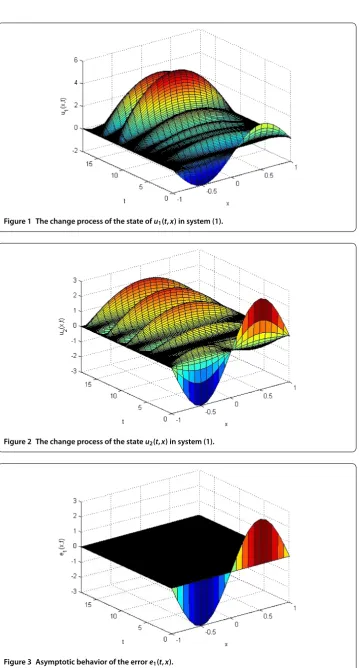
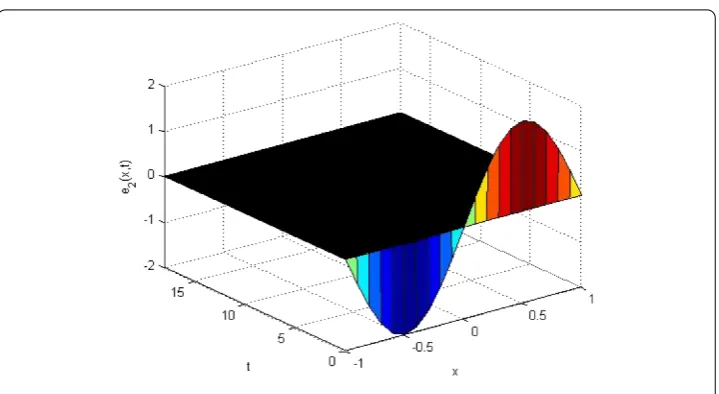
We present a simple example here in order to illustrate the usefulness of our main re-sults. Our aim is to examine the adaptive synchronization of a given delayed RDNNs with unknown time-varying coupling strengths.
Example Consider the drive-response systems () and () with={x||xl|< ,l= },
(σij)n×n=
.ej(t) .ej(t–τj(t)) .ej(t–τj(t)) .ej(t)
, gj(y) =tanh(y) and τj(t) = e t
+et, A=I,W=
–
–
, H=
– –
, D=D= ., J = ., J= ., ς∗∗= , ς∗∗= ,ξ∗∗= , ξ∗∗= , ζ∗∗ = ,
ζ∗∗= ,η¯i(t,x) =η¯i(t,x) =η¯i(t,x) = t– ,i= , . Then, a simple computation yields
ςm= .,ςM= .,ξm= ,ξM= ,ζm= ,ζM= ,μ= .,λmax(–D) = –.,λmax(–A) = –,
λmax(–ρ) = –,λmax(|W|L) = ,λmax(L|WT|) = ,λmax(LL) = ,λmax(|H||HT|) = .
Choos-ingL= .,L= .,L= . and= ., we have
λmax(–D) +ςmλmax(–A) +
( –μ)
( –μ)λmax(–ρ)
+ ξMλmax
|W|L+ ξMλmax
LWT
+
–μλmax(LL) +ζ
Mλmax
|H|HT– (ςm+ξm+ζm) –
≤L+L+L= ..
Therefore, it can be concluded from Theorem that the considered drive-response sys-tems are adaptive asymptotic synchronization in the mean square sense.
Figure 1 The change process of the state ofu1(t,x) in system (1).
Figure 2 The change process of the stateu2(t,x) in system (1).
Figure 4 Asymptotic behavior of the errore2(t,x).
5 Conclusions
In this paper, a novel adaptive learning control method is used in stochastic delayed RDNNs with unknown time-varying periodic connected strengths. By constructing Lyapunov-Krasovskii-like composite energy functional, the adaptive learning laws of pa-rameters and the adaptive control strategy are designed to guarantee the adaptive asymp-totic synchronization of considered system in the mean square sense. Finally, a simple example and simulations have been utilized to verify our theoretical result is feasible and effective.
Competing interests
The authors declare that they have no competing interests.
Authors’ contributions
WZ designed and performed all the steps of proof in this research and also wrote the paper. JL and MC participated in the design of the study and suggested many good ideas that made this paper possible and helped to draft the first manuscript. All authors read and approved the final manuscript.
Author details
1Institute of Mathematics and Applied Mathematics, Xianyang Normal University, ShaanXi, Xianyang 712000, P.R. China. 2Department of Mathematics, Xidian University, ShaanXi, Xi’an 710071, P.R. China.
Acknowledgements
This work is partially supported by the National Natural Science Foundation of China (60974139), Project supported by the National Science Foundation for Post-doctoral Scientists of China under Grant No. 2013M540754, the Special research projects in Shaanxi Province Department of Education under Grant No. 2013JK0578 and Doctor Introduced project of Xianyang Normal University under Grant No. 12XSYK008.
Received: 7 May 2013 Accepted: 6 August 2013 Published: 21 August 2013 References
1. Rakkiyappan, R, Balasubramaniam, P, Cao, J: Global exponential stability results for neutral-type impulsive neural networks. Nonlinear Anal., Real World Appl.11, 122-130 (2010)
2. Balasubramaniam, P, Vembarasan, V: Synchronization of recurrent neural networks with mixed time-delays via output coupling with delayed feedback. Nonlinear Dyn.70, 677-691 (2012)
3. Kwon, OM, Park, JH, Lee, SM, Cha, EJ: Analysis on delay-dependent stability for neural networks with time-varying delays. Neurocomputing103, 114-120 (2013)
4. Fang, M, Park, JH: Non-fragile synchronization of neural networks with time-varying delay and randomly occurring controller gain fluctuation. Appl. Math. Comput.219, 8009-8017 (2013)
6. Zhang, W, Li, J: Global exponential stability of reaction-diffusion neural networks with discrete and distributed time-varying delays. Chin. Phys. B20(3), 030701 (2011)
7. Zhang, W, Li, J, Chen, M: Global exponential stability and existence of periodic solutions for delayed
reaction-diffusion BAM neural networks with Dirichlet boundary conditions. Bound. Value Probl.2013, 105 (2013). doi:10.1186/1687-2770-2013-105
8. Carroll, T, Pecora, L: Synchronization in chaotic systems. Phys. Rev. Lett.64, 821-824 (1990)
9. He, W, Cao, J: Exponential synchronization of hybrid coupled networks with delayed coupling. IEEE Trans. Neural Netw.21, 517-583 (2010)
10. Jeonga, SC, Jib, DH, Parkc, Ju H, Wona, SC: Adaptive synchronization for uncertain chaotic neural networks with mixed time delays using fuzzy disturbance observer. Appl. Math. Comput.219, 5984-5995 (2013)
11. Vembarasan, V, Balasubramaniam, P: Chaotic synchronization of Rikitake system based on T-S fuzzy control techniques. Nonlinear Dyn. (2013). doi:10.1007/s11071-013-0946-0
12. Park, JH: Synchronization of cellular neural networks of neutral type via dynamic feedback controller. Chaos Solitons Fractals42, 1299-1304 (2009)
13. Park, MJ, Kwon, OM, Park, Ju H, Lee, SM, Cha, EJ: Synchronization criteria for coupled Hopfield neural networks with time-varying delays. Chin. Phys. B20, 110504 (2011)
14. Wu, Z, Park, JH, Su, H, Chu, J: Discontinuous Lyapunov functional approach to synchronization of time-delay neural networks using sampled-data. Nonlinear Dyn.69, 2021-2030 (2012)
15. Li, X, Cao, J: Adaptive synchronization for delayed neural networks with stochastic perturbation. J. Franklin Inst.345, 779-791 (2008)
16. Gan, QT: Adaptive synchronization of Cohen-Grossberg neural networks with unknown parameters and mixed time-varying delays. Commun. Nonlinear Sci. Numer. Simul.17, 3040-3049 (2012)
17. Sun, Y, Cao, J, Wang, Z: Exponential synchronization of stochastic perturbed chaotic delayed neural networks. Neurocomputing70, 2477-2485 (2007)
18. Wang, Y, Cao, JD: Synchronization of a class of delayed neural networks with reaction-diffusion terms. Phys. Lett. A
369, 201-211 (2007)
19. Gan, Q: Global exponential synchronization of generalized stochastic neural networks with mixed time delays and reaction-diffusion terms. Neurocomputing89, 96-105 (2012)
20. Hu, C, Jiang, H, Teng, Z: Impulsive control and synchronization for delayed neural networks with reaction-diffusion terms. IEEE Trans. Neural Netw.21, 67-81 (2010)
21. Zhang, W, Li, J: Global exponential synchronization of delayed BAM neural networks with reaction-diffusion terms and the Neumann boundary conditions. Bound. Value Probl.2012, 2 (2012). doi:10.1186/1687-2770-2012-2 22. Gan, Q: Exponential synchronization of stochastic Cohen-Grossberg neural networks with mixed time-varying delays
and reaction-diffusion via periodically intermittent control. Neural Netw.31, 12-21 (2012)
23. Zhang, W, Li, J, Chen, M: Dynamical behaviors of impulsive stochastic reaction-diffusion neural networks with mixed time delays. Abstr. Appl. Anal.2012, Article ID 236562 (2012). doi:10.1155/2012/236562
24. Li, S, Yang, H, Lou, X: Adaptive exponential synchronization of delayed neural networks with reaction-diffusion terms. Chaos Solitons Fractals40, 930-939 (2009)
25. Lou, X, Cui, B: Asymptotic synchronization of a class of neural networks with reaction-diffusion terms and time-varying delays. Comput. Math. Appl.52, 897-904 (2006)
26. Cao, J, Chen, G, Li, P: Global synchronization in an array of delayed neural networks with hybrid coupling. IEEE Trans. Syst. Man Cybern., Part B, Cybern.38, 488-498 (2008)
27. Lu, J, Ho, DWC: Global exponential synchronization and synchronizability for general dynamical networks. IEEE Trans. Syst. Man Cybern., Part B, Cybern.40, 350-361 (2010)
28. Li, Z, Jiao, L, Lee, JJ: Robust adaptive global synchronization of complex dynamical networks by adjusting time-varying coupling strength. Physica A387, 1369-1380 (2008)
29. Chen, L, Wu, L, Zhu, S: Synchronization in complex networks by time-varying couplings. Eur. Phys. J. D48, 405-409 (2008)
30. Huang, L, Wang, Z, Wang, Y, Zuo, Y: Synchronization analysis of delayed complex networks via adaptive time-varying coupling strengths. Phys. Lett. A373, 3952-3958 (2009)
31. Xu, J, Tan, Y: A composite energy function based learning control approach for nonlinear systems with time-varying parametric uncertainties. IEEE Trans. Autom. Control47, 1940-1945 (2002)
32. Sun, Y, Li, J: Generalized projective synchronization of chaotic systems via adaptive learning control. Chin. Phys. B19, 020505 (2010)
33. Guo, X, Li, J: Stochastic synchronization for time-varying complex dynamical networks. Chin. Phys. B21, 020501 (2012)
34. Wang, T, Li, J, Tang, S: Adaptive synchronization of nonlinearly parameterized complex dynamical networks with unknown time-varying parameters. Math. Probl. Eng.2012, Article ID 592539 (2012). doi:10.1155/2012/592539 35. Guo, X, Li, J: A new synchronization algorithm for delayed complex dynamical networks via adaptive control
approach. Commun. Nonlinear Sci. Numer. Simul.17, 4395-4403 (2012)
36. Guo, X, Li, J: Projective synchronization of complex dynamical networks with time-varying coupling strength via hybrid feedback control. Chin. Phys. Lett.28, 120503 (2011)
37. Li, J, Zhang, W, Chen, M: Synchronization of delayed reaction-diffusion neural networks via an adaptive learning control approach. Comput. Math. Appl.65, 1775-1785 (2013)
38. Lu, J: Global exponential stability and periodicity of reaction-diffusion delayed recurrent neural networks with Dirichlet boundary conditions. Chaos Solitons Fractals35, 116-125 (2008)
39. Liang, J, Wang, Z, Liu, Y, Liu, X: Global synchronization control of general delayed discrete-time networks with stochastic coupling and disturbances. IEEE Trans. Syst. Man Cybern., Part B, Cybern.38, 1073-1083 (2008) 40. Mao, X: Stochastic Differential Equations and Applications. Horwood, Chichester (1997)
doi:10.1186/1687-1847-2013-253