R E V I E W
Open Access
TCP performance in multi-hop wireless ad hoc
networks: challenges and solution
Ammar Mohammed Al-Jubari
1*, Mohamed Othman
1, Borhanuddin Mohd Ali
2and Nor Asilah Wati Abdul Hamid
1Abstract
Transmission control protocol (TCP) performance over multi-hop wireless networks is currently attracting considerable interest from the research community. The characteristics of multi-hop wireless networks, such as mobility, link layer contention, high bit error rate, asymmetric path, network partition, hidden exposed nodes and dynamic routing, do not fit the requirements of TCP for a good reliable data delivery. Here we want to provide an overview of the research progress in applying TCP algorithms to the problem of multi-hop conditions and characteristics. The scope of this review will encompass core methods and protocols of TCP over multi-hop networks, including cross-layer, network layer protocols and medium access control (MAC) layer protocols. The research contributions in each field are systematically summarized and compared, allowing us to clearly define existing research challenges, and to highlight promising new research directions. The findings of this review should provide useful insight into current multi-hop networks literature and be a good source for anyone who is
interested in“TCP in wireless” approaches or related fields.
Keywords:TCP, multi-hop wireless network, survey
1 Introduction
The rapid advancement in portable computing platforms and wireless communication technology has led to making it an integral part of the Internet. As the Internet users’ requirements of flexibility and mobility increase, multi-hop wireless networks have become the best solution to satisfy these requirements. These networks are complex distribu-ted systems that consist of wireless mobile or static nodes. Compared to traditional infrastructure wireless networks, multi-hop ad hoc networks have many features: dynamic self-organization, self-configuration, free movement, high scalability, low deployment cost, robustness and easy main-tenance. These features give ad hoc networks the ability to play a leading role in the next generation of wireless net-works. Recently, the introduction of new standards such as Bluetooth, IEEE 802.11 and Hyperlan makes possible the deployment of multi-hop ad hoc networks for commercial purposes. In these networks, because of the challenges introduced by wireless multi-hop transmission and limited resources, providing performance quality and reliability of
data delivery comparable to wired networks is a major challenge.
Transmission control protocol (TCP) [1] is a connection-oriented unicast transport protocol that offers the following features: explicit and acknowledged connection initiation and termination; end-to-end reliability; in-order, and not duplicated data delivery; flow control; congestion avoid-ance; and out-of-band indication of urgent data. These multifold characteristics of TCP make it by far the most used transport protocol in Internet applications such as www (HTTP), mail (SMTP), file transfer (FTP) and remote access service (Telnet). In fact, TCP was originally designed to perform well in wired networks where the network con-gestion is the main reason for packet loss and it deals with this effectively by making corresponding transmission adjustment to its congestion window. At the present time, the Internet spans a very large base of heterogeneous net-works such as wired and wireless, and ensuring that TCP provides efficient services for such a complex environment is a continuing mission of researchers.
In multi-hop wireless networks that employ IEEE 802.11 as the underlying network interface, TCP experiences severe performance degradation because it is not opti-mized to take advantage of the characteristics of wireless * Correspondence: [email protected]
1Department of Communication Technology and Network Faculty of
Computer Science and Information Technology, Universiti Putra Malaysia 43400 UPM, Serdang, Selangor DE, Malaysia
Full list of author information is available at the end of the article
links. In wired networks, when a packet is detected to be lost, either by time-out or by multiple duplicated acknowl-edgments (ACKs), TCP slows down the sending rate to prevent network congestion. Unfortunately, wireless net-works inherit several types of loss that are not related to congestion, which renders TCP not adapted for such an environment. The factors that may cause losses and affect TCP performance in multi-hop wireless networks are:
Frequent route failures caused by node mobility. High bit error rates.
Medium access contention complicated by hidden/ exposed terminal problems.
Interference and collision complicated by sharing the same path.
In fact, TCP is unable to distinguish between packet losses due to congestion from losses due to the specific features of multi-hop ad hoc networks. In theory, TCP should be independent of the underlying network technol-ogy. Specifically, TCP should not care whether it is run-ning over wired or wireless connections. In practice, TCP suffers a significant degradation in performance over wire-less networks because most TCP deployments have been carefully designed based on assumptions that are specific to wired networks and do not hold in a wireless environ-ment. Ignoring the properties of wireless transmission can lead to poor performance of TCP. Therefore, numerous enhancements and optimizations have been proposed over the last few years to improve TCP performance over multi-hop wireless networks.
Overview of the article
The main aim of this review is twofold: the first is to pre-sent a comprehensive survey on research contributions that investigate the performance of TCP in multi-hop wireless networks; the second aim is to define existing research challenges, and to highlight promising new research directions. The scope of the survey is the core methods of improving TCP performance in multi-hop wireless networks, which encompass methods and proto-cols of TCP over multi-hop networks, including cross layer approaches. The research contributions in each field are systematically summarized and compared, allowing us to clearly define existing research challenges, and to high-light promising new research directions. The findings of this review should provide useful insights into current multi-hop networks literature and be a good source for anyone who is interested in“TCP in wireless”approaches or related fields. To this end, we first introduce the role of TCP in providing reliable end-to-end data transfer func-tions, and describe how TCP incorporates numerous con-trol functions that are intended to make efficient use of the underlying network through a host-based congestion control function. Then, we present taxonomy of existing solutions, and describe their most representative features,
benefits and design challenges. We also discuss open issues in this research area, with special attention to the ones most related to multi-hop wireless ad hoc networks.
In this article, we surveyed the solutions that guarantee the end-to-end data delivery that require no intermediaries to inform TCP about the state of the connection in wire-less networks. The end-to-end semantic property of TCP provides the ultimate reliability at the TCP layer. This property would be violated if any intermediate node (not the TCP destination) generates ACKs on behalf of the des-tination. Any modifications that break the end-to-end semantic of TCP, such as splitting a TCP connection into wired and wireless portions so that the traffic control is done separately, cannot guarantee the arrival of a certain data segment at the destination even though the source has received the ACK of that segment. Thus, we only con-sidered the solutions that preserve the end-to-end seman-tic of any established TCP connection so that the traffic control and maintenance of the connection are performed by the two end systems of the connection, based on the measured network conditions. Any solutions that require intermediaries or do not preserve the end-to-end semantic of a TCP connection are not discussed here. Interested readers can refer to [2,3] for early works to improve the performance of TCP in wired-cum-wireless environments. They can also refer to [4-8] for surveys of recent TCP enhancements in ad hoc wireless networks.
directions. The authors in [6] used a detection-response framework to categorize different approaches and analysed the possible design options. They only selected the approaches that fit in their framework. In addition, they summarized the performance studies of these approaches. The purpose of their survey is not to compare them among each other, but to briefly show how well each approach performs in terms of improvement over standard TCP. In [7], the authors grouped the solutions based on whether a connection is split between wired and wireless portions as well as the way a wireless segment loss is handled. In [8], the focusing was on the cross-layer-based approaches that improve the performance of TCP in multi-hop mobile ad hoc networks. In this survey, no com-parison between the solutions was presented. The survey briefly shows the problem identified and the solution pro-posed of each approach. Our survey article provides the readers a short tutorial of the surveyed representative solu-tions so that they can understand the basic mechanisms of these enhancements easily. Furthermore, it highlights the advantages and the weaknesses of the proposed solutions and discussed wither these solutions have alleviated the identified problem or they still need further improvements. In other words, our intended readers are the general audi-ence who would like to quickly acquire the state of the art on TCP solutions in wireless networks.
The remainder of this article is organized as follows. Section 2 introduces a background about TCP, and TCP challenges in wireless networks. Section 3 categorizes and reviews core methods in multi-hop ad hoc networks that have been proposed to improving TCP performance. Sec-tion 4 shows a general comparison of the TCP approaches and their targeted features, discusses the strengths and limitations of these approaches, and identifies future research trends and challenges. Section 5 concludes the article.
2 Background on TCP challenges in multi-hop wireless networks
In this section, we begin with a brief overview of multi-hop ad hoc networks and some of its specific properties. Then, we give an overview of TCP and its functions. Finally, we present the problems that arise with TCP when applied over multi-hop ad hoc networks.
2.1 Overview of multi-hop wireless networks
With the recent proliferation of wireless communication and personal computing systems, wireless ad hoc networks are expected to play an important role in future civilian and military settings where wireless access to wired back-bone is either ineffective or impossible. Ad hoc networks comprise mobile or static hosts that can communicate with each other using wireless links. It is also possible to have access to some hosts in a fixed infrastructure, which,
in this case, is called hybrid network. In this environment, a route between two hosts may consist of one or more hops of ad hoc nodes. In this way, multi-hop network paths can be established between any pair of nodes with-out relying on a pre-existing network infrastructure, cen-tralized control or dedicated network devices (i.e., router switches, servers).
Some of the most important issues in ad hoc networks are finding and maintaining routes, as host mobility can cause topology changes; efficient transport and reliable data delivery; and network security. These networks can be realized by different wireless communication technolo-gies such as Bluetooth, IEEE 802.11, and Ultra-wide band (UWB). However, each one of these networks combined with the communication technologies pose various chal-lenges in designing proper algorithms for them. As a result, several algorithms and considerable research efforts have been attempted to solve these problems. In this arti-cle, our focus is on TCP over multi-hop wireless networks that employ IEEE 802.11 as the underlying network interface.
2.2 Overview of TCP
A number of mechanisms is used by TCP to achieve high performance and avoid congestion collapse. These mechanisms maintain the sending rate of data entering the network at an appropriate level. Basically, the conges-tion window at the sender and the advertised window at the receiver regulate the maximum number of outstanding packets that can be transmitted. Modern implementations of TCP contain several intertwined algorithms such as slow-start, congestion avoidance, Fast Retransmit and Fast Recovery (RFC 5681) [9]. In addition, TCP sender employs retransmission time-out (RTO) mechanism, which is based on the estimated round-trip time (RTT) between the sender and receiver, and the variance in this round trip time. The behaviour of this timer is specified in RFC 2988 [10]. Enhancing TCP to reliably handle loss, mini-mize errors, manage congestion and go fast in very high-speed environments are ongoing areas of research and standards development. As a result, there are a number of TCP algorithms variations. As it is necessary to under-stand the performance of TCP when applying over ad hoc networks, this sub-section provides a brief overview of the main mechanisms of TCP, as well as discussing various acknowledgment generation methods. For a detailed description of TCP’s algorithms, refer to reference [11].
Slow-Start
The principle behind this mechanism is to control TCP connection first initiated (or after a prolonged discon-nection). It sets the congestion window (cwnd) size to
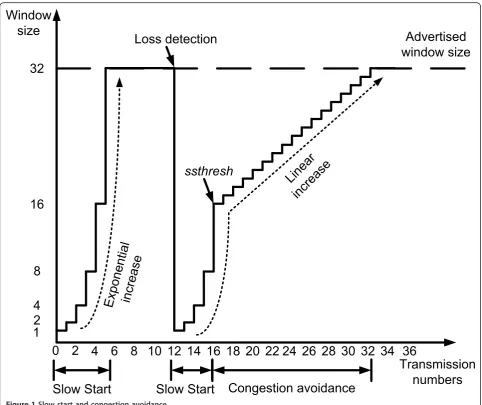
acknowledgment (ACK). This happens until either a packet loss event occurs orcwnd reaches the slow-start threshold (ssthresh). The benefit of this mechanism is to estimate the available bandwidth by progressively prob-ing for more bandwidth. If cwndreached thessthresh, TCP enters the linear growth phase or called congestion avoidance phase. During the slow start phase, when a loss event occurs, TCP assumes this is due to network congestion and takes steps to reduce the size of cwnd, which, in turn, slows down the sending rate. After the first packet loss,ssthresh, which is used to determine the start of the congestion avoidance phase, is set to half of the current cwnd. Then, cwnd will be reset to one and will grow according to the aforementioned pro-cedure untilssthreshis reached. Although the strategy is referred to as“slow-start”, its congestion window growth is quite aggressive, more aggressive than the congestion
avoidance phase. Figure 1 gives an overview of slow start behaviour.
Congestion Avoidance
This phase, as its name implies, tries to avoid network congestion by restricting the growth of cwnd. In this way, TCP forces a linear increase of cwnd after it reaches thessthresh. This linear increase is achieved by incrementing the cwndadditively by one segment for each RTT and an ACK is received. This happens until a loss event occurs. Figure 1 shows an example of how the congestion window is controlled by the slow-start and the congestion avoidance algorithms for anssthresh
of 16.
Multiplicative decrease
It is the algorithm that controls the ssthresh value, which is, in turn, responsible for changing the slow start phase to the congestion avoidance phase. With a
2
1
2
4
8
16
32
0
4
6
8
10
12
14
16
18
20
22
24
26
28
30
32
34
36
Slow Start
Slow Start
Congestion avoidance
Transmission
numbers
Window
size
Loss detection
ssthresh
Advertised
window size
multiplicative decrease, TCP setsssthreshto half of the current cwndeach time a loss event occurs. To this point, thecwnditself is set to one to force a slow start. Thus, in case of consecutive loss, multiplicative decrease reduces the sending rate severely.
Fast Retransmit and Fast Recovery
Identifying the packet loss in TCP is indicated by two means. One is the occurrence of a time-out event, which corresponds to a failure of receiving an ACK within a predefined time interval (RTO). Nevertheless, when the RTO value is large, waiting for a time-out event to trigger retransmission is considered inefficient. Due to this,“Fast Retransmit”was proposed to provide a timely detection of a lost packet. It triggers when the sender receives three duplicate ACKs from the receiver. Upon receiving these duplicate ACKs, TCP retransmits the missing packet. Fast Recovery is executed after Fast Retransmit: It first sets ssthresh to half of the current
cwnd and then reducescwnd tossthresh. When a non-duplicate acknowledgment is received, TCP exits the Fast Recovery, setscwnd equal to ssthresh, and enters the congestion avoidance phase.
Generating Acknowledgements
The mechanisms described above are a sender-based mechanism. They must deal with a TCP receiver mechanism, which is responsible for returning ACKs to the TCP sender. Currently, there are several forms of acknowledgment, which can be used alone or together in TCP.
Positive Acknowledgement The receiver explicitly noti-fies the sender which packets were received correctly. In this way, the receiver will know which packets were not received and need to be retransmitted. This method is used by TCP (RFC 793) [1] to verify receipt of the trans-mitted data. Most of the TCP variants are based on this mechanism where a positive ACK should be generated for each packet received.
Negative Acknowledgement (NACK)In this form, the receiver explicitly notifies the sender which packets were received incorrectly and thus may need to be retrans-mitted (RFC 4077) [12].
Selective Acknowledgement (SACK)In this mechanism, the receiver should inform the sender about all segments that have arrived successfully. In this way, the sender will only retransmit the segments that have actually been lost. Positive selective acknowledgment is an option in TCP (RFC 2018) [13].
Cumulative AcknowledgementEach ACK is a confirma-tion that all packets up to the current number have been received correctly.
Delayed Acknowledgement Instead of generating an ACK as soon as a packet is received, this mechanism gives the TCP receiver the ability of delaying the ACK for a while. Specifically, as introduced in RFC 1122 [14], an
ACK should be generated for at least every second in-order data packet received. The receiver contains a timer bound variable interval (default 500 ms) that gives the number of seconds to wait for the second in-order packet. Thus, the ACK must be generated within 500 ms of the arrival of the first unacknowledged packet. The time-out of this timer causes immediate ACK generation of the first packet. In addition, out-of-order packets cause immediate ACK generation.
Duplicate AcknowledgementIn order to trigger the fast retransmit algorithm, the receiver should send an immedi-ate duplicimmedi-ate ACK when it receives a data packet above a gap in the sequence space.
2.3 TCP challenges in multi-hop wireless networks
In this section, a thorough understanding of the major problems that arise with TCP, when applied over multi-hop wireless networks, is discussed.
2.3.1 Routing failures
In stable wired networks, route failures occur very rarely. However, in multi-hop wireless networks they are the norm rather than the exception. The node mobility is the main source of frequent topology changes and route ures in mobile ad hoc networks. Moreover, the link fail-ures due to the contention on the wireless channel may lead to route failures in both static and mobile ad hoc networks. When a route failure occurs, packets that are buffered at intermediate nodes along the route will be dropped. This large amount of packet drops may cause a series of time-outs at the TCP sender. As a result, the RTO value will be doubled for each subsequent time-out. Furthermore, TCP will mistakenly interpret the loss as an indication of network congestion and trigger the conges-tion control mechanisms to reduce the size ofcwndand
ssthresh. In addition, TCP does not have any indication of the route re-establishment duration, because the route re-establishment event after route failures depends on the underlying routing protocol. These actions have three adverse effects: (1) the small cwndandssthreshvalues reduce the initial sending rate after the route is restored. Therefore, it takes a long time for the sending rate to catch-up to a high value after a new route is found. (2) The large RTO value reduces the responsiveness of TCP; even if the route is restored, TCP will take a long time to converge to the right level of operation. (3) The large idle time of TCP caused by route re-establishment will degrade the throughput.
2.3.2 Random wireless losses
the reliable TCP protocol. (1) Packets loss due to corrup-tion violate the assumpcorrup-tion of TCP’s congestion control mechanism in that congestion is the main reason for most losses. In this case, whenever a packet loss is detected, TCP will mistakenly take this as an indication of network congestion and reduce the sending rate unne-cessarily. In other words, even though the network is not congested, TCP reduces the sending rate in the face of wireless errors. This unnecessary reduction of sending rate deteriorates TCP throughput when packet losses are mainly due to corruption. (2) In the presence of severe wireless channel contention, where the BER is high and the link-layer local recovery mechanism [16] is unable to recover the lost packets, TCP will face a large amount of consecutive packet losses. The current TCP’s“error detection and recovery” mechanism is inefficient to recover from these losses. Either only one lost packet is recovered per RTT, or a time-out is needed to recover from substantial losses.
2.3.3 Hidden and exposed terminals
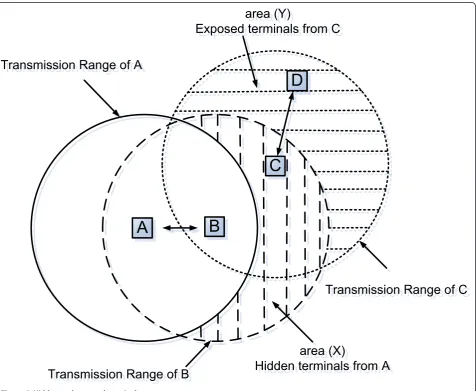
Due to the sharing of the wireless bandwidth among ad hoc stations, medium access control (MAC) may rely on physical carrier sensing multiple access mechanism with collision avoidance (CSMA/CA) to determine the idle channel, such as in the IEEE 802.11 distributed coordina-tion funccoordina-tion (DCF). However, all CSMA/CA-based MAC protocols do not completely solve the hidden/ exposed station problem [17]. Figure 2 illustrates an example of the hidden terminal problem. Suppose that nodes A and C want to transmit to node B. By only sen-sing the medium, node A will not be able to detect trans-missions by any node in the dashed area, such as C, because it is outside the transmission range of C. Node C is, therefore,“hidden”to node A. Thus, transmission of A and C will lead to collisions at node B. Unfortunately, this will affect TCP and lead to poor performance.
To alleviate the hidden station problem, virtual carrier sensing has been introduced to wireless MAC layers [18].
A
B
C
D
C
Transmission Range of A
Transmission Range of A
Transmission Range of B
B
Transmission Range of B
Transmission Range of C
Transmission Range of C
B
area (Y)
Exposed
d
terminals from C
area (Y)
Exposed terminals from C
area (X)
Hidden terminals from A
area (X)
Hidden terminals from A
It is based on a two-way handshaking that precedes data transmission. One such virtual sensing mechanism is the 802.11 Request To Send/Clear To Send (RTS/CTS) exchange mechanism [19]. In this mechanism, the source station transmits a short control frame, called RTS, to the destination station. Upon receiving the RTS frame, the destination station replies by a CTS frame, indicating that it is ready to receive the data frame. Both RTS and CTS frames contain the total time of the data transmis-sion. All stations receiving either RTS or CTS will keep silent during the data transmission period (e.g., station C in Figure 2).
However, as pointed out in [20,21], the hidden station problem may persist in IEEE 802.11 ad hoc networks even with the use of the RTS/CTS handshake. This is because the power needed for interrupting a packet reception is much lower than that of delivering a packet successfully. In other words, the node’s transmission range is smaller than the sensing node range. Moreover, the RTS/CTS mechanism introduces a new problem termed the exposed terminal problem, where some nodes that heard the RTS/ CTS exchange refrain from transmission even though they would not have interfered with any ongoing transmission. In Figure 2, we show a typical scenario where the exposed terminal problem occurs. Let us assume that node A wants to transmit to node B. Node A sends an RTS and waits for B to send a CTS. Suppose a node D is transmitting data to node C, thus, D has transmitted an RTS to C just before A sends the RTS to B and C has transmitted a CTS. This CTS is heard by B which prevents B from sending the CTS to A. Therefore, any transmission from a node within the area (Y) to a node within (X) will prevent A from transmit-ting data to B, although simultaneous transmissions from area Y to × would not have interfered with transmission from A to B. Thus, the exposed station problem may result in a reduction of channel utilization. Unfortunately, this will affect TCP performance and lead to increased packet transmission delays. Moreover, this allows an aggressive sender to capture the channel, which reduces the chance of transmissions of the other senders in the vicinity.
2.3.4 Intraflow and interflow contention: packets compete for airtime
In shared multi-hop wireless networks, nodes cooperate to forward each other’s packets through the networks. Due to the contention for the shared channel, the throughput of each single node is limited not only by the raw channel capacity, but also by the transmissions in its neighbour-hood. To discuss the impact of medium contention on the performance of TCP traffic, the channel contentions are characterized as intra-flow contention and inter-flow con-tention, which result from the interaction between the TCP traffic and the MAC layer contentions.
Inter-flow contention refers to the contention experi-enced by a node due to transmissions by nearby flows.
Intra-flow contention (or self-contention [22]), however, refers to the contention for the shared channel experi-enced by a node due to the transmissions of the same flow (due to the forward data transmissions and the reverse ACKs transmissions). Thus, each multi-hop flow encounters contentions not only from other flows that pass through the neighbourhood, i.e., the inter-flow con-tention, but also from the transmissions of itself because the transmission at each hop has to contend the channel with upstream and downstream nodes, i.e., the intra-flow contention.
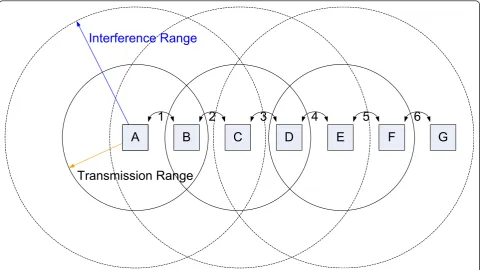
The following discussion demonstrates the effects of both types of contention. In Figure 3, we show a typical scenario where the intra-flow contention problem occurs. Consider a chain topology with seven nodes and the sen-der is placed at the first node (node 0). The transmission of node 0 in a 7-node chain experiences interference from three subsequent nodes, while the transmission of node 2 is interfered by five other nodes. This implies that node 0, i.e., the source, could actually inject more packets into the chain than the subsequent nodes can forward. These packets are eventually dropped at the two subse-quent nodes. Besides the contentions inside a multi-hop flow, the contentions between flows could also seriously decrease the network throughput. If two or more flows pass through the same region, the forwarding nodes of each flow encounter contentions not only from its own flow but also from other flows. Thus, the previous hops of these flows could actually inject more packets into the region than the nodes in the region can forward. These packets are eventually dropped by the congested nodes.
Both types of contention could result in severe colli-sions and congestion, and significantly degrade the per-formance of TCP in multi-hop ad hoc networks [23]. Moreover, contention allows an aggressive sender to cap-ture the channel, which reduces the chance of transmis-sions of the other senders in the vicinity. This not only greatly decreases the end-to-end throughput but also increases the end-to-end delay due to the long queuing delay. Furthermore, heavy contention is usually caused by using a large TCP congestion window. Previous stu-dies have shown that the maximum congestion window size should be kept small and should be maintained at a level proportional to some fraction of the length (in terms of the hop count on the path) of the connection [20,24] in order to alleviate the effect of contention. Unfortunately, as indicated in reference [20], conven-tional TCP does not operate its congestion window at an appropriate level and, thus, its performance is affected by the contention severely.
2.3.5 TCP instability and delay spike
to a high value for better performance. However, the multi-hop wireless networks may often experience delay spikes in the order of up to a few seconds [25]. Delay spike is defined as a sudden and sharp delay increase exceeding the typical RTT by several times of the typical TCP connection. Delay spikes will cause TCP to invoke spurious retransmissions.
There are many factors that may cause a sudden delay spike to be frequent in wireless multi-hop networks, such as: (1) hop-by-hop link-layer errors and contention along the path that leads to a longer waiting time and many link-level retransmission attempts before the packets in the queue are transmitted, (2) route changes or intermit-tent disconnections due to mobility that leads to a higher delay experienced by the transmitted packets,(3) wireless bandwidth fluctuation and (4) blocking by high-priority traffic.
In TCP, a retransmission timer mechanism is adopted to ensure reliable delivery of data. The retransmission time-out value is dynamically determined by estimating the RTT samples of the connection. Under the above circum-stances, when a delay spike occurs the sender may not receive an acknowledgment within the time-out period and, thus, the sender will regard all the transmitted but not acknowledged packets as lost. Consequently, the sen-der will unnecessarily reduce the sending rate and aggres-sively retransmit those packets that are deemed lost but are merely delayed. Meanwhile, TCP will exponentially
increase the retransmission time-out value, which leads to a long waiting time period if congestion loss takes place and, thus, wastes the limited available bandwidth.
3 Approaches to improve TCP performance in multi-hop wireless networks
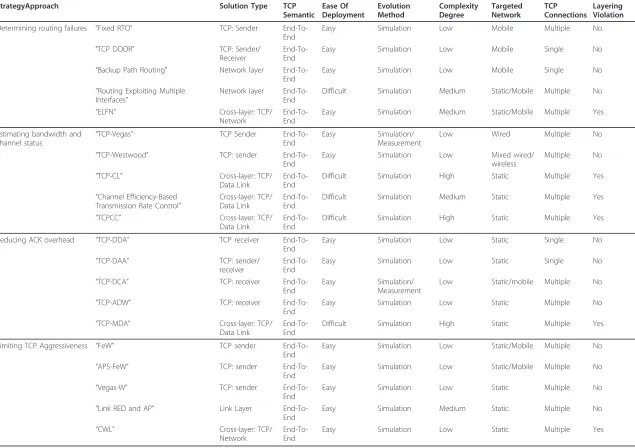
In this section, we present some of the major approaches that have been made in the literature to improve the per-formance of TCP in multi-hop wireless networks. We regroup these approaches to four sets according to the strategy used in order to improve TCP performance. How-ever, some approaches can be matched to several types of strategies but are only classified to their main strategy. The approaches that belong to the same set are classified into two types: cross-layer approaches and layered approaches. The cross-layer proposals rely on interactions between two layers of the open system interconnection (OSI) architecture. Specifically, the cross-layer interaction, considered in this article, is between the TCP layer and either the network layer or the data link layer. These approaches were motivated by the fact that“providing lower layer information to upper layer should help the upper layer to perform better”. The layered approaches rely on adapting OSI layers independently of other layers. Thus, depending on which layer is involved, layered pro-posals can be further classified into three types: TCP layer, network layer and link layer approaches. For each approach presented here, the representative schemes are
E
D
B
C
F
G
2
1
3
4
5
6
Interference Range
Transmission Range
A
presented and their mechanisms are described, along with discussion concerning their strengths and weaknesses in improving TCP performance in multi-hop wireless net-works. In addition, a comparison of the main characteris-tics of various TCP enhancements is provided for each category.
3.1 Determining the routing failures
In typical wired networks where the route for the connec-tion is relatively invariable, TCP performs well and net-work congestion is the key factor affecting its performance. However, in multi-hop wireless networks, route failures are the norm rather than the exception and occur frequently due to mobility and high BER. When a route failure occurs, packets that are buffered at the inter-mediate nodes along the route will be dropped. Moreover, the routing protocol would take time to discover a route-route re-computation process. The amount of time required for retransmitting the dropped packets and for discovering a new route has a negative impact on TCP performance. In addition, when TCP detects the bursty losses, TCP sender will encounter a time-out or even ser-ies of time-outs. In this case, TCP will dramatically reduce the size ofcwndandssthreshbecause it does not have the ability to distinguish between losses due to route failure and those due to congestion. Therefore, it takes a long time for the sending rate to return to a high value after a new route is restored.
Due to the above factors, TCP needs to have some effec-tive means to determine these events accurately so as to allow it to react appropriately. The approaches that address the problem of TCP caused by route failure can fall into three categories: TCP layer approaches, network layer approaches, and TCP and network cross-layer approaches.
3.1.1 TCP layer approaches
Fixed RTO Dyer et al. introduced fixed RTO [26], which is a simple heuristic technique that does not rely on feed-back from the underlying layers. Fixed RTO is designed to distinguish between route loss and network congestion and thereby tries to improve the performance of TCP. In the event of time-out, the conventional TCP retransmits the unacknowledged packet and doubles the RTO interval. For each retransmission of the packet, the RTO is doubled until an ACK for the retransmitted packet has been received. This exponential growth of the RTO enables TCP to handle network congestion gracefully. However, in multi-hop wireless networks, the losses may occur fre-quently and temporarily due to route losses and the net-work congestion is rare. Based on this and by taking advantage of the capability of routing algorithms that are designed to repair broken routes quickly, the authors show that it is intuitive to let TCP retransmit the unac-knowledged packet at periodic intervals rather than having
to wait increasingly long periods of time between retrans-missions. Therefore, fixed RTO keeps the RTO fixed after the first retransmission. When time-outs occur consecu-tively, i.e., the missing ACK is not received before the sec-ond RTO expires, this is taken to be evidence of a route loss. The unacknowledged packet is retransmitted again but the RTO is not doubled a second time. The RTO remains fixed until the route is re-established and the retransmitted packet is acknowledged.
To evaluate the performance of TCP with fixed RTO, three routing protocols, two on-demand (Ad-Hoc on Demand Distance Vector (AODV) and Dynamic Source Routing (DSR)) and one adaptive proactive routing proto-col (Adaptive Distance Vector (ADV)), have been consid-ered. The results indicate that the proactive ADV algorithm performs well under a variety of conditions and that the fixed RTO technique improves the performances of TCP over the two on-demand algorithms significantly. Nevertheless, the assumption that two consecutive time-outs are the exclusive results of route failures needs more analysis, especially in the presence of congestion.
TCP DOORTCP detection of out-of-order and response (DOOR) [27] is an end-to-end approach which does not require any feedback from the network or from the lower layers. This approach was designed by Wang and Zhang to improve TCP performance by detecting and responding to out-of-order packet delivery events, which are the results of frequent route changes. In TCP-DOOR, the out-of-order (OOO) events are interpreted as an indication of route failure. Thereby, the sender can distinguish route changes from network congestion. The detection of OOO events can be accomplished either by the sender or by the receiver. While the receiver can notify the sender about detected out-of-order data packets, the sender itself may notice ACKs arriving out-of-order. Once the TCP sender recognizes the OOO event, two response actions are sug-gested. In the first action, the sender may temporarily dis-able the congestion control mechanism of TCP by keeping its state variables constant. In the other action, if the con-gestion control mechanism was invoked during the past time period, the TCP sender should recover immediately to the state before the invocation of the congestion control.
routing algorithm (TORA) [28], OOO may occur if pack-ets from different paths are out-of-order.
3.1.2 Network layer approaches
Backup Path Routing In this approach, Lim et al. [29] have investigated the performance of TCP over a multi-path routing protocol. It is shown that multimulti-path routing can improve the path availability of TCP connections. The authors found that the original multipath routing may degrade TCP performance due to frequent out-of-order packet delivery and inaccuracy in average RTT measure-ment. Therefore, they introduce a new variation of multi-path routing strategy, called backup multi-path routing. Under the backup path routing strategy only one path at any time is used. However, the backup path routing strategy maintains several paths from source to destination. The other alternative paths are used as a backup when the cur-rent path is broken. Two methods have been considered as criteria for selecting the paths. In the first method, the shortest-hop path is selected as the primary path and the shortest-delay path is the alternative one. For the second method, the shortest-delay path is the primary and the maximally disjoint path is selected to be the alternative. The alternative maximally disjoint path is the path that has the fewest overlapped intermediate nodes with the pri-mary path.
The simulation results show that TCP is able to gain improvements under the backup path routing scheme. As a comparison between the two methods suggested in this approach, the authors found that the first method outper-forms the second one. They justified that when the second method is used, routes tend to be longer in the number of hops. Nevertheless, the method where the shortest-path is selected as primary and maximal disjoint as alternative was not considered. Moreover, the authors show that TCP’s performance degrades when the multipath routing protocol SMR [30] is used.
Routing exploiting multiple interfacesIn [31], Yoon and Vaidya proposed a network layer scheme that utilizes multiple heterogeneous wireless interfaces in multi-hop wireless networks. The idea is to use two heterogeneous wireless interfaces in each node: a primary 802.11a inter-face and a secondary 802.11b (or 802.11) interinter-face. The primary path over 802.11a interface is maintained by a reactive routing protocol such as DSR, while the secondary path over 802.11b interface is maintained by a proactive routing protocol such as Destination-Sequenced Distance-Vector Routing (DSDV). In normal conditions, TCP data packets will use the primary path, which has the higher rate, and the control packets (ACK) will take the second-ary path. In the event of link failures, TCP will use the sec-ondary path to recover its packets and preserve its window size. It keeps communicating using the low-rate interface, until the high-rate path is recovered. The 802.11b (or 802.11) interface is used at the secondary path because
they exhibit different properties than the 802.11a interface (i.e., slower rate but larger transmission range).
The simulation results show that using a secondary, lower rate but longer range interface can increase TCP throughput. However, the proposed scheme requires that each node be equipped with two radio interfaces, which raises the question of whether the additional cost pays off the performance gain. Moreover, dynamic route changes induced by node mobility causes reordering of TCP pack-ets at the receiver side, which, in turn, incurs duplicate ACKs at the sender side. With multiple interfaces routing, the chance of TCP packet reordering is higher and may affect the potential gain of using multiple interfaces. A more intelligent delivery mechanism to avoid TCP packet reordering is required.
3.1.3 TCP and network cross-layer approaches
Explicit link failure notification technique (ELFN)
ELFN [32] is a simple approach designed by Holland and Vaidya. This approach is based on a real interaction between TCP and routing protocols. This interaction aims to provide link failure information to the TCP sender to allow TCP to distinguish packet losses that are caused by link failures from those that are caused by congestion. When a link failure occurs, an ELFN message, which is piggybacked on the route failure message, will be sent by the routing protocol to the TCP sender. The ELFN mes-sage is like a“host unreachable”Internet control message protocol (ICMP) message, which contains the sender receiver addresses and ports, as well as TCP packet’s sequence number. The sender, upon receiving the ELFN message, responds by disabling its retransmission timers and enters a“standby”mode. During the standby period, the TCP sender uses a periodic probe message to deter-mine whether the route has been restored. If the acknowl-edgment of the probe packet is received (implying that the route is re-established), the TCP sender resumes its retransmission timers and leaves the standby mode to continue the normal operations. In this way, TCP can avoid the slow-start phase and continues with a high rate.
Explicit link failure notification technique (ELFN) is a simple efficient technique that provides significant enhancements over standard TCP. However, ELFN requires intermediate nodes to notify TCP on the pre-sence of route failures and this makes its deployment and implementation complicated.
3.1.4 Comparison
RTO and TCP DOOR employ end-to-end TCP semantic techniques to distinguish between packet losses induced by route failures and network congestion. In fixed RTO, this is done by considering two consecutive time-outs as a sign of route failures. Meanwhile, in TCP-DOOR, receiv-ing out-of-order packets is interpreted as an indication of route failures. The main advantage of fixed RTO and TCP DOOR is that they do not require any notification from routing layer neither do they require other nodes coopera-tion to detect route failures. Comparing these two propo-sals, TCP DOOR performs better than fixed RTO, but at the cost of more modifications.
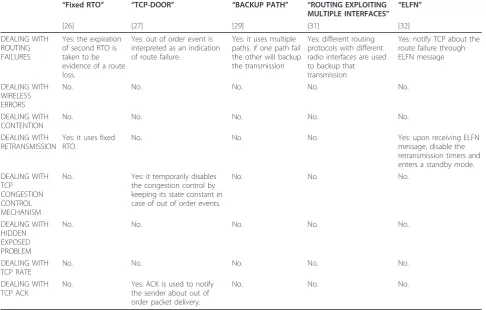
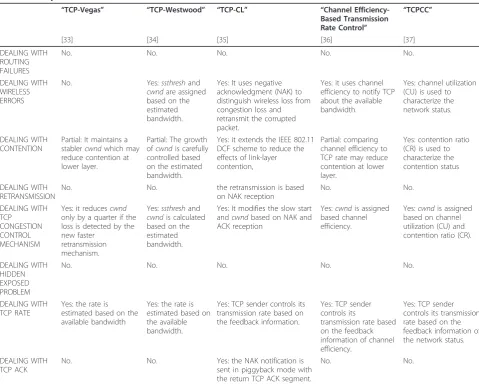
In the network layer solutions, Backup Path Routing and Routing Exploiting Multiple Interfaces maintain two routes, one primary path for normal data transmission and another backup path for recovering the data in case of route failures. In Backup Path Routing, this is done by using multipath routing protocol. Meanwhile, Routing Exploiting Multiple Interfaces uses different routing pro-tocol running over different radio interfaces. By compar-ing these two approaches, Routcompar-ing Exploitcompar-ing Multiple Interfaces performs better than Backup Path Routing, but at the cost of employment where each node must be equipped with two radio interfaces. The TCP and net-work cross-layer proposal, ELFN, is based on an explicit notification from the network layer to detect the route failure. For detecting re-establishments, ELFN uses a probing mechanism and the implementation of this mechanism is not easy. What is the optimal value of the probing interval? And what is the implication of this mechanism in the case of high load? Especially, it is seen that in the case of high load, ELFN performs worse than the standard TCP. Table 1 illustrates a summary of the main characteristics of the discussed TCP enhancements.
3.2 Estimating bandwidth and channel status
As discussed in Section 2, the traditional loss-based con-gestion control mechanism of TCP cannot accurately adjust the sending rate when it is used in multi-hop wire-less networks. Packet loss is not always a sign of conges-tion; it could be due to mobility or due to wireless errors. It is well known that one of the critical sources of TCP poor performance in multi-hop wireless networks lies on the lake coordinate between TCP and MAC layers. If there exists a big difference between the transmission rates of MAC and TCP, it may cause network congestion and retransmissions. To this end, several TCP schemes have been proposed recently to address the problem by better estimating the available bandwidth and the channel status. The representative schemes that take advantage of controlling the rate to enhance TCP performance include TCP-Vegas [33], TCP-Westwood [34], TCP-CL [35], Channel Efficiency-Based Transmission Rate Control [36], and TCPCC [37].
3.2.1 TCP layer approaches
TCP-Vegas TCP-Vegas [33] is one of the TCP variants that uses a rate-based congestion control mechanism. It was developed at the University of Arizona by Brakmo and Peterson. The main idea is to adjust the sending rate carefully by comparing with the estimated rate. It empha-sizes packet delay, rather than packet loss, as a sign to help determine the rate at which to send packets. In addi-tion, it also modifies the congestion detection and avoid-ance algorithms to improve the overall throughput of TCP. Even though TCP-Vegas was not intentionally designed for wireless, the TCP performance can be improved because its inherent rate-based congestion con-trol algorithm could pro-actively avoid possible conges-tion and packet losses by ensuring that the number of outstanding segments in the network is small.
The most significant difference between TCP-Vegas and the conventional TCP variants is the use of a rate-based technique to control the congestion window size. Unlike other flavours like Reno, NewReno, etc., which detect con-gestion only after it has actually happened via packet drops, TCP Vegas detects congestion at an incipient stage based on increasing RTT values of the packets in the con-nection. For every RTT, TCP-Vegas compares the expected throughput to the actual throughput measured. The expected throughput is calculated as the current window size divided by the minimum observed RTT. However, the actual throughput is measured as the number of bytes transmitted between the time a distinguished segment is transmitted and acknowledged, divided by the time it takes to get the acknowledgment back. If the difference between the two values is smaller thana, TCP-Vegas increases
cwndlinearly for the next RTT, assuming that throughput is less than the available bandwidth; and if the difference is greater thanb, TCP-Vegas decreases the congestion win-dow linearly for the next RTT to avoid overrun the band-width. If the difference is betweenaandb, TCP-Vegas keepscwndunchanged. In addition to the rate-based con-gestion control modification, TCP-Vegas modified the slow-start mechanism by allowingcwndto grow exponen-tially only once in every other RTT. This is to allow TCP-Vegas to compare the expected and the actual throughput. If the difference is greater than thegthreshold, TCP-Vegas changes from slow-start mode to the linear increase/linear decrease mode as described above.
are inaccuracies in the calculated expected throughput after a route change event. Another problem is the unfairness of TCP-Vegas, when it inter-operates with other versions like Reno. In this case, the performance of Vegas degrades because Vegas reduces its sending rate before Reno as it detects congestion early and, hence, gives greater bandwidth to co-existing TCP Reno flows. Therefore, the fairness provided by the linear increase/ decrease mechanism for congestion control in Vegas is an important issue for research.
TCP-Westwoodis another TCP variant based on band-width estimation, which was introduced by Casetti et al. [34]. TCP-Westwood is a sender-side modification that improves upon the performance of TCP Reno in wired as well as in wireless networks. The key idea is to continu-ously estimate the bandwidth used by the connection via measuring the rate of returning ACKs. When a loss occurs, either by receiving three duplicated ACKs or after a time-out, TCP-Westwood uses the estimated band-width to capture the congestion state much faster and then computes the congestion window and slow start threshold. The authors call this mechanism faster recov-ery. Moreover, when there is a prolonged absence of ACKs, the estimated bandwidth will exponentially decrease. The rationale of this strategy is simple: upon a
packet loss event, in contrast with conventional TCP, which blindly reduces thecwndandssthresh, TCP West-wood attempts to compute a propercwndandssthresh
values, which are consistent with the effective bandwidth used at the time congestion is experienced. In fact, the conventional TCP schemes are not effective over wireless links where sporadic losses due to radio channel pro-blems are often misinterpreted as a symptom of conges-tion and, thus, lead to an unnecessary window reducconges-tion. Nevertheless, TCP-Westwood is particularly robust to wireless because it tries to maintain the sending rate at the level just before the occurrence of a packet loss to avoid the unnecessary window reduction.
Experimental studies of TCP-Westwood reveal improve-ments in throughput performance as well as in fairness. In addition, friendliness with TCP Reno was observed in a set of experiments showing that TCP Reno connections are not starved by TCP-Westwood connections. Moreover, TCP-Westwood fully complies with the end-to-end TCP design principle and the improvement is most significant in wireless networks with lossy links. However, in contrast with conventional TCP, which cannot distinguish between random errors and congestion loss, TCP-Westwood per-formance is also not sensitive to random errors. When a random error occurs, caused by route failure or by channel
Table 1 Comparison of the main characteristic of various TCP Enhancements
“Fixed RTO” “TCP-DOOR” “BACKUP PATH” “ROUTING EXPLOITING MULTIPLE INTERFACES” “
ELFN”
[26] [27] [29] [31] [32]
DEALING WITH ROUTING FAILURES
Yes: the expiration of second RTO is taken to be evidence of a route loss.
Yes: out of order event is interpreted as an indication of route failure.
Yes: it uses multiple paths. if one path fail the other will backup the transmission
Yes: different routing protocols with different radio interfaces are used to backup that transmission
Yes: notify TCP about the route failure through ELFN message
DEALING WITH WIRELESS ERRORS
No. No. No. No. No.
DEALING WITH CONTENTION
No. No. No. No. No.
DEALING WITH RETRANSMISSION
Yes: it uses fixed RTO.
No. No. No. Yes: upon receiving ELFN
message, disable the retransmission timers and enters a standby mode. DEALING WITH
TCP CONGESTION CONTROL MECHANISM
No. Yes: it temporarily disables the congestion control by keeping its state constant in case of out of order events.
No. No. No.
DEALING WITH HIDDEN EXPOSED PROBLEM
No. No. No. No. No.
DEALING WITH TCP RATE
No. No. No. No. No.
DEALING WITH TCP ACK
No. Yes: ACK is used to notify the sender about out of order packet delivery.
error, the estimated bandwidth will quickly reduce as described previously and this leads to poor performance after recovering the path. Similar to Vegas, TCP-Westwood uses the observed smallest roundtrip time (RTTmin) in estimating the bandwidth. This may lead to problems, since any route change will invalidate the RTTmin and, thus, lead to incorrect bandwidth estimates. Thus, the tendency of the researches is to make TCP able to react to different types of error.
3.2.2 Cross-layer approaches
TCP-CLCheng and Lin proposed TCP-CL [35], which is a collaborative approach based on a cross-layer design for enhancing the end-to-end performance of TCP in wireless networks. The authors show that by making slight modifi-cations to the legacy IEEE 802.11 MAC and TCP proto-cols, TCP-CL provides a significant improvement in the performance of TCP in multi-hop wireless environments. The standard IEEE 802.11 MAC layer provides a reliable operation over the communication channel by defining a retry limit parameter (RETL). Using this parameter when-ever a node fails to transmit a frame, it retransmits that frame and then increases the value of RETL by one. If the value of RETL exceeds a specified threshold (i.e., 7 for basic access mechanisms and 4 for virtual carrier-sensing mechanisms), the frame will be discarded, link failure will be reported to the link layer, and the RETL will be set to zero. The RETL is also reset to zero once the frame has been successfully transmitted. Nevertheless, if the link experiences a high degree of contention, the MAC layer may mistakenly infer a link failure. Consequently, this mis-interpretation of link failures may severely affect the per-formance of TCP.
Thus, to reduce the effects of link-layer contention on the performance of TCP, this approach extends the IEEE 802.11 DCF scheme by introducing a new variable, desig-nated as the retransmission limit (RETF), to record the number of retransmission attempts in the event of contin-uous transmission failures. If the value RETF does not exceed the retransmission threshold as well as receipt of TCP ACK within the same flow, it forwards the TCP negative acknowledgment (NAK) piggybacks using the reverse TCP ACK along the end-to-end path and increases the value of RETF. If the value of RETF exceeds the retransmission threshold, it discards the transmitted packet and then resets the contention and RETL, respec-tively. The NAK option is triggered only when a link-layer frame is dropped as a result of transmission errors and is limited by the retransmission threshold value. If a TCP data frame is discarded after several retransmission attempts (limited by the retry threshold), the MAC-layer protocol triggers the TCP NAK option in the TCP header associated with the sequence number of the dropped packet and then piggybacks the option using a reverse TCP ACK to notify the TCP sender to retransmit the
missing packet. Note that the NAK notification is sent in piggyback mode with the return TCP ACK segment in order to avoid increasing contention in the link layer. This cross-layer support from the link layer protocol ensures that the transport layer TCP protocol is aware of the transmission error in the link layer and can then react to this error in accordance with the wireless corruption infor-mation conveyed by the received NAK. TCP is therefore capable of differentiating between corruption and conges-tion losses, thus, allowing it to react appropriately in each case.
This approach has proposed a cross-layer solution desig-nated as TCP-CL to improve TCP performance in multi-hop wireless networks. Overall, the results show that the proposed scheme has a number of key advantages com-pared to conventional TCP, including a more efficient treatment of frequent transmission losses, a faster reaction to corruption losses, and the ability to distinguish between congestion errors and transmission errors and to take appropriate remedial action. Importantly, the proposed mechanism does not require any node to cache any unac-knowledged packets for every TCP connection passing through it. The performance of TCP-CL is compared with that of standard TCP-Reno and TCP-Westwood schemes in terms of throughput. The simulation results reveal that TCP-CL achieves a significant improvement in the TCP transmission performance over multi-hop wireless net-works. However, this scheme keeps a single path to each destination without utilizing available paths effectively. Moreover, more analysis is required to study the effect of mobility on this scheme.
Channel efficiency-based transmission rate controlis a cross-layer approach conducted by Zhang et al. [36]. In this approach, the authors show that, in multi-hop wireless networks, if the transmission rate of TCP does not match that of the medium access control (MAC) protocol, it causes network congestion and network performance degradation. Therefore, they propose a new approach to control the transmission rate of TCP by utilizing the MAC information through a cross-layer. The main contribution of this approach is to feedback the real channel efficiency of MAC protocol to TCP so as to adaptively control the transmission rate. This will help to reduce the big differ-ence between the transmission rate of TCP and MAC and, consequently, reduce the network congestion and retrans-mission. To this end, two important measures, real MAC channel efficiency and virtual TCP channel efficiency, have been introduced. In the criterion of the real MAC channel efficiency, TCP adjusts the transmission rate, which is implicitly controlled by the congestion window and the flow of TCP ACKs to maintain the virtual TCP channel efficiency to be close to the real MAC channel efficiency.
order to alleviate the load of MAC protocol before a congestion event occurs and to enhance the network per-formance. Simulation results show that the proposed mechanism outperforms 802.11 DCF in terms of throughput and delay. However, this approach does not handle the effect of route failures and high BER at the intermediate nodes. Moreover, the mobility has a great impact on the channel efficiency, and it is not clear how this approach will perform over mobile networks, thus, more analysis is required.
TCPCCis a cross-layer approach conducted by Zhang et al. [37]. In this study, the authors show that the over-injection of conventional TCP window mechanism results in severe contentions, and medium contentions cause net-work congestion. They also show that, two important metrics, channel utilization (CU) and contention ratio (CR) should be used to characterize the network status. Then, based on these two metrics, they propose a new TCP transmission rate control mechanism based on chan-nel utilization and contention ratio (TCPCC). In this mechanism, each node collects the information about the network busy status and determines the CU and CR accordingly. The CU and CR values fed back through ACK are ultimately determined by the bottleneck node along the flow. The TCP sender controls its transmission rate based on the feedback information.
The simulation results in [37] show that TCPCC mechanism significantly outperforms the conventional TCP mechanism and the TCP contention control mechan-ism in terms of throughput and end-to-end delay. Never-theless, similar to channel efficiency-based transmission rate control, TCPCC does not have a mechanism to handle the route failures. Moreover, TCPCC requires the use of explicit feedback information from intermediate nodes. Deploying TCPCC is more difficult, since it relies on the cooperation of all nodes.
3.2.3 Comparison
Five approaches have been discussed. These approaches address the problem of TCP inability to control the traffic based on the networks conditions, which is one of the main reason for performance degradation in multi-hop wireless networks. To solve this problem, two available methods are presented. The first one is by allowing TCP to estimate the network condition without violating the layered principle. In particular, TCP has to perform some statistical operations to estimate the status and react accordingly, such as TCP-Vegas [33] and TCP-Westwood [34]. The other way is to feedback the status of the net-work through cross-layer information. In this way, TCP can read this information and adjust itself. The approaches that use this method are TCP-LC [35], channel efficiency-based transmission rate control [36], and TCPCC [37]. These approaches that make use of the explicit feedback from the networks provide significant improvements in
TCP performance. However, if we consider the concept of protocols and applications in isolation, TCP-Westwood seems to be the preferred choice. This is because TCP-Westwood uses the idea of bandwidth estimation and can effectively alleviate the effect of the losses that are not caused by congestion. Table 2 illustrates a summary of the main characteristics of the discussed TCP enhancements.
3.3 Reducing ACK traffic overhead
From an end-to-end perspective in general and a TCP viewpoint in particular, there are two types of segment: DATA and ACKs, injected into the network by the sender and the receiver, respectively. Several researchers show that, in multi-hop wireless networks, reducing the number of segments in the communication pipe can reduce the contention and collision caused by sharing the same path. In order to achieve this, some researches proposed to enhance the overall TCP performance by reducing the number of DATA segments transmitted by the sender. Some of these enhancements are discussed in the next section. From the receiver’s perspective, other researches argue that spatial contention can be reduced by introdu-cing fewer ACK segments, say by taking advantage of their cumulative property. Such approaches aiming to reduce spatial contention caused by ACKs are named ACK-thin-ning, delayed ACKs, or ACK-reducing and are the point of focus for this section. These approaches have been examined in the literature and have been shown to be beneficial in terms of increasing TCP throughput.
In the legacy TCP, upon successful reception of every data packet transmitted from a sender to a receiver, an ACK response from the receiver to the sender will be gen-erated (Figure 4a). If a data packet has not been acknowl-edged for some time, it is considered lost and is retransmitted by the sender. In fact, ACKs are considered control traffic used by TCP to ensure reliable data recov-ery. However, the small TCP ACKs consume wireless resources as much as the long TCP data packets. More-over, the interference and collision between data and ACK packets, which are caused by sharing the same route, increase with the number of ACKs generated [39]. There-fore, it is desirable to reduce the number of control traffic (ACKs) so as to make the resources available for the actual data packets and to reduce the interference and collision between the data and the ACK packets. This is achieved by merging several ACKs in one ACK, which is possible due to the cumulative ACK option used in TCP.
perform better by employing the delayed ACKs in the case of throughput, bandwidth and energy consumption. How-ever, in 802.11 networks, the interference problem between ACK and data packets may still persist and the benefit of standard TCP with delayed ACK can be further improved. (Figure 4c) shows the case of delaying ACK for more than two packets. In fact, lowering the number of ACKs may improve TCP performance, however, the large cumulative ACKs will induce packet loss due to retrans-mission time out at the sender side of TCP. To address this problem, numerous enhancements and optimizations have been proposed to reduce traffic overhead caused by generating more ACKs than necessary.
3.3.1 TCP layer approaches
Dynamic delayed ACK (TCP-DDA)TCP-DDA [39] is a simple receiver modification introduced by Altman and Jiménez. In this approach, the authors investigated the impact of producing delayed ACKs for more than two received packets on TCP performance in multi-hop
wireless networks. They proposed a limited dynamic delayed ACK scheme, in which the receiver begins delay-ing one ACK (senddelay-ing one ACK for two in order packets received) and keeps increasing until four based on the sequence number of the acknowledged packet. For instance, when the delayed ACK is set to four, the receiver may send a single ACK for packet (Pi) implying that pack-ets (Pi-1), (Pi-2) and (Pi-3) have also been successfully received, without sending separate ACKs for each. The receiver keeps delaying four ACKs except at session start-up it decreases the delayed ACK to one again.
Although the delayed ACK option decreases the fre-quency of RTT samples measurable by the TCP sender, this reduction of feedback has a significant impact on the RTO expiration. As a result, the TCP may retransmit all the packets that their ACKs delayed, even though the packets are received. Therefore, TCP should precisely select the optimal value of the ACK delay window. Although TCP-DDA has shown a good performance in
Table 2 Comparison of the main characteristic of various TCP Enhancements
“TCP-Vegas” “TCP-Westwood” “TCP-CL” “Channel Efficiency-Based Transmission
No. Yes:ssthreshand
cwndare assigned based on the estimated bandwidth.
Yes: It uses negative acknowledgment (NAK) to distinguish wireless loss from congestion loss and retransmit the corrupted packet.
Yes: it uses channel efficiency to notify TCP about the available
Partial: It maintains a stablercwndwhich may reduce contention at lower layer.
Partial: The growth ofcwndis carefully controlled based on the estimated bandwidth.
Yes: it extends the IEEE 802.11 DCF scheme to reduce the effects of link-layer contention,
Partial: comparing channel efficiency to TCP rate may reduce contention at lower
No. No. the retransmission is based on NAK reception
Yes: it reducescwnd
only by a quarter if the loss is detected by the new faster
Yes: It modifies the slow start andcwndbased on NAK and ACK reception
Yes:cwndis assigned based channel efficiency.
Yes:cwndis assigned based on channel
Yes: the rate is estimated based on the available bandwidth
Yes: the rate is estimated based on the available bandwidth.
Yes: TCP sender controls its transmission rate based on the feedback information. rate based on the feedback information of the network status.
DEALING WITH TCP ACK
No. No. Yes: the NAK notification is sent in piggyback mode with the return TCP ACK segment.
static ad hoc networks compared to the standard TCP, it may be inefficient in high traffic scenarios with consider-able packet loss. Moreover, TCP-DDA has been obtained for only a single flow in static networks, multiple flows and mobility are good issues for further improvement.
Dynamic adaptive ACK (TCP-DAA) TCP-DAA [41] is
a sender/receiver modification introduced by Oliveira and Braun. In TCP-DAA, the receiver reduces the number of ACKs by taking advantage of the cumulative property of TCP. TCP-DAA dictates changes to the sender as well as the receiver. In this approach, the receiver may combine up to four ACK packets when the wireless channel is in good condition and less for lossy channels. The limit of four packets is imposed by the sender’s congestion win-dow limit that is also fixed at four packets. The authors report that the low limit of the sender’scwndis proper for minimizing collisions and more than enough for scenarios having up to 10 hops. The delay of ACK responses are performed in a dynamic manner based on packet loss event. When there is no packet loss, TCP-DAA delays ACKs until it receives more data packets up to four, but reduces the number to two in case of out-of-order packet delivery. These concepts lead this approach to outperform a regular TCP whenever the channel is able to provide higher bandwidth.
However, there is some processing overhead associated with this method, there is a general increase in through-put and better utilization of the wireless channel. This approach shows improvement not only in the through-put, which is the key issue in this area, but also in power consumption. Consequently, the overall energy consump-tion is significantly reduced, which is a key issue for bat-tery-powered devices. TCP-DAA focuses on networks of short hops, at most ten hops, as stated in this article. Nevertheless, the evaluation includes long-hop networks, which are particularly valuable in some scenarios such as large sensor networks.
Delayed cumulative acknowledgment (TCP-DCA)
TCP-DCA is a TCP receiver-based scheme introduced by Chen et al. [43]. In this scheme, the authors show that TCP does not always get throughput gain by delaying unlimited ACKs. In addition, there exists an optimal delay window size at the receiver that produces best TCP throughput. In TCP-DCA, path length is an important factor to be considered when choosing appropriate delay window sizes. Therefore, TCP-DCA selected different size of delay window to adapt TCP ACK generation based on the number of hops. When the number of hops between the sender and the receiver is less or equal to three hops, the delay window is set to be equal to the
(a)
(b)
(c)
DATA
DATA
DATA
ACK
ACK
ACK
cwndsize. For path lengths between four and nine hops, the delay window is set to be fixed with five packets. In case of long paths, more than ten hops, the receiver will set the delay window to three packets. TCP-DCA has shown good performance in multi-hop wireless networks. In conclusion, delaying ACKs for large numbers of data packets, a large delay window is always beneficial in con-nection with short-paths, but may be inappropriate for long-path networks. The longer the end-to-end path the longer the time for TCP sender to detect lost packets caused by delaying more ACKs. In addition, when travel-ling a longer path, a packet is more likely to suffer interference.
TCP-DCA is an end-to-end TCP semantic scheme, which shows good performance over static, mobile and hybrid ad hoc networks. TCP-DCA has been proposed to decrease the number of ACKs adaptively based on the path length. However, knowing the number of hops between the sender and the receiver is not a property of TCP and may require interaction with underlying layers. Moreover estimating the number of hops by TCP is not easy, especially in mobile networks where the path length is changing dynamically. Besides, TCP-DCA uses a large fixed delay window through the whole transmission between a sender and receiver and this may affect the performance with channels with high bit error rate.
TCP with Adaptive Delay Window (TCP-ADW)
TCP-ADW is a TCP receiver-based modification introduced by Al-Jubari and Othman [44]. The authors show that using a fixed delay window is invalidated in this chan-ging environment and the optimal delay window size at the receiver that produces best TCP throughput can be achieved dynamically. TCP-ADW adjusts the delay win-dow dynamically based on several conditions such as transmission rate, slow start phase, path length and packet lost event. To reduce the number of ACK pack-ets appropriately, TCP-ADW makes the ACK generated by reaching the optimal dynamic delay window. In this way, the receiver will be able to adapt itself to different values of delays imposed by the wireless channel condi-tions. In addition, it delays just enough to avoid the transmission time-out at the sender. In this approach, unless the sender’s retransmission timer expires, the receiver always increases the delay window based on the increase in the transmission rate, except at session startup. During the startup, the receiver sets the delay window to one and increases it based on the transmis-sion rate. When the packet loss occurs, the receiver decreases its delay window to a certain value based on the hop count (path length). In case of short path, the receiver decreases the delay window to half. For the long path, however, the receiver will decrease its delay window to two. This is because the TCP sender will take a long time to detect lost packets obtained by
delaying more ACKs. Out-of-order packets immediately cause the ACK generation to inform the sender of the packet loss/recovery in a timely manner, as introduced in the recommendation of RFC 2581 [40]. The receiver uses a fixed interval of 200 ms for timing out.
TCP-ADW is an end-to-end TCP solution, which shows a significant performance over TCP-DCA and much more over the regular TCP in static ad hoc net-works. However, evaluating TCP-ADW over mobile ad hoc networks and studying its performance over chan-nels with high BER is required.
3.3.2 Cross-layer approaches
Monitoring Delayed Acknowledgment (TCP-MDA)
MDA is across-layer-based modification introduced by Armaghani et al. [45]. TCP-MDA proposed a dynamic interaction strategy between TCP and MAC layers, which reduces the number of ACKs by monitoring the channel condition. To properly set the number of delayed ACKs in TCP, TCP-MDA uses a mechanism to collect collision probability along the path from sender to receiver in MAC layer. Based on the estimated colli-sion probability, TCP adjusts itself to the channel condi-tion by delaying less ACKs in high traffic condicondi-tions and more ACKs in low traffic conditions. If the channel is in a good condition, when the estimated collision probabil-ity is less than a predefined threshold, the TCP receiver may combine up to four ACKs. However, when a high collision in the MAC layer is observed, the TCP receiver generates more ACKs to avoid unnecessary retransmis-sion caused by time-out in the sender side. The limit of four ACKs is imposed by the sender’s cwnd, which is defined as the maximum number of data packets a TCP sender may inject into the network at any time without waiting for an ACK from the receiver. This low limit of four packets forcwndis proper to minimize the channel contention in short range scenarios [46].
performance of TCP in case of high transmutation rate and low BER.
3.3.3 Comparison
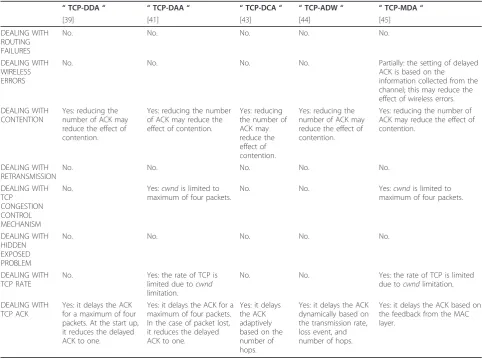
Five approaches have been presented. These approaches address the problem of reducing the overhead caused by ACKs traffic on the wireless channel, which is one of the key issues of TCP performance degradation in multi-hop wireless networks. Some approaches are based on end-to-end TCP layer modification, such as DDA, DAA, DCA, ADW and others are based on cross-layers, such as MDA. DDA and DAA reduce the number of ACKs dyna-mically but it is limited up to four packets. DDA increases the delay window based on the increase of sequence number of packets. However, DAA increases the delay window based on in-order packets delivery and reduces the delay window based on the loss events (out-of-order packet delivery). For the DCA approach, the delay window is adaptively set based on the number of hops. DCA shows a good performance over DAA, which, in turn, outperform DDA. In ADW, the delay window is not limited and is set adaptively and dynamically based on three impotent factors, number of hops, transmission rate, and loss event. The results of ADW show that ADW has a significant performance over DCA and much more over the standard TCP in static ad hoc networks. In the cross-layer approach, use the feedback from the MAC layer to set the delay window. MDA uses a limited delay window of up to four packets to generate an ACK. The simulation results of MDA illustrate that MDA out-perform DAA and the regular TCP as well. Table 3 illus-trates a summary of the main characteristics of the discussed TCP enhancements.
3.4 Limiting TCP aggressiveness
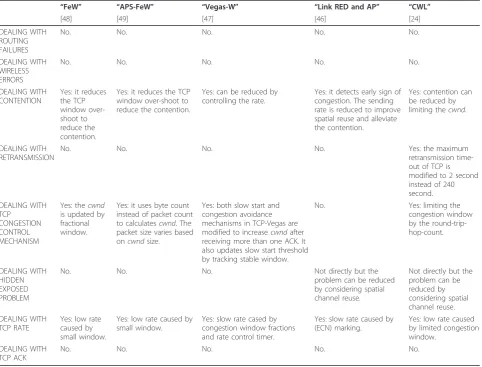
It is well known that one of the main functions of TCP is the TCP window mechanism that controls the amount of traffic sent into the network. However, one of the critical reasons for poor TCP performance in multi-hop wireless