© 2015, IRJET.NET- All Rights Reserved
Page 1361
Design and Implementation of RWA for Optical WDM Networks
Niranjan Dasar
1, Mrs. Triveni C L
21
MTech (DECS), Dept. of E&C, Malnad College of Engineering Hassan, Karnataka, India
2
Asst.Professor, Dept. of E&C, Malnad College of Engineering Hassan, Karnataka, India
---***---Abstract -
The project studies the problem of linkfailure and recovery in the optical wavelength division multiplexed (WDM) networks. Three algorithms namely conversion free routing (CFR), converter shared wavelength routing (CSWR) and dedicated routing algorithms are implemented. Performance of optical network based on these three algorithms is analyzed. Two different networks: NSFNET AND EUROCORE are considered for the implementation of the algorithm. In the simulation, proposed CSWR algorithm gives better result in terms of implementation cost and comparatively decreases the blocking probability as number of wavelengths increases.
Key Words:
WDM networks, optical switches, wavelength converters.I. INTRODUCTION
The size and speed of information exchange needs to be increase to meet the current trends in multimedia communications include voice, video, data and images. People using number of smart devices for multimedia applications ranging from video-conferencing, online applications like Napster etc. These trends needs flexible network with extremely high capacities to manage the expected vast growth in the network traffic volume. Optical fiber communication satisfies the demands for these networks by operating in the range of a few megabits to tens of gigabits per second. Wavelength division multiplexing technology is used to satisfy these data rates [1].
In optical WDM networks, data is transmitted through the light path. Since each light path can carry a large amount of data, failure of the network seriously cause huge data loss and damage the important applications of the end-user. Hence survivability is the key feature to be considered while constructing the network. Survivability is provided to the optical networks by providing the backup paths for each primary path. Initially primary path is selected for the transmission of the data. Whenever primary path fails, backup path is selected. A fundamental property of light-path is its continuity. A connection must be assigned the same wavelength on all hops of its path. This can lead to blocking of connection request when same wavelength is not available on given path. Wavelength converters provide solution to this problem by shifting the wavelength of an incoming signal to another wavelength. This reduces
the blocking due to wavelength unavailability on a hop, requiring only one of the wavelengths being available [2]. All optical wavelength converters are costly and the design should aim at minimizing the total number of converters while achieving good blocking performance.
© 2015, IRJET.NET- All Rights Reserved
Page 1362
path relocation does not affect the data transmission asthere is no active participation of it in the transmission. We are using these algorithms in our system with little modification as explained in below explanations.
Routing and wavelength assignment problem was discussed in [4]. There are static and dynamic routing schemes. We are using dynamic routing scheme that uses the current status of the network.
For routing primary and backup path, we are using Dijkstra’s shortest path algorithm as proposed in [5]. This is the oldest and best method to compute the shortest path between the source and destination. We consider hop count as a parameter.
There are two types recovery techniques are proposed in [6] and [7] for survivable WDM networks. We are using path protection technique to recover the failed primary path with dedicated backup.
Different node architectures are available for the wavelength conversion. The simplest wavelength converter node architecture is proposed in [10], which has drawback of expensive converters cannot be shared. Share-per-node architecture is proposed in [3], which has drawback of switching complexity and converter unavailability. We are using share-by-wavelength-switch architecture in our system as proposed in [9]. Main aim is to share the expensive wavelength converters hence reduce the system cost.
III. PROPOSED MECHANISMS
In this section, system design of the proposed mechanism will be discussed. Wavelength routed optical WDM mesh network with wavelength conversion is considered. As explained in the section 2.5, dynamic routing mechanism is considered. In dynamic routing mechanism, shortest path between the source and destination node is computed based on the present network status. Shortest path is computed using the Dijkstra’s algorithm as explained in the section 2.4. In the proposed algorithm, path-level protection with shared protection mechanism is considered. A wavelength router architecture based on the shared-by-wavelength-switch converter configuration is used. Shared-by-wavelength-switch converter is chosen since its cost is less and gives the best performance as compared to the share-per-node wavelength converter. In the proposed mechanism, we are assumed that the connections are blocked due to unavailability of free wavelengths in the paths and/or unavailability of wavelength converters at the node.
The design goal of the CSWR algorithm is to improve the network performance. We consider the blocking probability as a parameter to measure the network performance. Proposed algorithm reduces the number of connections blocked due to unavailability of the wavelength converter hence improves the system performance. And reduces cost by using shared-by-wavelength-switch converter configuration. Then we
compare the results of CSWR algorithm with the Conversion Free Primary Routing (CFPR) algorithm and dedicated protection scheme. Comparison of results with other algorithm gives the performance analysis of the system based on CSWR algorithm.
3.1 Conversion Free Routing (CFR) Algorithm
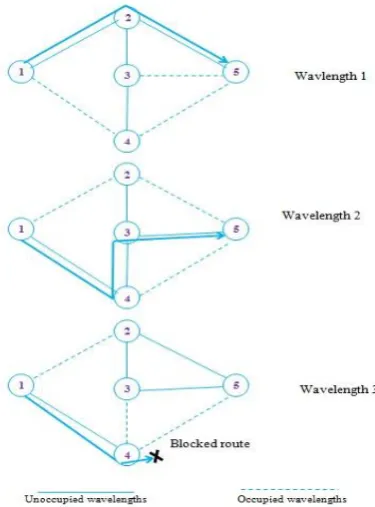
It is the very basic algorithm, where routing is done without wavelength conversion. This is the least cost routing mechanism as there is no converters and gives the good quality signals. CFR algorithm uses Dijkstra’s algorithm as explained in section 2.4 for the determination of shortest path between source and destination on each wavelength. The route with least distance is selected as a primary path, and then the route having next shortest distance is selected as the backup path. As we are using shared protection mechanism, this back up can be shared among other primary paths. If there is no free wavelengths are available, then the route will be block.
Figure 3.1: Conversion Free Routing
© 2015, IRJET.NET- All Rights Reserved
Page 1363
3.2 Converter Shared Wavelength Routing (CSWR)
Algorithm
Proposed CSWR is the effective algorithm to overcome the drawback of the CFR algorithm. We are introducing the wavelength converters at each node to avoid the blocking of data due to the unavailability of the wavelength. Optical wavelength conversion technology used in this algorithms helps to improve the network performance. The proposed CSWR algorithm includes both conversion free and conversion mechanisms. Initially it computes the primary and backup paths without any wavelength conversion as explained in CFR algorithm. Whenever there is no same wavelength is available on the next link, it checks for the nearest free wavelength in that link. If there is free wavelengths are available, then wavelength converter is utilized. If there is no free wavelengths are available then the connection will block.
We are using the shared-by-wavelength-switch converter configuration as explained section 2.6. The main advantage of the shared-by-wavelength-switch converter architecture is its low cost. Instead of using the wavelength converters for each wavelength, we are using the shared-by-wavelength-switch converter architecture. It is cost effective and those wavelengths require conversion only utilizes the converter.
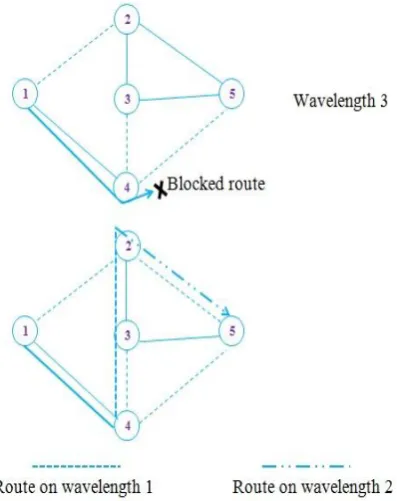
Figure 3.2: Converter Shared Wavelength Routing
Let us consider the example as explained in the section 3.1. In the CFR algorithm, path on wavelength 3 was blocked due to unavailability of the same wavelength on the next links. In CSWR algorithm, blocked route can be establishing using wavelength converter. This algorithm checks for the
free wavelength in the next links and converts wavelength to the nearest wavelength present in the next link. Path establishment using the CSWR algorithm is shown in the figure 3.2. At node 4, CSWR algorithm checks for the free wavelengths available in the next links. It finds that, wavelength 1 is free at the link 4-3 and hence path is established with wavelength conversion. We are assuming that there is no free wavelength available at links 4-5 and 3-5. Because of no wavelengths are available at link 3-5 and only wavelength 1 is available at 3-2, established route will be extend up to node 2. There is only wavelength 2 is available at link 2-5, again requires wavelength conversion at node 2. Finally path 1-4-3-2-5 is established between source and destination using CSWR algorithm.
3.3 Dedicated Routing Algorithm
Dedicated routing means that each links having their own converters at all the nodes. This is also known as full range wavelength conversion. This completely reduces the blocking due to the converter unavailability as there is a full range conversion. But the implementation cost is very high.
Shortest path between source and destination is computed using the Dijkstra’s algorithm. Consider every link on the shortest route between source and destination pair. Choose the wavelength that is free at source node to next node in the path. Then allocate that the link as used. Then algorithm checks if the same wavelength is free in the next link of the chosen route. If yes then allocates same at that particular link. Else check which wavelength nearest to the recent one is free, which is known as first fit wavelength conversion. This will continue until the destination node is reached. When no conversion is possible as all wavelengths in next link of the path being utilized, request is dropped. Otherwise connection is established between source and destination.
IV. PERFORMANCE ANALYSIS
© 2015, IRJET.NET- All Rights Reserved
Page 1364
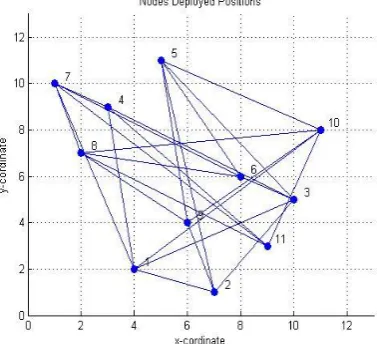
Figure 4.1: EUROCORE, 11 node network with 50 linksAs per the requirement of the routing and wavelength allocation for all the three algorithms, a primary path and a backup path is identified, at initial it’s a dijkstra’s shortest path with minimum weights or distance. Two different routes can share a link or a node as part of path. Hence there is sharing of paths. Figure 4.3 explains sharing with an example where two paths are sharing the nodes as well as links for the purpose.
Figure 5.2: NSFNET, 14 node network with 42 links
Request1: The source node = 1 and the destination node = 2. The results are as follows
The paths are: Primary P1= [1 2] and Backup b1= [1 3 2]. Path wise hops are 1 and 2 respectively.
Request2: The source node = 3 and the destination node = 8. The results are as follows
The paths are: Primary p2= [3 2 4 5 7 8] and Backup b2= [3 1 8].
The primary path has more hops than the backup; this is so because routing is done minimizes weights. In the figure blue lines trace primary path and red lines are backup paths.
Figure 4.3: sharing, example routing
For execution of this project user has the freedom of choosing the network. The network of choice is then applied algorithm and results are observed. We can also vary the number of wavelengths assigned for the links. The number of converter in case of converter share allocation plays an important role too. Also the share between primary wavelength and backup are decided by the user itself.
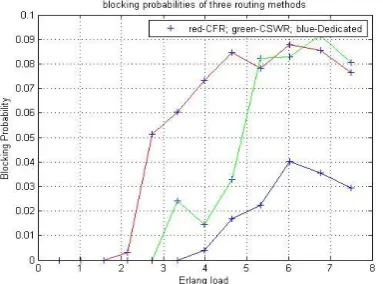
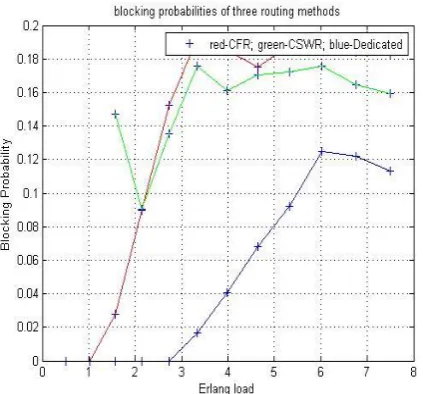
Figure 4.4: EUROCORE performance for lower number wavelengths
© 2015, IRJET.NET- All Rights Reserved
Page 1365
Figure 4.5: EUROCORE performance for higher numberwavelengths
The Figure 4.5 shows results for 11 node EUROCORE network, here the maximum possible links are 110, and the number of wavelengths per link is 40 instead 20 as earlier. The wavelengths of W (total) reserved for primary path are 30 compared to 15, and number of converters (W*M) at the node == 20*24
Analysing Figure 4.4 and 4.5 we note that higher wavelength number offers better performance. As in Figure 4.5, the share per node and CFR show significant decrease in the blocking probabilities, whereas dedicated node allocation shows no blocking at all until a load of 8 Erlang. As is the case of higher number of wavelengths availability a higher number of wavelength converters also improve the performance substantially. Figure 5.6 is an imprint of the results with for 11 node EUROCORE network, here the maximum possible links are 110, and the number of wavelengths per link is 20, which is equal to that of result in Figure 4.4. The wavelengths of W (total) reserved for primary path are 15 and number of converters (W*M) at the node == 20*220, Which is way higher providing very high conversion range for CSWR algorithms.
Figure 4.6: EUROCORE performance for higher number converters
An overview of Figure 4.4 and 4.6 gives us the notion that with similar number of wavelengths and primary to backup share, the blocking probabilities decrease for higher number of converters. The cost of
converters is leverage for the performance of blocking probability in this case.
A similar analysis is applicable to a 14 node NSFNET, owing to the similar reasoning as in case of UEROCORE. Hence the figures along with input parameter values are presented below in an attempt to avoid the repeated vocabulary.
Figure 4.7: NSFNET performance for lower number wavelengths
Figure 4.8: NSFNET performance for higher number wavelengths
© 2015, IRJET.NET- All Rights Reserved
Page 1366
Figure 4.9 NSFNET performances for higher numberwavelengths
As the discussion has been throughout this section the blocking probabilities decrease with an increase in the converter availability. Figure 4.9 shows the results with similar inputs as in case of that resulting in Figure 4.7 except that the converter has 32*180 conversion capability. Here CSWR and CFR show significant improvement compared to Figure 4.7 but all importance goes to zero blocking for 8 Erlang load provided by dedicated node allocation.
V. CONCLUSION
Routing and wavelength allocation using three algorithms: CFR, CSWR and Dedicated algorithms are implemented using MATLAB, for two different networks: NSFNET and EUROCORE. The results are analyzed for varying load along with a change in number of converter availability and number of wavelengths. The variations in results across the networks for similar changes in specific parameters are found to be consistent. For example a higher number of wavelengths decreased blocking probabilities in both the networks.
It must be noted that a higher number of wavelengths needs better technology for wavelength segregation and more converters also are a matter of expenses for better performances/services.
Comparatively CSWR algorithm gives better performance since its shared converter cost is less and blocking probability lies between other two algorithms in most cases.
REFERENCES
[1] P. Green, “Progress in optical networking,” IEEE Communications Magazine, vol. 39, no. 1, pp. 54–61, Jan. 2001.
[2] Manoj shivkumar and Krishna shivlingam. “A routing algorithm framework for survivable optical networks based on resource consumption minimization,. Journal of light wave technology”, vol. 25, no. 7, july2007.
[3] Sunil Gowda and Krishna M. Sivalingamworks, ‘Protection Mechanisms for Optical WDM Networks based on Wavelength Converter Multiplexing and Backup Path Relocation Techniques” IEEE infocom 2003.
[4] Jason P. Jue, “Lightpath Establishment in Wavelength-Routed WDM Optical Networks,”
[5]http://www.cs.nyu.edu/courses/summer07/G22.2340 001/Presentations/Puthuparampil.pdf
[6] Dongyun Zhou and Suresh Subramaniam, “Survivability in Optical Networks,” IEEE 2000.
[7] S. Ramamurthy and B. Mukherjee, “Survivable WDM Mesh Networks Part 1 - Protection,” in Proc. IEEE INFOCOM, vol. 2, New York, Mar. 1999, pp. 744–751.
[8] K. C. Lee and V. O. K. Li, “A wavelength convertible optical network,” J. Lightw. Technol., vol. 11, no. 3, pp. 962– 970, May/Jun. 1993.
[9] Tony K. C. Chan, Eric W. M. Wong and Yiu-Wing Leung, “Shared-by-Wavelength-Switches: A Node Architecture Using Small Optical Switches and Shared Wavelength Converters,” IEEE photonics technology letters, vol. 18, no. 12, june 15, 2006.
[10] Byrav Ramamurthy and Biswanath Mukherjee, “Wavelength Conversion in WDM Networking,” IEEE journal on selected areas in communications, vol. 16, no. 7, september 1998.
[11] N. M. Bhide, K. M. Sivalingam, and T. Fabry-Asztalos, “Routing Mechanisms Employing Adaptive Weight Functions for Shortest Path Routing in Multi-Wavelength Optical WDM Networks,” Journal of Photonic Network Communications, vol. 3, no. 3, pp. 227–236, July 2001.