© 2015, IRJET.NET- All Rights Reserved
Page 1442
FINITE ELEMENT ANALYSIS OF FLIGHT CONTROL SERVO ACTUATOR
TEST LOADING RIG
ANIL SURENDRA KHOT
1, Prof. M. D. DESHPANDE
21
M.Tech Student (Machine Design), Mechanical Engineering, KLS’s Gogte Institute of Technology, Belagavi,
Karnataka, India
2
Professor, Mechanical Engineering, KLS’s Gogte Institute of Technology, Belagavi, Karnataka,
---***---Abstract –
The outline of this paper is to present thefinite element analysis of flight control servo actuator test loading rig, also proposes to maintain the life cycle of the assembly is greater than 20 Million Cycles and also maintain the minimum structural stiffness of 200x10⁵ N/mm. The objective of this work is to carry out Dynamic analysis of loading rig and validate the results. The software used for the modelling is SOLID WORKS 2012 and the ANSYS software is used for the analysis of loading rig. The result obtained from the ansys and theoretical calculations are valid.
Key Words:
Ansys, Solid Works, etc…
1. INTRODUCTION
Servo Actuator loading rig is an important rig for simulating aerodynamic load and inertia of flight control actuators on ground. The rig will be used for carrying out different tests like Endurance Cycling, loaded frequency response, loaded rate, static and dynamic stiffness on flight control actuators.
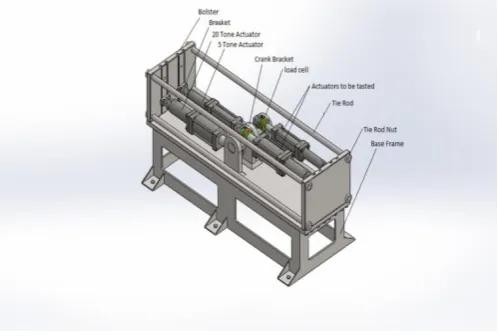
Fig. 1.1 Flight control Actuator Test Loading Rig. There shall be two independent loading actuators of 5 tonne and 20 tonne capacities, two parallel sliding
channels to independently cater to test actuators requiring different stall loads. The hydraulic power pack shall fulfill the load and actuator rate requirement.
In the test loading rig the servo actuators are placed at the bottom sides and the actuators to be tasted i.e. flight control actuators are placed at the upper side. The servo actuators and flight control actuators are connected each other with the help of crank and bracket assembly. The required pressure is applied to the servo actuators with the help of power pack and the same opposite pressure is applied to the flight control actuators with the help of another power pack. The type of load acting on the rig is completely reversible. The operating frequency of the test loading rig is 25Hz. The analysis and calculations are to be carried out for this operating frequency.
2. COMPONENTS OF TEST LOADING RIG
2.1 Bolster
Fig. 2.1 Bolster
© 2015, IRJET.NET- All Rights Reserved
Page 1443
Table 2.1 Details of BolsterSL. NO.
NAME MATERIAL SIZE WEIGHT QTY
1. Bolster Structural Steel 800mm x 600mm x 65mm
215.3 Kg
02 Nos.
2.2 Base Frame
Fig. 2.2 Base Frame
Most of the test rigs are mounted on Base frames. Actuators, Bolsters, crank brackets are mounted on the base frame to carry its weight, to maintain its alignment and to assist in carrying the dynamic loads which every actuator generates. Test rig base frame needs an effective design technology to ensure that the base frame as designed performs the required functions, and maintains its integrity. There is also a need to maximize the life of the test rig base frame under the loads to which it is exposed.
2.3 Bracket
Fig. 2.3 Bracket
The test loading rig has the eight numbers of brackets. The bracket pins are placed in the each bracket. The both the ends of the actuators are connected to the bracket. Bolsters are connected to the crank with the help of M20 cap screws and connected to the bolster with the help of M20 bolts.
2.4 Rig Tie Rod
Fig. 2.4 Rig Tie Rod
In this test loading rig the four tie rods are used. Bolsters are connected at both the ends of tie rod.
Table 2.2 Details of Rig Tie Rod
SL.
NO. NAME MATERIAL SIZE WEIGHT QTY
1. Rig Tie Rod EN 8
Ø60m m × length 2869m
m
61.9 Kg Nos. 04
3. DESIGN CALCULATION
3.1
Actuator’s Longitudinal Stiffness And
Damping Factor
Here we are going to use two single acting cylinders. One is the capacity of 5 tonnes and another is the capacity of 20 tonnes.
i. 20 Tonne Actuator
Fig. 3.1 20 Tonne Actuator Given data:-
© 2015, IRJET.NET- All Rights Reserved
Page 1444
Inner diameter of Piston (d) = 100 mmLength of Cylinder (L) = 290 mm
Longitudinal Stiffness (K) of cylinder is given by
(1)
Where β = Bulk Modulus of oil =107.45 Bar
A = Area of piston= 12252.2 mm
V = Volume of Cylinder = 3553138 mm3
K= 181587 N/mm (2)
Longitudinal Damping (C) of cylinder is given by
(3)
The hydraulic oil of grade Servo 68 is used in the actuators.
Where = Density of Oil = 890 kg/m3
= Kinematic viscosity of oil = 3.25x10⁻⁴ m2/s
D = Diameter of Cylinder = 160 mm
δ =Difference between piston & cylinder=0.025 mm
l = Length of piston = 60 mm
C = 349 N-S/mm
(4)
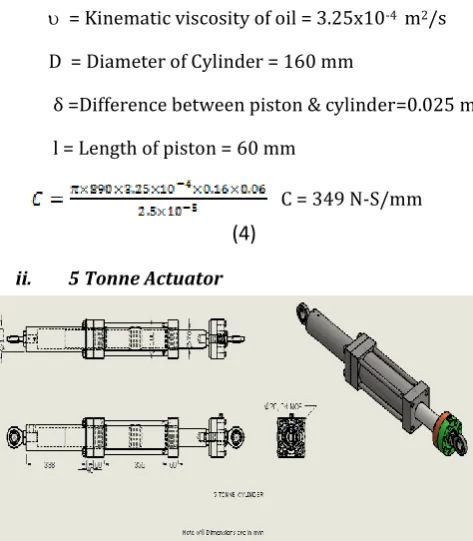
ii. 5 Tonne Actuator
Fig. 3.2 5 Tonne Actuator Given data:-
Let Outer diameter of Piston (D) = 100 mm
Inner diameter of Piston (d) = 70 mm
Length of Cylinder (L) = 290 mm
Longitudinal Stiffness (K) of cylinder is given by
Where β = Bulk Modulus of oil =107.45 Bar
A = Area of piston= 4005.5 mm
V = Volume of Cylinder = 161603.88 mm3
K= 59611 N/mm
Longitudinal Damping (C) of cylinder is given by
The hydraulic oil of grade Servo 68 is used in the actuators.
Where = Density of Oil = 890 kg/m3
= Kinematic viscosity of oil = 3.25x10⁻⁴ m2/s
D = Diameter of Cylinder = 160 mm
δ=Difference between piston & cylinder= 0.025 mm
l = Length of piston = 60 mm
C = 218 N-S/mm
3.2 Life Cycle
i. Structural Steel
Design endurance limit is given by
(8)
Where Ksr= surface factor=1
= size factor=0.8
= load factor=1
= reliability factor=0.897 for 90% of reliability
= temperature factor=1 for T≤450oC
= endurance limit of the test specimen=200MPa
σse
143.52 N/mm2
© 2015, IRJET.NET- All Rights Reserved
Page 1445
a) Since the endurance limit of the entire component i.e.132.46 N/mm2 is very less than the endurance limit of
structural steel i.e. 200 N/mm2. Hence the lives of all the
components are infinite.
ii.EN8
Design endurance limit is given by
Where = surface factor=1
= size factor=0.8
= load factor=1
= reliability factor=0.897 for 90% of reliability
= temperature factor=1 for T≤450oC
= endurance limit of the test specimen=270MPa
σse
193.77 N/mm2
Results obtained:-
a) Since the endurance limit of the rig tie rod i.e. 193.77 N/mm2 is less than the endurance limit of EN8 i.e. 270
N/mm2. Hence the life of the rig tie rod is infinite.
4. ANALYSIS BY ANSYS
The ANSYS program is used to carry out the Static, Modal and harmonic response of the test loading rig. For our project we have used ANSYS WORK BENCH 14 for FEA analysis of the machine elements.
4.1 Modal Analysis
A system with N degrees of freedom has N natural frequencies of free vibration and N mode shapes of free vibration, one associated with each natural frequency. The following figure shows the mode shapes of the test loading rig.
Fig.4.1 First mode Shape“
Fig.4.2 Second mode Shape“
Fig.4.3 Third mode Shape
Fig.4.4 Fourth mode Shape
© 2015, IRJET.NET- All Rights Reserved
Page 1446
Fig.4.6 Sixth mode ShapeTable 4.1 Details of mode shape MODAL ANALYSIS
MODE NO. DEFORMATION (mm) FREQUENCY (Hz)
1. 4.4415 34.558
2. 4.2247 35.051
3. 4.4932 35.632
4. 4.5155 35.737
5. 4.2904 36.148
6. 4.4693 36.209
Results obtained:-
a) The first mode of the modal analysis has the natural frequency of 34.558 Hz and it goes on increases as the number of mode shapes increases. The natural frequency of first mode shape i.e. 34.558 Hz is higher than the working frequency of the system i.e. 25Hz. Hence the design is safe.
4.7 Harmonic Response Analysis Of Test Loading
Rig
Harmonic response is continuous periodic response in the whole system caused by mechanical load. Here, the ANSYS method is used for harmonic response analysis, namely, the responses in the structure are determined in different frequencies, responses are found in corresponding frequency curve, peak values in the curves are observed.
Fig 4.12 Von-mises stress in Test loading Rig at 25Hz Results obtained:-
a) Maximum Stress in the Test Loading Rig = 52.597N/mm2
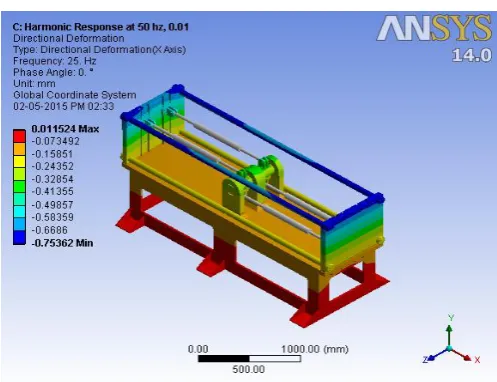
Fig 9.13 Directional Deformation of Test Loading Rig at 25Hz
Results obtained:-
a) Maximum Deformation in the Test Loading Rig =0.011524mm
4.8 Structural Stiffness
Total load acting on the system P=25 tonne
Maximum deflection of the system δ= 0.011524mm
Structural stiffness =
© 2015, IRJET.NET- All Rights Reserved
Page 1447
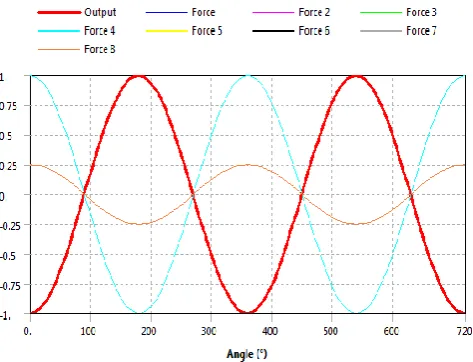
i. Phase Diagram For Applied ForcesFig 9.14 Phase diagram of for applied forces The Fig. 9.14 shows the phase diagram of test loading rig for applied forces. Phase Response plots show a response over a range of phase angles, so you can determine how much a response lags behind the applied load. There are two types of forces are acting on the loading rig i.e. 20 tonne and 5 tonne. Both the forces are acting in a sine wave manner. However, unlike Frequency Response plots that shows response amplitude over a frequency range.
5.
RESULTS AND DISCUSSION
The following results have been obtained by ANSYS and theoretical calculations for different parts and the results are compared.
Table 5.1 Stress and deflection results
Component stress of the material. The material is safe.
The table below shows the buckling results for rig tie rod.
Table 5.2 Buckling results
Component Critical buckling load in
Tonne
Load acting on the component in Tonne
Rig Tie rods in
compression 62.20 12.5
Since the actual loads acting on the tie rod is very less than the critical loads, hence this component will not buckle.
6.
CONCLUSION
i. Life cycle of the test loading rig infinite i.e. greater than 20 Million Cycles.
ii. The structural stiffness of test loading rig is 245.28x10⁵ N/mm i.e. Greater than 200x10⁵ N/mm.
iii. The stresses induced in all the components of test loading rig within the value of working stress i.e. 125 N/mm2. Hence the component does not
undergo yielding.
iv. Directional deformation of test loading rig i.e.0.011524mm, less than 0.05mm.
v. The buckling analysis is done for the tie rods in compression. The critical load in tie rod is much less than the actual load acting on this component, hence buckling will not occur.
REFERENCES
[1] Structural behavior of large-scale triangular and trapezoidal threaded steel tie rods in assembly using finite element analysis by Wei Duan and Suraj Joshi.
[2] Project report on Static and dynamic analysis of spur gear by B. Harish Reddy and G. Shiv kumar.
[3] Design of steel structure by Prof, S. R.Satish Kumar and Prof. A. R. Santha Kumar.
[4] Design And Standardization Of Base Frame & Ant Vibration Mounts For Balanced Opposed Piston Air Compressor by KISHOR D. JADHAV & MANEET.R.DHANVIJAY
© 2015, IRJET.NET- All Rights Reserved
Page 1448
[6] Design of Machine Elements- I by J.B.K Das and P.L,Srinivasa Murthy.
[7] Machine Design Data Hand Book by Dr. K. Lingaiah and Prof. B. R. Narayana Iyengar, Fourth addition(Volume I).
[8] Magnetic field analysis of a VCM spherical actuator by HyoYoung Kim, HyunChang Kim, DaeGab Gweon
[9] Dynamic structural analysis of a fast shutter with a pneumatic actuator by A. Nemov, A. Panin, A. Borovkov, M. Khovayko, E. Zhuravskaya, Yu. Krasikov, W. Bielb, O. Neubauer.
BIOGRAPHIES
Mr. ANIL SURENDRA KHOT is currently M.Tech student (Machine Design), Dept. of Mechanical Engineering in KLS’s Gogte Institute of Technology, Belagavi, Karanataka, India.