
R E S E A R C H
Open Access
A fractional-order Legendre collocation
method for solving the Bagley-Torvik
equations
Fakhrodin Mohammadi
1*and Syed Tauseef Mohyud-Din
2*Correspondence:
[email protected] 1Department of Mathematics,
University of Hormozgan, P.O. Box 3995, Bandarabbas, Iran Full list of author information is available at the end of the article
Abstract
In this article, a numerical method based on the fractional-order shifted Legendre polynomials (FSLPs) and their operational matrix of fractional integration is
introduced for solving the fractional Bagley-Torvik equations. The main advantage of the presented method is that it can reduce a solution of the initial and boundary value problems for the fractional Bagley-Torvik differential equations to a system of algebraic equations. In order to confirm the efficiency and superiority of the presented method, some numerical examples are provided and a comparison is presented between the obtained results and those results achieved from other existing methods in the literature.
MSC: 26A33; 34A08; 65N35
Keywords: Bagley-Torvik equations; Riemann-Liouville fractional integration; fractional-order Legendre polynomials; operational matrix; collocation method
1 Introduction
Fractional calculus, the theory of differentiation and integration to non-integer order, is very useful for the description of various physical phenomena, such as damping laws, diffusion process, etc. Fractional derivatives provide an excellent instrument for the de-scription of memory and hereditary properties of various materials and processes [–]. Especially, fractional differential equations provide outstanding tools for illustration of many engineering and physical problems. Since most fractional differential equations do not have exact and analytic solutions, the accurate numerical techniques for solving these fractional equations are a challenging and motivational research area in mathematics and engineering.
The fractional Bagley-Torvik equation was originally formulated in a description of a real material by the use of fractional calculus. Moreover, the Bagley-Torvik equation has appeared in simulating the motion of a rigid plate immersed in a Newtonian fluid [–]. This equation has been studied both analytically and numerically in []. Diethelm [] transformed this equation into a system of fractional differential equation and solved the problem with the Adams predictor and the corrector method. Recently, considerable at-tention has been devoted to numerical solutions of the fractional Bagley-Torvik equation. For example the spectral tau method [, ], the operational formulation of collocation
methods [, ], collocation methods [–], wavelet methods [, ], pseudospectral methods [], differential transform methods [], hybrid functions methods [], and fractional Taylor methods [] have been used to solve this fractional differential equa-tion. In this study, a fractional-order Legendre collocation method is proposed for solving the Bagley-Torvik equations.
Applications of orthogonal functions and polynomials for numerical solution of ordi-nary differential equations refer, at least, to the time of Lanczos []. Moreover, the origin of some current spectral method, such as the Galerkin, tau, and pseudospectral methods can be found in the ‘weighted residual method’ of Finlayson and Scriven []. Nowadays, spectral methods are efficient techniques for solving a different kind of fractional differ-ential and integral equations accurately [, , , ]. The main advantage of spectral methods lies in their accuracy for a given number of unknowns. For smooth problems in simple geometries, they offer exponential rates of convergence (spectral accuracy). By us-ing the operational matrices for basis functions, spectral methods reduce the solution of fractional differential and integral equations into a solution of systems of algebraic equa-tions which produce highly accurate soluequa-tions for these equaequa-tions [, , , ].
This paper is structured as follows: In Section some basic preliminaries of the frac-tional calculus are presented. The FSLPs and their properties are introduced in Section . Section is devoted to an operational matrix of fractional integration for the FSLPs. Ap-plication of the FSLPs for solving the Bagley-Torvik equation is considered in Section . Convergence and an error estimate for the FSLPs expansion are given in Section . The efficiency and superiority of the proposed method is demonstrated by considering some numerical examples in Section . Finally, a conclusion is given in Section .
2 Preliminaries
In this section we review some basic definitions and preliminaries of the fractional calculus which are used in the next sections.
2.1 Fractional calculus
Fractional-order calculus is a branch of calculus which deals with integration and differen-tiation operators of non-integer order. Among the several formulations of the generalized derivative, the Riemann-Liouville and Caputo definition are most commonly used, which can be described as follows [].
Definition A real functionf(t),t> , is said to be in the spaceCμ,μ∈Rif there exist
a real numberp>μand a functionf(t)∈C[,∞) such thatf(t) =tpf(t), and it is said to
be in the spaceCn
μ,n∈Niff(n)∈Cμ.
Definition The Riemann-Liouville fractional integration of orderν≥ of a function
f ∈Cμ,μ≥–, is defined as
Jν
f(t) =
(ν)
t
(t–τ)
ν–f(τ)dτ, ν> ,
f(t), ν= .
The Riemann-Liouville fractional operatorJνhas the following properties:
JνJνf(t)=JνJνf(t), ν
JνJνf(t)=Jν+νf(t), ν
,ν≥,
Jνtλ= (λ+ ) (λ+ν+ )t
ν+λ, ν≥,λ> –.
Definition The fractional derivative of orderν> in the Caputo sense is defined as
Dν
erties of the Caputo fractional operatorsDνare given by the following expressions:
Jν
For more details of fractional calculus and their applications please refer to [–].
3 The FSLPs and their properties
The FSLPs can be defined based on the definition of the shifted Legendre polynomials by introducing the change of variablet=xαforα> []. LetP
n(x) is thenth shifted Leg-endre polynomial andP(n,α)(x) denote thenth FSLPs,i.e. Pn(xα). By using the recurrence formula for the shifted Legendre polynomials, it can be given as
Any functionf(t) defined over [, ] may be expanded in terms of FSLPs as
in which theckare derived by
ck=α(k+ )
P(m,α)(x)P(n,α)(x)wα(x)dx.
If the infinite series in equation () is truncated, then it can be written as
f(x)fM(x) =
4 Operational matrix of fractional integration of FSLPs
In recent years various operational matrices for the polynomials have been developed to cover the numerical solution of differential, integral and integro-differential equations. The main advantage of these operational matrices is that they replace differential and in-tegral operators with some matrices. Consequently, they reduce such problems to those of solving a system of algebraic equations, greatly simplifying the problem [–]. In this section the operational matrix of fractional integration for FSLPs will be derived.
Theorem . The Riemann-Liouville fractional integration of orderνfor the M×FSLPs vectorα(x)can be defined as
Now the termxαris expanded exactly by FSLPs as
xαr= M–
j=
in which theρr,scan be derived as
By substituting equations () and () in () we have
Jν
this means that the fractional integration ofith element ofα(x) can be expanded in FSLPs
as derived in equation () and this yields the desired result directly.
5 Numerical solution of Bagley-Torvik equations The fractional Bagley-Torvik equation is of the form
ADy(x) +ADνy(x) +Ay(x) =f(x), ≤x≤R, <ν< , ()
subject to the initial conditions
y() =α, y() =α, ()
or the boundary conditions
y() =β, y(R) =β, ()
whereA,A,A,α,α,β, andβare constants withA= . To solve this fractional
Bagley-Torvik equation we consider two cases.
Case () Intitial conditions: For solving the Bagley-Torvik equation () with intitial con-ditions (), we use the change of variablet=xRto transformx∈[,R] int∈[, ]. So, we
subject to the initial conditions
Y() =α, Y() =Rα, ()
in whichY(t) =y(Rt) andF(t) =f(Rt). Now, we approximate the functionsY(t) andF(t) in terms of FSLPs as
where Cis an unknownM× vector. Substituting equation () in equation () and applying the Riemann-Liouville integral operatorJwe get
A
by using the operational matrix of fractional integrationM(ν)we have
A
Now we collocate the equation () at theMzeros of the shifted Legendre polynomial
PM(x). This generates a system ofMalgebraic equations for the unknown vectorC. After finding the solution of this algebraic system, the solutionY(t) can be derived by substitut-ing the vectorCin equation ().
Case () Boundary conditions: To solve the Bagley-Torvik equation () with boundary conditions (), similar to the previous case, by using the change of variablet=xRwe obtain
A
substituting the approximation functionsY(t) andF(t) defined in equation () into equa-tion () and using the operaequa-tional matrix of fracequa-tional integraequa-tionM(ν)we get
A at theMzeros of the shifted Legendre polynomialPM(x) and this gives a system ofM algebraic equations for the unknown vectorC. Moreover, the boundary conditiony(R) =
Y() =βgive a linear equation. This equation together withMalgebraic equations derived
6 Error analysis
In this section, in order to demonstrate the efficiency of the proposed FSLPs method, we have given some theorems on convergence and error estimation. The next theorem gives an upper bound for the error function of the truncated FSLPs series.
Theorem . Let f(x)be a defined function on[, ] and g(x) =f(xα)∈Cn+[, ],the
mean error bound for the truncated FSLPs series fM(x) =
M–
M– which approximatesf(x) with minimum mean error, so
f–fM α=
in which Qn(x) is the well-known polynomial interpolation for g(t) at shifted zeros of Chebyshev polynomials in the interval [, ]. Now by using an error bound of the poly-nomial interpolationQn(t) (Theorem . in []) we have
taking the square root of both sides completes the proof.
Now, we give the error estimation of the numerical method given in the previous section. Supposey(x) is the exact solution of () andyM(x) is the approximate solution fory(x). Here, we introduce a process for estimating the error of the approximate solution,i.e. eM(x) =y(x) –yM(x). Consider the perturbation functionRM(x), depending only on the approximate solutionyM(x) as
RM(x) =ADy(x) +ADνy(x) +Ay(x) –f(x), ()
subtracting () from () we obtain
ADeM(x) +ADνeM(x) +AeM(x) =RM(x), ()
these Bagley-Torvik equations with initial conditionseM() = ,eM() = or boundary conditions eM() = ,eM(R) = can be solved by using the proposed FSLPs method as given in previous section for this system to find an approximation of the error function
7 Numerical examples
In this section, the efficiency and superiority of the proposed method is demonstrated by some illustrative examples. All algorithms are performed by Maple .
Example Let us consider the Bagley-Torvik equation () with the following conditions [, , ]:
A=A=A= , ν= ., ≤x< , f(x) =x+ ,
y() = , y() = .
The exact solution of this problem is
y(x) =x+ .
The FSLPs basis and its fractional operational matrix have been applied for solving this fractional Bagley-Torvik equation. Forα= andM= the presented FSLPs collocation method results in the following linear system for the unknownsc,c, andw:
⎧ ⎪ ⎪ ⎪ ⎪ ⎪ ⎪ ⎨ ⎪ ⎪ ⎪ ⎪ ⎪ ⎪ ⎩
.w– .c+ .c
– . = ,
–.w– .c+ .c
– . = ,
c+c– = ,
in whichw=y() andy(x) =cP(,α)(x) +cP(,α)(x). Solving this linear system we obtain
c= ., c= .,
w= ..
Hence, we gety(x) = +xup to digits precision which is the exact solution.
Example In this example, we consider the Bagley-Torvik equation () with the follow-ing conditions [, , ]:
A= , A=A= , ν= ., ≤x< ,
f(x) =
√
x
√ π +t
–t, y() =y() = .
The exact solution of this problem is
y(x) =x–x.
following linear system:
Example In this example, we consider the Bagley-Torvik equation () with the follow-ing conditions [, , ]:
The exact solution of this problem is
y(x) =x–x
Similar to the previous examples the FSLPs method has been used for solving this problem. After solving the linear system derived by the presented collocation method forα= and
M= we get the following values for the unknown coefficients:
c= ., c= –.,
c= ., c= .,
c= –., c= .,
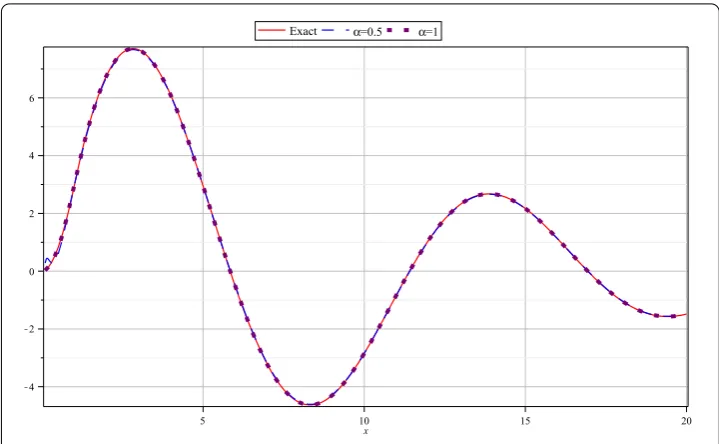
Figure 1 The exact and approximate solution forα= 0.5, 1 andM= 20.
and this results in
y(x) = .x– .x+ .x
– .x+ .x+ .×–, which is the exact solution up to digits precision.
Example In this example, we consider the Bagley-Torvik equation () with the follow-ing conditions []:
A= , A=A= , ν= ., ≤x< ,
f(x) =
√
x
√ π +x
+x, y() = , y() = .
The exact solution of this problem is
y(x) =x.
Similar to the previous examples the FSLPs method has been used for solving this problem and by solving the linear system derived by the presented collocation method forα= and
M= we get
c= ., c= .,
c= ., c= –.×–.
and this results in the solution function in the interval [, ] as
(a)
(b)
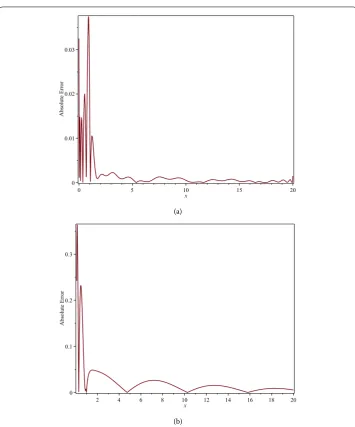
Figure 2 The absolute error of the obtained results.We took(a)α= 1 and(b)α= 0.5.
By the change of variablet=xin this function we get
.x– .–x+ .×–,
which is the exact solution up to digits precision.
Example Consider the fractional Bagley-Torvik equation () with the following con-ditions [, –]:
A= , A= ., A= ., ν= ., ≤x< ,
y() = , y() = , f(x) =
Table 1 Comparison of the numerical solution forν= 1.5,α= 0.5, 1, andM= 17 with other results in [23, 27]
t Exact FSLPs (α= 0.5) FSLPs (α= 1.0) Ref. [27] Ref. [23]
1.40625 4.85696 4.80915 4.85715 4.95531 4.67105
2.03125 6.83165 6.78579 6.85062 6.93440 6.48436
2.96875 7.67925 7.64470 7.67261 7.80605 7.21918
3.59375 6.97278 6.94967 6.98356 7.09830 6.51938
4.21875 5.48313 5.47278 5.48883 5.59310 5.09093
5.46875 1.28657 1.29947 1.28343 1.33675 1.11881
7.96875 –4.53369 –4.50974 –4.53926 –4.59731 –4.30082
9.53125 –3.64404 –3.63542 –3.64279 –3.71142 –3.40603
11.7188 0.59143 0.57883 0.59421 0.58569 0.61398
13.5938 2.64127 2.62760 2.63996 2.67926 2.51628
15.4688 1.72175 1.71945 1.72207 1.75636 1.60585
16.4063 0.63025 0.63383 0.62882 0.64944 0.56273
17.3438 –0.44428 –0.43668 –0.44270 –0.44298 –0.45529
18.9063 –1.50186 –1.49344 –1.49966 –1.52298 –1.44138
19.8438 –1.52304 –1.51713 –1.518921 –1.54859 –1.44734
The exact solution of equation is given by
y(x) =
The proposed FSLPs collocation method is implemented for solving this fractional Bagley-Torvik equation. Figure shows the exact and approximate solution forα= ., andM= . The absolute errors for the obtained numerical solutions withα= . andα= are plotted in Figure . Moreover, a comparison between the results achieved by the proposed FSLPs method withM= and other methods in Refs. [, ] is presented in Table . From Table we can immediately see that the FSLPs method, in comparison to other existing methods, is more efficient and accurate.
8 Discussion and conclusion
A new type of orthonormal fractional-order Legendre polynomials is defined. The oper-ational matrix of fractional integration for this fractional-order basis is derived. By using this fractional operational matrix and collocation method a numerical method is proposed for solving the fractional Bagley-Torvik equations. A comparison is made between nu-merical results derived by the presented collocation method and other existing nunu-merical method. According to the numerical results, we can conclude that the presented method is more accurate and effective for a numerical solution of the fractional Bagley-Torvik equations.
Competing interests
Authors’ contributions
All authors participated in drafting, revising, and commenting on the manuscript. Also, all authors read and approved the final draft of the manuscript.
Author details
1Department of Mathematics, University of Hormozgan, P.O. Box 3995, Bandarabbas, Iran.2Department of Mathematics,
HITEC University, Taxila Cantt, Pakistan.
Acknowledgements
We express our sincere thanks to the anonymous referees for valuable suggestions that improved the final manuscript.
Received: 5 September 2016 Accepted: 7 October 2016 References
1. Kilbas, AA, Srivastava, HM, Trujillo, JJ: Theory and Applications of Fractional Differential Equations. Elsevier, San Diego (2006)
2. Oldham, KB, Spanier, J: The Fractional Calculus. Academic Press, New York (1974) 3. Podlubny, I: Fractional Differential Equations. Academic Press, San Diego (1999)
4. Golmankhaneh, AK, Golmankhaneh, AK, Baleanu, D: On nonlinear fractional Klein-Gordon equation. Signal Process.
91(3), 446-451 (2011)
5. Baleanu, D, Golmankhaneh, AK, Golmankhaneh, AK: Solving of the fractional non-linear and linear Schrödinger equations by homotopy perturbation method. Rom. J. Phys.54(10), 823-832 (2009)
6. Bhrawy, AH, Zaky, MA, Baleanu, D: New numerical approximations for space-time fractional Burgers’ equations via a Legendre spectral-collocation method. Rom. Rep. Phys.67, 340-349 (2015)
7. Bhrawy, AH, Baleanu, D: A spectral Legendre-Gauss-Lobatto collocation method for a space-fractional advection diffusion equations with variable coefficients. Rep. Math. Phys.72, 219-233 (2013)
8. Bhrawy, AH: A new spectral algorithm for a time-space fractional partial differential equations with subdiffusion and super diffusion. Proc. Rom. Acad., Ser. A : Math. Phys. Tech. Sci. Inf. Sci.17, 39-46 (2016)
9. Bhrawy, AH: A Jacobi spectral collocation method for solving multi-dimensional nonlinear fractional sub-diffusion equations. Numer. Algorithms73, 91-113 (2016)
10. Kazem, S, Abbasbandy, S, Kumar, S: Fractional-order Legendre functions for solving fractional-order differential equations. Appl. Math. Model.37(7), 5498-5510 (2013)
11. Torvik, PJ, Bagley, RL: On the appearance of the fractional derivative in the behavior of real materials. J. Appl. Mech.
51, 294-298 (1984)
12. Bagley, RL, Torvik, PJ: A theoretical basis for the application of fractional calculus to viscoelasticity. J. Rheol.27(3), 201-210 (1983)
13. Yan, T, Luo, S: Local polynomial smoother for solving Bagley-Torvik fractional differential equations.Preprints
2016080231 (2016). doi:10.20944/preprints201608.0231.v1
14. Diethelm, K, Ford, J: Numerical solution of the Bagley-Torvik equation. BIT Numer. Math.42(3), 490-507 (2002) 15. Baleanu, D, Bhrawy, AH, Taha, TM: Two efficient generalized Laguerre spectral algorithms for fractional initial value
problems. Abstr. Appl. Anal.2013, Article ID 546502 (2013)
16. Bhrawy, AH, Hafez, RM, Alzahrani, EO, Baleanu, D, Alzahrani, AA: Generalized Laguerre-Gauss-Radau scheme for the first order hyperbolic equations in a semi-infinite domain. Rom. J. Phys.60, 918-934 (2015)
17. Bhrawy, AH, Taha, TM, Alzahrani, EO, Baleanu, D, Alzahrani, AA: New operational matrices for solving fractional differential equations on the half-line. PLoS ONE10(9), e0138280 (2015). doi:10.1371/journal.pone.0126620 18. Bhrawy, AH, Abdelkawy, MA, Alzahrani, AA, Baleanu, D, Alzahrani, EO: A Chebyshev-Laguerre Gauss-Radau
collocation scheme for solving time fractional sub-diffusion equation on a semi-infinite domain. Proc. Rom. Acad., Ser. A : Math. Phys. Tech. Sci. Inf. Sci.16, 490-498 (2015)
19. Cenesiz, Y, Keskin, Y, Kurnaz, A: The solution of the Bagley-Torvik equation with the generalized Taylor collocation method. J. Franklin Inst.347(2), 452-466 (2010)
20. Yuzbasi, S: Numerical solution of the Bagley-Torvik equation by the Bessel collocation method. Math. Methods Appl. Sci.36(3), 300-312 (2013)
21. El-Gamel, M, El-Hady, AM: Numerical solution of the Bagley-Torvik equation by Legendre-collocation method. SeMA J. (2016). doi:10.1007/s40324-016-0089-6
22. Mohammadi, F: Numerical solution of Bagley-Torvik equation using Chebyshev wavelet operational matrix of fractional derivative. Int. J. Adv. Appl. Math. Mech.2(1), 83-91 (2014)
23. Ray, SS: On Haar wavelet operational matrix of general order and its application for the numerical solution of fractional Bagley-Torvik equation. Appl. Math. Comput.218(9), 5239-5248 (2012)
24. Esmaeili, S, Shamsi, M: A pseudo-spectral scheme for the approximate solution of a family of fractional differential equations. Commun. Nonlinear Sci. Numer. Simul.16, 3646-3654 (2011)
25. Arikoglu, A, Ozkol, AI: Solution of fractional differential equations by using differential transform method. Chaos Solitons Fractals34, 1473-1481 (2007)
26. Mashayekhi, S, Razzaghi, M: Numerical solution of the fractional Bagley-Torvik equation by using hybrid functions approximation. Math. Methods Appl. Sci.39(3), 353-365 (2016)
27. Krishnasamy, VS, Razzaghi, M: The numerical solution of the Bagley-Torvik equation with fractional Taylor method. J. Comput. Nonlinear Dyn.11(5), 051010 (2016)
28. Lanczos, C: Trigonometric interpolation of empirical and analytical functions. J. Math. Phys.17, 123-129 (1938) 29. Finlayson, A, Scriven, LE: The method of weighted residuals: a review. Appl. Mech. Rev.19, 735-748 (1966) 30. Doha, EH, Bhrawy, AH, Ezz-Eldien, SS: A Chebyshev spectral method based on operational matrix for initial and
boundary value problems of fractional order. Comput. Math. Appl.62(5), 2364-2373 (2011)
32. Ezz-Eldien, SS, Hafez, RM, Bhrawy, AH, Baleanu, D, El-Kalaawy, AA: New numerical approach for fractional variational problems using shifted Legendre orthonormal polynomials. J. Optim. Theory Appl. (2016).
doi:10.1007/s10957-016-0886-1
33. Saadatmandi, A: Bernstein operational matrix of fractional derivatives and its applications. Appl. Math. Model.38, 1365-1372 (2014)
34. Saadatmandi, A, Dehghan, M: A new operational matrix for solving fractional-order differential equations. Comput. Math. Appl.59(3), 1326-1336 (2010)
35. Bhrawy, AH, Alofi, AS: The operational matrix of fractional integration for shifted Chebyshev polynomials. Appl. Math. Lett.26, 25-31 (2013)
36. Doha, EH, Bhrawy, AH, Ezz-Eldien, SS: A new Jacobi operational matrix: an application for solving fractional differential equations. Appl. Math. Model.36, 4931-4943 (2012)
37. Doha, EH, Bhrawy, AH, Ezz-Eldien, SS: A Chebyshev spectral method based on operational matrix for initial and boundary value problems of fractional order. Comput. Math. Appl.62, 2364-2373 (2011)
38. Bhrawy, AH, Zaky, MA: Shifted fractional-order Jacobi orthogonal functions: application to a system of fractional differential equations. Appl. Math. Model.40, 832-845 (2016)
![Table 1 Comparison of the numerical solution for ν = 1.5, α = 0.5,1, and M = 17 with otherresults in [23, 27]](https://thumb-us.123doks.com/thumbv2/123dok_us/972157.1119443/12.595.117.477.107.277/table-comparison-numerical-solution-n-a-m-otherresults.webp)
