University of East London Institutional Repository: http://roar.uel.ac.uk
This paper is made available online in accordance with publisher policies. Please scroll down to view the document itself. Please refer to the repository record for this item and our policy information available from the repository home page for further information.
Author(s): Chandler, Alan; Keable, Rowland
Title: Achieving carbon neutral structures through pure tension: using a fabric formwork to construct rammed earth columns and walls
Year of publication: 2009
Citation: Chandler, A and Keable, R. (2009) ‘Achieving carbon neutral structures through pure tension: using a fabric formwork to construct rammed earth columns and walls’Proceedings of the 11th International Conference on Non-conventional Materials and Technologies (NOCMAT2009) 6-9 September 2009, Bath, UK Link to published version:
Proceedings of the 11th International Conference on
Non-conventional Materials and Technologies (NOCMAT2009) 6-9 September 2009, Bath, UK
ACHIEVING CARBON NEUTRAL STRUCTURES THROUGH
PURE TENSION: USING A FABRIC FORMWORK TO
CONSTRUCT RAMMED EARTH COLUMNS AND WALLS
Alan Chandler
1, Rowland Keable
21
Head of Technology, University of East London Architecture Programme
2
Director of Ramcast CIC
Abstract: The use of fabric to re-think conventional compressive containment for rammed earth allows the making of compressive structures through tensile means, saving weight, materials costs, and the importation of technology into ‘developing world’ situations. Fabric formwork achieves a permanent architecture that is defined with the most portable of tools.
The need to develop a system that is tested and approved in the ‘developed West’ is important as a way of challenging the current stranglehold that the use of cement has on developing nations. To obtain mortgage loans in many situations cement use is a
prerequisite by local funders, from urban situations in Botswana to dam relocation
programmes in the Punjab, where for example displaced villages are required to build with imported concrete where earthen structures could provide secure and simple architecture that can be self built and affordable. If ‘Western’ methods are available for self-builders, then the perception of earth as ‘poor’ material can be questioned, with a chance that the cement dependent status quo can be challenged.
The research programme at the University of East London School of Architecture and the Visual Arts led by Chandler and Keable has developed over 5 years a series of
refinements to lighter weight, robust systems for rammed earth construction. This work has received a £10,000 grant to develop the research as a ‘Fabric earthform’ product, but also as a non-profit programme for Southern African states to promote the development of local variants of fabric formed rammed earth construction.
Keywords: Fabric formwork; rammed earth; carbon neutral construction
1
Senior Lecturer, [email protected] 2
1 Innovation Transfer:
The last 50 years has seen sporadic experimentation with flexible formwork for concrete, initiated by Felix Candela in Mexico to construct 2 way anticlastic arches linked as a single hangar structure for a restricted economy primary school. Through innovations by Miguel Fisac, Mark West and Kenzo Unno, Chandler and Pedreschi, a language of tensile concrete casting is being developed.
1.1 Principles of textiles in formwork:
Natural structures are fundamentally different from our constructions by virtue of the fact that they are self-assembling (they grow). The geometry produced by the wet concrete + fabric container system does not, of course, ‘grow’ in any real sense, but it can be said to ‘self-assemble’ its final geometric form by ‘finding’ the precise geometries demanded of it by gravity and the laws of nature (Mark West, excerpt from Global Holcim awards
competition entry 2005-6). Hydrostatic pressure of the material within the form works against the fabric shutter to induce pure geometric responses between restraints or fixed points/edges. The play of compressive restraint and tensile surface creates a form of tensegrity structure, within which the cast material is half of the balancing equation. Tensile restraint is inherently lighter and more energy efficient than compressive restraint allowing lighter forms but also flexible geometries, and with water permeable fabrics this leads to higher strength and defect free surfaces.
The fabric used in the UEL research is an engineered polypropylene weave with a range of specifiable water permeability (approximately 160 litres per metre square per minute for the UEL research). For concrete casting this permeability is useful to leach excess water and entrapped air, delivering a concrete with low excess water content at the point of cure. The resultant 'sweating' allows for a migration of cement fines and sand dust to the inner surface of the textile, giving the concrete enhanced definition and strength at the face of the cast with a quality almost unachievable with rigid formwork.
The shuttering fabric has the inherent properties of high tear resistance and elasticity, with a tensile strength of between 9 and 33 kN, and more importantly an elongation capacity of between 15%-28% in both warp and weft (relevant standard ISO 10319), which allows the fabric to respond three dimensionally to the significant
hydrostatic pressure of the cast material. The geometry of the textile is utilised
orthogonally with lateral fibres acting in tension. The vertical fibres of the weave act as a jig themselves to restrain the lateral threads in place. The tear resistance allows for simple bolt through fixings without the risk of the openings in the fabric spreading under load. One of the many details developed by Mark West involves using a marlinspike to force apart the weave, allowing the insertion of fixings through the material. The weave thus remains unbroken, allowing it to retain its integrity and be fully re-usable. The use of a UV inhibitor in manufacture allows for multiple re-use of the same fabric, which retails in the region of 1 euro per square metre, weighing between 80 – 200 grams per square metre.
The degree of expansion required dictates the placement of the restraints. The placement of connecting ties is therefore not simply a technical decision, relating to the fixity of the forms under load, nor purely aesthetic, to do with the pattern making of bolt holes within a surface, rather a combination of the two. The development of a coherent language of detail directly from the process of construction and physical laws is an
essential starting point for both architectural expression, and for a simplicity that makes it easy to communicate and disseminate to others - why build a solid wall by building two wooden ones first? Interestingly, the apparently fundamental oppositions of tensile / compressive, heavyweight / lightweight, surface / mass, prescribed technique / infinite variety become not oppositions when using fabric, but logical aspects of the same activity.
This line of research into concrete formwork being replaced by fabric formwork clearly originates in a desire to achieve an economy of means in the making of structural casting. There is a belief that architectural innovation is not achieved through disinterested
production. Form is often the result of simple thinking, and not through inevitable physical constraints, with uncritical custom often disguising an insanity of technique and
wastefulness of materials and resources. This is particularly true in the adoption of Western construction practice by developing nations across the globe. By using an alternative logic, the construction process can become simpler, cheaper, more democratic, at the same time as becoming more sensual, individual and provocative. If this line of argument is applied to the use of concrete itself, then the logical focus of the research shifts from the use of high embodied energy, high carbon material such as concrete towards material which has greater capacity for re-use, is cheaper and readily available without transportation, and is carbon neutral. Within one year of casting the first Concrete prototype at UEL, fabric formwork was employed in constructing a structural rammed earth wall.
The issue of embodied Energy in all cement products is both well understood and confusing. It is well understood that figures for cement and clinker production are published each year in the U.S. Geological Survey Yearbook. These figures are given in tonnes, broken down by continent and country, and with annual totals. These are not contentious figures in that they relate to a saleable commodity. Meanwhile, the Intergovernmental Panel on Climate Change (IPCC) Working Group II uses the figure of 1.25 tonnes of carbon dioxide per tonne of cement produced. By using these two set of figures it is then possible to track the changes in annual global emissions from cement production since the Kyoto start year, 1990. Over that period cement production, and its associated emissions have doubled.
What is confusing is the very low level of response from both regulators and industry in dealing with this issue. It is amazing that replacement materials, even though many are available, receive little or no incentives either in terms of research or production. To put this into a different context, and one which receives a wide degree of public debate and
2 Affordable innovation:
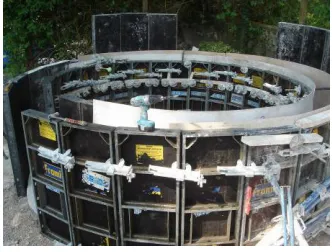
Ironically, the advantages of fabric over conventional rigid concrete shuttering also applies to the construction of rammed earth walls and columns. Conventional rammed earth formwork is fundamentally a re-use of standard concrete forms. With up to 80 kNm2 capacity, these steel framing systems or bespoke timber/ply panel constructions are designed to resist the hydrostatic pressures of liquid concrete, to maintain water tight rigid containment to allow the accurate placement of steel reinforcement and withstand poker vibration. None of these attributes are relevant to earth construction. The dimensions of the system panels are varied, and can carry on average 300 uses per panel. The high quality and cost of these panels is also reflected in the weight, with steel sections generally
[image:5.612.230.396.307.433.2]requiring crane assistance for placement. With timber bespoke panels the variety and size is almost limitless, and whereas the material elements are cheaper on initial outlay, and lighter in weight than the metal systems, the labour time and associated leakage risk on a bespoke system is greater.
Figure 1: Concrete formwork for rammed chalk - Calyx visitor centre, Dover 2007 by Rowland Keable
The bolted connections in a concrete panel system are uniformly spaced and of
uniform panel separation. This gives complete predictability of the casts dimension, but by definition applies a uniform material distribution even when the actual structural capacity may vary along the length of the wall element. This structural regularity is akin to the steel I beam which through its production maintains a continuous section, despite load
concentrations occurring in the centre of the beam. The fabric formwork, through its
flexibility can accommodate variable bolt spacings, allowing for an undulation in the surface and introducing a local thickening of the wall element. This ‘self buttressing’ capability allows for a greater efficiency of material use and more importantly when using abundant material such as earth, labour time.
2.1 Fabric earth Wall One
ramming impact and performed without fault. Accessibility between the vertical grounds was restricted although the unrolling of the fabric as the ramming progressed upwards was successful. This formwork was still based on the consideration of the fabric as a shutter for concrete. Further development of an earth specific fabric language was necessary,
particularly as the bracing of the formwork was substantial and offered only 40% weight saving over a conventional ply shutter.
[image:6.612.89.543.169.343.2]
Figure 2: Fabric applied to rammed earth walls UEL 2005, images: A.Spencer, M. Viegas, D. Lellau
2.2 Fabric earth Wall Two – climbing formwork
Traditional Moroccan formwork inspired the use f fabric as a panel system capable of travelling up the wall a sit progressed, saving the need for bracing a sit built upon
registration holes left by the previous lift. Simple timber elements and rope tourniquets established a mobile system, with the simple swelling of a fabric sheet providing the corner detail.
[image:6.612.96.535.490.642.2]
The timber selection proved insufficient – hardwood rather than softwood is required to cope with the pressure even of a hand rammer, which was used for this test rather than pneumatics. However, the result and repeatability of the system was proven, with fine detail and strong compaction, a total of two lifts were completed establishing the validity of the self supporting concept. The framing of the panels was still additional load on the system weight. Further materials reduction was required for the system to be completely portable.
[image:7.612.91.537.182.332.2]
Figure 4: Climbing formwork strike and resulting earth detail, images A. Chandler
2.3 Fabric earth column
The use of fabric for concrete columns was developed by Mark West at the University of Manitoba, Canada, refined to fit within a rucksack. However when cast, bracing was required to hold the form during the pour. With the incremental nature of ramming earth – where the layer 150mm below the top surface at any given time is fully compacted, the fabric column form had the ability to ‘grow’ without bracing. Three column forms were developed and tested, the most successful used simple timber slats as vertical clamps to incrementally rise up the column just in advance of the ramming surface.
[image:7.612.252.374.506.672.2]2.4 Fabric earth wall 2
In reflecting upon the ability to ‘grow’ the formwork during the ramming process, the bolt through technique developed at UEL for a concrete form was used – with timber struts ‘borrowing’ support offered by the bolts of the lift below to set out and restrain the bolts above the ramming level. Once the ramming level has passed two bolt levels, the lowest line of bolts may be removed and added to the next layer, further minimising the kit of parts. A simple stitching detail to one end allowed the fabric containment to advance upwards as the earth was rammed. Important innovations in the type of bolt restraint allowed the formwork to be easily removed. In total, excluding the rammer the formwork weighted just over 4 kg for a two metre square panel 350 mm thick.
[image:8.612.115.514.222.369.2]
Figure 6: Earth wall system using fabric, bolts and guides 2008, images A. Chandler
[image:8.612.220.407.420.669.2]The redistribution of earth from landscape to vertical architecture with almost nothing has achieved two metre structural columns from formwork weighing less than 5 kg, the formwork for a 350 mm thick wall two metres by two metres weighed less than 10 kg.
3 Novel technology for established materials:
In summary, the research into fabric formed rammed earth has achieved a fully tensile formwork which unlike concrete formwork, exploits rammed earth’s instant setting
properties and makes external propping unnecessary. The ability to self-build strong, thermally massive and bullet proof walls has been proven through prototypes. The task of taking the research to the field is planned for late 2009.
4 Acknowledgements:
The authors wish to thank Prof. Remo Pedreschi and Dr Peter Walker for their ongoing collaboration in the development of fabric formwork and of earth construction.
5 References:
CHANDLER A. and PEDRESCHI R., 2007. Fabric Formwork. London: RIBA Publications. WALKER P, KEABLE R., MARTON J., MANIATIDIS V., 2005. Rammed Earth: Design and
Construction Guide. London: IHS BRE .
CHANDLER A. 2007. A Philosophy of Engagement. In: K. LLOYD-THOMAS. ed, 2007. Material Matters, London: Routledge, pp. 115-124.
CHANDLER A. 2004. Building Walls. In: Architectural Research Quarterly, Vol 8, Number 3-4: Cambridge: Cambridge University Press, pp 204-214.