R E S E A R C H
Open Access
Energy-efficient resource allocation for
OFDMA-based two-way relay channel with physical-layer
network coding
Min Zhou
1*, Qimei Cui
1, Mikko Valkama
2and Xiaofeng Tao
1Abstract
Physical-layer network coding (PNC) is a novel cooperative technique for two-way relay channel (TRC), where two users exchange information via intermediate relay node(s). On the other hand, the issue of green communications to reduce energy consumption has recently started to arouse much attention. This article studies the energy-efficient resource allocation problem for orthogonal frequency division multiple access (OFDMA)-based TRC with PNC. In particular, resource allocation for multi-user, multi-relay OFDMA systems is vital for the optimization of power allocation, relay selection and subcarrier assignment. By applying convex optimization techniques, an optimal resource allocation scheme is proposed to minimize total transmit power with required rates. Numerical simulations show that the proposed scheme provides diversity gain compared to the single relay network, and PNC gain relative to the TRC without PNC.
1 Introduction
Wireless relay was introduced in 3GPP-LTE-Advanced [1] for throughput enhancement and coverage extension without requiring large transmit powers. However, prac-tical relay systems typically consider half-duplex mode [2], where relay nodes cannot transmit and receive simultaneously. For the purpose of overcoming the spec-tral loss of half-duplex relay, physical-layer network cod-ing (PNC) [3-7] was proposed in two-way relay channel (TRC), where two users wanted to exchange information with each other via relay node(s).
Compared with the traditional one-way relay schemes that need four time slots to finish information exchange in TRC, network coding (NC) scheme [8] needs three time slots. PNC makes use of the additive nature of simultaneously arriving electromagnetic waves for equivalent network coding operation at physical layer. The number of required time slots of PNC is reduced to two: in the first time slot, two users transmit their sig-nals simultaneously to relay node(s); then in the second time slot, relay node(s) broadcast the processed version
of the received superimposed signal to the two users. Distinguished by the process function of relay node(s), PNC has several sub-protocols, such as denoise-and-for-ward (PNC-DNF) [3,4], decode-and-fordenoise-and-for-ward (PNC-DF) [5] and amplify-and-forward (PNC-AF) [5-7]. To the best of authors’knowledge, PNC-AF is the only protocol of PNC that has been demonstrated in a practical sys-tem with a bit rate of 500 kbps [6]. Since PNC-AF is most likely to be realized in practical systems also more widely, this article will focus on PNC-AF.
OFDM/OFDMA is one of the most important trans-mission techniques for future wireless communication systems. In addition, TRC with PNC that employs OFDM/OFDMA has recently attracted considerable attention. Maximizing the system rate by varying the power allocation and tone permutation in TRC with sin-gle relay over OFDM was considered in [9]. Power allo-cation to maximize the sum-rate under the total power constraint was developed for a TRC exchanging OFDM signals via a single relay in [10,11]. The resource alloca-tion problem for the OFDMA-based multiuser TRC sys-tem was investigated by [12], where an iterative algorithm was proposed to maximize the sum-rate. In [13], adaptive subcarrier allocation was proposed to maximize the achievable sum-rate for a multi-user multi-relay OFDMA-based TRC. In summary, the past
* Correspondence: [email protected]
1Wireless Technology Innovation Institute, Key Laboratory of Universal
Wireless Communication, Ministry of Education, Beijing University of Posts and Telecommunications, Beijing, 100876, China
Full list of author information is available at the end of the article
literatures mainly focus on maximizing sum-rate to achieve full system load, which rarely happens in practi-cal systems, even at peak traffic hours [14]. Hence, the systems optimized for full system load should be rede-signed for arbitrary system load to achieve better energy efficiency.
In this article, an energy-efficient resource allocation to minimize transmit power consumption with required link rates is considered for OFDMA-based TRC with PNC. Additionally, OFDMA-based TRC indicates that the subcarriers of an OFDM symbol can be shared by multiple relay nodes. The main contributions of our study are:
•An optimal energy-efficient resource allocation is proposed with joint power allocation, relay selection and subcarrier assignment. To the best of authors’ knowledge, this problem is considered for the first time in OFDMA-based TRC with PNC and multiple relay nodes.
•The best energy-efficient subcarrier assignment for OFDMA-based TRC with PNC is proved to be an opportunistic subcarrier assignment, where each subcarrier is assigned to a unique relay node.
•The closed-form expressions of optimal power
allocation, relay selection, subcarrier assignment and minimum transmit power consumption are derived through convex optimization techniques.
This article is organized as follows. In Section 2, the system model is given. In Section 3, energy-efficient resource allocation problem is formulated as an
optimi-zation problem, which has been decomposed toN
per-subcarrier problems. In Section 4, the per-per-subcarrier problem is solved and the joint power allocation, relay selection and subcarrier assignment scheme is proposed to achieve the minimum transmit power consumption. Section 5 gives numerical simulations and performance
analysis under the energy efficiency evaluation frame-work (E3F) provided in EARTH project [15]. Conclu-sions are given in the last section.
Notation: [●]T denotes the transpose of vector. |●| denotes the scalar norm. For vectors,≽and = are used to indicate the componentwise inequality and equality, respectively.
2 System model
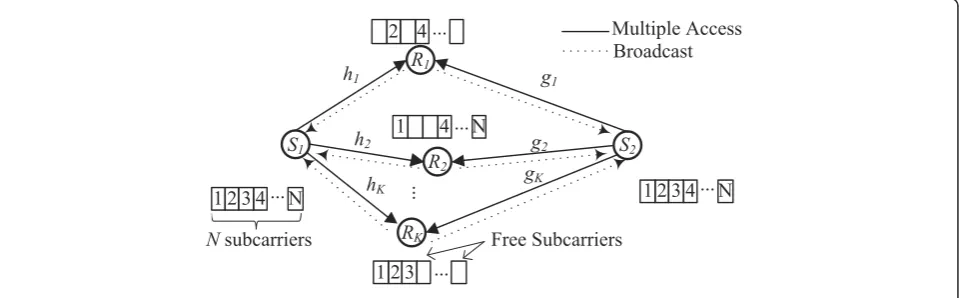
This article considers a TRC with multiple relay nodes
as shown in Figure 1, which has two users, K
half-duplex relay nodes and N subcarriers. Suppose that
users S1 and S2 intend to exchange information with
each other and there is no direct path between the two users. Hence, the exchange will be finished with the assistance of the relay nodes. It is assumed that all the nodes are equipped with a single antenna and operated in a time division duplexing (TDD) mode. Assuming channel reciprocity, which is justified by the TDD mode, given that the duplexing period is small com-pared to channel coherence time, the complex channel coefficient fromSito Riis same as channel from Rito
Si. Since OFDM divides the wideband signal into many narrowband subcarriers, with proper cyclic prefixing, the individual subcarriers in an OFDM signal experience frequency-flat fading. For generality, we also assume that the subcarrier responses depend in the general case on subcarrier index which is denoted here by n. The amount of correlation between different subcarriers depends on the relation of channel coherence band-width and subcarrier spacing. In terms of mobility and Doppler spread, we assume that the channel coherence time is long compared to OFDM symbol duration. Accordingly, this article considers a quasi-static fading channel for which the channels are constant within one frame but change independently from one frame to another. Furthermore, we also assume that the radio channels corresponding to different relay nodes are
...
h1
hK
g1
gK
h2 g2
Multiple Access Broadcast
RK
2 1 3 ...
1 ...N 2 4 ...
S1
R2
R1
S2
2 1 3 4...N 2
1 3 ...N
Nsubcarriers 4
4
Free Subcarriers
mutually independent. In addition, the complex channel coefficient on thenth subcarrier between S1andRi, and
S2 and Ri are denoted by hi(n) and gi(n), respectively, while the Additive White Gaussian Noise (AWGN) at S1, S2, and Ri on the nth subcarrier are denoted by
u(in),and u(in),respectively.
The considered PNC-AF protocol finishes the infor-mation exchange in two time slots. In the first time slot for multiple access phase, userS1transmit data symbol
x1(n)with power Ps(,1n) on thenth subcarrier, while userS2
transmit x(2n) with power Ps(,2n). Assuming perfect syn-chronization, the received signal at relay nodeRionnth subcarrier is expressed as:
y(in)=h(in)
Ps(,1n)x1(n)+gi(n)
Ps(,2n)x2(n)+u(in) (1) Then, if the relay node Riis selected to participate in transmission and assigned with the nth subcarrier, Ri will amplify the received signal on the nth subcarrier by
multiplying y(in)with amplification factorα(n)
i . To
make the transmitted power at Ri on thenth subcarrier equal to P(r,ni),the factor α(in) is expressed as
where N0is power spectral density of AWGN and W
denotes the subcarrier bandwidth.
Let τi andri(n)be the relay selection indicator variable and subcarrier assignment indicator variable onnth sub-carrier, respectively, where
τi=
1, whenRiis selected to patriciate in transmission
0, otherwise (3)
and
ρ(n)
i =
1, when thenth subcarrier is assigned toRi
0, otherwise (4)
By taking ρi(n) and τi into account, we use
τiρi(n)αi(n)as a general scale factor for Ri onnth sub-carrier. It is noted that thenth subcarrier of relay node Ri is marked as free subcarrier (as shown in Figure 1), while ρi(n) is equal to zero.
In the second time slot for broadcast phase, all the relay nodes broadcast the scaled signals to the two users. The received signals at S 1 and S 2 on thenth
subcarrier are given, respectively, by
˜
Assuming that channel state information (CSI) is available, each user can cancel its own transmit signal component from the received signal. Therefore, the resulting signals atS1 andS2 on thenth subcarrier can
be written as
3 Problem formulation and simplification
In this section, the optimal energy-efficient resource allocation is formulated as a joint optimization of power allocation, relay selection and subcarrier assignment to achieve the minimum transmit power consumption with required link rates. With the mathematical analysis, the optimization problem has been decomposed into N sub-problems. Then, the subproblems are simplified by using the Karush-Kuhn-Tucker (KKT) condition.
3.1 Problem formulation
The objective is to find the optimal subcarrier assign-ment {ρi(n)}, relay selection {τi} and power allocation
{P(s,1n),Ps(,2n),P(r,ni)}that minimize the overall transmit power subject to satisfying each link’s rate requirement ¯r1 and
¯
r2 in bit/s for linksS1 ® relay(s)®S2 andS2 ® relay
(s)® S1, respectively. The optimization is formulated as
ρ(n)
i ∈ {0, 1},τi∈ {0,1} ∀i,n (12)
where r(1n) and r(2n) are the achievable rates on thenth subcarrier for linksS1® relay(s)® S2and S2 ® relay
(s)® S1, respectively. From (7) and (8), the expressions
of r1(n) and r(2n) are given by
The factor 1/2 comes from the two time slots required by messages exchange. However, Problem 3.1 has high
computational complexity, while optimum values ofK
(2N+1)+2Nvariables need to be found. Some simplifica-tions will be implemented in the following section.
3.2 Problem simplification
Equal rate allocation is considered in this article to sim-plify the complexity of problem. On average, the rate of each subcarrier is ¯r1
Nbps for linkS1 ®relay(s)®S2and
¯
r2
N bps in the reverse direction. Since the separate rate
requirement on each subcarrier is known, Problem 3.1
is decomposed to Nindependent subproblems to find
the minimum transmit power consumption on per-sub-carrier basis. The optimization problem on thenth sub-carrier can be expressed now as (Problem 3.2):
minimize
The overall transmit power consumption will be the sum of individual transmit power consumptions on each subcarrier.
In mathematics, Problem 3.2 is a nonlinear program-ming, where some of the constraints or the objective
function are nonlinear. Karush-Kuhn-Tucker (KKT) conditions are necessary and sufficient for a solution in nonlinear programming to be optimal [16]. By substitut-ing (2), (13), and (14) into Problem 3.2 and applysubstitut-ing the KKT optimality conditions, the transmit power of S1
andS2on thenth subcarrier can be expressed as:
P(s,1n)=
Observation 1: It is observed that at least one subcar-rier should be assigned to relay nodeRi, ifRiis selected. Hence the relay selection indicator variable can be expressed as
carrier optimization on thenth subcarrier.
Finally, the original Problem 3.1 with K(2N+1)+2N variables is reduced to a per-subcarrier optimization Problem 3.3 with only 2Kvariables. Furthermore, Pro-blem 3.3 has very simple constraints, where the only requirements are that the factors α(n)
i should be
nonne-gative and ρi(n)∈ {0, 1}.
Remark 1:Problem 3.3 is to find the minimum power consumption on the nth subcarrier. If Problem 3.3 is solved, the minimum power consumption on the other subcarriers can also be obtained with the similar steps. Accordingly, the overall minimum power consumption will be the sum of transmit power consumptions on each subcarrier. In the following section, more detailed mathematical analysis will be carried out around the per-subcarrier optimization Problem 3.3.
4 Per-subcarrier optimization
Problem 3.3 is a mixed binary integer programming pro-blem, which considers the minimum power consump-tion on the nth subcarrier. However, it is prohibitive to find the global optimum in terms of computational complexity. To obtain the global optimum, an exhaus-tive search is needed throughout the subcarrier assign-ment vectorsr(n)and amplification factor vectorsa(n)to find the overall minimum transmit power. Before sol-ving the Problem 3.3 with optimal subcarrier assignment vectorr(n), we first propose an energy-efficient resource allocation scheme with opportunistic subcarrier assign-ment in 4.1. Then, the proposed heuristic scheme is proved to be the optimal solution of Problem 3.3 in Sec-tion 4.2.
4.1 Energy-efficient resource allocation with opportunistic subcarrier assignment
This section considers the Problem 3.3 with an opportu-nistic subcarrier assignment, where each subcarrier is assigned to an unique relay node. Hence, Problem 3.3 is divided into a power allocation and a opportunistic sub-carrier assignment problem.
Power allocation criterion: It is assumed that thenth subcarrier is only assigned to relay nodeRd. Under this assumption, we can determine the subcarrier assign-mentsr(n), which are directly given by
By substituting (25) into Problem 3.3, the problem becomes easy to solve. Hence, the solution is given directly as: carrier, while it is only assigned to relay node Rd. By substituting α¯(dn) and (25) into (9), (19), and (20), the closed-form expression of power allocated to two users and relay node Rdon nth subcarrier can be expressed as:
Opportunistic subcarrier assignment criterion: The index d˜ of the relay node assigned with thenth subcar-rier is determined as
˜
Remark 2: To summarize shortly, the energy-efficient resource allocation algorithm on thenth subcarrier with opportunistic subcarrier assignment approach proposed above has two steps: First, thenth subcarrier is assigned to the best relay Rd˜ by opportunistic subcarrier assign-ment criterion. Then, optimal transmit power deter-mined by power allocation criterion will be allocated to S1, S2, and Rd˜ on the nth subcarrier. The minimum
transmit power consumption P(on)on thenth subcarrier
of this scheme is given byP(on)=P¯(n)
4.2 Energy-efficient resource allocation with optimal subcarrier assignment
In this section, it is proved that the above opportunistic two-step resource allocation algorithm is also the opti-mum method in terms of energy-efficiency. This is for-mulated with the following Theorem:
optimal energy-efficient subcarrier assignment scheme, in which the nth subcarrier is assigned to the best relay node from the K candidate relay nodes.
Proof: Two steps are needed to complete the proof. We first consider the necessary and sufficient conditions of Theorem 1, and then solve its corresponding mathe-matical problem.
Step 1: Necessary and sufficient conditions of
Theo-rem 1: If opportunistic subcarrier assignment is the optimal scheme, the minimum transmit power con-sumption on thenth subcarrier is P(n)
o , which is given
in Section 4.1. Since P¯(n)α(n),ρ(n) is the transmit
power consumption on thenth subcarrier, Theorem 1
will be proved if we can prove that P¯(n)α(n),ρ(n) can-not have a value less than P(n)
o in the feasible region.
The mathematical expressions of the necessary and suf-ficient conditions are
Thus to prove Theorem 1, we start by showing that the
left-hand side of (32) is positive. Let
1×K= [ζ1,ζ2,. . .,ζK] transforms to solving the following optimization problem
minimizef(1×K) (33)
subject to1×K 0 (34)
wheref(Ξ1 × K) is the left-hand side of (32) multiplied by its denominator and is expressed in more details by (35).
Hence, the necessary and sufficient condition of Theo-rem 1 is that the minimum value off(Ξ1 ×K) is nonne-gative in the feasible region.
Step 2: Solution of the corresponding optimization pro-blem of necessary and sufficient conditions: Let γ =P(on)/N0W. It is obvious that f(Ξ1 × K) is strictly increasing withζi, whenζi>g. So the minimum value off (Ξ1 ×K) is not changed while we change the constrained conditionΞ1 ×K≽0 tog≽Ξ1 ×K≽0. So the correspond-ing mathematical problem can be rewritten as:
minimizef(1×K) (36)
subject toγ 1×K 0 (37)
Since ΛK= {g ≽Ξ1 × K ≽0} is a closed and bounded set andf(Ξ1 × K) : ΛK®ℝis continuous, problem (36) has a solution [[17], Theorem 0.3]. We consider here the second-order necessary conditions for optimality [[18], Chapter 11.5] of problem (36). The Hessian matrix off(Ξ1 ×K) is
The first-order leading principal minors off(Ξ1 ×K) is
ψ(1), which is positive. The second-order leading princi-pal minors off(Ξ1 ×K) is that:
|∇2f(
1×K)2×2|=ψ(1)ψ(2)−ϑ(1, 2)ϑ(2, 1)≤0 (39)
According to the Sylvester’s criterion [[18], Theorem 7.2.5],∇2f(Ξ1 ×K)must be positive semi-definite matrix (PSM) or indefinite matrix (IM). Next, we will prove that minimum value off(Ξ1 ×K) is nonnegative in cases
condition, it is obvious that
fmin(1×K) = 0, while∇2f(1×K) is PSM (40)
wherefmin(Ξ1 ×K) is the minimum value of functionf (Ξ1 ×K) in the feasible region.
Next, we will proveb0(w)≥0. It is first known that
straightforwardly. Then, the problem degenerates to provef(Ξ1 × (K-1))≥0.
With the similar discussion repeated from step 2 and K-2 times iteration, the problem will degenerate to
prove f(Ξ1 × 1) = f(ζi) ≥ 0. We know that
The two real roots of (44) are
ε1,2 = m
proved, the following result has been achieved
fmin(1×K)≥0, while∇2f(1×K) is IM (46)
From (40) and (46), it is then clear that the minimum value off(Ξ1 ×K) is nonnegative. The necessary and suf-ficient conditions of Theorem 1 discussed in step 1 are thus satisfied. Theorem 1 is proved.■
From Theorem 1, it is known that the proposed opportunistic subcarrier assignment criterion is the opti-mal energy-efficient criterion in multi-user multi-relay OFDMA-based TRC with PNC-AF.
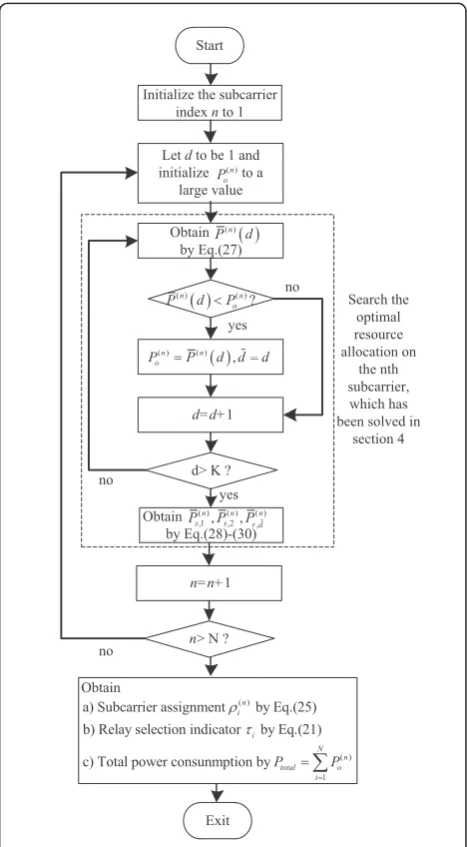
Remark 3: The overall optimal energy-efficient resource allocation algorithm is described in the Figure
2. As discussed in Section 3.2, resource allocation has
been decomposed intoNindependent subproblems on
the subcarriers. Then, the per-subcarrier resource
allo-cation is implemented from the subcarrier 1 to N.
Finally, the subcarrier assignment, relay selection indica-tor variables are calculated and the minimum power consumption is achieved.
5 Performance analysis
To capture the energy efficiency perspective in the ana-lysis, we employ the energy consumption index (ECI) from EARTH project [15]. ECI provides the energy per bit, which is defined as the energy consumption (E) dur-ing the observation period (T) divided by the total
Obtain a) Subcarrier assignment by Eq.(25) b) Relay selection indicator by Eq.(21)
c) Total power consunmption by n
number of bits (B) that were correctly delivered in the network during the same time period. For the two-way relay networks, ECI can be expressed as:
ECIE/B=
E B =
1 2Ptotal (¯r1+¯r2)
[Joule/bit] (47)
wherePtotalis the overall transmit power required to
deliver required rates r¯1 and r¯2, and the factor 1/2 comes from the two time slots required by messages
exchange. We assume that the spectral density of noise, denoted byN0, is equal to -174 dBm/Hz and all the
sub-carrier complex gains are realized independently through complex normal distribution of the form
CN0, 1 (1+di,j)/2
, where di,j is the distance between
node i and node j, and the path loss exponent Δis 3.
We assume that L is the distance between two users
and all the relay nodes are randomly distributed between them.
1.920 2.112 2.304 2.496 2.688 2.88 0.5
1 1.5 2 2.5x 10
−9
Rate betweenS2andS1(Mbit/s)
Energy Consumption Index (ECI) Joule/bit
PNC−AF with OERA in SR−TRC NC with OERA in SR−TRC
one−way relay AF with OERA in SR−TRC one−way relay DF with OERA in SR−TRC
Figure 3PNC gain with symmetric rate pair, wherer¯1=r¯2,K= 1,W= 15 kHz,N= 128,L= 1000 m.
0 0.2 0.4 0.6 0.8 1
0 0.5 1 1.5 2 2.5x 10
−9
¯
r1/(¯r1+ ¯r2)
Energy Consumption Index (ECI) Joule/bit
PNC−AF with OERA in SR−TRC NC with OERA in SR−TRC
one−way relay AF with OERA in SR−TRC one−way relay DF with OERA in SR−TRC
The ECI of each scheme is averaged over 1 × 10⁸ independent realizations of relay’location by Monte-Carlo simulation.
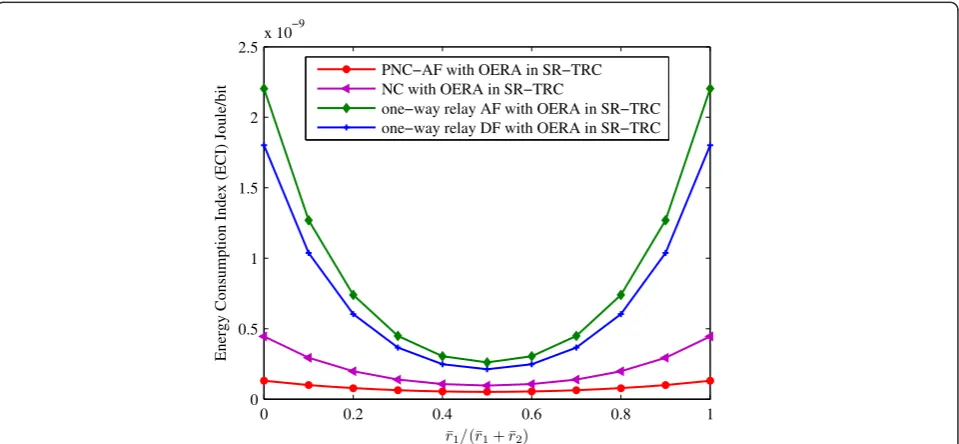
PNC gain is depicted in Figures 3 and 4, in which ECI of PNC-AF, NC, one-way relay AF and one-way relay DF with Optimal Energy-efficient Resource Allocation (OERA) are compared for TRC with single relay (SR-TRC). ECI with symmetric rates denoted by ¯r1=¯r2is shown in Figure 3, which depicts that ECI increases with the sum-rate and that PNC-AF achieves PNC gain to greatly reduce the ECI compared with the other schemes. ECI with asymmetric rates is shown in Figure 4, where the X-coordinate is the ratio of r¯1 to the fixed sum-rate with ¯r1+r¯2= 3.84Mbit/s. Compared with other schemes, Figure 4 depicts PNC gain increases with
the gap between r¯1 and ¯r2 and minimum ECI is
achieved while ¯r1=¯r2.
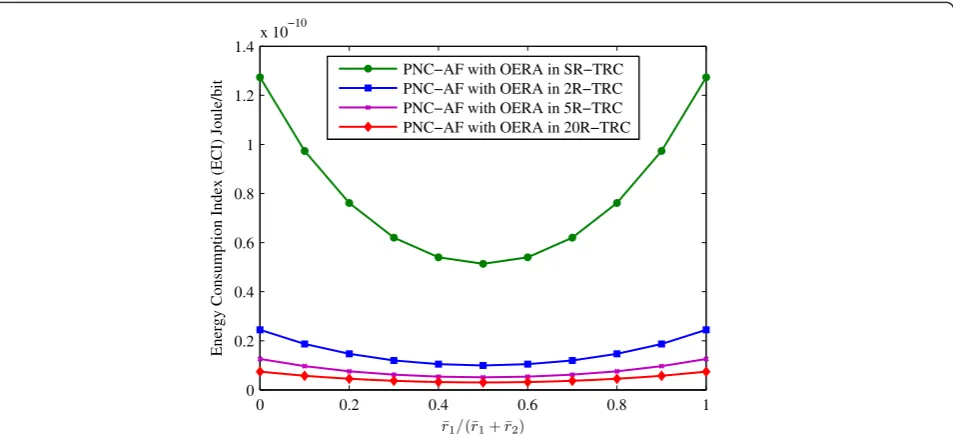
Diversity gain is demonstrated in Figure 5, in which
PNC-AF with OERA in SR-TRC and TRC with K =
[2,5,20] relay nodes (KR-TRC) are compared. The simu-lation depicts that PNC-AF with multiple relay nodes achieves great diversity gain which is directly propor-tional to the number of relay nodes, and the minimum ECI is achieved while ¯r1=¯r2.
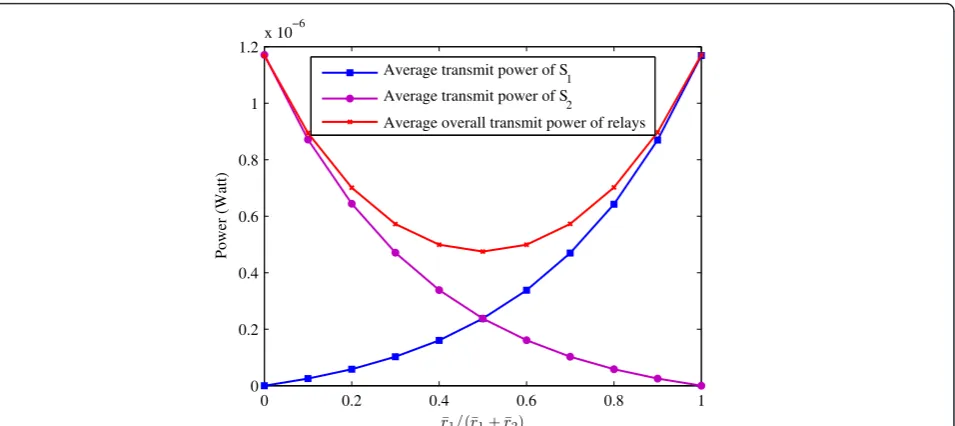
Figure 6 depicts the power allocation between S1, S2
and relay node(s). The X-coordinate is the ratio of 1000 to fixed sum-rate. Simulation shows that the average transmit power allocated toS1 is directly proportional to
the ratio of ¯r1 to fixed sum-rate, while average transmit power allocated toS2 is inversely proportional to the
ratio. The transmit power of relay node(s) is minimum in symmetric rate pair condition, in which ¯r1=¯r2.
6 Conclusion and discussion
In this article, we studied multi-user, multi-relay OFDMA-based two-way relay network with PNC-AF protocol. An optimal energy-efficient resource allocation with joint power allocation, relay selection and subcar-rier assignment to achieve the minimum transmit power consumption with required link rate pair were derived. From the analysis, we proved that the optimal subcarrier assignment criterion in energy efficiency sense is an opportunistic subcarrier assignment, in which a subcar-rier is assigned to a unique relay node. Based on the proof, the closed-form expressions of power allocation, relay selection, subcarrier assignment and minimum transmit power consumption were derived. The simula-tions confirmed the proposed scheme is far superior to the other existing schemes in terms of energy efficiency. It was also observed that energy efficiency of TRC is generally better with symmetric symmetric rate pair than asymmetric rate pair.
Beside the scenario considered in this article, energy efficiency can be further improved with more complex schemes, e.g., adaptive bit allocation on subcarriers and phase alignment operation at relay nodes. Furthermore, the analysis of energy efficiency is based on Shannon capacity expressions in this article, which do not take into account the impact of practical channel coding, modulation and retransmission methods. Hence, the
0 0.2 0.4 0.6 0.8 1
0 0.2 0.4 0.6 0.8 1 1.2 1.4x 10
−10
¯
r1/(¯r1+ ¯r2)
Energy Consumption Index (ECI) Joule/bit
PNC−AF with OERA in SR−TRC PNC−AF with OERA in 2R−TRC PNC−AF with OERA in 5R−TRC PNC−AF with OERA in 20R−TRC
Figure 5Diversity gain with asymmetric rate pair, wherer¯1+¯r2= 3.84 Mbit/s,W= 15 kHz,N= 128,L= 1000 m, andK= 1, 2, 5,
consideration of energy efficiency in more practical sce-narios will be another future research item.
Acknowledgements
This article is supported by International Scientific and Technological Cooperation Program (2010DFA11060), China-EU International Scientific and Technological Cooperation Program (0902), National Nature Science Foundation of China (Grant No. 61001119, 61027003) and Fund for Creative Research Groups of China (Grant No. 61121001). This article is partially sponsored by the Finnish Funding Agency for Technology and Innovation (Tekes), under the project Energy and Cost Efficiency for Wireless Access. Author details
1Wireless Technology Innovation Institute, Key Laboratory of Universal
Wireless Communication, Ministry of Education, Beijing University of Posts and Telecommunications, Beijing, 100876, China2Department of Communications Engineering, Tampere University of Technology, Tampere, P.O.Box 553, FI-33101, Finland
Competing interests
The authors declare that they have no competing interests.
Received: 19 July 2011 Accepted: 27 February 2012 Published: 27 February 2012
References
1. S Parkvall, E Dahlman, A Furuskar, Y Jading, M Olsson, S Wanstedt, K Zangi, LTE-Advanced - Evolving LTE towards IMT-Advanced, inIEEE 68th Vehicular Technology Conference, 2008. VTC 2008-Fall, Calgary, Canada, 1–5 (2008) 2. SW Peters, AY Panah, KT Truong, RW Heath, Relay architectures for 3GPP
LTE-Advanced. EURASIP J Wirel Commun Netw.2009(2009)
3. S Zhang, SC Liew, P PLam, Hot topic: physical layer network coding, inProc International conference on Mobile computing and networking (MobiCom’06), Los Angeles, USA, 358–365 (2006)
4. P Popovski, H Yomo, Physical network coding in two-way wireless relay channels, inIEEE International Conference on Communications, Glasgow, Scotland, 707–712 (2007)
5. P Popovski, H Yomo, The anti-packets can increase the achievable throughput of a wireless multi-hop network, inIEEE International Conference on Communications, 2006.9, 3885–3890 (2006)
6. S Katti, S Gollakota, D Katabi, Embracing wireless interference: analog network coding, inACM SIGCOMM 2007, Kyoto, Japan,9, 397–408 (2007) 7. R Louie, Y Li, B Vucetic, Practical physical layer network coding for two-way
relay channels: performance analysis and comparison. IEEE Trans Wirel Commun.9(2), 764–777 (2010)
8. Y Wu, PA Chou, SY Kung, Information exchange in wireless networks with network coding and physical-layer broadcast, Tech Rep MSR-TR-2004-78, Microsoft Research, Redmond, Wash, USA, 2004
9. CK Ho, R Zhang, YC Liang, Two-way relaying over OFDM: optimized tone permutation and power allocation, inIEEE International Conference on Communications, 2008. ICC’08, 3908–392 (2008)
10. M Dong, S Shahbazpanahi, Optimal spectrum sharing and power allocation for OFDM-based two-way relaying, in2010 IEEE International Conference on Acoustics Speech and Signal Processing (ICASSP), 3310–3313 (2010) 11. YU Jang, ER Jeong, Y Lee, A two-step approach to power allocation for
OFDM signals over two-way amplify-and-forward relay. IEEE Trans Signal Process.58(4), 2426–2430 (2010)
12. K Jitvanichphaibool, R Zhang, YC Liang, Optimal resource allocation for two-way relay assisted OFDMA. IEEE Trans Veh Technol.58(7), 3311–3321 (2009)
13. H Shin, JH Lee, Subcarrier allocation for multiuser two-way OFDMA relay networks with fairness constraints, in2010 IEEE 71st Vehicular Technology Conference, 1–5 (2010)
14. LM Correia, D Zeller, B Oliver, D Ferling, Y Jading, I Godor, G Auer, L Van Der Perre, Challenges and enabling technologies for energy aware mobile radio networks. IEEE Commun Mag.48, 66–72 (2010)
15. D2.3 - Energy efficiency analysis of the reference systems, areas of improvements and target breakdown.EARTH project, 39–40, (2010), https:// bscw.ict-earth.eu/pub/bscw.cgi/d31515/EARTH_WP2_D2.3.pdf
16. S Boyd, L Vandenberghe,Convex Optimization(Cambridge University Press, Cambridge, UK, 2004)
17. JL Troutman,Variational Calculus and Optimal Control: Optimization with Elementary Convexity(Springer, US, 1995)
18. DG Luenberger, Y Ye,Linear and Nonlinear Programming(Springer, US, 2009)
19. RA Horn, CR Johnson,Matrix Analysis(Cambridge University Press, UK, 1985)
0 0.2 0.4 0.6 0.8 1
0 0.2 0.4 0.6 0.8 1 1.2x 10
−6
¯
r1/(¯r1+ ¯r2)
Power (Watt)
Average transmit power of S1 Average transmit power of S2
Average overall transmit power of relays
Figure 6Power allocation between the users and relay node(s) with asymmetric rate pair, wherer¯1+r¯2= 3.84 Mbit/s,W= 15 kHz,
20. B Luo, Q Cui, H Wang, X Tao, Optimal joint water-filling for coordinated transmission over frequency-selective fading channels. IEEE Commun Lett.
15(2), 190–192 (2011)
doi:10.1186/1687-1499-2012-66
Cite this article as:Zhouet al.:Energy-efficient resource allocation for OFDMA-based two-way relay channel with physical-layer network coding.EURASIP Journal on Wireless Communications and Networking2012
2012:66.
Submit your manuscript to a
journal and benefi t from:
7Convenient online submission
7Rigorous peer review
7Immediate publication on acceptance
7Open access: articles freely available online
7High visibility within the fi eld
7Retaining the copyright to your article