R E S E A R C H
Open Access
Asymptotic behavior of a
regime-switching SIR epidemic model with
degenerate diffusion
Manli Jin, Yuguo Lin
*and Minghe Pei
*Correspondence:
[email protected] School of Mathematics and Statistics, Beihua University, Jilin, China
Abstract
In this paper, we consider a stochastic SIR epidemic model with regime switching. The Markov semigroup theory will be employed to obtain the existence of a unique stable stationary distribution. We prove that, ifRs< 0, the disease becomes extinct exponentially; whereas ifRs> 0 and
β
(i) >α
(i)(ε
(i) +γ
(i)),i∈S, the densities of thedistributions of the solution can converge inL1to an invariant density.
MSC: 47D07; 60J60; 60H10; 92D30
Keywords: Stationary distribution; Markov semigroups; Asymptotic stability
1 Introduction
Infectious disease population dynamics is often influenced by different types of environ-mental noise, in which white noise is the most typical one. The effects of white noise on epidemic models have already been considered by many authors (e.g.[1–4]). In this lit-erature the extinction and persistence of the disease were discussed. In reference [4], the authors assumed that the environmental white noises mainly influence the natural death ratesμof the populations. That is,μ→μ+σB(t), where˙ B(t) is a standard Brownian mo-tion,σ2represents the intensity of white noise. By replacingμdtbyμdt+σdB(t) in the deterministic SIR model with saturated incidence, the authors obtained a stochastic SIR model, which takes the form of
⎧ ⎨ ⎩
dS(t) = (–β1+S(αt)II((tt))–μS(t))dt–σS(t)dB(t),
dI(t) = (β1+S(αt)II((tt))– (μ+ε+γ)I(t))dt–σI(t)dB(t). (1.1)
In this model,S(t) andI(t) denote the number of susceptible and infected individuals at timet, respectively. The influx of individuals into the susceptibles is given by a constant. The natural death rate is denoted by constantμand individuals inI(t) suffer an additional death due to disease with rate constantε;βandγrepresent the disease transmission coef-ficient and the rate of recovery from infection, respectively;αis the saturated coefficient. Since the dynamics of compartmentRhas no effect on the disease transmission dynam-ics, it was omitted from the classical SIR model. In [4] the authors analyzed the long-time
behavior of densities of the distributions of the solution and proved that the densities can converge inL1to an invariant density.
In reality, except for white noise there is another important environmental noise: color noise, which can cause the population system to switch from one environmental regime to another. Such a switching is usually described by a continuous-time Markov chainr(t), t≥0 with a finite state spaceS={1, 2, . . . ,N}. And the generator= (γij)N×N ofr(t) is
given by
Pr(t+δ) =j|r(t) =i= ⎧ ⎨ ⎩
γijδ+o(δ) ifi=j,
1 +γiiδ+o(δ) ifi=j,
whereγij≥0 fori,j= 1, . . . ,Nwithj=iandγii= –
j=iγijfor eachi= 1, . . . ,N. Assume
Markov chainr(t) is independent of Brownian motion. For convenience, throughout this paper we assume
γij> 0 fori,j= 1, . . . ,Nwithj=i.
This assumption ensures that the Markov chainr(t) is irreducible. Consequently, there exists a unique stationary distributionπ={π1,π2, . . . ,πN}ofr(t) which satisfiesπ = 0,
N
i=1πi= 1 andπi> 0,∀i∈S.
Incorporating color noise into system (1.1), we get a regime-switching diffusion model: ⎧
⎨ ⎩
dS(t) = ((r(t)) –β1+(r(αt())r(St())t)II((tt))–μ(r(t))S(t))dt–σ(r(t))S(t)dB(t),
dI(t) = (β1+(rα(t())r(St())t)II((tt))– (μ(r(t)) +ε(r(t)) +γ(r(t)))I(t))dt–σ(r(t))I(t)dB(t), (1.2)
where(i),β(i),μ(i),ε(i),γ(i),α(i) andσ(i),i∈S, are all positive constants.
In the earlier literature, regime switching was introduced into population models; see e.g.[5–8]. Due to the important effect of color noise on disease transmission, many author considered deterministic epidemic model with Markovian switching [9, 10].
Recently, much literature considered asymptotic behavior of stochastic epidemic model under regime switching,e.g.[11–14]. In this literature the uniform ellipticity condition is necessary when proving the ergodicity of stochastic system. But for system (1.2) the diffu-sion matrix of system (1.2) is given byAi=σ2(i)
S2SI
SI I2 ,i∈S. ObviouslyAiis degenerate,
the uniform ellipticity condition is no longer satisfied. System (1.2) withα=ε=γ = 0 has been considered by Liu [12], but the author ignored the fact that a degenerate diffusion matrix cannot ensure uniform ellipticity.
Throughout this paper, ifAis a vector or matrix, we useAto denote its transpose; set
ˆ
g=mink∈S{g(k)}andgˇ=maxk∈S{g(k)}for any vectorg= (g(1), . . . ,g(N)); set
Ri:=νi(i) –μ(i) –ε(i) –γ(i) –
σ2(i)
2 , i∈S and R
s= N
i=1
πiRi,
whereν= (ν1, . . . ,νN)is the unique positive solution of linear equation
Remark1.1 The existence of the unique solution of (1.3) is given by Lemma 2.1 in [12].
By using similar arguments to Theorem 2.1 of [14], it follows that, for any (S(0),I(0), r(0))∈R2
+×S, system (1.2) has a unique global solution, which remain inR2+with proba-bility 1.
The aim of this paper is to consider the long-time behavior of system (1.2). We prove that the disease becomes extinct exponentially ifRs< 0; whereas ifRs> 0 andβ(i) >α(i)(ε(i) +
γ(i)),i∈S, system (1.2) has a stable stationary distribution.
The rest of this paper is organized as follows. In Section 2, we present the sufficient condition for the extinction of the disease. In Section 3 the conditions for the existence of a stable stationary distribution are given. Finally, we draw a conclusion.
2 Extinction of the disease
In this section, we present the sufficient condition for the extinction of the disease.
Theorem 2.1 IfRs< 0,the disease I(t)tends to zero exponentially.
Proof Consider the following system:
dX(t) =r(t) –μr(t) X(t) dt+σr(t) X(t)dB(t).
By the stochastic comparison theorem, it follows thatS(t)≤X(t) a.s. ifS(0) =X(0) > 0. According to Corollary 4.1 in [12], we have
lim
By using the generalized Itó formula, it follows from (1.2) that
lnI(t) –lnI(0)
3 Existence of stationary distribution and its stability
In order to investigate the existence of stationary distribution of system (1.2) and its stability, it suffices to consider the corresponding property for system (3.1).
Theorem 3.1 Let(x(t),y(t))be a solution of system(3.1)with initial value(x(0),y(0),r(0))∈
R2×S.Then for every t> 0the distribution of(x(t),y(t),r(t))has a density u(t,x,y,i).If
Next, we will prove this theorem by Lemmas 3.1–3.2. Let (x(i)(t),y(i)(t)) be a solution of system
Denote byAithe differential operators
Aif =
According to Lemma 3.3 and Lemma 3.5 in [4], we know that for anyi∈Sthe operator Aigenerates an integral Markov semigroup{Ti(t)}t≥0on the spaceL1(R2,B(R2),m) and t> 0 the distribution of the process (x(t),y(t),r(t)) is absolutely continuous and its density u= (u1,u2, . . . ,uN) (whereui:=u(t,x,y,i)) satisfies the following master equation:
∂u
∂t =
u+Au, (3.4)
LetX=R2×S,be theσ-algebra of Borel subsets ofX, andmˆ be the product measure on (X,) given bym(Bˆ ×i) =m(B) for eachB∈B(R2) andi∈S. Obviously,Augenerates a Markov semigroup{T(t)}t≥0on the spaceL1(X,,m), which is given byˆ
T(t)f =T1(t)f(x,y, 1), . . . ,TN(t)f(x,y,N) , f ∈L1(X,,m).ˆ
Letλbe a constant such thatλ>max1≤i≤N{–γii}andQ=λ–1+I. Then (3.4) becomes
∂u
∂t =λQu–λu+Au. (3.5)
Obviously,Qis also a Markov operator onL1(X,,m).ˆ
From the Philips perturbation theorem [16], (3.5) with the initial conditionu(0,x,y,k) = f(x,y,k) generates a Markov semigroup{P(t)}t≥0on the spaceL1(X) given by
P(t)f=e–λt
∞
n=0
λnS(n)(t)f, (3.6)
whereS(0)(t) =T(t) and
S(n+1)(t)f = t
0
S(0)(t–s)QS(n)(s)f ds, n≥0. (3.7)
Lemma 3.1 Ifβ(i) >α(i)(ε(i) +γ(i)),i∈S,then the semigroup{P(t)}t≥0is asymptotically stable or is sweeping with respect to compact sets.
Proof Since{T(t)}t≥0 is an integral Markov semigroup,{P(t)}t≥0 is a partially integral Markov semigroup. In view of (3.3), (3.7) andQij> 0 (i=j), we know that, for every
non-negativef∈L1(X) withf= 1, ∞
0
P(t)f dt> 0, a.e.onX.
By using similar arguments to Corollary 1 in [17], it follows that{P(t)}t≥0is asymptotically stable or is sweeping with respect to compact sets.
Remark3.1 A densityf∗is called invariant ifP(t)f∗=f∗for eacht> 0. The Markov
semi-group{P(t)}t≥0is called asymptotically stable if there is an invariant densityf∗such that
lim
t→∞P(t)f –f∗= 0 forf ∈D,
whereD={f ∈L1(X) :f ≥0,f= 1}.
A Markov semigroup{P(t)}t≥0is called sweeping with respect to a setA∈if for every f ∈D
lim
t→∞
A
P(t)f(x)m(dx) = 0.ˆ
Proof We will construct a nonnegativeC2-functionVand a closed setU∈B(R2) (which
In fact,A∗is the adjoint operator of the infinitesimal generator of the semigroup{P(t)}t≥0. Since the matrixis irreducible, there exists = (1,2, . . . ,N) that is a solution of
the Poisson system (see [18], Lemma 2.3) such that
–R= –
where the functionf(x) is given in (3.11). Define aC2-functionVas follows:
Direct calculation implies that
where equations (1.3) and (3.9) are used. Hence,
A∗V≤f(x) +g(y) –rRs+rβ(i)α(i)e
In view of (3.10), we can obtain
For (x,y)∈U1, according to (3.10) we have
A∗V≤ max
x∈[0,∞)f(x) +g(y) –rR
s+rβˇαˇeκ+y→–∞, asy→+∞,
and
A∗V≤ max
x∈[0,∞)f(x) +g(y) –rR
s+rβˇαˇeκ+y→ max
x∈[0,∞)f(x) –rR
s≤–2, asy→–∞.
Takingρ∈(0,∞) large enough such that
A∗V≤–1, onU1–U2, (3.13)
whereU2={(x,y)∈R2:x∈[–κ,κ],y∈[–ρ,ρ]}. NotingU2⊂U1, we obtain (R2–U1)∪ (U1–U2) =R2–U2. Combining (3.12) and (3.13), it follows that, for anyi∈S,
A∗V(x,y,i) < –1, (x,y)∈R2–U2.
Such a functionVis called a Khasminski˘ı function. By using similar arguments to those in [19], the existence of a Khasminski˘ı function implies that the semigroup is not sweeping from the setU2. According to Lemma 3.1, the semigroup{P(t)}t≥0is asymptotically stable, which completes the proof.
4 Conclusion
In this paper, we consider the long-time behavior of a regime-switching SIR epidemic model. Since the diffusion is degenerate we employ the Markov semigroup theory to study the long-time behavior of system (1.2). We prove that ifRs< 0, the disease becomes
ex-tinct exponentially; whereas ifRs> 0 andβ(i) >α(i)(ε(i) +γ(i)),i∈S, the densities of the
distributions of the solution can converge inL1to an invariant density. In some sense,Rs
is the threshold determining that the disease does or does not occur.
LetS={1, 2},=–2 21 –1. Obviously,π= (1/3, 2/3). TakeS(0) = 2,I(0) = 1 and
(1) = 0.9, μ(1) = 0.2, ε(1) = 0.2, γ(1) = 0.3,
β(1) = 0.3, α(1) = 0.1, σ(1) = 0.1,
(2) = 1.0, μ(2) = 0.2, ε(2) = 0.1, γ(2) = 0.4,
β(2) = 0.1, α(2) = 0.15, σ(2) = 0.2.
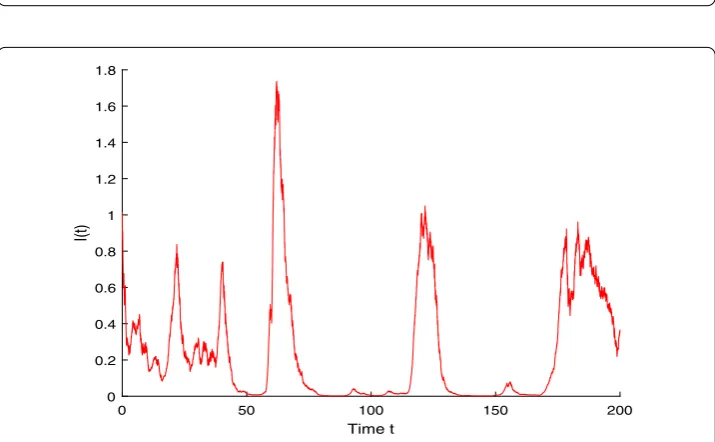
It is easy to check that the disease persists and becomes extinct in fixed environments 1 and 2, respectively. However, in the regime-switching case, we getRs= 0.1042 > 0.
Ac-cording to Theorem 3.1, the disease is persistent (see Figure 1). In fact, the condition
β(i) >α(i)(ε(i) +γ(i)),i∈Sis not necessary (see Figure 2). In the proof of Theorem 3.1, such a condition is mainly used to ensure that the support of the invariant measure (if it exists) in each fixed environment isR2
Figure 1The sample path ofI(t) withS(0) = 2,I(0) = 1. Hereα(1) = 0.1 andα(2) = 0.15. In this case,
β(i) >α(i)(ε(i) +γ(i)),i∈S
Figure 2The sample path ofI(t) withS(0) = 2,I(0) = 1. Hereα(1) = 0.7 andα(2) = 0.3. In this case,
β(i) <α(i)(ε(i) +γ(i)),i∈S
continue our research in this direction. In addition, delay is a common phenomenon in the natural world; then it is interesting to consider stochastic models with delay (seee.g. [22, 23]), which can lead to further investigation of along the line of the present paper.
Acknowledgements
The authors thank the anonymous referees for valuable suggestions, which led to improvement of the original manuscript. The work was supported by the Education Department of Jilin Province (Grant No: [2016]47).
Competing interests
The authors declare that they have no competing interests.
Authors’ contributions
Publisher’s Note
Springer Nature remains neutral with regard to jurisdictional claims in published maps and institutional affiliations.
Received: 6 October 2017 Accepted: 25 January 2018
References
1. Tornatore, E., Buccellato, S., Vetro, P.: Stability of a stochastic SIR system. Physica A354, 111–126 (2005)
2. Gray, A., Greenhalgh, D., Hu, L., et al.: A stochastic differential equation SIS epidemic model. SIAM J. Appl. Math.71, 876–902 (2011)
3. Ji, C., Jiang, D., Yang, Q., Shi, N.: Dynamics of a multigroup SIR epidemic model with stochastic perturbation. Automatica48, 121–131 (2012)
4. Lin, Y., Jiang, D., Jin, M.: Stationary distribution of a stochastic SIR model with saturated incidence and its asymptotic stability. Acta Math. Sci.35B, 619–629 (2015)
5. Luo, Q., Mao, X.: Stochastic population dynamics under regime switching. J. Math. Anal. Appl.334, 69–84 (2007) 6. Li, X., Jiang, D., Mao, X.: Population dynamical behavior of Lotka–Volterra system under regime switching. J. Comput.
Appl. Math.232, 427–448 (2009)
7. Zhu, C., Yin, G.: On hybrid competitive Lotka–Volterra ecosystems. Nonlinear Anal.71, e1370–e1379 (2009) 8. Liu, M., He, X., Yu, J.: Dynamics of a stochastic regime-switching predator–prey model with harvesting and distributed
delays. Nonlinear Anal. Hybrid Syst.28, 87–104 (2018)
9. Greenhalgh, D., Liang, Y., Mao, X.: Modelling the effect of telegraph noise in the SIRS epidemic model using Markovian switching. Physica A462, 684–704 (2016)
10. Li, D., Liu, S., Cui, J.: Threshold dynamics and ergodicity of an SIRS epidemic model with Markovian switching. J. Differ. Equ.263, 8873–8915 (2017)
11. Zhang, X., Jiang, D., Alsaedib, A., et al.: Stationary distribution of stochastic SIS epidemic model with vaccination under regime switching. Appl. Math. Lett.59, 87–93 (2016)
12. Liu, Q.: The threshold of a stochastic susceptible-infective epidemic model under regime switching. Nonlinear Anal. Hybrid Syst.21, 49–58 (2016)
13. Settati, A., Lahrouz, A.: Asymptotic properties of switching diffusion epidemic model with varying population size. Appl. Math. Comput.219, 11134–11148 (2013)
14. Han, Z., Zhao, J.: Stochastic SIRS model under regime switching. Nonlinear Anal., Real World Appl.14, 352–364 (2013) 15. Xi, F.: On the stability of jump-diffusions with Markovian switching. J. Math. Anal. Appl.341, 588–600 (2008) 16. Lasota, A., Mackey, M.C.: Chaos, Fractals and Noise. Stochastic Aspects of Dynamics. Springer Applied Mathematical
Sciences, vol. 97. New York (1994)
17. Rudnicki, R.: Long-time behaviour of a stochastic prey–predator model. Stoch. Process. Appl.108, 93–107 (2003) 18. Khasminskii, R.Z., Zhu, C., Yin, G.: Stability of regime-switching diffusions. Stoch. Process. Appl.117, 1037–1051 (2007) 19. Pichór, K., Rudnicki, R.: Stability of Markov semigroups and applications to parabolic systems. J. Math. Anal. Appl.215,
56–74 (1997)
20. Dieu, N.T., Nguyen, D.H., Du, N.H., Yin, G.: Classification of asymptotic behavior in a stochastic SIR model. SIAM J. Appl. Dyn. Syst.15(2), 1062–1084 (2016)
21. Hening, A., Nguyen, D.H.: Coexistence and extinction for stochastic Kolmogorov systems. Ann. Appl. Probab. To appear (2017). https://arxiv.org/abs/1704.06984
22. Liu, M., Fan, M.: Stability in distribution of a three-species stochastic cascade predator–prey system with time delays. IMA J. Appl. Math.82, 396–423 (2017)