Secure and Efficient Proof of Storage with Deduplication
Qingji Zheng
Department of Computer Science University of Texas at San Antonio
[email protected]
Shouhuai Xu
Department of Computer Science University of Texas at San Antonio
[email protected]
ABSTRACT
Both security and efficiency are crucial to the success of cloud storage. So far, security and efficiency of cloud storage have been separately investigated as follows: On one hand, security notions such as Proof of Data Possession (PDP) and Proof of Retrievability (POR) have been introduced for detecting the tamperation of data stored in the cloud. One the other hand, the notion of Proof of Ownership (POW) has also been proposed to alleviate the cloud server from stor-ing multiple copies of the same data, which could substan-tially reduce the consumption of both network bandwidth and server storage space. These two aspects are seemingly quite to the opposite of each other. In this paper, we show, somewhat surprisingly, that the two aspects can actually co-exist within the same framework. This is possible fundamen-tally because of the following insight:The public verifiability offered by PDP/POR schemes can be naturally exploited to achieve POW. This “one stone, two birds” phenomenon not only inspired us to propose the novel notion of Proof of Storage with Deduplication (POSD), but also guided us to design a concrete scheme that is provably secure in the Random Oracle model based on the Computational Diffie-Hellman (CDH) assumption.
Categories and Subject Descriptors
C.2.4 [Communication Networks]: Distributed Sys-tems; H.3.4 [Information Storage and Retrieval]: Sys-tems and Software
General Terms
Security
Keywords
cloud storage, outsourced storage, proof of storage, dedu-plication, integrity checking, proof of ownership, proof of data possession, proof of retrievability
Permission to make digital or hard copies of all or part of this work for personal or classroom use is granted without fee provided that copies are not made or distributed for profit or commercial advantage and that copies bear this notice and the full citation on the first page. To copy otherwise, to republish, to post on servers or to redistribute to lists, requires prior specific permission and/or a fee.
Copyright 200X ACM X-XXXXX-XX-X/XX/XX ...$5.00.
1.
INTRODUCTION
Cloud computing is getting increasingly popular because it can provide low-cost and on-demand use of vast storage and processing resources. The present paper focuses on the security and efficiency of cloud storage, namely that clients outsource their data to cloud storage servers. While cloud storage offers compelling scalability and availability advan-tages over the current paradigm of “one storing and main-taining its own IT systems and data”, it does not come with-out security concerns. This has led to studies on cloud stor-age security and efficiency, which are, however, addressed separately as we discuss below.
From the perspective of cloud storage security, there have been two notable notions:
• Proof of Data Possession (PDP): This notion was in-troduced by Ateniese et al. [2]. It allows a cloud client to verify the integrity of its data outsourced to the cloud in a very efficient way (i.e., far more efficient than the straightforward solution of downloading the data to the client-end for verification). This notion has been enhanced in various ways [8, 3, 15].
• Proof of Retrievability (POR): This notion was intro-duced by Juels and Kaliski [10]. Compared withPDP,
POR offers an extra property that the client can ac-tually “recover” the data outsourced to the cloud (in the flavor of “knowledge extraction” in zero-knowledge proof). This notion has been enhanced and extended in multiple aspects [12, 6, 5, 16].
From the perspective of cloud storage efficiency, dedupli-cation technique has become a common practice of many cloud vendors. This is reasonable especially when there are many duplications in the data outsourced to the cloud (e.g., only 25% of data may be unique according to a survey [1]). As such, the cloud vendor can substantially save storage space by storing a single copy of each data — no matter how many clients outsourced it, which explains the term “dedu-plication”. This issue was first introduced to the research community by [9]. Because straightforward deduplication is vulnerable to attacks (e.g., a dishonest client can claim that it has certain data while it does not), Halevi et al. [13] pro-posed the notion called Proof of Ownership (POW) as well as concrete constructions.
tackle this problem by proposing a “2-in-1” notion we call Proof of Data Storage with Deduplication (POSD). Specifi-cally, we introduce the novel concept ofPOSD, and formalize its functional and security definitions. Moreover, we propose the first efficientPOSDscheme and prove its security in the Random Oracle model based on the Computational Diffie-Hellman (CDH) assumption. We also analyze and compare the performance of our scheme and the performance of some relevantPDP/POR/POWschemes, which suggests that our
POSDscheme is as efficient as thePDP/POR/POWschemes.
Organization. The rest of the paper is organized as fol-lows. Section 2 briefly reviews the related prior work. Sec-tion 3 discusses the notaSec-tions and cryptographic settings. Section 4 presents the definitions ofPOSD. Section 5 de-scribes ourPOSDscheme and its security as well as perfor-mance analysis. Section 6 concludes the paper.
2.
RELATED WORK
Cloud storage security was not systematically studied un-til very recently, despite previous investigations for similar problems (cf. [2]). Ateniese et al. [2] introduced the concept ofPDP, and Juels et. al [10] proposed the concept ofPOR, which was improved significantly by Shacham and Waters [12]. The main difference between the two notions is that
POR uses Error Correction/Erasure Codes to tolerate the damage to portions of the outsourced data. These solutions are later enhanced in various ways [8, 4, 5, 6, 16].
Data deduplication of ciphertext data in the pre-cloud era was studied in [14, 7]. Data deduplication in the context of cloud computing was recently introduced [9]. Halevi et al. [13] dubbed the term of POW and presented the first systematic study of deduplication in cloud, including several alternative solutions that offer different trade-offs between security and performance.
3.
PRELIMINARIES
3.1
Notations
Letℓbe a security parameter. A functionε(ℓ) is negligi-ble if it is smaller thanℓ−constfor any constantconst and sufficiently largeℓ.
Letqaℓ-bit prime andpa prime such thatq|(p−1). Let
Fbe a data file consisting ofn blocks, where theithblock
Fiis composed ofmsymbols inZq, i.e. Fi= (Fi1· · ·,Fim), whereFi∈Zmq .
Let fidbe the identity that uniquely identifies data file
F. Let each file be associated with some auxiliary informa-tion (i.e. cryptographic tags), denoted byTag. We consider two variants ofTag: Tagintis the cryptographic information for auditing data integrity, andTagdupis the cryptographic information for duplication checking.
Let [] denote the optional arguments of a function or al-gorithm; for example,Alg(a, b[, c]) means that algorithmAlg
has two argumentsaandb, and optionally a third argument
c.
3.2
Cryptographic Setting and Assumptions
Let ℓbe a security parameter. Let Gand GT be cyclic groups of prime order q and g be a generator of G. Let
e : G×G → GT be a bilinear map, with the following properties: (i) e can be computed efficiently; (ii) for all
(u, v) ∈ G×G, and a, b ∈ Zq, e(ua, vb) = e(u, v)ab; (iii)
e(g, g)̸= 1.
The standard Computational Diffie-Hellman (CDH) Prob-lem is the following: Given (g, gw, h) ∈ G3, whereg, gw, h are selected uniformly at random fromG, computehw. The CDH Assumption says that no probabilistic polynomial-time (ppt) algorithm can solve the CDH Problem with a non-negligible probability (inℓ).
The Discrete Log (DLOG) Problem is the following: Given any primeq-order cyclic groupGand two random elements
gandh, findwsuch thatgw=h. The DLOG Assumption says that no ppt algorithm can solve the DLOG Problem only with a non-negligible probability (in ℓ). The DLOG Assumption is weaker than the CDH Assumption.
LetH1:{0,1}∗→GandH2:{0,1}∗→Zq be randomly chosen from the respective families of hash functions. Both
H1andH2 are modeled as random oracles.
LetPRF:{0,1}ℓ×{0,1,}∗→ {0,1}ℓbe a family of secure pseudorandom functions.
4.
REQUIREMENTS, MODEL AND
DEFI-NITIONS OF
POSD
Requirements. Built on top of [2, 10, 13], we summarize the performance requirements ofPOSDas:
• A solution should use common functions (e.g., hash functions) so as to allow cross-client data deduplication and cross-client cloud data integrity auditing.
• A solution should consume bandwidth that is substan-tially less than the size of the data file in question. This prevents the aforementioned trivial solutions.
• A solution should not force the cloud server, when de-termining whether to conduct a deduplication oper-ation, to retrieve any significant portion of the data file in question. This is plausible because it could be very resource-consuming to load a large data file from secondary storage to memory.
• A solution should only require the client to make a single pass over its data file, while using an amount of memory that is substantially smaller than the size of the data file in question.
As in the cases ofPDP/POR andPOW, there are trivial solutions to fulfill the functions of POSD. Specifically, a client can download the whole data from the cloud to verify the integrity of its data outsourced to the cloud, and the server can ask the client to upload a data file to show that the client indeed has a copy of the data file before conducting the deduplication operation. However, this trivial solution is not practical because it incurs prohibitive communication overhead. On the other hand, it was also noted in [2, 10, 13] that simple heuristics will not solve the respective problems without shortcomings.
Model participants. We consider a cloud storage service model that involves the following three participants.
(ii) Cloud storage clients, denoted by C: A client out-sources its data to the cloud in a secure fashion, while allowing the cloud storage server to conduct data dedu-plication operations. (If a client does not want the server to conduct this operation, this can be achieved via an appropriate contract-level agreement that is out of the scope of the present paper.)
(iii) Third party, denoted by Auditor: A client may al-low a third party to check the integrity of its data outsourced to the cloud. Moreover, any client, who possesses a data file that is duplicated (i.e., the same data file has been uploaded to the server by another client), can act as aAuditorof that specific data file.
Communication channels. If the data file outsourced to the cloud is not confidential, there is no need for pri-vate channels. (In this case, secure deduplication still can be relevant because it may be very expensive to eavesdrop the communication during the transfer of a large data file.) In the case the outsourced data files are confidential, we can assume the availability of private communication chan-nels for the execution of certain protocols. This is com-mon toPDP/POR/POW[2, 12, 13] and avoids unnecessary complications in describing the protocols (given that private channels can be implemented using standard techniques in a modular fashion). Note that in order to facilitate dedu-plication, the data will be stored in plaintext in the cloud, which is the same as inPOW[13].
Functional definition. The following definition ofPOSD
is built on the definitions ofPDP/POR[2, 12] andPOW[13].
Definition 1. (functional definition) APOSDscheme, de-noted by Λ, consists of the following tuple of polynomial-time algorithms (Keygen,Upload,AuditInt,Dedup).
Keygen: This is the key generationalgorithm. It takes as
input a security parameterℓ, and outputs two pairs of public/private keys (pkint,skint) and (pkdup,skdup), where pkint is made public and skint is the corre-sponding private key of a client (this pair of keys may be used for integrity protection/verification purpose),
pkdup is made public andskdup is the private key of the server (this pair of keys may be used for secure deduplication purpose).
Upload: This is thedata uploadingprotocol running by a clientCand a serverSover a private channel so that secrecy of the data is assured. Suppose Cwants to upload a new data file F to the cloud, where S can easily determine that Fhas not be outsourced to the cloud by any client (e.g., by comparing the hash value provided by C against the list of hash values stored by the server). For preprocessing, Client Ctakes as input a new data fileFwith a unique identifierfidand the secret keyskint, outputs some auxiliary informa-tionTagint that can be used to audit the integrity of
Fin the cloud. At the end of the execution, S stores (fid,F,Tagint) received fromCas well as possibly some deduplication informationTagdup, which may be pro-duced by the server usingskdup. The server may also keep a hash value of the F’s so as to facilitate the detection of data duplications and thus the need of deduplication.
AuditInt: This is thedata integrity auditing protocol. It
is executed between server S and Auditor so that
SconvincesAuditor that integrity of some data file stored in the cloud is assured. TheAuditor’s input includes the data file identifierfidand the correspond-ing client’spkint. The server’s input includes the data fileFcorresponding tofidand the auxiliary informa-tionTagint associated toF. Essentially, the protocol is of challenge-response type, whereAuditorsends a challenge chal to the server and the server computes and sends back a responseresp. Ifrespis valid with re-spect tochalas well as the other relevant information,
Auditoroutputs 1, meaning that the integrity ofFis assured, and 0 otherwise. Formally, we can write it as:
b←(Auditor(fid,pkint)⇐⇒S(fid,F,Tagint)) whereb∈ {0,1}.
Dedup: This is the deduplication checking protocol. It is
executed between serverSand clientC, who claims to possess a data fileF(the detection of the need to dedu-plicate can be fulfilled byCsending the hash value of its data file toS, which can determine whether or not the data file has been in the cloud). This protocol is also essentially of challenge-response type. Basically,S
sends a challengechaltoC, which returns a response
resp that is produced using data file F and possibly other information. Sverifies the validity ofrespusing possiblyTagdupandpkdup, and outputs 1 if the verifi-cation is successful (meaning that the client indeed has data fileF) and 0 otherwise. Formally, we can write it as:
b←(S(fid,Tagdup,[skdup,]pkdup)⇐⇒C(fid,F))
whereb∈ {0,1}.
Correctness definition. We require aPOSDscheme Λ = (Keygen,Upload, AuditInt,Dedup) to be correctif, for honest client and server, the execution of theAuditInt pro-tocol will always output 1 and the execution of theDedup protocol will always output 1.
Security definition. We define security ofPOSDusing games, which specify both the adversary’s behavior (i.e., what the adversary is allowed to do) and the winning con-dition (i.e., under what circumstance we say the attack is successful). At a high-level, we require aPOSD scheme to beserver unforgeable, which is similar to the security defined by the data possession game in [2], and (κ, θ) uncheatable, which is similar to the security definition in [13].
Intuitively, we say aPOSD scheme is server unforgeable
if no cheating server can successfully execute theAuditInt protocol with an honestAuditorwith a non-negligible prob-ability. Formally, we have:
Definition 2. (server unforgeability) ForPOSDscheme Λ = (Keygen,Upload,AuditInt,Dedup), consider the follow-ing game between an adversary Aand a challenger, where
A plays the role of the cloud server S while possibly con-trolling many compromised clients, and the challenger acts as an honest client.
• Run algorithmKeygento generate (pkint,skint) and (pkdup,skdup). Makepkint andpkdup public, includ-ing givinclud-ing skint to the respective client andskdup to
A. Note that theskintof the challenger is not given to
A. For any other client, the corresponding skint may be given toAas long as it requests (i.e., these clients are compromised by, or collude with,A).
Challenge Stage: At this stage,Acan do anything with re-spect to the clients other than the challenger. With rere-spect to the challenger,Adoes the following.
• A adaptively chooses a data file F ∈ {0,1}∗ for the challenger. The challenger picks a unique identifier
fid and runs the Upload protocol with A. At the end of the execution, A obtains (fid,F,Tagint). The above process may be repeated for polynomial many times. Denote by Q = {(fid,F,Tagint)}, the set of tuplesAreceived from the challenger when executing theUpload protocol. Note that the challenger keeps a record ofQfid={fid}, namely the projection ofQon attributefid.
• Acan executeAuditIntwith the challenger with re-spect to any fid∈ Qfid, and execute Dedupwith the
challenger with respect to some data file (possibly cho-sen by A). This process can be executed polynomial (inℓ) number of times.
Forgery Stage:
• The adversary outputs anfid∈ Qfid corresponding to
Fthat was outsourced to the cloud.
The adversary wins the game if for anyF′̸=F,
1←(Auditor(fid,pkint)⇐⇒ A(fid,F′,·)), We say Λ isserver unforgeableif the winning probability for anypptalgorithmAis negligible inℓ.
Intuitively, we say aPOSDscheme is (κ, θ) uncheatableif given a fileFwith min-entropyκ, no cheating client, who can findF′containingθ-bit Shannon entropy ofF, convinces the server that it hasFwith a probability non-negligibly more than 2−(κ−θ). Formally, we have:
Definition 3. ((κ, θ) uncheatability) For a POSDscheme Λ = (Keygen, Upload,AuditInt,Dedup), consider the following game between the adversaryA(who plays the role of the compromised clients) and a challenger (who plays the role of the server and an honest client).
Setup Stage:
• Run algorithm Keygen to generate (pkint,skint) as well as (pkdup,skdup). Makepkint and pkdup public, including givingpkint andpkdup to the adversaryA. For a compromised client, the corresponding skint is given to A. However, both skdup and the skint cor-responding to the honest client are only given to the challenger. (Note that if the skint corresponding to the honest client is given to A,Acould use it to au-thenticate to the server to download the client’s any data outsourced to the server.)
• The challenger chooses a data fileFofκ-bit min-entropy, and a unique identifier fid. The challenger honestly executes theUploadprotocol by playing the roles of both the client and the server, and gives the publicly observable information to the adversaryA.
Challenge Stage: At this stage,Aseeks to infer the content of F by running the Upload, AuditInt and Dedup pro-tocols with the challenger. In particular, Amay penetrate into the cloud server to learn some portions of F. This is reasonable because stealing the whole F, or any form of its compressed version (becauseFhas enough min-entropy and thus Shannon entropy), could alert the defender about the compromise because of the abnormal use of network band-width and/or CPU resources. Moreover, subliminal chan-nels normally do not offer bandwidth compatible to the mag-nitude ofκ. Note that the above adversarial model also ac-commodates thatAcan command the compromised clients to launch some type of guessing attacks with respect toF, which is possible for example whenFhas a public structure (e.g., Word document or movie file). In any case, suppose
Alearned up toθ-bit Shannon entropy ofF.
Forgery Stage: Aeventually outputs someF′. Awins the game if
1←(S(fid,Tagdup,[skdup,]pkdup)⇐⇒C(fid,F′)).
We say Λ is (κ, θ)uncheatableif the winning probability for anypptalgorithmAis negligibly (inℓ) more than 2−(κ−θ). Note thatκ−θ≥ℓwould be the most often cases because we mainly deal with large data files, and thus A’s winning probability is effectively required to be negligible inℓ.
Discussion. In the above security definitions, we did not consider the notion offairness, which was very recently introduced to prevent a dishonest client from legitimately accusing an honest cloud server of tampering its data in the setting ofdynamic POR[16]. This is becausePOSDin this paper deals withstaticdata, rather than dynamic data where fairness can be reasonably involved [16]. For static data, fairness can be easily achieved by letting a client sign signFin theUploadprotocol or after a successful execution of theDedupprotocol.
5.
POSD
CONSTRUCTION AND ANALYSIS
5.1
Basic Ideas
As discussed above, it is conceptually convenient to think “POSD=PDP/POR+POW” becausePOSDaims to fulfill the functionalities of both integrity audit and deduplication. In this paper, we focus on the scenario of “POSD=PDP+POW” because of the following. First,PORis more costly thatPDP
due to its use of Error Correcting/Erasure Codes for fulfill-ing retrievability. Second, in theDedupprotocol ofPOSD
(andPOW), retrievability is actually not needed because the server already knows F. Nevertheless, the basic ideas are equally applicable to the scenario of “POSD=POR+POW.” In what follows we first elaborate the insight that led us to our design.
the AuditInt protocol and the Dedup protocol. Specifi-cally, both protocols are in a sense for verifying integrity ex-cept that one is for data in the cloud-end (i.e., cloud server attests to client) and the other is for data in the client-end (i.e., client attests to cloud server). Because theAuditInt
protocol is the core ofPDP/POR, there is some similarity betweenPDP/PORand POW(as noted in [13]) as well as
POSD. However, it is stated in [13] thatPDP/PORprotocols are not applicable in the setting ofPOW(and thusPOSD) — we call this the “Deduplication Gap” betweenPDP/POR
andPOW/POSD— because of the following:
InPDP/POR, there is a preprocessing step that facilitates that the client can later verify the in-tegrity of its data in the cloud. Whereas, in the setting of POW, a new client possesses a secret data fileF,but no other secrets.
Halevi et al. [13] correctly excluded the possibility of us-ing PDP/POR based on symmetric key cryptosystems [2, 12] for the purpose of POW (because the new client does not, and should not, know the secret keys). We observe, however, that Publicly Verifiable PDP/POR protocols are actually sufficient for the purpose ofPOW. As we will see, this is made possible because the client can compute the needed information fromFon the fly and without using any secret information.
Why is the public verifiability sufficient to bridge the above “Deduplication Gap”? Conceptually, pub-lic verifiability ofPDP/PORmeaning that a third party, who may be given somenon-secretinformation by a client, can verify the integrity of the client’s data in the cloud. Putting this into the setting ofPOW/POSD, we can let the Dedup protocol be essentially the same as the corePDP/POR pro-tocol by reversing the roles of the client and the server. More specifically, if theAuditIntprotocol is publicly verifiable, it is possible that only the public keypkintis needed for the cloud server and only the data fileF(as well as the public parameters, of course) is needed for the client.
5.2
Construction
Recall that q is an ℓ-bit prime and p is another prime such that q|(p−1). Gand GT are cyclic groups of prime orderq, and e : G×G → GT is a bilinear map. We use two hash functions (random oracles)H1 :{0,1}∗→Gand
H2:{0,1}∗→Zq.
Fis a data file consisting ofnblocks ofmsymbols inZq, namelyFi= (Fi1· · ·,Fim), whereFi∈Zmq for 1≤i≤n. F is uniquely identified byfid.
ThePOSD scheme is described as follows (in the end of this subsection we will explain some design decisions to help understand our scheme):
Keygen: This algorithm generates cryptographic keys as
follows:
• Select v1 and v2 uniformly at random from Z∗p such that the orders of v1 and v2 are q (if v2 is generated from v1, then the DLOG of v2 to base v1 should be erased afterwards). Selectsj1, sj2uniformly at random from Z∗q for 1≤j≤m. Set zj =v−
sj1
1 v
−sj2
2 modp
for 1≤j≤m.
• Letgbe a generator ofG. Selectuuniformly at ran-dom fromG. Selectw uniformly at random fromZ∗q, and setzg =gw.
• Set pkint = {q, p, g, u, v1, v2, z1,· · ·, zm, zg} and the client’s private keyskint={(s11, s12),· · ·,(sm1, sm2), w}. Note that using an appropriate Pseudorandom Func-tion (PRF), we can further reduce the storage at the client-end to constant (i.e., using a single key to the
PRFfor generating thes11, s12,· · ·, sm1, sm2, w).
• Set pkdup = pkint and skdup =null, where pkdup is also made public.
Upload: This protocol is performed between a client, who is to outsource a data file F to the cloud, and the cloud server as follows:
• For each data block Fi, where 1 ≤ i≤ n, the client selectsri1, ri2uniformly at random fromZ∗q and com-putes:
xi = vr1i1v ri2
2 modp,
yi1 = ri1+ m
∑
j=1
Fijsj1 modq,
yi2 = ri2+ m
∑
j=1
Fijsj2 modq,
ti =
(
H1(fid||i)·uH2(xi)
)w
(in G).
The client sends (fid,F,Tagint) to the server, where
Tagint={(xi, yi1, yi2, ti)1≤i≤n}.
• Upon receiving (fid,F,Tagint), the server setsTagdup=
Tagint.
AuditInt: This protocol is executed between an auditor,
which can be the client itself, and the cloud server to verify the integrity of the client’s data fileF stored in the cloud. Note that the client does not need to give any information to the auditor except the public keyspkintand the data file identifierfid.
• The auditor chooses a set ofcelementsI={α1, . . . , αc} whereαiis selected uniformly at random from{1, . . . , n}, and chooses a set of coefficientsβ={β1, . . . , βc}where
βi is selected uniformly at random fromZ∗q. The au-ditor sendschal= (I, β) to the server.
• The server computes:
µj=
∑
i∈I
βiFij modq
for 1≤j≤m, and
Y1 =
∑
i∈I
βiyi1 modq,
Y2 =
∑
i∈I
βiyi2 modq,
T = ∏
i∈I
tβi
i (in G).
The server sendsresp= ({µj}1≤j≤m,{xi}i∈I,Y1,Y2,T) to the server, wherexi=vr1i1v
ri2
2 mod pfor 1≤i≤n were generated by the client in the execution of the
• Upon receivingresp, the auditor parsesrespas
{{µj}1≤j≤m,Y1,Y2,T,{xi}i∈I}, computes
X = ∏
i∈I
xβi
i modp,
W = ∏
i∈I
H1(fid||i)βi,
and verifies
X =? vY1
1 vY22 m
∏
j=1
zµj
j modp
e(T, g) =? e(Wu∑i∈IβiH2(xi), zg) (in GT). If both hold, return 1; otherwise, return 0.
Dedup: This protocol is executed between the client, who claims to have a data fileFwith identifierfidthat was al-ready outsourced to the cloud by another client, and the server. This is a simple variant of the above AuditInt
protocol, where the auditor only needs to know the pub-lic keys pkint and the data file identifier fid. Here, we let the cloud server play the role of the auditor (with some mi-nor adaptations because there are some information that is not known to the client in producing the response), who naturally knowspkintandfid.
• The server chooses a set ofcelementsI={α1, . . . , αc} whereαiis selected uniformly at random from{1, . . . , n}, and chooses a set of coefficientsβ={β1, . . . , βc}where
βiis selected uniformly at random fromZ∗q. The server sendschal= (I, β) to the client.
• The client computes
µj=
∑
i∈I
βiFij mod q
for 1≤j≤m, and sends resp= ({µi}1≤i≤m) to the server.
• The server computes fromTagdup={(xi, yi1, yi2, ti)1≤i≤n}:
Y1 =
∑
i∈I
βiyi1 modq,
Y2 =
∑
i∈I
βiyi2 modq,
W = ∏
i∈I
H1(fid||i)βi,
X =
∏
i∈I
xβi
i modp,
T =
∏
i∈I
tβi
i (in G).
The server verifies
X =? vY11v Y2
2 m
∏
j=1
zµj
j modp,
e(T, g) =? e
(
Wu
∑
i∈IβiH2(xi), z g
)
(in GT). If both hold, return 1; otherwise, return 0.
Discussion on some design decisions. To help under-stand our scheme, now we discuss some design decisions we
made to satisfy both the above performance design require-ments and the security definitions. First, ourUpload and
AuditIntprotocols are new. When compared with existing protocols for the similar purpose [2, 12, 8, 5, 6, 16], it has the following significant advantage during the execution of the
Uploadprotocol (a thorough comparison will be present in Section 5.5). Our scheme only requires the client to perform
O(n) exponentiation operations plusO(mn) multiplication operations, wheren is the number of data blocks andm is number of symbols in each block (i.e.,mnis the number of symbols in a data file). In contrast, the referred schemes require the client to perform O(mn) exponentiation oper-ations plusO(mn) multiplication operations. As such, our
AuditIntprotocol would be of independent value as it could
also be used as the core ofPDP/PORprotocols. Second, in ourPOSDscheme we usedzj=v−
sj1
1 v
−sj2
2 for
verification, which is reminiscent of the signature scheme in [11]. However, our scheme is not a digital signature scheme because we actually allow a sort of manipulation. On the other hand, we use zj=v−
sj1
1 v
−sj2
2 rather than, for exam-ple,zj=v−
sj1
1 . This is because security of our construction partially relies on the DLOG problem, or more precisely the DLOG ofv2 with respect to basev1.
Third, in the Upload protocol, the purpose of ti is to prevent the server from forging any new legitimate tuple of (x′i, yi1′ , yi2′ ) from a legitimate (xi, yi1, yi2) and Fi. To see this, let us consider the case without using ti. Note that (xi, yi1, yi2) with respect to blockFisatisfies
xi=v1yi1v yi2
2 m
∏
j=1
zFij
j modp.
Without usingti, the server can chooseri1′ andr′i2fromZ∗q, and set
x′i = xiv r′i1 1 v
r′i2
2 modp,
y′i1 = yi1+r′i1 modq,
y′i2 = yi2+r′i2 modq
so that (x′i, yi1′ , yi2′ ) also satisfies
x′i=v yi′1
1 v
y′i2 2
m
∏
j=1
zFij
j modp.
As another example of attacks, the server can generate (x′i, y′i1, y′i2) as follows: let x′i = xiz1 modp, y′i1 =yi1 and y′i2 =yi2. During the execution of the Upload protocol, the server may return F′i = {Fi1+ 1,Fi2, . . . ,Fim} by adding one to the first symbol of blockFi. As a consequence, (x′i, yi1′ , yi2′ ) andF′ialso satisfy
x′i=v y′i1
1 v
yi′2 2 z
Fi1+1
1 m
∏
j=2
zFij
j modp.
5.3
Correctness Analysis
thePOSDscheme can be verified as follows:
vY1
1 v2Y2 m
∏
j=1
zµj j
= v
∑ i∈Iβiyi1
1 v
∑ i∈Iβiyi2
2
m
∏
j=1 (v−sj1
1 v
−sj2
2 )
µj
= v
∑ i∈Iβiyi1
1 v
∑ i∈Iβiyi2
2
m
∏
j=1 (v−sj1
1 v
−sj2
2 )
∑ i∈IβiFij
= v
∑
i∈Iβi(ri1+∑mj=1Fijsj1)
1 v
∑
i∈Iβi(ri2+∑mj=1Fijsj2)
2 m
∏
j=1 (v−sj1
1 v
−sj2
2 )
∑ i∈IβiFij
= v
∑ i∈Iβiri1
1 v
∑ i∈Iβiri2 2
= (vri1
1 v ri2
2 ) ∑
i∈Iβi
= ∏
i∈I
xβi i
= X.
and
e(T, g)
= e
( ∏
i∈I
tβi i , g
)
=e
( ∏
i∈I
(
H1(fid||i)uH2(xi)
)wβi
, g
)
= e
( ∏
i∈I
(
H1(fid||i)uH2(xi)
)βi
, gw
) = e ( ∏
i∈I
H1(fid||i)
∏
i∈I
uH2(xi)
)βi
, zg
= e ( Wu ∑
i∈IβiH2(xi), z g
)
.
5.4
Security Analysis
Now we prove that thePOSDscheme satisfies Definitions 2 and 3.
Theorem 1. AssumeH1andH2are hash functions
mod-eled as random oracles, and theCDHproblem is hard. The POSDscheme isserver unforgeable.
Proof. We show our proof through a sequence of games
between a challenger, who plays the role of an honest client, and adversaryA, who acts as the malicious server. The over-all proof strategy is: givenfid′ corresponding to (F,Tagint) stored in the server and a challenge randomly selected by the challenger, if the adversary can pass the verification us-ing (F′,Tag′int)̸= (F,Tagint), then there is an algorithm that can solve the CDH problem.
Game0: Game0 is defined as in Definition 2, where the challenger only keeps the relevant public and private keys, andQfid, which is the list of the data file identifiersfid’s it has used (as mentioned before, aPRFcan reduce the storage of thefid’s to constant).
Game1: Game1 is the same as Game0 except that the challenger keepsQ={(fid,F,Tagint)},, the list of (fid,F,Tagint) involved in the execution of theUpload protocol. In this case, we prove that if the adversaryAcan produce a forgery (fid′,F′,Tag′int)∈ Q/ that can pass the test in theAuditInt
protocol with respect to the challenger’s challenge (I, β), then there is an efficient algorithm that can solve the CDH problem.
The simulator is constructed as follows:
• For generating the keys, the simulator works as follows:
– Select v1 and v2 uniformly at random from Z∗p such that the order ofv1 andv2 isq. Select uni-formly at randomsj1andsj2fromZ∗qfor 1≤j≤
m. Setzj=v− sj1
1 v
−sj2
2 modpfor 1≤j≤m.
– Letgbe a generator of groupG, and selecthfrom
G at random. Setu=gγhη, whereγ and ηare chosen uniformly at random fromZ∗q.
– Selectzguniformly at random from groupG, which means that the simulator does not know the cor-respondingwwithzg=gw.
– Setpkint={p, q, g, u, h, v1, v2, z1, . . . , zm, zg}and
pkdup=pkint. However, the simulator only knows secrets sk = {(s11, s12), . . . ,(sm1, sm2)} but not thew.
• The simulator modelH2(·) as a random oracle. Given
xi, if xi has been queried, returnH2(xi). Otherwise, select η uniformly at random from Z∗q and return η. The simulator keeps the list of (xi, H2(xi)).
• When the simulator is asked to compute Tagint for data file F, the simulator executes the following: for each data blockFi where 1≤i≤n, selectri1andri2 uniformly at random fromZ∗q and computes
xi = vr1i1v ri2
2 modp,
yi1 = ri1+ m
∑
j=1
Fijsj1 modq,
yi2 = ri2+ m
∑
j=1
Fijsj2 modq.
Selectλiuniformly at random fromZ∗q and set
H1(fid||i) =gλi/
(
uH2(xi)
)
.
Thus, we have
ti=
(
H1(fid||i)uH2(xi)
)w
= (gw)λi= (z g)λi. Set the cryptographic tag for blockFias (xi, yi1, yi2, ti) and thus Tagint ={(xi, yi1, yi2, ti)1≤i≤n}. The simu-lator keeps the list of (fid||i, H1(fid||i)). Note that λi is unknown toA.
• When A queries H1(fid||i) separately, the simulator operates as follows. If fid||ihas been queried, return
H1(fid||i). Otherwise, select λ′i uniformly at random fromZ∗q and returnhλ
′
i. Note thatλ′
i is unknown to
A.
SupposeAproduces (fid′,(I, β),{xi}i∈I,Y′1,Y′2, T′,{µ′j}1≤j≤m) to winGame1. This means thatfid′∈ Qfid, but
({µ′j}1≤j≤m,{xi′}i∈I,Y′1,Y′2,T′)̸= ({µj}1≤j≤m,{xi}i∈I,Y1,Y2,T),
(1) where µ = ∑i∈
IβiFi modq,µ ′ =∑
i∈IβiF ′
i modq, and (fid′,F,Tagint)∈ Qfrom which {xi}i∈I,Y1,Y2,Tare com-puted. The correctness of the scheme implies
e(T, g) =e
( ∏
i∈I
H1(fid′||i)βiu ∑
i∈IβiH2(xi), z g
)
(2)
SinceAwins inGame1, we have
e(T′, g) =e
( ∏
i∈I
H1(fid′||i)βiu ∑
i∈IβiH2(x′i), zg
)
. (3)
In what follows, we will consider three cases of Eq. (1):
• Case 1: T̸=T′.
• Case 2: T=T′, butxi̸=x′ifor somei∈I.
• Case 3: T=T′,xi=x′i for alli∈I, but (Y1,Y2,{µj}1≤j≤m)̸= (Y′1,Y′2,{µ′j}1≤j≤m).
In each case, we will utilize, among other things, Eqs. (2) and (3), to show that the simulator can solve the CDH prob-lem, which means thatAcannot winGame1 with a non-negligible probability. This will complete the proof.
Case 1: T̸=T′. In this case, we have
e(T/T′, g) =e
(
u
∑
i∈Iβi(H2(xi)−H2(x′i)), z g
)
.
By substitutinguwithgγhη, we have
e(T/T′, g) =e
(
(gγhη)∑i∈Iβi(H2(xi)−H2(x′i)), z g
)
.
Rearrange the terms, we get
T/T′= (gwγhwη)
∑
i∈Iβi(H2(xi)−H2(x ′ i)). We claim that
∑
i∈I
βi(H2(xi)−H2(x′i))̸= 0 modq.
Otherwise, we getT/T′= 1, which contradicts the assump-tionT̸=T′. Together with the fact that zg =gw, we can get
hw=
(
(T/T′)·z−γ(
∑
i∈I(H2(xi)−H2(x′i)) g
)∑ 1
i∈I(H2 (xi)−H2 (x′i)), which means that if T ̸= T′, the simulator can solve the CDH problem by computinghwwith respect to givengand
zg=gw for unknownw.
Case 2: T=T′, butxi̸=x′i for somei∈I. BecauseT=T′, we have
∏
i∈I
H1(fid′||i)βiu ∑
i∈IβiH2(xi)=∏ i∈I
H1(fid′||i)βiu ∑
i∈IβiH2(x′i).
By arranging the term, we have
u
∑
i∈Iβi(H2(xi)−H2(x′i))= 1.
As the probability that
∑
i∈I
βi(H2(xi)−H2(x′i)) = 0 mod q
is negligible andu=gγhη, we have
h = g
∑
i∈Iγ(H2 (xi)−H2 (x′i))
∑
i∈Iη(H2 (xi)−H2 (x′i))
= gγη−1
∑
i∈I(H2(xi)−H2(x′i)).
This means that the simulator can solve the DLOG of ran-domhwith respect to baseg, which immediately breaks the CDH assumption.
Case 3: T=T′,xi=x′ifor alli∈I, but (Y1,Y2,{µj}1≤j≤m)̸= (Y′1,Y′2,{µ′j}1≤j≤m).
Note that
∏
i∈I
x′βi i =vY
′
1
1 v Y′2
2 m ∏ j=1 zµ ′ j
j modp
and
∏
i∈I
xβi
i =v
Y1 1 v Y2 2 m ∏ j=1
zµj
j mod p.
Becausexi=x′ifor alli∈I, we have
vY′1
1 v Y′2
2 m ∏ j=1 zµ ′ j
j =v
Y1
1 vY22 m
∏
j=1
zµj
j modp.
By replacingzjwithv− sj1
1 v
−sj2
2 in the above equation, we get
vY′1−Y1−∑jm=1sj1(µ′j−µj)
1 =v
Y2−Y′2−
∑m
j=1sj1(µj−µ′j)
2 modp.
Thus, if (Y1,Y2,{µj}1≤j≤m) ̸= (Y′1,Y′2,{µ′j}1≤j≤m), then the simulator can compute the DLOG of random v2 with respect to base v1, which immediately breaks the CDH as-sumption.
Theorem 2. AssumeH1andH2are hash functions
mod-eled as random oracles, and theCDHproblem is hard. The POSDscheme is(κ, θ)uncheatable with respect to challenge ofc= θ−nκlog(2θ−κ+ϵ)blocks in theDedupprotocol, where
κis the min-entropy of the fileFin question,θis the amount of entropy leaked to or stolen by the adversary, andϵis neg-ligible in security parameterℓ.
Proof. According to Theorem 1, given thatH1 andH2 are hash functions modeled as random oracles, and the CDH problem is hard, our scheme is server unforgeable. That is, given the challenge{I, β}with file identifierfid, the response
{µ1,· · ·, µm,{xi}i∈I,Y1,Y2, T}must be computed honestly from (fid,F,Tagint), so that
∏
i∈I
xβi
i = v
Y1 1 v Y2 2 m ∏ j=1
zµj
j modp,
e(T, g) = e
( ∏
i∈I
H1(fid||i)βiu ∑
i∈IβiH2(xi), zg
)
cloud server. Recall that Tagdup = Tagint, then we have
{x′i = xi}i∈I,Y′1 = Y1,Y′2 = Y2,T′ = T. Therefore, in order to satisfy
∏
i∈I
x′βi
i = vY
′
1
1 v Y′2
2 m
∏
j=1
zµ
′ j
j modp,
e(T′, g) = e
( ∏
i∈I
H1(fid||i)βiu ∑
i∈IβiH2(x′i), zg
)
we have µ′j =µj,1 ≤j ≤ m, otherwise we can solve the DLOG problem of randomv2 with respect to base v1 (see case 3 in the proof of Theorem 1). That is, the malicious client must compute (µ′1,· · ·, µ′m) honestly fromF. In other words, the malicious client can win the game only if it can figure out the unknown bits entropy in the data blocks spec-ified by the setI.
Let Evnt denote the event that there are c data blocks with unknown bits entropy and the adversary tries to guess the unknown bits entropy in order to cheating successfully. In order to simplify the model, assume that the unknown bits entropy distributes over the data blocks ofFuniformly. Meanwhile, because the challenged data blocks are chosen uniformly at random so that we can assume that the un-known bits entropy distributes overFuniformly. Therefore the probability
Pr[Evnt] = 1 2c(κ−θ)/n = 2c(θ−κ)/n
= 2log(2θ−κ+ϵ) (c= n
θ−κlog(2
θ−κ +ϵ)) = 2θ−κ+ϵ
= 1
2κ−θ +ϵ. This completes the proof.
5.5
Performance Analysis
0.991 0.992 0.993 0.994 0.995 0.996 0.997 0.998 0.999 0
100 200 300 400 500 600 700
Integrity Assurance
c
Err = 0.1
Err = 0.05
Err = 0.01
Figure 1: The impact ofErrand integrity assurance on challenge sizec
On the size of the challenges. The size of the challenges in theAuditIntprotocol is an important performance pa-rameter. Let Err be the probability of block being cor-rupted (i.e., portions of the data modified by the server).
Figure 1 shows the required size of challenges in order to achieve integrity assurance in the interval [0.991,0.999] un-der three circumstances: Err= 0.1,Err= 0.05 andErr= 0.01. Consider, for example, the case ofErr= 0.01. It only requires to send less than 500 challenges in order to achieve 99.1% integrity assurance, regardless of the size of the data blocks. This also explain the advantage ofPORandPDP.
512K 576K 640K 704K 768K 832K 896K 960K 1M−1 0
5 10 15
θ
lo
g
(
c
)
ǫ= 2−6 0
ǫ= 2−7 0
ǫ= 2−8 0
Figure 2: The impact of θ on the challenge size c:
n= 215 and κ= 1M bits
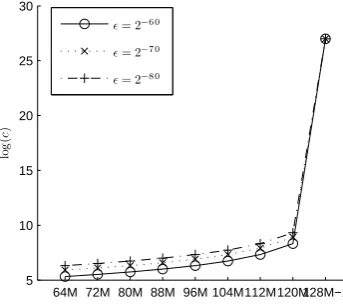
Theorem 2 shows a lower bound on the number of chal-lenged data blocks in order to fulfill (κ, θ)uncheatability. In order to illustrate the impact of the lower bound of c
with parameters κ, θ, n and ϵ, we consider two cases: one file with small min-entropy (1M bits) and the other with large min-entropy (128M bits). With respect to negligible probability 2−80, Figure 2 shows that given a file of 215 data blocks with 1M bits min-entropy, our scheme can ful-fill (1M,960K) uncheatabilityby challenging about 26 data blocks (or 0.1% portions of the data file).
64M 72M 80M 88M 96M 104M112M120M128M−1 5
10 15 20 25 30
θ
lo
g
(
c
)
ǫ= 2−6 0
ǫ= 2−7 0
ǫ= 2−8 0
Figure 3: The impact of θ on the challenge size c:
n= 227 and κ= 128M bits
Figure 3 shows that given a file of 227 data blocks with 128M bits min-entropy, fulfilling (128M,120M)uncheatability
of the data file). This shows that even if the adversary has obtained 93.75% of the data file (e.g., by penetrating into the cloud server in a stealthy fashion and without being de-tected), the attacker cannot cheat against reasonably small challenges.
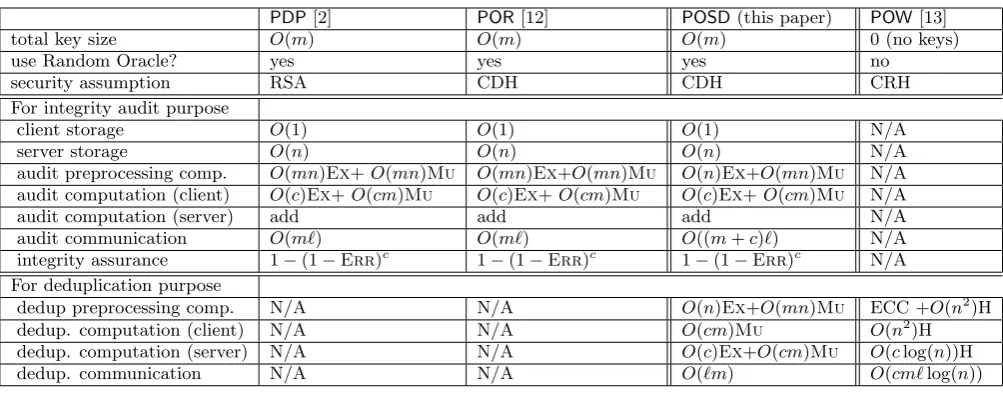
Comparison with some relevant schemes. Because
POSDis the first scheme that simultaneously allows proof of storage integrity and deduplication, in Table 1 we com-pare its efficiency to the most efficientPDP scheme in [2], the most efficientPOR scheme in [12], and the only exist-ing POW scheme in [13], respectively. The two particular
PDPand POR schemes are chosen also because they offer the afore-mentionedpublic verifiability, namely that a third-party can examine the storage integrity on behalf of a client, which is exploited to constructPOSD. ThePOWscheme is the one based on Merkle-tree in [13]; it is chosen because its security is compatible with ourPOSDscheme (there are more efficient but less secure solutions in[13]). Note that in the client storage, we consider a single fileF. In principle, each client can outsources polynomially-many data files to the cloud. In this case, storage of the identifies, fid’s, still can be made constant by letting each client use a Pseudo-random FunctionPRFto generate fid’s from its secret key while maintaining a counter.
From the perspective of assuring cloud data storage in-tegrity, we draw the following observations from Table 1. First, ourPOSD scheme requiresO(n) exponentiations for a client to preprocess a data file before uploading it to the cloud. This complexity is substantially smaller than the preprocessing complexityO(mn) exponentiations of the schemes in [2, 12]. Second, ourPOSDscheme incursO((m+
c)ℓ) communication overhead in the audit process, which is higher than theO(mℓ) communication overhead of thePDP
andPORschemes. To demonstrate that the extra commu-nication is not significant especially when we deal with large files, let us consider the following realistic example. Suppose a data file consists of 227blocks of 28symbols (2.5-GB file if
ℓ= 160). Assume that the probability of block corruption is
Err= 0.01. That is, roughly 221data blocks are corrupted. Suppose we want to achieve 99.5% integrity assurance (i.e., with probability 99.5% the tamperation of a data file is de-tected), the extra communication overhead in our POSD
scheme is only 216bits (8KB). Moreover, it should be noted that thePDPandPORschemes cannot fulfill deduplication. From the perspective of secure data deduplication, , we draw the following observations from Table 1. First, our
POSDscheme is slightly less efficient than thePOWscheme. However, the POW scheme cannot fulfill the auditability of cloud storage security (note that it was well-known that Merkle-tree is not sufficient to fulfillPDP/POR[2, 12, 16]). Second, our POSD scheme incurs smaller communication overhead becauseO(mℓ) is often much smaller thanO(clog(n)mℓ). Third, the POW scheme is indeed secure in the standard model based on the existence of Collision-Resistant Hash (CRH) functions. However, it cannot fulfill auditability of cloud storage integrity.
6.
CONCLUSION
We motivated the need of the cloud storage notion we call proof of storage with deduplication orPOSD, to fulfill data integrity and duplication simultaneously. We also presented an efficient POSD scheme, which is proven secure in the
Random Oracle model based on the Computational Diffie-Hellman assumption. Compared with thePDP/POR/POW
schemes, which cannot achieve one of the two goals, our scheme is as efficient as theirs.
One interesting future work is to remove the random or-acle in the protocol without jeopardizing performance. An-other is to seek a different design methodology for such protocols so as to achieve even substantially better perfor-mance.
7.
REFERENCES
[1] The digital universe decade - are you ready? International Data Corporation, 2010. http://idcdocserv.com/925.
[2] G. Ateniese, R. Burns, R. Curtmola, J. Herring, L. Kissner, Z. Peterson, and D. Song. Provable data possession at untrusted stores. InProceedings of the 14th ACM conference on Computer and
communications security, CCS ’07, pages 598–609, New York, NY, USA, 2007. ACM.
[3] G. Ateniese, R. Di Pietro, L. V. Mancini, and G. Tsudik. Scalable and efficient provable data possession. In Proceedings of the 4th international conference on Security and privacy in communication netowrks, SecureComm ’08, pages 9:1–9:10, New York, NY, USA, 2008. ACM.
[4] G. Ateniese, S. Kamara, and J. Katz. Proofs of storage from homomorphic identification protocols. In
Proceedings of the 15th International Conference on the Theory and Application of Cryptology and Information Security: Advances in Cryptology, ASIACRYPT ’09, pages 319–333, Berlin, Heidelberg, 2009. Springer-Verlag.
[5] K. D. Bowers, A. Juels, and A. Oprea. Proofs of retrievability: theory and implementation. In
Proceedings of the 2009 ACM workshop on Cloud computing security, CCSW ’09, pages 43–54, New York, NY, USA, 2009. ACM.
[6] Y. Dodis, S. Vadhan, and D. Wichs. Proofs of retrievability via hardness amplification. In
Proceedings of the 6th Theory of Cryptography Conference on Theory of Cryptography, TCC ’09, pages 109–127, Berlin, Heidelberg, 2009.
Springer-Verlag.
[7] J. R. Douceur, A. Adya, W. J. Bolosky, D. Simon, and M. Theimer. Reclaiming space from duplicate files in a serverless distributed file system. InProceedings of the 22 nd International Conference on Distributed Computing Systems (ICDCS’02), ICDCS ’02, pages 617–, Washington, DC, USA, 2002. IEEE Computer Society.
[8] C. Erway, A. K¨up¸c¨u, C. Papamanthou, and R. Tamassia. Dynamic provable data possession. In
Proceedings of the 16th ACM conference on Computer and communications security, CCS ’09, pages 213–222, New York, NY, USA, 2009. ACM.
[9] D. Harnik, B. Pinkas, and A. Shulman-Peleg. Side channels in cloud services: Deduplication in cloud storage.IEEE Security and Privacy, 8:40–47, November 2010.
PDP[2] POR[12] POSD(this paper) POW[13]
total key size O(m) O(m) O(m) 0 (no keys)
use Random Oracle? yes yes yes no
security assumption RSA CDH CDH CRH
For integrity audit purpose
client storage O(1) O(1) O(1) N/A
server storage O(n) O(n) O(n) N/A
audit preprocessing comp. O(mn)Ex+O(mn)Mu O(mn)Ex+O(mn)Mu O(n)Ex+O(mn)Mu N/A audit computation (client) O(c)Ex+O(cm)Mu O(c)Ex+O(cm)Mu O(c)Ex+O(cm)Mu N/A
audit computation (server) add add add N/A
audit communication O(mℓ) O(mℓ) O((m+c)ℓ) N/A
integrity assurance 1−(1−Err)c 1−(1−Err)c 1−(1−Err)c N/A
For deduplication purpose
dedup preprocessing comp. N/A N/A O(n)Ex+O(mn)Mu ECC +O(n2)H
dedup. computation (client) N/A N/A O(cm)Mu O(n2)H
dedup. computation (server) N/A N/A O(c)Ex+O(cm)Mu O(clog(n))H
dedup. communication N/A N/A O(ℓm) O(cmℓlog(n))
Table 1: Efficiency comparison between somePDP, POR,POWand ourPOSDschemes, wheren is the number of blocks of a data file, m is the number of symbols of a data block, c is the number of blocks that will be challenged,Err is the probability of block corruption,Exrepresents modular exponentiation operation, Mu represents modular multiplication operation, and N/A indicates that a property is not applicable to a certain scheme.
ACM conference on Computer and communications security, CCS ’07, pages 584–597, New York, NY, USA, 2007. ACM.
[11] T. Okamoto. Provably secure and practical identification schemes and corresponding signature schemes. InProceedings of the 12th Annual
International Cryptology Conference on Advances in Cryptology, CRYPTO ’92, pages 31–53, London, UK, 1993. Springer-Verlag.
[12] H. Shacham and B. Waters. Compact proofs of retrievability. InProceedings of the 14th International Conference on the Theory and Application of
Cryptology and Information Security: Advances in Cryptology, ASIACRYPT ’08, pages 90–107, Berlin, Heidelberg, 2008. Springer-Verlag.
[13] B. P. A. S.-P. Shai Halevi, Danny Harnik. Proofs of ownership in remote storage systems. Cryptology ePrint Archive, Report 2011/207, 2011.
http://eprint.iacr.org/.
[14] M. W. Storer, K. Greenan, D. D. Long, and E. L. Miller. Secure data deduplication. InProceedings of the 4th ACM international workshop on Storage security and survivability, StorageSS ’08, pages 1–10, New York, NY, USA, 2008. ACM.
[15] Q. Wang, C. Wang, K. Ren, W. Lou, and J. Li. Enabling public auditability and data dynamics for storage security in cloud computing.IEEE Trans. Parallel Distrib. Syst., 22:847–859, May 2011. [16] Q. Zheng and S. Xu. Fair and dynamic proofs of