Cryptanalysis for Block Cipher Structures
Shengbao Wu1,2, Mingsheng Wang1
1. State Key Laboratory of Information Security, Institute of Software, Chinese Academy of Sciences, Beijing 100190, PO Box 8718, China 2. Graduate School of Chinese Academy of Sciences, Beijing 100190, China
[email protected] [email protected]
Abstract. Estimating immunity against differential and linear crypt-analysis is essential in designing secure block ciphers. A practical mea-sure to achieve it is to find the minimal number of active S-boxes, or a lower bound for this minimal number. In this paper, we provide a gen-eral algorithm using integer programming, which not only can estimate a good lower bound of the minimal differential active S-boxes for various block cipher structures, but also provides an efficient way to select new structures with good properties against differential cryptanalysis. Exper-imental results for the Feistel, CAST256, SMS4, CLEFIA and General-ized Feistel structures indicate that bounds obtained by our algorithm are the tightest except for a few rounds of the SMS4 structure. Then, for the first time, bounds of the differential active S-boxes number for the MISTY1, Skipjack, MARS and Four-cell structures are illustrated with the application of our algorithm. Finally, our algorithm is used to find four new structures with good properties against differential cryptanaly-sis. Security evaluation against liner cryptanalysis can be processed with our algorithm similarly by considering dual structures.
Key words: block cipher structures, active S-boxes, integer program-ming, differential cryptanalysis.
1
Introduction
An essential assignment of designing a block cipher is to ensure its security against known attacks, especially the two most important cryptanalysis ap-proaches — differential cryptanalysis [2] and linear cryptanalysis [8]. A practical method to achieve it is to estimate the upper bounds of the maximum differential characteristic and linear trail probabilities.
the maximum differential characteristic (linear trail) probability is equivalent to counting the minimal number of differential (linear) active S-boxes in some consecutive rounds, or a lower bound for this minimal number.
There are two classes of methods to count the minimal number of differential (linear) active S-boxes for a block cipher structure with SP-type F-function. One shows it with proofs, which usually enumerate many possible cases artificially to obtain a lower bound. Proof results are useful to indicate the strength of block cipher structures, but sometimes valid for only restricted numbers of rounds. Kanda [7] got the first result for the security of Feistel structure, which then improved by Wang et.al [15]. Wu el.al [16] analyzed the CAST256 structure and obtained the lower bounds of active S-boxes for 8 and 16 round. The lower bounds of active S-boxes number for the CLEFIA and SMS4 structure were concerned by Shibutani [17] and Wang et.al [18] respectively.
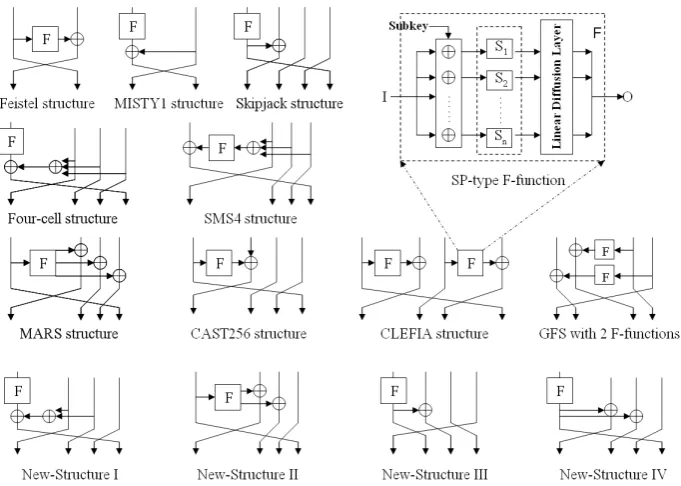
Fig. 1.Some well-known block cipher structures, SP-type F-function and several new structures with good properties against differential cryptanalysis.
general-ized Feistel structures(GFS). A search algorithm is also proposed by Shibutani [17] to dispose the CLEFIA structure.
However, so far, known results are only limited in several structures. Security evaluation for many well-known structures with SP-type F-functions is uncon-scious, such as the MISTY, Skipjack, MARS and Four-cell structures. What’s more, every known proof method or search algorithm is designed based on the specific observations of the target structure. There is not a general method to deal with many block cipher structures simultaneously.
In this work, we focus on counting the minimal number of differential active S-boxes for block cipher structures with SP-type F-functions. We provide a gen-eral algorithm using integer programming, which not only can estimate a good lower bound of the minimal differential active S-boxes for various block cipher structures, but also provides an efficient approach to find new structures with good properties against differential cryptanalysis. Because of the duality between differential characteristic and linear trail [3, 4], our algorithm can be easily ex-tended to the linear cryptanalysis by considering its dual structure. Comparing with the best known results (theoretical or experimental results if they exist) for the Feistel, CAST256, SMS4, CLEFIA and Generalized Feistel structures, the lower bounds obtained by our algorithm are the tightest except for a few rounds of the SMS4 structure. Then, our algorithm is applied to the MISTY1, Skipjack, MARS and Four-cell structures. We get the lower bound of differential active S-boxes for these structures for the first time. Finally, our algorithm is used to find new structures with good properties against differential and linear cryptanalysis. We list four of them in Fig.1, which named as New-Structure I, II, III and IV respectively.
This paper is organized as follows. Section 2 introduces some preliminaries. The algorithm for computing the minimum number of active S-boxes is presented in Section 3. Experimental results of the well-known structures and the new structures are reported in Section 4. Finally, we conclude this paper in Section 5.
2
Preliminaries
2.1 Block Cipher Model
In this subsection, we describe structures in Fig.1 with a general model. The operation between data blocks and in the key addition layer is exclusive-OR.
Definition 1. A (b, ns, r) SP-type block cipher is a block cipher with b data branches,rrounds andnsSP-type F-functions in a round, where all F-functions in thisr-round block cipher are same.
block cipher can be represented generally as the following model:
Ik,j =fj(xk,1, xk,2, . . . , xk,b) = b M
p=1
αj,p·xk,p, (j= 1,2, . . . , ns)
xk+1,i=gi(xk,1, xk,2, . . . , xk,b, Ok,1, Ok,2, . . . , Ok,ns)
= b M
p=1
ζi,p·xk,p⊕ ns
M
q=1
ηi,q·Ok,q, (i= 1,2, . . . , b)
where αj,p, βj,q, ζi,p, ηi,q ∈ {0,1}. For the convenience of discussions, the nota-tionsxk,i,Ik,jandOk,jwill be renamed asxb·(k−1)+i,Ins·(k−1)+jandOns·(k−1)+j
respectively in the subsequent discussions.
For example, the Feistel structure with SP-type F-function is a (2,1, r) SP-type block cipher. Itsk-th round relations are:
Ik=x2·(k−1)+2; x2·k+1=x2·(k−1)+2; x2·k+2=x2·(k−1)+1⊕Ok.
Moreover, the MISTY1, Skipjack, CAST256, SMS4, MARS, Four-cell, CLE-FIA and GFS structures with SP-type F-function are in the block cipher model. Of course, many structures that don’t list in Fig.1 are included in this model. Note that, equations in the block cipher model above are also hold when each data is substituted to its difference. Such equations are called difference-based relations of a block cipher structure.
2.2 Solve Linear Systems and Integer Programming
Gauss-Jordan elimination [20] can be adopted to solve a linear system, which gets the solution by reducing the augmented matrix of this system to reduced row echelon form using elementary row operations.
Sometimes, we must consider the optimization problem:
min N X
j=1
cjxj, subject to (1)
8 < :
N P j=1
aijxj≥di (i= 1,2, . . . , M)
xj integer (for some or allj= 1,2, . . . N)
(2)
2.3 Definitions
Let ∆I denotes the difference of I. Then, the following definitions are used in this paper.
Definition 2. Let λ= (λ1, . . . , λn)∈ Fmn2 , whereλj ∈ Fm2 (1 ≤j ≤n). The hamming weightwtof λis denoted as the number of nonzero components in λ, that is,wt(λ) = #{λj|λj ̸= 0,1≤j≤n}.
Definition 3. Let a(b, ns, r)SP-type block cipher be given. A differential input pattern is a vector v ∈ {0,1}ns·r, where the i-th element of v is ′0′ represents
that ∆Ii= 0,′1′ represents that ∆Ii̸= 0.
Definition 4. The differential branch number of a linear diffusion layer P in the F-function is defined as Bd= min∆λ̸=0{wt(∆λ) + wt(P(∆λ))}, where∆λis the input difference of P.
Since the key addition layer, S-boxes and linear diffusion layerP are bijective in an SP-type F-function, we have (1)∆O= 0 if and only if∆I= 0 and∆O̸= 0 if and only if∆I ̸= 0; (2)Bd= min∆I̸=0{wt(∆I) + wt(∆O)}.
3
Algorithm
In this section, we present a united algorithm to compute a lower bound of the minimal number of differential active S-boxes for anyr-round structure included in the (b, ns, r) model.
3.1 Idea of the Algorithm
For a given (b, ns, r) block cipher structure, allrround difference-based relations concerning with the structure can be viewed as a homogeneous linear systemΦr with variables (∆x1, ∆x2, . . . , ∆xb·(r+1), ∆I1, . . . , ∆Ir·ns, ∆O1, . . . , ∆Or·ns). Φr
has at least one solution, known as the zero solution. But it’s a trivial solution when we consider differential cryptanalysis.
To compute the minimal number of differential active S-boxesDr, we need to solve linear systemΦrand compute the number of active S-boxes involved in each nontrivial solution. But it’s difficult to do this. For one thing, the specification of F-functions is unknown, which results in the impossibility of checking whether every solution is correct; For another, the computational ability might be another problem to obtain all concrete solutions.
To conquer these difficulties, we try to find a lower bound of Dr in our algorithm. Firstly, the limitation of F-functions is relaxed. For a given input difference∆I ̸= 0, the output difference∆Ocan be any nonzero difference. This relaxation may increase the solutions of Φr, which leads our algorithm to find only a lower bound ofDr. Then, linear systemΦris divided into 2ns·rrestricted linear systemsΦvr according to the 2ns·rpossible differential input patternsv of (∆I1, . . . , ∆Ir·ns). For a given v, Φ
v
∆Ii= 0 and∆Oi= 0 toΦrfor all vi= 0. Finally, for each restricted linear sys-temΦvr, we solve it and exhaust all nontrivial solutions to deduce a lower bound of Dvr, whereDvr= min{
Pns·r
i=1 wt(∆Ii) : for all nontrivial solutions satisfyingΦ v r}. The final lower bound ofDr= min{lower bound ofDvr: for eachv that makes Φvr have nontrivial solutions}.
However, two questions arise in the final step. (Q1) For a given differential input patternv, is there a nontrivial solution satisfyingΦv
r? (Q2) How to evaluate a tight lower bound ofDv
r whenΦvr has at least a nontrivial solution? LetMv
r be the coefficient matrix ofΦvr with column ordering (∆x1, ∆x2, . . . , ∆xb·(r+1), ∆I1, . . . , ∆Ir·ns, ∆O1, . . . , ∆Or·ns). And let M
v
r be the reduced row echelon form of Mv
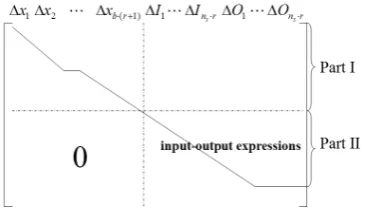
r (See Fig.2). Expressions corresponding to Mrv can be par-titioned into Part I and Part II. Part I consists of expressions involving ∆Iis, ∆Ois and at least one of∆xis as variables; Part II consists of expressions only containing∆Iis and∆Ojs as variables.
Fig. 2.A possible form ofMv
r, where all nonzero elements lie above the echelon line.
Now, questionQ1can be solved by observingMv
r. On the one hand, there is only a zero (trivial) solution if the rank ofMv
r is equal to the number of columns; On the other hand, there is not any solution when we observe a contradiction in Mv
r, which happens in such a manner: an equation∆Ii= 0 or∆Oi= 0 is found in Part II ofMv
r butviis 1 in the differential input patternv.
Then, we consider question Q2 for each differential input pattern v that passes through questionQ1. According toDv
r, the only useful part in a nontrivial solution for counting the number of active S-boxes is the value of (∆I1, . . . , ∆Ins·r).
And every solution satisfying Part II of Mv
r can be extended to at least a so-lution satisfying all expressions in Mv
r with same active S-boxes. So, we only concern solutions satisfying expressions in Part II ofMv
Proposition 1. Let an input-output expression be given:
∆Iu1⊕∆Iu2⊕ · · · ⊕∆Iup=∆Ow1⊕∆Ow2⊕ · · · ⊕∆Owq
where ui, wj ∈ {1,2, . . . , ns·r}, p+q ≥ 2, and ∆Iui ̸= 0, ∆Owj ̸= 0 for all
i= 1, . . . , p,j = 1, . . . , q. Then we have
1) If(p= 1or q= 1)andui≠ wj for alli= 1, . . . , pandj= 1, . . . , q, then p
X
i=1
wt(∆Iui) +
q X
j=1
wt(∆Iwj)≥ Bd, (3)
2) Ifp= 1 and there exists aj0∈ {1,2, . . . , q} subjecting to u1=wj0, then
2wt(∆Iu1) +
X
j∈{1,...,q}\{j0}
wt(∆Iwj)≥ Bd, (4)
3) Ifq= 1and there exists an i0∈ {1, . . . , p}subjecting to ui0 =w1, then
2wt(∆Iw1) +
X
i∈{1,...,p}\{i0}
wt(∆Iui)≥ Bd, (5)
4) If(p= 2andq= 0)or(p= 0andq= 2), then
wt(∆Iu1) = wt(∆Iu2) or wt(∆Iw1) = wt(∆Iw2), (6)
5) Else,wt(∆Iui)≥1,wt(∆Iwj)≥1, i= 1, . . . , p, j= 1, . . . , q.
Proof. Clearly, wt(∆Ii) = wt(∆P−1(Oi)).
1) If q = 1, then p P i=1
wt(∆Iui) + wt(∆Iw1) ≥ wt(
p L i=1
∆Iui) + wt(∆Iw1) =
wt(∆Ow1) + wt(∆Iw1)≥ Bd.
Ifp= 1, then∆Iu1=
q L
j=1
∆Owj =P(
q L
j=1
∆P−1(O
wj)) =P(∆
q L
j=1 P−1(O
wj)).
Hence wt(∆Iu1) +
q P
j=1
wt(∆Iwj) = wt(∆Iu1) +
q P
j=1
wt(∆P−1(Owj))
≥wt(P(∆ q L
j=1 P−1(O
wj))) + wt(∆
q L
j=1 P−1(O
wj))≥ Bd.
2) Without loss of generality, letj0 = 1. Using the same reasons as in 1), we have 2wt(∆Iu1) +
q P
j=2
wt(∆Iwj) = wt(∆Iu1) +
q P
j=1
wt(∆P−1(Owj))≥ Bd.
3) Without loss of generality, let i0 = 1. Then, 2wt(∆Iw1) +
p P
i=2
wt(∆Iui) ≥
wt( p L
i=1
4) Obviously, when p= 2 andq = 0, we have wt(∆Iu1) = wt(∆Iu2). If p= 0
and q = 2, then ∆Ow1 = ∆Ow2. Hence ∆P−
1(O
w1) = ∆P−
1(O
w2). So,
wt(∆Iw1) = wt(∆P−
1(O
w1)) = wt(∆P−
1(O
w2)) = wt(∆Iw2).
5) In this case, no obvious relations between ∆Iui (i = 1, . . . , p) or ∆Owj
(j = 1, . . . , q) can be found. So, we only know that wt(∆Iui) ≥ 1, and
wt(∆Iwj)≥1 fori= 1, . . . , p, j= 1, . . . , q.
LetΛv
r be the expressions in Part II ofMrv except all ∆Ii= 0 and∆Oi= 0, Sv
r be the linear space generated by the expressions in Λvr over F2. 1 Then, all input-output expressions which fulfill the requirements in proposition 1 are contained inSv
r\{0}. Now, the second questionQ2for a given differential input patternv is reduced to solve the following pure integer programming problem:
min r·ns
X
i=1
wt(∆Ii), subject to (7)
8 < :
Inequalities and equations deduced fromSrv\{0}by proposition 1 wt(∆Ii) = 0 ifvi= 0
wt(∆Ii)≥1 ifvi= 1
(8)
3.2 An Algorithm
By the analysis of subsection above, the pseudo-code of a basic algorithm for estimating a lower bound ofDr is described as follows.
Input: Thek-th round difference-based relations of a given structure.
Output: A lower bound ofDr.
Dr← ∞;
Generate the linear systemΦr;
forevery differential input patternvdo
1
Generate the restricted linear systemΦvr and adoptGauss-Jordan
2
eliminationto obtain the reduced row echelon form matrixMv r;
if vis a pattern which passes through the questionQ1 then
3
Obtain the linear spaceSv r;
4
if Srv\{0}=∅then
5
Dv
r =wt(v);
6
else
Use proposition 1 to select all useful constraint conditions supplied 7
by expressions inSv
r\{0}and solve the integer programming
8
problem (7) to obtain a lower boundDrv;
IfDvr < Dr, thenDr←Drv;
returnDr.
Algorithm 1: Pseudo-code of a basic algorithm for computing Dr 1
Algorithm Complexity. The time complexity of this algorithm is domi-nated by step 1, 7 and 8 in Algorithm 1. However, it’s hard to achieve the accurate time complexity because the elimination of differential input patterns in step3and the number of constraint conditions obtained in step7vary from structure to structure. The worst size of constraint conditions for a givenr-round block cipher structure is 2r·ns−1. So, the worst case of this algorithm should
solve 2r·ns integer programming problems with r·n
s variables and 2r·ns −1 constraint conditions.
3.3 An Improved Algorithm
In general,Algorithm1 may be inefficient becauseSv
r contains all linear rela-tions derived fromΛv
r. In this subsection, we present an improved algorithm. We try to improve the dominating steps1,7and8ofAlgorithm1 in two aspects. For one thing, using the results of smaller rounds to reduce the times of solving integer programming problems. This idea is proposed by Matsui [9] and used in [14]; For another, reducing the number of input-output expressions involved in step 4can reduce the size of integer programming problems. That is, we only consider a subsetSr,ev ⊆Srv\{0} in the improved algorithm.
How to choose a suitable subset Sr,ev of input-output expressions is a chal-lenging problem. On the one hand, a largeSr,ev may generate many reduplicate constraint conditions that affect the efficiency of the algorithm; On the other hand, a smallSv
r,emay miss some useful constraint conditions that influence the tightness of results.
By comparing many experimental results, we suggest a manner here. LetMv r,e be the coefficient matrix of Φv
r with column ordering (∆x1, ∆x2, . . . , ∆xb·(r+1), ∆O1, . . . , ∆Or·ns, ∆I1, . . . , ∆Ir·ns). That is, in the matrixM
v
r, we exchange its (b·(r+1)+j)-th column with (b·(r+1)+r·ns+j)-th column for allj= 1, . . . , r·ns. Similarly, we have a corresponding matrixMv
r,e and an expression setΛvr,e here. NowSv
r,e consists of four parts: i) Expressions inΛvr; ii) Expressions inΛvr,e ; iii) The sum of every two distinct expressions in Λv
r overF2; iv) The sum of every two distinct expressions inΛv
r,e overF2.
Instead of considering all 2l−1 input-output expressions inSvr\{0}, the size ofSr,ev is reduced tol·(l+ 1) now, wherelis the number of expressions inΛvr.
In the improved algorithm Algorithm 2, we use Di to store the minimal number of active S-boxes for i-round block cipher. Set is used to store the information of foregoing rounds. Every elementE in Sethas four components: E[1] is a differential input pattern which belongs to {0,1}ns·(i−1), where i is
the number of current round;E[2] represent the round number ofE[1], that is, E[2] =i−1;E[3] is a lower bound of DE[1]i−1; E[4] indicates the corresponding round number ofE[3]. Binary(j, ns) converts the integerj into a binary vector with length ns. a||b combines vector a and b to a new vector. For example, [0,1]||Binary(1,2) = [0,1]||[0,1] = [0,1,0,1].
the value of DE[2] will not be renewed in this case, which means that we don’t need to solve the integer programming problem here.
Input: Thek-th round difference-based relations of a given structure.
Output: Lower bounds ofDifor 0≤i≤r.
D0←0,Di← ∞(i= 1. . . r) andSet← {[[],0,0,0]};
fori←1tordo
Generate the linear systemΦi;
[Set, Di] =SubFun(Set,Φi);
returnDi(i= 1, . . . , r);
SubFun(Set,Φi)
tempSet← ∅;
while Set̸=∅do
E←Random(Set); /* Select a random element in Set. */ forj←0to2ns−1do
v←E[1]||Binary(j, ns),E[2]←E[2] + 1;
Obtain the restricted linear systemΦvE[2]and adoptGauss-Jordan eliminationto obtain the matrixMv
E[2];
if vis a pattern which passes through the questionQ1 then if E[3] +DE[2]−E[4]< DE[2]then
1
ComputeDvE[2] by using the step4to8of Algorithm1. Of
course,Sv
E[2]\{0}is replaced byS
v
E[2],ehere;
tempSet←tempSet∪ {[v, E[2], DvE[2], E[2]]};
IfDv
E[2]< DE[2], thenDE[2]←DEv[2]; else
tempSet←tempSet∪ {[v, E[2], E[3], E[4]]};
Set←Set\ {E};
Set←tempSet;
return[Set, Di];
Algorithm 2: Pseudo-code of an improved algorithm for computing Dr
Algorithm Complexity.The worst time complexity of this algorithm for the final round should solve 2r·ns integer programming problems with r·n
s variables andO(r2·n2
s) constraint conditions. And it costs 4·(r−1)·ns·2(r−1)·ns bits at most to store the temporarySet, where 4 is the number of components in every element E and (r−1)·ns is the binary length of E[1] which is the dominating component inE for storage.
4
Experimental Results
directly use the function ”MinimalIntegerSolution” provided in Magma to solve integer programming problems. The function returns a vector which represents an optimal solution of the problem. What we are interested is the minimal sum of the optimal solutions for some consecutive rounds of a structure.
We choose Bd = 5 to illustrate experimental results since it is a widely used branch number in many well-known block ciphers, such as AES, Camellia, CLEFIA and SMS4. And all results for a structure list in Table 1 can be got in hours on a 2.66 Ghz processor. We record results up to 25 or 26 F-functions (⌈n25
s⌉ rounds) for all structures illustrated in Fig.1 except for the SMS4 and
MARS structures, whose results are only up to 21 rounds.
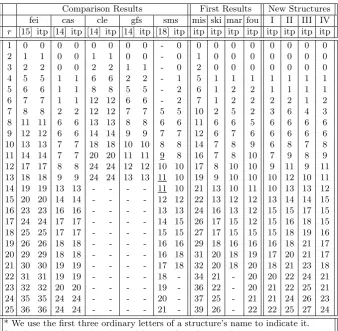
Table 1.Lower bounds ofDr for some block cipher structures
Comparison Results First Results New Structures
fei cas cle gfs sms mis ski mar fou I II III IV
r [15] itp [14] itp [14] itp [14] itp [18] itp itp itp itp itp itp itp itp itp
1 0 0 0 0 0 0 0 0 - 0 0 0 0 0 0 0 0 0
2 1 1 0 0 1 1 0 0 - 0 1 0 0 0 0 0 0 0
3 2 2 0 0 2 2 1 1 - 0 2 0 0 0 0 0 0 0
4 5 5 1 1 6 6 2 2 - 1 5 1 1 1 1 1 1 1
5 6 6 1 1 8 8 5 5 - 2 6 1 2 2 1 1 1 1
6 7 7 1 1 12 12 6 6 - 2 7 1 2 2 2 2 1 2
7 8 8 2 2 12 12 7 7 5 5 10 2 5 2 3 6 4 3
8 11 11 6 6 13 13 8 8 6 6 11 6 6 5 6 6 6 6
9 12 12 6 6 14 14 9 9 7 7 12 6 7 6 6 6 6 6
10 13 13 7 7 18 18 10 10 8 8 14 7 8 9 6 8 7 8
11 14 14 7 7 20 20 11 11 9 8 16 7 8 10 7 9 8 9
12 17 17 8 8 24 24 12 12 10 10 17 8 10 10 9 11 9 11
13 18 18 9 9 24 24 13 13 11 10 19 9 10 10 10 12 10 11
14 19 19 13 13 - - - - 11 10 21 13 10 11 10 13 13 12
15 20 20 14 14 - - - - 12 12 22 13 12 12 13 14 14 15
16 23 23 16 16 - - - - 13 13 24 16 13 12 15 15 17 15
17 24 24 17 17 - - - - 14 15 26 17 15 12 15 16 18 15
18 25 25 17 17 - - - - 15 15 27 17 15 15 15 18 19 16
19 26 26 18 18 - - - - 16 16 29 18 16 16 16 18 21 17
20 29 29 18 18 - - - - 16 18 31 20 18 19 17 20 21 17
21 30 30 19 19 - - - - 17 18 32 20 18 20 18 21 23 18
22 31 31 19 19 - - - - 18 - 34 21 - 20 20 22 24 21
23 32 32 20 20 - - - - 19 - 36 22 - 20 21 22 25 21
24 35 35 24 24 - - - - 20 - 37 25 - 21 21 24 26 23
25 36 36 24 24 - - - - 21 - 39 26 - 22 22 25 27 24
4.1 Compare with Known Results
Results obtained by our algorithms in this paper for the Feistel, CAST256, CLE-FIA, GFS with 2 F-functions and SMS4 structures are shown in the first big column of Table 1. For comparison, the best previous results (theoretical or ex-perimental results if they exist) are also illustrated. From the result table 1, we observe that lower bounds of Dr obtained by our algorithms are the tightest except for only a few rounds of the SMS4 structures, which are round 11,13 and 14. Comparison results demonstrate that our algorithms is correct and acquire tight bounds.
4.2 Apply to Other Well-known Structures
With the application of our algorithm, we give the first security evaluation for the MISTY, Skipjack, MARS and Four-cell structures against differential crypt-analysis in the second big column of Table 1.
In [10], the conclusion shows that the MISTY1 structure is structurally stronger than the Feistel structure with both differential and linear cryptanalysis under the condition that allS-boxes are bijective. The result of our algorithm confirms this again when they have the same SP-type F-function.
Forr≤21 rounds, we observe that the lower bounds of Dr for the MARS structure are same to that of the SMS4 structure when they have same Bd. In fact, it’s the dual structure of the SMS4 structure, which indicates that the SMS4 structure has same immunity against differential and linear cryptanalysis.
4.3 Find New Structures
Although many structures have been adopted in designing block ciphers, the number of them is negligible in comparison with that included in the general (b, ns, r) model. Some structures with good immunity against differential and linear cryptanalysis may hide in this model. Our algorithms provide a way to select them out. In Fig.1, we display four of them, which are named as New-Structure I, II, III and IV respectively.
SMS4 is a concrete 128-bit block cipher in the (4,1, r) SP-type block cipher model withBd= 5. Since the maximum differential probabilitypsfor an active S-box in SMS4 isps= 2−6, we need at least 22 active S-boxes to guarantee its immunity against differential cryptanalysis. Look up lower bounds in Table 1 and [18], 26 round2of SMS4 is requested to provide 22 active S-boxes.
If we replace the underlying structure of SMS4 with other structures in the (4,1, r) block cipher model in Fig.1, we conclude that other structures require less rounds (See Table 2) for immunity against differential cryptanalysis than the SMS4 structure except the MARS structure.
Results in Table 2 indicate that we indeed find some new structures with good properties against differential cryptanalysis. Especially for the New-Structure II 2 Although we don’t get this bound by our algorithm directly, we can harness the
Table 2.Rounds needed for providing 22 active S-boxes
Name SMS4 MARS CAST256 Skipjack Four-cell New I New II New III New IV
Round 26 26 24 23 25 25 22 21 24
and III, they are better than any other well-known structures involved in Table 2.
5
Conclusions
In this paper, a unified algorithm is proposed to evaluate the lower bounds of the minimal number of differential active S-boxes for block cipher structures contained in the general model, which includes the Feistel, MISTY1, CAST256, Skipjack, SMS4, CLEFIA, MARS, Four-cell and GFS structures as instances. Although it’s a general algorithm, our experimental results have indicated its exactness and efficiency.
Thanks to the symmetrical role of ∆Iui and ∆Owj in Proposition 1, our
algorithm can be directly used in linear cryptanalysis to count the minimal number of linear active S-boxes by considering the dual structures.
Moreover, our algorithms provide an approach to find new structures with good properties against differential cryptanalysis in the block cipher model of section 2. Some new structures are displayed in Fig.1. We believe that more useful structures can be found with the help of our algorithm.
References
1. Aoki, K., Ichikawa, T., Kanda, M., et al: Camellia: A 128-bit Block Cipher Suitable for Multiple Platforms - Design and Analysis. Stinson, D. R., Tavares, S. (eds.) SAC 2000, LNCS, vol. 2012, pp. 39-56. Springer, Heidelberg (2001)
2. Biham, E., Shamir, A.: Differential Cryptanalysis of DES-like Cryptosystems. Jour-nal of Cryptology, Vol.4, No.1, pp. 3-72 (1991)
3. Biham, E.: On Matsui’s Linear Cryptanalysis. Santis, A. D. (eds.) Eurocrypt’94, LNCS, vol. 950, pp. 222-238. Springer, Heidelberg (1995)
4. Matsui, M.: On Correlation Between the Order of S-boxes and the Strength of DES. Santis, A. D. (eds.) Eurocrypt’94, LNCS, vol. 950, pp. 366-375. Springer, Heidelberg (1995)
5. Daemen, J., Rijmen, V.: The Design of Rijndael: AES - The Advanced Encryption Standard. Springer-Verlag (2002)
6. Diffe, W, Ledin, G(translators).: SMS4 Encryption Algorithm for Wireless Net-works. Cryptology ePrint Archive, report 2008/329, received 29 Jul 2008. http: //eprint.iacr.org/
7. Kanda, M.: Practical Security Evaluation against Differential and Linear Crypt-analyses for Feistel Ciphers with SPN round function. Stinson, D. R., Tavares, S. (eds.) SAC’2000, LNCS, vol. 2012, pp. 324-338. Springer, Heidelberg (2001) 8. Matsui, M.: Linear Cryptanalysis Method for DES Cipher. Helleseth, T. (eds.)
9. Matsui, M.: Differential Path Search of the Block Cipher E2. Technical Report, ISEC99-19 (1999)
10. Matsui, M.: New Structure of Block Ciphers with Provable Security against Dif-ferential and Linear Cryptanalysis. Gollmann, D. (eds.) FSE’96, LNCS, vol. 1039, pp. 205-217. Springer, Heidelberg (1996)
11. Shirai, T., Preneel, B.: On Feistel Ciphers Using Optimal Diffusion Mappings across Multiple Rounds. Lee, P. J. (eds.) Asiacrypt’04, LNCS, vol. 3329, pp. 1-15. Springer, Heidelberg (2004)
12. Shirai, T., Shibutani, K.: On Feistel Structures Using a Diffusion Switching Mecha-nism. Robshaw, M. (eds.) FSE’06, LNCS, vol. 4047, pp. 41-56. Springer, Heidelberg (2006)
13. Shirai, T., Shibutani, K., Akishita, T., et al.: The 128-bit Blockcipher CLEFIA. Biryukov, A. (eds.) FSE’07, LNCS, vol. 4593, pp. 181-195. Springer, Heidelberg (2007)
14. Shirai, T., Araki, K.: On Generalized Feistel Structures Using the Diffusion Switch-ing Mechanism. IEICE Trans. Fundam. Electron. Commun. Comput. Sci. vol. E91-A, No. 8, pp. 2120-2129 (2008)
15. Wang, N., Jin, C.: Security Evaluation against Differential and Linear Cryptanal-yses for Feistel Ciphers. Frontiers of Computer Science in China, Vol.3(4) (2009) 16. Wu, W., Zhang, W., Lin, D.: On the Security of Generalized Feistel Scheme with
SP Round Function. International Journal of Network Security, Vol.3, No.3, pp. 215-224 (2006)
17. Shibutani, K.: On the Diffusion of Generalized Feistel Structures Regarding Differ-ential and Linear Cryptanalysis. Biryukov, A. (eds.) SAC 2010,LNCS, vol. 6544, pp. 211-228. Springer, Heidelberg (2011)
18. Wang, M., Liu, J., Wang, X.: The upper bounds on differential characteristics in block cipher SMS4. Cryptology ePrint Archive, report 2010/155, received 25 Mar 2010,http://eprint.iacr.org/
19. Bosma, W., Cannon, J., Playoust, C.: The MAGMA Algebra System I: The User Language. In Journal of Symbolic Computation, Vol. 24, Issues 3-4, pp. 235-265 (1997)
20. Meyer, C. D.: Matrix Analysis and Applied Linear Algebraic. Cambridge University Press (2001).