Computing endomorphism rings
of elliptic curves under the GRH
Gaetan Bisson
LORIA, 54506 Vandœuvre-l`es-Nancy, France TU/e, 5600 MB Eindhoven, The Netherlands
Abstract
We design a probabilistic algorithm for computing endomorphism rings of ordinary elliptic curves defined over finite fields that we prove has a subexponential runtime in the size of the base field, assuming solely the generalized Riemann hypothesis.
Additionally, we improve the asymptotic complexity of previously known, heuristic, subexponential methods by describing a faster isogeny-computing routine.
1
Introduction
Endomorphism rings of ordinary elliptic curves over finite fields are central objects in complex multiplication (CM) theory; as such, they appear in various computational number-theoretic contexts. For instance, the CM method for generating curves with a prescribed number of points relies on evaluating so-called Hilbert class polynomials, for which the state-of-the-art algorithm of [18] requires an endomorphism-ring-computing subroutine. They are also potentially relevant security parameters in certain cryptographic applications.
They were first studied by Kohel [12] who, assuming the generalized Riemann hypothesis (GRH), gave a deterministic method for computing them in time
O(q1/3+) where qis the cardinality of the base field. Recently, a probabilistic algorithm with subexponential complexity in logqwas obtained in [2] by relying on several additional assumptions; its runtime is
L(q) √
3/2+o(1) where L(x) = expp
logxlog logx.
Additionally, we use a more direct, faster isogeny-computing routine than [2] which allows us to bring down the exponent in the complexity. Explicitly, on input an ordinary elliptic curveE defined over a finite fieldFq our main algorithm outputs the structure of its endomorphism ring EndE in proven (under the GRH) probabilistic time
L(q)1+o(1)+L(q)1/ √
2+o(1)
where the first term only accounts for the cost of factoring of a certain integer less than 4qusing the state-of-the-art proven method of Lenstra and Pomerance [14]; in other words, apart from that factorization, we were able to adapt and prove under the GRH all parts of the heuristic subexponential method above while improving its asymptotic complexity.
Section 2 fixes notations on endomorphism rings and orders. Section 3 then presents the order-testing method using “relations”. Section 4 gives the direct-but-fast isogeny-computing routine. Section 5 describes our lattice-ascending procedure and main algorithm. Section 6 proves that class groups are character-ized by short relations. Section 7 finally shows how orders are determined by their class groups.
2
Background
LetEbe an ordinary elliptic curve defined over a finite fieldFq. The Frobenius endomorphism πacts on geometric points ofE by raising their coordinates to theqthpower; its characteristic polynomialχπ(x) is of the formx2−tx+qand computing the integer t is equivalent to finding the number of points on the curve, namelyχπ(1). Schoof showed in [15] how this can be done in deterministic polynomial time in the size of the base field, logq.
Many endomorphisms stem from the Frobenius endomorphism, as Deuring proved in [6] thatQ⊗EndE 'Q(π). Since the number fieldK=Q[x]/(χπ(x)) is isomorphic toQ(π), by computing the tracetwe have already determined the endomorphism ring “up to fractions”. From now on, we make this isomorphism implicit by settingπ=x.1
The number fieldK is called the CM field ofE; the implicit isomorphism maps EndE to an order inK so we have
Z[π]⊆EndE ⊆ OK
whereOK is the ring of integers ofK. Conversely, Waterhouse proved in [21, Theorem 4.2] that all orders containingZ[π] arise as endomorphism rings. The
index [OK :Z[π]] is essentially the square part of the discriminant ∆ =t2−4q;
this measures how broad the search-range is: in the worst case, it can be exponential (in logq).
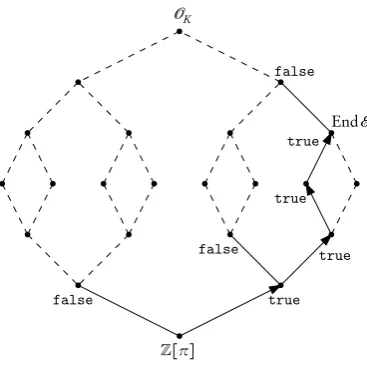
The orders ofK containing Z[π] form a finite lattice (in the set-theoretic sense) whereOK is the maximal order,Z[π] the minimal one, and EndE lies in
between. Unfortunately it might have exponentially many orders so we need to devise a better way of finding EndEthan testing each in turn; this is the purpose of the lattice-ascending algorithm of Section 5 which tests only polynomially many orders. For those orders O, we “test” whether O ⊆ EndE with the methodology of Section 3 which we develop in Sections 6 and 7.
1The conjugate ofxmight equivalently be taken asπ; this choice just needs to be made
3
The CM approach
We now present the approach of [2] to testing whether O ⊆ EndE in a somewhat more abstract flavor. For the theory of imaginary quadratic orders, we refer to [5].
In this paper, it is implicitly understood that we exclusively consider ideals of norm coprime to ∆, so that their images inZ[π] are unramified and invertible.
Since every (invertible) ideal class of each order containingZ[π] has a
represen-tative of this type, this has no effect on our use of class groups, which arises from the following result of CM theory.
Theorem 3.1. When a is an ideal of EndE, denote by φa the isogeny with
kernel T
α∈akerα. The ideal class groupcl(O)acts faithfully and transitively on
the set of isomorphism classes of elliptic curves with endomorphism ring O by a:E 7→φa(E).
Intuitively, the structure of the class group dictates that of the isogeny graph; hence, by looking at the latter, we might deduce things on the former and obtain information about the endomorphism ring. This action is effective, as embodied in Proposition 4.4. In this setting, we formalize the notion of “structure” by the following concept.
Definition. We define relations as multisets of ideals of Z[π]. We say that
a relation R holds in an orderO (or that it is a relation ofO) if the product
Q
a∈RaO is trivial in cl(O); we say that it holds in the isogeny graphif the
composition of the isogeniesφaEndE fora∈R fixesE.
The theorem implies that a relation holds in EndE if and only if it holds in the isogeny graph, which gives a way to tell the endomorphism ring apart from other orders of the lattice (we will see in the next section thatφaEndE can be computed without knowing EndE).
To avoid testing all orders, we rely on this simple result from [5, Chapter 7]:
Lemma 3.2. If a relation holds in some order, it also does in all orders con-taining it.
Intuitively, as we ascend the lattice of orders, more and more relations hold, which also translates into class groups getting smaller. This is why we chose
Z[π] to be the ring of our ideals: via the morphisma7→aOwe can map ideals
ofZ[π] to any order above in a way that induces surjective morphisms of class
groups.
To search for the endomorphism ring EndE in the lattice, we will “test” whether ordersOlie below it by selecting relations of them and checking whether they hold in the isogeny graph. Before we describe that procedure in detail, let us mention how to compute isogenies.
4
Computing the CM action
To make use of Theorem 3.1, we need to work with isomorphism classes
j-invariants are the same. Computing the cardinality takes polynomial time, and since thej-invariant is a rational function in the coefficients of a Weierstrass equation, it does not take longer to evaluate it. In the following, it is implicitly understood that we work with isomorphism classes via this representation.
To evaluate the actionφa(E) of an ideala, we combine classical tools:
Algorithm 4.1.
Input: An elliptic curveE/Fq with Frobenius polynomialχπ and an ideal a. Output: The isogenous elliptic curveφa(E).
1. Find a basis(Pi)of the`-torsion ofE overFq`−1 where`= norm (a). 2. Write the matrix M of the Frobenius endomorphism on the basis(Pi). 3. Compute the eigenspaces ofM ∈Mat2(Z/`Z).
4. Determine which is the kernel of the isogeny φa. 5. Compute this isogeny.
Step 5 computesφa from its kernel, which V´elu’s formulæ [19] do in O(`) curve operations over Fq`−1. Step 4 relies on an idea from the SEA algorithm
found in [8, Stage 3]:
Proposition 4.2. Letabe an ideal ofOof prime norm`; write it as`O+u(π)O
where the polynomial uis an irreducible factor ofχπ mod`. The characteristic
polynomial of the restriction to the kernel ofφa of the Frobenius endomorphism isu.
Since the map a 7→ aO from ideals of Z[π] preserves their norm ` and polynomialu, there is no need to knowO to computeφaO; this is particularly useful forO= EndE.
Step 2 decomposesπ(Pi) asPj∈{1,2}MijPj for which a baby-step giant-step approach requires O(`) operations in E/Fq`−1. Step 3 is classical and takes
quasi-linear time in log`; it outputs theFq-rational subgroups ofE[`] isomorphic toZ/`Z.
Finally, Step 1 uses the fact that points of rational subgroups of order`are necessarily defined over an extension of degree `−1; it proceeds by selecting random`k-torsion points over this extension and lifting one along the other to obtain independent`-torsion points. This idea originates from [4, Theorem 1] to which we refer for details.
Algorithm 4.3.
Input: An elliptic curveE/Fq with Frobenius polynomialχπ and a prime`. Output: A basis of the `-torsionE[`]of E overFq`−1.
a. Decompose#E(Fq`−1)asm`k where`-m.
b. Let P andQbem times random points ofE(Fq`−1); c. Compute the order`kP ofP and`kQ ofQand assume k
P ≥kQ.
d. Precompute the table(i, i`kP−1P) fori∈ Z/`Z.
e. Forj fromkQ−1down to1:
f. If `jQ=i`kP−1P for somei, setQ←Q−i`kP−j−1P.
g. If Q= 0E then go back to Step b.
h. Return(`kP−1P, `kQ−1Q).
requires O(`logq) operations inFq`−1. Similarly, bothkP andkQ are bounded
byk=O(`logq). The lookup in Step f is negligible if an efficient data structure such as a red-black tree is used to store the precomputed table of Step d. Finally, the probability of going back to Step b isO(1/`) as proven in [4].
Using fast arithmetic, operations inFq`−1 take at most (`logq)1+o(1) time,
so we have:
Proposition 4.4. Algorithm 4.1 returns the curve φaEndE(E) isogenous to
a prescribed curve E/Fq in probabilistic time O(`2+o(1)log2+o(1)q), where `= norm (a).
5
Ascending the lattice of orders
Orders in an imaginary quadratic fieldKare of the formZ+fOK for some
f ∈Nknown as the conductor; inclusion of orders corresponds to divisibility of
conductors. Those orders we are interested in containZ[π] so their conductors
divide the index [OK:Z[π]].
We will be ascending the lattice of orders one step at a time: each step consists in enumerating all orders lying directly above a prescribed order, that is, containing it with prime index`. The possible values for` are the prime factors of [OK:Z[π]] which can be listed by factoring (the square-part of) the
discriminant ∆, for which the state-of-the-art proven method of Lenstra and Pomerance [14] uses L(q)1+o(1) operations. Enumerating orders above (resp.
below) then simply amounts to dividing (resp. multiplying) the conductor by the possible `’s; naturally, since our orders are to containZ[π], this is subject to
the condition that the conductor remains a factor of the index [OK :Z[π]].
Our strategy to locate the endomorphism ring in this lattice by testing orders and ascending in corresponding directions works as follows: given some orderO0 contained in EndE (we start withO0=
Z[π]), find some orderOdirectly above O0 which lies below EndE; then replaceO0 byOand iterate the process. The ascension ends when noOis contained in EndE; then, we must have EndE ' O0. See Figure 1 where we start from the bottom and ascend towards ordersOfor which the statementO ⊆EndE holds.
We formalize this procedure into:
Algorithm 5.1.
Input: An ordinary elliptic curveE over a finite fieldFq. Output: An order isomorphic to the endomorphism ring ofE.
1. Compute the Frobenius polynomial χπ(x)of E.
2. Factor the discriminant ∆and construct the orderO0=Z[π]. 3. For ordersO directly aboveO0:
4. If O ⊆EndE setO0← O and go to Step 3.
5. ReturnO0.
Steps 1 and 2 are classical and only require polynomial time in logq, except the factorization of ∆ which takes L(q)1+o(1) time. Under the GRH, we will
false
false
true
Z[π] OK
EndE
true true
true false
Figure 1: Locating EndE by ascending a test-sequence of orders.
Proposition 5.2 (GRH). LetO be an order above Z[π]. One can determine
whether O ⊆EndE in probabilistic time L(q)1/√2+o(1) with failure probability
o(1/log2q).
The number of orders directly above Z[π] (to be tested in Step 4) is the
number of prime factors of [OK:Z[π]] and it decreases asO0 grows; the number
of ascending steps (of times Step 3 is reached) is bounded by the sum of the exponents in the factorization of [OK : Z[π]] into prime powers. These two
quantities are smaller than log2∆ so the overall number of tests is at most
quadratic in logq. As a consequence, we have:
Theorem 5.3(GRH). The endomorphism ring of an ordinary elliptic curve defined overFq can be computed, with failure probabilityo(1), in probabilistic time
L(q)1+o(1)+L(q)1/ √
2+o(1) where the first term only accounts for the complexity
of factoring the discriminant∆ =O(q).
The output may be unconditionally verified using the certification method of [2, Section 3.2]. This probabilistic procedure can be adapted to use the isogeny-computing routing of Section 4 and the proof material of Section 6; under the GRH, it then requiresL(q)1/√2+o(1)operations. As a result, we obtain
an algorithm for which the above theorem holds without the “failure probability” statement; this is sometimes called aLas Vegas algorithm.
The rest of this paper is devoted to the proof of Proposition 5.2.
6
Class groups from short relations
To test whetherO ⊆EndE reliably, wecharacterize O by a set of relations
R for which the (quasi-)quadratic cost of computing the associated isogeny P
a∈Rnorm (a)
2
is small.
We start by bounding the norms of ideals to appear in our relations: form the set Bof prime ideals p of Z[π] with norm less than some integerN to be
fixed later, and consider smooth ideals
σ(n) = Y
p∈B
pnp
for vectorsn∈ZB. IfσO(n) denotes the corresponding ideal class in cl(O), the kernel of the mapσO is a lattice ΛO inZB consisting of all relations ofOformed
of ideals inB: the coordinate np is the multiplicity of the idealpin the relation. WhenσO is surjective, we have
cl(O)'ZB/ΛO.
Nothing of value is lost by only considering relationsRof ΛO since, assuming the GRH, Bach proved in [1] thatσO is indeed surjective provided thatN ≥ 12 log2|∆|.
The isogeny chain associated to a relationn∈ΛO comprises at mostknk1=
P|n
p|isogenies of degree up toN so the complexity of evaluating it is crudely
bounded by knk1N2+o(1). This norm can be controlled by a result of Jao,
Miller, and Venkatesan [11, Corollary 1.3] and more specifically its following specialization found in [3, Theorem 2.1].
Theorem 6.1. Under the GRH, for all positive numbersthere exists a constant
c >1 such that, for any imaginary quadratic order O of discriminant D and integers N ≥log2+|D|and
l≥c log|D|
log log|D|,
the probability, for random vectors n∈ZB of norml, that the ideal class σ O(n)
falls in any subset S ofcl(O) is at least 12# cl(#SO).
Corollary 6.2 (GRH). For N = log2+|D| the diameter of the lattice ΛO is
o(log4+|D|).
Proof. To prove this, we construct a generating set for ΛOformed byO(log2+|D|) relations of norm o(log2|D|). Siegel showed in [17] that cl(O) is an abelian group of order D1/2+o(1) so there exist O(log|D|) ideal classes αi such that
ZB/ΛO ' Qhαii; we fix these and proceed to write a generating set for ΛO consisting of:
• relations expressing thatαord(αi)
i = 1;
• relations expressing the primesp∈ Bin terms of theαi.
First define a mapσO−1by fixing a preimage of norm at mostclog|D|/log log|D|
for each ideal class; it exists by Theorem 6.1. Now use a double-and-add approach to ensure that norms remain small: for eachi, express thatαord(αi)
(i) σO−1α2ij−2σO−1αi2j−1forj∈ {1, . . . ,blog2ord(αi)c};
(ii) P jbjσ
−1
O
α2j
i
wherebj denotes thejth least significant bit of ord(αi).
Now write each p∈ B on theαi by decomposing its class as a product Qαnii whereni∈ {0, . . . ,ord(αi)}; notingδp the vector with coordinate one atp and zero elsewhere, this gives the relations:
(iii) δp−P i
P jcijσ−O1
α2ijwherecij is thejth least significant bit ofni.
Preimages byσO have lengtho(log|D|) and there are at mostPblog2ord(αi)c=
O(log|D|) terms, therefore each such relation has lengtho(log|D|)2.
To generate short relations, we simply plug this bound into the algorithm of Seysen [16] and rely on ingredients of Hafner and McCurley [9] for the proof. Note that Childs, Jao, and Soukharev [3] proposed a similar algorithm for finding one relation, while we seek several random relations in order to characterize the orderO.
Algorithm 6.3.
Input: An imaginary quadratic order Oof discriminantD.
Output: A quasi-random relationn∈ΛO withknk1=o(log6+|D|).
1. Form the setB of primesp of Owith norm less than N =L(q)z.
2. Draw uniformly at random a vectorx∈ZB with coordinates |xp|<log4+|D| ifnorm (p)<log2+|D|, elsexp= 0. 3. Compute the reduced ideal representativea ofσO(x). 4. If afactors over Bas Qpyp then return the vector x−y. 5. Otherwise, go back to Step 2.
Proposition 6.4 (GRH). Let O be an order containing Z[π]; its
discrimi-nant D is then at most ∆ =O(q). The algorithm above requires L(q)z+o(1)+
L(q)1/(4z)+o(1) operations to find a relation of O whose associated isogeny can be computed in time L(q)2z+o(1).
Proof. Step 4 consists in testing the smoothness of (the norm of)a; Lenstra, Pila,
and Pomerance [13, Corollary 1.2] proved this requires explog2/3+o(1)Nlog3q
operations, that is,L(q)o(1)sinceN=L(q)z. The probability that this factoriza-tion is successful, in other words, that the norm ofaisN-smooth isL(q)1/(4z)+o(1) provided that it behaves as a random integer; this follows directly from combining the corollary above with [16, Proposition 4.4]; see also [9]. The relation involves
o(log4+2+q) ideals of norm up toL(q)z, whence the time bound for evaluating the associated isogeny by Proposition 4.4.
Hopefully, the relations we generate discriminate between orders with distinct class groups:
Lemma 6.5 (GRH). Take any two ordersOand O0; a relation ofO generated
by the algorithm above has a probability[ΛO : ΛO∩ΛO0]−1+o(1)of also holding
in O0.
7
Orders from class groups
Our proof of Proposition 5.2 now boils down to exhibiting the following.
Algorithm 7.1.
Input: An ordinary elliptic curveE/Fq and an order O ⊇Z[π].
Output: WhetherO ⊆EndE.
1. Compute a set of3 log logqrelations of O.
2. If one does not hold in the isogeny graph, returnfalse.
3. Check whetherO ⊆EndE locally at2 and3; if not, return false. 4. Returntrue.
By Proposition 6.4, Step 1 requiresL(q)z+o(1)+L(q)1/(4z)+o(1) operations
to find relations whose associated isogenies are then evaluated by Step 2 in
L(q)2z+o(1). To balance these quantities, we set z = 1/2√2 which gives an
overall complexity ofL(q)1/√2+o(1).
The correctness follows from Lemma 3.2 and Theorem 3.1, in that Steps 1 and 2 determine whether ΛO ⊆ ΛEndE; the probability of failure is at most (2 +o(1))−3 log logq =o(1/log2q), by Lemma 6.5 applied toO0 = EndE. The proposition below argues that, combined with Step 3, this really determines whetherO ⊆EndE.
Proposition 7.2. Let O andO0 be two orders in an imaginary quadratic field
K. The lattice ΛO0 containsΛO if and only if the order O0 containsO or:
1. K=Q( √
−4)andO0 has conductor 2;
2. K=Q( √
−3)andO0 has conductor 2 or3;
3. The prime2splits inK and O0 has index2in some order above O of odd
conductor.
Intuitively, this means that identifying orders by their class groups has a single blind spot locally at 2 and 3 where the two biggest orders cannot be distinguished; Step 3 is thus required in our algorithm to ensure it exactly determines the endomorphism ring even amongst those orders with identical class groups. This statement is a straightforward refinement of [2, Proposition 5]; we nevertheless give the proof below for completeness.
Proof. Denote bySO (resp. SO0) the set of primes ` that split into principal
ideals inO(resp. O0). Using relations formed of a single prime ideal, we see that ΛO ⊆ΛO0 impliesSO ⊆SO0. NowSO (resp. SO0) is also the set of primes that
split completely in the ring class fieldLO of O(resp. LO0). By Chebotarev’s
density theoremSO ⊆SO0 thus impliesLO0 ⊆LO which means that the class
field theory conductorf(LO0/K) ofLO0 dividesf(LO/K).
This conductorf(LO/K) is related to thatfO of Oas follows (see [5, Exer-cises 9.20–9.23]).
f(LO/K) =
OK, whenK=Q( √
−4) andfO= 2,
OK, whenK=Q( √
−3) andfO= 2 or 3,
uOK, when 2 splits inKand fO = 2uwithuodd,
Naturally, the same stands for O0. In the latter case, the fact thatf(L O/K) dividesf(LO0/K) implies that fO0 dividesfO, in other wordsO ⊆ O0; the three
other cases correspond, in order, to the exceptions listed in the proposition.
Finally, let us address Step 3. To check whetherO ⊆EndE locally at some primep, one uses a method of Kohel [12] known as “climbing the volcano”, which can be done in the traditional “blind” way by following threep-isogeny paths fromE and seeing which hits the “floor of rationality” first, or using the more advanced technique of [10] to directly determine the kernel of the ascendingp -isogeny by pairing computations. Eventually, both methods return the valuation atpof the conductor of EndEby computing at mostO(valp[OK :Z[π]]) isogenies
of degreep; since we usep= 2,3, this takes polynomial time in logq.
Acknowledgments
This work owes everything to the numerous fruitful discussions the author had with Karim Belabas, Andreas Enge, Pierrick Gaudry, Andrew V. Sutherland, and Emmanuel Thom´e. This paper also benefited from the remarks of Tanja Lange who kindly proofread it.
References
[1] Eric Bach. Explicit bounds for primality testing and related problems.
Mathematics of Computation, 55(191):355–380, 1990.
[2] Gaetan Bisson and Andrew V. Sutherland. Computing the endomorphism ring of an ordinary elliptic curve over a finite field. Journal of Number Theory, 131(5):815–831, 2011.
[3] Andrew M. Childs, David Jao, and Vladimir Soukharev. Constructing elliptic curve isogenies in quantum subexponential time, 2010. Preprint available athttp://arxiv.org/abs/1012.4019.
[4] Jean-Marc Couveignes. Linearizing torsion classes in the Picard group of algebraic curves over finite fields. Journal of Algebra, 301:2085–2118, 2009.
[5] David A. Cox. Primes of the formx2+ny2. Pure and Applied Mathematics. John Wiley & Sons, 1989.
[6] Max Deuring. Die Typen der Multiplikatorenringe elliptischer Funktio-nenk¨orper. Abhandlungen aus dem mathematischen Seminar der hambur-gischen Universit¨at, 14:197–272, 1941.
[7] Kirsten Eisentr¨ager and Kristin Lauter. A CRT algorithm for constructing genus 2 curves over finite fields. In Fran¸cois Rodier and Serge Vladut, editors,Arithmetic, Geometry and Coding Theory–AGCT 10, 2004.
[9] James L. Hafner and Kevin S. McCurley. A rigorous subexponential algo-rithm for computing in class groups. Journal of the American Mathematical Society, 2(4):837–850, 1989.
[10] Sorina Ionica and Antoine Joux. Pairing the volcano. In Algorithmic Number Theory Symposium—ANTS IX, volume 6197 ofLNCS, pages 201– 218. Springer, 2010.
[11] David Jao, Stephen D. Miller, and Ramarathnam Venkatesan. Expander graphs based on GRH with an application to elliptic curve cryptography.
Journal of Number Theory, 129(6):1491–1504, 2009.
[12] David Kohel. Endomorphism rings of elliptic curves over finite fields. PhD thesis of the University of California at Berkeley, 1996.
[13] Hendrik W. Lenstra, Jr., Jonathan Pila, and Carl Pomerance. A hyperel-liptic smoothness test, I. Philosophical Transactions of the Royal Society of London, A, 345(1676):397–408, 1993.
[14] Hendrik W. Lenstra, Jr. and Carl Pomerance. A rigorous time bound for factoring integers. Journal of the American Mathematical Society, 5(3):483–516, 1992.
[15] Ren´e Schoof. Counting points on elliptic curves over finite fields. Journal de Th´eorie des Nombres de Bordeaux, 7:219–254, 1995.
[16] Martin Seysen. A probabilistic factorization algorithm with quadratic forms of negative discriminant. Mathematics of Computation, 48(178):757–780, 1987.
[17] Carl Ludwig Siegel. ¨Uber die Classenzahl quadratischer Zahlk¨orper. Acta Arithmetica, 1:83–86, 1935.
[18] Andrew V. Sutherland. Computing Hilbert class polynomials with the Chinese Remainder Theorem. Available athttp://arxiv.org/abs/0903. 2785, 2009.
[19] Jacques V´elu. Isog´enies entre courbes elliptiques. Comptes Rendus de l’Acad´emie des Sciences de Paris, 273, 1971.
[20] Markus Wagner. ¨Uber Korrespondenzen zwischen algebraischen Funktio-nenk¨orper. PhD thesis of the Technische Universit¨at Berlin, 2009.