Making Collusion-Secure Codes (More) Robust against Bit Erasure
Koji Nuida
Research Center for Information Security (RCIS), National Institute of Advanced Industrial Science and Technology (AIST), Akihabara-Daibiru Room 1003, 1-18-13 Sotokanda, Chiyoda-ku, Tokyo 101-0021,
Japan
E-mail: [email protected] Abstract
A collusion-secure code is called robust if it is secure against erasure of a limited number of
unde-tectable bits, in addition to collusion attacks under Marking Assumption. In this article, we propose
the first general conversion method of (non-robust) c-secure codes to robustc-secure codes. Also, the
same method amplifies robustness of given robustc-secure codes. By applying our conversion toc-secure
codes given by Nuida et al. (AAECC 2007), we present robustc-secure codes with code length of order
Θ(c2log2c) with respect toc. This code length improves preceding results by Sirvent (WCC 2007) and by
Boneh and Naor (ACM CCS 2008) and is close to the one by Billet and Phan (ICITS 2008), although our
construction is based on a weaker assumption than those preceding results. As an application, applying
our resulting code to construction by Boneh and Naor also improves their traitor tracing scheme against
imperfect decoders in efficiency of both key sizes and pirate tracing procedure.
Keywords: Collusion-secure code, bit erasure tolerance, general conversion, digital fingerprinting,
traitor tracing scheme
1
Introduction
1.1
Background
Recently, digital content distribution services have been widespread by virtue of progress of information technology. Digitization of content distribution has improved convenience for ordinary people. However, the digitization also enables malicious persons to perform stronger attacks, therefore the number of illegal content redistribution is increasing very rapidly. Hence technical countermeasures for such illegal activities are strongly desired.
first encodes each user’s identification data and then embeds each codeword as a fingerprint into a copied content that will be sent to the corresponding user. Such a scheme aims at tracing, when unauthorized copies of the content are distributed, the adversarial user (calledpirate) from the fingerprint word embedded in the pirated content (called pirated word). However, it is known that a coalition of two or more pirates would be able to perform a strong attack to the fingerprint word, called collusion attack [5]. Hence any fingerprint code should be equipped with traceability of pirates (with overwhelming probability) against collusion attacks.
For traceability evaluation of fingerprint codes, the security assumption that is most standard so far is the one proposed by Boneh and Shaw [5], calledMarking Assumption. The motivation of the assumption is as follows. Suppose that in embedding process of fingerprints, first each content is divided into several segments, and then each bit of a fingerprint codeword is embedded into one of the segments (without overlapping). Suppose further that the choices of segments are common to all users’ contents. In the situation, pirates can compare their copies of the content with each other to find differences. If their contents contain different bits at some position, then some difference will be detected there, which tells the pirates that the segment contains a bit of the fingerprint (such a position is referred to asdetectable). On the other hand, if their contents contain the same bit at some position, then no differences will be detected there and pirates will obtain no information on this bit of the fingerprint word (such a position is referred to as undetectable). Now the Marking Assumption states that any bit in an undetectable position will be left unchanged in the pirated word, while any bit in a detectable position can be freely selected or even erased. A fingerprint code is calledc-secure [5] if at least one of the pirates is traceable under Marking Assumption with overwhelming probability provided the number of pirates does not exceed a given constant c. See Section 2 for precise definitions. The first concrete instance of c-secure codes was given by Boneh and Shaw themselves [5], and several construction ofc-secure codes have been proposed so far, such as [3, 7, 8, 11, 15, 16, 17].
However, one may feel that the Marking Assumption is somewhat impractical, as the requirement of perfect protection of undetectable positions would be far beyond the ability of state-of-the-art fingerprint embedding schemes. Thus various relaxation of Marking Assumption to allow some attacks to undetectable positions have been introduced, and several c-secure codes under those assumptions, called robust c-secure codes, have been proposed, for example, in [9, 12, 13]. Recently, such robustc-secure codes are also studied in connection with traitor tracing schemes against pirates with powerful decoders [14] or imperfect decoders [4]. Hence robustc-secure codes are important in both theoretical and practical viewpoints.
difficulty in studies of robustc-secure codes are desired.
1.2
Our Contribution and Some Relevant Remarks
In this article, we present the first general conversion method of any c-secure code to a robust c-secure code. The same method can also amplify robustness of a given robustc-secure code. Our conversion is very simple and is applicable toc-secureq-ary codes (such as [13, 15]) as well as binary ones. Our conversion is a “black-box” algorithm, in the sense that our conversion requiresno knowledge of specific properties for the targetc-secure code, except a relation between code length and error probability.
The essential idea of our conversion method is explained as follows. Here we focus on binary codes for simplicity. First, our relaxation of Marking Assumption says that at most a limited number (that isδ-fraction of the total code length, whereδis a parameter) of undetectable bits may be erased. The caseδ= 0 coincides with the original Marking Assumption. For simplicity, here we assume that the target c-secure code C is not robust. To resist erasure of some undetectable bits, our conversion method first expands each bit inC to a block ofb identical bits, and then appends Lcommon dummy bits to every codeword. Moreover, the distribution of the “undetectable blocks” (that is, blocks originated from undetectable bits inC) is concealed from the pirates by using a (common and secret) random permutation and (common and secret) random bit flippings. In the situation, when a pirated word for the expanded code is given, even if a part of an undetectable block was erased, the original undetectable bit can be still recovered provided at least one bit in the block survives. Moreover, by choosing sufficiently large block sizeb and numberLof dummy bits, it becomes unlikely that all bits in an undetectable block are erased. Thus a valid pirated word for the original code is obtained with overwhelming probability, therefore the resulting code is equipped with the desired robustness (see Theorem 1 for details).
We also investigate appropriate parametersbandL(see Theorem 2). By using the result, we describe the asymptotic behavior of code lengths of the resulting robustc-secure codes in terms of those of the original c-secure codes. Moreover, by adopting the (less) robust c-secure codes proposed by Nuida et al. [12] as the target code, we obtain robust c-secure binary codes (for arbitrary parameters 0< δ <1) with code lengths msatisfying
m∼21.41244
(
clogc 1−δ
)2
log(N/ε) , (1)
whereN is the number of users,εis the error probability and log denotes the natural logarithm (see Theorem 3). Comparing with the tight lower bound Ω(c2log(N/ε)) of code lengths ofc-secure codes given by Tardos
[16], it seems that our code length is of “nearly optimal” order. The constant factor≈21.4 is also not huge; for example, the factor is 100 for Tardos codes [16].
code with δ= 0.5 generated by our conversion has about 177,000-bit length, which is about 440 times as long as the original (see Section 5 for details). However, when we implement those codes by embedding them into a digital content, embedding one bit with bit erasure rate (in undetectable positions) 0.5% is very likely to need much more redundancy than embedding one bit with the bit erasure rate 50%. Comparison of efficiency of two robustc-secure codes with different robustness parametersδin implementation would be a challenging research topic, which is beyond the scope of this article.
To be honest, there remain some rooms for improving the results of this work. First, our conversion method can be thought of as concatenating the target c-secure code with a repetition code (together with some dummy digits); hence it is likely that the use of more sophisticated erasure codes can improve the efficiency, and that the use of better error-correcting codes can extend our method to a further relaxed situation (discussed in, for example, [12]) where some bit flipping (as well as bit erasure) may occur in undetectable positions. Secondly, the security evaluation in this article is not fully optimized, therefore a more detailed analysis would be able to improve the choice of parameters (such as the code length). However, this article aims at pioneering, by exhibiting simple but concrete ideas, the study of general conversion methods fromc-secure codes to (more) robust ones. Therefore, we leave the above-mentioned issues as open problems, which would need further complicated arguments.
1.3
Related Works
As mentioned in Section 1.1, there have been proposed various relaxation of the Marking Assumption. Guth and Pfitzmann [9] considered the situation that each undetectable bit is erasedindependentlywith a certain probability, and they extended Boneh-Shaw codes [5] to their assumption. (Safavi-Naini and Wang [13] considered the same assumption for q-ary codes.) Though there seems no overall implication from one of our assumption and theirs to the other, our assumption would look weaker due to the lack of bitwise independence condition in their assumption.
by replacing the extended Boneh-Shaw code used in the traitor tracing scheme in [4] with our code, their scheme is improved in efficiency of both key size and pirate tracing procedure.
On the other hand, Nuida et al. [12] considered another relaxation of Marking Assumption, which bounds the number of undetectable bitsthat are either erased or flipped byδfraction of the total code length. Their assumption is thus weaker than ours, and theirδ-robustc-secure codes have code lengthsm= Θ(c2log(N/ε))
that are shorter than (1). However, in their scheme the parameterδ is restricted to be far from 1, namely δ =O(c−2) (see Section 6.1 of [12]), while in our scheme δ can be arbitrarily close to 1. To extend our
conversion method to their weaker assumption would be an interesting future research topic.
1.4
Notations and Terminology
Here we clarify some notations and terminology. In this article, log denotes the natural logarithm. The expression “x→x0” means “xconverges tox0” (or “xdiverges tox0”, whenx0 =±∞). For i, j∈Z, the
lower factorial (i)j is defined by (i)j =i(i−1)· · ·(i−j+ 1). The symbols⌊x⌋and ⌈x⌉denote the largest M ∈Z withM ≤xand the smallest M ∈Zwith M ≥x, respectively. Moreover, Σq ={s0, s1, . . . , sq−1}
denotes a q-ary alphabet (where Σ2 = {0,1}), and for s ∈ Σq and j ∈ Z, the expression “rotate s by j” means to convert s= sh ∈ Σq into si ∈ Σq, where i ≡h+j (mod q). We put [n] = {1,2, . . . , n} for an integer n, and define 2[n] and ([n]
k
)
to be the sets of all subsets of [n] and of all k-element subsets of [n], respectively.
1.5
Organization of the Article
This article is organized as follows. Section 2 summarizes the notion of fingerprint codes and our relaxed Marking Assumption, called δ-Marking Assumption. Section 3 presents the main theorems of this article. Section 4 gives the proofs of main theorems, where some intricate part will be postponed until the appendix. Finally, Section 5 shows some numerical examples of our results.
2
Robust Fingerprint Codes
In this section, we summarize formal definitions regarding fingerprint codes, including security assumptions. One may feel that our formulation looks different from the conventional one due to the slight generality, however the conversion between the two is easy.
We start with the following definition:
to as pirate tracing game. The players of the game is a provider and pirates, and the game is proceeded as follows:
1. Provider generates an N ×m q-ary matrix W = (wi,j)1≤i≤N,1≤j≤m and an element st called state information.
2. Pirates generateC⊂[N],1≤ |C| ≤c, without knowing W andst. 3. Pirates receive the codewords wi= (wi,1, . . . , wi,m),i∈C.
4. Pirates generate a word y = (y1, . . . , ym)on Σq∪ {?} under a restriction specified below, and send y
to provider.
5. Provider generatesAcc⊂[N] fromy,W, andst(without knowing C). 6. Then pirates win if ev(Acc, C) = 1, and providerwins ifev(Acc, C) = 0.
In the above formulation, the symbol ‘?’ signify erasure of a digit in the word y. Let Gen, Reg, ρ, and Tr denote the algorithms used in the steps 1, 2, 4, and 5 in the above game, respectively. We call the algorithms Gen, Reg, ρ, and Tr codeword generation algorithm, registration algorithm, pirate strategy, and
tracing algorithm, respectively. An intuitive meaning of the functionevis thatevreturns 0 if the tracing of the provider “succeeded” and it returns 1 if the tracing “failed”. In the usual setting,evshould be defined to return 0 if and only if∅ ̸=Acc⊂C. However, the above formulation enables us to consider more general situations as well. For example, in some preceding schemes [10, 16] false accusation of innocent users does not occur even under a very weak assumption. In our formulation, we can deal with such false accusation alone by definingevto return 0 if and only ifAcc⊂C. On the other hand, an example of state information stin our formulation is the collection of bias parameters pi in Tardos codes [16]. The pairC = (Gen,Tr) of two algorithmsGen andTris called afingerprint code, and the following quantity
P r[(W,st)←Gen();C←Reg();y←ρ(C,(wi)i∈C);Acc←Tr(y, W,st) : ev(Acc, C) = 1] is callederror probability ofC.
To specify the restriction mentioned in the step 4 above, we introduce some terminology. We call the wordy output byρa pirated word. For 1≤j ≤m,j-th column in a codeword is called undetectable if the j-th digitswi,j of codewordswi coincide for all i∈ C; and called detectable otherwise. Now we introduce the following two variants of the assumption on the pirate strategyρ, where 0≤δ <1 is a parameter (the classification is according to [15]):
Definition 3. In the above setting, the δ-Marking Assumption (in general digit model)states the following: We have yj ∈ Σq∪ {?} for every detectable column, while we have yj ∈ {wi,j | i ∈ C} ∪ {?} for every
undetectable column; and the number of undetectable columns with yj = ?is not larger thanδm.
Our following argument is based on either of the above two assumptions, where which of the two as-sumptions is adopted is fixed throughout the argument. Note that these two asas-sumptions are identical for binary (q= 2) case. Note also that any of the two assumptions with parameter δ = 0 coincides with the conventional Marking Assumption [5]. We say that a fingerprint code C isδ-robustc-secure (with ε-error) if, for any registration algorithmRegand any pirate strategyρsatisfyingδ-Marking Assumption, the error probability ofCis lower than or equal to ε. Whenδ= 0, such aC is calledc-secure (withε-error) [5]. The aim of this article is to propose the first general conversion method from given δ0-robustc-secure codes to
δ-robustc-secure codes, where 0≤δ0< δ <1.
3
Main Results
This section summarizes the main results of this article. In Section 3.1, we describe our general conversion method and state its validity. In Section 3.2, we propose an appropriate choice of code lengths and relevant parameters for our conversion, and describe the asymptotic behavior of the resultingδ-robustc-secure codes. Proofs of the results will be given in Section 4.
3.1
The Conversion Method
Let C = (Gen,Tr) be an arbitrary δ0-robust c-secure q-ary code with ε0-error, where 0 ≤ δ0 < 1 and
0≤ε0<1. Letm0be the code length ofC. We show construction (fromC) of aδ-robustc-secureq-ary code
C= (Gen,Tr) withε-error, where δ0 < δ <1 andε0< ε < 1. The valueε−ε0 signifies the loss of security
through our conversion. The resulting code C has code length m =bm0+L, where b ≥1 and L ≥0 are
integer parameters. First, the new codeword generation algorithmGen proceeds in the following manner: 1. PerformGenand obtain the outputsW = (wi,j)i,j andst.
2. For every digit wi,j in W, replace it with a block ofbdigits each of which is identical withwi,j. 3. Append L identical digits s0 ∈ Σq, called dummy digits, to the tail of every word obtained by the
previous step. Hence the resulting word has lengthm=bm0+L.
4. Choose a secret word fl= (fl1, . . . ,flm), whereflj ∈ {0,1, . . . , q−1}, uniformly at random. Then for
5. Choose a secret permutationpermofmletters 1, . . . , m uniformly at random, and permute the digits of every word obtained by the previous step according to perm(i.e., j-th digit of the word becomes perm(j)-th digit of the resulting word).
6. Output the matrixW = (wi,j)1≤i≤N,1≤j≤mand the corresponding state informationst= (st,fl,perm), where wi= (wi,1, . . . , wi,m) is the word obtained from wi by the steps 2–5.
Intuitively, the steps 2–3 supply sufficient redundancy to the codewords, while the steps 4–5 conceal the internal structure of codewords from the pirates. On the other hand, the new tracing algorithmTrproceeds in the following manner, where it takes as inputs a pirated wordy of lengthm, anN×m q-ary matrixW, and a triplest= (st,fl,perm):
1. Permute the digits iny according to the inverse ofperm, and for every 1≤j≤m, rotatej-th digit of the resulting word by−flj if and only if the digit is not ‘?’. Let y(1) denote the resulting word. 2. Generate a wordy= (y1, . . . , ym0) in the following way: For each 1≤j≤m0, put
• yj=x∈Σq, ifj-th block ofy(1) (that is, from the ((j−1)b+ 1)-th to the (jb)-th digits) contains at least one digit xand no digits different from bothxand ‘?’.
• yj= ?, otherwise.
3. For every 1 ≤ i ≤N, permute the digits in wi according to the inverse of perm; remove the last L digits (i.e., the dummy digits) of the resulting word; rotate j-th digit of the resulting word by −flj for every 1 ≤j ≤bm0; and replace the j-th block of the resulting word with its first digit for every
1≤j≤m0. Letwi= (wi,1, . . . , wi,m0) denote the resulting word.
4. PerformTr, withy,W = (wi,j)1≤i≤N,1≤j≤m0 andstas inputs, and output what theTroutputs. Intuitively, the algorithm Tr first converts the given codewords and pirated word for C to those for C by reversing the conversion process inGenand then perform the tracing algorithm forC. If suitable parameters are chosen, the obtained pirated wordy forC will be valid except a sufficiently small probability, hence the overall error probability ofC will be bounded by the specified valueε.
In order to prove the security of our conversion, we assume that the parameters satisfy the following condition:
L≥ν1and
(
a ν2
)(ba+L−bν2 ν1−bν2
) (ba+L
ν1
) ≤ε−ε0for every integer 0≤a≤m0 ,
where ν1=⌊δ(bm0+L)⌋andν2=⌊δ0m0⌋+ 1 .
(2)
Theorem 1. In the above situation, the resulting fingerprint code C = (Gen,Tr) is δ-robustc-secure with
ε-error.
3.2
Code Lengths and Parameters
In this subsection, first we propose an appropriate choice of parameters that satisfy the condition (2). Here we assume for simplicity that
ε0=ε/2
for bounds of error probabilities. Now we set
b=
⌈
log(m0/ν2) + 1 +ν2−1log(1/ε0)
log(1/δ)
⌉
, (3)
L= max
{⌈
bν2
1−(1−ν2/m0) 1/b
⌉
−bm0+b−1,
⌈
δbm0
1−δ
⌉}
, (4)
where ν1 =⌊δ(bm0+L)⌋and ν2 =⌊δ0m0⌋+ 1 as specified in (2). Moreover, in fact when the value ofν2
is small, some part of our analysis below can be made sharper, therefore the choice of parameters can be improved. More precisely, in the caseν2 = 1, which means thatδ0 = 0 (i.e., the originalc-secure codeC is
not robust), we can define the parameterbby
b=
⌈
log(m0/ε0)
log(1/δ)
⌉
(whenδ0= 0) , (5)
which is smaller than the parameter in (3) for the caseν2= 1. Now we have the following result, which will
be proven in Section 4.2:
Theorem 2. In the above situation, the parameters bandL satisfy the condition (2) for Theorem 1.
Hence by Theorem 1, the resulting fingerprint codeCof lengthm=bm0+L, with the above parameters,
obtained by our conversion method indeed becomesδ-robustc-secure withε-error.
For the above choice of parameters, we study the asymptotic behavior of the code length m of C. In what follows, we consider (even implicitly) sequences ofδ0-robustc-secure codesC withε0-error and of the
corresponding δ-robustc-secure codes C with ε-error (with various parameters), rather than an individual instance of them. We consider the asymptotic behavior in the limit case c → ∞, N/ε → ∞, and δ →1. We may assume without loss of generality that the parameter δ0 converges to a constantdwith 0≤d≤1,
by applying Bolzano-Weierstrass Theorem (which implies that any infinite sequence of real numbers in a finite interval has a convergent subsequence) to the sequence of the parameter δ0, 0≤δ0 <1. Moreover,
we assume further thatd <1 to simplify our argument. Note thatm0= Ω(c2log(N/ε0)) by the celebrated
Theorem 3. In the above situation, we have the followings:
1. We havem= Θ(b2m
0)for arbitrary δ0-robustc-secure codes C.
2. If δ0 = Ω(c−2) and m0 = Θ(c2log(N/ε0)), then the lengthsm of the corresponding δ-robust c-secure
codesC satisfy
m= Θ
((
clog(1/δ0)
1−δ
)2
log(N/ε)
)
.
More precisely, ifm0∼Kc2log(N/ε0)for a constant K >0, and
(a) ifδ0= Θ(g(c)−1)for an eventually positive functiong(c)such thatg(c) =O(c2)andg(c) =ω(1),
then we have
m∼K
(
clogg(c) 1−δ
)2
log(N/ε) ;
(b) if0< d <1, then we have
m∼DK
(
c 1−δ
)2
log(N/ε) ,
where
D= max
{
−d(1−logd)2
log(1−d) , 1−logd
}
<∞ .
3. There existδ-robustc-secure binary codesC with ε-error of length
m= Θ
((
clogc 1−δ
)2
log(N/ε)
)
.
Moreover, the constant factor for the above asymptotic expression can be approximately 21.41244; i.e., we have
m∼K
(
clogc 1−δ
)2
log(N/ε), K/21.41244 .
The third part of Theorem 3 will be proven by applying the part 2(a) to the robust c-secure codes given in [12]. The part 2(b) says that to obtainδ-robustc-secure codes for arbitrary 0< δ <1 with code lengths of quadratic order with respect toc, which is theoretically the lowest, it suffices to find such codes forconstant
0< δ <1.
4
Proofs of Main Theorems
4.1
Proof of Theorem 1
To prove Theorem 1, letρbe an arbitrary pirate strategy satisfyingδ-Marking Assumption for the fingerprint codeCobtained by our conversion. By using thisρ, we construct a pirate strategyρfor the originalδ0-robust
c-secure codeC in the following manner. The algorithmρtakes as input a subset C⊂[N] and a collection WC of codewords wi forC withi∈C. Thenρproceeds as follows:
1. Choose a sequence fl and a permutation perm as in the definition of Gen uniformly at random, and convertWC to a collectionWcC of codewords forC in the same way as the steps 2–5 in the definition ofGen by using thoseflandperm.
2. Executeρwith inputsC andcWC, and obtain the output wordyb(of lengthm).
3. Convertybto a wordyb(1)of lengthm0in the same way as the steps 1–2 in the definition of the algorithm
Tr by using the sameflandpermas the first step above.
4. If the number of undetectable columns in by(1) (with respect to W
C) marked with ‘?’ is larger than δ0m0, then replace the ‘?’ in every such column with the common digit of the same column in WC. Otherwise, leaveyb(1) unchanged. Then output the resulting wordyb(2).
By definition, the pirate strategy ρ satisfies δ0-Marking Assumption with respect to C. An Intuitive idea
of the proof is to show that the distributions ofyb(2) and of the word y constructed in the step 2 ofTr are
sufficiently close to each other, therefore the security ofC implies the security ofC.
To give a formal security proof, we may assume without loss of generality that the registration algorithm Regoutputs an arbitraryfixed subsetC⊂[N]. In the proof, we use the following notations:
• (W ,st): The output of the algorithmGen
• (W,st): The output of the algorithmGenperformed in the step 1 ofGen
• yb(1): The word of lengthm0 generated by the step 3 of the above pirate strategyρ, with inputs being
C and the collectionWC of codewords of pirates inW
• yb(2): The word of lengthm
0generated from by(1) in the step 4 ofρ, with the same inputs as above
• y: The word of lengthmoutput by the pirate strategyρforC, with inputs beingCand the collection WC of codewords of pirates inW
• y(1): The word of lengthm generated by the step 1 of the algorithmTr, with inputsy,W, and st
• y: The word of lengthm0generated from y(1) in the step 2 ofTr
Then the following property holds, which will be proven in Appendix A:
Lemma 1. Let E denote the event that more than δ0m0 undetectable blocks in y(1) (with respect toC, W
andperm) are entirely marked with ‘?’. Then we haveP r[E]≤ε−ε0.
LetX be the set of all triples (y′, W′,st′) of a wordy′ of lengthm0over Σq∪{?}, anN×m0q-ary matrix
W′, and state informationst′ forC. LetXMAbe the subset ofX of all (y′, W′,st′)∈ X such thaty′ satisfies
δ0-Marking Assumption with respect toC andW′, and putX¬MA=XrXMA. By virtue of Lemma 1, the
definition ofTr implies that
P r[(y, W(1),st)∈ X¬MA] =P r[E]≤ε−ε0 . (6)
On the other hand, the definition ofρimplies that
P r[(by(1), W,st) = Ξ] =P r[(y, W(1),st) = Ξ] for any Ξ∈ X . (7) In what follows, we write Ξ(1) = (yb(1), W,st) and Ξ(2)= (by(2), W,st). Then by (7) and the definition ofTr, the error probability ofC againstρis
∑
Ξ∈X
P r[(y, W(1),st) = Ξ]P r[ev(Tr(Ξ), C) = 1] = ∑
Ξ∈X
P r[Ξ(1)= Ξ]P r[ev(Tr(Ξ), C) = 1] .
On the other hand, by the definition ofρ, the error probability ofC againstρis
∑
Ξ∈XMA
P r[Ξ(2)= Ξ]P r[ev(Tr(Ξ), C) = 1]
= ∑
Ξ∈XMA
∑
Ξ′∈X
P r[Ξ(1)= Ξ′]P r[Ξ(2)= Ξ|Ξ(1) = Ξ′]P r[ev(Tr(Ξ), C) = 1]
(note thatρsatisfiesδ0-Marking Assumption as mentioned above). Moreover, by the definition ofρ, we have
Ξ(2)= Ξ(1) if and only if Ξ(1)∈ XMA. This implies that the error probability ofC againstρis
∑
Ξ∈XMA
P r[Ξ(1)= Ξ]P r[ev(Tr(Ξ), C) = 1]
+ ∑
Ξ∈XMA
∑
Ξ′∈X¬MA
P r[Ξ(1)= Ξ′]P r[Ξ(2) = Ξ|Ξ(1)= Ξ′]P r[ev(Tr(Ξ), C) = 1] .
Hence the difference of the error probability ofC againstρfrom the error probability ofC againstρis
∑
Ξ∈X¬MA
P r[Ξ(1) = Ξ]P r[ev(Tr(Ξ), C) = 1]
− ∑
Ξ∈XMA
∑
Ξ′∈X¬MA
P r[Ξ(1) = Ξ′]P r[Ξ(2)= Ξ|Ξ(1)= Ξ′]P r[ev(Tr(Ξ), C) = 1]
≤ ∑
Ξ∈X¬MA
P r[Ξ(1) = Ξ]P r[ev(Tr(Ξ), C) = 1]≤ ∑
Ξ∈X¬MA
P r[Ξ(1) = Ξ] =P r[Ξ(1) ∈ X¬MA]≤ε−ε0
(we used the properties (6) and (7) in the last inequality). AsC is δ0-robustc-secure withε0-error and ρ
satisfiesδ0-Marking Assumption, the error probability ofC againstρis bounded byε0+ (ε−ε0) =ε. Hence
4.2
Proof of Theorem 2
To prove Theorem 2, we suppose that the parameterLsatisfies (4) and the parameterbsatisfies (3). However, in the caseν2= 1, we suppose instead thatb satisfies (5) which is better than (3). Our goal is to show the
property (2). First, it follows from (4) thatL≥δbm0/(1−δ), thereforeL≥δ(bm0+L) andL≥ν1 by the
definition ofν1. The main part of the claim is thus the second inequality in (2).
For the purpose, we may assume thatν1≥bν2, as otherwise the desired inequality is obvious. First note
that for any integer 0≤a≤m0, we have
(ba+L−bν2
ν1−bν2
) (ba+L
ν1
) = (ba+L−bν2)!ν1!(ba+L−ν1)! (ν1−bν2)!(ba+L−ν1)!(ba+L)!
= (ba+L−bν2)!ν1! (ν1−bν2)!(ba+L)!
= (ν1)bν2 (ba+L)bν2
(see Section 1.4 for the notation). Now we present the following lemma, which will be proven in Appendix B:
Lemma 2. In the above setting,(νa
2
)
(ν1)bν2/(ba+L)bν2 is increasing for integer 0≤a≤m0. By virtue of Lemma 2, it suffices to prove that(m0
ν2
)
(ν1)bν2/(bm0+L)bν2 ≤ε−ε0. To prove this, we use the following two inequalities:
Lemma 3(cf., [6]). For integers 0≤k≤n, we have (nk)≤(ne/k)k.
Proof. First, we have(nk)= (n)k/k!≤nk/k!, therefore it suffices to show that 1/k!≤(e/k)k, or equivalently k!≥(k/e)k. As logxis an increasing function, we have
log(k!) = k
∑
j=1
logj ≥
∫ k
0
logx dx= lim
ξ→+0(xlogx−x)|x=k−(xlogx−x)|x=ξ =klogk−k ,
thereforek!≥eklogk−k =kk/ek. Hence Lemma 3 holds.
Lemma 4. For integersh≥i≥j≥1, we have (i)j/(h)j ≤(i/h)j.
Proof. Apply the inequality (i−x)/(h−x)≤i/hfor every 0≤x≤j.
First we consider the case that bsatisfies (3). By Lemma 3 and Lemma 4, we have
(
m0
ν2
)
(ν1)bν2 (bm0+L)bν2
≤
(
m0e
ν2
)ν2( ν
1
bm0+L
)bν2 =
(
m0e
ν2
(
ν1
bm0+L
)b)ν2
≤
(
m0e
ν2
δb
)ν2
, (8)
where we used the fact ν1 ≤δ(bm0+L) (that follows from the definition of ν1) in the last inequality. By
the condition (3), we have
bν2log(1/δ)≥ν2log(m0/ν2) +ν2+ log(1/ε0) ,
therefore we have δ−bν2 ≥ (m
0e/ν2)ν2ε−01. This implies that the right-hand side of (8) is not larger than
Secondly, we consider the case that ν2 = 1, therefore b satisfies (5) instead of (3). In this case, we use
the precise valuem0 of the binomial coefficient
(m0 ν2
)
instead of the bound given in Lemma 3 to sharpen the analysis. Now we have
(
m0
ν2
)
(ν1)bν2 (bm0+L)bν2
≤m0
(
ν1
bm0+L
)b
≤m0δb , (9)
where we used the factν1 ≤δ(bm0+L) in the last inequality. By the condition (5), we haveblog(1/δ)≥
log(m0/ε0), therefore the right-hand side of (9) is not larger thanε0=ε−ε0. Hence the claim also holds in
this case, concluding the proof of Theorem 2.
4.3
Proof of Theorem 3
We give proofs of the first part, the second part, and the third part of Theorem 3 in Sections 4.3.1, 4.3.2, and 4.3.3, respectively.
4.3.1 Proof of the First Part
To prove the first part of Theorem 3, put
L1=
⌈
bν2
1−(1−ν2/m0)1/b
⌉
−bm0+b−1, L2=
⌈
δbm0
1−δ
⌉
,
therefore we haveL= max{L1, L2}(see (4)). First we present the following lemma, which will be proven in
Appendix C:
Lemma 5. In the above setting, we have
1−
(
1− ν2 m0
)1/b
∼ ν2
m0b
ifd= 0 ,
−ν2log(1−d)
m0bd
if0< d <1 .
By virtue of Lemma 5, we have
bm0+L1∼
b2m
0 ifd= 0 ,
−d log(1−d)b
2m
0 if 0< d <1
(10)
(note thatm0 =ω(1), as we are assuming thatc → ∞, N/ε→ ∞, andε0 =ε/2). On the other hand, we
give the following lemma to analyzeL2:
Lemma 6. We havelog(1/δ)∼1−δ whenδ→1.
We put
B=
log(m0/ν2) + 1 +ν2−1log(1/ε0) ifb is defined by (3),
log(m0/ε0) ifb is defined by (5),
(11)
thereforeb=⌈B/log(1/δ)⌉. As B= Ω(1) and log(1/δ)→0 (note that now δ→1), we haveB/log(1/δ) = ω(1) andb ∼B/log(1/δ)∼B/(1−δ) (see Lemma 6), therefore (1−δ)−1 ∼b/B =O(b). Hence we have
L2=O(b2m0) andbm0+L2=O(b2m0). This implies thatbm0+L1is eventually dominant overbm0+L2,
therefore we havem= max{bm0+L1, bm0+L2}= Θ(b2m0). Hence the first part of Theorem 3 holds.
4.3.2 Proof of the Second Part
To prove the second part of Theorem 2, we use the following lemma, which will be proven in Appendix D: Lemma 7. Let x1 andx2 be eventually positive functions. If eitherx1= Θ(x2)andx2=ω(1), or x1∼x2
andlogx2= Ω(1), then we have logx1∼logx2.
In the following proof, we define the parameter b by (3). We use the value B given in (11). Then we haveb∼B/(1−δ) as mentioned in Section 4.3.1. On the other hand, asε0=ε/2 andN/ε→ ∞, we have
log(N/ε0) = log 2 + log(N/ε) and log(N/ε0)∼log(N/ε).
First, we have δ0m0 = Ω(log(N/ε0)) = Ω(log(N/ε)) by the properties of m0 and δ0 specified in the
statement. Secondly, asν2=⌊δ0m0⌋+ 1, we haveν−21log(1/ε0)≤(δ0m0)−1log(1/ε0) =O(1). Thirdly, we
haveν2 ∼δ0m0 as δ0m0= Ω(log(N/ε)) =ω(1) (note that N/ε→ ∞), hencem0/ν2∼1/δ0. Moreover, we
have log(1/δ0) = Ω(1) as we assumed thatδ0→d <1. Now we have log(m0/ν2)∼log(1/δ0) by the last two
properties and the second part of Lemma 7. By these results, we haveb∼B/(1−δ)∼(1−δ)−1log(1/δ 0),
therefore
m= Θ
((
clog(1/δ0)
1−δ
)2
log(N/ε)
)
by the first part of Theorem 3.
From now, we prove claims (a) and (b). First we consider the claim (a). In this case, we haved= 0 as δ0= Θ(g(c)−1) andg(c) =ω(1), thereforebm0+L1∼b2m0by (10). Moreover, we have log(1/δ0)∼logg(c)
by the first part of Lemma 7. Nowb∼(1−δ)−1log(1/δ
0) as shown above, therefore b∼(1−δ)−1logg(c).
Hence we have
bm0+L1∼
(
logg(c) 1−δ
)2
m0
and
bm0+L2∼bm0+
δbm0
1−δ = bm0
1−δ ∼
logg(c) (1−δ)2m0 .
As logg(c) = ω(1), this implies that we have eventually m = bm0+L1. Hence the claim (a) follows, as
Secondly, we consider the claim (b). Recall from the second last paragraph that log(m0/ν2)∼log(1/δ0),
ν2−1log(1/ε0) ≤ (δ0m0)−1log(1/ε0), and b ∼ B/(1−δ). On the other hand, as δ0 → d > 0, we have
log(1/δ0)∼ −logdand
log(1/ε0)
ν2
≤log(1/ε0)
δ0m0
= Θ
(
log(1/ε0)
δ0c2log(N/ε0)
)
=o(1) ,
thereforeB∼1−logd. Thus we haveb∼(1−logd)/(1−δ), and the property (10) implies that
bm0+L1∼ −
db2m0
log(1−d) ∼
−d(1−logd)2 (1−δ)2log(1−d)m0
and
bm0+L2∼bm0+
δbm0
1−δ = bm0
1−δ ∼
1−logd (1−δ)2m0 .
Hence we have m = max{bm0+L1, bm0+L2} ∼ Dm0/(1−δ)2, therefore the claim (b) holds as m0 ∼
Kc2log(N/ε
0)∼Kc2log(N/ε), concluding the proof of the second part of Theorem 3.
4.3.3 Proof of the Third Part
To prove the third part of Theorem 3, we apply the part 2(a) of the theorem to theδ0-robustc-secure binary
codes C given by Nuida et al. in [12]. It follows immediately from the argument in Section 6.1 of [12] that theirδ0-robustc-secure codes withε0-error have code lengthsm0satisfying thatm0∼Kc2log(N/ε0), where
K= (j2
1(A0logA0−A0+ 1))−1,j1= 2.40482· · · (see Section 4 of [12] for the precise definition ofj1), and
A0= 1 + 2(π−1−∆0)/j1for a certain parameter ∆0, provided 0≤∆0≤(2π)−1and 2c2δ0/j1∼∆0. AsKis
a continuous function of ∆0, and we haveK/5.35311 when ∆0= 0 (see Theorem 2 of [12]), it follows that
there exists a constant 0<∆0<(2π)−1such thatK/5.35311. Now by puttingδ0=j1∆0c−2/2 = Θ(c−2)
to satisfy the above requirement, the part 2(a) of Theorem 3 implies thatm∼4K(clogc/(1−δ))2log(N/ε)
with 4K/21.41244. Hence the third part of Theorem 3 holds, concluding the proof of Theorem 3.
5
Examples
We have seen in Theorem 3 the asymptotic behavior of code lengths ofδ-robustc-secure codes obtained by our conversion method. In this section, we give some numerical examples for the case of smallerc. Here we use theδ0-robustc-secure binary codesCwithε0-error given in [12] as the target of our conversion method.
We choosec asc∈ {2,3,4,6,8}, and we consider the following three choices of parametersN andε0:
• Case 1: N = 100c andε0= 10−11;
• Case 2: N = 109 andε
0= 10−6;
LetCk (k∈ {1,2,3}) denote the aboveδ0-robustc-secure codeC with various parameter δ0 listed in Table
1. Namely, the first instance C1 is not robust at all. The second instance C2 is a slightly robust one, which
is the one appeared in Section 5 of [12]. The third instance C3 is the most robust one, in the sense that
the valuesδ0 forC3 are maximal subject to the conditions forδ0 specified in [12]. The code lengthsm0 for
these three families are shown in Tables 2 and 3. For the tables, the lengths ofC1 and C2 are quoted from
Tables 4 and 5 in [12]. On the other hand, for C3, we chose the parametersβ appeared in the formula of
error probability (see Theorem 1 in [12]) as in Table 4, which are optimized by numerical calculation.
Table 1: Parameter δ0 for the original codesC=Ck in [12] c C1 C2 C3
2 0 0.005 0.0625
3 0 2.58556×10⁻³ 1.76067×10⁻²
4 0 2.58556×10⁻³ 1.32044×10⁻² 6 0 1.78017×10⁻³ 5.61077×10⁻³ 8 0 1.36437×10⁻³ 3.09638×10⁻³
Then we apply our conversion method to these codes Ck,k∈ {1,2,3}, obtainingδ-robustc-secure codes
Ck withε-error. Here we setε= 2ε0 (as in Section 3) and δ= 0.5 for the parameters, hence the resulting
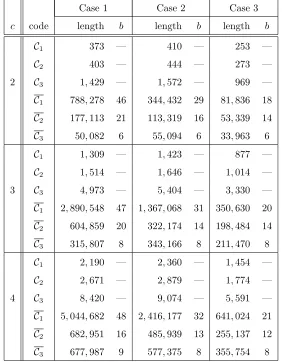
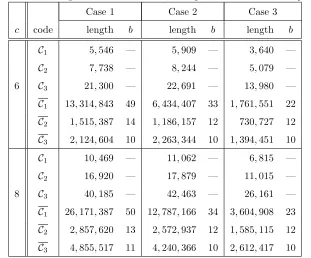
codes Ck are much more robust than the original codes Ck. The code lengths m=bm0+L forCk are also shown in Tables 2 and 3, where we determined the parametersLby (4) and we determined the parameters bforC1 by (5) and forC2 andC3 by (3), respectively. The values ofbare also included in Tables 2 and 3.
Tables 2 and 3 show that bothC2andC3are always more efficient thanC1under our choices of parameters.
This suggests that the (even slight) robustness of the originalc-secure codes is significant to improve efficiency of (more) robustc-secure codes obtained by our conversion method. On the other hand, these two tables also show that there does not exist overall superiority or inferiority of any ofC2andC3to the other, hence it isnot
always a good strategy to apply our conversion to more robustc-secure codes. An intuitive explanation of the phenomenon would be possible, as follows. If the original code for our conversion becomes more robust, then the efficiency of our conversion itself is improved (indeed, in Tables 2 and 3, the ratio m/m0 of code
lengths for the pair (C3,C3) is always better than the ratio for the pair (C2,C2)), while the code lengthm0
Table 2: Code lengths for c-secure codes, with parameterδ= 0.5,c∈ {2,3,4}
Case 1 Case 2 Case 3
c code length b length b length b
C1 373 — 410 — 253 —
C2 403 — 444 — 273 —
2 C3 1,429 — 1,572 — 969 —
C1 788,278 46 344,432 29 81,836 18
C2 177,113 21 113,319 16 53,339 14
C3 50,082 6 55,094 6 33,963 6
C1 1,309 — 1,423 — 877 —
C2 1,514 — 1,646 — 1,014 —
3 C3 4,973 — 5,404 — 3,330 —
C1 2,890,548 47 1,367,068 31 350,630 20
C2 604,859 20 322,174 14 198,484 14
C3 315,807 8 343,166 8 211,470 8
C1 2,190 — 2,360 — 1,454 —
C2 2,671 — 2,879 — 1,774 —
4 C3 8,420 — 9,074 — 5,591 —
C1 5,044,682 48 2,416,177 32 641,024 21
C2 682,951 16 485,939 13 255,137 12
Table 3: Code lengths for c-secure codes, with parameterδ= 0.5,c∈ {6,8}
Case 1 Case 2 Case 3
c code length b length b length b
C1 5,546 — 5,909 — 3,640 —
C2 7,738 — 8,244 — 5,079 —
6 C3 21,300 — 22,691 — 13,980 —
C1 13,314,843 49 6,434,407 33 1,761,551 22
C2 1,515,387 14 1,186,157 12 730,727 12
C3 2,124,604 10 2,263,344 10 1,394,451 10
C1 10,469 — 11,062 — 6,815 —
C2 16,920 — 17,879 — 11,015 —
8 C3 40,185 — 42,463 — 26,161 —
C1 26,171,387 50 12,787,166 34 3,604,908 23
C2 2,857,620 13 2,572,937 12 1,585,115 12
C3 4,855,517 11 4,240,366 10 2,612,417 10
Table 4: Parameterβ for error probability formula ofC3
c 2 3 4 6 8
β 0.093099 0.032980 0.019780 0.0085396 0.0047522
6
Conclusion
In this article, we proposed the first general conversion method of non-robustc-secure fingerprint codes to robust c-secure codes, and of less robust c-secure codes to more robust ones. Our conversion deals with the originalc-secure code as a black-box, namely we need no knowledge of properties of the original code except code length and error probability. We estimated appropriate values of parameters for our conversion theoretically, deriving a closed-form formula of the resulting code length. By using the formula, we described the asymptotic behavior of the resulting code length. Moreover, by applying our conversion to some existing (less robust) c-secure codes, we obtained robust c-secure codes with code lengths of order (clogc)2 with respect toc, which improves some preceding construction based on a stronger assumption than ours.
Acknowledgments
Hideki Imai and the anonymous referees of ICITS 2009 for their precious comments.
A
Proof of Lemma 1
Recall the condition (2) for the parameters. To prove Lemma 1, it suffices to consider the worst case that pirates always mark as many undetectable columns in the pirated wordy with ‘?’ asδ-Marking Assumption allows, i.e., they mark⌊δm⌋=ν1 undetectable columns with ‘?’ in total (note that there are indeed at least
ν1 undetectable columns in y by the conditionL≥ν1; see (2)). For an integera and eachJ ∈
([a]
ν2
)
, where ν2=⌊δ0m0⌋+ 1 as defined in (2), letE′(a, J) denote the event that the numberauof undetectable columns
in W (or equivalently, the number of undetectable blocks inW) with respect toC is aand that for every j ∈ J, the j-th undetectable block in y(1) is entirely marked with ‘?’. (Note that ([νa]
2
)
=∅ when a < ν2.)
Then, whenever the eventEspecified in the statement of Lemma 1 occurs, some of the eventsE′(a, J) with 0≤a≤m0 andJ ∈
([a]
ν2
)
also occurs. This implies that
P r[E]≤ m0
∑
a=0
P r[au=a]
∑
J∈([a]
ν2)
P r[E′(a, J)|au=a] . (12)
As the undetectable digits in codewords of pirates are completely shuffled by the steps 4–5 in Gen, it follows that everyν1-element subset of thebau+L undetectable columns iny(1) is chosen by pirates with
equal probability to be marked with ‘?’. Hence for eacha, the probabilitiesP r[E′(a, J)|au=a] forJ ∈
([a]
ν2
)
coincide with each other. As|([νa] 2
)
|=(νa 2
)
, it follows from (12) that
P r[E]≤ m0
∑
a=0
P r[au=a]
(
a ν2
)
P r[E′(a,[ν2])|au=a] . (13)
Now suppose that au = a and the first ν2 undetectable blocks in y(1) (containing bν2 digits in total) are
entirely marked with ‘?’. Then there are (ba+L−bν2 ν1−bν2
)
choices of the remaining ν1 −bν2 digits out of the
remainingba+L−bν2 undetectable columns to be marked with ‘?’. On the other hand, there are in total
(ba+L ν1
)
choices of theν1undetectable columns to be marked with ‘?’. This implies thatP r[E′(a,[ν2])|au=
a] =(ba+L−bν2 ν1−bν2
)
/(baν+L 1
)
, therefore it follows from (13) that
P r[E]≤ m0
∑
a=0
P r[au=a]
(
a ν2
)(ba+L−bν2 ν1−bν2
) (ba+L
ν1
) ≤
m0
∑
a=0
P r[au=a](ε−ε0) =ε−ε0 ,
where we used the condition (2) in the second inequality. Hence we haveP r[E]≤ε−ε0as desired, therefore
B
Proof of Lemma 2
To prove Lemma 2, it suffices to show that
(
a ν2
)
/(ba+L)bν2 ≤
(
a+ 1 ν2
)
/(ba+L+b)bν2
for any integer 0 ≤a ≤m0−1. As the claim is obvious when a < ν2, we may assume that a ≥ν2. As
(a ν2
)
/(aν+1 2
)
= 1−ν2/(a+ 1) and
(ba+L)bν2 (ba+L+b)bν2
=(ba+L+b−bν2)b (ba+L+b)b (note thatb≤bν2∈Z), the claim is equivalent to that
1− ν2 a+ 1 ≤
(ba+L+b−bν2)b (ba+L+b)b
for any integerν2≤a≤m0−1 . (14)
To prove this, we use the following inequality: Lemma 8. For integersh≥i≥j≥1, we have
(i)j (h)j ≥
(
i−j+ 1 h−j+ 1
)j .
Proof. Apply the inequality (i−j+x)/(h−j+x)≥(i−j+ 1)/(h−j+ 1) for every 1≤x≤j. By this lemma, the right-hand side of (14) is larger than or equal to
(
ba+L+ 1−bν2
ba+L+ 1
)b =
(
1− bν2 ba+L+ 1
)b ,
therefore it suffices to show that
1− ν2 a+ 1 ≤
(
1− bν2 ba+L+ 1
)b
for anyν2≤a≤m0−1 ,
or equivalently,
bν2
ba+L+ 1 ≤1−
(
1− ν2 a+ 1
)1/b
for anyν2≤a≤m0−1
(note that 0< ν2/(a+ 1)<1). This is also equivalent toL≥f(a), where
f(a) = bν2 1−
(
1− ν2 a+1
)1/b −ba−1 forν2≤a≤m0−1 .
Now we present a lemma, which will be proven below:
This lemma implies thatf(a)≤f(m0−1), whileL≥f(m0−1) by the condition (4) forL, therefore we
haveL≥f(a) provided Lemma 9 holds.
Finally, we prove Lemma 9. The claim is obvious if b = 1, therefore we assume that b ≥ 2. Put x= (1−ν2/(a+1))1/b. Thenxis an increasing function ofa, and 0< x <1. Now we havea+1 =ν2/(1−xb),
therefore dxda=bν2xb−1(1−xb)−2. Asf(a) =bν2/(1−x)−ba−1, this implies that
d
dxf(a) = bν2
(1−x)2 −
b2ν 2xb−1
(1−xb)2 =
bν2
(1−x)2(1−xb)2f1(x) ,
where f1(x) = (1−xb)2−bxb−1(1−x)2. As xis an increasing function of a, it suffices for our purpose
to prove that dxdf(a) > 0, or equivalently f1(x) > 0. As 0 < x < 1, we have f1(x) > 0 if and only if
1−xb > √bx(b−1)/2(1−x). Put f2(x) = 1−xb−
√
bx(b−1)/2(1−x), therefore our goal is to show that f2(x)>0. Now we have
d
dxf2(x) =−bx
b−1−√bb−1
2 x
(b−3)/2+√bb+ 1
2 x
(b−1)/2=√bx(b−3)/2f 3(x) ,
wheref3(x) =−
√
bx(b+1)/2−(b−1)/2 + (b+ 1)x/2. Moreover, we have d
dxf3(x) = b+ 1
2 (1−
√
bx(b−1)/2) .
This implies that the functionf3(x) for 0< x <1 is maximized atx=x0=b−(b−1)
−1
. We have f3(x0) =−
√
bx0·x (b−1)/2
0 −
b−1
2 +
b+ 1
2 x0=−x0− b−1
2 +
b+ 1 2 x0=
b−1
2 (x0−1)<0 , thereforef3(x)<0 for 0< x <1. This implies that dxdf2(x)<0 for 0< x <1, therefore f2(x)> f2(1) = 0
for 0< x <1, as desired. Hence Lemma 9 holds, concluding the proof of Lemma 2.
C
Proof of Lemma 5
To prove Lemma 5, first we give the following lemma: Lemma 10. In the current situation, we haveν2/m0→d.
Proof. First, note that ν2 =⌊δ0m0⌋+ 1 ≤δ0m0+ 1, therefore ν2/m0 ≤ δ0+ 1/m0. As we are assuming
that c→ ∞,N/ε→ ∞, andε0 =ε/2, it follows thatm0 =ω(1). Hence we haveν2/m0→0 ifδ0 →0, or
equivalently, ifd= 0. On the other hand, ifd >0, then we haveδ0m0=ω(1), thereforeν2=⌊δ0m0⌋+ 1 =
ω(1) andν2∼δ0m0∼dm0. This implies that we haveν2/m0→din any case.
By Lemma 10, we have (1−ν2/m0)m0/ν2 → A, where we put A=e−1 ifd= 0 and A = (1−d)1/d if
0< d <1. Note that 0< A <1 in any case. Put ξ=ν2/(bm0). Now for any 0< η <min{A,1−A}, we
have eventually
therefore we have eventually 0<(A−η)ξ <(1−bξ)1/b <(A+η)ξ<1 and 1−(A+η)ξ
ξ <
1−(1−bξ)1/b ξ <
1−(A−η)ξ
ξ . (15)
Note thatb=ω(1) by the definition ofb(note thatδ→1), therefore we haveξ→0. Now by l’Hˆopital’s Rule, the left-hand side and the right-hand side of (15) converge to−log(A+η) and −log(A−η), respectively. Hence we have
−log(A+η)≤lim inf1−(1−bξ)
1/b
ξ ≤lim sup
1−(1−bξ)1/b
ξ ≤ −log(A−η) . Asη >0 can be arbitrarily small, by taking the limitη→0 we have
lim inf 1−(1−bξ)
1/b
ξ = lim sup
1−(1−bξ)1/b
ξ =−logA ,
therefore (1−(1−bξ)1/b)/ξ→ −logA. As−logA= 1 ifd= 0 and−logA=−d−1log(1−d) if 0< d <1,
the proof of Lemma 5 is concluded.
D
Proof of Lemma 7
To prove Lemma 7, first we consider the case that x1 = Θ(x2) and x2 = ω(1). Then the first condition
implies that there exist anM0>0 and anM1<∞such that we have eventuallyM0< x1/x2< M1. Hence
it holds eventually that logM0<logx1−logx2<logM1, or equivalently
logM0
logx2
< logx1 logx2 −
1< logM1 logx2
(note that by the condition x2=ω(1), logx2 is eventually positive). Asx2=ω(1), both the left-hand side
and the right-hand side converge to 0, therefore logx1/logx2→1. Hence logx1∼logx2 in this case.
Secondly, we consider the other case that x1 ∼x2 and logx2 = Ω(1). Then the first condition implies
that x1/x2 → 1, therefore logx1−logx2 → 0. As logx2 = Ω(1), it follows that logx1/logx2−1 → 0,
therefore we have logx1∼logx2in this case. Hence the proof of Lemma 7 is concluded.
References
[1] E. Amiri and G. Tardos, “High rate fingerprinting codes and the fingerprinting capacity,” in Proc. SODA 2009, 2009, pp. 336–345.
[2] O. Billet and D. H. Phan, “Efficient traitor tracing from collusion secure codes,” in Proc. ICITS 2008, 2008, pp. 171–182.
[4] D. Boneh and M. Naor, “Traitor tracing with constant size ciphertext,” in Proc. ACM CCS 2008, 2008, pp. 501–510.
[5] D. Boneh and J. Shaw, “Collusion-secure fingerprinting for digital data,” IEEE Trans. Information Theory, vol. 44, pp. 1897–1905, 1998.
[6] T. H. Cormen, C. E. Leiserson, R. L. Rivest and C. Stein, Introduction to Algorithms, 2nd ed., MIT Press, 2001.
[7] J. Cotrina-Navau, M. Fernandez and M. Soriano, “A family of collusion 2-secure codes,” in Proc. IH 2005, 2005, pp. 387–397.
[8] M. Fernandez and M. Soriano, “Fingerprinting concatenated codes with efficient identification,” in Proc. ISC 2002, 2002, pp. 459–470.
[9] H.-J. Guth and B. Pfitzmann, “Error- and collusion-secure fingerprinting for digital data,” in Proc. IH 1999, 2000, pp. 134–145.
[10] K. Nuida, “An improvement of short 2-secure fingerprint codes strongly avoiding false-positive,” in Proc. IH 2009, 2009, pp. 161–175.
[11] K. Nuida, S. Fujitsu, M. Hagiwara, H. Imai, T. Kitagawa, K. Ogawa and H. Watanabe, “An efficient 2-secure and short random fingerprint code and its security evaluation,” IEICE Trans. Fundamentals, vol. E92-A, pp. 197–206, 2009.
[12] K. Nuida, S. Fujitsu, M. Hagiwara, T. Kitagawa, H. Watanabe, K. Ogawa and H. Imai, “An improvement of discrete Tardos fingerprinting codes,” Des. Codes Cryptogr., vol. 52, pp. 339–362, 2009.
[13] R. Safavi-Naini and Y. Wang, “Collusion secure q-ary fingerprinting for perceptual content,” in Proc. DRM 2001, 2002, pp. 57–75.
[14] T. Sirvent, “Traitor tracing scheme with constant ciphertext rate against powerful pirates,” in Proc. WCC 2007, 2007, pp. 379–388.
[15] B. ˘Skori´c, S. Katzenbeisser and M. U. Celik, “Symmetric Tardos fingerprinting codes for arbitrary alphabet sizes,” Des. Codes Cryptogr., vol. 46, pp. 137–166, 2008.
[16] G. Tardos, “Optimal probabilistic fingerprint codes,” J. ACM, vol. 55, pp. 1–24, 2008.
![Table 1: Parameter δ0 for the original codes C = Ck in [12]cCCC](https://thumb-us.123doks.com/thumbv2/123dok_us/1863917.1242293/17.595.199.428.219.335/table-parameter-d-original-codes-c-ck-cccc.webp)