Cube attacks on Trivium
S. S. Bedi and N. Rajesh Pillai
Scientific Analysis Group,
Metcalfe House Complex, Delhi, INDIA
[email protected], [email protected]
Abstract
This paper discusses the Cube attacks proposed in [3] and [5] applied to Trivium variants. Independent verification of the equations given in [3] and [5] were carried out. Experimentation showed that the precomputed equations were not general. They are holding when applied to the class of IVs for which they were computed - whereIV bits at locations other than those corresponding to the cube are fixed at 0. When theseIV bits are fixed at some other values, the relations do not hold. The probable cause for this is given and an extra step to the method for equation generation is suggested to take care of such cases.
1
Introduction
Cube Attacks [3] were proposed by Dinur and Shamir as a generic class of attacks applicable to systems which can be described as polynomials. Here we consider equations for an output bit from the cipher for a fixed key and different Initialization Vectors (IVs). In cube attack one tries to obtain linear equations in the unknown key bits by combining the equations for an output bit of the cipher for a set of IVs. The IVs in a set are identical at all except k bit positions, where they take all possible combination of values. In other words, theIVs form coordinates of ak-dimensional hypercube.
By carefully choosing the cube, one can obtain linear equations involving only key bits and sum of output bits. One of the first attacks of this kind was the Algebraic IV Differential Attack (AIDA) described by Vielhaber in [5]. Vielhaber applied it on a Trivium variant with a reduced number of initialization rounds (576 instead of 1152). The paper [5] gave linear equations for the secret key bits in terms of sums of output bits which could be used for attacking the cipher. But no systematic method for obtaining such equations was described. A procedure for finding such linear equations was first given in the September 2008 on eprint [3] and later in Eurocrypt 2009 [4]. Linear equations for variants of Trivium with 672 and 767 rounds were given in [4].
and an additional step to the method for generation of equations is suggested to obtain more general equations.
In the next section a brief introduction to cube attacks is given. In Section 3, verification (of the equations in [4]) performed and the results are given. In Section 4, the causes for equations not holding when remaining bits of IV are fixed to random values are investigated and modification to the equation search procedure is suggested. This is followed by Discussions and Conclusions.
2
Cube Attacks
Cube attacks are applicable to systems which can be modelled as a polynomial F(K, IV) = Y, where K is the secret key (of say n bits x1, ...xn) and IV
is publicly known initialization vector (of say m bits v1, ..., vm). We use the
expression Fi(K, IV) =Yi to denote the polynomial representation for the ith
output bit of the cipher. The main idea of cube attacks is to combine equations for sameK but various chosen IV in such a way that low degree equations in the variables inK are obtained. In particular theIVs can be chosen such that linear equations for the unknown bits in K can be obtained. Once sufficient number of linear equations are obtained, the keyK can be recovered.
For obtaining such equations, the setCof chosenIVs is to be taken such that
P
IV∈CFi(K, IV) is a linear combination of bits in K. Let IV = (v1, .., vm)
and K = (x1, .., xn). Suppose that for a particular group of variables U =
{vi1, .., vik} from the IV part, the expression for the ith output bit can be
rewritten as
Fi(x1, .., xn, v1, .., vm) =vi1vi2..vikP(x1, .., xn, V) +Q
Where P(.) is a polynomial over variables in {x1, .., xn} ∪ V with V =
{v1, .., vm} − U and P(.) is linear over xis. The polynomial Q is such that
none of the terms in Q have the monomialvi1vi2..vik as a factor. Let C be a
set of 2|U|points where the variables inU are taking all possible combinations of values and the variables in{x1, .., xn} ∪V are fixed to some arbitrary value.
Consider the sum
X
C
Fi(x1, . . . , xn, v1, . . . , vm) = X
C
vi1. . . vikP(x1, . . . , xn, V) +
X
C
Q
= P(x1, . . . , xn, V)
The first summation reduces to P(x1, .., xn, V) as the coefficient ofP(.) in the
summation is nonzero for only one case inC. The second summation evaluates to zero as each monomial inQgets added an even number of times (a monomial not divisible byj variables from the set U will be added 2j times) and hence
For precomputation of linear relations, the approach used in [4] was to ran-domly selectU ={vi1, .., vik} ⊂ {v1, .., vm}. The set of chosenIVs were formed
by allowing variables inU to take all possible combinations of values while keep-ing variables inV ={v1, .., vm} −U fixed to 0. A linearity check was performed
for the polynomial p(x1, .., xn) =P(x1, .., xn,0). If the check was satisfied, the
polynomial pwas saved for use in the online phase of attack. If not, the set would be modified by adding or deleting an element from the set and the search continued.
From the construction of the equations, one can conclude that equation holds for the cube when bits at positions in V are zero. Nothing can be concluded about the 2|V|−1 cubes where the bits at positions inV are not all simultane-ously zero. It should be noted that in both [4] and [5], it was implicitly assumed that the equations obtained for the cube with variables in V fixed to 0 will be holding in general. That is they will also hold for the cubes where the variables in V are fixed to any of the 2|V| possible combinations. Results of the verifi-cation exercises carried out for the equations given in [4] and [5] showed that the equations are not general (see Tables 1 and 2). As a result the equations obtained in [4, 5] are useful for attacking only for a restricted set ofIVs
3
Verification of Equations for Trivium Variants
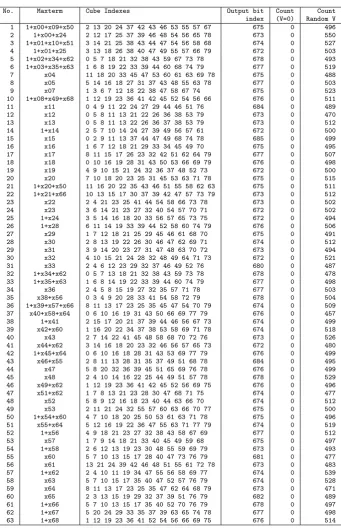
The precomputed equations for Trivium variants given in Tables 1 and 2 of [4] were considered. The variants considered differ from Trivium [2] only in the number of initialization rounds after which system generates outputs. The number of initialization rounds are 672 for Table 1 and 767 for Table 2 (instead of 1152 rounds as in Trivium).
In Table 1, the equations have been given as triples (p(K), U, i) wherep(K) is the linear combination of bits fromK;U is the set ofIV positions which define the cube and i is the output bit position. In Table 2, there is an additional column which inidicates the elements of V which are fixed to 1. LetC denote the set of 2|U|chosenIVs where bits at positions given inU are allowed to take all possible values and bits at remaining positions are kept fixed. Then equation denoted by the triple (p(K), U, i) is
p(K) = X
IV∈C
Fi(K, IV)
For computing the equations, the authors of [4] tookCas the set of 2|U|vectors where the bits in positionsV ={1..80} −U ofIV (and the last column also for Table 2) are fixed to 0.
For verification, we performed the following steps. A random 80-bit vector was generated and used as K. We evaluated the coefficient polynomialP by summing output bits corresponding to the different IVs in the set C and the common keyK. We then compared the result with simple polynomial evaluation ofp(x) onK.
bit over 1000 runs. The second last column gives count for the case whenV = 0. The results show that the relation seems to hold with a high probability when V = 0. The last column gives the number of times the relation was failing when V was fixed to an arbitrary non zero value.
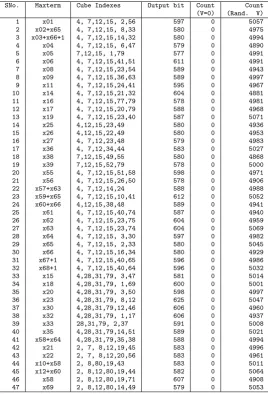
A similar exercise was carried out for the expressions given in [5]. In this case also the 47 polynomials were found to be holding when bits at V were fixed to 0. When this constraint onIV was relaxed, none of the relations were holding. The last two columns of Table 2 show the number of times the relation was failing for the specific output bit for 10000 runs.
This shows that the relations in [4] and [5] may not be as general as implied.
4
Possible Causes and Modification Suggested
In this section the possible causes for the equations not holding for general case are discussed. The authors of [4] were aware of one – occurrence of a high degree terms in the coefficient polynomial for the monomialvi1...vik. Since the
linearity test is probabilistic, the chances of detecting presence of a high degree term is low. 1
In this section we show that nonlinear polynomials are detected as a linear polynomial for many other cases also. To show this we first briefly describe the method suggested in [4] for detecting and finding linear coefficient polynomials p.
LetU ={vi1, .., vik} andV denote the complement set{v1..vm} −U. The
expression forith output bit can be written as
Fi(xi, .., xn, v1, ..vm) =vi1vi2..vikP(x1, ..xn, V) +q(x1, ..xn, v1, ..vm)
wherevi1vi2..vik does not divide any of the terms ofq.
For the attack as described in [4] we are interested in findingU and isuch that we get equations of the form
Fi(x1, .., xn, v1, .., vm) =vi1vi2..vikp(x1, ..xn) +q(x1, ..xn, v1, ..vm)
where p(.) is linear. To identify suchU, the method suggested in [4] is to try for U of various sizes. For each U, set the remaining variables (those in V) to 0 and evaluate the cube. For the case when U is too large, the expression
P
IV∈CFi(X, IV) evaluates to a constant irrespective of X. For smaller sizes,
the expression will be a nonlinear polynomial. The idea is to keep trying till we hit the size in between where the sum evaluates to a polynomial of degree 1. To check ifP
IV∈CFi(X, IV) is a polynomial of degree 1, the method in [4] checks
if
X
IV∈C
Fi(X+Y, IV) = X
IV∈C
Fi(X, IV) + X
IV∈C
Fi(Y, IV) + X
IV∈C
Fi(0, IV)
for sufficient number of randomly selected keysX andY. If the equation holds for all the random cases tried, the polynomial P is assumed to be of the re-quired form viz. linear inxjs and then the individual coefficients for the linear
combination are calculated.
1Such high degree terms will contribute to the polynomial value with an equally low
The set C of IVs used were such that bits at locations in V were fixed to 0 and bits at locations in U were allowed to run over all possible choices (Second para of section 4.2 of [4]). Because of this the polynomials of the kind P(.) =x1+x2+vkx1x2 for some vk ∈V will also show up as linear. In fact
bothx1+x2+vk1x1x2 andx1+x2+vk2x3 will be detected asx1+x2.
This shows that fixing the bits at positions inV to 0 will give us equations which need not hold for the general case. To detect such cases (with a high probability) verification of the equation for sufficient number of cases with IV bits at locations in V fixed to some random values should also be carried out. This can be done by choosing a random keyX and two random settingsV1and
V2 for the variables at positions in the setV. Check if the relation P(X, V1) =
P(X, V2) holds. If it holds for sufficient number(say 100) of Xs, then with a
high probability P(.) is independent of IV bits at positions inV. Once this is ensured, the other steps as given in [4] can be carried out for obtaining the equations.
4.1
Relaxation of the Maxterms
Observe that the maxterms computed in Tables 1 and 2 contain variables only from the secret key part. Where as in general case they can contain some linear terms from V, the fixed part ofIV also. Using this observation, we tried to find polynomialsP(x1, .., xn, V) which were of degree 1 and having at least one
variable from the secret key part.
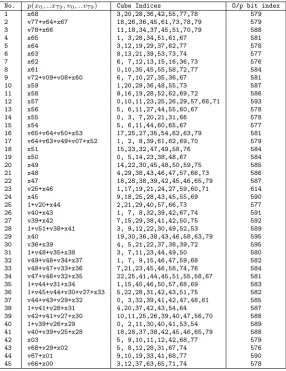
Set of 45 equations found for Trivium with 576 initialization rounds are given in Table 3. The precomputed equations in this case will be applicable to a large set of IVs. These equations will help in reducing the effective keyspace of Trivium with 576 rounds to 235.
This approach of making equations was attempted on Trivium with 672 initial rounds. Till the time of writing this work, we were unable to obtain equations which hold for cubes of dimension up to 14. Work in this direction is still in progress.
5
Discussions
The method for finding equations given in [4] assumed that the bits in remain-ing positions ofIV are set 0. The equations obtained though not general will be applicable for some other sets ofIVs. The usefulness of a relation depends on the proportion ofIVs for which it holds.
Finding cubes so that equations which hold in general may turn out to need more computation. In particular the cube dimensions may be larger than indicated in [4].
Larger cube dimension implies requirement of greater amount of crypts on same secret key setting. This may make the attack difficult to apply in practice.
Based on our experiments, we believe that using randomly chosen IVs with the additional constraint of a lower bound on Hamming weight (forIV) will reduce the chances of finding useful equations.
6
Applicability of Cube attacks
There have been discussions on the applicablity of cube attacks. Some cryptog-raphers believe that the cube attacks are applicable for systems of small degree only [1]. The reason being that it is highly unlikely that a random polynomial of high degree will have low degree maxterms.
Consider a random polynomial overnsecret variables andmpublic variables where the probability of each monomial occurring in the polynomial is 0.5. Let A denote a monomial formed by product of d−1 public variables and let x denote a private variable. The monomial A will be a maxterm of F(X, IV) when the coefficient polynomial ofAin F is linear. This happens when all the terms inF divisible byA are of degreed. In other words for every monomial of the form Axin F, no monomial which is divisible by Axand is of d+ 1 or higher degree occurs inF.
The number of terms of degreed+ 1 toD=deg(F) divisible byAxis equal to the number of monomials of degrees from 1 to D −d over the remaining n+m−dvariables which will bePD−di=1 n+m−di
=N. In a random polynomial, the probability of all these monomials simultaneously not occurring will be 2−N. The value N grows rapidly with D−d. So obtaining cubes of sizes significantly smaller than the degreeDis a very low probability event for random polynomials. Larger dimensions for the cubes means exponentially higher effort for searching and setting up the equations for the attack.
Cryptographers try to design ciphers so that the degree of the polynomial describing the output bit in terms of the key andIV quickly becomes indistin-guishable from random polynomials of high degree over the same set of variables. Since the probability of obtaining low degree maxterms for random polynomials is extremely low, probability of getting useful equations for the cube attack will also be low forsuch systems.
7
Conclusions
Verification of the equations for cube attack in [4] for reduced round variants of Trivium was carried out. It was observed that the equations given in [4] are not general and are applicable for a very restricted class ofIVs. The fact that equations identified may not hold in general was mentioned in [4] also. The reasons given were that it might be due to some high degree terms which will cause the linear equation to fail with a very low probability. We have given an example where terms which are not of high degree lead to a situation where an incorrect linear equation is detected.
to try cubes of higher dimensions to get linear relations.
Acknowledgements
The authors thank Dr P K Saxena, Director SAG, for his constant support and encouragement for the work.
References
[1] D. J. Bernstien. Why haven’t cube attacks broken anything? http://cr.yp.to/cubeattacks.html.
[2] C. D. Canni`ere and B. Preneel. Trivium - a stream cipher construction in-spired by block cipher design principle. eSTREAM, ECRYPT Stream Cipher Project, Report 2006/021, 2006. http://www.ecrypt.eu.org/stream.
[3] I. Dinur and A. Shamir. Cube attacks on tweakable black box polynomials. Cryptology ePrint Archive, Report 2008/385, 2008. http://eprint.iacr. org/.
[4] I. Dinur and A. Shamir. Cube attacks on tweakable black box polynomials. In A. Joux, editor,EUROCRYPT, volume 5479 ofLecture Notes in Computer Science, pages 278–299. Springer, 2009.
Table 1: Verification of equations for Trivium with 672 initialization rounds
Verification of Equations from [4]. The count in last two columns denote the number of times equation failed in 1000 runs. A count value of 0 denotes that equation is holding for all the 1000 runs. The first count is whenV =0. The second count gives number of times equation failed when
V was fixed to a random value during superpoly computation.
No. Maxterm Cube Indexes Output bit Count Count
index (V=0) Random V
1 1+x00+x09+x50 2 13 20 24 37 42 43 46 53 55 57 67 675 0 496
2 1+x00+x24 2 12 17 25 37 39 46 48 54 56 65 78 673 0 550
3 1+x01+x10+x51 3 14 21 25 38 43 44 47 54 56 58 68 674 0 527
4 1+x01+x25 3 13 18 26 38 40 47 49 55 57 66 79 672 0 503
5 1+x02+x34+x62 0 5 7 18 21 32 38 43 59 67 73 78 678 0 493
6 1+x03+x35+x63 1 6 8 19 22 33 39 44 60 68 74 79 677 0 519
7 x04 11 18 20 33 45 47 53 60 61 63 69 78 675 0 488
8 x05 5 14 16 18 27 31 37 43 48 55 63 78 677 0 503
9 x07 1 3 6 7 12 18 22 38 47 58 67 74 675 0 523
10 1+x08+x49+x68 1 12 19 23 36 41 42 45 52 54 56 66 676 0 511
11 x11 0 4 9 11 22 24 27 29 44 46 51 76 684 0 489
12 x12 0 5 8 11 13 21 22 26 36 38 53 79 673 0 470
13 x13 0 5 8 11 13 22 26 36 37 38 53 79 673 0 512
14 1+x14 2 5 7 10 14 24 27 39 49 56 57 61 672 0 500
15 x15 0 2 9 11 13 37 44 47 49 68 74 78 685 0 499
16 x16 1 6 7 12 18 21 29 33 34 45 49 70 675 0 495
17 x17 8 11 15 17 26 23 32 42 51 62 64 79 677 0 507
18 x18 0 10 16 19 28 31 43 50 53 66 69 79 676 0 498
19 x19 4 9 10 15 21 24 32 36 37 48 52 73 672 0 500
20 x20 7 10 18 20 23 25 31 45 53 63 71 78 675 0 515
21 1+x20+x50 11 16 20 22 35 43 46 51 55 58 62 63 675 0 511
22 1+x21+x66 10 13 15 17 30 37 39 42 47 57 73 79 673 0 512
23 x22 2 4 21 23 25 41 44 54 58 66 73 78 673 0 502
24 x23 3 6 14 21 23 27 32 40 54 57 70 71 672 0 502
25 1+x24 3 5 14 16 18 20 33 56 57 65 73 75 672 0 494
26 1+x28 6 11 14 19 33 39 44 52 58 60 74 79 676 0 506
27 x29 1 7 12 18 21 25 29 45 46 61 68 70 675 0 491
28 x30 2 8 13 19 22 26 30 46 47 62 69 71 674 0 512
29 x31 3 9 14 20 23 27 31 47 48 63 70 72 673 0 494
30 x32 4 10 15 21 24 28 32 48 49 64 71 73 672 0 521
31 x33 2 4 6 12 23 29 32 37 46 49 52 76 680 0 487
32 1+x34+x62 0 5 7 13 18 21 32 38 43 59 73 78 678 0 478
33 1+x35+x63 1 6 8 14 19 22 33 39 44 60 74 79 677 0 498
34 x36 2 4 5 8 15 19 27 32 35 57 71 78 677 0 503
35 x38+x56 0 3 4 9 20 28 33 41 54 58 72 79 678 0 504
36 1+x39+x57+x66 8 11 13 17 23 25 35 45 47 54 70 79 674 0 509
37 x40+x58+x64 0 6 10 16 19 31 43 50 66 69 77 79 676 0 457
38 1+x41 2 15 17 20 21 37 39 44 46 56 67 73 674 0 499
39 x42+x60 1 16 20 22 34 37 38 53 58 69 71 78 674 0 518
40 x43 2 7 14 22 41 45 48 58 68 70 72 76 673 0 526
41 x44+x62 3 14 16 18 20 23 32 46 56 57 65 73 672 0 480
42 1+x45+x64 0 6 10 16 18 28 31 43 53 69 77 79 676 0 499
43 x46+x55 2 8 11 13 28 31 35 37 49 51 68 78 684 0 495
44 x47 5 8 20 32 36 39 45 51 65 69 76 78 676 0 499
45 x48 2 4 10 14 16 22 25 44 49 51 57 78 678 0 529
46 x49+x62 1 12 19 23 36 41 42 45 52 56 69 75 676 0 496
47 x51+x62 1 7 8 13 21 23 28 30 47 68 71 75 674 0 477
48 x52 5 8 9 12 16 18 23 40 44 63 66 70 674 0 512
49 x53 2 11 21 24 32 55 57 60 63 66 70 77 675 0 500
50 1+x54+x60 4 7 10 18 20 25 50 53 61 63 71 78 675 0 496
51 x55+x64 5 12 16 19 22 36 47 55 63 71 77 79 674 0 519
52 1+x56 4 9 18 21 23 27 32 38 43 58 67 69 677 0 512
53 x57 1 7 9 14 18 21 33 40 45 49 59 68 675 0 497
54 1+x58 2 6 12 13 19 23 30 48 55 59 69 79 673 0 493
55 x60 5 7 10 13 15 17 28 40 47 73 76 79 681 0 477
56 x61 13 21 24 39 42 46 48 51 55 61 72 78 673 0 483
57 1+x62 2 4 10 11 19 34 47 55 56 58 69 77 674 0 539
58 x63 5 7 10 15 17 35 40 47 52 57 76 79 674 0 528
59 x64 8 11 13 17 23 25 35 47 62 64 68 79 673 0 471
60 x65 2 3 13 15 19 29 32 37 39 51 76 79 682 0 489
61 1+x66 5 7 10 13 15 17 35 40 52 70 76 79 678 0 497
62 1+x67 5 20 24 29 33 35 37 39 63 65 74 78 677 0 498
Table 2: Verification of equations for Trivium with 576 initialization rounds
Verification of Equations from [5]. The count in last two columns denote the number of times equation failed in 10000 runs. A count value of 0 denotes that equation is holding for all the 10000 runs. The first count is whenV = 0. The second count gives number of times equation failed whenV was fixed to a random value during superpoly computation. The variables for this table are having numbering 1..80 instead of 0..79 for ease of comparison with original paper.
SNo. Maxterm Cube Indexes Output bit Count Count
(V=0) (Rand. V)
1 x01 4, 7,12,15, 2,56 597 0 5057
2 x02+x65 4, 7,12,15, 8,33 580 0 4975
3 x03+x66+1 4, 7,12,15,14,32 580 0 4994
4 x04 4, 7,12,15, 6,47 579 0 4890
5 x05 7,12,15, 1,79 577 0 4991
6 x06 4, 7,12,15,41,51 611 0 4991
7 x08 4, 7,12,15,23,54 589 0 4943
8 x09 4, 7,12,15,36,63 589 0 4997
9 x11 4, 7,12,15,24,41 595 0 4967
10 x14 4, 7,12,15,21,32 604 0 4881
11 x16 4, 7,12,15,77,79 578 0 4981
12 x17 4, 7,12,15,20,79 588 0 4968
13 x19 4, 7,12,15,23,40 587 0 5071
14 x25 4,12,15,23,49 580 0 4936
15 x26 4,12,15,22,49 580 0 4953
16 x27 4, 7,12,23,48 579 0 4983
17 x36 4, 7,12,34,44 583 0 5027
18 x38 7,12,15,49,55 580 0 4868
19 x39 7,12,15,52,79 578 0 5000
20 x55 4, 7,12,15,51,58 598 0 4971
21 x56 4, 7,12,15,26,50 578 0 4906
22 x57+x63 4, 7,12,14,24 588 0 4988
23 x59+x65 4, 7,12,15,10,41 612 0 5052
24 x60+x66 4,12,15,38,48 589 0 4941
25 x61 4, 7,12,15,40,74 587 0 4940
26 x62 4, 7,12,15,23,75 604 0 4959
27 x63 4, 7,12,15,23,74 604 0 5069
28 x64 4, 7,12,15, 3,30 597 0 4982
29 x65 4, 7,12,15, 2,33 580 0 5045
30 x66 4, 7,12,15,16,34 580 0 4929
31 x67+1 4, 7,12,15,40,65 596 0 4986
32 x68+1 4, 7,12,15,40,64 596 0 5032
33 x15 4,28,31,79, 3,47 581 0 5014
34 x18 4,28,31,79, 1,69 600 0 5001
35 x20 4,28,31,79, 3,50 598 0 4997
36 x23 4,28,31,79, 8,12 625 0 5047
37 x30 4,28,31,79,12,46 606 0 4960
38 x32 4,28,31,79, 1,17 606 0 4937
39 x33 28,31,79, 2,37 591 0 5008
40 x35 4,28,31,79,14,51 589 0 5021
41 x58+x64 4,28,31,79,35,38 588 0 4994
42 x21 2, 7, 8,12,19,45 583 0 4996
43 x22 2, 7, 8,12,20,56 583 0 4961
44 x10+x58 2, 8,80,19,43 583 0 5011
45 x12+x60 2, 8,12,80,19,44 582 0 5064
46 x58 2, 8,12,80,19,71 607 0 4908
Table 3: New Equations for Trivium with 576 initialization rounds
No. p(x0, ..x79, v0, ..v79) Cube Indices O/p bit index
1 x68 3,20,28,36,42,55,77,78 579
2 v77+v64+x67 18,26,36,45,61,73,78,79 579
3 v78+x66 11,18,34,37,45,51,70,79 588
4 x65 1, 3,28,34,51,61,67 581
5 x64 3,12,19,29,37,62,77 578
6 x63 8,13,21,39,53,73,74 577
7 x62 6, 7,12,13,15,16,36,73 576
8 x61 0,10,35,45,55,58,72,77 584
9 v72+v09+v08+x60 6, 7,10,27,35,36,67 581
10 x59 1,20,29,36,48,55,73 587
11 x58 8,16,19,28,52,62,69,72 586
12 x57 0,10,11,23,25,26,29,57,68,71 593
13 x56 5, 6,11,27,44,55,60,67 578
14 x55 0, 3, 7,20,21,31,66 578
15 x54 5, 6,11,44,60,65,67 577
16 v65+v64+v50+x53 17,25,27,35,54,62,63,79 581
17 v64+v63+v49+v07+x52 1, 2, 8,39,61,62,69,70 579
18 x51 15,23,32,47,49,58,76 584
19 x50 0, 5,14,23,38,48,67 584
20 x49 14,22,30,45,48,50,59,75 585
21 x48 4,29,38,43,46,47,57,66,73 586
22 x47 18,28,38,39,42,45,46,65,79 587
23 v25+x46 1,17,19,21,24,27,59,60,71 614
24 x45 9,18,25,28,43,45,55,69 590
25 1+v20+x44 2,21,29,40,57,66,73 577
26 v40+x43 1, 7, 8,32,39,42,67,74 591
27 v39+x42 7,15,29,38,41,42,50,75 592
28 1+v51+v38+x41 3, 9,12,22,30,49,52,53 589
29 x40 19,30,36,38,43,46,58,63,79 595
30 v36+x39 4, 5,21,22,37,38,39,72 595
31 1+v48+v35+x38 3, 7,11,23,44,49,50 580
32 v49+v48+v34+x37 1, 7, 9,15,46,47,59,68 582
33 v48+v47+v33+x36 7,21,23,45,46,58,74,76 584
34 v47+v46+v32+x35 22,25,41,44,45,51,55,58,67 581
35 1+v44+v31+x34 1,15,45,46,50,57,68,69 583
36 1+v45+v44+v30+v27+x33 5,22,28,31,42,43,51,75 582
37 v44+v43+v29+x32 0, 3,32,39,41,42,47,48,61 585
38 1+v41+v28+x31 4,20,37,42,43,54,64 587
39 v42+v41+v27+x30 10,11,25,26,39,40,47,56,70 588
40 1+v39+v26+x29 0, 2,11,30,40,41,53,54 589
41 v40+v39+v25+x28 18,28,37,38,42,45,46,65,79 588
42 x03 5, 9,10,11,12,42,68,77 579
43 v68+v29+x02 5, 8,12,28,31,67,74 576
44 v67+x01 9,10,19,33,41,68,77 590