TABLE OF CONTENTS:
Vol. 36, No. 3, May 1963
ARTICLES275
280
286
289
295
298
302
307
309
312
316 323
327
332
337
343
346
351
354
359
363
Attentiveness of Guarding Dogs for Reducing Predation on Domestic Sheep by Ray Coppinger, Jay Lorenz, John Glendinning, and Peter Pinardi
Molybdenosis in an Area Underlain by Uranium-bearing Lignites in the Northern Great Plains by Laura R. Stone, James A. Erdman, Gerald L. Feder, and Heinrich D. Holland
Effect of Soil Contamination on the Mineral Composition of Forage Fertilized with Nitrogen by H.F. Mayland and F.A. Sneva
Plant-Soil Relationships on Bentonite Mine Spoils and Sagebrush-grassland in the Northern High Plains by Carolyn Hull Sieg, Daniel W. Uresk, and Richard M. Hansen
Influence of Clay and Organic Matter of Rangeland Soils on Tebuthiuron Effec- tiveness by K.W. Duncan and C.J. Scifres
Distribution of Dry Matter and Chemical Constituents in Plant Parts of Four Florida Native Grasses by R.S. Kalmbacher
A Comparison of Four Methods Used to Determine the Diets of Large Herbivores by M.L. McInnis, M. Vavra, and W.C. Krueger
Summer Food Habits of Domestic Sheep in Southeastern Montana by Lynn E. Alexander, Daniel W. Uresk, and Richard M. Hansen
Responses of Selected Wildlife Species to the Removal of Mesquite from Desert Grassland by David J. Germano, Roger Hungerford, and S. Clark Martin Response of Selected Plant Species Seeded on Mule Deer Winter Range by Donavin A. Leckenby and Dale E. Toweill
Food Habits of Nilgai Antelope in Texas by William J. Sheffield
Fistuia Sample Numbers Required to Determine Cattle Diets on Forest and Grassland Range by J.L. Holechek and M. Vavra
Vehicle Impacts on Northern Great Piains Range Vegetation by Gene F. Payne, John W. Foster, and Wayne C. Leininger
Fire History at the Forest-Grassland Ecotone in Southwestern Montana by Ste- phen F. Arno and George E. Gruel1
Huisache Growth Browse Quality, and Use Following Burning by G.A. Ras- mussen, C.J. Scifres, and D.L. Drawe
Fire-induced Mortality of Redberry Juniper [Juniperuspinchotii Sudw.] by Allen A. Steuter and Carlton M. Britton
Fuel-Load Reductions Resulting from Prescribed Burning in Grazed and Ungrazed Douglas-fir Stands by G. Thomas Zimmerman and Leon F. Neuenschwander
Response of Wildlife Food Plants to Spring Discing of Mesquite Rangeland in Northwest Texas by William M. Webb and Fred S. Guthery
Evaluation of a Fertilized fpasture System Grazed by Yearling Steers by Paul E. Nyren, Warren C. Whitman, James L. Nelson, and Thomas J. Conlon
Effects of Annual Applications of Low N Fertilizer Rates on a Mixed Grass Prairie by Frank Rauzi and Merle L. Fairbourn
Published bimonthly-January, March, May, July, September, November
Copyright 1983 by the Society for Range Management
INDIVIDUAL SUBSCRIPTION is by membership in the Society for Range Management.
LIBRARY or other INSTITUTIONAL SUBSCRIP- TIONS on a calendar year basis are $56.00 for the United States postpaid and $66.00 for other coun- tries, postpaid. Payment from outside the United States should be remitted in US dollars by interna- tional money order or draft on a New York bank, BUSINESS CORRESPONDENCE, concerning sub- scriptions, advertising, reprints, back issues, and related matters, should be addressed to the Manag- ing Editor, 2760 West Fifth Avenue, Denver, Cola. 80204.
EDITORIAL CORRESPONDENCE, concerning manuscripts or other editorial matters, should be addressed to the Editor, 2760 West Fifth Avenue, Denver, Colo. 80204.
INSTRUCTIONS FOR AUTHORS appear on the inside back cover of each issue.
THE JOURNAL OF RANGE MANAGEMENT (ISSN 0022-409X) is published six times yearly for $56.00 per year by the Society for Range Management, 2760 West Fifth Avenue, Denver, Cola. 80204. SECOND CLASS POSTAGE paid at Denver, Colo. POSTMASTER: Return entire journal with address change-RETURN POSTAGE GUARANTEED-to Society for Range Management, 2760 West Fifth Avenue, Denver, Colo. 80204.
The Journal of Range Management Serves as a forum for the presentation and discus- sion of facts, ideas, and philosophies pertain- ing to the study, management, and use of rangelands and their several resources. Accordingly, all material published herein is signed and reflects the individual views of the authors and is not necessarily an official posi- tion of the Society. Manuscripts from any source-nonmembers as well as members- are welcome and will be given every consid- eration. by the editors. Submissions need not be of a technical nature, but should be ger- mane to the broad field of range manage- ment. Editorial comment by an individual is also welcome and subject to acceptance by the editor, will be published as a “Viewpoint.”
366 370 375 378 382 385 387 390 395 399 402
Effect of Weedy Annuals on the Survival and Growth of Transplants Under Arid Conditions by Gordon A. Van Epps and Cyrus M. McKell
Vegetation Changes from 1935 to 1980 in Mesquite Dunelands and Former Grasslands of Southern New Mexico by J.T. Hennessy, R.P. Gibbens, J.M. Tromble, and M. Cardenas
Relationship between Cutler Mormon-Tea (E~~edra cutleri] and Coppice Dunes in Determining Range Trend in Northeastern Arizona by Harmon S. Hodgkinson Economics of Gypsum and Elemental Sulfur as Fertilizers on Subcover-grass Pastures in Northern California by D.M. Center and M.B. Jones
Short-term Changes in a Cottonwood-Ash-Willow Association on a Grazed and an Ungrazed Portion of Little Ash Creek in Central Arizona by Robert C. Szaro and Charles P. Pase
Cattle Trampling of Simulated Ground Nests under Short Duration and Continu- ous Grazing by B.H. Koerth, W.M. Webb, F.C. Bryant, and F.S. Guthery Seedbed Ecology of Winterfat: Fruits Versus Threshed Seeds by D. Terrance Booth and Gerald E. Schuman
Germination Requirements of Green Needlegrass (Stipa viriduh Trin.) by Timothy E. Fulbright, Edward F. Redente, and A.M. Wilson
‘Magnar’ Basin Wildrye-Germination in Relation to Temperature by Raymond A. Evans and James A. Young
Yield of Three Range Grasses Grown Aloneand in Mixtures with Legumes by W.J. McGinnies and C.E. Townsend
Seasonal Changes in Yield, Digestibility, and Crude Protein of Vegetative and Floral Tillers of Two Grasses by Larry M. White
TECHNICAL NOTES
405 An Improved Method for Attaching the Esophageal Fistula Bag R.J. Kartchner and D.C. Adams
BOOK NOTED
407 Economics, Ethics, and Ecology: Roots of Productive Conservation. Edited by Walter E. Jeske; The Southwest Under Stress: National Resource Development Issues in a Regional Setting by Allen V. Kneese and F. Lee Brown; Proceedings of the XIV International Grassland Congress Edited by J. Allen Smith and Virgil W. Hays; Remote Sensing for Resource Management Edited by Chris J. Johannsen and James L. Sanders; In-Place Resource Inventories: Principles and Practices Edited by Thomas B. Brann, Louis 0. House IV, and H. Gyde Lund.
Managing Editor PETER V. JACKSON III
2760 West Fifth Avenue Denver, Cola. 80204 Editor
PATRICIA G. SMITH
Society for Range Management 2760 West Fifth Avenue Denver, CO 80204
Book Review Editor RICHARD E. FRANCIS
Rocky Mountain Forest and Range Experiment Station 2205 Columbia S.E.
Albuquerque, New Mexico 67106
ASSOCIATE EDITORS E. TOM BARTLETT
Dept. of Range Science Colorado State University Fort Collins, CO 80523
GARY FRASIER 2000 East Allen Road Tucson, AZ 85719 HENRY MAYLAND
USDAJARS P.O. Box 1109 Kimberly, ID 83341 JOHN MENKE
Dept. of Agronomy and Range Science University of California Davis. CA 95616
KIETH SEVERSON Forest Hydrology
Laboratory
Arizona State University Tempe. AZ 85281 STEPHEN SHARROW
3080 NW Princess Street Corvallis, OR 97330
DAN URESK
Rocky Mountain Forest and Range Experiment Station South Dakota School of Mines Rapid City, SD 57701 PHILLIP URNESS
Dept. of Range Science Utah State University Logan, UT 84322
STEVE WALLER Deot. of Aoronomv 34j Keim Hall-Eait Campus Lincoln, NE 68583 BRUCE WELCH
Shrub Science Laboratory 735 N 500 E
Provo, UT 84701 EARL WILLARD
School of Forestry University of Montana Missoula, MT 59801 KARL WOOD
Dept. of Animial and Range Sciences Box 3-1
Attentiveness
of Guarding
Dogs for
Reducing Predation on Domestic Sheep
RAY COPPINGER, JAY LORENZ, JOHN GLENDINNING, AND PETER PINARDI
Abstract
Dogs used to protect domestic sheep from predators are expected to be attentive to the animals they guard. However, 40% of the sheep producers cooperating in our experimental program to assess the potential of Old World dogs to deter predation in the United States have expressed dissatisfaction with their dog’s attentiveness. In contrast, European shepherds appear satisfied with their dogs. In order to find the causes of this apparent difference, a series of measured observations was made in Italy, and data on 4 different strains of imported guarding dogs working in the U.S. were analyzed. The results indicate that the 4strahtsare significantly different in attentiveness, although overall it was remarkably similar to the actual attentiveness of Italian dogs. The attentiveness of livestock guarding dogs can be maximized for U.S. sheep producers by (1) selecting strains for superior attentive behavior and (2) adjusting management systems slightly to take advantage of the dogs’ capabilities.
Protecting sheep (Ovis aries) from predatory canids with another type of canid is the method of choice in parts of Europe but until recently has been practically unknown in the United States. A few individual sheep producers in the U.S. have been using guarding dogs (Canis familiaris) of European ancestry, but until the mid-seventies no studies had tested the effectiveness of live- stock guarding dogs with a view toward promoting a successful technique to the U.S. sheep industry. Initial research by various investigators showed promising results (Coppinger and Coppinger 1981; Linhart et al. 1979; Green and Woodruff 1980, 1982), and ranchers from several areas reported significant relief from predation.
In order to analyze the effectiveness of this novel technique, a hypothetical model was proposed for an effective canine guardian (Coppinger and Coppinger 1980a). The guardian must exhibit 3 basic behaviors: being trustworthy, attentive, and protective toward sheep. In practice, these behaviors overlap and are not discrete. For example, a dog might be trustworthy because it is totally inattentive or untrustworthy because it is disruptively atten- tive. Or it may be unprotective, not because of lack of aggression toward potential predators but because of inattentiveness toward the sheep. Adequate protection for the producer, however, can be achieved only if a minimum standard in all 3 behaviors is main- tained by the dog.
The authors are professor of biology, School of Natural Science, Hampshire College, Amherst MA 01002; researchassociate(Lorenz), Livestock Dog Project,and research assistants, Livestock Dog Project, New England Farm Center, Hampshire College.
This study was sponsored primarily by grants from the Rockefeller Brothers Fund and USDA #59-2259-0-2-l 19-O to Dr. Coppinger at Hampshire College. Thanks are due to Paolo Breber who introduced us to the ltalianfield sites and to the sheepherders and their dogs, and explained our project to members of the Italian Forestry Service. Luigi Potena and his field officers provided housing and guidance in the Foresta Demaniale, and Dr. Bernard0 Di Cesare and his officers were guides in the Monti della Laga. Mary Walton translated for us during the Demaniale visit. Quinn and Marilyn Hamed supported the acquisition of the Anatolian Shepherd Dogs. Fernando Cinelli and the Grant McCargo family provided barkless environments for data transcription and report writing. Michael Sutherland of the Statistical Consulting Center at the University of Massachusetts assisted with analysis of the data. Lynn Miller and Lorna Coppinger lent editorial expertise.
Manuscript received Nov. 29, 1982.
This behavioral model has been useful for analyses of successes and failures of dogs and is now the basis for data collection as we attempt to isolate causes of good guarding ability or a breakdown or lack of that ability. We will address trustworthiness and protectiveness in future papers. In this paper, we present results obtained in a series of studies and experiments on attentiveness. An attentive dog is one that pays attention to and follows the sheep. Attentiveness implies a social bond between dog and sheep which results in the dog constantly maintaining contact with the flock. Studies on livestock guarding dogs contain several implicit assumptions, most importantly that the. behavior of the dogs toward sheep and predators is in part genetic. Most investigators report on dogs with traditional guarding heritages (Linhart et al. 1979, Coppinger and Coppinger 1980b, Green and Woodruff 1980), although the work of Black (198 1) with Navajo dogs led to his conclusion that almost any breed of dog will do if raised and trained in the proper environment.
The extent to which successful performance of a livestock guarding dog is based on a genetic predisposition and/or training is beginning to receive experimental verification. Arons (1981), testing a time-honored technique reportedly held in value by some Old World shepherds, and indeed noted by Darwin (1972[ 1839]), suckled pups on ewes. That stage of development may not be a critical period for socialization, and in fact the suckled pups showed no greater attentiveness to sheep than did normally raised pups. In addition, Green and Woodruff (1980) indicated that Great Pyrenees and Komondors first introduced to sheep at ages greater than 6 months were sometimes successful, which implies either a predisposition for flock guarding or an extended critical period of socialization.
Our interviews with shepherds in Italy, Turkey, and Yugoslavia suggested that nearly 100% of their dogs are attentive, that is, the dogs are always near the flock and are paying enough attention to it so that they know when something goes wrong. Data from the experimental working dogs we have placed on U.S. farms, however, show that of those dogs judged to be trustworthy with sheep, only slightly better than half are attentive. Since the major inhibition of attentiveness to sheep among American dogs seems to be their attachment to people, a series of observations was designed to test whether sheepdogs working in Italy were focused on the sheep or on the shepherds.
We returned to Italy to determine if, or how, the attentiveness of American guarding dogs differs from that of their Italian counterparts. We assumed that the genetic composition of the strains of dogs we imported in 1977 is similar to the many strains of Maremmas at work in the Abruzzi Mountains where some of our dogs originated a generation ago. Furthermore, since wolves (Canis lupus) prey upon sheep in the Abruzzi Mountains (Boitani
1982), we assumed that shepherds would still be selecting dogs that could protect the flocks. Any differences we measured would probably be due to the working environment and would give us insight into methods for improving livestock guarding dogs for work on U.S. sheep ranges.
Methods and Materials
management systems, each dog’s health and behavior. freouencv of Dogs in the United StatesUS. dogs in this study were progeny of dogs imported from Italy (Maremma), Turkey (Anatolian Shepherd), and Yugoslavia (Shar Planinetz). They were all purchased for the project by the senior author in situ, with the exception of 8 Anatolian Shepherds donated by members of the Anatolian Shepherd Dog Club of America. Dogs acquired were from working stock or the immediate offspring of working parents. The Maremma purebred puppies were the product of a single sire, while the Shar Planinetz were descended from 2 unrelated sires and 3 sisters. Therefore, the term “strain” is substituted for “breed” in order to give a truer representation of results. The limited sample size of the parental generation does not allow a determination of any between-breed differences.
Pups were raised normally by their mothers for at least 8 weeks at the Hampshire College or the senior author’s kennel, always with sheep nearby. After weaning, 200 pups were placed with 139 sheep producers throughout the United States. The producers were a self-selected group who expressed an interest in cooperating, had 20 or more sheep, commercial intent, and were willing to answer an annual questionnaire. The pups were delivered randomly, with little choice allowed as to breed or sex. Placements began in September, 1978, and were continuing at the time of data collection.
Dogs were placed in a variety of conditions, with flocks of 2 dozen sheep which grazed in fenced pasture near the barn, with larger flocks grazing in pastures of several dozen acres, with bands of a thousand or more sheep grazing over unfenced range or fenced range of several hundred acres (Table 1). In the U.S., continuous supervision of sheep is typically minimal, except on summer moun- tain pastures where a mounted shepherd is usually in attendance. On smaller farms and on well-managed range operations, sheep are housed or gathered at night. However, it is not unusual in the U.S. for some flocks to be unattended from one day to the next.
Farmer/cooperators were given written and oral information on how to manage a guardian dog and were asked to contact us with questions or problems as they arose. In turn, we explained the 3 basic behaviors and what to look for to ensure that each behavior was being properly expressed. In December, 198 1, questionnaires for the 200 dogs were sent to the cooperators for their observations during the calendar year. The form contained questions on sheep
Table 1. U.S. cooperator rating of dogs’attentivenessindifferent manage ment systems, 1981.
Excellent Fair Total number or good (%) or poor (%) reported’ Type of operation
Range 62 38 13
Fenced 61 39 72
Mixed 40 60 15
Total 100
Numberofsheepguarded
O-100 55 45 40
100-1000 61 39 46
WOO+ 63 38 16
Total 102
Behavior of sheep
Flock 59 35 16
Loose flock 58 38 66
Scattered flock 45 50 19
Total 101
Overall attentiveness 59 41 102
predation before and after the dog’s arrival, and a’checklistafor rating each dog’s performance. Spot checks on accuracy of responses were made by Coppinger or Lorenz, who visited some of the sites where the dogs worked. For this paper, only the responses for attentiveness were used. Also only those U.S. dogs that were at least a year old (n= 110) at the time the questionnaire was sent were selected from the responses.
Dogs in Italy
Italian shepherd dogs (in Italian, Pastore Maremmano- Abruzzese) were observed in 3 areas of the central Appenine Mountains during June and July, 1982. The areas were chosen because of the numbers of dogs working there, and the similarity of the environment to that of U.S. intermountain ranges (Taylor et al. 1979). Sheep are trucked in for spring and summer grazing. We were introduced to the farmers and their shepherds by Paolo Breber, a native and local authority on the use of livestock guardings dogs in Italy, and interviewed them using the format of the U.S. questionnaire.
The population of sheep and dogs for 2 areas was estimated in 28 sheep camps and crosschecked with the farmers. Grazing in this part of Italy commenced after the morning milking and cheese processing, from about 10 a.m., and lasted until about 4 p.m. Sheep were guided over the grazing allotment by the ever-present shepherd. In the late afternoon the sheep were milked again, put into netting enclosures, and sheep and dogs were left for the night. In the Monti della Laga the sheep were grazed in the forest. These flocks were usually unattended by the shepherd, but the dogs followed them closely. The dogs were actually performing very much like dogs are expected to in the U.S.: being trustwothy, attentive, and protective without a shepherd present. Sheep were released and directed toward the grazing areas after the morning milking, left, and gathered again in the late afternoon for the evening milking. We could not do a formal study in this area because both dogs and sheep were for the most part invisible among the trees, and the shepherds could give us no information as to the proportion of successful dogs.
In the Gran Sasso we estimated a total of 5,000 sheep and 50 dogs, or about 1 dog per 100 sheep. Sheep were grazed in flocks of about 300 with one shepherd and anywhere from 0 to 5 dogs per flock. Daily counts fluctuated slightly, but on June 28 we counted 37 dogs attending the various flocks and 7 adult dogs (16%) remaining in 18 camps. Attentive dogs were reasonably tenacious to a particular flock or shepherd on a daily basis although there was some switching of flocks by some dogs.
In the Foresta Demaniale there were about 3,000 sheep and 35 dogs, with 5 dogs remaining in camp during the grazing period. Again, flock size averaged 300 with 1 shepherd and 1 to 5 dogs. One operation had 3 dogs that were inattentive and some dogs that switched flocks during the day, complicating data collection. However, sheep and dog management in both areas was similar, and interviews with shepherds confirmed our estimates of the number of dogs.
Three types of observational data were obtained to test the attentiveness of each dog to sheep or to shepherd, all based on the locations of the dogs relative to sheep or shepherd: proximity, orientation, and sidedness (on which side of the flock was the dog relative to the shepherd). Each dog was observed for 4 continuous hours when shepherd, sheep, and dog were out at pasture together. Any general inattentiveness of dogs was investigated by driving to the camps during the day when the sheep were out grazing and searching for dogs that were unattached to the flock. Recording of information was done on portable tape recorders, with standarized data transcribed at the end of each day.
The first observations were made on the proximity of the dog to both shepherd and sheep, and the length of time it spent at that location. For a movement to qualify as a separate observation, the The number changes between categories because some individuals did not answer all dog had to take a minimum-of S-steps and stop for at least 15
the questions. seconds. For the analysis, average distances of a dog from the
shepherd and from the sheep were computed for the data for each 4-hour period as follows:
average distance to shepherd (column): ijf .A
j=l +'
average distance to sheep (row): $ if i+ /N
i=l
where j = colt&n dog is in i = row dog is in
f = frequency of appearances of dog in box N = total number of observations per dog
Both distances were entered in Figure 2 in the appropriate column or row. Dogs which were sheep-attentive were predicted to have low row scores, while those following the shepherd would have 10~ column scores.
The second set of observations was made on each dog’s orienta- tion to shepherd or sheep. Often, for example, a resting dog would become alert and follow, when the shepherd started to move, or might follow the sheep even though the shepherd was inactive. When a dog moved and then stopped, the observer recorded an “A” if the dog was closing the distance between itself and the shepherd, or a “B” if it was approaching the sheep. If the observer could not tell or if the movement was not applicable (i.e., the dog chased a rabbit, or the dog, sheep and shepherd were
moving single file up a trail), ?
recorded a “C.” The dog’s score was given as a percent different in the total number of A’sand B’S: A - B.
-
A+B
Dogs which were attentive to sheep would tend to have highnegative scores since they would be closing the distance between themselves and the sheep, irrespective of the shepherd.
The third set of observations were made on which side of the flock the dog stopped relative to the shepherd. A visual line was drawn through the middle of the flock of sheep parallel to the movement of the sheep, and each time the dog moved and then stopped it was given a plus (i-) if it stopped on the same side of the line as the shepherd, or a minus (-) if on the opposite side. If the movement was obscure or not applicable, a zero (0) was recorded. Again, a dog’s score was determined as the percent difference in the total number of pluses and minuses recorded: (+) - (-) Data for
(+) + (-)
sidedness would place a sheep-attentive dog randomly with respect to the shepherd and thus result in a low score.
FAIR 2 t 1.7 19 1.9 t
34
Go00 1
19
EXCELLENT 0 1 , 1 I
I 1 I I
M X s A
Fig. 1. U.S. cooperaror rating of attentivertess of 98 adult dogs, by strain. Average scores are presented f S.E. (vertical lines). Sample sizes are presented beneath averages. ANOVA. 601. Duncan mult@le range tests, 6.01, showing homogeneous subsets, are indicated. M= Maremma; X=Crossbred; S=Shar Planinetz; A=Anatolian.
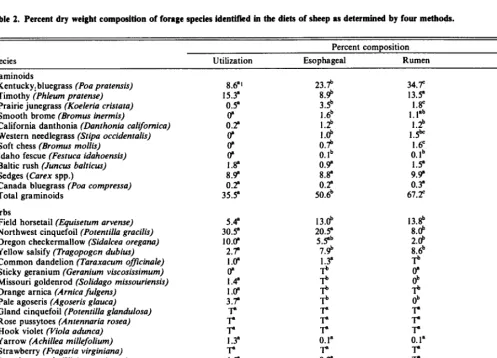
Table 2. U.S. cooperator rat&q of attentive doRs from 4 Renetk stdm, 1981. ANOVA, 6.01.
Strain Maremma Crossbred Shar Planinetz Anatolian
Excellent Fair or Total number or good (%I poor (%I reported
81 19 26
68 32 34
42 58 19
37 63 19
Results
Dogs in the United States
The responses of American sheep producers were analyzed separately according to their type of operation, number of sheep, and flocking behavior of sheep (Table 1). Overall, 59% of their dogs rated excellent or good in attentiveness. Note that the percentages are fairly uniform except for dogs switched between open range and fenced pasture, in the excellent/good column.
Table 2 and Figure 1 give the percentages of attentiveness for four genetic strains of dog. Differences in overall attentiveness between strains is significant at the .Ol level. The Duncan multiple range test shows that the Maremma and Crossbred strains are not significantly different from each other in attentiveness, and neither are the Crossbred, Shar Plainetz and Anatolian subset significantly different from each other. The Maremma and Crossbred subset, however, are significantly more attentive than the Crossbred, Shar Planinetz, and Anatolian subset. The overlap of the Crossbred with each subset is not surprising, since this strain is mostly Maremma X Shar Planinetz crossbreedings.
Dogs in Italy
The scores for attentiveness of the dog to sheep or shepherd could be arranged independently for each set of observations (proximity, orientation, or sidedness), based on prediction. Since orientation and sidedness scores are continuous (i- 1 .O to -I .O), separation into discrete categories is somewhat arbitrary. There- fore, the data for these two sets of observations are arranged according to the score the dog received for proximity, to see if there is agreement between these various methods (see Table 3).
Figure 2 gives the average proximity of 33 dogs to shepherds and sheep. Generally it was assumed that dogs whose average location score was above the diagonal in Figure 2 were tending to follow the shepherd, while those below were following the sheep. Of course dogs could be following both so for analytical purposes we
3 -15 PmxlrrrY Q I.0
SHEPHERO
15 -100
0 -15 I5 -100 ,100
A
B
C
D
1 2 3 4 Fig. 2. Average distances to shepherd andsheep of 33 Italianpredator con-
trol dogs. Letters and numerals on right and bottom axes are discussion references (see text).
categorized dogs whose average score lay in a diagonal box (Al, B2, C3 or D4) as sheep/shepherd-attentive.
Thirteen dogs (39%) were located above the diagonal, which suggests that they were more shepherd-attentive than the 20 dogs (61%) below the diagonal which were in closer proximity to the sheep. However, 12 of the 33 dogs (36%) were in boxes C3 and D4, right on the diagonal, which indicates a possible dual attraction. If we then look at the numbers remaining in boxes above and below the diagonal, we find 14 (42%) following sheep and 7 (21%) following shepherd.
Table 3 gives the average orientation and sidedness scores for the 33 Italian dogs. The orientation prediction here is that dogs strongly oriented toward the shepherd would have high positive scores while those oriented equally to both shepherd and sheep would have low scores, random as to sign.
The orientation data in Table 3 show 9 dogs (27%) with positive scores of 50% or greater indicating that better than 3 out of every 4 times a dog moves it closes the distance between itself and the shepherd. Dual attraction to sheep and shepherd was displayed by 14 dogs (42%) with 6 positive and 8 negative scores of 49% or lower. Orientation to sheep appeared in 10 dogs (30%) with negative scores above 50%.
The prediction for sidedness is that a dog attentive to sheep would be randomly located as to the side of the flock where the shepherd was. Random location would be indicated by a low score ((+)-(-PO) and a random sign. A preference for the shepherd’s side of the flock would be shown by a high score ((+)>(-)) with a positive value. A dog showing equal attraction for shepherd and sheep would be random as to sidedness when it was following sheep
Table 3. Predictions and scores of orientation end sidedness experiments, listed according to proximity scores.
Proximity
Orientation Sidedness
Actual Actual
score Predmon x score Prediction z
Shepherd- attentive
1.00 1.00
.89
.71 (+) high + .76 .65 60 .50 Shepherd/sheep- attentive 60 SO 44 .26 .22
.20 (+/-) low -403 .09 .06 -.25 -.37 -.78 -1.00 Sheep- attentive .02 SKI -.06 -.22 -.25 -.28
-.56 (+) high -.49 -60 -.67 -.73 -.83 -.85 -.88 -1.00
1
.oo
.90 .70
.65 (+) high + .69 .54 .54 .47 I .oo .72 .58 .46 .38
.36 (+) modei”&+ .35 .32 .I6 .I4 .I2 .06 -.I0 .78 .74 .66 .56 .32 .30
22 (+I-) low +.17 .20 -.06 -.I2 -.20 -.25 -.36 -.42
but nonrandom when following the shepherd. Thus (+) would be greater than (-), but a more moderate score would be predicted.
In the experiment for sidedness, 7 dogs (23%) scored moderate (.33 to 66) and positive, and 14 dogs (45%) scored low (0 to .32) of which 5 were negative. Two dogs with moderate negative scores (-.42 and -.36) were placed in the sheep-sided group even though their scores were higher than predicted. In both cases these dogs appeared to be avoiding the shepherds and shepherd-sided dogs. Although there is fair agreement within each category, individ- ual dogs changed categories within the different sets of observa- tions. In several cases it was obvious that there were other factors influencing the dog besides just sheep and shepherd. In one case a shepherd beat a dog which then avoided him, appearing to be a sheep-attentive dog; in other cases there were dominance struggles between dogs which influenced their scores.
Discussion and Conclusion
Although direct comparisons between the US. and Italian data cannot be made due to differences in data collection, the high numbers of observations involved in both sets of data and the minimum of 1 year’s practical experience of the cooperating farmers revealed a consistency in the reports and hence impart reliability to the scores.
American sheep producers rated 59% of their dogs to be atten- tive to sheep. Between strains of dogs, there was a significant difference @<.Ol) in attentiveness ranging from 8 1% excellent or good, to 37% (Table 2). We could detect no environmental differ- ences in the way each of these strains was managed, and in fact precautions were taken in the distribution of dogs in order to guard against any biases. It is noteworthy that dogs raised in different management systems (fenced vs. open range) have the same per- centages of good/excellent dogs.
Observations of Italian dogs indicated that these dogs behave very much like the ones working in the U.S. However, the Italian management system differs enough from U.S. systems to make even their inattentive dogs valuable as livestock protectors. Man- aging sheep in the Gran Sasso and Foresta Demaniale involved one 6-hour grazing period per day. The sheep were milked in the morning and accompanied out onto the range by dogs and shep- herd. Thirty-seven percent of the dogs in the regioneither stayed in camp or were following the shepherd and not the sheep; 29% of the dogs were following both shepherd and sheep. Therefore, only 34% were truly attentive to the sheep alone, and would no doubt rate an “excellent” in attentiveness from a U.S. sheep producer.
Looking at Figure 2, we find that half the dogs are below the diagonal, and so are sheep-attentive dogs, thus approaching the 59% good/excellent sheep-attentive dogs in the U.S. The discre- pancy between the Italian claim of 100% attentive dogs and the 50% we measured is due to the Italian system of managing sheep, which provides a framework that keeps all the dogs on the job for at least part of the day. Shepherd-attentive dogs follow the shep- herd and thus attend the sheep during grazing. Dogs in camp are surrounded by sheep for that portion of the day when the sheep are back in camp. Sheep-attentive dogs follow the sheep out for the day and then back in the evening. Thus, dogs of varying ability are useful in their total system.
That this following instinct has a genetic component is suggested by the data on U.S. guarding dogs (Figure 1 and Table 2), and by the similarity between the frequency of ideal performances of Italian and American dogs (Table 2 and Figure 2), even though management on the two continents is quite different. This is not to suggest that there are not environmental influences on the behav- ior, but simply to point to the fact that in a given area certain dogs are more predisposed to show this behavior, and that the predispo- sition is probably genetically based. By implementing a program of selective breeding, then, the frequency of attentive dogs could be greatly improved.
In the meantime, dogs with less than adequate attentive behavior could reduce losses to predators on U.S. pastures and ranges if
producers would adapt their management systems enough to take advantage of the talents their dogs do have. People-oriented dogs must he weaned from People to sheep, or provided with a shepherd. Dogs that spend their time at the barn and not with the sheep must also he taught to stay with the flock. If corrective measures do not work, it may be time to get a different dog, one that better suits an individual’s livestock management system.
Literature Cited
horn,
C. 1981. Raising livestock guarding dogs. Sheep Canada 5(3):5-7. Boitani, L. 19112. Wolf management in intensively used areas of Italy. p. 158-l 72 In: F.H. Harrington and P.C. Paquet, eds. Wolves ofthe World. Noyes Publications, N.J.Black, H. 1981. Navajo sheep and goat guarding dogs: a new world solution to the coyote problem. Rangelands 3:235-237.
Coppinger, R., and L. Coppinger. 19800. Livestock-guarding dogs. Country Journal 7(4):68-77.
Coppinger, L., and R. Coppinger. 198Ob. So firm a friendship. Natural History 89(3): 12-26.
Coppinger, R.,and L. Coppinger. 1981. Protecting the flock. Sheep! (July): 14-17.
Darwin, C. 197y18393. The Voyage of the Beagle. Bantam Books N.Y. Green, J.S., and R.A. Woodruff. 1980. Is predator control going to the
dogs? Rangelands 2:187-189.
Green, J.S., and R.A. Woodruff. 1982. Livestock guarding dog research at the U.S. sheep experiment station. Sheep Canada 7(l)%-7.
Linhart, S.B., R.T. Sterner, T.C. Carriyn, and D.R. Henna. 1979. Komondor guarding dogs reduce sheep losses to coyotes: a preliminary evaluation. J. Range Manage. 32238-241.
Taylor, R.F., J.P. Workman, and J.E. Brown. 1979. The economics of sheep predation in southwestern Utah. J. Range Manage. 32317-321.
To increase carrying capacity, improve forage
quality and extend the pasture season, plant..
.Perma-Pel Horse
Pasture Seed Mix
A special blend of tender, hardy grasses that are favored by horses and provide good protein forage and inexpensive TDN that saves on hay and grain costs. Grass seeds are selected for plants that grow good sod pas- tures, to reduce plant damage from trampling by horses with good pasture management.There are no clover seeds in this mix.Perma-Pel Cattle
and Sheep
Pasture Seed Mix
A special blend with grasses, clovers and sub-clovers and other legume seeds to grow pastures that put efficient, eco- nomical weight gains on cattle and sheep. Special care is taken in this mix to add plants that reduce the danger of bloat, so long as a balanced grass popu- lation is maintained.One bag plants one acre.
Perma-Pel Pasture the seed to the ground and camouflages Seed Mixes are con- the seeds to prevent loss from birds veniently packaged while awaiting germination. All legume in bags designed for seeds are also coated with Rhizo-Kote planting one acre. to innoculate the seed with rhizobia Both grass and (soil bacteria) to assure proper nitrogen legume seeds are fixation of the legume plants.
coated with additives
that enhance the Look for this special Perma-Pel Pasture microenvironment of Seed Mix at your local seed dealer. the soil surrounding the seed and
promote a high emergence rate. The
RAMSEY SEED, INC.
PO. Box 352, Manteca, CA 95336 extraweightofthiscoatingalsoanchors (209) 823-1721Molybdenosis in an Area Underlain by
Uranium-bearing Lignites in the Northern
Great Plains
LAURA R. STONE, JAMES A. ERDMAN, GERALD L. FEDER, AND HEINRICH D. HOLLAND
Abstract
In the fall of 1975, cattle grazing to the north of an abandoned uranium mine on Flint Butte in Harding County, S. Dak., showed signs of molyhdenosis, a disease due to molybdenum-induced copper deficiency. To identify the source of the problem, plant, water, and soil samples were collected on a grid design over a 16 km* (- 9 miles*) area around Flint Butte. Uranium, molybdenum, and copper concentrations were determined in western wheatgrass (Agropyron smith@ and sweetclover (Mililotur officindis); molybdenum and copper concentrations and pH were determined in pond waters; and the pH of soils was determined. Ratios of copper to molybdenum in the forage were found to be below 2:1, the lowest value considered safe for cattle. Molybdenum concen- trations in some surface waters were extremely high. These condi- tions are related to the outcrop of uranium- and molybdenum- bearing llgnites at Flint Butte and in the nearby Flint Hills. Similar lignites are widespread, and It is likely that nutritional problems of the type e?countered in the Flint Butte area exist in similar geo- logic terrain over a broad region of the northern Great Plains.
Several thin beds of uranium-bearing lignite were stripmined at Flint Butte, in the northwestern corner of South Dakota (Fig. 1) during the mid-1960’s. These beds represent the Lodgepole facies (Stevenson 1956) in the Tongue River Member of the Fort Union formation. The lignite was taken by truck to an ashing plant in southwestern North Dakota, where it was burned to concentrate the uranium (U). The kilns at the plant operated from July 1963 to May 1967.
In 1968, black angus cattle grazing near the former ashing plant exhibited the following symptoms: excessive weight loss, severe diarrhea, and grayed coats (Christianson and Jacobson 1971). Calves were the most severely affected. Sheep were also affected, but to a lesser degree. The cattle were first treated for possible bacterial infection. When they did not respond to treatment, radia- tion sickness was suspected. However, the levels of grama radia- tion in the pastures did not exceed normal background levels. Finally, analyses of soil and fecal samples from the area around the plant revealed abnormally high concentrations of molybdenum (MO); a sample of the ashed lignite from the partly dismantled plant contained 3,200 ppm MO. The health problem was diagnosed as molybdenosis, a MO-induced copper (Cu) deficiency. Molybde- num contamination from the ashing plant was clearly the source of
Authors are respectively, chemist, botanist, and hydrologist, U.S. GeologicakSur- vey, Denver, Colorado 80225, and professor, Department of Geological Sciences, Harvard University, Cambridge, Mass. 02138.
L. Stone’s current address is Box 299, Strong Memorial Hospital Medical Center, Rochester, N.Y. 14642. Inquiries for reprints should be directed to J. Erdman.
Authors thank R.C. Maul, Harding County Extension agent, for bringing the problem to our attention. He and a neighboring rancher, J. Miller, spent many hours sharing their knowkdge of the Flint Butte area. Wearealsograteful to R.J. Ebensand
R.R. Tidball for their help in planning the study; to T. F. Harms, C.S.E. Papp and M.L. Tuttle for their guidance in the laboratory; and to K.C. Stewart and D.M. McKnight for assistance in collecting the samples, often under less than ideal condi-
tions. R.C. Maul, A.A. Case, professor of veterinary toxicology at the University of
Missouri, N.M. Denson, and A.T. Miesch of the U.S. Geological Survey reviewed an
earlier version of the manuscript. Manuscript received June 7, 1982.
FALLON
L__,/_& /____-_-_____-_____7
I
Fig. 1. Location of the Flint WItte study area, and other areas in eastern Montana and western North and South Dakota underlain by uranium- bearing lignite. (Adapted from Denson and Gill 1956: Rpiringos et al. 1965; Stevenson 1956.)
the problem. Molybdenum is strongly associated with the U- bearing lignites in the Cave Hills area of which Flint Butte also is a part (Pipiringos 1966), as well as in the surrounding region (Den- son and Gill 1956).
In the fall of 1975, cows and calves grazing to the north of the abandoned uranium mine on Flint Butte showed symptoms similar to those of the cattle that had grazed near the ashing plant. The abandoned mine was suspected as the source of the contamination. According to Deutscher et al. (1982), analyses of weathered grass and hay samples revealed relatively low Cu levels (1.5-3.3 ppm), and samples of blood and liver from cattle contained low concen- trations of Cu, especially in the liver. Liver Cu levels in 5 mature cows that were slaughtered averaged only 8 ppm, dry-weight basis. In the western parts of the United States these levels are typically 30-100 ppm in the dried tissue (Church et al. 1971, p. 458). Since MO was normal in both the forage (0.8-4.4 ppm) and cattle tissue, the problem appeared to be due to a Cu deficiency.
In September and October of 1978, we interviewed several ranchers in northwestern South Dakota and in southwestern North Dakota. These interviews showed that strikingly similar problems exist in these areas. Some ranchers observed that in years of especially high rainfall the range plants thrive, but that the cattle do poorly in certain pastures. Naturally occurring lime and salts were evident in widespread “seep” areas. In some pastures, calves tend to have chronic diarrhea. They exhibit gaunt, unthrifty frames and do not gain weight. Calves brought in from outside the region had normal liver Cu levels. Copper levels in these calves dropped significantly after 9 months spent in some pastures (Dr. Bart Berg, veterinarian, Hettinger, North Dakota, personal communication
1978). Levels as low as 5 ppm Cu were recorded (Harding County Agricultural Extension Office, 1976). Black cows gave birth to gray calves, and hair loss from the ears and between the rear legs of cattle was noticeable.
Molybdenosis results from the interactions of Cu, MO, sulfide, and sulfate in the rumen and tissues of ruminants, which make Cu metabolically unavailable. Molybdenosis is a worldwide problem; it has been reported not only in the United States, but also in Canada, Great Britain, New Zealand, and the Soviet Union. The biochemistry of the disease has been discussed by Church et al. (197 1) and by Huisingh and Matrone (1976).
In a survey of MO toxicity in the western United States, Kubota (1975) found that cattle grazing on forage containing IO-20 ppm MO showed symptoms typical of molybdenosis. Webb and Atkin- son (1965) reported that 5 ppm MO in forage is the approximate upper level tolerated by cattle in Ireland; Alloway (1973) and Thornton (1977) have suggested that values as low as 2 ppm are important in MO-induced hypocuprosis in cattle. Others believe that it is not high concentrations of MO alone, but the ratio of Cu to MO that is the cause of molybdenosis. The recommended Cu:Mo ratio in cattle forage is about 6:l (Dollahite et al. 1972); Cu:Mo ratios below 21 will lead to the development of molybdenosis symptoms (Miltimore and Mason 1971; Dollahite et al. 1972). Dietary Cu can be administered in the form of salt licks that are supplemented with Cu sulfate, or by injections of Cu glycinate (Dye and O’Harra 1959). These methods raise the Cu level in the rumen so that the effective Cu:Mo ratio is higher than 2: 1 (Dye and O’Harra 1959).
In October 1978, a study was designed to determine the extent of the molybdenosis problem around Flint Butte. The objective was to determine whether there are specific areas in the vicinity of Flint Butte that are hazardous to cattle, and if the hazard is related to the local geology. If so, it might be possible to identify other areas in the region where similar problems to cattle could be expected. The U, MO, and Cu concentrations in selected forage plants, the con- centrations of MO, Cu, and pH of water, and soil pH were deter- mined. The availability of MO to plants increases under conditions of high pH (Alloway 1973), so MO levels in the forage could be increased by the alkaline conditions that prevail in many soils of the northern Great Plains.
Methods
Sampling Design
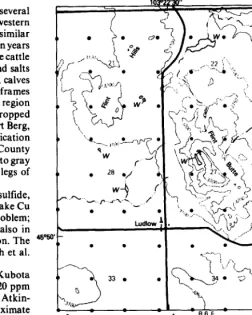
A grid design with a sample spacing of approximately 500 m (- 1600 ft) was established in an area of over 16 km* (- 9 miles*); Flint Butte was near the center of the grid (Fig. 2). Soil samples repres- enting the upper 15 cm (6 in) of the soil profile were collected at each of 81 sites for pH determination. We tried to collect samples of western wheatgrass (Agropyron smithii) and sweetclover (Meli- lotus of~cinalis) at each site, but there were some “holes” in the design due to the absence of one or both species at some sites; only 77 wheatgrass samples and 58 sweetclover samples were obtained. Western wheatg ss was sampled because it was widespread in the area; it also pro uces high quality hay and provides year-around grazing for liv 3‘ stock (Freeman 1979). Sweetclover was sampled because it is a highly palatable forage plant for cattle and has a high protein content (Miles 1970). Like most legumes, sweetclover is a
JOURNAL OF RANGE MANAGEMENT 36w May 1983
+ . . .I . l ‘r,
is
33 :-1~~~~~~~~
0 1 2 MILES
I
0 1 2 KILOMETFBS
Fig. 2. Detailed map of Flint Butte and vicinity, showing location of mine, the grid sampling design for plants and soils. and the location of the six pond-water samples (W). Contour intervals are given in feet. (Adapted from U.S. Geological Survey 7.5minute series
topographic maps, Ludlow and Ludlow SE quadrangles.)
6lo accumulator and therefore, sites with soils that contain anom- alous levels of MO should be more easily detected. Plant samples were composited from several individual plants within a 10-m (- 30 ft) radius of each sampling site. In a few cases, sampling loca- tions were moved to points where the wheatgrass and sweetclover were present. All of the relocated sampling points were within 100 m (- 330 ft) of the originally intended site. Vegetation samples were taken in a manner which minimized contamination by soil. Surface water samples were collected at the 6 ponds indicated in Figure 2. Sediments suspended in most water samples were removed by means of a Milliporer pressure syringe apparatus using 0.45 micrometer filters. At two sites the high concentration of sediment made filtering difficult; sediment was removed from these samples by centrifugation in the laboratory prior to filtering. The pH was determined at each site using a Digi-sense pH meter. Analytical Methods
All methods of analysis used in this study are standard tech- niques currently in use in the laboratories of the U.S. Geological Survey (USGS) in Denver, Colorado. Plant samples were air dried and ground in a Wiley mill to pass a 1.3-mm sieve. They were not washed since they were meant to be representative of forage as ingested by cattle on the rangeland. Portions of the ground samples were ashed at 5000 C in a muffle furnace. The samples were analyzed in randomized order for Cu, MO, and U. Cu and MO were determined by the methods outlined by Nakagawa (1975) and Nakagawa et al. (1975). The samples were aspirated in a Perkin Elmer Model 306 atomic absorption unit. Uranium was deter- mined by the method of Huffman and Riley (1970). Fluorescence was measured on a Jarrell Ash Model 26-000 solid state fluorimeter.
Water samples were. analyzed for Cu and MO in the laboratories ‘Use of trade names is for descriptive purposes only and does not imply endorsement by the U.S.G.S.
of the Water Resources Division, USGS, Denver, Colorado. The samples were aspirated into an Inductively-Coupled Plasma Emis- sion Spectrometer.
The soil samples were dried at room temperature and were sieved to minus 10 mesh (2mm). Soil pH was determined in the laboratory by the method outlined by Peech (1965).
Results Geochemicd Patterns
The concentration of U and MO in both wheatgrass (Fig. 3aand 3b) and sweetclover (Fig. 3c and 3d) is strongly correlated with the local geology. High concentrations of both metals were found in samples associated with the uraniferous Tongue River member. The U concentrations in the ash ranged from<0.4 ppm (0.4 ppm is the lower limit of detection) to 4.0 ppm in wheatgrass, and <0.4 to 50 ppm in sweetclover. Concentrations of MO (dry-weight basis) ranged from< 1 to 44 ppm in wheatgrass, and from 1 to 203 ppm in sweetclover; the highest values occur in samples taken at the mine.
Copper concentrations in forage showed no consistent relation- ship to the local geology. However, the concentrations of Cu in wheatgrass ranged from only 0.2 to 1.6 ppm on a dry-weight basis; these values are well below the levels judged optimal for cattle nutrition. Concentrations of Cu in sweetclover were generally nutritionally adequate and ranged from 4.6 to 10.7 ppm. The pattern of the Cu:Mo ratio was found to be similar to the MO patterns shown in Figures 3b and 3d; the lowest ratios were asso- ciated with the areas of highest MO concentrations. In wheatgrass, the Cu:Mo ratios ranged from 0.01 to 1.1, well below the critical threshold value of 2: 1. The ratios for sweetclover ranged from 0.03 to 5.9; 41 of the 58 values fell below the critical Cu:Mo ratio.
The soil pH showed no clear relationship to topography or to geology (Fig. 4), and has been discounted as a factor in controlling the MO levels in the plants of this area. The correlations between
44 IP 01 Od a.4 404 di 0.6 1.0, s 6 II 1 4 i.
!. > ,J,,
1
li-syy!3
LY u___.- - - a.4 0.8 ii 0,. l?. 5.. - - - 1 (I +.’ 1:
1
Fig. 3. Uranium and molybdenum concentrations in western wheatgrass (a and b) and in sweetclover (c and d). Dashes indicate that samples were unavaihzble at the site. Cross-hatched areas are underhtin by the Tongue River Member of the Fort Union Formation, and the bold contour indicates the outcrop of the Lodgepole facies which contains the uranium- bearing [ignites. Areas not cross-hatched are underlain by the Ludlow Member of the Fort Union; dotted lines indicate outcrops of non- uraniferous lignites. (Geology adapted from Stevenson 1956).
7.2
6.3 5.7 6.;
!
6.2 7.2 6.2 6.9 7.1 6.6 D ::::.. ,::::.::
7.4 t%P 6.4/j& 6.3
Fig. 4. 7’7~ pH of surface soils. (Geologic detail explained in b&me 4.)
the soil pH and MO content of both plant species were not signi!% cant at the 95% confidence level.
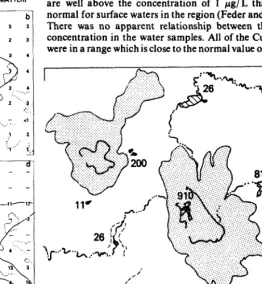
The MO concentrations in the water samples are shown in Figure 5. Molybdenum concentrations ranged from I I to 910 I.rg/ L, which are well above the concentration of 1 pg/L that is considered normal for surface waters in the region (Feder and Saindon 1976). There was no apparent relationship between the pH and MO concentration in the water samples. All of the Cu concentrations were in a range which is close to the normal value of about IO ug/ L.
110 *A."
f'
/
,I’
I \
I
62
_::‘.I ,,I-
L -___
Fig. 5. Molybdenum (vg/ L) in pond waters. (Geologic detail exphu’ned in Figure 4.)
The geochemical anomalies are clearly stratigraphically con- trolled. The highest U and MO concentrations and the lowest Cu:Mo ratios in forage plants generally occur near outcrops of the Tongue River Member of the Fort Union Formation. Major anomalies occur not only in the mined area of Flint Butte, but also to the northwest in the undisturbed area on the Flint Hills (Fig. 2).
Seasonal Variation
In 1976, the Agricultural Extension Service in Harding County conducted a study of the seasonal effects on Cu and MO levels in forage. Deutscher et al. (1982) reported that Cu concentrations decreased from an average of 4.3 ppm in samples collected in June, to 2.7 ppm in samples collected in the September-October period. Concentrations of MO in the same forage samples remained con- stant throughout the season.
We conducted a somewhat similiar study in the Flint Butte area. Vegetation at 8 of the grid-point sites sampled in October 1978 were resampled in August 1979. The results (Fig. 6) are similar to those reported by Deutscher et al. (1982). The Cu levels, on dry weight basis, in the 8 samples of wheatgrass collected in August 1979 ranged from 3.5 to 10 ppm, whereas the 8 samplescollected at the same sites in October 1978 ranged from 0.2 to 1.5 ppm. On the other hand, the MO concentrations in wheatgrass from these grid points remained fairly constant. The same relationship is evident for sweetclover: Cu levels in sweetclover were lower in the October samples than in August samples, and the MO concentrations were again fairly constant. Although the Cu levels were lower in the October samples, sweetcover sampled at that time was not nutri- tionally deficient. The Cu:Mo ratios were, however, critically low in both species during both seasons.
It appears, then, that as the season progresses the Cu concentra- tions in forage decrease while MO concentrations remain fairly constant. This may cause some areas to become Cu deficient, and MO anomalies in some localities may aggravate the deficiency.
Regional Implications
Denson and Gill (1956) compiled a generalized section of geo- logic formations, most of which are uraniferous, that are exposed in southeastern Montana and adjacent areas in North Dakota and South Dakota (Table 1). Many of these exposures occur as hills or buttes that are underlain by uranium-bearing strata. The locations of some of these hills and buttes are shown in Figure 1. Sedimen- tary rocks of Late Cretaceous through Eocene age generally have a dip of - 2-7 m per km (lo-40 ft per mi) to the northeast into the Williston Basin of North Dakota. The lignite-bearing beds com- prise a sequence that is - 600 m (2000 ft) thick (Denson and Gill 1956).
WESTERN WHEATGRASS 15
SWEETCLOVER
4
1
40 CRITICAL THRESHOLO
1
13 24 29 31 33 41 43 57 13 24 29 31 33 41 43 57
SITE SITE
Fig. 6. Copper and molybdemun concentrations in western wheatgrass and sweetcoverfrom 8 sites thar were sampledfirsr in October 1978 (bargraph) and later in August 1979 (open bargraph).
The overlying younger volcanic tuffs found in the Arikaree Formation and White River Group are mildly radioactive. It is thought that U and MO in the lignite were probably leached from the overlying tuffs by oxidizing groundwater and deposited in the reducing environment of the lignites; field evidence supports this theory. The lignites that dip into the Williston Basinand lie uncon- formably below the Oligocene and Miocene tuffs contain the high- est concentrations of U and MO (Denson and Gill 1956). These high concentrations occur in the upper parts of the stratigraphi- tally higher beds regardless of age (Fig. 7).
EXPLANATION . . . .
Radioactive lignite Nonradioactive lignite
Fig. I.
Diagrammatic section across northwestern Sourh Dakota and sourhwestern North Dakota showing stratigraphic distribution of uranium-bearing lignite. (From Denson and Gill 1956,)In the vicinity of Flint Butte, the lignites in the Lodgepole facies remobilized the U and MO into the area immediately surrounding of the Tongue River Member of the Fort Union Formation are the butte.
stratigraphically higher and closer to the unconformity below the We propose that the conditions that are causing Cu-MO imbal- radioactive tuffs (which have since been completely eroded) than antes in cattle at Flint Butte probably occur in geologically similar those of the Ludlow Member of the Fort Union Formation. Ura- areas elsewhere in the region. An incidence of Mo-induced Cu nium and MO were therefore concentrated in the Tongue River deficiency in cattle from western Manitoba has been described by strata. Subsequent weathering of the Tongue River strata has Doyle and Fletcher (1977).
Tabk I. &+nerag& section of formations exposed in southeastern Montana and adjacent p&s of North and South Dakota (from Dcnson and Gill 1956).
System Series
Thickness
Group, formation, member in feet Lithologic characteristics (italics added)
Quaternary- Holocene and- --- O-100 Silt, sand and gravel in dunes, terraces, and alluvial fans along main
Pleistocene. stream channels
Miocene- Arikaree Formation--- 260
Massive greenish-white to ash-gray tuffaceous sandstone and siltstone with a few thin beds of quartzite and volcanic ash. Dominantly of aeolian origin. Contains local occurrences of carnotitet in calcareous siltstone in the Short Pine Hills. Caps most of the high buttes of eastern Montana and North and South Dakota.
- Unconformity
Massive buff to pinkish-tan tuffacerous siltstone and claystone. Con- tains abundant vertebrate remains. Well exposed in Chalky Buttes Brule Formation- O-240 and Little Badlands of North Dakota. Preserved only in pre-Arikaree
landslide blocks in Slim Buttes and Short Pine Hills of South Dakota. Not present in southeastern Montana.
White River Group Oligocene
Chadron Formation-- O-160
Dark-gray bentonite and light-gray tuffaceous claystone, siltstone and sandstone. Basal unit consists of coarse-grained conglomeraticsand- stone. Lower part at many places weather golden yellow. Carnotite occurs in upper part of formation in the Slim &ares.
Tertiary-
- Unconformity
Eocene- Golden Valley Formation- O-175
Gray to yellow sandstone, sihstone, and purplish-gray to white kaolinitic clay. Contains a few thin lenticular beds of lignite and carbonaceous shale. In the Little Badlands where closely overlain by Oligoceneand Miocene rocks, carbonaceous bea!s are radioactive.
Sentinel Butte Member ~60
Dark-gray bentonitic claystone and shale, buff to brown sandstone with numerous beds of lignite which are radioactive in HT. Sentinel, B&on, and Chalky Buttes. Contains carnotite-bearing sand- stone at Whetstone Butte.
Tongue River Member- 600-i- Fort
Paleocene- Union Paleocene-Union Formation L
Massive gray to tan sandstone, s&stone, and shale. Contains many lenticular beds of quartxite and thick persistent beds of lignite. For- mation has large deposits of uranium bearing lignite in Medicine PoQ and clove Hills areas, and at Lodgepole Butte.
Cannonball Member-. O-300
Marine dark-gray and brown sandstoneand shale with large limeycon- cretions. Intertongues and thins to the west with the Ludlow Member of the Fort Union Formation.
Gray to light-yellow-tan sandstone, gray shale, and thick lmticular beds of lignite. Contains radioactive lignite deposits in the Slim Buttes and Ludlow Member- 350 Cave, Long Pine and Ekaktka Hills. Local &posits of uranophanet-
bearing sandstone in the Slim Buttes.
Hell Creek Formation-- 425
Dark-gray bentonitic claystone and gray-brown lenticular sandstone. Many concretions and thin lenses of iron carbonate. Contains thin lenses of lignite in upper part. Local occurrence of camotite in sand- stone in the Long Pine Hi&.
Upper
cretaceous- Cretaceous- Fox Hills Sandstone---- 25-75
Pierre Shale-- 500+1
exposed ‘Uranium-hearing minerals of secondary origin.
Marine grayish-white to brown sandstone.
Marine dark-gray to brownish-black bentonitic claystone and shale containing large limestone concretions and thin beds of bentonite.