Available online:
http://edupediapublications.org/journals/index.php/IJR/
P a g e | 899Biodiesel: A Future fuel (A Review)
Gowtham kumar S.N
1, Raghavendra Prasad S.A
2, Gerard Elston Shawn D’souza
3,Chirag B
Shetty
4, Jaidev
51,3,4,5
Students, B.E, Mechanical Engineering, Alva’s Institute of Engineering & Technology,
Mangalore, Karnataka.
2
Assistant Professor, Mechanical Engineering, Alva’s Institute of Engineering & Technology,
Mangalore, Karnataka.
Abstract:
Due to the concern on the availability of recoverable fossil fuel reserves and the environmental problems caused by the use those fossil fuels, considerable attention has been given to biodiesel production as an alternative to petro diesel. The general way to produce biodiesel fuel is by Transesterification of vegetable oil with methanol in the presence of either alkaline or strong acid catalysts. Transesterification reaction is quite sensitive to various parameters. An ideal Transesterification reaction differs on the basis of variables such as fatty acid composition and the free fatty acid content of the oil. The benefits of biodiesel go far beyond the clean burning nature of the product. Bio diesel is a renewable resource helping to reduce the dependence of the economy on limited resources and imports, create a market for farmers and reduce the amount of waste oil, fat and grease being dumped into landfills and sewers. This paper reviews the production and use of Biodiesel fuel as an alternative fuel for existing IC engines.
Keywords: biodiesel, Transesterification, economy, IC engines, fuel.
1.
Introduction
Biodiesel has become more attractive recently because of its environmental benefits and the fact that it is made from renewable resources.Biofuels can be produced across the world using resources that are available locally, thereby reducing foreign exchange for buying crude oil and increases the country's economy. Fuel is any material that stores energy that can later be extracted to perform mechanical work in a controlled manner. This may include combustion, exothermic chemical reactions and nuclear reactions [1]. Vegetable oil from plant sources is the best starting material to produce biodiesel because the conversion of pure triglyceride to fatty acid methyl ester is high and the reaction time is relatively short. The most common way to produce biodiesel is by transesterification, which refers to a catalyzed chemical reaction involving
vegetable oil and an alcohol to yield fatty acid alky estersand glycerol [2].
Biodiesel is a mixture of mono-alkyl esters obtained from vegetable oils like soy bean oil, jatropha oil, rapeseed oil, palm oil, sunflower oil, corn oil, peanut oil, canola oil and cottonseed oil (3 Ma, F., dan Hanna[3]. In the conventional transesterification process, Sunflower seed oils, methanol and NaOH in various concentrations) were refluxed together in a 500 ml glass reactor equipped with a glass anchor shaped mechanical stirrer, a water condenser and funnel. After the complete conversion of the vegetable oil, the reaction was stopped and the mixture was allowed to stand for phase separation: the ester mixture formed the upper layer and glycerine formed the lower layer[4]. The main advantages of using biodiesel is that it is biodegradable, can be used without modifying existing engines, and produces less harmful gas emissions such as sulfur oxide. Biodiesel reduces net carbon-dioxide emissions by 78% on a lifecycle basis when compared to conventional diesel fuel[ 5].
2.
Synthesis of Biodiesel
2.1 Direct Use and Blending
The direct use of vegetable oils in diesel engine is not favorable and problematic because it has many inherent failings. Even though the vegetable oils have familiar properties as biodiesel fuel, it required some chemical modification before can be used into the engine. It has only been researched extensively for the past couple of decades, but has been experimented with for almost hundred years. Although some diesel engine can run pure vegetable oils, turbocharged direct injection engine such as trucks are prone to many problems. Energy consumption with the use of pure vegetable oils was found to be similar to that of diesel fuel. For short term use, ratio of 1:10 to 2:10 oil to diesel has been found to be successful [6].
2.2 Micro Emulsion Process
Available online:
http://edupediapublications.org/journals/index.php/IJR/
P a g e | 900 optically isotropic fluid microstructures withdimensions generally in the 1-150 nm range formed spontaneously from two normally immiscible liquids and one or more ionic or non-ionic amphiphiles [7].
2.3 Thermal Cracking (Pyrolysis)
Pyrolysis can be defined as the conversion of one substance into another by means of heat in the absence of air (or oxygen) or by heat in the presence of a catalyst which result in cleavage of bonds and formation of a variety of small molecules. The pyrolysis of vegetable oil to produce biofuels has been studied and found to produce alkanes, alkenes, alkadienes, aromatics and carboxylic acids in various proportions. Another disadvantage of pyrolysis is the need for separate distillation equipment for separation of the various fractions. Also the product obtained is similar to gasoline containing sulphur which makes it less ecofriendly [8] Pyrolytic chemistry is difficult to characterize because of the variety of reaction path and the variety of reaction products that may be obtained from the reaction occur. The pyrolyzed material can be vegetable oils, animal fats, natural fatty acids and methyl esters of fatty acids. The first pyrolysis of vegetable oil was conducted in an attempt to synthesize petroleum from vegetable [9].
2.4 Mixing of Alcohol and Catalyst
This typical process is mainly done by mixing alkali hydroxide (commonly potassium hydroxide and sodium hydroxide) with common alcohols (methanol and ethanol) in the mixer with standard agitator to facilitate the mixing. Alkali hydroxide is dissolved in the alcohol to produce alkoxide solution [10].
3.
Production of Biodiesel from vegetable
oil
There are four basic routes to biodiesel production from oils and fats.
1. Base catalyzed transesterification 2. Direct acid catalyzed transesterification
3. Conversion of oil into its fatty acids and then into biodiesel
4. Non - catalytic transesterification of oils and fats [11] Transesterification consists of a number of consecutive, reversible reactions. Triglycerides are converted step wise to diglycerides, monoglycerides and finally glycerol liberating a mole of ester in each step. The reactions are reversible, the equilibrium lies towards the production of fatty acid ester and glycerol .
Figure 1. : The mechanism decomposition of triglycerides [11]
3.1Acid catalyzed transesterification
Carboxylic acids can be esterified by alcohols in the presence of suitable acidic catalyst in water free Conditions. The most frequently cited reagent for the preparation of methyl esters is 5%anhydrous hydrogen chloride in methanol. In a typical esterification procedure, using methanolic hydrogen chloride, the lipid sample is dissolved in at least a 100-fold excess of the reagent and the solution is refluxed for about two hours or is held at 50o C
overnight.
Figure 2. : Mechanism of Acid catalyzed transesterification [12]
Free fatty acids in the oil were reduced by using acid catalyst. Free fatty acids reduce the yield of biodiesel by saponification, hence acid catalyzed transesterification has an advantage of more yield. However, the reaction is slow that one run can take more than a day [17].
3.2 Base catalyzed Transesterification
Available online:
http://edupediapublications.org/journals/index.php/IJR/
P a g e | 901Figure 3.: Base catalyzed Transesterification of lipids [13]
4. Types of Transesterification:
4.1 Homogeneous base catalyzed
transesterification
Homogeneous alkaline catalysts are more preferable and commonly used since Transesterification reaction using its acid counterpart has slower rate [17]. The most common basic catalysts are potassium hydroxide (KOH), potassium methoxide (KOCH3), sodium hydroxide (NaOH), sodium methoxide (NaOCH3), and sodium ethoxide (NaOCH2CH3). These catalysts are commonly used because of several advantages such as able to catalyze reaction at low reaction temperature and atmospheric pressure, high conversion in shorter time, and economically available [18]. Sodium methoxide (NaOCH3) and potassium methoxide (KOCH3) are better catalyst than sodium hydroxide (NaOH) and potassium hydroxide (KOH) due to the ability to dissociate into CH3O- and Na+ and CH3O- and K+ respectively when comparing on biodiesel yield [19].
4.2 Homogeneous acid-catalyzed
Transesterification
Waste oils contain free fatty acids which cannot be converted to biodiesel using an alkaline catalyst. These FFAs will produce soap that inhibit the separation of the ester, glycerin, and wash water when react with an alkaline catalyst [21]. Hence, liquid acid-catalyzed Transesterification is proposed in order to overcome lots of conundrum caused by liquid base catalysts. Sulfuric acid, sulfonic acid, hydrochloric acid, organic sulfonic acid, and ferric sulphate are most commonly acids used as catalysts in transesterification . In the production of biodiesel, hydrochloric acid and sulfuric acid are favoured as catalyst. Despite of its insensitivity to FFA in the feedstock and can catalyzes esterification and transesterification simultaneously, acid catalyst has been less popular in transesterification reaction because it has relatively slower reaction rate. Thus, alcohol to oil molar ratio is the main factor influencing the reaction. Addition of excess alcohol can speeds up the reaction and favours the formation biodiesel product. The steps involve during acid-catalyzed transesterification are initial protonation of
the acid to give an oxonium ion followed by the oxonium ion and an alcohol undergo exchange reaction to give the intermediate which later loses a proton to become an ester [22]. In a study of acid-catalyzed transesterification of sunflower oil using HCl reported 95.2% of biodiesel yield with 100˚C reaction temperature and 1.85 wt% catalyst loading. used H2SO4 in the acid-catalyzed transesterification
with 0.5 wt% catalyst loading reported 92.5% biodiesel yield from Chlorella pyrenoidosa.
4.3 Acid - base transesterification
In the homogenous acid and base catalyzed transesterification processes, the most commonly used base catalysts are NaOH and KOH while acid catalysts are sulphuric acid and sulphonic acid. The major drawback of base transesterification is saponification which may be due to the presence of free fatty acids in the oil that is subjected for transesterification. Esterification of free fatty acids is possible by acid catalysis which reduces the soap formation, ultimately leads to more yield of alkyl ester (biodiesel). In transesterification process, biodiesel is produced from a reaction between vegetable oil, alcohol in the presence of base or acid catalyst. Methanol is most preferred alcohol because of its low cost and its physical and chemical properties. The highest biodiesel yield was at 3% weight of catalyst, 60o C and reaction time of 120
minutes. The results of acid -base catalyzed synthesis showed that biodiesel yield was improved when compared to base catalyzed synthesis alone. The kinematic viscosity of acid -base catalyzed biodiesel satisfied the standard test method for kinematic viscosity [22]
4.4 Heterogeneous case catalyzed
transesterification
Available online:
http://edupediapublications.org/journals/index.php/IJR/
P a g e | 902 reported transesterification by using eggshells ascatalyst which is the closest comparison to this study. [22]. Furthermore, base-catalyzed transesterification was proved to have higher reaction rate as compared to acid-catalyzed transesterification which need more vigorous reaction condition including higher temperature during transesterification [26] The effect of base catalyst, Potassium hydroxide (KOH) and volume of methanol on the rate of transesterification of croton oil was investigated by separately varying the mass of base or volume of methanol added to different portions the reaction mixture containing 100 g croton oil and determining their effects on the % yield of biodiesel relative to the mass of croton oil. The KOH was dissolved in methanol then added to the reaction mixture in a biodiesel reactor at constant temperature and stirred continuously at 350 rpm. The effects of temperature and volume of methanol on the rate of transesterification were also investigated by separately varying the temperature and volume of methanol and determining their effects on the % yield of biodiesel.
4.5 Heterogeneous acid-catalyzed
transesterification:
Despite of the effectiveness of homogeneous acid catalyst, it can lead to absolute contamination problems which require good separation and product purification processes [11]. This will be resulted in higher production cost. Some of advantages of heterogeneous acid catalyst are insensitive to FFA content, can simultaneously conduct esterification and transesterification, eliminate the washing step of biodiesel, simpler separation process of catalyst from product, regenerating and reusing the catalyst is possible and also reduce the corrosion problems In addition, solid acid catalysts are preferred over liquid acid catalysts due the fact that they contain a multiple sites with different strength of Bronsted or Lewis acidity [27]. Bronsted acid catalysts have the advantage of promoting simultaneous esterification and transesterification with the use of cheaper feedstock containing high concentration of free fatty acids [28]. A Lewis acid site is more active as compared to Bronsted but is at risk to poisoning from water and/or free fatty acids. The volume of methanol required to react completely with FFA in croton oil was calculated from the acid value. Since the esterification reaction is a reversible reaction, a FFA:methanol ratio of 1:3 was used to shift the equilibrium to the right and improve the yield of ester. Exactly 2mL of 99% pure methanol was added to different portions of 100 g of croton oil in a reactor and mixed for 5 minutes by stirring at 350 rpm.
4.6 Enzyme (Biocatalyst) catalyzed
transesterification:
Enzymatic transesterification has drawn researcher’s attention due to the downstream processing problem posed by chemical transesterification. Huge amount of wastewater generation and difficulty in glycerol recovery are some of the problems that eventually increase the overall production cost of biodiesel and being not environmental benign. In contrast, enzyme catalysis occurs without the generation of by-products, easy recovery product, mild reaction condition, insensitive to high FFA oil and catalyst can be reuse.
However, enzyme catalyzed biodiesel production has some limitations especially when implemented in industrial scale because of high cost of enzyme, slow reaction rate and enzyme deactivation [29]. alcoholysis, esterification and transesterification they have a wide spectrum of biotechnological applications. Lipases are also highly specific as chemo-, regio- and enantioselective catalysts. Thanks to direct evolution and protein engineering it is possible to enhance catalytic potential of lipases and to ‘tailor’ them to specific application and process conditions, enabling further expansion of their industrial use Among lipases of plant, animal and microbial origins, most commonly used are microbial lipases. In addition, the enzymatic yield is independent of potential seasonal variations and it is possible to achieve rapid growth of microorganism in low-cost culture media [30]
4.7 Microwave assisted transesterification
In conventional transesterification process heating of material takes place by conduction. Whereas microwaves heat by means of thermal radiation and it is very efficient mode of heat transfer. In microwave assisted continuous transesterification, vegetable oil and methanolic NaOH solution were fed separately via 2 pumps and mixed at the tee connector at the inlet of modified house hold microwave oven (800W). Microwave energy is delivered directly to the reacting molecules which undergo chemical reaction. Reaction time was reduced to 60 seconds with palm oil, 5 to 10 minutes in case of non-edible oils of Honge and Jatropha where their respective conversion in conventional method was 1 hour and 1 to 2 hours. Biodiesel produced by microwave assisted transesterification has reduced performance due to their comparatively high viscosity. Also smoke opacity, HC and CO emissions increased with such oils [31].
4.8 Ultra sonically assisted transesterification
Available online:
http://edupediapublications.org/journals/index.php/IJR/
P a g e | 903 between oil and methanol . Ultrasonic reactordrastically reduces the amount of catalyst, molar ratio of oil to methanol 1:6, reaction time, reaction temperature, mass transfer resistance elimination and energy input for production of biodiesel[32]. Transesterification reaction takes place at interfacial region of two immiscible phases (oil and methanol), which may be achieved by vigorous mixing using ultra sonic waves and produces pure fuel with highest possible conversion percentage. The reaction rate constants were evaluated and found that rate constants are 3-5 times higher than that of mechanical agitation . Acoustic and hydrodynamic cavitation found effective tool for intensification of esterification of fatty acids with acid catalyst (H2SO4) 99.4 % conversion soybean oil to FAME
(fatty acid methyl ester) was achieved in about 15 minutes at 40 oC and molar ratio of 6:1 methanol to oil with 20kHz ultrasonic frequency. Lipase catalyzed transesterification activity enhanced with ultrasonic irradiation. also ultrasonic assisted transesterification reduced amounts of lipase and reaction time. Yields of biodiesel were always higher when ultrasound was used [33]
5. Results
5.1 Sulfuric Acid Process (Two-Step
Transesterification)
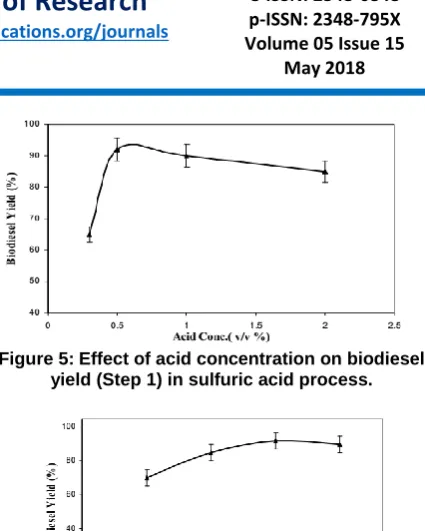
Acid esterification reaction was studied for four different molar ratios. The sulfuric acid catalyst amount was varied in the range of 0.3% to 2%. These percentages are based on volume of the oil used for the acid esterification reaction. The catalyst amount also affects the yield of process is shown in Figure 1. The acid-catalyst process attained maximum yield for waste cooking oil at 0.5% catalyst concentration. It was observed that the yield started to decline when the catalyst concentration was increased to above 0.5%. The yield remains the moreover same with further increase in the methanol to oil molar ratio. Theexcess methanol in the ester layer can be removed by distillation. Canakci and Van Gerpan [34] advocate the use of large excess quantities of methanol (15:1-35:1) while using the sulphuric acid as catalyst. Figure 2 shows the methanol to oil molar ratio effect in alkali transesterification (Step 2). [37]. An alkali catalyst was studied in the range of 0.3% to 2.5% using KOH as an alkali catalyst. The influence of the alkali catalyst amount on the yield is shown in Figure 3. The maximum yield was achieved for waste cooking oil at 2% of catalyst loading. During the experi- ments, it was also observed that transesterification could not take place properly with an insufficient amount of an alkali catalyst loading. The production yield slightly decreased above 2% of catalyst loading. At higher concentrations, the intensification of mass transfer became more important than increasing the amount of catalyst.
Figure 5:Effect of acid concentration on biodiesel
yield (Step 1) in sulfuric acid process.
Figure 5:Effect of molar ratio on biodiesel yield (Step 2) in sulfuric acid process.
5.2 Microwave Catalytic Transesterification
The effect of methanol to oil molar ratio and catalyst concentration (BaO and KOH) on waste biodiesel yield using microwave method. Methanol-to-oil ratios of 6:1, 9:1, 12:1, and 15:1 were tested for both catalysts. In this study, for homogeneous catalysts (KOH), a molar ratio of 9:1 and 2% catalyst were found to be effective with maximum biodiesel yield of 92%. For BaO, excess methanol started to interfere in the separation of glycerin due to an increase in the solubility and resulted in lower biodiesel yield [27]. In combine effect of excess alcohol and KOH catalyst leads to saponification resulting in lower biodiesel yield and lower biodiesel quality. An advantage associated with heterogeneous catalysts is that they can be recovered and reused several times. The reactivity of BaO catalyst was found to be quite different than KOH catalyst as it posses different catalytic activity, basicity, leach- ing tendency, and specific surface area, which influence the transesterification of oil [38]
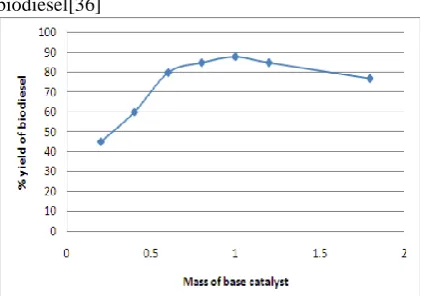
5.3 Effect of mass of base catalyst on transesterification
Available online:
http://edupediapublications.org/journals/index.php/IJR/
P a g e | 904 yield of biodiesel was obtained. Figure 2 shows theeffect of mass of KOH added on the % yield of biodiesel[36]
Figure 6: Effect of temperature and time on Esterification
The % yield of biodiesel increased with increase in reaction temperature. The maximum yield of biodiesel was obtained after one hour at a reaction temperature of 60oC. Although the maximum yield
of biodiesel increased with increase reaction time at 30oC, 40oC and 50o C, no significant increase in
maximum yield of biodiesel was observed at the reaction temperature of 60oC after one hour. Figure 4
shows the variation of yield of croton biodiesel with time at various reaction temperatures.[ 38]
6. DISCUSSIONS
6.1 Flash Point and Alcohol Control
The volatility of biodiesel is extremely low, and properly produced biodiesel presents minimal risk for handling and safety. To ensure safe handling of biodiesel, a minimum flash point of 130°C is set to limit residual methanol. The flash points of the samples are shown in Figure 1, with only four samples having a flash point below 130°C. Certain feed stocks and process conditions may result in slightly lower flash points, and the methanol content of these samples needed to be tested. The samples with flash points below 130°C were sent for methanol analysis. Three of the four samples with a flash point below 130°C met the methanol content requirement. The final sample had excess methanol content and failed both requirements. [39]
6.2 Acid Number
The acid number of biodiesel should be low to ensure no residual free fatty acids or processing acids are present in the fuel. The presence of excess acids can lead to corrosion and deposits in fuel systems. Previous surveys have shown few failures on acid value [38,39], and the current survey shows no failures for acid number. The average acid number of these samples was 0.24 mgKOH/g, approximately half of the specification limit. One sample was close
to the specification limit, at 0.48 mgKOH/g and was the highest value recorded in this survey.
6.3 Cold Soak Filtration
Previously, biodiesel users experienced many cold weather operability problems with biodiesel blends [40]. In an effort to combat the impact of minor components not measured in D6751, the CSFT was added as an annex in 2008. The annex was converted into a full ASTM test method, D7501, in 2010. Reports of problems in cold weather have been significantly reduced since the addition of the CSFT. Immediately after the adoption of the CSFT into D6751, over 50 biodiesel samples from different feedstocks and processes were tested, with the results being bimodal; the biodiesel samples either passed or failed the test [41]. Failure of the CSFT was not correlated to biodiesel feedstock.
6.4 Oxidation
Stability Because biodiesel contains polyunsaturated fatty acid chains, it will degrade by the well-known peroxidation mechanism [42]. A large body of work has been conducted on the oxidation and stabilization of biodiesel with synthetic and natural antioxidants [43,44]. An oxidation stability limit was adopted in D6751 in early 2007. The 2007 survey showed a wide variety of oxidationstability levels in B100, with 30% of samples collected failing the specification, although this represented only 8.5 million gallons of the nearly 500 million gallons in the market at that time. The current study shows a significant improvement in meeting the oxidation stability limit. Only two samples had oxidation stability results below the 3-hr limit Two samples were very close to the 3-hr limit but met the limit based on the method variability, as the error bars are over 3 hours. On average, the median value for both the producer samples and terminal samples is around 9.5 hrs.
6.5 Cloud Point
CP is not limited in D6751 but is an important operability parameter that must be reported. The CP is the temperature where the fuel first begins to form crystals and is used to predict cold weather operability. For biodiesel, the CP is particularly important because biodiesel is almost always blended with petroleum diesel, and the CP of the biodiesel will have a significant impact on the final blend properties. CP is determined by the FAME profile and SMG content of the biodiesel, with higher levels of saturated FAME and SMG increasing CP [45] The average CP was around 2°C, although several samples had higher CPs [7].
Available online:
http://edupediapublications.org/journals/index.php/IJR/
P a g e | 905 Biofuels are renewable fuels which areproduced by living organisms by carbon fixation. These fuels do not influence climatic adverses like global warming that are caused by conventional, non-renewable fossil fuelsWith exception of hydropower and nuclear energy, the major part of all energy consumed worldwide comes from petroleum, charcoal and natural gas. However, these sources are limited, and will be exhausted in the near future. Thus, Biodiesel is an alternative and renewable fuel for diesel engines and has become more attractive in recent times. The catalysts used in the production of biodiesel are acids, bases and enzymes. Transesterification is a commonly employed method to reduce the viscosity during the production of biodiesel. The purpose of this method is to reduce the viscosity of oil or fat using acid or base catalyst in the presence of methanol or ethanol. However, the biodiesel production by transesterification is strongly affected by molar ratio of alcohol, reaction temperature, reaction time and catalyst concentration. The main advantage in biodiesel usage is attributed to lesser exhaust emissions in terms of carbon monoxide, hydrocarbons and particulate matter. Biodiesel is a good alternative fuel for diesel engines because it is environmentally friendly and renewable in nature. Biomass is the least expensive and most globally available resource. Therefore, priority should be shifted towards utilizing biomass, leaving aside food for human consumption
8. Acknowledgements
We Five students of 6th semester, BE would like
to thank Prof. Raghavendra Prasad S.A for their continues support and guidance in making this review paper.
9. References
[1] Meher L.C., Sagar D.V. & Naik S.N., “Technical aspects of biodiesel production by Transesterification – a review”. Renew Sustain Energy Rev, 2006; pp. 248–68. [2] Thirumarimurugan M., Sivakumar V. M., Merly Xavier, A., Prabhakaran, D. & Kannadasan, T. “Preparation of Biodiesel from Sunflower Oil by Transesterification”, International Journal of Bioscience,
Biochemistry andBioinformatics, 2(6), 2012, pp. 441-444.
[3] Ma, F., Dan Hanna, M. A., “Biodiesel Production: A Review,” Biores. Technol., 70, 1999, pp. 1-15.
[4] Hossain, A. N. Boyce, A. Salleh, & Chandran, “Bio Diesel Production from Waste Soyabean Oil”, Biomass as
Renewable Energy and Environmental Recycled Process,
2010, pp. 4323-4240.
[5] Carvalho, J. Ribeiro, A. Castro, J. Vilarinho, C. & Castro, F. “Biodiesel Production By Microalgae and Macroalgae from North Littoral Portuguese Coast”. 1St
International Conference, 2011.
[6] Arifin, S.F. “Production of Biodiesel From Waste Cooking Oil And Rbd Palm Oil Using Batch Transesterification Process”, Universiti Malaysia Pahang, Thesis. 2009.
[7] Arifin, S.F. “Production of Biodiesel From Waste Cooking Oil And Rbd Palm Oil Using Batch Transesterification Process”, Universiti Malaysia Pahang,
Thesis, 2009.
[8] Parawira, W. “Biodiesel production from
Jatrophacurcas: A review”. Scientific Research and Essays, 5(14), 2010, pp. 1796-1808.
[9] Arifin, S.F. “ Production Of Biodiesel From Waste Cooking Oil And Rbd Palm Oil Using Batch Transesterification Process”, Universiti Malaysia Pahang, Thesis, 2009
[10] Parawira, W. “Biodiesel production from Jatrophacurcas: A review”. Scientific Research and Essays, 5(14), 2010, pp.1796-1808.
[11] Anil K., Redeem V., Aoyi O. & Maurice O., “Acid-Base transesterification of oil with high free fatty acid content”Journal of Biosciences Bioengineering.6 (7),2002, pp.77-82.
[12] Anil K., Redeem V., Aoyi O. & Maurice O., “Acid-Base transesterification of oil with high free fatty acid content”Journal of Biosciences Bioengineering.6 (7),2002, pp.77-82.
[13] Canakci M & Gerpen J. Van, “A pilot plant to produce biodiesel from high free fatty acid feed stocks”,
American society of agricultural engineers, 2003, 46(4), pp. 945-954.
[14] Ramdas A.S., Jayaray S. & Muraleedharan C. “Biodiesel production from high free fatty acid rubber seed oil”, Fuel 2005, 84(4), pp. 335-340.
[15] Nayak S.K., Behera,G. R., Mishra P. C., “Physio-chemical characteristics of punnang oil and rice husk-generated”.
[16] Nayak,S. K., Mishra,P. C. “Emisiion from utilization of producer gas and mixes of jatropha biodiesel”, Volume 38,Issue 14,17, 2016, pp. 1993-2000.
[17] E. Lotero, Y. Liu, D. E. Lopez, K. Suwannakarn, D. a. Bruce, and J. G. Goodwin, “Synthesis of Biodiesel via Acid Catalysis,” Ind. Eng. Chem. Res., vol. 44, no. 14, 2005, pp. 5353–5363.
[18] M. K. Lam, K. T. Lee, & A. R. Mohamed, “Homogeneous, heterogeneous and enzymatic catalysis for transesterification of high free fatty acid oil (waste cooking oil) to biodiesel: a review.” Biotechnol. Adv., vol. 28, no. 4, pp. 500–18,
[19] I. M. Atadashi, M. K. Aroua, a. R. Abdul Aziz, & N. M. N. Sulaiman, “The effects of catalysts in biodiesel production: A review,” J. Ind. Eng. Chem., vol. 19, no. 1, 2013, pp. 14-26.
[20] Y. C. Sharma & B. Singh, “Development of biodiesel from karanja, a tree found in rural India,” Fuel, vol. 67, 2008, pp. 1740–1742.
[21] M. Canakci & J. Van Gerpen, “Biodiesel Production via Acid Catalysis,” Trans Am Soc Agric Eng, vol. 42, 1999, pp. 1203–1210.
[22] T. C. Venkateswarulu , International Journal of
ChemTech Research Vol.6, No.4, 2014, pp 2568-2576.
Available online:
http://edupediapublications.org/journals/index.php/IJR/
P a g e | 906 comparison with homogeneous NaOH,” Chem. Eng. J.,vol. 134, 2007, pp. 123-130.
[24] M. Kouzu, T. Kasuno, M. Tajika, Y. Sugimoto, S. Yamanaka, & J. Hidaka, “Calcium oxide as a solid base catalyst for transesterification of soybean oil and its application to biodiesel production,” Fuel, vol. 87, no. 12, 2008, pp. 2798–2806.
[25] T. L. Chew & S. Bhatia, “Catalytic processes towards the production of biofuels in a palm oil and oil palm biomass-based biorefinery,” Bioresour. Technol., vol. 99, no. 17, 2008, pp. 7911–7922.
[26] M. G. Kulkarni & A. K. Dalai, “Waste Cooking Oil s An Economical Source for Biodiesel : A Review,” Ind Eng
Chem Res, vol. 45, 2006, pp. 2901–2913.
[27] D. E. López, J. G. Goodwin, D. a. Bruce, & E. Lotero, “Transesterification of triacetin with methanol on solid acid and base catalysts,” Appl. Catal. A Gen., vol. 295, no. 2, 2005, pp. 97-105.
[28] Z. Helwani, M. R. Othman, N. Aziz, J. Kim, and W. J. N. Fernando, “Solid heterogeneous catalysts for transesterification of triglycerides with methanol: A review,” Appl. Catal. A Gen., vol. 363, no. 1-2, pp. 1- 10, Jul. 2009.
[29] A. Bajaj, P. Lohan, P. N. Jha, & R. Mehrotra,
“Biodiesel production through lipase catalyzed
transesterification: An overview,” J. Mol. Catal. B Enzym.
vol. 62, no. 1, pp. 9-14, Jan. 2010.
[30] Gupta, R., Gupta, N. & Rathi P. “Bacterial lipases: an overview of production, purification and biochemical properties”, Applied Microbiology and Biotechnology, Vol. 64, No. 6, 2004, pp. 763-781.
[31] Stavarche C, Vinatoru M & Maeda Y., ultrasonics sono chemistry., 12, 2004, pp. 367-372.
[32] Stavarche C, Vinatoru M & Maeda Y., ultrason.sono chem.2007, pp. 14-380.
[33] Saka S and Dadan K. Biodiesel fuel from rapeseed oil as prepared in super critical methanol Fuel 2001;80:225. [34] S. Zhang, Y. G. Zu, Y. J. Fu, M. Luo, D. Y. Zhang & T. Efferth, “Rapid Microwave-Assisted Transesterification of Yellow Horn Oil to Biodiesel Using a Heteropolyacid Solid Catalyst,” Bioresource Technology, Vol. 101, No. 3, 2010, pp. 931-936.
[35] J. H. Kim, B. S. Kang, M. J. Kim, Y. M. Park, D. K. Kim, J. S. Lee & K. Y. Lee, “Transesterification of Vegetable Oil to Biodiesel Using Heterogeneous Base Catalyst,” Catalysis Today, Vol.93-95,2004,pp. 315-320. [36] A. J. Gotch, A. J. Reeder & A. J. McCormick, “Study
of Heterogeneous Base Catalysts for Biodiesel
Production,” Journal of Undergraduate Chemistry Research, Vol. 4, 2008, pp. 58-62.
[37] W. O. Osawa , Journal of Environmental Science,
Toxicology and Food Technology Volume 8, Issue 11 Ver.
III (Nov. 2014), PP 49-54
[38] Alleman, T.L.; McCormick, R.L. Results of the 2007 B100 Quality Survey. NREL/TP-54042787. Golden, CO: National Renewable Energy Laboratory, March 2008. http://www.nrel.gov/docs/fy08osti/42787.pdf.
[39] Tang, H. Abunasser, N. Wang, A. Clark, B.R., Wadumesthrige, K. Zeng, S. Kim, M. Salley, S.O. Hirschlieb, & G. Wilson, J., “Quality survey of biodiesel blends sold at retail stations.” Fuel , 87(2951), 2008; pp. 2951-2955.
[40] Dunn, R.O. “Effects of Minor Constituents on Cold Flow Properties and Performance of Biodiesel.” Progress
in Energy and Combustion Science, 35(6), 2009; pp. 481-489.
[41] Alleman, T.L. “Influence of Time on Cold Soak Filtration Results and Trace Component Analysis.”
Presented at the 2nd International Congress on Biodiesel: The Science and the Technologies, 15(17), 2009, Munich, Germany.
[42] Frankel., E.N. "Lipid Oxidation. First edition, Bridgwater, England, The Oily Press, 1998; pp. 470. [43] Mittlebach, M. & Schober, S. “The Influence of Antioxidants on the Oxidation Stability of Biodiesel.”
Journal of the American Oil Chemist’s Society, 80(8), 2003, pp.817-823.
[44] Tang, H., Wang, A., Salley, S.O. & Ng, K.Y.S. (2008) “The Effect of Natural and Synthetic Antioxidants on the Oxidative Stability of Biodiesel.” Journal of the American Oil Chemist’s Society, 8(:4), 2008, pp. 373-382.
[45] Chupka, G.M. Fouts, L. McCormick, R.L. “Effect of low level impurities on low temperature performance properties of biodiesel.” Energy and Environmental Science, (5), 2012, pp. 8734-8742.
10. About Author
Prof. Raghavendra Prasada S.A
Assistant Professor, Alva’s Institute of Engineering & Technology, Mangalore. He had completed his B.E in Mechanical engineering from Shree Devi Institute of Technology ,Mangalore and his M.tech in Thermal Power Engineering from A.I.E.T ,Mangalore. He has published many journal papers in national and international journals.
![Figure 1. : The mechanism decomposition of triglycerides [11]](https://thumb-us.123doks.com/thumbv2/123dok_us/1924749.1252698/2.595.327.502.381.496/figure-mechanism-decomposition-triglycerides.webp)
![Figure 3.: Base catalyzed Transesterification of lipids [13]](https://thumb-us.123doks.com/thumbv2/123dok_us/1924749.1252698/3.595.79.267.113.181/figure-base-catalyzed-transesterification-lipids.webp)