Available online:
https://edupediapublications.org/journals/index.php/IJR/
P a g e | 625An Efficient Realization Structure and Synthesis of Ternary
Content-Addressable Memory (TCAM) Design Based on Reversible Circuits
Ch. Raju & S. Raghavendra
1Assistant Professor, Department of ECE, ISL Engineering College, Hyderabad , Telangana, India.
2Assistant Professor, Department of ECE, ISL Engineering College, Hyderabad , Telangana, India.
Abstract— Reversible computing is a model of computing where the computational process to some extent is reversible. A necessary condition for reversibility of a computational model is that the relation of the mapping states of transition functions to their successors should at all times be one-to-one. Content addressable memory is a special type of memory which can do search operation in a single clock cycle. CAM has disadvantages of high power dissipation during the matching operation. Ternary content addressable memory (TCAM) is a special type of memory which is used to search for logic 0, logic 1, logic ’x’. These types of memory are used in routers in order to perform the lookup table function in a single clock cycle. As the use of networks, typified by the Internet, has spread widely in recent years, attention has focused on TCAMs as a key device for increasing the speed of packet forwarding (packet data transfers) by networking equipment by enabling high-speed lookup of destinations, etc., for large volumes of information during packet data transfers. Reversible logic has gained its interest in recent years due to its ultra low power characteristics. Many works have been done to reduce the power consumption in TCAM. This paper deals with a novel design of TCAM cells using reversible logic. The proposed design is optimized in terms of number of garbage outputs and quantum cost. The proposed TCAM cell does the function of the conventional TCAM cell.
Keywords—TCAM, Garbage output, Quantum cost, Reversible logic, Content addressable memory, Power consumption
I. INTRODUCTION
Ternary content addressable memory compares input data against stored data (logic ’0’, logic ’1’, don’t care) in parallel and outputs the matched data. TCAM find its applications in routers and some networking equipment due to its deterministic and high speed searches by using parallel operation to compare the data stored with the search words. RAM needs an address to fetch the data stored in the memory
whereas CAM need the contents to be searched in the search lines and the matched address is obtained at the output. CAM is known for its high speed search operation. However, the CAMs consume lot of power due to its high speed operation and lot of heat is dissipated. High power consumption in CAM devices increases the junction temperatures of the chip which increases the heat dissipation there by reducing the performance of the chip. When there is computation in any logic circuits, the loss in information will lead to heat generation in the system. Landauer proposed that for every single bit loss of information there will be KTln2 Joules of energy will be dissipated in the form of heat. Bennett showed that heat dissipation will be zero ideally if the circuit is designed using reversible elements. According to the definition of reversible elements, the circuit is said to be reversible if there is no loss in information. Feynman has proposed the first 2×2 reversible gate which will do ex or operation. Now-a-days, the research in designing the irreversible circuits to reversible circuits is the great area of concern due to its low power characteristics of the design. In the conventional TCAM design, 16 transistors are used to do the search and match operations. designed using the reversible elements which are used to store the data. The match line and the search line are also designed using reversible elements which emulate the conventional NAND type TCAM cell. To the best of our knowledge, this is the first paper on designing a novel TCAM cell using reversible elements. The design is verified by using Xilinx ISE simulator.
Available online:
https://edupediapublications.org/journals/index.php/IJR/
P a g e | 626111. TCAM cells are arranged in the 2D array format.
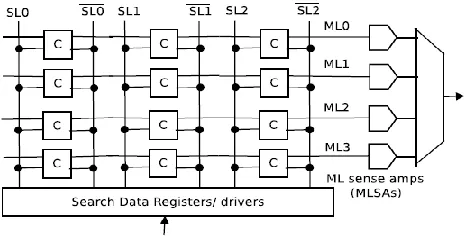
Fig. 1: Conventional 4 × 3 TCAM Array
The row cells will have common match line which is used to enable or disable the whole row based on matching condition or mismatching condition. The column cells will have common search line which is used to search the whole column. A conventional TCAM array is shown in Figure 1.
Fig. 2: Conventional NAND type TCAM Cell
Figure 1 shows the conventional 4×3 TCAM array with 4 rows (TCAM words) and 3 columns. The cells in the same row are connected through the common match-line and the cells in the column have common search-line. There are 3 stages in the conventional TCAM cell. Search line (SL)
which proves the irreversibility operation of the TCAM cells. Figure 2 shows the conventional NAND type TCAM cell.
Figure 3 shows the usage of TCAM in routing table. The search data are given through the search registers. The address look up matches both entry 2 and entry 3. By using longest prefix matching method entry 2 will be selected and its address is passed to the priority encoder. This will be decoded and the corresponding address will be matched by the RAM.
One approach that is well defined in the literature for practical implementation of reversible circuits is to never turn a switch ON or OFF when there is either voltage across it or current going through it. Reversible energy recovery logic uses this approach in order to avoid the non-adiabatic losses, which is essential for an ultra low power energy system. As a proof of concept for low power energy consumption using reversible logic, an ultra low power 16-bit carry look ahead adder was proposed in using reversible energy recovery logic.
Available online:
https://edupediapublications.org/journals/index.php/IJR/
P a g e | 627Fig. 4: Feynman Gate
III. REVERSIBLE ELEMENTS
This section discusses about the basics of reversible elements. According to the definition of the reversible circuit, there should not be any loss in the information. The design constraints in the reversible circuit is that the input and output vectors must map uniquely. There should be equal number of inputs and outputs and fan outs are not allowed in the design. Feedback from the output to the input of the same gate is not allowed. The design parameters in the reversible element design are quantum cost, worst case delay and the garbage output. Quantum cost is defined as the number of 1×1 reversible gate or 2 × 2 reversible gates. Worst case delay is defined as the number of delay units to produce the output for the given input. The worst case delay of the 1×1 reversible gate is defined as 1 unit of delay. Garbage output is the number of unused output to ensure the reversibility property of the circuits designed. Feynman has proposed the 2 × 2 Feynman gate which performs the operation of the ex or gate. Figure 4 shows the 2 × 2 Feynman gate with inputs and outputs.
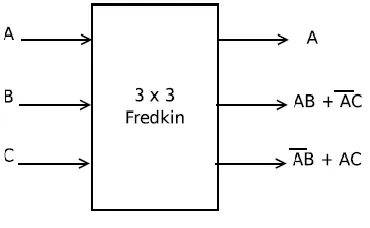
Figure 5 shows the 3 × 3 Fredkin gate with inputs and outputs. As per the definition of quantum cost, the quantum cost of 2 × 2 Feynman gate is 1 and 3 × 3 Fredkin gate is 5. Feynman gate can be used as the fanout gate with one input as 0. Feynman gate can also act as not gate with the B input as 1 which will invert the value of A.
Fredkin gate can act as multiplexer with the input A as the selection line. Peres has introduced 3 × 3 Peres gate. Figure 6 shows the Peres gate. Peres gate can be used as logical NAND or AND gate based on the values of input C.
Fig. 5: Fredkin Gate
The quantum cost of the Peres gate is 4 and the worst case delay is 4. Reversible element based SRAM cell was designed in [9]. The main disadvantage in the design [9] is that quantum cost of the proposed SRAM cell can be further reduced and the reversible decoder proposed does not contain enable signal which is essential for chip select.
Fig. 6: Peres Gate
IV. SRAM CELL BASED ON REVERSIBLE
ELEMENTS
Available online:
https://edupediapublications.org/journals/index.php/IJR/
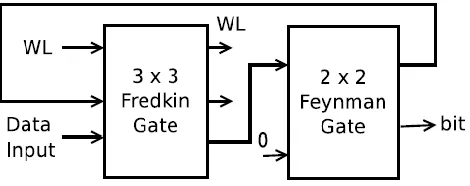
P a g e | 628cell proposed in [9]. This design is used to store the bit in the TCAM memory cells.
The design proposed in Figure 8 emulates the functionality of SRAM array with the reversible read circuits, reversible write circuits. The row decoder in [10] is used in the designing of SRAM array.
Fig. 7: SRAM Cell using Reversible Gates
V. PROPOSED TCAM CELL USING
REVERSIBLE ELEMENTS
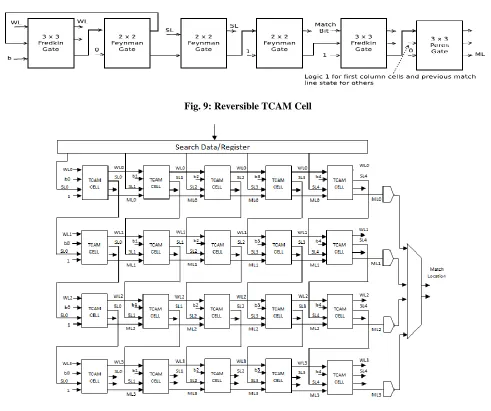
This section discusses about the proposed TCAM cell using reversible elements. Figure 9 shows the proposed TCAM cell. SRAM cell discussed in the previous section is used to store the bits. The data will be stored initially in the SRAM cell using the reversible SRAM cell as discussed in the previous section. The data stored will be passed to the 2 × 2 Feynman gate with the search line as one input. So, the search line will be duplicated and ex-or operation of data and the search-line data will be the other output. If both search line data and the data stored are same, then the output of the
constant value of logic ’1’. Table I illustrates the functionality of the TCAM cell using the match bit.
TABLE I: Truth Table for Proposed Reversible TCAM Cell
Available online:
https://edupediapublications.org/journals/index.php/IJR/
P a g e | 629Fig. 8: Reversible SRAM Cell with Read and Write Signals
Available online:
https://edupediapublications.org/journals/index.php/IJR/
P a g e | 630Fig.11: Proposed 4:2 Reversible Encoder.
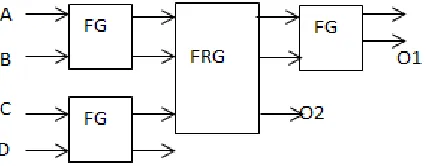
A single Fredkin gate is capable of working like a 1:2 decoder if the first input is IN1, while the second and third inputs are 0 and 1 respectively.A design of 2:4 decoder using 3 Fredkin gates has been proposed, as shown in Figure 12.
Fig: 12: Proposed reversible 2:4 decoder
VII. SEARCH OPERATION IN TCAM ARRAY
This section discusses about the operation of TCAM array and how the data are searched and matched. Figure.10 proposes the 4 × 5 reversible TCAM array. The data are stored in each TCAM cell using normal SRAM operation. Once the data is stored in the TCAM cell, match bit will be set either logic ’0’ or logic ’1’ based on whether the stored value is bit or don’t care. Search data are passed to the corresponding TCAM cell from search data registers.
stored in the TCAM is either logic ’0’/logic ’1’ or don’t care bit based on the value of the match bit.
TABL II: Design metrics of Reversible Ternary Contents Address Memory inters of Garbage Outputs (GO), Quantum Cost (QC), Gate Count (GC) and Constant Inputs (CI).
Reversible Design GO QC GC CI
SRAM 2 9 2 1
SRAM(R/W) 3 16 4 3
TCAM 6 17 6 4
ENCODER 2 8 4 0
DECODER 2 15 3 4
If the value of the match bit is ’0’ then the data will be either logic ’0’ or logic ’1’. If the match bit is ’1’ then the data stored is don’t care. If M = 1, then the output is logic ’1’ at all cases of input. If the value of M = 0 then the output will be logic ’0’ or logic ’1’ based on the matching of search data and the data stored. The output from the 3 × 3 Fredkin gate is passed to the 3 × 3 Peres gate. The inputs to the Peres gate are the output from the 3 × 3 Fredkin gate, previous matchline values and the constant input ’0’. The previous match-line value of the first TCAM cell is set to be 1 which resembles the match line precharge in the conventional TCAM cell. The
Available online:
https://edupediapublications.org/journals/index.php/IJR/
P a g e | 631VIII.SIMULATION RESULTS
Fig. 14: RTL sub schematic of Reversible 4X5 TCAM Array
Fig. 15: Technology schematic of Reversible 4X5 TCAM Array
Fig. 16: Design summary of Reversible 4X5 TCAM Array
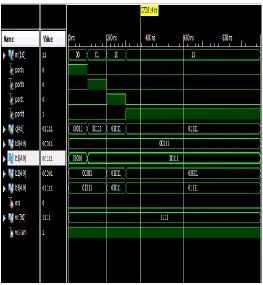
Fig. 17: Simulation of Reversible 4X5 TCAM Array
IX. CONCLUSION AND FUTURE WORK
This paper proposed a novel design of 4x5 TCAM
array design using reversible circuit design. Ternary content
addressable memory compares input data against stored data
(logic ’0’, logic ’1’, don’t care) in parallel and outputs the
matched data. In reversible SRAM design, 3 × 3 Fredkin gate
and the 2 × 2 Feynman gate is used to form the SRAM cell
which is used to store the single bit of information. Each and
every SRAM cell will have word line (WL) in order to make
the SRAM cell to function in one of the modes that is either in
read/write or hold state. 3×3 Fredkin gate and Peres gate are
used to perform the search line and match line operation. The
design is verified and simulated by using Xilinx ISE
Available online:
https://edupediapublications.org/journals/index.php/IJR/
P a g e | 632techniques and test methodology for low-power tcams,” Very Large Scale Integration (VLSI) Systems, IEEE Transactions on, vol. 14, no. 6, pp. 573–586, 2006.
[2] R. Landauer, “Irreversibility and heat generation in the computing process,” IBM Journal of Research and Development, vol. 5, no. 3, pp. 183–191, July 1961.
[3] C. Bennett, “Logical reversibility of computation,” IBM Journal of Research and Development, vol. 17, no. 6, pp. 525– 532, Nov 1973.
[4] R. Feynman, “Quantum mechanical computers,” Foundations of Physics, vol. 16, no. 6, pp. 507–531, 1986.
[5] F. Zane, G. Narlikar, and A. Basu, “Coolcams: Power-efficient tcams for forwarding engines,” in INFOCOM 2003. Twenty-Second Annual Joint Conference of the IEEE Computer and Communications. IEEE Societies, vol. 1. IEEE, 2003, pp. 42–52.
[6] K. Pagiamtzis and A. Sheikholeslami, “Content-addressable memory (cam) circuits and architectures: a tutorial and survey,” Solid-State Circuits, IEEE Journal of, vol. 41, no. 3, pp. 712–727, March 2006.
[7] J. Lim, D.-G.Kim, and S.-I.Chae, “A 16-bit carry-lookahead adder using reversible energy recovery logic for ultra-low-energy systems,” Solid-State Circuits, IEEE Journal of, vol. 34, no. 6, pp. 898–903, 1999.
[8] A. Peres, “Reversible logic and quantum computers,” Physical review A, vol. 32, no. 6, p. 3266, 1985.