Eukaryotic

-Alanine Synthases Are Functionally Related but
Have a High Degree of Structural Diversity
Zoran Gojkovic´, Michael P. B. Sandrini and Jure Pisˇkur
Section of Molecular Microbiology, BioCentrum DTU, DK-2800 Lyngby, Denmark Manuscript received February 9, 2001
Accepted for publication April 23, 2001
ABSTRACT
-Alanine synthase (EC 3.5.1.6), which catalyzes the final step of pyrimidine catabolism, has only been characterized in mammals. ASaccharomyces kluyveri pyd3 mutant that is unable to grow onN-
carbamyl--alanine as the sole nitrogen source and exhibits diminished-alanine synthase activity was used to clone analogous genes from different eukaryotes. PutativePYD3sequences from the yeastS. kluyveri, the slime moldDictyostelium discoideum, and the fruit flyDrosophila melanogastercomplemented thepyd3defect. When theS. kluyveri PYD3 gene was expressed in S. cerevisiae, which has no pyrimidine catabolic pathway, it enabled growth onN-carbamyl--alanine as the sole nitrogen source. TheD. discoideumandD. melanogaster PYD3gene products are similar to mammalian-alanine synthases. In contrast, theS. kluyveriprotein is quite different from these and more similar to bacterialN-carbamyl amidohydrolases. All three-alanine synthases are to some degree related to various aspartate transcarbamylases, which catalyze the second step of thede novopyrimidine biosynthetic pathway. PYD3expression in yeast seems to be inducible by dihydrouracil andN-carbamyl--alanine, but not by uracil. This work establishes S. kluyveri as a model organism for studying pyrimidine degradation and-alanine production in eukaryotes.
C
ELLS constantly build up and break down nucleo- known eukaryotic-alanine synthase genes are the ones tide compounds to ensure a balanced supply of isolated from rat (Kvalnes-KrickandTraut1993) and nucleotides for nucleic acid synthesis. The catabolic human (Vrekenet al.1999). The rat enzyme, depending pathway, together with thede novobiosynthetic and sal- on the presence of allosteric effectors, exists as a stable vage pathways, determines the size of the pyrimidine homohexamer, inactive trimer, or active homodode-pool in the cell. In the first step of pyrimidine degra- camer (MatthewsandTraut1987). The native hex-dation, dihydropyrimidine dehydrogenase (EC 1.3.1.2) americ enzyme occurs in the absence of ligands, but reduces uracil and thymine to the corresponding 5,6-dihy- readily dissociates to trimers in response to -alanine, dro derivatives (Figure 1). Thereafter, dihydropyrim- or associates to form dodecamers upon binding of the idinase (EC 3.5.2.2) opens the pyrimidine ring and, substrate. A model suggesting an allosteric regulatory depending on the dihydropyrimidine, forms N-carba- site distinct from the catalytic site was proposed ( Mat-myl--alanine or N-carbamyl--aminoisobutyric acid, thews et al.1992). The regulation of the mammalianwhich is degraded to the corresponding-amino acids genes encoding -alanine synthase was not studied. (WallachandGrisolia1957; Figure 1). Degradation of uracil is the only pathway providing
N-Carbamyl--alanine amidohydrolase (EC 3.5.1.6, -alanine in animal tissues (Traut and Jones 1996).
also known as -alanine synthase or -ureidopropio- Microorganisms may additionally form-alanine either nase) catalyzes the third and final step of pyrimidine by direct␣-decarboxylation ofl-aspartate (Williamson degradation: irreversible hydrolysis ofN-carbamyl--ala- and Brown 1979) or by degradation of polyamines
nine to-alanine (CaravacaandGrisolia1958). This (Large1992).-Alanine is an indispensable metabolite step of pyrimidine catabolism is poorly understood. In as it precedes formation of coenzymeA (CoA) and pan-bacteria this enzyme enables utilization of a variety of
tothenic acid in bacteria and fungi (Cronanet al.1982). carbamyl amino acids (Watabeet al.1992;Ogawaand
This unusual amino acid also plays a role in pigmenta-Shimizu1994;Ikenakaet al. 1998;Nanbaet al.1998).
tion of insect cuticle (Jacobs1980) and fungal cell walls The eukaryotic counterpart has been purified from calf
(Jacobs1982), while in mammals and birds it is involved (WaldmannandSchnackerz1989), rat (Tamakiet al.
in the formation of neurally active dipeptides (anserine 1987), mouse (Sanno et al.1970), andEuglena gracilis
and carnosine). From a clinical point of view,-alanine (Wasternacket al.1979). Nevertheless, so far the only
and its derivatives represent degradation products of one of the most employed anti-cancer drugs, 5-fluoro-uracil, and may be responsible for the neurotoxicity and Corresponding author:Jure Pisˇkur, Section of Molecular
Microbiol-brain necrosis observed during chemotherapy (Okeda
ogy, Bldg. 301, BioCentrum DTU, Technical University of Denmark,
DK-2800 Lyngby, Denmark. E-mail: [email protected] et al. 1990). Because of its chemical similarity to the
well controlled -alanine production is an important aspect of metabolic regulation (Scriver and Gibson 1995). However, practically nothing is known about the regulation of-alanine production at the genetic level in humans or any other organisms.
The majority of fungi, includingSaccharomyces cerevis-iae, cannot utilize pyrimidines or their degradation products as the sole source of nitrogen (LaRue and Spencer1968). Apparently, S. cerevisiae does not have the pyrimidine catabolic pathway. However,S. kluyveri
has a functional degradation pathway and we developed a genetic system in this yeast to study the pyrimidine catabolic genes (Gojkovic et al. 1998, 2000). In this article we report on theS. kluyveri PYD3gene, encoding -alanine synthase, and its regulation at the transcrip-tional level. In addition, we cloned and sequenced the analogous genes fromDictyostelium discoideumand Dro-sophila melanogasterand functionally expressed these in theS. kluyveri pyd3-3mutant. This work provides initial data on the origin of the pyrimidine catabolic pathway in eukaryotes.
MATERIALS AND METHODS
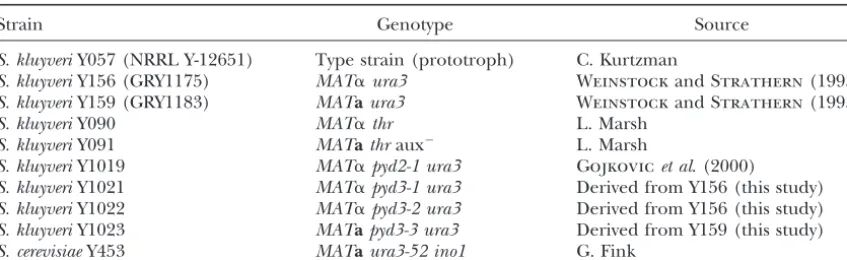
Strains and growth media:The yeast strains used in this work are listed in Table 1. Yeast strains were grown at 25⬚in YPD medium (1% yeast extract, 2% bacto peptone, 2% glu-cose) or in defined minimal (SD) medium (1% succinic acid, 0.6% NaOH, 2% glucose, 0.67% yeast nitrogen base without amino acids; Difco, Detroit). When indicated, (NH4)2SO4was
replaced either with 0.1% uracil, dihydrouracil,N
-carbamyl--alanine,-alanine, or proline as the sole nitrogen source. The growth rate was determined in liquid medium by follow-ing the optical density at 600 nm. TheEscherichia colistrain DH5␣was used for plasmid amplification. Bacteria were grown at 37⬚in Luria-Bertani medium supplemented with 100 mg/ liter of ampicillin for selection (Sambrooket al.1989). The E. coliBL21-CodonPlus (Stratagene, La Jolla, CA) strain was used for heterologous protein expression.
Mutagenesis:Yeast mutants were generated with ethyl meth-anesulfonate (EMS) using standard mutagenesis techniques (Lawrence1991; Gojkovicet al. 1998). Mutagenized cells were plated on YPD medium, replicated on medium con-tainingN-carbamyl--alanine as sole nitrogen source, and cho-sen by inability to grow on this medium. To test for reces-siveness or dominance of the mutations, each mutant was crossed with a strain of the opposite mating type, either Y090
Figure 1.—Reductive catabolism of pyrimidines showing or Y091. Prototrophic diploid colonies were selected on SD intermediates, enzymes, and the corresponding genes. medium and thereafter at least three colonies from each cross were tested for growth onN-carbamyl--alanine medium. In-terallelic complementation tests were carried out by crossing Y1023 with Y1021 and Y1022.
well-known neural inhibitor ␥-amino-n-butyric acid
Cloning and DNA sequences analysis:Transformation and (GABA), -alanine is thought to function as a
neuro-complementation ofS. kluyverimutants was done by electro-transmitter (Sandberg and Jacobson 1981). Apart poration as described inGojkovicet al. (2000) using the wild-from having a well-described inhibitory function, GABA type genomic library fromS. kluyveri. This library, based on the Yep352 vector, was kindly provided by M. Costanzo ( Cos-can also act as an excitatory transmitter (Wagneret al.
tanzoet al. 2000). S. cerevisiaewas transformed by the lithium 1997), suggesting that -alanine might also have the
acetate method (Gietz and Schiestl1995). Plasmid DNA same effect. Disorders in the -alanine metabolism of
was purified fromE. colitransformants on QIAGEN (Valencia, humans, such as hyper-alaninemia, are associated with CA) columns. Both strands of the completePYD3genes were severe neural dysfunction, seizures, and death (Higgins sequenced using Thermo Sequenase radiolabeled terminator cycle sequencing kits (Amersham Pharmacia Biotech).
TABLE 1
The yeast strains used in this study
Strain Genotype Source
S. kluyveriY057 (NRRL Y-12651) Type strain (prototroph) C. Kurtzman
S. kluyveriY156 (GRY1175) MAT␣ura3 WeinstockandStrathern(1993)
S. kluyveriY159 (GRY1183) MATaura3 WeinstockandStrathern(1993)
S. kluyveriY090 MAT␣thr L. Marsh
S. kluyveriY091 MATathraux⫺ L. Marsh
S. kluyveriY1019 MAT␣pyd2-1 ura3 Gojkovicet al. (2000)
S. kluyveriY1021 MAT␣pyd3-1 ura3 Derived from Y156 (this study)
S. kluyveriY1022 MAT␣pyd3-2 ura3 Derived from Y156 (this study)
S. kluyveriY1023 MATapyd3-3 ura3 Derived from Y159 (this study)
S. cerevisiaeY453 MATaura3-52 ino1 G. Fink
Y, the laboratory yeast collection; aux⫺, unidentified auxotrophic requirement.
otide sequence analysis and protein sequence comparisons go(dT) cellulose (Sambrooket al. 1989). Total RNA (10g) applied in formaldehyde loading buffer was separated in a were performed with Winseq (F. G. Hansen, unpublished
software) and ClustalW 1.7 (Thompsonet al. 1994) programs. 1.2% agarose-formaldehyde gel run with MOPS buffer. RNA bands were capillary transferred to a HYBOND-N⫹ nylon Database searches were performed using the BLAST network
services at the National Center for Biotechnology Informa- membrane using 20⫻ SSC. Hybridization with the random-primed32P-labeled PCR fragment from P260 was carried out
tion and the Saccharomyces Genome Database at Stanford
Genomic Resources. The S. kluyveri 3361-bp nucleotide se- overnight. Membranes from Northern analyses were prehy-bridized at 65⬚(Sambrooket al. 1989) and hybridized at 42⬚ quence, containing the PYD3 gene, is listed in GenBank/
EMBL databases under accession no. AF333185, theD. dis- in 50% formamide, 5⫻ SSC, 2⫻ Denhardt’s reagent, 0.1% SDS, and 10% dextran sulfate. Membranes were washed twice coideum PYD3gene is under AF333186, andD. melanogasteris
under AF333187. with 2⫻SSC for 5 min at room temperature, twice with 2⫻
SSC, 1% SDS for 30 min at 65⬚, and twice with 0.1⫻SSC for
Plasmids:The Yep352 library plasmid containing the
full-length S. kluyveri PYD3 gene is named P260. This plasmid 20 min at 65⬚.
Primer extension analysis: Approximately 10 pmol of the was used for transformingS. kluyveri pyd3mutants and theS.
cerevisiae Y453 strain. Expressed sequence tag (EST) clones synthetic oligonucleotide, PYD3PEXT: 5⬘-CTGGCGGAAACA GTAGTA-3⬘was end labeled with [␥-32P]ATP in a 20-l
reac-from D. discoideum P399 (SSG647, GenBank accession no.
C89941) andD. melanogasterP550 (GH 26887, GenBank acces- tion mixture with T4 polynucleotide kinase as described by the manufacturer (GIBCO BRL, Gaithersburg, MD). Two mi-sion no. AI513795), containing full-length cDNA, were
ob-tained from the University of Tsukuba and Research Genetics crograms of poly(A)⫹RNA, isolated from cells grown on dihy-drouracil medium, was incubated with 1 pmol end-labeled (Birmingham, AL), respectively. For promoter studies the
918-bpPYD3promoter sequence, from⫺918 bp to the start codon, primer at 70⬚for 10 min and then placed on ice for 10 min. Four microliters of 5⫻first strand buffer, 2l of 0.1m dithi-obtained by PCR using Pfu DNA polymerase (Stratagene),
was inserted in theEcoRI/BamHI sites of the plasmid pYLZ-2 othreitol, and 1l of 10 mmdNTPs were added to the reaction mixture. After incubation for 2–5 min at 37⬚, 200 units of (Hermann et al. 1992). The resulting plasmid was termed
P289. A plasmid for heterologous expression in yeast, P403, SuperScript RNA H⫺reverse transcriptase (GIBCO BRL) was added and the mixture was incubated at 37⬚ for 1 hr. The was constructed by removing anAgeI/HindIII part of theGAL1
promoter from a pYES2 vector (Invitrogen, San Diego) and products were analyzed on 7% acrylamide sequencing gel.
Enzyme assays and protein purification:Yeast transformants replacing it with a PYD3 promoter. The-alanine synthase
cDNAs fromD. discoideum,D. melanogaster, and human were were grown in an appropriate medium to an optical density of 1.0–1.5 at 600 nm.-Galactosidase activity assays were per-cloned into P403, giving P492, P493, and P536, respectively.
The C-terminal 8⫻His-taggedE. coliexpression vector, P343, formed after breaking cells with glass beads in a FastPrep machine. All values are expressed in Miller units (Miller
was constructed by inserting anEcoRI/HindIII fragment
con-taining an eight-histidine tag from the plasmid pASKMh 1972). The data presented were obtained from at least three independent transformants. Denaturing electrophoresis of (Baderet al. 1998) and ligating it into theEcoRI/HindIII site
of the pASK75. TheXbaI andEcoRI sites of P343 were used the protein extracts was performed on SDS/PAGE (4.5% acryl-amide stacking gel and 10% running gel) in the discontinuous to clone theS. kluyveri PYD3gene, giving a plasmid P491.
DNA and RNA manipulation:Yeast genomic DNA was iso- buffer system (Laemmli1970). Protein was quantified by the method ofBradford(1967). Bovine serum albumin served lated using zymolyase and standard procedures (Johnston
1994). Chromosomal DNA suitable for contour-clamped as a protein standard.
The-alanine synthase activity was measured according to homogeneous electric field (CHEF) electrophoresis was
obtained and separated according toPetersenet al. (1999). Van Kuilenburg et al. (1999). One unit is defined as the amount of enzyme that can catalyze the transformation of 1 The VacuGene XL vacuum blotting system (Pharmacia
Bio-tech, Piscataway, NJ) was used for blotting of chromosomes mol ofN-carbamyl--alanine into-alanine in 1 min at 37⬚. The [14C]N-carbamyl--alanine was obtained from Moravek
onto HYBOND-N⫹nylon membrane (Amersham, Arlington
Heights, IL). Total RNA was extracted from exponentially Biochemicals (Brea, CA). Cells were grown in 500 ml of either SD or proline/dihydrouracil medium until late exponential growing yeast cells using the FastRNA Red kit (BIO 101, Vista,
oli-RESULTS
TABLE 2
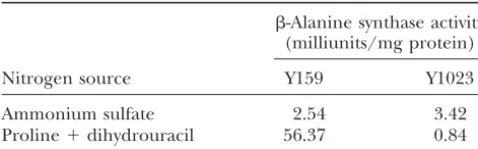
-Alanine synthase activities inS. kluyveriY159 (PYD3) Isolation of yeast mutants unable to grow onN-
carba-and Y1023 (pyd3-3) myl--alanine as sole nitrogen source:SeveralS. kluyveri
mutants that are unable to grow on N-
carbamyl--ala--Alanine synthase activity nine as the sole nitrogen source were isolated after (milliunits/mg protein)
mutagenesis with EMS; they were namedpyd3(py rimi-dine degradation step three; Table 1). Besides their
Nitrogen source Y159 Y1023
inability to grow onN-carbamyl--alanine, the mutants
Ammonium sulfate 2.54 3.42
were not able to grow on uracil or dihydrouracil as sole
Proline⫹dihydrouracil 56.37 0.84
nitrogen sources. Ammonium ions, which are necessary -Alanine synthase enzyme activity was measured in cells for growth, are liberated only in the last step of pyrimi-grown in media containing glucose as a carbon source and dine degradation. Detailed growth studies of thepyd3 0.5% ammonium sulfate or 0.1% proline and dihydrouracil
mutants revealed that they also could not grow on dihy-as a nitrogen source supplemented with uracil to overcome
drothymine (data not shown). However, growth of the auxotrophic requirements. The assays were performed at 37⬚.
One unit is defined as the amount of enzyme that can catalyze pyd3mutants on-alanine and-aminoisobutyrate was the transformation of 1 mol of substrate into product in not impaired, suggesting that thepyd3mutants probably
1 min under standard conditions. bear a defect in the gene coding for-alanine synthase.
All pyd3 mutations were recessive and fail to comple-ment each other and thus are allelic.
No-alanine synthase enzymatic activity was obtained p.s.i.). After centrifugation (13,000⫻gfor 15 min), proteins
from the pyd3-3 mutant (Table 2). The pyd3 mutant were assayed immediately in Tris buffer (50 mmTris HCl, pH
accumulates and excretes high amounts of theN- carba-7.5). The concentration of N-carbamyl--alanine was
deter-mined in a cell-free extract by a colorimetric procedure at 466 myl--alanine (ⵑ6g/108cells) when grown in the
pres-nm (Westet al. 1982). The cells were grown to midexponential ence of 0.1% uracil, compared with 0.05g determined phase in 40 ml of appropriate medium, harvested by centrifu- in the supernatants of proline⫹uracil-grown wild-type gation, and crushed with glass beads in a FastPrep machine
cells. These results suggest that thepyd3mutation is in (40–60 sec at maximum speed). Samples were diluted with
the gene for the third catabolic activity or in a gene 0.1mpotassium phosphate buffer (pH 7.4) and cell-free
ex-tracts were obtained by centrifugation. For recombinant pro- that regulates the third catabolic activity.
tein expression,E. colicells were grown to a density ofA600 nm⫽ Cloning and sequence analysis of thePYD3gene:The
0.5–0.6 in Luria-Bertani medium supplemented with 100g/ S. kluyveri pyd3 ura3 mutant strain, Y1023, was trans-ml ampicillin. Protein expression was induced by 200g/liter
formed to Ura⫹with anS. kluyverigenomic library. Sev-of anhydrotetracycline hydrochloride (ACROS ORGANICS,
eral Ura⫹Pyd⫹ colonies were identified. Colonies that NJ) for 10 hr at 25⬚. Collected cells were resuspended in buffer
lost the Ura⫹phenotype also lost the ability to grow on A (50 mm sodium phosphate, pH 8.0; 300 mmNaCl; 10%
glycerol; 25 mm imidazole) and disrupted by French press N-carbamyl--alanine, indicating that the
complement-(1000 p.s.i.). After centrifugation at 13,000⫻gfor 30 min, ing DNA was plasmid borne. Plasmids from these trans-the supernatant was applied to a 5-ml Ni2⫹-NTA column
(QIA-formants were rescued into theE. coliDH5␣strain, and GEN). The column was washed with 10 volumes of buffer A,
all were identical. When this plasmid was introduced 10 volumes of buffer B (50 mmsodium phosphate, pH 6.0;
into the other two pyd3 mutants, Y1021 and Y1022, it 300 mmNaCl; 10% glycerol; 25 mmimidazole), and finally
complemented theirpyd3defect as well, supporting the with 10 volumes of buffer B containing 50 mmimidazole. The
recombinant-alanine synthase was eluted from the column idea that all three pyd3 mutant genes are allelic. The by a linear gradient of 50–500 mm imidazole in buffer B. plasmid contained a DNA insert with an open reading Fractions containing recombinant protein were precipitated
frame (ORF) of 1365 bp encoding a protein of 455 am-by ammonium sulfate (70% saturation at 0⬚), resuspended in
ino acids (Figure 2) with aMrof 49,707 and a pI of 5.2.
Tris buffer (50 mmTris HCl, pH 7.5; 100 mmNaCl; 1 mm
The deduced amino acid sequence encoded by theS.
DTT), and then applied to a G-25 column and stored at⫺80⬚
at a concentration of 10 mg/ml. kluyveri PYD3gene exhibits similarity to carbamyl amino
䉴 Figure2.—Multiple alignment of-alanine synthases and related proteins. The sequences used for the comparison are the following:-alanine synthases from human (NP057411), rat (Q03248),Drosophila melanogaster(AF333187),Dictyostelium discoideum (AF333186),Caenorhabditis elegans(U23139*), andS. kluyveri(AF333185);N-carbamyl-l-amino acid amidohydrolases fromBacillus stearothermophilusAMB2 (Q53389), Pseudomonassp. (Q01264), Bacillus subtilis(Z99120*),Escherichia coli (P77425*),Arthrobacter aurescens(AF071221), andHaemophilus influenzae(Q57051*); andN-carbamyl-d-amino acid amidohydrolases fromMethanobacterium thermoautotrophicum(AAB86277) andAgrobacterium radiobacter(AAB47607). The comparison was assembled with the ClustalW 1.7 program. Boxshade depicts all identical amino acids in white on black, similar amino acids are black on gray, while nonmatches are black on white. Putative proteins are marked by an asterisk (*). The residues involved in the active center of Agrobacterium N-carbamyl-d-amino acid amidohydrolases are marked by•. Ligands belonging to the two potential Zn2⫹binding sites that were
acid amidohydrolases from several bacteria. The highest similarity is toPseudomonas aeruginosa N
-carbamyl--ala-nine amidohydrolase, with an overall identity of 41% and a similarity of 56%. Similarity to other bacterial carbamyl amidohydrolases was in the range from 46 to 52%. While the bacterial enzymes catalyze a similar reaction, it is questionable whether they are directly involved in the degradation of pyrimidines. Mammalian -alanine synthases show no significant similarity to the
S. kluyverienzyme. In general, only a few common struc-tural features can be found among the aligned carbamyl amino acid amidohydrolases (Figure 2). Furthermore, comparison of S. kluyveri -alanine synthase sequence
to protein databases identified several candidates with
an average sequence identity near 20% and an average Figure3.—SDS/PAGE of the recombinantS. kluyveri -ala-similarity of 31–36%, includingN-acyl-l-amino acid ami- nine synthase. The protein was expressed inE. coliBL21 Co-dohydrolases (aminoacylases), indole-3-acetic amino donPlus and purified on a Ni2⫹-NTA column. Standard
pro-teins (lanes 1 and 6), homogenate ofE. colitransformed with acid hydrolases, carboxypeptidases, and
aminotripepti-P343 (lane 2), proteins from noninducedE. colitransformed dases from different organisms.S. kluyveri-alanine
syn-with P491 (lane 3), proteins from E. coli transformed with thase is longer than other eukaryotic carbamyl amidohy- P491 at 10 hr after induction (lane 4), and concentrated drolases due to the prolonged N terminus. (Figure 2). purified heterologousS. kluyveri -alanine synthase (lane 5) No Pyd3 homologues are encoded in the S. cerevisiae are shown. Proteins were visualized by Coomassie brilliant
blue staining. genome. The sequence upstream of thePYD3ORF has
high similarity to theS. cerevisiaechitin synthase 3 gene (CHS3) located on chromosome II. The downstream
CG3027 gene product (GenBank accession no. sequence exhibits very high similarity to the chitin
syn-AAF54141) published by Adams et al. (2000) as it is thase 2 gene (CHS2), also on chromosome II, and to
missing 60 bp close to the C terminus. Since the missing the chitin synthase 1 gene (CHS1) on chromosome XIV
sequence contains 5⬘and 3⬘intron splicing sites and is (data not shown). The region between theS. cerevisiae
not present in the cDNA clone, we consider it to be a
CHS3andCHS2genes spans 30 kb. However, inS.
kluy-third intron. In addition, when translated, the sequence
verithe distance between these two genes is only 2.5 kb.
within the 60-bp insert has no homology to any known Thus, it seems that this region is not very conserved
-alanine synthases. TheD. melanogaster PYD3gene maps among members of the Saccharomyces genus. After
sep-to region 84D11 of the Drosophila genome. So far, there aration of theS. kluyverichromosomes by CHEF
electro-are no known mutations that map to this region. The phoresis and hybridization with the PYD3gene, we
as-D. discoideum PYD3 gene is similar to the mammalian signedPYD3to chromosome IV (data not shown).
-alanine synthase (Figure 2). The gene is 54% identical The final proof thatPYD3encodes an active
pyrimi-to the rat-alanine synthase and 53% identical to the dine catabolic enzyme was obtained by overexpression
human enzyme. ThePYD3gene fromD. melanogasteris inE. coli. TheS. kluyveri PYD3gene was subcloned into
ⵑ63% identical to the human and rat enzyme with over-anE. coliexpression vector, and the putative-alanine
all similarity of 77%. When compared to each other, synthase was expressed as a histidine-tagged protein
the D. discoideum and D. melanogaster PYD3 genes are (Figure 3). The purified enzyme could successfully
con-58% identical on the amino acid level. However, they vertN-carbamyl--alanine to-alanine with the specific
do not show any close similarity to theS. kluyveri PYD3
activity of 4.73 units/mg of protein. Thus, theS. kluyveri
gene.
PYD3gene indeed codes for-alanine synthase.
To demonstrate that the cloned genes are involved
Slime mold and fruit fly-alanine synthase:No
poten-in pyrimidpoten-ine catabolism, the cDNA sequences of the tial S. kluyveri PYD3 homologs were found in the D.
D. discoideumandD. melanogaster PYD3genes were placed
discoideumandD. melanogasterEST databases. However,
under the control of theS. kluyveri PYD3promoter and using the rat-alanine synthase protein as a query,
sev-introduced into Y1023. Both-alanine synthase genes eral EST homologs were identified. Sequencing of D.
complemented the defect of theS. kluyveri pyd3-3mutant
discoideum SSG647 clone revealed an ORF of 1176 bp
(Figure 4A). These results suggest strongly that D.
dis-encoding a protein of 391 amino acids (Figure 2) with
coideum and D. melanogaster genes code for a protein a calculated molecular mass of 44 kD. Similarly, theD.
involved in pyrimidine catabolism. In addition, the
-ala-melanogasterGH 26887 clone contained an 1161-bp ORF
nine synthase gene from human (Vreken et al. 1999) encoding a protein of 386 amino acids (Figure 2) with
also complemented the S. kluyveri pyd3 mutation a predicted Mr of 43,800. The GH 26887 sequence is
-alanine synthase mRNA, Poly(A)⫹ RNA was isolated
from theS. kluyveritype strain Y057 grown in dihydroura-cil medium. Two transcription sites were detected at nucleotide positions⫺107 and⫺99 relative to the indi-cated AUG start codon (Figure 5A). The region up-stream from the start codon (Figure 5B) was subcloned into a uracil-based high-copy plasmid, pYLZ-2, con-taining the lacZ gene as a reporter. The plasmid was transformed into S. kluyveri and independent trans-formants were grown in various media (Figure 5C). No -galactosidase activity was observed when cells were grown in SD or on medium containing proline. High activity of the reporter gene was found in cells grown on dihydrouracil as the only source of nitrogen, while one-third of the activity, compared to that of dihydroura-cil, was determined in the cells from SD⫹0.1% dihy-drouracil medium. It could be that ammonium ions inhibit transcription. The obtained results could also be explained that dihydrouracil transport is sensitive to nitrogen catabolite repression (NCR). In this case dihydrouracil would not be able to enter the cell in the presence of ammonium ions and subsequently induce thePYD3gene. Inability of ammonia to completely shut down thePYD3promoter in SD⫹dihydrouracil-grown cells may be attributed to a high-copy-number plasmid. Unfortunately, when thePYD3gene was present on a low copy plasmid no activity was detectable (data not shown).
The second reaction in the degradation of pyrimi-dines, hydrolysis of dihydrouracil to N-
carbamyl--ala-nine, is activated by dihydrouracil (Gojkovic et al. Figure4.—Growth ofS. kluyveriandS. cerevisiaecontaining 2000). Transcription of the PYD3 gene is detectable heterologous-alanine synthase genes (A). The Y1023 cells only in cells grown in the presence of dihydrouracil were transformed with P403, P492, P493, and P563, and the
or to a lesser extent withN-carbamyl--alanine as sole
Ura⫹ transformants were selected and grown in liquid SD
nitrogen sources (Figure 6). Using the yeast-alanine medium overnight at 28⬚. The A600was adjusted to 0.1, and
aliquots (5l) of serial 10-fold dilutions were spotted onto synthase DNA as a probe against totalS. kluyveriRNA, medium containing N-carbamyl--alanine as sole nitrogen an mRNA band ofⵑ1.5 kb was observed. If an alternative source. The plates were photographed after incubation for 5 nitrogen source was present the mRNA was not detected days at 25⬚. (B) Growth of the S. cerevisiae uracil-requiring
(Figure 6). Thus transcription of PYD3 mRNA is in-strain Y453 transformed with theS. kluyveri-alanine synthase
duced by dihydrouracil andN-carbamyl--alanine.
How-gene. The Y453 cells were transformed with P260, selected
for Ura⫹transformants on SD medium, inoculated into liquid ever, because in the cell dihydrouracil is degraded by media containing 0.1%N-carbamyl--alanine, and incubated dihydropyrimidinase toN-carbamyl--alanine it is diffi-at 28⬚. The growth rate was determined by following the ab- cult to conclude if dihydrouracil indeed directly induces sorbance at 600 nm. The medium for strain Y453 lacking the
transcription ofPYD3. To determine the time response P260 plasmid was supplemented with uracil to overcome the
ofPYD3transcriptional activation, 0.1% dihydrouracil ura3defect. (䉬) Y453, (䊏) Y453⫹P260.
was added to cells grown on proline. Proline is consid-ered to be a “neutral” nitrogen source in yeast and it does not interfere with regulation or uptake of other
ThePYD3gene functions inS. cerevisiae:S. cerevisiae
cannot grow onN-carbamyl--alanine as sole nitrogen compounds (Magasanik1992). No basal transcription of thePYD3gene was observed in cells grown on proline. source (Gojkovic et al. 1998), which is not surprising
since it does not have any genes encoding -alanine However, 10 min after the addition of dihydrouracil it was possible to detectPYD3 mRNA. After 60 min the synthase. Cells transformed with the PYD3gene grew
onN-carbamyl--alanine and reached stationary phase same level was attained as in cells continuously grown on dihydrouracil (Figure 7, A and B).
after a few days, while nontransformed cells could not
grow (Figure 4B). Nitrogen catabolite repression is a physiological
re-sponse by which, in the presence of a preferred nitrogen
Analysis of yeast-alanine synthase gene expression:
en-Figure5.—Analysis of theS. kluyveri PYD3mRNA. (A) Mapping 5⬘ ends ofS. kluyveri N-carbamyl--alanine amidohydrolase mRNAs. The 5⬘ends of the 1.5-kb mRNAs were mapped with the primer PYD3PEXT in primer extension experiments using poly(A)⫹RNA from cells grown on dihydrouracil (lane 1). The signals corresponding to the transcription start points at positions
⫺107 and ⫺99 are marked by arrows. (B) The sequence of the promoter and 5⬘-untranslated mRNA of theS. kluyveri PYD3 gene. The putativecisregulatory elements,URSGATA, are boxed. An unusually long poly(A) sequence, located upstream from the
start codon, is written in boldface type. (C)-Galactosidase activity assays were performed onS. kluyveriY156 transformed with the plasmid containing thePYD3promoter fused to thelacZgene. ThePYD3promoter sequence (PYD3p) containing 918 bp upstream of the start codon was cloned into the pYLZ-2 vector. pYLZ-2 denotes the high-copy plasmid without thePYD3promoter sequence.
zymes is severely decreased. Common cis-acting ele- GATA-like sequences (Figure 5B). To assay whether the
S. kluyveri PYD3catabolic gene is under NCR, we mea-ments present in S. cerevisiae NCR-sensitive genes are
GATA sequences (Yoo and Cooper 1989; Bysani et sured the level ofPYD3transcription in the presence of a readily transported and metabolized nitrogen source,
Figure6.—Northern blot analysis of yeastPYD3expression. The prototrophic type strain cells of S. kluyveri Y057 were grown under various physiological conditions for several hours after which total RNA was isolated, blotted, and probed with a DNA fragment from thePYD3 gene. The sole sources of nitrogen for growth of the cells are given for each lane. Lane 1, ammonia; lane 2, uracil; lane 3, dihydrouracil; lane 4, N-carbamyl--alanine; lane 5, -alanine; and lane 6, proline. The small ribosomal subunit (18 S) was used as a control for equal loading.
namely ammonia (Figure 7C). Shortly after the addition
Figure 7.—Induction and nitrogen catabolite repression of ammonium sulfate, the level ofPYD3mRNA began to
ofPYD3transcription. (A) Induction ofPYD3 transcription decrease.PYD3transcription fell to undetectable levels
by dihydrouracil shown as Northern analyses of cells grown between 10 and 15 min after the addition of this pre- in proline medium. A total of 40 ml of cells was collected at ferred nitrogen source (Figure 7C). The observed re- the indicated times (in minutes) and total RNA was isolated. A DNA fragment from thePYD3 gene was used as a probe. sults could be explained that NCR works directly on
Dihydrouracil (0.1%) was added at time point zero. (B) After expression ofPYD3or, alternatively, only on the uptake
ⵑ30 min mRNA reached levels comparable to cells grown in of dihydrouracil. Anyhow, a regulatory pattern ofPYD3
dihydrouracil medium. (C) Nitrogen catabolite repression of expression resembles the one observed for theS. kluyveri transcription of thePYD3 gene. Northern analysis of PYD3 PYD2gene (Gojkovicet al. 2000). mRNA from cells grown in dihydrouracil medium and after the addition of 0.5% ammonia at 0 min. rRNA 18 S bands were
The diversity and origin of-alanine synthases:There
used as loading controls. Ammonium ion represses completely are remarkable similarities between the catabolic and
the expression of thePYD3gene within 15 min after addition. thede novobiosynthetic pathways of pyrimidines.
-Ala-nine synthase catalyzes an almost reverse reaction of the second step ofde novopyrimidine biosynthesis.
There-fore, it was expected that the yeast-alanine synthase d-amino acid amidohydrolases, while the third subfam-ily includes mammalian and other eukaryotic putative would exhibit similarity to the second enzyme in thede
novo biosynthetic pathway, aspartate carbamyltransfer- -alanine synthases. The tree topology did not change significantly when different calculation methods (maxi-ase (ATC(maxi-ase). Only 14% sequence identity betweenS.
cerevisiaeATCase and the S. kluyveri Pyd3 protein can mum parsimony, maximum likelihood, clustering, or transformed distance) were used. The S. kluyveri en-be found, althoughKvalnes-KrickandTraut(1993)
reported 21.2% sequence identity between rat liver-ala- zyme, on both the nucleotide and amino acid levels, exhibits higher identity with bacterial than with mam-nine synthase andE. coliATCase. Substantially higher
sequence similarity, almost 19%, was observed between malian carbamyl amidohydrolases. However, the Dicty-ostelium and Drosophila enzymes complemented apyd3
the Pyd3 protein and ornithine carbamylase from
Schizo-saccharomyces pombe. Carbamyltransferases have a differ- defect inS. kluyveri. As reported for mammals, the yeast enzyme is involved in the pyrimidine catabolic pathway ent catalytic mechanism from carbamyl
amidohydro-lases but bind very similar ligands. Multiple alignment and with -alanine production, and, although not re-lated structurally, the catalytic properties of the yeast and a phylogenetic analysis of available carbamyl
amido-hydrolases revealed that all the enzymes could be and other eukaryotic enzymes must be similar. grouped into three subfamilies (Figure 8). The first
subfamily includes bacterial N-carbamyl-l-amino acid
DISCUSSION amidohydrolases together withS. kluyveri enzyme and
the putative huy-C protein from Arabidopsis thaliana. This article describes the cloning of the gene for -ala-nine synthase by complementation of theS. kluyveri pyd3
Among these, so far only theS. kluyverienzyme is
carbamyl-Figure 8.—A phyloge-netic tree showing relations of carbamyl amidohydro-lases with transcarbamy-lases. The phylogenetic tree was derived using the Clus-talW 1.7 and TreeView 1.5.2 programs (http://taxonomy. zoology.gla.ac.uk/rod/fod. html). The numbers given on the branches are fre-quencies (written as per-centages) at which a given branch appeared in 1000 bootstrap replications. The enzyme names are as fol-lows: CA, carbamyl amido-hydrolase; BS, -alanine synthase; ATC, aspartate transcarbamylase (EC 2.1. 3.2); ORT, ornithine car-bamoyltransferase (EC 2.1. 3.3). Putative homologous enzymes based on sequence similarities are marked #. Only the ATCase domain of multifunctional enzymes was used for comparison (*). Accession numbers are in parentheses.
D. melanogaster. The S. kluyveri -alanine synthase is lases (Kobayashiet al. 1992). However, this residue is not present in theS. kluyverienzyme, which has isoleu-closely related to bacterialN-carbamyl-l-amino acid
ami-dohydrolases. However, the role of bacterialN-carbamyl cine at this position, but it is conserved in both theD. discoideum andD. melanogasterenzymes. It is clear that amidohydrolases in pyrimidine catabolism has never
been elucidated. Surprisingly, amino acid similarity be- all N-carbamyl-d-amino acid amidohydrolases and eu-karyotic-alanine synthases, except one fromS. kluyveri, tween yeast and other eukaryotic putative-alanine
syn-thases is not very evident. Apparently only a few struc- have a conserved catalytic center (Glu-Lys-Cys) but oth-erwise differ in overall structure. Agrobacterium amido-tural features are common for all these carbamyl
amidohydrolases. One of the conserved residues shared hydrolase is much shorter compared to the mammalian enzymes and it forms a homotetramer while the rat -ala-by all the amidohydrolases that were compared is a
glutamic acid toward the N termini of the proteins. A nine synthase exists as a homohexamer. Until now, only the rat and the human enzymes proved to be directly less conserved, very hydrophobic region precedes this
invariant residue. The same glutamic acid residue is a involved in the catabolic pathway. In contrast, many bacterial carbamyl amidohydrolases cannot useN- carba-part of a conserved motif shared by rat liverN-
carbamyl--alanine amidohydrolase, nitrilases, cyanide hydra- myl--alanine as substrate (Ogawaet al. 1994; Nanba
et al. 1998;Wilmset al. 1999), and they may not partici-tases, and aliphatic amidases (BorkandKoonin1994).
All of these proteins constitute a family of carbon-nitro- pate in the degradation of pyrimidines. The sequence similarity among carbamyl amidohydrolases is not very gen hydrolase enzymes, and it was suggested that this
residue might be involved in catalysis (BorkandKoo- high; in a phylogenetic tree they group together but are divided into three subfamilies. Identical results were nin1994). Indeed, the recent report of the crystal
struc-ture ofAgrobacterium sp. N-carbamyl-d-amino acid amido- consistently obtained, despite using various calculation methods, which supports the idea of a single ancestral hydrolase confirmed involvement of Glu46 in the active
center (Nakaiet al. 2000). Lys126, also involved in the gene.
The pyrimidine catabolic pathway shows similarity to active center, is present inD. discoideumandD.
melanogas-ter-alanine synthase but not in theS. kluyverienzyme. de novopyrimidine biosynthesis. For example, a cysteine, observed in the active center of the dihydroorotate dehy-Another highly conserved motif, which contains an
in-variant cysteine, was shown to be a part not only of the drogenase (fourth step in thede novopathway;Bjo¨ rn-berget al. 1997;Rowlandet al. 1998), is also present Agrobacterium amidohydrolase (Grifantiniet al. 1996;
dehydroge-nase. Similarity between the second catabolic enzyme in lar situation was observed for the PYD2 gene, which encodes the second pyrimidine catabolic enzyme, 5,6-yeast, dihydropyrimidinase, and dihydroorotases, which
catalyzes the third step ofde novobiosynthesis, was also dihydropyrimidine amidohydrolase (Gojkovic et al. 2000). Contrary to the situation described for mammals observed (Gojkovic et al. 2000). The third catabolic
enzyme exhibits only a limited degree of homology to and some bacteria, uracil does not act as an activator of this pathway in yeast.PYD3expression is undetectable the enzyme catalyzing the secondde novobiosynthetic
reaction. The similarity between-alanine synthase and when ammonia is present, even in the presence of an inducer. This observation leads us to hypothesize that the second enzyme in thede novobiosynthetic pathway,
ATCase, is only 20%. In addition to aspartate and orni- NCR is superimposed over induction of PYD3 or that dihydrouracil transport is sensitive to NCR and thus the thine transcarbamylase (Kvalnes-Krick and Traut
1993), the rat-alanine synthase shows sequence simi- inducer cannot be transported into the cell. So far, we have not been able to determine thecis-acting sequences larities with several diverse proteins involved in the
re-duction of organic nitrogen compounds (Bork and responsible for dihydrouracil/N-carbamyl--alanine
in-duction, but preliminary results suggest that there are Koonin1994). These observations, together with a
pro-posed molecular evolution of carbamyltransferases several such sequences present in the minimal pro-moter. ThePYD3gene may be under the same regula-(Labedan et al. 1999), suggest that the last common
ancestor to all existing life already had differentiated tion as theS. kluyveri PYD2gene (Gojkovicet al. 2000), and it is apparent that the promoters from both genes copies of genes coding for transcarbamylases and
carba-myl amidohydrolases. Following differentiation, the car- possess common short motifs, but so far it is not clear if these represent the pathway-specificcis-acting elements. bamyl amidohydrolases with a broad substrate specificity
for different carbamyl amino acids evolved into pyrimi- On the other hand, it is likely that thePYD1gene encod-ing dihydropyrimidine dehydrogenase is under differ-dine catabolic proteins and “specialized” in the
degrada-tion ofN-carbamyl--alanine. However, to understand ent regulation, especially regarding the role of dihy-drouracil andN-carbamyl--alanine.
fully the ancestral pattern of these enzymes it is
neces-sary to answer also the following question: What is the We thank Maria Costanzo for supplying the S. kluyveri genomic biological function of differentl- andd-carbamyl amino library, Andre´ van Kuilenburg for providing us with the human -alanine synthase clone, W. Knecht for P343, and the Dictyostelium acids and carbamyl amidohydrolase activity in the cell?
cDNA project in Japan [supported by Japan Society for the Promotion It could be that active carbamyl groups, for example,
of Science (RFTF96L00105) and Ministry of Education, Science, carbamyl phosphate, attach to several amino acids in
Sports and Culture of Japan (08283107)] for sending us the SSG647 the cell, generating carbamyl amino acids. These com- EST clone. We also thank Albert Kahn and Pernille Winding for pounds are then detoxified with carbamyl amidohydro- their comments on the manuscript, Elizabeth A. Carrey for a useful discussion, Christian Winther for help with illustrations, and Jeanne lases. On the other hand, in some organisms carbamyl
Hvidtfeldt for technical assistance. This work was supported by the amidohydrolases could be necessary for generation of
Danish Research Council.
d-amino acids, which are constituents of toxins in frog skin, for instance (Birket al. 1989;Kreil1997).
S. cerevisiae does not have a-alanine synthase gene
LITERATURE CITED and cannot degrade N-carbamyl--alanine. However,
when transformed with the S. kluyveri PYD3 gene, S. Adams, M. D., S. E. Celniker, R. A. Holt, C. A. Evans, J. D. Gocayne et al., 2000 The genome sequence ofDrosophila melanogaster.
cerevisiaegains the ability to utilizeN-carbamyl--alanine
Science287:2185–2195.
as a sole nitrogen source. It is clear, therefore, thatS. Bader, B., W. Knecht, M. FriesandM. Loffler, 1998 Expression, cerevisiaecan transport N-carbamyl--alanine, although purification, and characterization of histidine-tagged rat and hu-man flavoenzyme dihydroorotate dehydrogenase. Protein Ex-this compound cannot be degraded by wild-typeS.
cere-press. Purif.13:414–422.
visiae. When a reporter gene linked to the PYD3pro- Birk, I. M., R.Dierstein, I.Kaiser, U.Matern, W. A.Koniget al., moter was introduced into S. cerevisiae, no activity re- 1989 Nontoxic and toxic oligopeptides withd-amino acids and unusual residues inMicrocystis aeruginosaPCC 7806. Arch. Micro-sulted (data not shown). Apparently S. cerevisiae lacks
biol.151:411–415. not only the structural genes necessary for pyrimidine Bjo
¨ rnberg, O., P. Rowland, S. LarsenandK. F. Jensen, 1997 Ac-catabolism, but also some of the regulatory elements tive site of dihydroorotate dehydrogenase A fromLactococcus lactis investigated by chemical modification and mutagenesis. Bio-responsible for full induction of this pathway. However,
chemistry36:16197–16205. a low basal level ofPYD3gene transcription must occur,
Bork, P., andE. V. Koonin, 1994 A new family of carbon-nitrogen judging from the growth of transformedS. cerevisiaeon hydrolases. Protein Sci.3:1344–1346.
Bradford, M. M., 1967 A rapid and sensitive method for the
quanti-N-carbamyl--alanine, despite the fact that we did not
tation of microgram quantities of protein utilizing the principle detect-galactosidase activity when thePYD3promoter
of protein-dye binding. Anal. Biochem.72:248–254.
preceded the gene. Bysani, N., J. R. DaughertyandT. G. Cooper, 1991 Saturation mutagenesis of the UASNTR(GATAA) responsible for nitrogen
The expression of the -alanine synthase gene inS.
catabolite repression-sensitive transcriptional activation of the
kluyveri is regulated at the level of transcription. The
allantoin pathway genes inSaccharomyce cerevisiae. J. Bacteriol.173:
transcription of thePYD3gene is induced in the pres- 4977–4982.
simi-carbamyl-alanine and carbamyl-aminoisobutyric acid. J. Biol. et al., 2000 Crystal structure ofN-carbamyl-d-amino acid amido-Chem.231:357. hydrolase with a novel catalytic framework common to amidohy-Costanzo, M. C., N. Bonnefoy, E. H. Williams, G. D. Clark-Walker drolases. Struct. Fold Des.8:729–737.
andT. D. Fox, 2000 Highly diverged homologs ofSaccharomyces Nanba, H., Y. Ikenaka, Y. Yamada, K. Yajima, M. Takano et al., cerevisiae mitochondrial mRNA-specific translational activators 1998 Isolation ofAgrobacteriumsp. strain KNK712 that produces have orthologous function in other budding yeasts. Genetics154: N-carbamyl-d-amino acid amidohydrolase, cloning of the gene 999–1012. for this enzyme, and properties of the enzyme. Biosci. Biotechnol. Cronan, J. E., K. J. LittelandS. Jackowski, 1982 Genetic and Biochem.62:875–881.
biochemical analyses of pantothenate biosynthesis inEscherichia Ogawa, J., andS. Shimizu, 1994 -ureidopropionase withN -carbam-coliandSalmonella typhimurium. J. Bacteriol.149:916–922. oyl-␣-l-amino acid amidohydrolase activity from an aerobic bacte-Gietz, R. D., andR. H. Schiestl, 1995 Transforming yeast with rium,Pseudomonas putidaIFO 12996. Eur. J. Biochem.223:625–
DNA. Methods Mol. Cell. Biol.5:255–269. 630.
Gojkovic, Z., S. Paracchini and J.Piskur, 1998 A new model Ogawa, J., M. C. C. Chung, S. Hida, H. YamadaandS. Shimizu, organism for studying catabolism of pyrimidines and purines. 1994 ThermostableN-carbamoyl-d-amino acid amidohydrolase: Adv. Exp. Med. Biol.431:475–479. screening, purification and characterization. J. Biotech. 38:
Gojkovic, Z., K. Jahnke, K. D. Schnackerz and J. Piskur, 11–19.
2000 PYD2 encodes 5,6-dihydropyrimidine amidohydrolase Okeda, R., M. Shibutani, T. Matsuo, T. Kuroiwa, R. Shimokawa which participates in a novel fungal catabolic pathway. J. Mol. et al., 1990 Experimental neurotoxicity of 5-fluorouracil and its Biol.295:1073–1087. derivatives is due to poisoning by the monofluorinated organic Grifantini, R., C. Pratesi, G. GalliandG. Grandi, 1996 Topologi- metabolites, monofluoroacetic acid and␣-fluoro--alanine. Acta
cal mapping of the cysteine residues ofN-carbamyl-d-amino-acid Neuropathol.81:66–73.
amidohydrolase and their role in enzymatic activity.J. Biol. Chem. Petersen, R. F., T. Nilsson-TillgrenandJ. Piskur, 1999
Karyo-271:9326–9331. types ofSaccharomycessensu lato species. Int. J. Syst. Bacteriol.49: Hermann, H., U. Ha¨cker, W. Bandlow andV. Magdolen, 1992 1925–1931.
pYLZ vectors:Saccharomyces cerevisiae/Escherichia colishuttle plas- Rowland, P., O. Bjo¨ rnberg, F. S. Nielsen, K. F. Jensen and S. mids to analyze yeast promoters. Gene119:137–141. Larsen, 1998 The crystal structure of Lactococcus lactis dihy-Higgins, J. J., C. R.Kaneski, I.Bernardini, R. O.Bradyand N. W. droorotate dehydrogenase A complexed with the enzyme reac-Barton, 1994 Pyridoxine-responsive hyper--alaninemia asso- tion product throws light on its enzymatic function. Protein Sci. ciated with Cohen’s syndrome. Neurology44:1728–1732. 7:1269–1279.
Ikenaka, Y., H. Nanba, Y. Yamada, K.Yajima, M. Takano et al., Sambrook, J., E. F. FritschandT. Maniatis, 1989 Molecular Clon-1998 Screening, characterization, and cloning of the gene for ing: A Laboratory Manual, Ed.2. Cold Spring Harbor Laboratory N-carbamyl-d-amino acid amidohydrolase from thermotolerant Press, Cold Spring Harbor, NY.
bacteria. Biosci. Biotechnol. Biochem.62:882–886. Sandberg, M., andI. Jacobson, 1981 -alanine, a possible neuro-Jacobs, M. E., 1980 Influence of-alanine on ultrastructure, tan- transmitter in the visual system? J. Neurochem.37:1353–1356. ning, and melanization ofDrosophila melanogastercuticules. Bio- Sanno, Y., M. HolzerandR. T. Schimke, 1970 Studies of a mutation chem. Genet.18:65–76. affecting pyrimidine degradation in inbred mice. J. Biol. Chem. Jacobs, M. E., 1982 -alanine and tanning polymorphism. Comp. 245:5668–5676.
Biochem. Physiol.72:173–177. Scriver, C. R., andK. M. Gibson, 1995 Disorders of- and␥-amino Johnston, J. R., 1994 Molecular Genetics of Yeast: A Practical Approach. acids in free and peptide-linked forms, pp. 1349–1368 in The IRL Press/Oxford University Press, Oxford. Metabolic and Molecular Basis of Inherited Disease.McGraw-Hill, New Kobayashi, M., N. Yanaka, T. NagasawaandH. Yamada, 1992 Pri- York.
mary structure of an aliphatic nitrile-degrading enzyme, aliphatic
Tamaki, N., N. Mizutani, M. Kikugava, S. FujimotoandC. Mizota, nitrilase fromRhodococcus rhodococcusK22 and expression of its 1987 Purification and properties of-ureidopropionase from gene and identification of its active site residue. Biochemistry31:
the rat liver. Eur. J. Biochem.169:21–26.
9000–9007. Thompson, J. D., D. G. HigginsandT. J. Gibson, 1994 Clustal Kreil, G., 1997 d-amino acids in animal peptides. Annu. Rev.
Bio-W: improving the sensitivity of progressive multiple sequence chem.66:337–345. alignment through sequence weighting, position-specific gap Kvalnes-Krick, K., andT. W. Traut, 1993 Cloning, sequencing,
penalties and weight matrix choice. Nucleic Acids Res.22:4673– and expression of a cDNA encoding-alanine synthase from rat
4680. liver. J. Biol. Chem.268:5686–5693.
Traut, T. W., and M. E. Jones, 1996 Uracil metabolism—UMP Labedan, B., A.Boyen, M.Baetens, D.Charlier, P.Chenet al., 1999
synthesis from orotic acid or uridine and conversion of uracil to The evolutionary history of carbamoyltransferases: a complex set
-alanine: enzymes and cDNAs. Prog. Nucleic Acid Res. Mol. of paralogous genes was already present in the last universal
Biol.53:1–78. common ancestor. J. Mol. Evol.49:461–473.
Van Kuilenburg, A. B., H. Van LentheandA. H. Van Gennip, 1999 Laemmli, U. K., 1970 Cleavage of structural proteins during
assem-A radiochemical assay for beta-ureidopropionase using radiola-bly of the head of bacteriophage T4. Nature227:680–685.
beled N-carbamyl-beta-alanine obtained via hydrolysis of 2-14C
Large, P. J., 1992 Enzymes and pathways of polyamine breakdown
5, 6-dihydrouracil. Anal. Biochem.272:250–253. in microorganisms. FEMS Microbiol. Rev.88:249–262.
Vreken, P., A. B. Van Kuilenburg, N. Hamajima, R. Meinsma, H. LaRue, T. A., andJ. F. T. Spencer, 1968 The utilization of purines
Van Lentheet al., 1999 cDNA cloning, genomic structure and and pyrimidines by yeasts. Can. J. Microbiol.14:79–86.
chromosomal localization of the human BUP-1 gene encoding Lawrence, C. W., 1991 Classical mutagenesis techniques. Methods
beta-ureidopropionase. Biochim. Biophys. Acta1447:251–257. Enzymol.194:273–281.
Wagner, S., M. Castel, H. GainerandY. Yarom, 1997 GABA in Magasanik, B., 1992 Regulation of nitrogen utilization, pp. 283–317
the mammalian suprachiasmatic nucleus and its role in diurnal inThe Molecular and Cellular Biology of the Yeast Saccharomyces: Gene
rhythmicity. Nature387:598–603. Expression. Cold Spring Harbor Laboratory Press, Cold Spring
Waldmann, G., andK. D. Schnackerz, 1989 Purification and prop-Harbor, NY.
erties of ureidopropionase from calf liver. Biol. Chem. Hoppe-Matthews, M. M., andT. W. Traut, 1987 Regulation ofN
-carbam-Seyler370:969. oyl--alanine amidohydrolase, the terminal enzyme in pyrimidine
Wallach, D. P., andS. Grisolia, 1957 The purification and proper-catabolism, by ligand-induced change in polymerization. J. Biol.
ties of hydropyrimidine hydrase. J. Biol. Chem.226:277–288. Chem.262:7232–7237.
Wasternack, C., G. LippmannandH. Reinbotte, 1979 Pyrimidine-Matthews, M. M., W. Liao, K. L. Kvalnes-KrickandT. W. Traut,
degrading enzymes. Purification and properties of -ureidopropi-1992 -alanine synthase: purification and allosteric properties.
onase ofEuglena gracilis. Biochim. Biophys. Acta570:341–351. Arch. Biochem. Biophys.293:254–263.
Watabe, K., T. Ishikawa, Y. MukoharaandH. Nakamura, 1992 Miller, J. H., 1972 Experiments in Molecular Genetics,pp. 201–205.
Cloning and sequencing of the genes involved in the conversion Cold Spring Harbor Laboratory Press, Cold Spring Harbor, NY.
from the native plasmid ofPseudomonassp. strain NS671.J. Bacte- formation of -alanine in Escherichia coli. J. Biol. Chem. 254:
riol.174:962–969. 8074–8082.
Weinstock, K. G., andJ. N. Strathern, 1993 Molecular genetics in Wilms, B., A. Wiese, C. Syldatk, R. Mattes, J. Altenbuchneret Saccharomyces kluyveri: theHIS3homolog and its use as selectable al., 1999 Cloning, nucleotide sequence and expression of a new marker gene inS. kluyveri andSaccharomyces cerevisiae. Yeast9: L-N-carbamoylase gene fromArthrobacter aurescensDSM 3747 in 351–361. E. coli. J. Biotech.68:101–113.
West, T. P., M. S. ShanleyandG. A. O’Donovan, 1982 Improved Yoo, H. S., andT. G. Cooper, 1989 The DAL7 promoter consists colorimetric procedure for quantitatingN-carbamoyl--alanine of multiple elements that cooperatively mediate regulation of with minimum dihydrouracil interference. Anal. Biochem.122: the gene’s expression. Mol. Cell. Biol.9:3231–3243.
345–347.
Williamson, J. M.,andBrown, G. M.,1979 Purification and