DOI: 10.1534/genetics.108.086777
Functional Conservation of the Yeast and Arabidopsis
RAD54
-Like Genes
Michael Klutstein,* Hezi Shaked,
†Amir Sherman,
‡Naomi Avivi-Ragolsky,
†Efrat Shema,*
Drora Zenvirth,* Avraham A. Levy
†and Giora Simchen*
,1*Department of Genetics, The Hebrew University, Jerusalem 91904, Israel,†Plant Sciences Department, Weizmann Institute of Science, Rehovot, 76100 Israel and‡Department of Genomics, Agriculture Research Organization, Beit-Dagan 50250, Israel
Manuscript received January 6, 2008 Accepted for publication January 27, 2008
ABSTRACT
TheSaccharomyces cerevisiae RAD54gene has critical roles in DNA double-strand break repair, homologous recombination, and gene targeting. Previous results show that the yeast gene enhances gene targeting when expressed inArabidopsis thaliana. In this work we address the trans-species compatibility of Rad54 functions. We show that overexpression of yeastRAD54in Arabidopsis enhances DNA damage resistance severalfold. Thus, the yeast gene is active in the Arabidopsis homologous-recombination repair system. Moreover, we have identified anA. thalianaortholog of yeastRAD54, namedAtRAD54. This gene, with close sequence similarity toRAD54, complements methylmethane sulfonate (MMS) sensitivity but not UV sensitivity or gene targeting defects ofrad54Dmutant yeast cells. Overexpression ofAtRAD54in Arabidopsis leads to enhanced resistance to DNA damage. This gene’s assignment as a RAD54 ortholog is further supported by the interaction of AtRad54 with AtRad51 and the interactions between alien proteins (i.e., yeast Rad54 with AtRAD51 and yeast Rad51 with AtRad54) in a yeast two-hybrid experiment. These interactions hint at the molecular nature of this interkingdom complementation, although the stronger effect of the yeast Rad54 in plants than AtRad54 in yeast might be explained by an ability of the Rad54 protein to act alone, independently of its interaction with Rad51.
D
NA repair and recombination are vital processes to maintain genome integrity, genetic variation, correct meiotic cellular division, and normal life of the organism. Many DNA repair proteins are well-conserved among eukaryotes, including plants (Britt and May2003). Nevertheless, there are also differences between species regarding preferences in usage and ef-ficiency of different DNA repair pathways. For example, in plants, the nonhomologous end-joining (NHEJ) path-way is more efficiently used and is thus preferred over homologous recombination (HR) for double-strand break (DSB) repair (Gorbunovaand Levy1999). The same also applies for integration of exogenous DNA into the genome, which in plants is executed mostly via a nonhomologous DNA repair pathway (Puchtaet al. 1996; Mengisteand Paszkowski1999). Homologous recombination involves tight regulation on many levels and many important and well-conserved components participate in the process. One such component that acts at a critical point during HR is the yeast geneRAD54 and its homologs in mammals, chicken, Drosophila, and fission yeast (Kanaaret al.1996; Muriset al.1996; Bezzubovaet al.1997; Kooistraet al.1999). This gene belongs to the RAD52 epistasis group and in yeastaffects mostly mitotic cell recombinational repair be-tween sister chromatids, while having little effect on meiosis. Another important homolog of RAD54 that acts primarily in meiosis in yeast is the gene TID1/ RDH54, which acts in recombinational repair between homologous chromosomes (Arbel et al. 1999). The effect of Rad54 on recombination and repair is thought to occur via recruitment by Rad51, at sites of DNA breaks, assisting the strand invasion and homology search process (Alexeevet al.2003; Mazinet al.2003). The Rad54 protein has motifs similar to those found in the switch2/sucrose nonfermenting2 (Swi2/Snf2) super-family (Eisenet al.1995), members of which are chro-matin modification-related proteins. DNA-dependent ATPase, ATP-dependent chromatin remodeling activities, and ability to translocate on dsDNA (Heyeret al.2006) have been found for the Rad54 protein, but helicase activity has not been shown for this protein, nor for any other member of the Swi2/Snf2 family (Peterson and Tamkun1995).
Mutations and disruptions ofRAD54homologs have been studied in different species. In Saccharomyces cerevisiae(Kunzand Haynes1981), chicken (Bezzubova et al.1997), mouse cells (Esserset al.1997), and the fis-sion yeastSchizosaccharomyces pombe(Muriset al.1996), these have a deleterious effect on DNA repair. The mutant cell lines are sensitive to methylmethane sulfo-nate (MMS) and ionizing radiation and integrate exog-enous DNA very ineffectively (Arbel et al. 1999). In
Sequence data from this article have been deposited with the GenBank Data Libraries under accession no. DQ912973 forAtRAD54.
1Corresponding author:Department of Genetics, The Hebrew University,
Jerusalem 91904, Israel. E-mail: [email protected]
Drosophila, aRAD54homolog was found to be involved in resistance to X-rays and in recombination repair (Kooistraet al.1999). It was also found that the human homolog of RAD54 can partially relieve the MMS-sensitive phenotype ofS. cerevisiae rad54Dcells (Kanaar et al. 1996). These findings suggest that a functional
homolog of RAD54 could also be found in other
organisms, like the plantArabidopsis thaliana.
Recently, it was shown that expression of the budding yeast gene RAD54 in Arabidopsis plants is associated with enhanced frequencies of gene targeting (Shaked et al. 2005), suggesting that RAD54 orthologs may be involved in DNA repair in the plant system and that some degree of conservation exists between the yeast and plant systems. Orthologs ofRAD54may be used to further manipulate recombination and gene targeting levels in plants, thus facilitating research and genetic manipulations in agriculture.
Another recent study (Osakabe et al. 2006) had identified a putative Arabidopsis ortholog of RAD54, which interacts with AtRAD51 in a yeast two-hybrid system. When mutated, the mutant lines for this gene were sensitive to different kinds of DNA damage, and showed reduced levels of inter-/intrachromosomal recombination.
In the present study, we provide additional evidence that the same Arabidopsis gene is a functional homolog of yeastRAD54.
We have cloned the gene and have shown that it partially relieves DNA repair defects of yeastrad54Dcells. Our identification of this gene asAtRAD54was further supported by its interaction withAtRAD51in a yeast two-hybrid system, similar to a former work (Osakabeet al. 2006). This plant Rad54 homolog also interacts with the yeast Rad51 in a two-hybrid experiment, showing conser-vation of molecular mechanisms across kingdoms. We also show that the yeastRAD54gene, when overexpressed in Arabidopsis, enhances resistance of the plant to radiation of different kinds and interacts with AtRad51 in a yeast two-hybrid system. Moreover, overexpressing AtRAD54 in plants results in the same phenotype as overexpression of the yeast RAD54 in Arabidopsis, namely, increased resistance to ionizing radiation com-pared to the wild type. These results show conservation as well as partial compatibility between the yeast and plant systems in terms of HR repair.
MATERIALS AND METHODS
Cloning of plant genes and their expression in yeast:The plant gene At3g19210, in its protein-coding form (without introns), was cloned by PCR from cDNA of two-leaf-stage plants. Primers were designed according to the predicted sequence of the gene. (primer 1, 59-CGGGATCCATGGAG GAAGAAGATGAAGAGATCT; primer 2, 59-CGGAATTCTCA TACAAAATCATCATCGTGATTT). The primers contained BamHI restriction sites. The PCR product was subcloned into
the BamHI restriction site in the pRS426-gal1p (Gal1 pro-moter, a galactose inducible promoter) yeast expression vector (Mumberget al.1995). Arabidopsis gene At5g63950 cDNA was
ordered from SALK seed bank (clone no. R21465, see http:// signal.salk.edu/index.html) and cloned directly into the pMBLArt binary vector. For expression in yeast, the cDNA was cut from the plasmid usingEcoRI and cloned into a pDrive cloning vector using a PCR cloning kit (QIAGEN). The fragment was cut usingEcoRI, and recloned into the pRS426-gal1p plasmid using the same site. A control gene (RAD54of S. cerevisiae) was amplified with large upstream and down-stream regions, cut using SpeI and SalI and cloned into pRS426 and pRS426-gal1p plasmids, into the same restriction sites. Both vectors contained theURA3marker (all inserts were verified by sequencing). The vectors were transformed into yeast cells using the LiAc method (Schiestland Gietz
1989).
Yeast strains:Strain MKP15, used for the complementation experiments, was of YPH background, with the rad54D mutation inserted into strain YPH857 by the one-step re-placement method (Rothstein1991); MKP15 has the
geno-typeMATa, can1r, leu2, ade2, trp1, ura3, his3, rad54D THIS3.
For the intragenic recombination assay we used the follow-ing strains:
OH1X2:MATa/MATa,ho:LYS2/ho:LYS2, lys2/lys2,ura3/ura3, ADE2/ade2,TRP1/trp1,leu2ThisG/leu2ThisG,his4BTLEU2/
his4XTLEU2-BamHI-ura3(mutated on 5-FOA).
AA9X10:MATa/MATa,ho:LYS2/ho:LYS2,lys2/lys2,rad54Tura3
(mutated on 5-FOA)/ rad54Tura3 (mutated on 5-FOA),
ura3/ura3, leu2ThisG/leu2ThisG, his4B:LEU2/his4XT
LEU2-BamHI-ura3(mutated on 5-FOA).
For the two-hybrid experiment we used Clontech (Moun-tain View, CA) strain AH109.
Genotoxicity assay for yeast cells: MMS sensitivity was tested by growing yeast cells of strains MKP15 and YPH857 to logarithmic phase in liquid SCUra medium (either with glucose or with galactose), counting, and plating in serial dilutions on SC 1glucose 1MMS (0.06%), SC 1galactose 1MMS (0.06%), or on complete (SC) medium with glucose (Sherman1991). After 4 days incubation at 30°, appearance
of colonies was assayed and recorded.
UV sensitivity was tested by growing yeast cells of the above two strains to logarithmic phase in liquid SCUra medium (either with glucose or with galactose), counting them, and plating on SC, or SC1galactose plates. After 2 hr at 30°, the plates were irradiated with UV (0.85 J/m2/sec, standard
General Electric 15-watt lamp) for the indicated times, wrapped immediately in aluminum foil (to prevent photo-repair), and incubated at 30°for 4 days, after which colonies were counted.
Integration assay for yeast:APvuI-AatII fragment from the plasmid pRS404, containing theTRP1marker and flanking sequences was either cut from the plasmid or amplified by PCR (the results of the two methods were indistinguishable) and transformed into recipient cells also containing URA3 2m plasmids, either pRS426 or pRS426-Gal1p (a galactose in-ducible promoter) with the yeast or plantRAD54genes. To prevent plasmid loss, yeast cells were grown on medium lacking uracil (SCUra). The DNA fragment (500 ng) was transfected into yeast cells (23107/ml) of strains MKP15 and
YPH857 by the LiAc method (Schiestl and Gietz 1989).
colonies was recorded. Fifty plates were analyzed for every strain. To evaluate transformation efficiency of each strain, the same yeast strains were transformed with 50 ng of uncut DNA of the plasmid pRS424, also harboring theTRP1marker and plated on SC Trp medium. The relative integration effi-ciency of each strain was calculated by dividing the number of colonies obtained in the transformation with the fragment by the number of colonies in the transformation with the uncut plasmid (pRS424), adjusted to the amounts of DNA used.
Intragenic recombination assay:Diploid yeast cells contain-ing the heteroallelichis4B/his4Xmutations were transformed either with AtRAD54 or with the yeast RAD54 harboring plasmids (mentioned above, pRS426-gal1p-AtRAD54 and pRS426-ScRAD54). Recombination was monitored by the appearance of His1 colonies on SCHis 1Glucose or SC
His1galactose plates.
Expression of ScRAD54 in Arabidopsis and genotoxicity assays in seedlings: Cloning of ScRAD54: To express the full length of the S. cerevisiae gene RAD54 in Arabidopsis, we amplified it with primers containing theEcoRI andXbaI sites, cloned it into corresponding sites on the pArt7 vector (Gleave
1992), isolated theNotI insert from this construct, and cloned it into the same site of the pMBLArt binary vector, containing gluphosinate (BASTA) plant resistance, giving rise to plasmid pHS-35SRAD54.
Plant material and Agrobacterium-mediated transformation: Agrobacterium-mediated transformation was done in wild-type Arabidopsis plants (ecotype Columbia). Plant transformation was done by floral dipping and transformants (T0) were selected by BASTA selection. T0plants were grown to maturity and the resulting T1seeds were used for further analysis.
g- and UV irradiation procedure: To test g-irradiation sensitivity of seedlings, seeds were surface sterilized, soaked overnight in distilled water at 4°, and then irradiated by a dose of 30 or 40 krad, provided by a60Co source from a
Gamma-beam 150 machine (Nordion, Kanata, Ontario, Canada) at the Radiation unit of the Weizmann Institute of Science. Plants were grown on 1/2 MS medium12% sucrose for 10 days. Growth conditions were 16 hr of light/day, at 25°. Seedlings were considered resistant tog-irradiation if they developed at least two true leaves following irradiation, whereas sensitive seedlings had no true leaves or only one. All the seeds used in this experiment (transgenic plants or WT), when not irradi-ated, had germination rates.99%. This assay is similar to that described elsewhere (Hefneret al.2003).
Yeast two-hybrid assay:Use was made of the Two-Hybrid kit (Clontech). Bait plasmid pAS1 was used to cloneAtRAD54(in XhoI sites, keeping correct orientation of the genes with respect to the vector) and yeastRAD54(in theNcoI andBamHI restriction sites). Prey plasmid pACT was used to clone both AtRAD51(Siaudet al.2004) and yeastRAD51(with restriction
sitesXhoI andBamHI). Plasmids pACT containing yeastRAD51 and pAS1 containingAtRAD54were cotransformed into wild-type AH109 yeast cells using the LiAc method (Schiestland
Gietz 1989). Similarly, pAS1 containing yeast RAD54 and
pACT containingAtRAD51were cotransformed into the same yeast cells. We also cotransformed into yeastAtRAD51in pACT together withAtRAD54in pAS1 and yeast RAD51on pACT together with yeast RAD54 on pAS1, as positive controls. Interaction between each pair of protein-coding plasmids was monitored by two steps of plate selection, first on SCLeu Trp medium, followed by SCLeuTrpHis13AT½the latter is a potent histidine uptake antagonist, 3-amino-Triazole (Sigma, 5 mmfinal concentration).
Overexpression ofAtRAD54in Arabidopsis:To express the AtRAD54 cDNA in plants, we isolated it from the pRS426 plasmid harboring theAtRAD54cDNA (previously cloned for yeast-expression purposes), usingBamHI restriction nuclease
and cloned it into the same sites of the pArt7 vector. The new insert was isolated byNotI and cloned into the same site of the pMBLArt binary vector, giving rise to plasmid pHS-35SAtRAD54.
RT–PCR:RNA was extracted from mid-log-phase yeast cells using the RNeasy kit (QIAGEN). RT was performed by using the Superscript II enzyme (Invitrogen, Carlsbad, CA) accord-ing to the manufacturer’s instructions. Results were analyzed using standard 1% agarose TBE gel.
Western blot analysis:Extraction of proteins from yeast cells was done according to Knop et al. (1999), as was Western
blotting. As first antibody we used the anti-AtRad54 antibody described in Osakabeet al. 2006 (kindly donated by S. Toki).
RESULTS
Identification of Arabidopsis RAD54 homologs: A BLAST search (http://www.ncbi.nlm.nih.gov/BLAST/) on the Arabidopsis genome using the sequence of yeast Rad54 protein (blastp) yielded 40 significant hits. These hits included all the previously analyzedRAD54 -related-SWI2/SNF2 Arabidopsis genes (Verbsky and Richards2001).
The Arabidopsis gene At3g19210 had the highest resemblance of its predicted protein sequence to the yeast Rad54 protein (Escore value,E120), exceeding by far
the other hits. We cloned the cDNA of this gene by PCR (as described below and in materials and methods) along with that of another member of the family (At5g63950, with significance scoreE59for resemblance
of the predicted protein to that of yeast Rad54).
Gene and protein structure of At3g19210: Using the published genomic sequence ofA. thaliana(TAIR) (http://www.arabidopsis.org/), we designed primers for cloning the cDNA of the gene At3g19210, by RT–PCR on a two-leaf-stage cDNA library. The cDNA thus ob-tained was sequenced and the sequence indicated that the gene comprises an open reading frame (ORF) of 2730 bp. The ORF of At3g19210 encodes a 910-amino-acid (aa) protein;i.e., it is 58 aa longer than the length predicted by TAIR. At3g19210 is composed of 21 exons and 20 introns (Figure 1A), the boundaries of which are slightly different from the predicted gene structure (NM_112808). The ORF’s full sequence is provided in supplemental Figure 1. This ORF’s sequence is identical to that previously published (Osakabeet al.2006).
1995). The function of domain d is still unknown. An-other functionally important domain in the yeast gene is the region necessary for the interaction between Rad54 and Rad51 that is located within the NH2-terminal 115 residues ( Jianget al.1996). This region is not conserved in any of the plant Rad54-like proteins (Figure 1B).
Complementation by plant genes of DNA repair deficiency in rad54D mutant yeast cells: The human ortholog of yeast RAD54 has been shown to partly complement the DNA repair defect of yeastrad54Dcells (Kanaaret al.1996). To test whether members of the A. thaliana RAD54-like gene family are able to similarly function as a Rad54 substitute, we introduced cDNA con-structs of two such genes intorad54Dcells and tested for complementation of their DNA repair defect. This defect preventsrad54Dcells from growing on media containing MMS, a mutagen that damages DNA (Chlebowiczand Jachymczyk1979). Therad54Dmutants are also more sensitive to UV radiation than wild-type cells, because of the involvement of Rad54 in the repair of some UV-damaged DNA molecules (Coleet al.1987; Keszenman -Pereyra1990).
Two Arabidopsis genes were cloned as cDNAs and transferred to a yeast expression vector with the in-ducible promoter of the geneGAL1: At3g19210, which is the A. thaliana gene closest to yeast RAD54, and At5g63950, another gene from the same SWI2/SNF2 family in Arabidopsis, but more distantly related to yeast
RAD54. The GAL1 promoter is active only in the
presence of galactose in the medium. As shown in Figure 2, the plant gene At3g19210 remedies the inability ofrad54D cells to grow on MMS plates; yeast cells containing the plant gene grew (divided) on galactose-containing MMS medium and not on glucose MMS medium, unlike the originalrad54Dcells, which did not grow on either medium. At3g19210 was thus namedAtRAD54, being a true ortholog of yeastRAD54. RT–PCR (data not shown) and Western analyses (Figure 2g) both confirmed that theAtRAD54cDNA and pro-tein were specifically expressed in medium containing galactose but not in a medium containing glucose. The other plant gene, At5g63950, did not complement the
MMS sensitivity ofrad54Dcells in similar experiments (Figure 2), suggesting that the ability to alleviate the repair deficiency ofrad54Dis not a general property of
SWI2/SNF2 Arabidopsis genes but rather a specific
property ofAtRAD54.
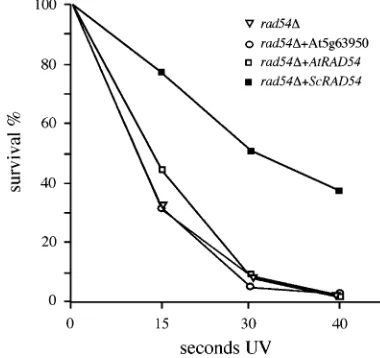
We also tested these two plant genes for complemen-tation of the repair deficiency ofrad54Dcells following UV radiation. Both genes, At3g19210 and At5g63950, did not complement the UV repair defect of the yeast rad54Dcells (Figure 3).
It was previously shown thatrad54Dcells of budding yeast are defective in targeted integration of DNA frag-ments introduced by transfection (Arbelet al. 1999), probably due to the defect in the homologous recom-bination pathway. We have tested whether AtRAD54 complements the rad54D defect in this respect. The assay was based on integration of a fragment from plasmid pRS404 into the genome of yeast strains con-taining another plasmid, pRS426 (seematerials and methods). The results in Figure 4 show that the
inte-gration efficiency of the fragment in strain rad54D 1 pRS426 was reduced to 0.1% compared to 3.9% in strain yPH871 pRS424 (wild type). The plasmid harboring ScRAD54 partially rescued the rad54D deficiency by increasing the integration efficiency up to 1.4%. Thus, therad54Dmutation is indeed responsible for the low integration frequency in the yeast mutant, as originally proposed by Arbel et al. (1999). However, neither
AtRAD54 nor At5g63950 complemented the DNA
in-tegration defect of rad54D yeast cells. We also tested whether the presence of theAtRAD54gene elevated the generation of His1 colonies in a heterozygous hetero-allelichis4B/his4Xstrain. This strain harbors a different mutation on each allele ofHIS4. A recombination event between the two mutation sites results in a functional allele and generation of a His1
colony. Therefore an elevation in the level of His1
colony generation might indicate a functional role of the gene in HR (see Xuet al. 1997 andmaterials and methods). The plantAtRAD54 gene did not cause elevation of the level of His1
colo-nies when transformed into either arad54Dstrain or a RAD54strain (data not shown). It thus seems that the plant ortholog AtRAD54 complements some DNA
re-Figure 1.—Gene and primary protein
pair deficiencies inrad54Dyeast cells but does not fully replace the gene in all aspects of recombination/repair. Activity of yeast Rad54 in Arabidopsis: To test functioning of yeast Rad54 in Arabidopsis, we examined whether expression of RAD54 improved resistance of Arabidopsis plants to ionizing radiation. We subcloned the yeast RAD54 into a binary vector, under the reg-ulation of the 35S promoter and introduced it into wild-type Arabidopsis plants. Seeds of independently derived transgenic plants expressing the pHS-35SRAD54 con-struct (all seedlings derived from these seeds expressed
the yeast RAD54 mRNA, as shown in supplemental
Figure 2 by an RT–PCR assay) were g-irradiated and allowed to germinate (Figure 5A). Seeds of the trans-genic plants were more resistant to g-irradiation than their wild-type progenitors, as shown by the increased fraction of seedlings developing to the true-leaves stage following exposure to 40 krad (Figure 5B): 7.7% for the wild typevs.14% (plant no. 6) to 96% (plant no. 5) in plants expressing the yeastRAD54gene. Irradiation of 60 krad resulted in total death of progeny of the wild-type plants whereas seedlings of transgenic plant nos. 2, 5, and 8 (which showed the highest resistance to 40 krad) were relatively resistant to 60 krad, with 6.8, 4.4, and 9% of seedlings developing two true leaves or more, re-spectively (Figure 5C). The differences in radiation
Figure 2.—Plant gene At3g19210
comple-ments DNA-repair deficiency inrad54Dyeast cells (strain MKP15). Drops of cell cultures grown to mid-logarithmic phase, were placed on plates con-taining SC 1glucose (a and d), SC 1glucose 1MMS (0.06%) (b and e), or SC 1galactose 1MMS (0.06%) (c and f) media. Cell-culture drops were serially diluted (310,3100, etc.), start-ing from 107cells/ml. (a–c) Top row (1),rad54D
strain (MKP15); row 2, WT strain (YPH857); row 3, rad54Dstrain1ScRAD54; row 4,rad54Dstrain1 At3g19120. (d–f) Top row (1),rad54Dstrain; row 2,rad54Dstrain1ScRAD54; rows 3 and 4 (two bot-tom rows),rad54Dstrain1At5g63950. (g) Specific expression ofAtRAD54in yeast cells: Western blot analysis with an anti-AtRad54 antibody. 1,rad54D cells (strain MKP15) without plasmid grown in glucose-containing medium; 2, rad54D cells without plasmid grown in galactose-containing medium; 3, rad54D cells with AtRAD54 plas-mid(pRS426-Gal1 promoter-AtRAD54) grown in glucose-containing medium; 4, rad54D cells with AtRAD54 plasmid (pRS426-Gal1 promoter-AtRAD54) grown in galactose-containing medium.
Figure4.—Integration efficiency of DNA fragments in
dif-ferent mutant yeast strains. Plotted are integration efficiencies of a transfected DNA fragment (calculated as explained in the
materials and methods) in strains harboring different
plas-mids containing plant and yeast genes.
Figure 3.—Plant DNA repair genes do not complement
resistance between independent transgenic plants (or their seedling progeny) might be due to position effects (resulting from the different integration sites of the yeast gene) or to the number of copies integrated.
In previous work (Shaked et al.2005), it was shown that expression of yeast RAD54 in Arabidopsis cells causes increases of the rates of targeted (homologous) integration by two orders of magnitude. Therefore, we conclude that in the plant context yeast Rad54 might increase the efficiency of the plant homologous re-combination system and that the yeast protein is very
active in this alien context, possibly replacing or acting in addition to the nativeAtRAD54.
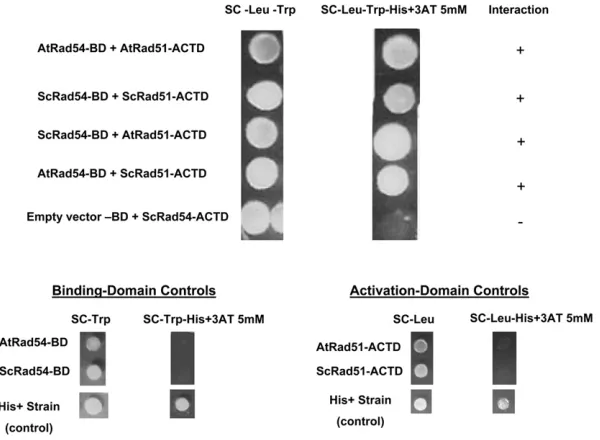
Yeast two-hybrid assays:As it is known that the yeast Rad54 protein interacts with Rad51 in a yeast two-hybrid system ( Jianget al. 1996), we examined whether the plant protein AtRad54 interacts similarly with the plant AtRad51 and whether this interaction is conserved between proteins of the two species. Use was made of the Two-Hybrid kit (Clontech). We found (as shown in Figure 6) that yeast Rad54 interacted with AtRad51, and that AtRad54 interacted with yeast Rad51. The plant proteins AtRad54 and AtRad51 also showed significant interaction, as did their yeast homologs Rad54 and Rad51 (as previously shown by Jiang et al. 1996 and by Osakabe et al.2006). These results (Figure 6) sup-port the designation of AtRAD54as the true ortholog of yeastRAD54 and show that the molecular function of the RAD54 homologs is conserved across different kingdoms.
Role of AtRAD54 in response to g-irradiation: Following the identification of At3g19210 as aRAD54 ortholog, we wanted to further test the function of this genein planta, by suppressing or increasing its activity. RNAi was previously reported to downregulate the plant native gene (Shakedet al.2006). Here, overexpression of the plant gene was performed by fusing it to a strong promoter, with the aim of producing high resistance/ tolerance to DNA damage. Sensitivity to g-irradiation was scored as the fraction of seedlings with two or more true leaves (resistant seedlings). Seedlings with cotyle-dons only or with only one true leaf were considered as sensitive to DNA damage. In the wild type, 7% of the 30-krad irradiated seeds developed as resistant seedlings compared to,2% for the RNAi line in whichAtRAD54 was silenced (Shaked et al.2006). The RNAi line was also more sensitive than the wild-type line to UV radiation (data not shown).
For overexpression ofAtRAD54,AtRAD54cDNA was cloned into a binary vector, under the regulation of the 35S promoter, and introduced into wild-type Arabidopsis plants. Seeds of independently derived transgenic plants expressing the pHS-35SAtRAD54cDNA construct (Fig-ure 7) wereg-irradiated prior to sowing. Seeds of the transgenic plants were more resistant to g-irradiation than their wild-type progenitors when exposed to 40 krad (Figure 7). Irradiation of wild-type plants with 40 krad resulted in 0.65% of seedlings with two or more true leaves, whereas plants overexpressing AtRAD54 cDNA showed much higher fractions of resistant seed-lings, ranging from 11.1% (plant no. 3) to 30.4% (plant no. 2) (Figure 7). The differences in radiation resis-tance between independent transgenic plants (or their seedling progeny) might be due to position effects or to the number of copies of the introduced gene. Thus, overexpression of AtRAD54 enhances resistance of Arabidopsis seedlings tog-radiation. It is worth noting that such an overexpression did not enhance
homolo-Figure5.—g-Irradiation resistance of Arabidopsis lines
ex-pressing the yeastRAD54gene. (A) Structure of the T-DNA vector that was used for transformation of Arabidopsis. 35S, cauliflower-mosaic virus promoter under which yeastRAD54 ORF was expressed. OCS39, terminator sequence from the Oc-topine synthasegene. Bar, thePhosphinothricingene which con-fers resistance to the BASTA herbicide. RB and LB, right and left borders of the pMBLArt T-DNA binary vector. (B) The re-sponse of T1progeny of transformants of the vector in A and of wild-type (WT) Columbia control to 40 kradg-irradiation. Plants were assayed as described inmaterials and methods.
gous recombination rates in another work (Osakabe et al.2006).
DISCUSSION
In this work we provide evidence that At3g19210 (AtRAD54) is the functional ortholog of RAD54. In addition, we show that the yeastRAD54gene, in plants, retains some of its DNA repair activities and that the plant geneAtRAD54is active in yeast, complementing
some of the DNA repair defects of the rad54D yeast mutant. We discuss below the evidence for orthology and the possible mechanistic basis for trans-species compatibility.
The gene At3g19210 (AtRAD54) was identified here as an ArabidopsisRAD54ortholog because (i)AtRAD54is more similar to yeastRAD54than to any plant gene; (ii) the cDNA of AtRAD54 remedies the MMS-sensitivity phenotype ofrad54Dyeast cells; (iii) we show here that overexpression of either gene in Arabidopsis enhances plant resistance tog-radiation, while RNAi downregula-tion ofAtRAD54was previously shown to confer sensitivity (Shaked et al. 2006); and (iv) our yeast two-hybrid ex-periments show that AtRAD54 interacts with AtRAD51, like the corresponding yeast homologs ( Jiang et al. 1996). Taken together, these data strongly support the identification ofAtRAD54as a functionalRAD54 ortho-log and further emphasize its role in DNA damage repair. During completion of this work we have learned about independently reached results concerning the same ArabidopsisAtRAD54cDNA clone (Osakabeet al. 2006). In their work, Osakabeet al.(2006) showed that this cDNA interacted withAtRad51in a yeast two-hybrid system, as also shown by our data; they also showed sensitivity of mutant AtRAD54 plants to genotoxic agents. Our work both confirms and extends the work of Osakabe et al. (2006), by showing functional com-plementation of the yeastrad54Dmutation by the plant geneAtRAD54, and by showing that theAtRAD54 over-expressing plants are more radiation resistant than control plants.
Our work (here, and in Shakedet al. 2005) suggests that some degree of functional complementation oc-curs between plant and yeast genes in both organisms: the plant geneAtRAD54in yeast cells and the yeast gene RAD54 in plants. The partial cross-compatibility of the DNA repair systems in yeast and Arabidopsis is
demon-Figure 6.—(Top) Yeast two-hybrid system
re-sults. Strain AH109 was transformed with two plas-mids: one containing the Gal4BD conjugated construct and the other with the Gal4ACTD con-jugated construct. The cells were grown on SC LeuTrp medium for selection of the plasmids and then on SCLeuTrpHis13AT to test for interaction between the different insert proteins coded by the two plasmids. (Bottom) Single-domain controls: strain AH109 was transformed with each of the single-domain plasmids alone and grown either on SCTrp or SCLeu plates for selection. Lack of activation of the HIS3 re-porter gene is seen as absence of growth on either SCTrpHis13AT or on SCLeuHis13AT plates. A His1
strain was added to all plates as a positive control for growth.
Figure 7.—g-Irradiation resistance of Arabidopsis lines
overexpressing theAtRAD54cDNA. (A) Structure of the vec-tor used to expressAtRAD54in plants. The same markers as in Figure 5 were used. (B) The response of T1progeny of trans-formants of the vector in A and of wild-type (WT) Columbia control to 40 kradg-irradiation. Plants were assayed as de-scribed inmaterials and methods. Bars represent the
strated by the overexpression of the yeastRAD54gene in Arabidopsis. The transgenic plants harboring overex-pression plasmids of the yeast gene RAD54 are much more resistant to g-radiation than wild-type plants (Figure 5) and undergo gene targeting more efficiently than wild-type plants by up to two orders of magnitude (Shakedet al.2005). From our results it appears that the yeast geneRAD54 is very potent in Arabidopsis plants and that the plantAtRAD54is active in yeast in enabling growth ofrad54Dmutants on MMS medium; however, the latter cross-kingdom activity is only partial, as the plant gene did not remedy the UV-sensitivity phenotype nor the homologous DNA integration defect that characterize the yeast rad54D mutant. Similarly, the humanhRAD54also only partly remediedrad54DDNA repair deficiency in yeast cells (Kanaaret al.1996).
The data reported here provide some insight into the possible mechanistic basis for partial cross-species com-plementation. The positive interactions in the two-hybrid assays between alien Rad54 and Rad51 partner proteins, namely the yeast Rad54 with AtRad51, and AtRad54 with yeast Rad51, are compatible with the phenotypic complementation observed in the trans-genic yeast (with plantAtRAD54) and transgenic plants (with the yeast gene). Indeed, several studies have shown that the interaction between Rad54 and Rad51 is essential for their function (Heyeret al.2006). The two-hybrid results also explain perhaps the elevation in gene targeting frequencies found when RAD54 was expressed in Arabidopsis plants (Shaked et al. 2005). Yet, there seems to be a higher potency of the yeast Rad54 protein in Arabidopsis, when compared to the activity of AtRad54 in yeast cells (which complements MMS resistance, but not UV resistance and gene targeting frequencies). There are two main explana-tions for this greater potency of the yeast Rad54 protein over AtRad54, which should be tested in future exper-iments. As the region in Rad54 necessary for its in-teraction with Rad51, which is located within the115 NH2-terminal residues ( Jiang et al. 1996), shares no
sequence similarity with the AtRad54 protein (Figure 1B), yeast Rad54 might be interacting with additional components of the plant system, which normally AtRad54 does not. This possible difference in protein activity between the yeast and plant systems might also explain some of the differences in efficiency of HR be-tween the two organisms (much higher in yeast). Alter-natively, the similar effects on DNA damage response in yeast (MMS resistance) of AtRAD54 and the yeast RAD54plasmids might be mediated by a repair function executed by the yeast Rad54 or AtRad54 alone (inde-pendent of interaction with Rad51), as also suggested (Osakabe et al. 2006) to explain the inability of over-expression ofAtRAD54to enhance homologous recom-bination frequency in plants. It was also shown that the yeast Rad54 protein can mediate nucleosome move-ment (sliding along the DNA)in vitro (Alexeev et al.
2003). This chromatin remodeling activity was enhanced by the Rad51–ssDNA complex; nevertheless Rad54 was also active on its own in this respect,in vitro(Alexeev et al.2003), suggesting the possibility of a role of Rad54, which is independent of its interaction with Rad51. A recent report (Bugreevet al.2006) suggests an addi-tional and novel role for Rad54. These authors propose that Rad54 functions alone to promote Holliday junc-tion branch migrajunc-tion, a funcjunc-tion which also might explain the strong effect ofRAD54by itself in an alien system.
In conclusion, this study has led to the identification of anA. thaliana RAD54ortholog and has established its involvement in DNA repair in the plant and its compat-ibility with the yeast HR machinery. We have also shown compatibility between the yeast RAD54 and the plant DNA repair system. We propose that the differences between species in the extent of alien-gene comple-mentation could be caused by alteration in the partner proteins found in a heterologous environment and/or by the ability of Rad54 and AtRad54 to act indepen-dently at various stages of the recombination and repair processes.
We thank M. P. Doutriaux for plasmids and helpful information and S. Toki for sharing unpublished data, plasmids, and antibodies. We thank Michal Lieberman-Lazarovich for preparing supplemental Figure 2. This work was supported by grant no. US-3223 from BARD (U.S.–Israel Binational Agricultural Research and Development Fund) to A.A.L. and G.S.
LITERATURE CITED
Alexeev, A., A. Mazinand S. Kowalczykowski, 2003 Rad54 protein
possesses chromatin-remodeling activity stimulated by the Rad51-ssDNA nucleoprotein filament. Nat. Struct. Biol.10:182–186. Arbel, A., D. Zenvirthand G. Simchen, 1999 Sister
chromatid-based DNA repair is mediated by RAD54, not by DMC1 or TID1. EMBO J.18:2648–2658.
Bezzubova, O., A. Silbergleit, Y. Yamaguchi-Iwai, S. Takedaand
J. M. Buerstedde, 1997 Reduced X-ray resistance and
homol-ogous recombination frequencies in a RAD54/mutant of the chicken DT40 cell line. Cell89:185–193.
Britt, A., and G. May, 2003 Re-engineering plant gene targeting.
Trends Plant Sci.8:90–95.
Bugreev, D., O. Mazinaand A. Mazin, 2006 Rad54 protein promotes
branch migration of Holliday junctions. Nature442:590–593. Chlebowicz, E., and W. Jachymczyk, 1979 Repair of MMS-induced
DNA double-strand breaks in haploid cells of Saccharomyces cer-evisiae, which requires the presence of a duplicate genome. Mol. Gen. Genet.167:279–286.
Cole, G., D. Schild, S. Lovettand R. Mortimer, 1987 Regulation
of RAD54- and RAD52-lacZ gene fusions in Saccharomyces cere-visiae in response to DNA damage. Mol. Cell Biol.7:1078–1084. Eisen, J., K. Swederand P. Hanawalt, 1995 Evolution of the SNF2
family of proteins: subfamilies with distinct sequences and func-tions. Nucleic Acids Res.23:2715–2723.
Essers, J., R. Hendriks, S. Swagemakers, C. Troelstra, J.deWit
et al., 1997 Disruption of mouse RAD54 reduces ionizing radia-tion resistance and homologous recombinaradia-tion. Cell89:195–204. Gleave, A., 1992 A versatile binary vector system with a T-DNA
or-ganisational structure conducive to efficient integration of cloned DNA into the plant genome. Plant Mol. Biol.20:1203– 1207.
Gorbunova, V., and A. A. Levy, 1999 How plants make ends meet:
Hefner, E., S. Preussand A. Britt, 2003 Arabidopsis mutants
sen-sitive to gamma radiation include the homologue of the human repair gene ERCC1. J. Exp. Bot.54:669–680.
Heyer, W., X. Li, M. Rolfsmeierand X. Zhang, 2006 Rad54: The
Swiss army knife of homologous recombination? Nucleic Acids Res.34:4115–4125.
Jiang, H., Y. Xie, P. Houston, K. Stemke-Hale, U. Mortensenet al.,
1996 Direct association between the yeast Rad51 and Rad54 re-combination proteins. J. Biol. Chem.271:33181–33186. Kanaar, R., C. Troelstra, S. Swagemakers, J. Essers, B. Smitet al.,
1996 Human and mouse homologs of the Saccharomyces cer-evisiae RAD54 DNA repair gene: evidence for functional conser-vation. Curr. Biol.6:828–838.
Keszenman-Pereyra, D., 1990 Repair of UV-damaged incoming
plas-mid DNA in Saccharomyces cerevisiae. Photochem. Photobiol.51:
331–342.
Kooistra, R., A. Pastink, J. Zonneveld, P. Lohmanand J. Eeken,
1999 The Drosophila melanogaster DmRAD54 gene plays a crucial role in double-strand break repair after P-element exci-sion and acts synergistically with Ku70 in the repair of X-ray dam-age. Mol. Cell Biol.19:6269–6275.
Kunz, B., and R. Haynes, 1981 Phenomenology and genetic control
of mitotic recombination in yeast. Annu. Rev. Genet.15:57–89. Mazin, A., A. Alexeevand S. Kowalczykowski, 2003 A novel
func-tion of Rad54 protein. Stabilizafunc-tion of the Rad51 nucleoprotein filament. J. Biol. Chem.278:14029–14036.
Mengiste, T., and J. Paszkowski, 1999 Prospects for the precise
en-gineering of plant genomes by homologous recombination. Biol. Chem.380:749–758.
Mumberg, D., R. Mullerand M. Funk, 1995 Yeast vectors for the
controlled expression of heterologous proteins in different ge-netic backgrounds. Gene156:119–122.
Muris, D., K. Vreeken, A. Carr, J. Murray, C. Smitet al., 1996
Iso-lation of the Schizosaccharomyces pombe RAD54 homologue,
rhp541, a gene involved in the repair of radiation damage and replication fidelity. J. Cell Sci.109:73–81.
Osakabe, K., K. Abe, T. Yoshioka, Y. Osakabe, S. Todorikiet al.,
2006 Isolation and characterization of theRAD54gene from
Arabidopsis thaliana.Plant J.48:827–842.
Peterson, C., and J. Tamkun, 1995 The SWI-SNF complex: A
chro-matin remodeling machine? Trends Biochem. Sci.20:143–146. Puchta, H., B. Dujonand B. Hohn, 1996 Two different but related
mechanisms are used in plants for the repair of genomic double-strand breaks by homologous recombination. Proc. Natl. Acad. Sci. USA93:5055–5060.
Rothstein, R., 1991 Targeting, disruption, replacement, and allele
rescue: integrative DNA transformation in yeast. Meth. Enzymol.
194:281–301.
Schiestl, R., and R. Gietz, 1989 High efficiency transformation of
intact yeast cells using single stranded nucleic acids as a carrier. Curr. Genet.16:339–346.
Shaked, H., C. Melamed-Bessudo and A. A. Levy, 2005
High-frequency gene targeting in Arabidopsis plants expressing the yeast RAD54 gene. Proc. Natl. Acad. Sci. USA102:12265–12269. Shaked, H., N. Avivi-Ragolskyand A. A. Levy, 2006 Involvement
of the Arabidopsis SWI2/SNF2 chromatin remodeling gene family in DNA damage response and recombination. Genetics173:985–994. Sherman, F., 1991 Getting started with yeast. Meth. Enzymol.194:3–21.
Siaud, N., E. Dray, I. Gy, E. Gerard, N. Takvorianet al., 2004 Brca2
is involved in meiosis in Arabidopsis thaliana as suggested by its interaction with Dmc1. EMBO J.23:1392–1401.
Verbsky, M., and E. Richards, 2001 Chromatin remodeling in
plants. Curr. Opin. Plant Biol.4:494–500.
Xu, L., B. M. Weinerand N. Kleckner, 1997 Meiotic cells monitor
the status of the interhomolog recombination complex. Genes Dev.
11:106–118.