Original Research Article
A cross-sectional study on prevalence of substance use and its
determinants among the male youth aged 15-24 years of
slums of city Amritsar
Sahil Sharma, Sanjeev Mahajan*, Mohan Lal, Tejbir Singh,
Shyam Sunder Deepti, Jasleen Kaur
INTRODUCTION
The word “slum” was first used in London during 1820s to identify the poorest quality housing and most insanitary and unhygienic conditions; a refuge for marginal activities including crime, vice and drug abuse.1
Youth is best described as a period of transition from the dependence of childhood to adulthood‟s independence. It
is also an age of considerable risk taking attitude accompanied by vulnerability, influenced by peer groups and media that result in changes in the perception and practice. The United Nations as well as Census of India defines „youth‟, as those persons between the ages of 15 and 24 years.2,3
In 2015 there were 1.2 billion youth globally and in Asia it was around 718 million.4 According to Curtain (2004),
ABSTRACT
Background: Slums are not new phenomenon. They are characterized by insanitary condition, crime, drug abuse etc. The male youth living in the slums, are prone to various health impacting conditions including substance use like alcohol consumption, smoking, tobacco chewing, drugs etc.
Methods: Cross-sectional study was conducted in the four selected urban slums of Amritsar city. From each slum 250 male youth aged 15-24 years were included in the study, so total 1000 respondents were interviewed and required information was filled in pre-designed semi-structured proforma. Data was compiled, analysed and valid conclusions were drawn.
Results: The overall prevalence of substance use among the respondents was 25.9% and as the age increases the prevalence of substance use also increases. Among substance users, tobacco (86.8%) was the most common substance consumed both in smoking form (52.1%) and smokeless form (34.7%), followed by the alcohol (72.2%) and then drugs (12%). Majority (62.1%) of respondents had initiated the substance use between 15-19 years of age. Factors like illiteracy, migration, joint family, married status and increased mental stress were significantly associated with substance use, however no association was found with socio economic status of the respondents.
Conclusions: Government should take robust steps to improve the awareness and education status of the youth living in the slums. As the younger ages are most vulnerable ones, health education, IEC and BCC activities regarding the harmful effects of substance use along with life skills should be incorporated into the school curriculum.
Keywords: Male, Youth, Slums, Substance use, Prevalence
Department ofCommunity Medicine, Government Medical College, Amritsar, Punjab, India
Received: 04 February 2019
Revised: 12 March 2019
Accepted: 13 March 2019
*Correspondence:
Dr. Sanjeev Mahajan,
E-mail: [email protected]
Copyright: © the author(s), publisher and licensee Medip Academy. This is an open-access article distributed under the terms of the Creative Commons Attribution Non-Commercial License, which permits unrestricted non-commercial use, distribution, and reproduction in any medium, provided the original work is properly cited.
almost half (46%) of the young population aged 15-24 years lived in the low-income countries.5 Youth population of India has increased from 73 million in 1961 to 232 million in 2011(19% of the total population). The percentage of youth population to total population in Punjab is 20.2% and the proportion of male youth to the total youth population in Punjab is around 54%.6
The young male adults living in the slums migrate from their homeland in search for the better jobs, leaving behind their families. In the absence of the social support system they create their own temporary and non-familial social circle among the slum dwellers which make them vulnerable to negative peer group activities like substance use.
Tobacco and Alcohol are the most commonly used substances and it can directly compromise the health of young population. The young adults who start consuming tobacco early in the developmental years are more vulnerable to nicotine dependence late in adulthood. Exposure to the alcohol in the early years can have detrimental effect on the cognitive, social and emotional maturation.7 Long term exposure of alcohol and other drugs increases the chances of injuries, hypertension, cirrhosis, HIV, gastritis, anxiety disorder, depression and major psychosis. The behavioural patterns established during this phase of life are the important factors for developing some chronic diseases in the adulthood. Nearly two-thirds of premature deaths and one-third of the total disease burden in adults are associated with conditions or behaviours initiated in their youth.8
As compared to females, males are more prone to unhealthy life style like alcohol consumption, smoking, tobacco chewing, drugs etc. and those living in the slums are even more vulnerable. The study was conducted with the objective to know the prevalence of substance use among the male youth living in the slums and various determinants associated with it.
METHODS
The cross-sectional study was conducted in the urban slums of city Amritsar from 1st January 2017 to 31st December 2017. There are 64 slums that have been notified by municipal corporation, Amritsar under Punjab slum areas (improvement and clearance) act, 1961 constituting 4.26% of the area of the city Amritsar.9
All the slums were numbered and divided into 4 sectors (east, west, north and south) according to their location and then from each sector one slum was selected randomly by lottery method. So in total 4 urban slums of city Amritsar were covered in the study i.e. Faizpura (north), Mohkumpura (east), Bangla Basti (south), and Kot Khalsa (west).
The male youth (15-24 years) who gave the consent were included in the study. Male youth (15-24 years) who
didn‟t give the consent, who were not available on three repeat visits and who were mentally unstable or deaf or dumb were excluded from the study. 250 eligible male respondents were interviewed from each selected slum, so total sample size of 1000 male youth was selected for the study. Purpose of the study was explained to the eligible respondent and he was interviewed after taking written informed consent. All the questions were asked in vernacular language and pre-tested semi-structured proforma was filled in.
The data thus collected was compiled and analysed statistically with the help of available software like Microsoft Excel. The ratios and proportions were calculated and chi square test was used as test of significance. The odds ratios were calculated with 95% confidence intervals by applying logistics regression analysis using SPSS 20 software (free trial version).
Modified Kuppuswamy Scale with price index of November 2017 was used to access the socio-economic status of study subjects.10.
RESULTS
The overall prevalence of substance use among the study population was 25.9%. As the age increases the prevalence of substance use also increases because 10.7%, 34.2% and 37.2% of the respondents belonged to the age group 15-18 years, 19-21 years and 22-24 years respectively who were engaged in the substance use. The result was highly significant with p value less than 0.0001 (Table 1).
Table 1: Distribution of respondents according to age group wise prevalence of substance use.
Age (in years) Substance use Total
Yes (%) No (%)
15-18 42 (10.7) 352 (89.3) 394
19-21 96 (34.2) 185 (65.8) 281
22-24 121 (37.2) 204 (62.8) 325
Total 259 (25.9) 741 (74.1) 1000
Chi-square statistic is 79.42, highly significant at p<0.0001.
Regarding different types of substances consumed by the substance users (259) , tobacco (86.8%) was the most common substance consumed, both in smoking form (52.1%) and smokeless form (34.7%), followed by the alcohol (72.2%) and then the drugs (12%) (Table 2).
Table 2: Distribution of respondents according to the frequency of substance use (n=259).
Variables Frequency Percentage*
Alcohol 187 72.2
Tobacco Smoking 135 52.1
Smokeless Tobacco 90 34.7
Drugs 31 12.0
*Multiple responses.
The proportion of study population who initiated substance use before the age of 15 years, between 15-19 years and between 20-24 years of age was 3.7%, 62.6% and 33.7% for alcohol; 11.1%, 61.5% and 27.4% for tobacco smoking; 24.4%, 63.3% and 12.2% for smokeless tobacco; and 16.1%, 58.1% and 25.8% for drugs respectively (Table 3).
Table 3: Distribution of respondents according to the age of initiation of substance use.
Age when started
(years) Alcohol Tobacco smoking Smokeless tobacco Drugs Total
No (%) No (%) No (%) No (%)
<15 7 (14.3) (3.7) 15 (30.6) (11.1) 22 (44.9) (24.4) 5 (10.2) (16.1) 49
15-19 117 (42.5) (62.6) 83 (30.2) (61.5) 57 (20.7) (63.3) 18 (6.5) (58.1) 275
20-24 63 (52.9) (33.7) 37 (31.1) (27.4) 11 (9.2) (12.2) 8 (6.7) (25.8) 119
Total 187 135 90 31 443
Mean Age 18.35±1.97 17.6±2.64 16±2.85 16.97±3.02 17.23±2.62
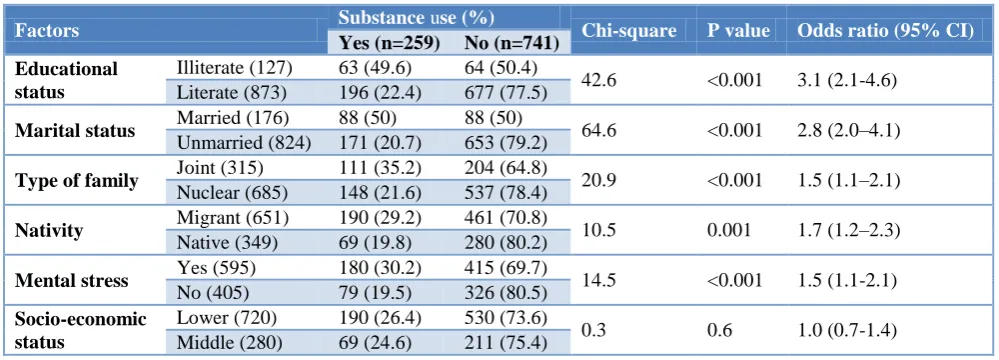
Table 4: Logistic regression analysis of substance use among the respondents in relation to various factors.
Factors Substance use (%) Chi-square P value Odds ratio (95% CI)
Yes (n=259) No (n=741) Educational
status
Illiterate (127) 63 (49.6) 64 (50.4)
42.6 <0.001 3.1 (2.1-4.6)
Literate (873) 196 (22.4) 677 (77.5)
Marital status Married (176) 88 (50) 88 (50) 64.6 <0.001 2.8 (2.0–4.1) Unmarried (824) 171 (20.7) 653 (79.2)
Type of family Joint (315) 111 (35.2) 204 (64.8) 20.9 <0.001 1.5 (1.1–2.1)
Nuclear (685) 148 (21.6) 537 (78.4)
Nativity Migrant (651) 190 (29.2) 461 (70.8) 10.5 0.001 1.7 (1.2–2.3)
Native (349) 69 (19.8) 280 (80.2)
Mental stress Yes (595) 180 (30.2) 415 (69.7) 14.5 <0.001 1.5 (1.1-2.1)
No (405) 79 (19.5) 326 (80.5)
Socio-economic status
Lower (720) 190 (26.4) 530 (73.6)
0.3 0.6 1.0 (0.7-1.4)
Middle (280) 69 (24.6) 211 (75.4)
The socio demographic profile of the male youth living in the slums of Amritsar (Table 4) depicts that almost two-third (65.1%) of the respondents were migrants, 12.7% didn‟t go to school for formal education and more than half (59.5%) responded that they were suffering from mental stress or tension. It was observed that 82.4% of study population was unmarried and 17.6% was married. More than two third (68.5%) respondents were living in the nuclear families and majority (72%) belonged to the lower socio economic status according to modified Kuppuswamy scale.
Table 4 also describes the relationship of substance use with various factors. The education status of the respondents, their marital status, type of family, nativity and mental stress are significantly associated with the substance use as p value is less than or equal to 0.001. However there is no statistical association with socio-economic status of the respondents as p value is more than 0.05.
Using logistic regression analysis, odds ratios with 95% confidence intervals were calculated. It was observed that the odds of substance use was 3.1 times higher among the illiterate respondents as compared to the literates (OR=3.1, CI=2.1–4.6, p<0.001). Married respondents were found to be 2.8 times more likely to consume substance as compared to unmarried ones (OR=2.8, CI=2.0-4.1, p<0.001). The study subjects residing in the joint family were 1.5 times more prone to substance use than those living in nuclear family (OR=1.5, CI=1.1-2.1, p<0.001). Similarly the odds of substance use was 1.7 times higher among the migrants as compared to the native respondents (OR=1.7, CI=1.2-2.3, p=0.001). Among those who were mentally stressed, the odds of substance use was 1.5 times higher as compared to those who didn‟t have mental stress (OR=1.5, CI=1.1-2.1, p<0.001) (Table 4).
(33.8%) responded that peer pressure was the most important reason for the increased substance use among the youth living in the slums. More than one-fourth (28.5%) replied that young people initiate the drugs to relieve mental stress and physical weakness. Unemployment (23.3%) was the third most common reason followed by the curiosity (14.2%). The other reasons were family problems (3.5%), illiteracy (2.7%), love affairs (2.3%), politics (1.9%), show off (1.8%), easy availability (1%) and depression (0.4%). 13.5% male youth didn‟t know any reason for the drug abuse among young people (Table 5).
Table 5: Distribution of respondents according to the reasons for increased substance use among youth.
Reasons for substance use* Frequency %
Peer pressure 338 33.8
Relieve stress and weakness 285 28.5
Unemployment 233 23.3
Curiosity 142 14.2
Any other 136 13.6
Don’t know 135 13.5
*Multiple reasons
DISCUSSION
Among the male youth living in the slums of Amritsar city, more than one-fourth were involved in the substance use. As the age increases the prevalence of substance use also increases. Majority had initiated the substance use between 15 to 19 years of age and this is the most vulnerable age group that needs to be targeted for the IEC/BCC activities. Awareness activities regarding the harmful effects of substance use along with life skill activities should be the part of school curriculum and must be started before 15 years of age preferably after 12 years.
Regarding the different types of substances consumed by the substance users, tobacco (86.8%) was the most common substance consumed, both in smoking form (52.1%) and smokeless form (34.7%), followed by the alcohol (72.2%) and then the drugs (12%) like heroin, cannabis, bhang etc.
A study by Kangule et al showed that the prevalence of substance use among the male youth living in the tribal areas of Maharashtra was more in the age group of 20-24 years (39.76%) and more than half (55%) of them consumed tobacco, followed by alcohol (20.7%) and marijuana (1.8%).11
Kokiwar et al in their study showed that the prevalence of substance use was 32.7% among the male adolescents of slums in the state of Andhra Pradesh and the prevalence of substance use increases significantly with age.12
A study by Katoki et al in the slums of Guwahati revealed that 73.3% of the adolescents living in the slums
of Guwahati had initiated the substance abuse in the age group 8-16 years; tobacco was most commonly consumed in the form of biddi (85%), gutkha (88.3%), khaini (51.7%) and half of the study subjects had consumed cheap branded alcohol.13
According to a study conducted on the youth of Manipur, the majority of youth had started taking drugs between 15 to 20 years (49.32%).14 Another study in the Arunachal Pradesh showed that mean age of initiation of alcohol use was 12.4 years, for tobacco mean age was 17.6 years and for opium mean age was 23.3 years.15
In Mankhurd slum of Mumbai, majority of slum dwellers started consuming alcohol at the age of 20 years and above.16 Among the youth, as the age increases the prevalence of substance use also increases; may be because of more exposure to friend circle, more freedom with age, financial independence and might be also due to stress. There are many probable reasons for the initiation of substance use early, like youth is the age of experimentation and they are very much susceptible to peer influences as in the slums smokeless tobacco, tobacco smoking, alcohol consumption is very common and highly prevalent. Mass media also has very important role, they also look up to the movie stars and want to imitate the behaviours they see, although warning is there.
In the present study almost two-third (65.1%) of the study population living in the slums of Amritsar city had migrated from the other states and within the Punjab also. The young males in search for better jobs and good income migrate to the big cities with a dream of a better life. They leave their homes and parents behind and settle in the big cities giving rise to the higher proportion of the nuclear families. In the present study more than two third (68.5%) of the study population lived in the nuclear families and less than one third (31.5%) lived in the joint family. Moreover due to urbanization there is change in trend from the joint families to nuclear families. NFHS 4 data showed that more than half (55.2%) of households in the urban areas of Punjab had nuclear families.17 Similar results were also seen in the study conducted in the slums of Lucknow by Dayal and Bhawana, where more than two third (66.4%) of youth were living in the nuclear family.18
status, financial and family responsibilities, lack of educational institutions near the slum, lack of motivation or the early employment of young people in some kind of work to earn livelihood. In the present study 17.2% of the study population was married and majority (72%) belonged to the families of lower socio economic status according to the modified Kuppuswamy scale. Since the families living in the slums generally have poor background in which fathers or grandfathers are mostly the head of the family. They are mostly illiterate or have low educational status and majority are employed in unskilled jobs. Even if the young males have good education and occupation status, level of education and occupation of head of the family lowers their socio-economic status. Education and awareness level of head of family have significant impact on the behaviour and attitude of children and youth living in the family.
It was observed that the education status of the respondents, marital status, type of family, nativity and metal stress were significantly associated with substance use. Using logistic regression analysis, it was observed that education was the most important determinant because substance use was 3.1 times more likely to occur among the illiterate study subjects as compared to the literate ones. Education has very positive impact, as the level of education increases the substance use decreases because education increases the awareness of a person and also helps in changing the risky behaviour. Similarly substance use was 2.8 times more common among the married respondents, 1.7 times more common among migrants, 1.5 times more likely among those residing in the joint families and having mental stress. The young male migrants in search for jobs in the big cities, away from their parent‟s watch are very much susceptible to the negative peer influences. The increased risk of the substance use among the married respondents could be due to increased burden of family responsibilities and increased stress. This is also the stage when the young population started doing the jobs and exposure to new environment, new friends and peer pressure along with increased stress leads to the initiation of substance use. In the joint families the young generation is living with parents and grand-parents, individual attention is lacking and there are more family conflicts. Habits and attitude of elders especially in the joint family have impact on the behaviour of the young generation. In the slums when they see family members involved in the substance use, they consider it normal and more likely to initiate early as well.
However no statistical association of substance use was found with socio economic class of the study population. Although people from low socio economic status are more vulnerable to the substance use but the socio economic status is not the only factor responsible for it. Male youth belonging to higher class may use substances for the purpose of enjoyment and because of peer pressure. Those belonging to the lower class may take it to overcome the physical and mental stress in life.
Similar results were observed in the study by Kokiwar et al in which no significant association was found between the substance use and social class but strong association with education status was present among the male adolescents living in the slums of Karimnagar district of Andhra Pradesh.12 Similar observations were also seen in the study by Kangule et al which pointed the strong association between education and substance abuse among the marginalized young males of Maharashtra.11
In the present study when the respondents were asked about the reasons for the increased substance use among the youth; peer pressure, mental stress and unemployment came out to be the top three responses given by the male youth living in the slums. Various studies like Devi, Kokiwar et al and Katoki et al showed that peer pressure was the most common and important reason for the initiation of the substance use.12-14
CONCLUSION
Youth is the most important stage of human life easily influenced by the behaviours of family members and peers. Government should take robust steps to improve the awareness and education status of the youth living in the slums. As the younger ages are the most vulnerable ones, health education, IEC and BCC activities regarding the harmful effects of substance use along with life skills to tackle the stressful and emotional situations should be incorporated into the school curriculum, it will have better impact to keep the children protected in their youth and adult life. There should be strict enforcement of the laws regarding the tobacco, alcohol and drugs. Moreover job opportunities should be created by the government in the low performing states to prevent the migration of young population.
ACKNOWLEDGEMENTS
I would like to express my special thanks of gratitude to the Head of department, Community Medicine, my supervisors, my colleagues and respondents of slum.
Funding: No funding sources Conflict of interest: None declared
Ethical approval: The study was approved by the Institutional Ethics Committee
REFERENCES
1. Kinyanjui M. Development Context and Millenium Agenda. The Challenge of Slums : Global report on Human Settlements, 2010.
3. Kumar S. Size, Growth and Composition of Adolescent and Youth Population in India. UNFPA, New Delhi, India, 2014.
4. Youth population trends and sustainable
development. Available at: http://www.un.org/en/ development/desa/population/publications/pdf/popfa cts/PopFacts_2015-1.pdf. Accessed on 8 January 2019.
5. Chougule M. Poverty, Youth and Polotics; A three dimensional view of youth in slum areas of solapur city. Social Affairs. 2015;1(3):1-12.
6. Youth info, Punjab, India. UNFPA; Available at: http://www.youthinfoindia.org/profiles/en /1/Youth
%20Info_Punjab_IND003.pdf. Accessed on 6
January 2019.
7. Arain M, Haque M, Johal L, Mathur P, Nel W, Rais A, et al. Maturation of the adolescent brain. Neuropsychiatr Dis Treat. 2013;9:449–61.
8. Sunitha S, Gururaj G. Health behaviours and problems among young people in India: Cause for concern and call for action. Indian J Med Res. 2014;140(2):185–208.
9. Sandhu RS, Teotia MK. The State of Cities in North-Western India: A Case of Selected JNNURM Cities (Study Focus City: Amritsar), 2013.
10. Modified Kuppuswamy scale. Available at: http://www.ihatepsm.com/blog/modified-kuppuswa my-scale. Accessed on 6 January 2019.
11. Kangule D, Darbastwar M, Kokiwar P. A cross sectional study of prevalence of substance use and its determinants among male tribal youths. Int J Pharm Biomed Sci. 2011;2(3):61-4.
12. Kokiwar P, Jogdand GR. Prevalence of substance use among male adolescents in an urban slum area
of Karimnagar district, Andhra Pradesh. Indian J Public Health. 2011;55(1):42.
13. Katoki K, Bhagabaty SM, Kalita M. Silhouette of substance abuse amongst an adolescent sample group from urban slums of Guwahati metro, North East India. Int J Med Res Health Sci. 2016;5(3):8. 14. Devi SR. Drug abuse among the youth of Manipur.
School of social sciencies, Manipur University, 1997.
15. Chaturvedi HK, Mahanta J. Sociocultural diversity and substance use pattern in Arunachal Pradesh, India. Drug Alcohol Depend. 2004;74(1):97–104. 16. Prasad R, Singh MN. Living condition and life style
of Mankhurd slum dwellers. International Institute for Population Sciences, Mumbai, 2009.
17. Singh A, Paswan B, Alagarajan M, Heller G. National Family Health Survey (NFHS-4), India, 2015-16: Punjab. Available at: http://rchiips.org /NFHS/NFHS-4Reports/Punjab.pdf. Accessed on 6 January 2019.
18. Dayal DB. Issues of family structure and academic achievement of youth residing in slum area of Lucknow city, 2012.
19. Vidhya IV. Socio-economic status of slum dwellers: a study on Thrikkumarakudam slum in Thrissur corporation. Int Res J Management Sci Tech. 2015;6(10).