Study of the Effect of Weft Parameters on the
Properties of Jute Fabrics Produced in S4A Loom
Woven from Single and Plied Weft Yarns
Prof. Swapan Kumar Ghosh1, Satyaranjan Bairagi2, Rajib Bhattacharyya3
Professor, Department of Jute and Fibre Technology, University of Calcutta, Kolkata, West Bengal, India 1
Senior Research Fellow, Department of Jute and Fibre Technology, University of Calcutta, Kolkata, West Bengal,
India 2
Teaching Associate, Department of Jute and Fibre Technology, University of Calcutta, Kolkata, West Bengal, India3
ABSTRACT: This paper delineates to carry out a detailed investigation of the effect of variation of pick density on the
physical, mechanical and hydraulic properties of three categories of jute fabric samples woven from single weft yarns, plied weft yarns and weft yarns running parallel in the fabric. The constituent weft yarns are varied in their counts, keeping fabric weight, warp count and warp yarn density unaltered in all the three categories of the woven fabric samples. Altogether seven number of fabric samples have been prepared in multi-phase, curvilinear and shuttleless S4A loom. The physical, mechanical and hydraulic properties of all these produced fabric samples have been determined and the effect of variation of pick density on these properties have been observed.
KEYWORDS: Pick density, Count, gsm, Plied yarn.
I. INTRODUCTION
woven fabric, the basic weave. It was observed that bursting and impact strengths of diced woven fabrics were higher than those of plain woven fabric, however breaking strengths of plain woven fabric along both warp and weft directions were higher than those of diced woven fabrics. In addition, the increases of yarn densities improved these physical properties of diced woven fabrics. The effects of the weave pattern, warp and weft densities on these physical properties of plain and diced woven fabrics were also evaluated in their study. J. Hayavadana et. al. have investigated effect of pick density and primary treatment conditions on mechanical properties of 100% PET fabrics as understood through alkaline hydrolysis [37]. M. Matsudaira et. al. have studied the effects of weave density, yarn twist and yarn count on fabric handle of polyester woven fabrics by objective evaluation method. "Koshi" and "hari" increase with weft yarn density and "shinayakasa" and "shari" decrease with the density. The effect of the density on "fukurami" and "kishimi" is small [38-40]. The effect of yarn twist is revealed remarkably on dechine and yoryu. "Koshi" and "hari" decrease and "shinayakasa" and "shari" increase with the twist in the case of dechine; however, all the primary handles increase a little with the twist for yoryu. "Kishimi" of yoryu increases greatly with the twist. "Koshi" and "hari" increase and "shinayakasa" decreases with yarn count for taffeta and georgette. The effect of the count on "fukurami" and "kishimi" is small for both fabrics. These results are expected to provide useful information to design ideal fabrics having desirable handle. K. Bilisik has studied the stick-slip properties of dry polyester plain, ribs and satin woven fabric weaves [41-43]. He found that the amount of stick-slip force was related to the number of interlacement points in the fabric, whereas the amount of accumulative retraction force was related to fabric structural response. Stick-slip force and accumulative retraction force depend on fabric weave, fabric density, the number of pulled ends in the fabric and fabric sample dimensions. The weft directional single and multiple yarn stick-slip and accumulative retraction forces of dry plain fabrics in fabric edge and centre regions were higher than those in the satin fabric due to fabric weave. In addition, the warp directional single and multiple yarn stick-slip and accumulative retraction forces in the dry wide and long satin fabric in fabric edge were higher than those in the weft direction due to fabric density. Stick-slip and accumulative retraction forces of polyester fabric in the multiple yarn pull-out test were higher than those of the single yarn pull-out test. P. Paul et.al have investigated on effect of weft yarn type and pick density on tearing strength of woven fabric. The present study was to acquire an understanding of the manner in which the yarn type and pick spacing contribute to the tear resistance of woven fabrics as measured by the Elmendorf Tear Test [44, 45]. Three different types of weft yarn and three different pick spacing for each sample were taken to carry out the tear strength. The result shows that with increase in the pick spacing warp way tearing strength increases. Tearing strength of fabric produced from polyester filament weft is maximum followed by fabric produced from P/V blend and cotton yarn weft. B.M.D. Dauda and M.P. Bandara have studied the effect of loom settings on fabric cover and beat-up force [46]. They have explained that beat-up is fundamental in woven fabric production and has significant influence on fabric quality and cover. R. K. Nayak et.al. have studied the effects of polyester content, pick density and weave on the thermal comfort and tactile properties of polyester / viscose blended yarn fabrics by measuring the low stress mechanical properties on Kawabata Evaluation System [47,48]. The fabrics with higher polyester content also show lower extensibility; the extensibility in warp direction is higher than in weft direction and Twill woven fabric give higher extensibility than the plain woven fabrics. N. E. Shahabi et.al. have studied effect of fabric structure and weft density on the Poisson’s Ratio of worsted fabric under uniaxial tension. It was found that there is an exponential correlation between warp and weft crimp during fabric extension [49,50]. For the worsted fabrics used in this research in all the fabric structures, fabrics with higher weft yarn density have higher value of Poisson’s ratio. It was also concluded that for the fabrics with the same condition but only different in structures, this ratio is related to the structural firmness of fabric. In all three fabric structures the value of the Poisson’s ratio were following the same pattern of twill 2/2, twill 3/1 and hopsack 2/2 from highest to lowest value. It was revealed that there is a high linear correlation between the crimp interchange ratio and Poisson’s ratio.
II. MATERIALANDMETHODS
2.1 Raw Materials
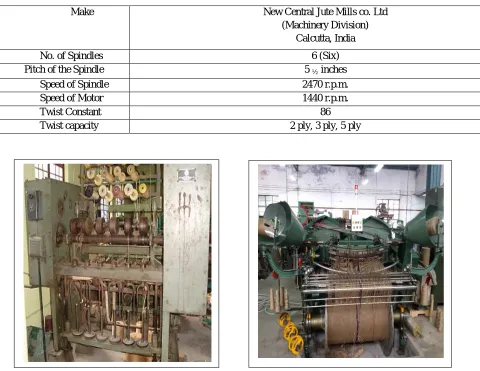
The particulars of the laboratory scale Jute Twisting Frame which has been employed to produce the plied yarns is specified in table 1 and the isometric views of the frame are shown in Figures 1 and 2 respectively.
Table 1: Particulars of Mini Jute Twisting Frame
Make New Central Jute Mills co. Ltd
(Machinery Division) Calcutta, India
No. of Spindles 6 (Six)
Pitch of the Spindle 5 ½ inches
Speed of Spindle 2470 r.p.m.
Speed of Motor 1440 r.p.m.
Twist Constant 86
Twist capacity 2 ply, 3 ply, 5 ply
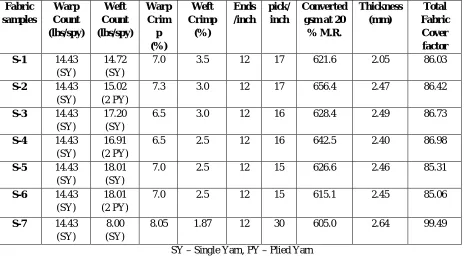
Table 2 Particulars of the Produced Jute 2/1 Twill Fabric Samples
SY – Single Yarn, PY – Plied Yarn
2.2 Conditioning of test fabric samples
The entire range of Woven Fabric Samples was conditioned using standard temperature (210 C ± 20 C) and humidity (65% ± 2 % R.H.) for 24 hours before commencement of any testingwork.
2.3Selection of fabric samples for testing work
Test samples were selected in such a way that it could represent the whole population of the fabric and the piece of fabric cut out for the laboratory test should be at least one metre long with full width of the fabric. No samples have been taken from nearer than 50 mm to the selvedge of the fabric sample.
III.RESULTS ANDDISCUSSIONS
In this project work seven numbers of different jute fabric samples have been woven in the shuttleless multiphase S4A loom by varying pick density, weft yarn count and ply of weft yarn in the Department of Jute and Fibre Technology, University of Calcutta. The test results of mechanical and hydraulic property parameters of produced jute fabric samples are provided in the tables that are appearing in the forecoming pages.
3.1 Effect of variation of pick density on the wide-width tensile strength of the produced fabric samples
Generally, an increasing trend is observed in the fabric strength values with an increase in the jute weft yarn count values and picks per inch of the jute woven fabrics. But in this project work, the test results of the tensile strength of the produced jute fabric samples, in the warp direction and weft direction, as provided in tables 3 and 4 respectively and it is observed that variation of pick density does not produce any significant difference in the values. S6 shows the maximum wide-width tensile strength value of 19.6 kN/m, in the warp way, while S5 shows the minimum wide-width tensile strength value of 13.76 kN/m in the same direction. While the third category of woven fabric sample S7 shows a
Fabric samples Warp Count (lbs/spy) Weft Count (lbs/spy) Warp Crim p (%) Weft Crimp (%) Ends /inch pick/ inch Converted gsm at 20 % M.R. Thickness (mm) Total Fabric Cover factor
S-1 14.43
(SY)
14.72 (SY)
7.0 3.5 12 17 621.6 2.05 86.03
S-2 14.43
(SY)
15.02 (2 PY)
7.3 3.0 12 17 656.4 2.47 86.42
S-3 14.43
(SY)
17.20 (SY)
6.5 3.0 12 16 628.4 2.49 86.73
S-4 14.43
(SY)
16.91 (2 PY)
6.5 2.5 12 16 642.5 2.40 86.98
S-5 14.43
(SY)
18.01 (SY)
7.0 2.5 12 15 626.6 2.46 85.31
S-6 14.43
(SY)
18.01 (2 PY)
7.0 2.5 12 15 615.1 2.45 85.06
S-7 14.43
(SY)
8.00 (SY)
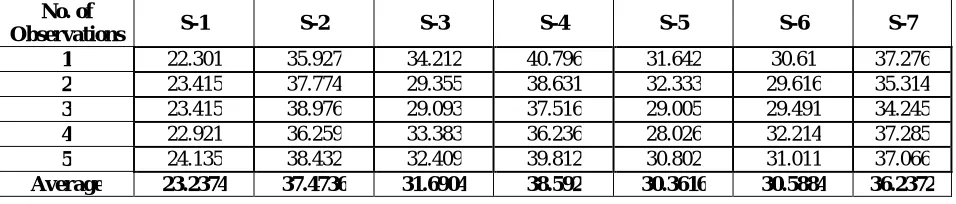
tensile strength value of 18.51 kN/m in the warp direction. Since the warp count and ends/inch of all the produced fabric samples have been kept constant at 14.43 lb/spyndle and 12 respectively, therefore there is no notable difference observed in the tensile strength values of the produced fabric samples in the warp way. Considering the tensile strength values of the fabric samples S1, S3 and S5, made of single weft yarns, it has been observed that the strength of fabric sample S3 is greater than that of fabric sample S1 which may be accounted for an increase in the weft count values. But, the tensile strength value of fabric sample S5 is lower than that of S3 which may be due to lower picks per inch (15) than that of S3 fabric sample whose picks per inch is16. The same reason may be attributed for the fabric samples S2, S4 and S6 made from 2 plied weft yarns. While, S7 fabric sample shows a tensile strength value of 36.24 kN/m in the weft direction which is at par with that of the S4 fabric sample.
Table 3 Wide Width Tensile Strength in kN/m of the different produced jute woven fabric samples in warp way
No. of
Observations S-1 S-2 S-3 S-4 S-5 S-6 S-7
1 18.342 13.106 17.748 19.065 13.928 17.199 17.141
2 19.141 16.172 17.718 18.853 11.845 18.358 19.592
3 17.01 16.565 17.338 17.092 14.312 20.208 18.261
4 17.924 13.955 19.079 18.03 12.893 20.63 19.752
5 18.357 18.892 19.904 19.814 15.828 21.795 17.823
Average 18.1548 15.738 18.3574 18.5708 13.7612 19.638 18.512
Table 4Wide Width Tensile Strength in kN/m of the different produced jute woven fabric samples in weft way
No. of
Observations S-1 S-2 S-3 S-4 S-5 S-6 S-7
1 22.301 35.927 34.212 40.796 31.642 30.61 37.276
2 23.415 37.774 29.355 38.631 32.333 29.616 35.314
3 23.415 38.976 29.093 37.516 29.005 29.491 34.245
4 22.921 36.259 33.383 36.236 28.026 32.214 37.285
5 24.135 38.432 32.409 39.812 30.802 31.011 37.066
Average 23.2374 37.4736 31.6904 38.592 30.3616 30.5884 36.2372
3.2 Effect of variation of pick density on the elongation at break of the produced fabric samples
Table 5 Breaking elongation percentage of the different produced jute woven fabric samples in warp way
No. of
Observations S-1 S-2 S-3 S-4 S-5 S-6 S-7
1 8.296 9.826 10.002 8.543 9.982 8.654 10.272
2 7.659 9.842 9.819 9.125 10.012 8.267 10.364
3 8.465 9.865 9.718 9.153 9.878 8.732 9.430
4 8.251 9.365 9.701 9.102 9.983 8.602 9.247
5 7.953 9.342 9.825 9.237 9.953 8.451 10.405
Average 8.124 9.648 9.813 9.03 9.961 8.541 9.943
Table 6 Breaking elongation percentage of the different produced jute woven fabric samples in weft way
No. of
Observations S-1 S-2 S-3 S-4 S-5 S-6 S-7
1 5.185 4.523 5.462 5.029 5.267 4.404 3.847
2 5.248 4.367 5.311 5.087 5.295 4.409 4.205
3 5.351 4.365 5.352 4.846 5.307 4.447 3.947
4 4.975 4.577 5.231 4.924 5.317 4.515 4.022
5 5.142 4.662 5.394 4.872 5.314 4.375 3.797
Average 5.180 4.4988 5.350 4.9516 5.300 4.430 3.963
3.3 Effect of variation of pick density on the tenacity of the produced fabric samples
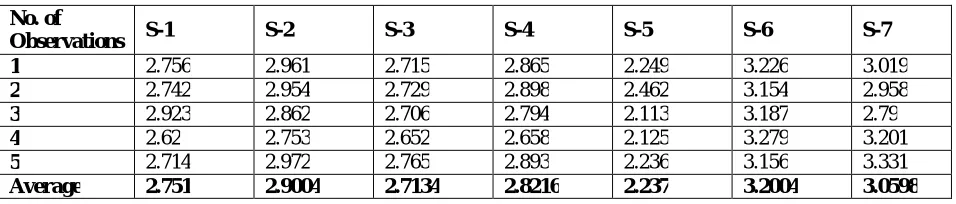
Fabric tenacity can be defined as the breaking load divided by the linear density of the yarn constituting the fabric. Increase in linear density of the yarns constituting the fabric requires greater breaking load. In this project work, the warp yarn count and ends per inch have been kept constant for manufacturing all the fabric samples. The tenacity values of the produced jute fabric samples in the warp and weft directions are furnished in tables 7 and 8 respectively. Therefore, tenacity of the fabric samples S1 to S7 is not significantly affected by variation in pick density. S6 fabric sample shows a maximum tenacity value of 3.2 cN/tex while fabric sample S5 shows a minimum tenacity value of 2.24 cN/tex in warp direction. The tenacity value of S7 fabric sample (3.06 cN/tex) in the warp direction is almost the same as that of S6 fabric sample. Considering the tenacity values of the fabric samples S1, S3 and S5, made of single weft yarns, it has been observed that the tenacity of fabric sample S3 is greater than that of fabric sample S1 which may be accounted for an increase in the linear density of the constituent weft yarn. But, the tenacity value of fabric sample S5 is lower than that of S3 sample which may be due to lower picks per inch (15) than that of S3 fabric sample whose picks per inch is16. The same reason may be attributed for the fabric samples S2, S4 and S6 made from 2 plied weft yarns.
Table 7 Tenacity in cN/tex of the different produced jute woven fabric samples in warp way
No. of
Observations S-1 S-2 S-3 S-4 S-5 S-6 S-7
1 2.756 2.961 2.715 2.865 2.249 3.226 3.019
2 2.742 2.954 2.729 2.898 2.462 3.154 2.958
3 2.923 2.862 2.706 2.794 2.113 3.187 2.79
4 2.62 2.753 2.652 2.658 2.125 3.279 3.201
5 2.714 2.972 2.765 2.893 2.236 3.156 3.331
Table 8 Tenacity in cN/tex of the different produced jute woven fabric samples in weft way
No. of
Observations S-1 S-2 S-3 S-4 S-5 S-6 S-7
1 4.214 5.356 5.952 6.024 4.952 5.201 5.837
2 3.678 5.237 5.475 6.397 4.801 5.682 6.161
3 3.851 6.267 6.227 5.858 5.742 4.763 6.25
4 4.134 4.876 5.892 6.671 5.287 5.800 5.836
5 3.014 6.025 5.302 6.427 5.851 5.181 5.868
Average 3.778 5.555 5.769 6.275 5.326 5.325 5.9904
3.4 Effect of variation of pick density on the bursting strength values of the produced fabric samples
The bursting strength values of the produced fabric samples, as provided in table 9 and it show that S2 has the maximum value of 32.32 kg/cm2 and S1 shows a minimum value of 23.74 kg/cm2. S7 shows a bursting strength value of 31.2 kg/cm2 which is very close to the maximum bursting strength value of fabric sample S2. This may be accounted for the contribution of two weft yarns in the strength of fabric, inserted in the same shed during the manufacturing of the fabric samples S2 and S7.
Table 9 Bursting strength in kgf/cm2 of the different produced jute woven fabric samples
No. of
Observations S-1 S-2 S-3 S-4 S-5 S-6 FS-7
1 22.70 31.50 27.20 34.00 29.50 30.00 33.2
2 27.00 34.10 23.30 26.50 26.40 28.00 29.1
3 20.50 34.00 30.90 29.90 31.10 30.90 27.6
4 25.50 30.00 32.00 33.50 27.50 28.60 32.7
5 23.00 32.00 25.50 34.00 28.50 30.00 33.4
Average 23.74 32.32 27.78 31.58 28.6 29.5 31.2
3.5 Effect of variation of pick density on the index puncture resistance values of the produced fabric samples
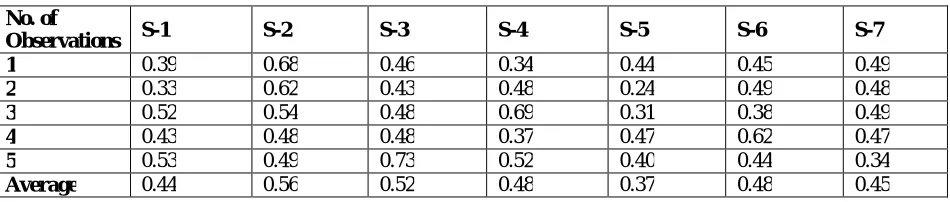
The index puncture resistance values of the produced jute fabric samples as listed in table 10 and it show that the fabric sample S2 having maximum fabric weight of 656.4 gsm exhibits maximum index puncture resistance of 0.56 kN while fabric sample S5 shows minimum index puncture resistance of 0.37 kN. The index puncture resistance of fabric sample S7 shows a value 0.45 kN which lies between the maximum and minimum values. The other fabric samples, S1, S3, S4 and S6 do not show any definite trend in their index puncture resistance values
Table 10Index Puncture Resistance (kN) of the different produced jute woven fabric samples
No. of
Observations S-1 S-2 S-3 S-4 S-5 S-6 S-7
1 0.39 0.68 0.46 0.34 0.44 0.45 0.49
2 0.33 0.62 0.43 0.48 0.24 0.49 0.48
3 0.52 0.54 0.48 0.69 0.31 0.38 0.49
4 0.43 0.48 0.48 0.37 0.47 0.62 0.47
5 0.53 0.49 0.73 0.52 0.40 0.44 0.34
3.6 Effect of variation of pick density on the static puncture resistance values of the produced fabric samples
The static puncture resistance values of the produced jute fabric samples as displayed in table 11 and it show that the fabric sample S3 exhibits maximum static puncture resistance of 2.87 kN while fabric samples S1 and S4 show minimum static puncture resistance of 2.29 kN each. The static puncture resistance of fabric sample S7 shows an intermediate value 2.50 kN. The other fabric samples, S2, S5 and S6 do not show any definite trend in their static puncture resistance values.
Table 11Static Puncture Resistance (kN) of the different produced jute woven fabric samples
No. of
Observations S-1 S-2 S-3 S-4 S-5 S-6 S-7
1 2.34 2.66 2.76 2.25 2.66 2.56 2.60
2 2.13 2.60 2.97 2.50 2.47 2.41 2.50
3 2.34 2.44 2.78 2.13 2.43 2.42 2.49
4 2.15 2.79 2.63 2.27 2.57 2.43 2.28
5 2.49 2.59 3.17 2.29 2.82 2.72 2.63
Average 2.29 2.62 2.87 2.29 2.59 2.51 2.50
3.7 Effect of variation of pick density on the dynamic perforation resistance values of the fabric samples
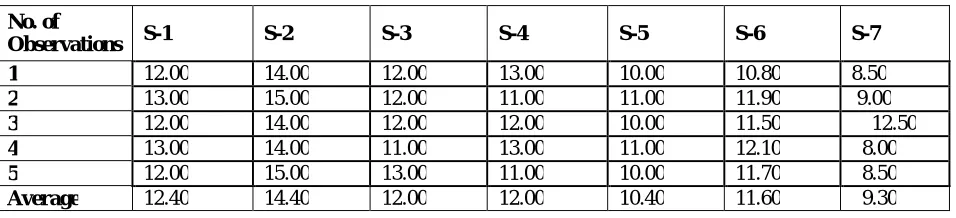
It has been investigated and inferred that several properties of a woven fabric influence its resistance to dynamic perforation. Considering the values obtained for all of these fabric properties, as provided in table 12, it has been observed that amongst the fabric samples S1, S3 and S5, manufactured from single weft yarns, S3 fabric sample shows maximum resistance to dynamic perforation. While, the tested value of dynamic perforation resistance of the fabric sample S7 shows the maximum resistance amongst all the fabric samples considered in this work. This may be accounted for the highest value of picks per inch (30), thickness (2.64 mm) and cover factor (99.49) of fabric sample S7 amongst all the fabric samples. No definite trend has been observed in the dynamic perforation resistance values of fabric samples S2, S4 and S6 which are manufactured from 2 plied weft yarns.
Table 12Dynamic Perforation Resistance (mm) of the different produced jute woven fabric samples
No. of
Observations S-1 S-2 S-3 S-4 S-5 S-6 S-7
1 12.00 14.00 12.00 13.00 10.00 10.80 8.50
2 13.00 15.00 12.00 11.00 11.00 11.90 9.00
3 12.00 14.00 12.00 12.00 10.00 11.50 12.50
4 13.00 14.00 11.00 13.00 11.00 12.10 8.00
5 12.00 15.00 13.00 11.00 10.00 11.70 8.50
Average 12.40 14.40 12.00 12.00 10.40 11.60 9.30
3.8 Effect of variation of pick density on the apparent opening size (AOS) values of the produced fabric samples
Table 13 Apparent Opening Size (o95) in micron of the different fabric samples
Sl. No. Fabric Sample AOS (o95) in micron
1 S-1 975
2 S-2 840
3 S-3 711
4 S-4 650
5 S-5 1105
6 S-6 1120
7 S-7 555
IV. CONCLUSION
resistance values. The tested value of dynamic perforation resistance of the fabric sample S7 shows the maximum resistance amongst all the fabric samples considered in this project work. This may be accounted for its highest value of picks per inch, thickness and cover factor amongst all the fabric samples. Considering all the fabric samples ranging from S1 to S7, it has been observed that S7 fabric sample, having maximum cover factor, shows the minimum AOS value amongst all fabric samples produced in this project work.
REFERENCES
[1] S.R. Ranganathan and Quayyum, “New Horizon for Jute (National Information Centre for Textiles and Allied Subjects)”, 1993. [2] B. C. Chattopadhyay and S. M. Chatterjee, J. Inst. Engineers (India), Text. Engg. Divn., Vol. 79, PP.11, 1998.
[3] Problem and Prospects for Diversified Jute Products (Food and Agriculture Organisation of the United Nations), ESC/M/91/1, 1991. [4] A.R. Horrocks and S.C. Anand, “Handbook of Technical Textiles”, Wood Head Publishing Limited, Cambridge, PP. 358-360, 2000. [5] R. V.V. Zanten, “Geotextiles and Geomembranes in Civil Engineering”, PP.6-7, 1986.
[6] T. Nanda Kumar, “Future Directions for Jute in Indian Jute, 1st edn”, Edited by Sur, D., JMDC, India, PP. 10, 2003. [7] H. Zahn and P.C Das, Textile Industries, Vol.-67, Pp.353, 1965.
[8] R.R. Atkinson, “Jute Fibre to Yarn”, Published by Chemical Publishing Co, New York, USA, PP. 13, 27, 36, 1965.
[9] W.K. Beckham and W.H. Mills, “Cotton –Fabric-Reinforced Roads”, Engineering News Record, Vol. 115, No. 14, PP.452 -455, 1935.
[10] R.M. Koerner and J.P. Welsh, “Construction and Geotechnical Engineering Using Synthetic Fabrics”, Published by John Wiley & Sons, New York, Pp. 5 – 7,1980.
[11] H.P. Bhattacharjee et.al., J. Text. Assoc., Vol.-35, PP. 23,1974.
[12] Indian Jute, A Bulletin of Jute Manufactures Development Council, Kolkata, Vol.- XIX, No.1, PP. 2, 2007.
[13] T. Sanyal, “Geosynthetics with Natural Fibres, Proc. of a Seminar - Workshop on Geosynthetics India”, Indian Institute of Technology, New Delhi, India, PP. 362,365 – 367, 2004.
[14] N. Sarda and S.B. Mhetre, J. of Textile Association, PP.342, 2014. [15] H.N. Yoon and A. Buckley, Textile Research Journal, 1984.
[16] M. Karahan and R. Eren, Fibres & Textiles in Eastern Europe, Vol. 14, No. 2 (56), PP. 59, 2006. [17] I. Frontczak-Wasiak, M. Snycerski, Fibres & Textiles in Eastern Europe, Vol. 12, No.1, 2004. [18] P. Hardt, Textile Praxis International, Vol. 45, No. 4, 1990.
[19] P.K. Chatterjee, B.S. Gupta, “Absorbent Technology”, Elsevier Science B.V., 2002.
[20] V. Sankaran and V. Subramaniam, Fibres & Textiles in Eastern Europe; Vol. 20, No. 5, PP.56, 2012. [21] BC.Goswami, J App Pol Sci: App Pol Sym; Vol. 33: PP. 245-259, 1978.
[22] H. Morino, M. Matsudaira, M. Furutani, Text Res J., Vol.75, No.3, PP.252-257, 2005. [23] V. Milašius, J Text I.,Vol. 91, No. 2, PP 277-284. 2000.
[24] Md. M. Haque, Journal of Science and Technology, Vol.4, No. 2, PP. 62, 2009.
[25] M. K. Talukdar, P. K. Sriramulu and D. B. Ajgaonkar, “Weaving-Machines Mechanisms Management”, Mahajan Publishers Private Limited, 1998. [26] F.T. Pierce, The Journal of The Textile Institute, PP. 45, 1937.
[27] A.T.C. Robinson and R. Marks, “Woven Cloth Construction”, A Textile Institute Publication.
[28] B. K. Behera, Jiri Militky, Rajesh Mishra and Dana Kremenakova Modeling of Woven Fabrics Geometry and Properties, Woven Fabrics, Prof. Han-Yong Jeon (Ed.), , In Tech, Available from: http://www.intechopen.com/books/woven-fabrics/modeling-of-woven-fabrics-geometry-and-properties, 2012.
[29] M.K. Singh and Nigam, A Journal of Industrial Engineering, Vol.2013, No. 7, http://dx.doi.org/10.1155/2013/206240, 2013. [30] R.L. Barker, International Journal of Clothing Science and Technology, Vol. 14, No. 3-4, PP. 181–200, 2002.
[31] C. V. Le, N.G. Ly, and R. Postle, Textile Research Journal, Vol. 65, No. 4, PP. 203–212, 1995. [32] J. Fan and. X. Cheng, Textile Research Journal, Vol. 75, No. 2, PP.99–105, 2005.
[33] H. Özdemir and E. Mert, Tekstil ve Konfeksiyon Vol. 23, No. 2, 2013. [34] P. Ünal and C. Taşkın,Tekstil ve Konfeksiyon, Vol. 17 No. 2, PP. 115-118, 2007. [35] R.T. Oğulata and F.D. Kadem, Tekstil ve Konfeksiyon, Vol. 18, No.3, PP. 185-190, 2008. [36] F. Şekerden and N. Çelik, Tekstil ve Konfeksiyon, Vol. 20, No.2, PP. 120-129, 2010. [37] J. Hayavadana et al., Man-made Textiles in India, Vol. LII, No.2, PP. 53, 2009.
[38] M. Matsudaira et. al., The Journal of the Textile Institute, Vol. 100, No. 3, PP. 265-274, 2009. [39] S. Kawabata, Journal of the Textile Machinery Society of Japan Vol. 26, PP. 72-128, 1973.
[40] S. Kawabata, “The Standardization and Analysis of Hand Evaluation (English)”, 2nd ed., HESC, Text. Mach. Soc. PP. 71-93, 1980. [41] K. Bilisik, Autex Research Journal, Vol. 14, No 3, 2014.
[42] S.A.R.D. Sebastian, A.I. Bailey, B,J. Briscoe, D. Tabor, Journal of Physics D: Applied Physics, Vol. 20, PP. 130-139, 1987. [43] E.A. Nikonova, A.B. Pakshver, Fiber Chemistry, Vol. 4, No. 6, PP. 657-660, 1973.
[44] P. Pal, D. Gon and M. Bera, Man-made Textiles in India, Vol. LIV, No.2, PP. 44, 2011. [45] H.M.Taylor, The Journal of the Textile Institute, Vol. 50, No. 161, 1959.
[46] B.M.D. Dauda and M.P. Bandara, Indian Journal of Fibre& Textile Research, Vol. 29, PP. 339, 2004. [47] R.K. Nayak, S.K. Punj and K.N. Chatterjee, Indian Journal of Fibre & Textile Research, Vol. 34, PP. 128, 2009. [48] B.K. Behera, R. Mishra, T.G. Singh and P. Saighal, Text Asia, Vol. 37, PP. 48, 2007.