Evaluation of Modules and Tools for Speech Synthesis
-
The ECESS Framework
-
H. Höge
1, Z. Kacic
2, B. Kotnik
2, M. Rojc
2, N. Moreau
3, H.-U. Hain
11Siemens AG, Corporate Technology, 81730 Munich, Germany 2University of Maribor, 3ELDA
E-mail: [email protected], [email protected], [email protected], [email protected], [email protected], [email protected]
Abstract
The consortium ECESS1 (European Center of Excellence for Speech Synthesis) has set up a framework for evaluation of software
modules and tools relevant for speech synthesis. Till now two lines of evaluation campaigns have been established: - Evaluation of the ECESS TTS modules (text processing, prosody, acoustic synthesis)
- Evaluation of ECESS tools (pitch extraction, voice activity detection, phonetic segmentation).
The functionality and interfaces of the ECESS TTS have been developed by a joint effort between ECESS and the EC-funded project TC-STAR2. First evaluation campaigns were conducted within TC-STAR using the ECESS framework. As TC-STAR finished in March
2007, ECESS continued and extended the evaluation of ECESS TTS modules and tools by its own. Within the paper we describe a novel framework which allows performing remote evaluation for modules via the web. First experimental results are reported. Further the result of several evaluation campaigns for tools handling pitch extraction and voice activity detection are presented.
1 www.ecess.eu 2 www.tc-star.org
1.
Introduction
The consortium ECESS (European Center of Excellence for Speech Synthesis) aims to speed up progress in speech synthesis technology by providing an appropriate framework. Evaluation - based on a common evaluation methodology - is one of the key elements of this framework. Till now two lines of evaluation campaigns have been established:
- Evaluation of the ECESS TTS modules (text processing, prosody, acoustic synthesis)
- Evaluation of ECESS tools (pitch extraction, voice activity detection, phonetic segmentation). The functionality and interfaces of the ECESS TTS modules (Perez 2006) and the procedures for evaluation (Bonafonte 2006) have been developed by a joint effort between ECESS and the EC-funded project TC-STAR. Within TC-STAR three evaluation campaigns on speech synthesis have been conducted by ELDA. Because TC-STAR finished in March 2007, ECESS continued and extended the evaluation of ECESS TTS modules by its own. The next ECESS evaluation campaign of modules handling UK English as language is scheduled on Spring 08. This evaluation will be the first evaluation campaign on speech synthesis, totally based on a web-based remote
evaluation procedure as described later.
Within ECESS, different tools mainly needed for generating language resources and to analyse speech signals have been investigated. Till now several evaluation campaigns have been organized for tools handling pitch extraction and voice activity detection. These campaigns were organized in the ‘traditional’ way: Training, test data,
and an evaluation script have been distributed to researchers, which test their modules themselves and report the results achieved. In future, remote evaluation will be explored also for tools.
The paper is organized as follows. Chapter 2 describes the methodology for evaluating ECESS modules based on a remote evaluation scheme. Chapter 3 describes the evaluation campaigns recently performed on tools.
2.
Evaluation of ECESS TTS Modules
2.1 The Remote Evaluation System RES
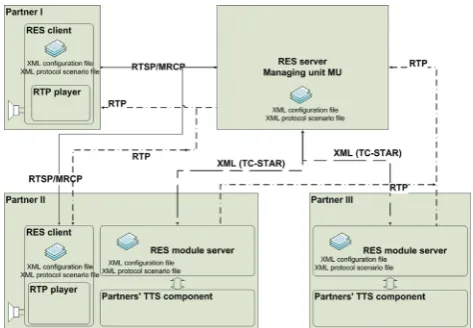
For the evaluation of the ECESS TTS Modules a new experimental platform – the Remote Evaluation System (RES) - has been developed. The RES is dedicated to distributed web-based online evaluation of the ECESS TTS modules, TTS systems and tools running at different institutions worldwide. The RES is based on web-based client- server architecture and is built up by three different RES components: the RES server, the RES module server and the RES client. Figure 1 shows the basic structure of the RES system. The core component is the RES server, which acts as a Managing Unit (MU) connecting RES clients with RES module servers. Each ECESS partner has to install one or more RES module servers locally by embedding one or more of his ECESS TTS modules into a server shell provided by the RES tool ‘unforma’ based on JavaCC (Tom Copeland 2007).
servers from one or several partners to build partial or complete TTS systems. Using the RES client, the evaluating institution is able to perform different evaluation tasks by sending test data via the RES client and by receiving results from the RES server modules. Additionally, the RES can be used by the partners to use ECESS TTS modules of other partners needed to test and improve the performance of their own module(s) or tools. All TTS modules and tools included in the RES are accessible via TCP/IP. Between RES clients and the MU the MRCP protocol is used for data exchange (IETF standard 2006). Each of the RES components performs specific sequence of actions, which is defined by XML based description in the form of finite-state machine. The ‘protocolgen’ tool has been developed for generating the XML based protocol descriptions and their implementation as finite-state machines.
Figure 1: Basic structure of the RES system
Figure 2: Interconnection between modules of the RES system.
First tests on using the RES framework have been already done. The integration of an ECESS TTS module into the RES module server is done by simply giving the name of a program or a script to be called in order to process the data. The input , which was sent by RES client through the MU, is stored by the RES module server in a predefined file. Then the ECESS tool or a script is started by the RES module server. The ECESS tool or script has to store the output results to a file which is then sent back through the MU to the RES client. In contrast to TC-STAR evaluation, no manual effort is needed for the developers of a TTS module to take part in the evaluation. The framework has been successfully tested under the Windows XP and the SuSE Linux 10.1.
2.2 Evaluation Campaigns on ECESS TTS
Modules and Systems
In the framework of evaluation components and systems for speech to speech translation systems, three TTS evaluation campaigns took place within the TC-STAR project between 2005 and 2007. They addressed a large variety of evaluation tasks for TTS systems developed in three different languages: Chinese, English and Spanish. This resulted in the definition of evaluation protocols for different aspects of the TTS research field:
• global evaluation of TTS systems (subjective tests), • separate evaluations of the three ECESS TTS modules
(objective and subjective tests), and
• evaluation of TTS-related research tasks (voice conversion, expressive speech synthesis).
2.2.1 Evaluation Specifications for Text Processing
The first remote ECESS evaluation campaign deals with the text processing modules for the tasks already defined within the TC-STAR:
• Normalization of Non-Standard-Words (NSWs), • End-of-Sentence Detection,
• POS Tagging, and
• Grapheme-to-Phoneme Conversion (G2P).
The normalisation task assesses the ability of the systems to disambiguate NSWs like abbreviations, acronyms, dates, times, phone numbers and so on. They have to be converted to the correct normalised form of the word, e. g. “Mr” to “Mister” or “29/02/08” to “29th of February
2008”.
The end-of-sentence detection is evaluated by comparing the submitted end-of-sentence boundaries with a reference (manually segmented by an expert) resulting in a sentence error rate.
The submitted POS tag sequences are automatically aligned to a reference POS tag sequence (manually tagged by an expert), resulting in a POS tag error rate.
In the same way, the submitted phoneme sequences are automatically compared to a reference. In case there is a mismatch between the phoneme reference and the systems output, a human expert has to judge whether the generated transcription is a valid pronunciation variant or not. Two metrics are computed for the G2P evaluation: the Phoneme Error Rate (PER, percentage of erroneous phonemes) and the Word Error Rate (WER, percentage of words containing at least one erroneous phoneme).
2.2.2 Evaluation Procedure
The novelty of the ECESS TTS module evaluation is the usage of the RES framework. ELDA is responsible for running the evaluations using the RES client. At the moment, a text processing evaluation client has been implemented. The RES evaluation client will be extended to cover the other ECESS evaluation tasks which are envisaged in the future.
SPEECON
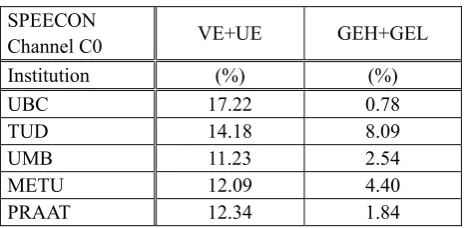
Channel C0 VE+UE GEH+GEL
Institution (%) (%)
UBC 17.22 0.78
TUD 14.18 8.09
UMB 11.23 2.54
METU 12.09 4.40
PRAAT 12.34 1.84
Table 1: ECESS PDA evaluation results
SPEECON
Channel C0 SR ACC
Institution (%) (%)
UBC 83.45 70.06
TUD 87.26 68.11
UMB 86.65 74.78
METU 86.36 70.45
PRAAT 87.16 70.89
Table 2: ECESS PMA evaluation results
SPEECON
Channel C0 NACC VACC UACC
Institution (%) (%) (%)
METU 85.52 86.12 82.40
UVIGO 91.35 94.63 85.41
UMB 93.70 96.81 79.15
Table 3: ECESS VAD+ evaluation results
It is evident from Table 1 that the lowest VE+UE error is achieved by the algorithm from UMB. Similarly, the lowest GEH+GEL error is produced by the algorithm from UBC. Table 2 shows the PMA performance evaluation results for the algorithms from the same institutions. In this case the highest value presents the better result. It can be concluded that the algorithm from TUD achieves the best SR performance among all the five tested procedures. The best ACC is achieved with the algorithm from the UMB.
Table 3 presents the results of the 1st ECESS VAD+
evaluation campaign. The three institutions were involved in this evaluation: METU, UVIGO (University of Vigo), and UMB. The algorithm from UMB achieved the best nonspeech (N) and voiced speech (V) accuracies. The best unvoiced speech classification accuracy is achieved by the algorithm of UVIGO.
The presented evaluation frameworks were found to be very efficient way to compare different algorithms in various evaluation scenarios. The overall performance of the selected tools outperformed the performance of the broadly used PDA/PMA tools (like Praat) substantially.
The performances presented in evaluation campaigns can be implicated also in real use of PDA, PMA, or VAD+ algorithms.
4.
Conclusion
The evaluation framework set by the ECESS partners provides a common evaluation methodology. It concerns the evaluation of TTS systems, TTS modules, as well as tools needed for generating the necessary language resources. Multilinguality is one of the key issues. Several evaluation campaigns of different tools were already performed with reports about substantial improvements of evaluated tools per campaign. A new perspective in evaluation is given by the development of the remote evaluation system (RES) that enables web-based on-line evaluation of TTS systems and TTS modules. Using the RES system, partners can make on-line evaluation of components running at different institutions worldwide. They can evaluate TTS modules or even the whole TTS system by including modules, if needed, from other partners in their own configuration or they could even construct and evaluate the whole TTS system without any of their own modules. To take part in the evaluation of particular module, no manual effort is needed by the developers of a TTS module, which is used by the RES. The defined evaluation framework represents an efficient and effective way of evaluation of TTS technology.
5.
Acknowledgements
We want to thank all ECESS partners contributing to the evaluation campaigns.
6.
References
J. Perez, A. Bonafonte , H.-U. Hain , E. Keller, S. Breuer, J. Tian 2006, ECESS Inter-Module Interface Specification for Speech Synthesis, Proc. LREC 2006 A. Bonafonte, H. Höge, I. Kiss, A. Moreno, U. Ziegenhain,
H. van den Heuvel, H.-U. Hain, X. S. Wang, M. N. Garcia 2006, TC-STAR: Specifications of Language Resources and Evaluation for Speech Synthesis, Proc. LREC 2006
D. J. Iskra et al., 2002. SPEECON - Speech Databases for Consumer Devices: Database Specification and Validation. Proc. LREC'2002. ELRA Catalogue Reference S0218, http://www.elda.org
B. Kotnik et al., 2006, Evaluation of Pitch Detection Algorithms in Adverse Conditions, Proc. Speech Prosody 2006
H. Höge et. All., 2006, Evaluation of Pitch Marking Algorithms, Proc. ITG Fachtagung Sprachkommunikation 2006.
Tom Copeland 2007, Generating Parsers with JavaCC, Centennial Books, Alexandria, 2007.