DOI: 10.1534/genetics.103.018986
The Effects of Intraspecific Competition and Stabilizing
Selection on a Polygenic Trait
Reinhard Bu
¨rger*
,1and Alexander Gimelfarb
†*Department of Mathematics, University of Vienna, A-1090 Vienna, Austria and†Department of Genetics, Stanford University, Stanford, California 94305
Manuscript received June 16, 2003 Accepted for publication December 31, 2003
ABSTRACT
The equilibrium properties of an additive multilocus model of a quantitative trait under frequency- and density-dependent selection are investigated. Two opposing evolutionary forces are assumed to act: (i) stabilizing selection on the trait, which favors genotypes with an intermediate phenotype, and (ii) intraspe-cific competition mediated by that trait, which favors genotypes whose effect on the trait deviates most from that of the prevailing genotypes. Accordingly, fitnesses of genotypes have a frequency-independent component describing stabilizing selection and a frequency- and density-dependent component modeling competition. We study how the equilibrium structure, in particular, number, degree of polymorphism, and genetic variance of stable equilibria, is affected by the strength of frequency dependence, and what role the number of loci, the amount of recombination, and the demographic parameters play. To this end, we employ a statistical and numerical approach, complemented by analytical results, and explore how the equilibrium properties averaged over a large number of genetic systems with a given number of loci and average amount of recombination depend on the ecological and demographic parameters. We identify two parameter regions with a transitory region in between, in which the equilibrium properties of genetic systems are distinctively different. These regions depend on the strength of frequency dependence relative to pure stabilizing selection and on the demographic parameters, but not on the number of loci or the amount of recombination. We further study the shape of the fitness function observed at equilibrium and the extent to which the dynamics in this model are adaptive, and we present examples of equilibrium distributions of genotypic values under strong frequency dependence. Consequences for the maintenance of genetic variation, the detection of disruptive selection, and models of sympatric speciation are discussed.
M
ANY ecologically important traits are subject to trast,Clarke(2004) argues on the basis of an extensive review of empirical results that “The case for frequency frequency- and density-dependent selection.Typ-dependence as a major factor in maintaining non-synon-ical situations leading to such selection include attacks
ymous polymorphisms seems overwhelming.” However, of parasites, presence of predators or competitors,
re-he also stresses tre-he importance of more empirical work source utilization, sexual dimorphism, and behavioral
needed to discriminate between FDS and other forms variability. Although it has been long known among
of balancing selection. Often, however, FDS will interact population geneticists that frequency-dependent
selec-with other forms of selection, or act in addition to them, tion (FDS) can maintain genetic polymorphism much
frequently on quantitative traits (e.g., Bulmer 1974, easier than frequency-independent selection (e.g.,Wright
1980;Slatkin1979;Clarkeet al.1988). In such cases, 1969; Cockerham et al. 1972; Matessi and Jayakar
an evaluation of the importance of FDS in maintaining
1976; Clarke 1979; Christiansen and Loeschcke
genetic variation relative to selective pressures that are 1980;Asmussen1983;AsmussenandBasnayake1990),
likely to be frequency independent, such as many caused even some pioneers in studying the evolutionary
signifi-by the abiotic environment or arising from the require-cance of frequency dependence (FD) are skeptical
ments of a functional morphology and developmental whether FD is responsible for a large fraction of
ob-and physiological constraints, may be particularly diffi-served polymorphisms (Maynard Smith1998). In
con-cult. One reason is that the determination of the kind and strength of selection acting on a (set of) trait(s) is everything but straightforward (e.g.,LandeandArnold This article is dedicated to the memory of Sasha Gimelfarb, who 1983;Endler1986;Schluter1988;Kingsolveret al. died May 11, 2004.
2001). Second, the majority of theoretical studies of the
1Corresponding author:Institut fu¨ r Mathematik, Universita¨t Wien,
evolutionary consequences of FDS either ignore genetics Strudlhofgasse 4, A-1090 Wien, Austria.
E-mail: [email protected] (e.g., evolutionary game theory and the so-called adaptive
dynamics approach) or are based on very simple genetic tion by showing that if the strength of competition rela-tive to stabilizing selection exceeds a certain threshold, models (a single locus or a normally distributed trait with
given variance). Therefore, little is known about the pat- the trait is under disruptive selection; hence genetic variance should be maintained. Otherwise, the trait is terns of genetic variation maintained by FDS.
General and systematic treatments of genetic models under stabilizing selection, which usually depletes heri-table variation (see also thediscussion). However, ques-with frequency- and density-dependent selection are
available only for a single locus (Nagylaki1979;Asmus- tions concerning the extent of variation maintained by FDS or if and how conclusions depend on the underly-sen 1983; Asmussen and Basnayake 1990). In these
models, fitnesses are assigned directly to genotypes, ing genetic structure can be answered only on the basis of more explicit genetic models.
though in a rather general way. These and other
investi-gations clearly demonstrate that FDS may strongly in- We complement and extend previous studies in sev-eral directions. First, we admit multiple diallelic loci to fluence the genetic structure of a population and has a
much higher potential in maintaining genetic variation contribute (additively) to the trait. Second, the popula-tion size is allowed to change according to its demo-than frequency-independent selection. In addition,
al-ready for one-locus two-allele models in which genotypic graphic dynamics. Because random genetic drift is ig-nored, the dynamics are still deterministic. Third, fitnesses are linear functions of the genotype
frequen-cies, complex dynamic behavior, such as chaos, may occur stabilizing selection that is asymmetric with respect to the existing range of phenotypic values is explored. for relatively wide ranges of parameter values (Altenberg
1991;GavriletsandHastings1995). Fourth, to cover a wide range of parameters, in
particu-lar from the high-dimensional genetic parameter space, We pursue a different approach by making specific
assumptions on how selection acts on phenotypes. In do- we adopt the statistical and numerical approach of Bu¨ rgerandGimelfarb(1999, 2002). Thus, for a given ing so, we lose generality compared to some of the
single-locus studies. However, it enables us to tackle questions number of loci, a range of recombination rates, and given ecological and demographic parameters, we calcu-such as, How strong must FD be relative to other selective
forces, such as stabilizing selection, to have a noticeable late the quantities of interest by iterating a large number of genetic systems with randomly chosen locus effects impact on the genetic structure of a population? or, When
is FD strong enough to be phenotypically detectable? To and initial conditions until equilibrium is reached and then computing the appropriate averages. This numeri-this end, we consider a quantitative trait that is subject to
(frequency-independent) stabilizing selection and medi- cal approach is complemented by analytical results and allows us to derive general inferences on the patterns ates frequency- and density-dependent selection through
intraspecific competition;i.e., individuals of similar phe- of genetic variation resulting from the interaction of multilocus genetics with FDS. In particular, the strength notypes compete. We use a functional form for fitness
of the trait introduced by Bulmer (1974, 1980) that of FD that leads to highly polymorphic genetic systems and to disruptive selection is determined. Also the evolu-does not specify the causes of stabilizing selection,i.e.,
whether real or induced by pleiotropic effects. Never- tion of mean fitness and of the equilibrium distribution of genotypic values under strong FD is examined. theless, mathematically this model is closely related to
models based on differential resource utilization and a This is not the first multilocus study exploring the amount of genetic variation maintained by FDS on a Lotka-Volterra approach (Slatkin1979;Christiansen
and Loeschcke 1980; Loeschcke andChristiansen quantitative trait.Clarkeet al.(1988) andManiet al.
(1990) employed a model of selection that is similar to 1984). Previous studies of this type of model assumed
a single locus contributing to a normally distributed Bulmer’s (1980), but differs in the way competition and stabilizing selection are modeled. Moreover, they trait (Bulmer 1974, 1980; Slatkin 1979), a classical
quantitative-genetics approach for a normally distrib- assume a finite population and admit several multiallelic loci with recurrent mutation. Their results are purely uted trait (Slatkin1979), a single locus with multiple
alleles (Christiansen and Loeschcke 1980), or two numerical and the main focus is on variation at the gene level. Therefore, direct comparison with the models recombining diallelic loci contributing additively to a
quantitative trait without assumptions on its distribution discussed above is difficult. The purpose of our study is not to demonstrate that FDS can be important, but (LoeschckeandChristiansen1984;Bu¨ rger2002a,b).
Roughly, conditions were identified under which FD is rather to identify conditions under which it has signifi-cant effects on the genetic structure of a population, strong enough to induce disruptive selection and
main-tain polymorphism. In the two-locus models, the amount what and how large these effects are, and how genetical and ecological parameters interact.
of genetic variation and the possible equilibrium pat-terns and their dependence on the parameters were derived.
THE MODEL Studies with simple genetics (Bulmer 1974, 1980;
varia-sufficiently large to ignore random genetic drift. Selec- specific competition function␣P(g), which measures the strength of competition experienced by phenotypegif tion acts only through differential viabilities. Individual
fitness is assumed to be determined by two components: the population distribution isP, is given by
(i) by stabilizing selection on a quantitative character ␣
P(g)⫽
兺
h␣(g,h)P(h) and (ii) by competition among individuals. The trait is
determined byn additive, diallelic loci of arbitrary
ef-and calculated to be fect. The model is an extension of that used inBu¨ rger
(2002b).
␣P(g)⫽1⫺ 1 2V␣
[(g⫺g)2⫹V
A] . (3)
Ecological assumptions: The first fitness component is frequency independent and may reflect some sort
Here,gandVAdenote the mean and (additive genetic)
of direct selection on the trait, for example, through
variance, respectively, of the distributionPof genotypic differential supply of a resource whose utilization
effi-values. ciency is phenotype dependent. However,
frequency-Similar toBulmer’s (1974, 1980) model, we assume independent stabilizing selection could as well be
that the absolute fitness of an individual with genotypic caused by indirect selection through pleiotropic side
value (phenotype)gis given by effects of alleles that contribute primarily to
fitness-related traits (e.g., Robertson 1967; Keightley and
W(g)⫽
冢
⫺N ␣P(g)冣
S(g) , (4) Hill1990;Bu¨ rger2000, chap. VII). We ignoreenviron-mental variation and deal directly with the fitnesses of
where and are positive parameters and N denotes genotypic values. In the absence of
genotype-environ-the total population size. For notational simplicity, genotype-environ-the ment interaction, this is no restriction because in the
dependence of W(g) on N and P is omitted. In the present model the only effect of including
environmen-context of density-dependent growth models, the pa-tal variance was a deflation of the selection intensity.
rameter in (4) is related to the growth rate of the For simplicity, we sometimes use the words genotypic
population andis proportional to the carrying capac-value and phenotype synonymously.
ity. More precisely, in a monomorphic population in Stabilizing selection is modeled by the quadratic
func-whichg⫽ g⫽ andVA⫽0, the fitness (of the
popula-tion
tion) becomes ⫺N/; hence the carrying capacity is
S(g)⫽1⫺(g⫺ )
2
2Vs
, (1)
K⫽ ( ⫺1) . (5)
Our model of FDS is closely related to models that whereVsis an inverse measure for the strength of
stabiliz-are based on Lotka-Volterra equations (Slatkin1979; ing selection and is the position of the optimum. Of
Christiansenand Loeschcke 1980; Loeschcke and course, S(g) is assumed to be positive on the range
Christiansen1984). The relation between these mod-of possible phenotypes, thus restricting the admissible
els and ours is worked out inBu¨ rger(2002b), where values ofVs. We use a scale on which the range of possible
it is shown that all these ecological models lead to fitness phenotypes is the interval [0, 1] (seeGenetic assumptions
functions that are mathematically equivalent to first or-below). Hence, if ⱖ0.5, thenVsmust satisfyVsⱖ1⁄22.
der in 1/Vsand 1/V␣. Thus, for sufficiently weak overall
We exclude pure directional selection by assuming 0⬍
selection, the differences vanish. As explained in
⬍1.
Bu¨ rger(2002b), the present choice of the fitness func-The second component of fitness is FD. We assume
tion makes the model more easily amenable to mathe-that competition between phenotypes gand h can be
matical analysis and does not lead to certain special described by
effects that a Gaussian fitness function causes under strong selection. If stabilizing selection is modeled by a
␣(g,h)⫽ 1⫺ 1
2V␣(g⫺h)
2, (2)
Gaussian fitness function, the equilibrium structure is much more complex than with quadratic fitness. This with the obvious constraint that the maximum differ- is so in the absence of FD (Nagylaki1989; Willens-ence between genotypic values must be no larger than dorfer and Bu¨ rger 2003) as well as for very strong FD (LoeschckeandChristiansen1984). Our fitness
√
2V␣. For our scaling this meansV␣ⱖ 0.5. Equation 2implies that competition between individuals of similar function is also closely related to that ofMatessiet al.
(2001); if higher-order terms are omitted, the induced phenotypes is much stronger than that between
individ-uals of very different phenotypes, as will be the case if dynamics and equilibrium structure become equivalent. Genetic assumptions: The trait values g are deter-different phenotypes preferentially utilize deter-different
food resources. Small V␣ implies a strong frequency- mined additively byn diallelic loci. There is no domi-nance or epistasis. The contribution of one allele at dependent effect of competition, whereas in the limit
V␣→ ∞, FD vanishes. LetP(h) denote the relative fre- each locus ᐉ is zero, and the contribution, ᐉ, of the
intra-It is assumed that the minimum and maximum geno- plicit and analytical characterization of the equilibrium typic values are always zero and one. Therefore, the properties of multilocus models in terms of all parame-actual contribution by the second allele at locus ᐉ is ters and initial conditions would be of limited value, scaled to be␥ᐉ⫽1⁄2 ᐉ/兺nk⫽1k. It follows that the geno- even if it were feasible. Therefore, we use a different typic value of the total heterozygote is always1⁄
2, and the approach by evaluating the quantities of interest for
average allelic effect among the nloci controlling the many randomly chosen parameter sets and initial condi-trait is␥ ⫽1/(2n). This normalization has the advan- tions and, consequently, obtaining statistical results. tage that the strength of selection on genotypes can be We proceeded as follows. For a given set ofecological
compared for different numbers of contributing loci. parameters (,,V␣,,Vs), a given numbernof loci, and
The effect of an increasing number of loci is a finer a given range of recombination rates, we constructed resolution of possible phenotypes through genotypic ⱖ1000 of what we call genetic parameter sets (allelic
values. effects of loci and recombination rates between adjacent
Dynamics:Gametes are designated byi, their frequen- loci from the given range). For each genetic parameter cies among zygotes in consecutive generations bypiand set, allelic effects were obtained by generating valuesᐉ
p⬘i, and the fitness of a zygote consisting of gametes j (ᐉ ⫽ 1, 2, . . . , n) as independent random variables, and k by Wj k (we do not indicate the frequency and uniformly distributed between 0 and 1, and trans-density dependence). LetR(jk→i) denote the proba- forming them into the actual allelic effects, ␥
ᐉ⫽ 1⁄2ᐉ/
bility that a randomly chosen gamete produced by ajk 兺
kk. The additivity assumption yields the genotypic val-individual is i. The function R is determined by the ues, and from Equations 1, 3, and 4, the genotypic pattern of recombination between loci. Since random fitnessesW
jkare calculated in each generation. Recombi-mating is assumed and gamete frequencies are mea- nation rates between adjacent loci, r
ᐉ,ᐉ⫹1(ᐉ ⫽ 1, . . . ,
sured after reproduction and before selection, Hardy- n⫺1), were either assumed to be all1⁄
2or obtained as
Weinberg proportions obtain and the genetic dynamics independent random variables, uniformly distributed can be described in terms of gamete frequencies by the between 0 and 0.01. We assumed absence of
interfer-well-known system of recursion relations ence and refer to these two scenarios as free
recombina-tion and tight linkage, respectively.
p⬘i ⫽W⫺1
兺
j,kWjkpjpkR(j k→i) , (6)
For each of such constructed genetic parameter sets, the recursion relations (6) and (7) were numerically whereW⫽兺j,kWjkpjpkis the mean fitness (e.g.,Bu¨ rger
iterated starting from 10 different randomly chosen ini-2000).
tial gamete distributions. To make the initial distribu-The ecological dynamics follow the standard
re-tions more evenly distributed in the gamete state space, cursion
they were chosen such that the (Euclidean) distance
N⬘ ⫽N W. (7) between any two of them was no less than a
predeter-mined value (0.25, 0.30, and 0.35 for two, three, and Thus, for a genetically monomorphic population with
four loci, respectively). An iteration was stopped after
g⫽g⫽ and VA ⫽ 0, the classical discrete logistic
generation t when either an equilibrium was reached equation is obtained, N⬘ ⫽ N( ⫺ N/). As is well
(in the sense that the geometric distance between gamete known, monotone convergence to the carrying capacity
distributions in two consecutive generations was⬍10⫺12),
K⫽ ( ⫺1) occurs if and only if ⱕ2 and oscillatory
ortexceeded 106generations (in some cases even 107).
convergence occurs if 2⬍ ⱕ 3 (e.g., Bu¨ rger2000).
If equilibrium was not reached, the parameter combina-Throughout this study, we are concerned only with
suf-tion was excluded from the analysis. Usually, the propor-ficiently small values so that the ecological dynamics
tion of excluded runs was small enough not to introduce are simple; i.e., convergence to a unique equilibrium
a bias. In a small region of ecological parameters (the population size occurs. Also the initialN0 was chosen
so-called transitory region, see next section), extremely sufficiently small (except for exploratory reasons,N0⫽
slow convergence was the rule because of very flat fitness
K) so that population size always remained positive.
landscapes. Since for some parameter combinations in Because this study is devoted to the equilibrium
struc-ture and the equilibrium population size is uniquely this region onlyⵑ20% of the runs converged within 106
determined if ⱕ3, this choice ofN0is no restriction. generations, we stopped runs that had not converged
only after 107generations. At that timeⵑ90% had
ful-filled our convergence criterion. If convergence within THE STATISTICAL APPROACH the specified maximum number of generations did not
occur, it was because of extremely slow convergence of Usually, parameters of genetic systems controlling
allele frequencies. Apart from a very flat fitness function, quantitative traits are unknown or can be inferred only
the main reason for slow convergence was the presence indirectly. Since, in addition, the dimensionality of the
of alleles of extremely small effect. No instance of com-parameter space and the number of gametes and
For each parameter combination withnⱕ4 loci, all ecological parameters, number of loci, and recombina-tion scenario. The data presented in the figures and statistics are based on 1000 genetic parameter sets that
led to equilibration; forn ⫽ 5 loci they are based on tables are such averages. We denote the average over
VrbyVrand refer to it as the relative genetic variance.
500 such genetic parameter sets. For each parameter
set we calculated the number of different equilibria, Its use is preferable when comparing systems with differ-ent numbers of loci, because the variance itself is the gamete frequencies at each equilibrium, and the
number of trajectories (initial distributions) converging strongly dependent on the average effect among loci, which decreases in proportion to 1/(2n). For a given to each equilibrium. Using this database, the
equilib-rium properties were analyzed. Whenever we use the number of loci, the relative genetic varianceVrand the
(average) genetic varianceVAbehave very similarly (results
term equilibrium without qualification, we mean a
(lo-cally asymptoti(lo-cally) stable equilibrium, unless other- not shown). BecauseVmax⫽1⁄2
兺
ᐉ␥2ᐉ, the expectation (andwise mentioned. in principle the whole distribution) ofVmaxcan be
calcu-Most of our numerical results are for two, three, and lated for each n. For n ⫽ 2, 3, 4, we have E[Vmax]⫽
four loci; only a few are for five or more because some 1⁄
4(1⫺ ln 2) ⬇0.077, 1⁄4(1⫹ 6 ln 2⫺ 9⁄2ln 3)⬇ 0.054,
four- and most five-locus parameter combinations are and1⁄
4(1⫺ 44 ln 2⫹27 ln 3)⬇0.041, respectively.
Mul-extremely time consuming. With five loci, for instance, tiplyingVrbyE[Vmax] yields an estimate ofVAthat
typi-1600 generations takeⵑ1 sec on an AMD Athlon proces- cally is within ⵑ10% of the “true” value (results not sor with 1.3 GHz. Since with five loci, typical runs for shown). The polymorphism displayed in the figures is weak or very strong FD equilibrate only after several the average number of polymorphic loci at a stable hundred thousand generations (for intermediate FD equilibrium, the average being taken over all 10 trajecto-more than 10 times as many), 10 initial conditions for ries in all 1000 genetic parameter sets.
each parameter combination are taken, and average For later use we note that for any number of loci we statistics are performed over 500 genetic parameter sets, haveVmaxⱕ 1⁄8, where the maximum is attained if the
the computing time was correspondingly long. The total alleles at one locus have effects 0 and1⁄
2 and those at
computer time for the project was equivalent to ⵑ2 other loci have no effect, andVAⱕ1⁄8, where the
maxi-CPU years, but we used several computers. mum is attained if there are only the two gametes with
effects 0 and1⁄
2in the population, each with frequency 1⁄
2, because zygotes are in Hardy-Weinberg proportions.
PROPERTIES OF GENETIC VARIATION For a given number of loci and given recombination AT EQUILIBRIUM
scenario, the genetic parameter sets as well as the initial In this section, we explore how the genetic variation conditions are the same for all ecological parameter maintained at equilibrium is affected by the strength of sets. Therefore, variation among quantities of interest FD relative to pure stabilizing selection and what role comes almost exclusively from variation in the ecologi-the oecologi-ther parameters in ecologi-the model, such as number of cal parameters. Only the exclusion of slow runs leads loci, recombination rates, position of the optimum, and to slight variation among the genetic parameter sets the demographic parameters, play. For this purpose, we used for different ecological parameter combinations. study the equilibrium properties, i.e., the number of An important role in this article is played by the quan-stable equilibria and their degree of polymorphism, the tity
genetic variance maintained, and the amount of linkage
disequilibrium. f⫽ Vs
V␣, (8)
For each parameter combination, we recorded the equilibria to which at least 1 of the 10 trajectories
con-which measures the strength of FD,i.e., the strength of verged, their number, the number of trajectories
con-competition relative to stabilizing selection. If f ⫽ 0, verging to a given equilibrium, the number of
polymor-there is no FD, whereasfⰇ1 means strong FD. As we phic loci at each equilibrium, the (additive) genetic
see below, the properties of our model depend on Vs
variance,VA, and the genic variance,VLE (i.e., the
vari-andV␣separately; however, to leading order in 1/Vs(the
ance that would be observed under linkage
equilib-strength of stabilizing selection) and 1/V␣ (the strength rium), at equilibrium. As a measure for global linkage
of competition), they depend only onf. In addition, we disequilibrium, we use the ratioVA/VLE. To facilitate the
introduce the compound demographic parameter comparison of genetic systems with different numbers
of loci, we calculated the ratioVr⫽VA/Vmaxof the genetic
⫽
N ⫺1 . (9)
variance and the maximum possible variance, Vmax, in
the given genetic system under the assumption of
link-The symmetric case:We begin by discussing numeri-age equilibrium.
cal results for the symmetric case in which the optimum These values were then averaged over all 1000 genetic
coincides with the genotypic value of the completely parameter sets, and standard deviations were calculated.
This yielded our “quantities of interest” for each set of heterozygote genotypes, i.e., ⫽ 1⁄
is very slightly higher than Vmax (actually, very slowly
increasing as f increases further) and nearly indepen-dent of the number of loci. The average amount of linkage disequilibrium is very small in this case, even for large values of f; i.e., the average VA/VLE is always
⬍1.03 (results not shown). For tight linkage, the genetic variance increases to values much higher thanVmaxasf
increases above 1.0. The increase beyondVmaxis almost
solely due to the build-up of strong positive linkage disequilibrium; the more loci, the higher the linkage disequilibrium. If f ⱖ 1.25, we haveVLE ⫽ Vmax under
both recombination scenarios because then a unique stable, fully polymorphic equilibrium is maintained (see Tables 1 and 2) at which all allele frequencies are 1⁄
2.
Therefore, our measureVA/VLE for linkage
disequilib-rium equals Vr if FD is strong. For weak or moderate
FD (f⬍1), linkage has only a minor, in general dimin-ishing, effect on the genetic variance (the more loci, the weaker the effect). As under pure stabilizing selection (Bu¨ rgerandGimelfarb1999), not only the (absolute) genetic variance but also the relative variance decreases with increasing number of loci if FD is weak (for some five-locus data see Table 3).
Figure 1b shows that for f ⱖ 1.25 all equilibria are completely polymorphic, irrespective of recombination. They are also unique (Tables 1–3) and, as already noted, symmetric in the sense that all allele frequencies are1⁄
2.
They differ, of course, in their linkage disequilibria. If Figure1.—Relative genetic variance (a) and polymorphism f ⬍1 and recombination is free, then the average de-(b) as a function off⫽Vs/V␣for n⫽ 2, 3, and 4 loci and gree of polymorphism is⬍1 but steadily increasing and free recombination (solid symbols) as well as tight linkage nearly independent of the number of loci. As f in-(open symbols). The strength of stabilizing selection is fixed
creases beyond 1, a marked increase of polymorphism to (Vs⫽1.25; this reduces the fitness of the extreme genotypic
the maximum possible amount occurs. For tight linkage values by 10%) andV␣is varied [the following pairs (V␣,f)
correspond: (∞, 0), (5.0, 0.25), (2.0, 0.63), (1.5, 0.83), (1.3, andf⬍1, on average equilibria exhibit more polymor-0.96), (1.2, 1.04), (1.0, 1.25), (0.8, 1.56), and (0.5, 2.5)]. In phism than for free recombination, and for a range of addition, ⫽0.5, ⫽2, and ⫽10,000. The bars between valuesfthe amount of polymorphism maintained may a and b indicate the type of fitness function observed for given
even decrease as fincreases. This latter phenomenon
f. The top bar indicates the true fitness function, the bottom
is more pronounced if stabilizing selection is stronger bar its quadratic approximation (see disruptive vs.
stabi-lizing selection). Black indicates stabilizing selection (results not shown) and was demonstrated analytically (傽-shaped); gray, a complicated fitness function (typically for two loci (Bu¨ rger2002a,b).
M-shaped); and light gray, disruptive selection (傼-shaped).
The bars in different shades of gray between the top and bottom of Figure 1 indicate the shape of the fitness function at equilibrium for the corresponding value f
parameters here are ⫽2 and ⫽10,000. This value
(seedisruptivevs.stabilizing selection). ofensures that rapid convergence ofNto the carrying
Tables 1 and 2 provide detailed insights into the ef-capacity occurs. The role of andis studied further
fects of increasing FD on the equilibrium structure. For below.
free recombination (Table 1), no stable equilibria with Figure 1 visualizes some of the most important
gen-two or more polymorphic loci were found iff ⬍1. As eral findings. It shows a distinct, threshold-like
depen-Table 1 shows, the introduction of FD leads to a steady dence of the (average) relative genetic variance and the
increase of single-locus polymorphisms at the expense (average) amount of polymorphism on fasfincreases
of stable monomorphic equilibria until a complete re-from values ⬍1.0 to values⬎ ⵑ1.2. This threshold is
structuring of the equilibrium pattern occurs between more pronounced the larger the number of loci is. The
f ⫽ 1 and f ⫽ 1.25. If f ⬎ 1, stable monomorphic genetic variance is slowly, but steadily, increasing with
equilibria cease to exist and as soon asfⱖ 1.25, there
f if f ⬍ 1. Then a rapid increase occurs in a narrow
is a unique stable, fully polymorphic equilibrium. Table interval, and for free recombination the genetic
vari-2 shows that similar behavior occurs with linked loci, the ance nearly levels off as f exceeds ⵑ1.2. For larger
TABLE 1
Equilibrium structure forn⫽2, 3, and 4 loci and free recombination
Two loci Three loci Four loci
Polymorphism Polymorphism Polymorphism
f No. (E) 0 1 2 No. (E) 0 1 2 3 No. (E) 0 1 2 3 4
0.00 2 0.51 0.49 0 2.5⫾1.0 0.52 0.48 0 0 3.7⫾1.6 0.57 0.43 0 0 0
0.25 2 0.38 0.62 0 2.6⫾1.1 0.41 0.59 0 0 3.8⫾1.7 0.44 0.56 0 0 0
0.50 2 0.26 0.74 0 2.7⫾1.2 0.28 0.72 0 0 4.0⫾1.8 0.31 0.69 0 0 0
0.83 2 0.09 0.91 0 2.9⫾1.3 0.10 0.90 0 0 4.3⫾1.9 0.11 0.89 0 0 0
0.96 2 0.03 0.97 0 3.2⫾1.4 0.04 0.96 0 0 4.6⫾1.9 0.03 0.97 0 0 0
1.04 2 0 0.73 0.27 2.8⫾0.9 0 0.65 0.35 0 3.6⫾1.5 0 0.37 0.59 0.04 0.00
1.14 1.1⫾0.3 0 0.07 0.93 1.1⫾0.3 0 0.02 0.07 0.92 1.1⫾0.5 0 0.00 0.00 0 0.99
1.25 1 0 0 1 1 0 0 0 1 1 0 0 0 0 1
1.56 1 0 0 1 1 0 0 0 1 1 0 0 0 0 1
2.50 1 0 0 1 1 0 0 0 1 1 0 0 0 0 1
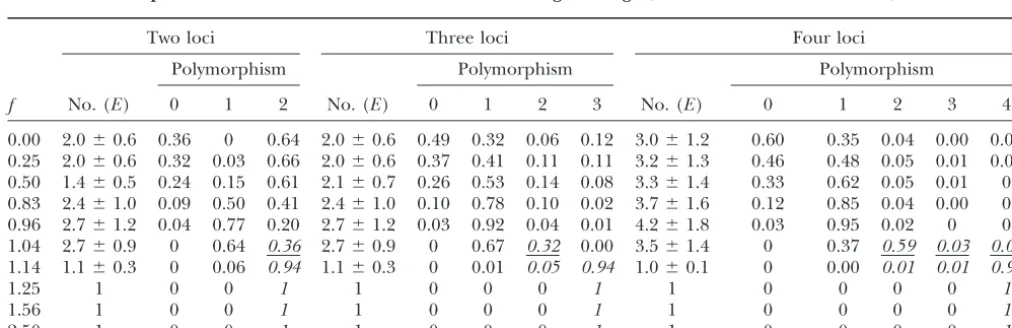
Presented are the average number of equilibria⫾the standard deviation, denoted by No. (E), and the proportion of trajectories converging to an equilibrium with the indicated number of polymorphic loci. Italic type indicates that all equilibria of this type have nonnegative linkage disequilibrium. Underlined italic type indicates that negative and nonnegative linkage disequilibria occur. The following parameters are the same in all cases: ⫽10,000, ⫽2,Vs⫽1.25, ⫽0.5. Data are not shown for all valuesfdisplayed in Figure 1 but, in addition, data for the largest possiblef(f⫽2.5) are included. (Integer entries such as 0, 1, or 2 mean exactly this value,i.e., no variation among the 1000 genetic parameter sets was observed.)
FD, stable equilibria may exist at which two or more loci may exist, whereas for large enough f all equilibria exhibit positive linkage disequilibrium. In the transitory are polymorphic. But again, single-locus polymorphisms
are increasing with increasingfat the expense of stable region, the equilibrium structure may be rather com-plex and several stable equilibria with different degrees equilibria with no or more than one polymorphic locus.
As in the case of free recombination, if f ⬎ 1, stable of polymorphism may coexist for certain parameter combinations. For instance, with four loci, free recombi-equilibria cannot be monomorphic, and if f ⱖ 1.25,
there is a unique fully polymorphic equilibrium with all nation,Vs⫽1.25, andf⫽1.04 (as in Figure 1 and Table
1), an unsymmetric four-locus polymorphism coexisting allele frequencies equaling 1⁄
2. We call the region in
which the degree of polymorphism and genetic variance with six two-locus polymorphisms was found. A detailed analytical study of the two-locus model with ⫽1⁄
2was
increase rapidly the transitory region.
Table 2 shows that for f ⬍ 1, multilocus polymor- performed by Bu¨ rger (2002a,b). It provides a good guide for shaping the intuition on how the equilibrium phisms, provided they exist, always have negative linkage
disequilibrium. In the transitory region, polymorphisms structure changes under increasingly strong FD. The occurrence of multiple stable equilibria for weak with negative, zero, and positive linkage disequilibrium
TABLE 2
Equilibrium structure forn⫽2, 3, and 4 loci and tight linkage (rrandom between 0 and 0.01)
Two loci Three loci Four loci
Polymorphism Polymorphism Polymorphism
f No. (E) 0 1 2 No. (E) 0 1 2 3 No. (E) 0 1 2 3 4
0.00 2.0⫾0.6 0.36 0 0.64 2.0⫾0.6 0.49 0.32 0.06 0.12 3.0⫾1.2 0.60 0.35 0.04 0.00 0.01 0.25 2.0⫾0.6 0.32 0.03 0.66 2.0⫾0.6 0.37 0.41 0.11 0.11 3.2⫾1.3 0.46 0.48 0.05 0.01 0.00 0.50 1.4⫾0.5 0.24 0.15 0.61 2.1⫾0.7 0.26 0.53 0.14 0.08 3.3⫾1.4 0.33 0.62 0.05 0.01 0 0.83 2.4⫾1.0 0.09 0.50 0.41 2.4⫾1.0 0.10 0.78 0.10 0.02 3.7⫾1.6 0.12 0.85 0.04 0.00 0 0.96 2.7⫾1.2 0.04 0.77 0.20 2.7⫾1.2 0.03 0.92 0.04 0.01 4.2⫾1.8 0.03 0.95 0.02 0 0 1.04 2.7⫾0.9 0 0.64 0.36 2.7⫾0.9 0 0.67 0.32 0.00 3.5⫾1.4 0 0.37 0.59 0.03 0.00
1.14 1.1⫾0.3 0 0.06 0.94 1.1⫾0.3 0 0.01 0.05 0.94 1.0⫾0.1 0 0.00 0.01 0.01 0.99
1.25 1 0 0 1 1 0 0 0 1 1 0 0 0 0 1
1.56 1 0 0 1 1 0 0 0 1 1 0 0 0 0 1
2.50 1 0 0 1 1 0 0 0 1 1 0 0 0 0 1
TABLE 3
Summary of results for five loci
Polymorphism
f Vr Wˆ /W0 %RF Nˆ No. (E) 0 1 2 3 4 5
⫽0.5
0.00 0.024 1.013 0 9,994 4.7⫾1.5 0.62 0.38 0 0 0 0
0.96 0.086 1.001 0.00 10,010 5.7⫾1.7 0.03 0.97 0 0 0 0
1.25 1.003 1.000 0.51 10,186 1 0 0 0 0 0 1
2.50 1.026 1.000 0.47 10,551 1 0 0 0 0 0 1
⫽0.75
0.00 0.024 1.040 0 9,994 3.3⫾1.3 0.59 0.41 0 0 0 0
0.96 0.076 1.004 0 10,008 4.2⫾1.5 0.02 0.98 0 0 0 0
1.25 0.797 0.997 1.00 10,157 1 0 0.00 0.08 0.25 0.48 0.18
2.50 0.859 0.978 0.99 10,465 1 0 0.00 0.04 0.22 0.45 0.29
The following parameters are chosen as in Figure 1 and Table 1: ⫽10,000, ⫽2,Vs⫽1.25; recombination is free.Vrshows the (average) relative genetic variance;Wˆ /W0, the average ratio of population mean fitness at equilibrium and initial mean fitness (see text for more details); %RF, the average proportion of trajectories whose mean fitness at equilibrium was reduced relative to initial mean fitness;Nˆ, the average population size at equilibrium; and No. (E), the average number of stable equilibria⫾ standard deviation. The last six columns show the proportion of trajectories converging to an equilibrium with the indicated number of polymorphic loci.
FD is consistent with previous results of pure stabilizing model. Letˆ denote the value of the compound demo-graphic parameter(9) at the equilibrium population selection (e.g.,Barton1986; Bu¨ rgerandGimelfarb
1999). The reason is that the phenotypes of several sizeNˆ. In theappendix, we prove that there is a critical valueφS, which can be written as
homozygous genotypes may closely match the optimum of the stabilizing-selection fitness function and, hence,
may be locally stable. Similarly, single-locus polymor- φS⫽ ˆ
冢
1⫺ 28Vs
冣
⫺1
⫽ ˆ ⫹ 2
8V␣, (10)
phisms may be stable if both homozygous genotypes code for phenotypes close to the optimum. The
equilib-such that for f ⬎ φS no stable monomorphic
equili-rium configurations for strong FD are discussed below
brium can exist, whatever the allelic effects and the inphenotypic distributions at equilibrium.
recombination rates are. Iff⬍φS, stable monomorphic
Without showing the results, we remark that the
aver-equilibria may exist for appropriate allelic effects and age deviation of the equilibrium mean genotypic value
recombination rates. Importantly, the critical value φS
from the optimum is always very small. It is maximal in
is independent of the number of loci and typically only the absence of FD, reaching 0.39␥ ⫽0.09 for two loci
slightly larger thanˆ . For the parameters used in Figure and 0.24␥ ⫽0.03 for four loci (the maximum possible
1 and Tables 1 and 2,i.e., ⫽1⁄
2,Vs⫽1.25, (10) yields
deviation is 0.5). It decreases with increasing number φ
S⫽1.03ˆ . Because for this range of valuesf(i.e.,fnear
of loci and increasing strength of FD. If f ⬎ 1, then
one) we haveⵑ10,000ⱕNˆⱕ10,200 (Table 4), Equation all deviations are ⬍0.005; if f ⱖ 1.25, they are zero
9 gives 1ⱖ ˆ ⱖ0.96, which yields a φS between 1.03
because the allele frequencies are1⁄
2at equilibrium.
and 0.99, respectively, in accordance with our numerical Results analogous to Figure 1 and Tables 1 and 2
findings.
were obtained by fixingV␣(⫽0.5, the strongest possible For two loci and a symmetric optimum, it was shown competition in our model) and varyingVsacross its full
(Bu¨ rger2002b) that there is a critical valueφD, in the
range (not shown). The main difference is that for small
present notation given by
Vstight linkage has a somewhat stronger effect (in the
direction predicted from the above results). Results for
φD⫽ ˆ
冢
1⫺5 16Vs
冣
⫺1
⫽ ˆ ⫹ 5
16V␣, (11)
five loci were obtained only for some parameter combi-nations. Therefore, they are summarized separately in
such that forf⬎ φDa single, globally stable, fully
poly-Table 3.
morphic equilibrium exists at which all allele frequen-Analytical estimates of the transitory region: The
cies are equal to1⁄
2. Although we cannot prove this for
multilocus model is too complex to admit a complete
more than two loci, our numerical results suggest that mathematical analysis. However, the stability of the
it continues to be true. The two-locus result implies monomorphic equilibria can be determined, and this
thatf⬎φDis necessary for the existence of a uniquely
provides analytical insight into the dependence of the
equilib-rium for all possible locus effects. Straightforward ma-nipulations of the conditionsf ⫽ φS and f ⫽ φD yield
simple formulas for the corresponding critical values of
V␣andVsin terms of the remaining parameters (see,e.g.,
the last paragraph of theappendix). For the parameters used in Figure 1 and Tables 1 and 2, (11) yieldsφD⫽
1.33ˆ . Because in this range of values f,Nˆ is between 10,200 and 10,500 (Table 4), this gives a φD between
1.28 and 1.21, respectively, which again is in accordance with our numerical findings.
The role of the demographic parameters:Before in-vestigating asymmetric selection, we examine how the properties of our model depend on the demographic parametersandand derive an approximation for the population size expected at equilibrium. As indicated by Equations 10 and 11, a crucial role is played by the compound demographic quantityˆ .
An estimate for the equilibrium population size Nˆ
can be obtained from (7) by the conditionW⫽1. From (4) it is straightforward to compute an explicit expres-sion for Win terms of the first four moments of the phenotypic distribution at equilibrium. If the mean co-incides with the optimum, g⫽ , as is almost always satisfied to a close approximation in our numerical re-sults (in particular, if more than two loci are involved), the following representation is obtained,
W⫽
冢
⫺N冣冢
1⫺ VA 2Vs冣
⫹N VA
V␣⫺
N
V
2 A ⫹M4
4V␣Vs
, (12)
whereM4denotes the fourth central moment.
Neglect-ing the last term, which usually is small relative to the others becauseV2
A ⫹M4Ⰶ V␣Vs, and equating the
re-sulting expression to one, we obtain for the equilibrium population size the approximation
Nˆ ⬇( ⫺1)⫹ VA 2Vs( ⫺1)⫺V␣
Vs(V␣⫺2VA)⫹V␣(Vs⫺VA). (13)
First, this informs us thatNˆ ⱖK⫽ ( ⫺1) if and only ifVA⫽ 0 or
fⱖ 1
2( ⫺1) (14)
because the denominator of the last term in (13) is always positive (recall that we haveVAⱕ1⁄8,V␣ⱖ1⁄2, and
Vsⱖ1⁄8if ⫽1⁄2). Table 4 shows that (14) predicts the
valuefat whichNˆ ⫽Knearly correctly (althoughg⫽
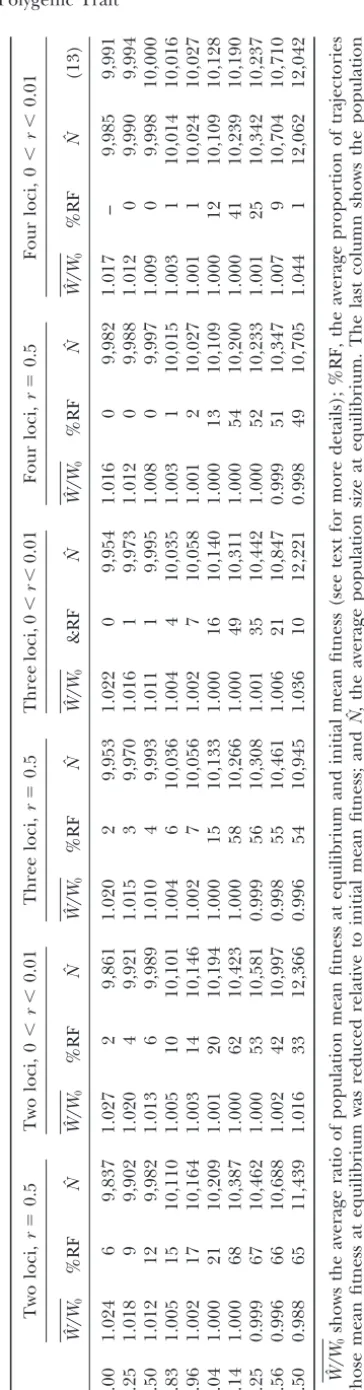
is assumed in its derivation), namelyf ⫽ 0.5 if ⫽ 2. Second, numerical evaluation of (13) shows that it in-deed provides a very accurate approximation of the numerically observed averageNˆ (compare the last two columns in Table 4). This is also the case for all other parameter combinations of Table 4, as well as for many others (e.g., for other values of and ; results not shown).
Differentiation of (13) with respect to V␣shows that
TABLE 4 Properties of equilibrium m ean fi tness and population size Two loci, r ⫽ 0.5 Two loci, 0 ⬍ r ⬍ 0.01 Three loci, r ⫽ 0.5 Three loci, 0 ⬍ r ⬍ 0.01 Four loci, r ⫽ 0.5 Four loci, 0 ⬍ r ⬍ 0.01 f Wˆ /W 0 %RF Nˆ Wˆ /W 0 %RF Nˆ Wˆ /W 0 %RF Nˆ Wˆ /W 0 &RF Nˆ Wˆ /W 0 %RF Nˆ Wˆ /W 0 %RF Nˆ (13) 0.00 1.024 6 9,837 1.027 2 9 ,861 1.020 2 9,953 1.022 0 9,954 1.016 0 9,982 1.017 – 9,985 9,991 0.25 1.018 9 9,902 1.020 4 9 ,921 1.015 3 9,970 1.016 1 9,973 1.012 0 9,988 1.012 0 9 ,990 9,994 0.50 1.012 1 2 9 ,982 1.013 6 9 ,989 1.010 4 9,993 1.011 1 9,995 1.008 0 9,997 1.009 0 9 ,998 10,000 0.83 1.005 1 5 1 0,110 1.005 10 10,101 1.004 6 10,036 1.004 4 10,035 1 .003 1 10,015 1.003 1 1 0,014 10,016 0.96 1.002 1 7 1 0,164 1.003 14 10,146 1.002 7 10,056 1.002 7 10,058 1 .001 2 10,027 1.001 1 1 0,024 10,027 1.04 1.000 2 1 1 0,209 1.001 20 10,194 1.000 1 5 10,133 1.000 16 10,140 1 .000 1 3 10,109 1.000 12 10,109 10,128 1.14 1.000 6 8 1 0,387 1.000 62 10,423 1.000 5 8 10,266 1.000 49 10,311 1 .000 5 4 10,200 1.000 41 10,239 10,190 1.25 0.999 6 7 1 0,462 1.000 53 10,581 0.999 5 6 10,308 1.001 35 10,442 1 .000 5 2 10,233 1.001 25 10,342 10,237 1.56 0.996 6 6 1 0,688 1.002 42 10,997 0.998 5 5 10,461 1.006 21 10,847 0 .999 5 1 10,347 1.007 9 1 0,704 10,710 2.50 0.988 6 5 1 1,439 1.016 33 12,366 0.996 5 4 10,945 1.036 10 12,221 0 .998 4 9 10,705 1.044 1 1 2,062 12,042 Wˆ /W 0 shows the average ratio of population m ean fi tness at equilibrium a nd initial mean fi tness (see text for m ore details); %RF, the average p roportion o f trajectories whose m ean fi tness at equilibrium w as reduced relative to initial mean fi tness; and Nˆ , the average population size at equilibrium. The last column shows the population size calculated from the approximation (13) using the observed genetic variance for four tightly linked loci. The parameters ⫽ 10,000, ⫽ 2, Vs ⫽ 1.25, ⫽ 0.5 are as in Tables 1 a nd 2.
which is only slightly larger than one. Hence, Nˆ in- A potentially important conclusion resulting from Equations 10, 11, and 15 is that for small growth rates creases with f unless is very small. Table 4 confirms
this. This is in accordance withAsmussen(1983), who , much largerf, hence stronger competition, is needed to induce a qualitative change in the equilibrium struc-showed for rather general one-locus models of FDS that
the population size at a stable interior equilibrium can ture becauseφD⬎φS⬎ ˆ ⬇ ( ⫺1)⫺1. This is not
im-mediately obvious for models based on the Lotka-Volt-exceed the carrying capacity if intraspecific competition
erra functional form (e.g.,Slatkin1979), in which the between like genotypes is stronger than that between
location of this region would depend on 2
k/V␣, where unlike genotypes. In Slatkin’s (1979)
quantitative-2
k is the width of the available resources. However, genetic model of Lande’s kind, the population size at
since Equation 19 ofBu¨ rger(2002b) informs us that the equilibrium with nonzero genetic variance is
pro-2
kis proportional toVswith proportionality constant/
portional to 1/
√
V␣.N⫺1, the models indeed lead to equivalent predictions. Equation 13 predicts that the equilibrium population
These multilocus results confirm and generalize the size is always proportional to, and this has been verified
conclusion of Bu¨ rger (2002a,b) that, compared with numerically (results not shown). Another important
pure stabilizing selection, FD leads to a quantitative, but point is (Table 4) that for a wide range of valuesf, the
not to a qualitative change, in the equilibrium proper-equilibrium population size deviates from Kby only a
ties of genetic variation as long as f⬍ ˆ ⬇( ⫺1)⫺1.
few percent [cf. (13) and recall that on average VA is
Only larger f induces a qualitative change. Notably, very small]. Therefore, we have
the critical value at which this occurs is independent of the number of loci.
ˆ ⫽
Nˆ ⫺ 1⬇
1
⫺1, (15) The asymmetric case:Now we turn to the asymmetric case and explore the consequences of a shifted opti-which equals 1 if and only if ⫽2. Table 4 also shows that mum. Even in the absence of FD,i.e., for pure stabilizing the deviation ofNˆ fromKdecreases with an increasing selection, very little work on the asymmetric case has number of loci. This is confirmed by (13) because (un- been done and no simple, general results are available less linkage disequilibrium is extremely high) in our (Hastings andHom 1990;Gavrilets andHastings model the averageVAdecreases with increasing number 1993; Bu¨ rger2000, pp. 213–216). Our numerical
re-of loci since the average effect re-of a locus decreases in sults are based on the assumption of free recombination
proportion to 1/(2n). and that the position of the optimum is at ⫽ 0.75.
Numerical iterations for various ecological parameter The main findings are summarized in Figure 2 and
sets in which has been changed by a factor of 10 Tables 5 and 3, which compare the asymmetric case
show that the only statistically significant effect on the with the corresponding symmetric case from Figure 1 properties of the system is that the carrying capacity and, and Table 1. Figure 2 clearly demonstrates the existence hence, the equilibrium population size are changed by of a transitory region and shows that its lower bound is the corresponding factor. Similarly, different values of nearly unaffected by the shift in the optimum, as
pre- induce exactly the transformation indicated by (10), dicted by our theoretical estimate (10) (for ⫽ 0.75, (11), and (13), but have no statistically significant effect we obtainφS ⫽1.06ˆ instead of the previous 1.03ˆ , and on the relative genetic variance, the number of equilib- ˆ is nearly identical in both cases). However, although ria maintained, or their degree of polymorphism (re- there is a distinctive increase of both the relative genetic sults not shown). For ⬎3, the dynamics ofNbecome variance and the polymorphism in a small range of complicated and were not studied in detail. However, valuesf, there is no clear upper bound of the transitory in the few runs performed the dynamics of gamete fre- region. Instead, both quantities increase very slowly un-quencies seemed to be nearly unaffected by the fluctua- tilf⫽2.5 is reached. For the given strength of stabiliz-tions of the population size. A similar observation was ing selection (Vs ⫽ 1.25), this is the largest possible
reported byClarkeandBeaumont(1992). value in this model and attained ifV␣⫽0.5.
If density dependence is ignored and the population For weak or moderate FD (f ⬍ 1), the degree of size is assumed constant and equal toK, then up to a polymorphism is unaffected by the change in (com-scale transformation of f by the factor ( ⫺1)ˆ , the pare Table 5 with Table 1, and see Table 3) and, except same results as for a changing population size are ob- for two loci, asymmetry leads only to a slight loss of tained. For instance, for a fixed population size of genetic variance. For five loci, the difference nearly van-10,000, the relative genetic variance and the polymor- ishes. If FD dominates (f ⬎ 1.1), then a shifted opti-phism at some valuefare about the same as those for mum leads to substantially reduced genetic variance variableN at the value ( ⫺1)ˆf(results not shown). and polymorphism relative to a symmetric one. Under Thus, for fixed population size, the critical values φS the strongest possible FD in our model, the relative
and φD are somewhat larger than those under density genetic variance and the average amount of
polymor-dependence because, by (14),Nˆ ⬎Kiff⬎1⁄
2( ⫺1)⫺1. phism still are diminished byⵑ20% relative to the
were also obtained for an optimum at the upper bound-ary of phenotypic values,i.e., for ⫽1. Then the trait is under pure directional selection if FD is absent. We found that for free recombination, four loci,Vs⫽1.25,
and the strongest possible FD,i.e.,f⫽2.5, the relative genetic variance is only 0.4, the average polymorphism is 2.0, and four-locus polymorphisms have a frequency of⬍0.02. For weak FD (f⫽0.83), no polymorphism at all is maintained. This is consistent with the finding of LoeschckeandChristiansen(1984) that for a single locus with multiple alleles, even under strong FD, no variation is maintained if the trait is under directional selection.
We also computed standard deviations of our quanti-ties of interest. For three, four, and five loci, the stan-dard deviation of the relative genetic variance is nearly twice the mean in the absence of FD and decreases to a value close to the mean as f increases to φS. This
holds for both recombination scenarios and for ⫽0.5 and ⫽0.75. Hence, genetic variation between genetic systems varies greatly for weak to moderate FD. Under free recombination, the standard deviation decreases further in absolute terms as f increases and is always
⬍2% of the mean if f ⬎ φD. Hence, the genetic
vari-ance maintained under strong FD is nearly independent of the locus effects. For tight linkage, the standard de-viation of the variance is between 15 and 20% of the mean iff⬎ φD; thus in absolute terms it increases for
Figure2.—Relative genetic variance (a) and polymorphism largef. (b) as a function off⫽Vs/V␣forn⫽2, 3, 4, and 5 loci in
the case of free recombination. The symmetric case ( ⫽
0.5) is compared with the asymmetric case ( ⫽0.75). The DISRUPTIVEVS.STABILIZING SELECTION parametersVs, , and are as in Figure 1 and V␣is varied;
hence the data for ⫽0.5 are those of Figure 1, except that Analysis of the conditions under which FDS induces data for some valuesfare omitted here. Instead, the range of disruptive selection on a trait is of importance because valuesfis extended here up to the maximum possiblef⫽2.5 disruptive selection is a prerequisite for sympatric speci-in this model to demonstrate the effects of an asymmetric
ation if it is to be induced by competition. The fitness optimum more clearly. The bars between a and b indicate
function in our model, (4), is a polynomial of degree which type of selection was observed in the asymmetric case,
⫽0.75 (cf. Figure 1 for ⫽0.5). 4 ing, and we classified its shape as傽-shaped (concave with a local maximum), resulting in stabilizing selection, 傼-shaped (convex with a local minimum), resulting in polymorphic. Actually, the more loci there are, the disruptive selection, or else, which we call complicated lower the fraction of fully polymorphic equilibria. The selection. The fitness function was calculated at each stable relative genetic variance depends only very weakly on equilibrium and classified according to one of the three the number of loci. The deviation of the mean from categories. For a symmetric optimum ( ⫽0.5), a fitness the optimum is about as small as in the symmetric case function classified as complicated is M-shaped in all
(results not shown). cases examined; i.e., there are two local optima (not
Thus, for weak or moderate FD (f ⱕ φS), free re- at the extreme genotypic values) separated by a local
combination, and three or more loci, a shift in the minimum. The shape of theM, however, can be rather optimum of small or moderate size (i.e., 0.25 ⱕ ⱕ variable because the minimum can be very shallow or 0.75 so thatis closer to the middle of the phenotypic very deep, and the fitness of the extreme genotypic range than to its boundaries) has only a minor effect values can be very low or just slightly lower than the on the amount and structure of the genetic variation maximum. TheMis asymmetric ifg⬆.For an asym-at equilibrium. For two loci, the effect is much larger metric optimum or at unstable equilibria in the symmet-because a shifted optimum destroys the inherent sym- ric case, other shapes may occur, such as monotone metries of the two-locus model that maintain much decreasing or increasing fitness, or one local maximum more relative genetic variance than that in models with and one local minimum.
TABLE 5
Equilibrium structure forn⫽2, 3, and 4 loci, free recombination, and an asymmetric optimum (⫽0.75)
Two loci Three loci Four loci
Polymorphism Polymorphism Polymorphism
f No. (E) 0 1 2 No. (E) 0 1 2 3 No. (E) 0 1 2 3 4
0.00 1.5⫾0.5 0.50 0.50 0 2.4⫾0.8 0.52 0.48 0 0 2.8⫾1.0 0.62 0.38 0 0 0
0.25 1.5⫾0.5 0.35 0.65 0 2.5⫾0.8 0.39 0.61 0 0 2.9⫾1.1 0.48 0.52 0 0 0
0.50 1.5⫾0.5 0.25 0.75 0 2.6⫾0.9 0.26 0.74 0 0 3.0⫾1.1 0.32 0.68 0 0 0
0.83 1.6⫾0.5 0.10 0.90 0 2.7⫾0.9 0.09 0.91 0 0 3.3⫾1.2 0.11 0.89 0 0 0
0.96 1.7⫾0.5 0.03 0.97 0 3.0⫾0.9 0.02 0.98 0 0 3.6⫾1.2 0.03 0.97 0 0 0
1.04 1.9⫾0.3 0 1 0 2.2⫾0.5 0 0.40 0.60 0 2.7⫾0.7 0 0.20 0.53 0.27 0
1.14 1 0 0.71 0.29 1 0 0.22 0.50 0.29 1 0 0.06 0.29 0.44 0.21
1.25 1 0 0.49 0.51 1 0 0.13 0.48 0.39 1 0 0.03 0.23 0.47 0.26
1.56 1 0 0.38 0.62 1 0 0.09 0.46 0.45 1 0 0.02 0.19 0.49 0.31
2.50 1 0 0.26 0.74 1 0 0.05 0.40 0.55 1 0 0.01 0.14 0.48 0.37
See Table 1 for definition of parameters.
by a quadratic polynomial through regression. There- side of (17) coincides withφD(11). Therefore, disruptive
selection occurs for all possible genetic systems in this fore, we also approximated our fitness function by a
quadratic polynomial and classified it as stabilizing selec- model iff⬎ φD. These results suggest that in the
sym-metric case, disruptive selection should be almost always tion if it was concave (curved downward) and as
disrup-tive otherwise. detectable if FD is strong enough to maintain a unique
fully polymorphic equilibrium. In Figures 1 and 2, the horizontal bars below the top
section display the dependence of the shape of the For the asymmetric optimum, the region with compli-cated selection is substantially extended and much fitness function on f. Except for the region in which
selection is complicated, the same type of selection oc- stronger FD is needed to produce disruptive selection (Figure 2). This is also predicted by (17), which gives curs at all equilibria and for all genetic parameter
com-binations. The coincidence between the type of selec- a critical value offbetween 1.7 and 1.9 if VA⫽ 1⁄8and
the numerically obtained Nˆ’s (in this region between tion acting and the properties of genetic variation
maintained at equilibrium is remarkable. The figures 10,300 and 10,800) are plugged in. In the transitory region (and only there), the fitness function is often clearly show that complicated selection occurs in the
transitory region,i.e., if φS⬍ f⬍φD. Under the assump- not only complicated, but also very flat near
equilib-rium, thus leading to extremely slow convergence (cf.
tion that the mean coincides with the optimum, g⫽
(as is satisfied to a close approximation for the vast the statistical approach). majority of parameter combinations if more than two
loci contribute to the trait—the more loci, the better
EVOLUTION OF MEAN FITNESS the approximation), it is straightforward to show that
W(g) is傽-shaped if and only if
For two loci and by ignoring density dependence, it was shown (Bu¨ rger 2002b) that under moderate or strong
f⬍ ˆ ⫹ VA
2V␣. (16) FD, the dynamics in this model may be highly nonadaptive;
i.e., mean fitness may often decrease and critical points Since by (10), monomorphic equilibria exist iff⬍ φS⫽ of the fitness surface bear little relevant information
ˆ ⫹1/(8V␣), (16) is satisfied for all possible genetic
about the dynamics or equilibrium properties of the
parameter combinations if and only iff⬍ ˆ . model. However, even if a stable polymorphism
coin-Another straightforward calculation shows that if cides with a critical point of the fitness surface, methods
g⫽ ⱖ1⁄
2(as is approximately the case in our numeri- relying on the invasion analysis of a rare mutant in a
cal results) disruptive selection occurs if and only if the monomorphic population may be insufficient for deriv-derivative ofW(g) atg⫽0 is positive. This is the case ing the correct evolutionary properties of this
equilib-if and only equilib-if rium (Christiansen1991).
For the present multilocus model we investigated
f⬎ ˆ ⫹VA⫹ 2
2
2V␣ ⫽
ˆ
冢
1⫺VA⫹222Vs
冣
⫺1
. (17) such and related issues using our statistical approach. For every trajectory, we calculated the ratioWˆ /W0of the
mean fitness at equilibrium (which, of course, is one) If ⫽1⁄
2andVA⫽1⁄8, which is the largest possible value
1000 genetic parameter sets pertaining to a given eco-logical parameter combination. Because initial points are randomly chosen, the average ratioWˆ /W0provides
a measure for the net change of population mean fitness during evolution. We also calculated the percentage of trajectories, %RF, for which mean fitness at equilibrium was lower than that initially. Some of these results are summarized in Table 4.
A number of noteworthy features are observed. As f
increases from zero, the average ratioWˆ /W0decreases
from a value⬎1 to 1.000 asfreachesⵑ1.0 (⬇φS). In
parallel, the proportion of trajectories for which fitness is reduced at equilibrium increases from nearly zero (except for two loci, when this proportion is a few per-cent) to 10% or more. This percentage reaches a maxi-mum of 40% or more in the transitory region and de-clines asfincreases beyondφD. For free recombination
this decline is very slow, but for tightly linked loci it is rapid; the more loci, the more rapid the decline.
Wˆ /W0decreases slightly below one forf⬎φDif
recombi-nation is free, but increases quite substantially if linkage is tight. Therefore, under moderate or strong FD (f⬎
φS) the dynamics are “on average” nonadaptive if the
loci are unlinked. However, if the loci are tightly linked and FD is very strong, then mean fitness decreases only with low probability and, on average, increases substan-tially above that of randomly chosen initial distributions.
Figure 3.—Frequencies of genotypic values and fitness As we see by way of example in the next section, this is
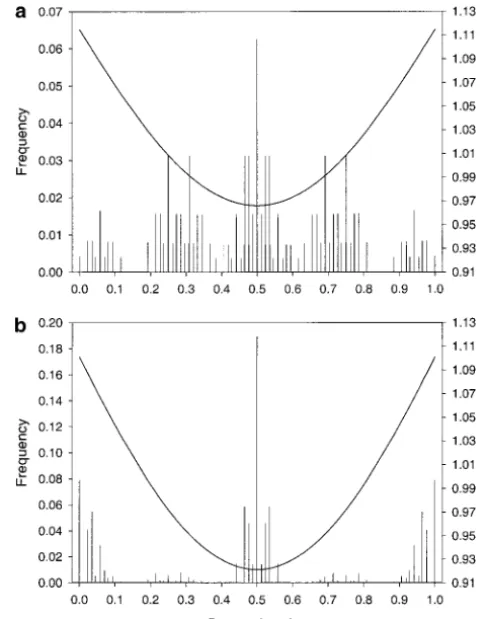
function at equilibrium for four loci. The locus effects are because with tightly linked loci, the phenotypic distribu- ␥1 ⫽ 0.036, ␥2 ⫽ 0.250, ␥3 ⫽ 0.191, and ␥4 ⫽ 0.023; the tion shows signs of clustering at its extreme phenotypic ecological parameters areVs⫽1.25,V␣⫽0.5, ⫽2, and ⫽ 10,000. Hence there is a unique, globally stable equilibrium values.
with all allele frequencies equal to1⁄
2. Only the linkage
disequi-libria depend on the genetic details. The 傼-shaped curve depicts the fitness function at this equilibrium. Its scale is PHENOTYPIC DISTRIBUTIONS AT EQUILIBRIUM
given on the right-hand side. (a) Freely recombining loci. Most ecological modeling focusing on the evolution- (b) Recombination rates between adjacent loci are randomly chosen between 0 and 0.01 and are 0.0089, 0.0037, and 0.0041 ary consequences of FDS has relied on assumptions
in this case. There are as many vertical bars (34⫽81 genotypic
about the distribution of genotypic or phenotypic
val-values) in b as in a, but many are invisible because their height ues. Models using the quantitative genetics approach
is so small. assume that phenotypic values are normally distributed
(and do not change shape), whereas models resorting
to game theory or adaptive dynamics consider the fate of have much higher frequencies. In particular, with tight linkage the extreme genotypic values occur with high fre-single mutants in otherwise monomorphic populations.
Figures 3 and 4 show how distributions of genotypic quency. Because of random mating, however, the central genotypic value is always the most frequent one.
values look in four- and eight-locus models if FD is
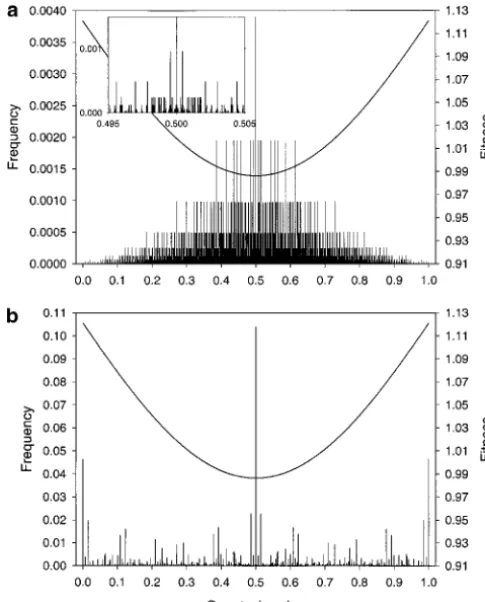
strong,i.e., such that a unique, fully polymorphic, stable We end with a little lesson on the central limit theo-rem. Despite its fractal appearance, the distribution for equilibrium exists. They display seemingly fractal
fea-tures;i.e., typically the frequencies of neighboring geno- eight loci and free recombination in Figure 4a is nearly normal. Figure 5 displays its cumulative density function typic values are radically different. Only a few runs with
eight loci were performed with the sole purpose of dem- together with that of a normal distribution with the same mean and variance. Also the cumulative density onstrating the equilibrium distribution.
Figure 3, a and b, as well as Figure 4, a and b, differ functions of the other distributions displayed in Figures 3 and 4 are shown. The distribution resulting from eight only because of different assumptions on the
recombi-nation rate; all other parameters, including the allelic tightly linked loci and those from four loci (linked or not) are markedly nonnormal. That the eight-locus dis-effects, are the same. Comparison of these pairs of
fig-ures shows that with tight linkage a much larger fraction tribution with free recombination is nearly normal is a consequence of the central limit theorem together with of genotypic values has very low frequency compared with