Wireless Polyhouse Cultivation System using
RF Module
Vikas Sharma1, Neelu Jain2
P.G. Scholar, Department of Electronics Engineering, PEC University of Technology, Chandigarh, India1
Associate Professor, Department of Electronics Engineering, PEC University of Technology, Chandigarh, India2
ABSTRACT: Today, India’s ranking is second worldwide in agriculture output. Agriculture not only provides food and raw material but is a source of livelihood, contributes to national income, provides vast employment opportunities, and basis of economic development.One such technique that helps in growing crops irrespective of its seasonal and climatic requirements is Polyhouse farming. The Polyhouse farming is greenhouse effect based farming technique. One major advantage of Polyhouse cultivation is that each and every factor influencing the growth of a crop inside a Polyhouse can be precisely controlled, like temperature, humidity and ventilation, water level etc.
In this paper different techniques of Polyhouse cultivation have been compared and RF based hardware for Polyhouse farming is discussed.By knowing the status of moisture and temperature through GSM with the use of moisture and temperature sensors, water flow can be controlled by just sending a message from our mobile. The smoke sensors used to send emergency information to user in case of fire in the fields or burning of motor. Data is transmitted and received through RF module both sides. The design is low power, low cost, robust and highly versatile.
KEYWORDS:Polyhouse cultivation, Sensors, Arduino microcontroller, GSM module, RF technology, Proteus, OrCAD.
I. INTRODUCTION
For Indian economy, agriculture plays an important role. Generally there are different environmental and soil conditions in different parts of the country which affect the quality of the crops [1]. Conventional farming requires suitable weather conditions, humidity, temperature and ventilation for cultivation of good crops while with Polyhouse cultivation these same required conditions can be maintained by the use of automated system. Also non seasonable and time consuming crops can be grown in any environmental condition in less time [2].
A greenhouse is where crops, plants and flowers can be grown in controlled environment [3]. It has a glass, plastic or translucent sheet covered on it to pass the sunlight which is trapped inside to warm the plants even during the night. Green houses have different shapes and sizes depending on their function. Mini greenhouse is made by people in their garden or backyard to grow seedlings or plants that need warmer conditions. Other industries or places need larger greenhouses for larger production [4].Polyhouse farming is the modified natural environment to achieve optimal plant growth and yield. Polyhouse (also kown as polytunnel, hoop greenhouse or hoophouse, or high tunnel) is an elongated frame covered with polythene sheets under which seedlings or plants are grown. These distinctive polyethylene tunnels can be seen in gardens and commercial farming operations in many parts of the world. The earnings or the profit is 4 to 8 times the conventional cultivation [2]. The different types of Polyhouses are uncontrolled, partially controlled and completely controlled. In uncontrolled Polyhouse only top part is covered. In partially controlled Polyhouse, it has open and close windows and in completely controlled Polyhouse windows are absent. There are three types ofPolyhouses-when it is attached or supported by a part of building or any type of constructed wall it is called Attached Polyhouse, when it is in free standing position it is called Detached Polyhouse andwhen several Polyhouses are joined together in a series it is called Connected Polyhouse. Polyhouses can be of different shapes and sizes such as are barrel shaped, ridges and furrow type and saw tooth type. Shapes and sizes vary according to the climatic conditions of the region/Country [3].
should be available when required.Polyhouse should be preferably South-North in direction to overcome the damage of wind current and it should get light from all sides.Structural design Polyhouse provides protection against damage from wind, rain, heat, and cold. The principle of Polyhouse farming is growing and producing healthy plants and crops in appropriate conditions in closed or partially closed space. Polyhouse is used to overcome hostile environmental conditions such as surplus rain, high temperature, cold weather condition, air flow etc. Various merits of Polyhouseare: it can be erected on unproductive soil, maintenance of humidity, efficient use of CO2, minimum labour required, use of
water and fertilizers to its minimum, maximum usage of space, easy control of pests and diseases and quality of product is best [2][5].
This paper discusses existing Polyhouse cultivation systems and also proposes hardware implementation of wireless Polyhouse cultivation system using RF module. Inside the Polyhouse, various sensors are used to provide the controlled environmental conditions, like temperature sensor to monitor the temperature, humidity sensor for air moisture content, moisture sensor for water level, rain detector to monitor the rain and smoke detector for fire in the field or for the burning of motors. The output data from these sensors is sent through RF module to the Arduino microcontroller which further sends the signal to the GSM module to take the required action. User decides the action and sends the signal through SMS to the GSM and the desired conditions are obtained with the help of output devices.
Analysis of existing Polyhouse cultivation systems is discussed in section II. Proposed hardware and methodologyin section III and software description in section IV is explained. Results of the proposed system are given in section V. Finally, the conclusion & future scope is given in section VI.
II. RELATEDWORK
Review of various Polyhouse systems based on different technologies has been discussed in this section. In Wired Technology, input sensors are connected directly with the microcontroller. Analog output of the sensors is sent to ADC which gives the digital output to the controller for further processing[6][7]. With the use of less hardware system, the efforts made by human can be reduced. The system can be used for controlling the greenhouse automatically without human intervention. ADC is used separately due to which power consumption is more [8]. In GSM based technology, the updates about the field condition can be sent to the user through GSM facility in the form of SMS[3][4]. Farmers can check the status of environmental conditions from their mobile phone at any remote location [9][10]. Therefore human efforts are reduced to maintain the desired condition [11][12].Manual monitoring of system is not required which reduces human efforts.The system avoids over irrigation, under irrigation and saves the water.SMS charges increases the cost of the system.Wireless transmission of data is also absent [13][14]. In GSM &bluetooth based Technology, The complete information about the system is sent to the user’s mobile phone through GSM module. To make the system more cost effective, bluetooth technology has been used alongwith GSM facility when it is within sufficient range [5][15].Wireless transmission is used only for output and not for input. In wireless Zigbee technology, wireless transmission of sensors data using Zigbee module makes the system automatic and human efforts also get to reduce. The system has more flexibility but Zigbee wireless range is limited [2][16]. In wireless RF technology, wireless range is increased because of RF module.Human efforts get to reduce.The system hardware is very complex and overall installation cost is high [17].
III.PROPOSEDHARDWAREANDMETHODOLOGY
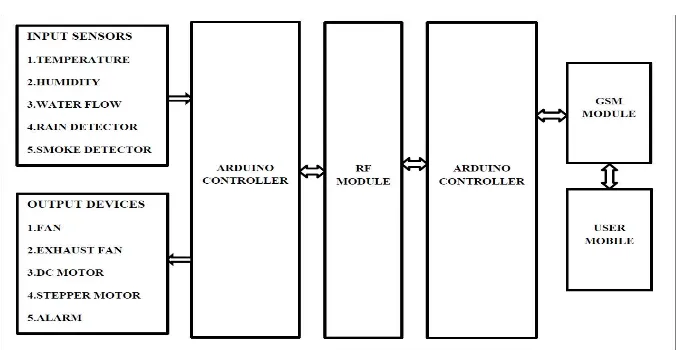
A. BLOCK DIAGRAM OF WIRELESS POLYHOUSE CULTIVATION SYSTEM USING RF MODULE
Fig. 1 Block Diagram of wireless Polyhouse cultivation system using RF module
The hardware of the system mainly includes an Arduino-microcontroller, a GSM module, RF module, ADC, input sensors and output controlling devices. The working of the proposed system is explained as follows:-
1. Input sensors: Any type of change in the environmental conditions is sensed by the sensors and the analog data obtained from these sensors is sent to microcontroller. Temperature sensor (LM35) is used to get the environmental temperature. DHT22 humidity sensor is used to get the humidity content in the air. By using the properties of the soil, such as electrical resistance, dielectric constant, or interaction with neutrons, soil moisture sensor measures the volumetric water content in soil. Rain water sensor is used to get the information about the rain. If there is rain, then there will be conduction between the wires in the sensor and the high level of voltage is sent.CO2sensor can detect fire, which can be indicated by large content of CO2.
Due to particle nature, CO2 fire detectors are not vulnerable to false alarms.
2. Arduino Controller: The output of the sensors is converted from analog to digital data by using Arduino microcontroller. After conversion, values sent to the nRF module for wireless transmission of data. It also receives the data from the RF transmitter as well as RF receiver. It also takes the necessary actions performed at the output devices to control the desired conditions. Arduino is also interfaced with the GSM module at the output side. To ease programming and to assimilate into other circuits, Arduino board consisting of an Atmel 8-bit or 16-8-bit and 32-8-bit AVR microcontroller with supplementary components can be used.
3. nRF24L01 Single Chip Transceiver: Digital output obtained from the Arduino is sent to the RF module which transmits the data wirelessly to the Arduino central unit. It also receives the data obtained from the central unit after processing the data through GSM module. The nRF24L01 can be used in ISM frequency band at 2.400 - 2.4835GHz.
4. SIM900A GSM Module: After receiving the data from the RF module, Arduino unit sends the commands to the GSM module which further communicates with the user. Now user decides that which necessary action should be performed according to the input parameters changed to obtain the optimum conditions. Just as a cell phone is used to connect to other device and to send & receive information by using SIM card, in same way the GSM shield by Arduino is used. The Modem is connected to PC as well as microcontroller with RS232 Chip (MAX232). Through AT command the baud rate can be arranged between 9600-115200.
B. FLOW CHART OF PROPOSED SYSTEM
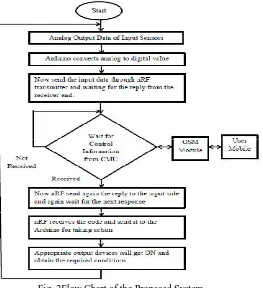
The operation of the proposed system can be described using flow chart which is shown in Fig. 2.
Fig. 2Flow Chart of the Proposed System
Initially the Analog output data of the sensors is sent to the input of Arduino ADC which gives the Digital output which is sent wirelessly through RF Module to the Arduino controller. Then the control signal is sent through GSM moduleto the user according to which the necessary actions are performed by making output devices ON or OFF.
IV.SOFTWAREDESCRIPTION
V. RESULTS
After simulation, prototype is assembled using developed Arduino board as shown in Figures 3 and 4.
Fig. 3Transmitter end of the proposed systemFig. 4Receiver end of the proposed system
In the proposed wireless Polyhouse cultivation system, DC power supply of 12V,1A is used at the transmitter end of the system to drive the sensors, Arduino controller, nRF module, output devices and the other components mounted on the transmitter PCB.Input data is taken from the sensors like temperature, humidity, moisture, water level and rain detector and is sent to the Arduino microcontroller.Arduino microcontroller receives the data from the sensors and converts it from analog to digital and sent to the nRF module for the wireless transmission.nRF module receives the data from the Arduino controller and transmits it wirelessly to the receiver end.Arduino microcontroller receives the data from the nRF receiver and waits for the signal for taking appropriate action. User has 2 options, AUTOMATIC or MANUAL mode and he can select any mode from the remote location and sent to the GSM module as feedback which further given to the Arduino microcontroller to take the action at the output side.
(a) (b)
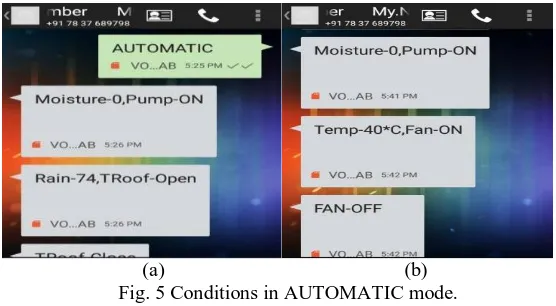
Fig. 5 Conditions in AUTOMATIC mode.
In AUTOMATIC mode the action is performed at the output according to change at the sensors values. Also when the input conditions are changed, status of the output devices is sent immediately to the user which is shown in the Fig. 5 (a) & (b).
(a) (b) (c) Fig. 6Conditions and code words in MANUAL mode.
After setting the MANUAL mode all the output devices turn OFF even if readings crosses the optimum values asshown in the Fig.6 (a). Now the following code words as shown in the Fig.6 (b) & (c) are used to control the devices by the user:- FAN ON, FAN OFF, XFAN ON, XFAN OFF, PUMP ON, PUMP OFF, TROOF ON, TROOF OFF, STATUS.
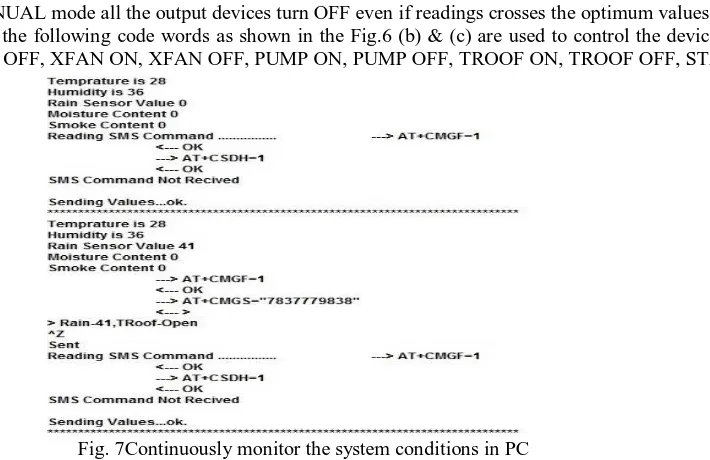
Fig. 7Continuously monitor the system conditions in PC
After sending the decision by the user to the Arduino controller through GSM modem, the necessary actions are performed by the output devices. Now this side becomes transmitter and other becomes receiver for the nRF module. Now the output devices will get ON or OFF according to the conditions. Now user can also continuously monitor the system conditions in PC/Laptop which is shown in the Fig. 7.
Table 1: Summary of results
Parameter Results Accuracy of
temperature
95-99% accuracy with the error (-0.5 to + 0.5) for the temperature actual and observed readings.
Speed Speed is a measure of system’s response time. Response time for sensors is around 3 seconds and the changed values are updated every 2 seconds. Time taken by the user to send the message from the mobile to perform the action takes around 3 seconds. Overall, around in 5 seconds we can change our decision and get performed.
Security Since it is totally wireless system, so receiver end of the system is placed under safe environment.
From the table 1, it is concluded that the error is occurred in the values of observed readings of the sensors with compare to the actual values. Speed is also define any system performance, so this system takes initially more time but after that it takes around 5 seconds for any response change. This system is more secure due to its extra functionality of wireless data transmission.
Comparison of various systems with the proposed system
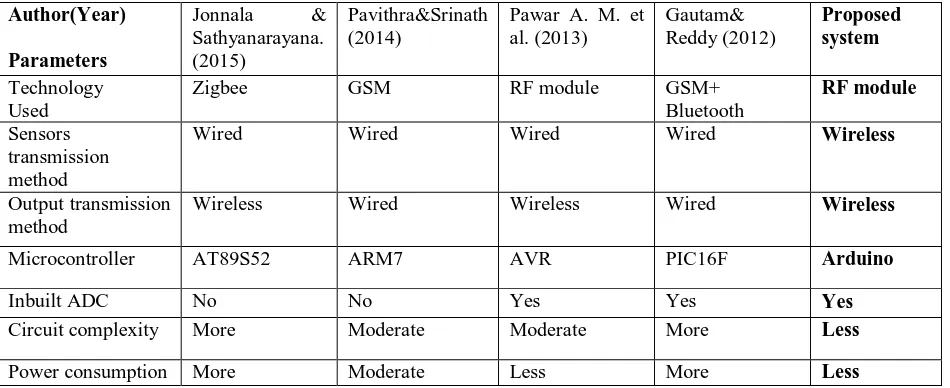
Comparison of various techniques with the developed wireless Polyhouse cultivation system based on different parameters is given in Table 2.
Table 2: Comparison of various techniques with the proposed system
Author(Year)
Parameters
Jonnala & Sathyanarayana. (2015)
Pavithra&Srinath (2014)
Pawar A. M. et al. (2013) Gautam& Reddy (2012) Proposed system Technology Used
Zigbee GSM RF module GSM+
Bluetooth
RF module
Sensors transmission method
Wired Wired Wired Wired Wireless
Output transmission method
Wireless Wired Wireless Wired Wireless
Microcontroller AT89S52 ARM7 AVR PIC16F Arduino
Inbuilt ADC No No Yes Yes Yes
Circuit complexity More Moderate Moderate More Less
Power consumption More Moderate Less More Less
VI.CONCLUSION& FUTURESCOPE
Irrigation has been the backbone of human civilization since man has started agriculture. As the generation evolved, man developed many methods of irrigation to supply water to the land. In the present scenario on conservation of water is of high importance. The wireless Polyhouse system is designed using Arduino microcontroller, input sensors, RF module, GSM modem and output devices with an objective to gather the information related to status of temperature, moisture and humidity by using the sensors with an interface to GSM. Data is transmitted wirelessly using RF module which increases the range of the system upto 70-100 meters. Water flow can be controlled by just sending a message from our mobile. The smoke sensor is used to send emergency information in case of fire in the fields or burning of motor. The design is low power, low cost, robust and highly versatile. The main advantage is that the system’s action can be changed according to the situation for different types of crops, extreme weather conditions like floods & drought. Initially, the designed system monitors the values of the sensors and provides outputs according to the set threshold values of the sensors. The system can work automatically or manually, set by using GSM message service. Thus, this system avoids over irrigation, under irrigation, top soil erosion and reduces the wastage of water. By implementing this system, agricultural lands, parks, gardens, golf courses can also be irrigated. Thus, this system is cheaper and efficient when compared to other Polyhouse cultivation systems. A secondary pump can be used in case of failure of the pump. High quality sensors can be used to increase the range and accuracy of the system but simultaneously, it will increase the cost of the system. The system performance and speed can be improved by using latest microcontrollers such as ARM, Raspberry Pi but the programming of these microcontrollers is complex & the cost of the system will also increase. Solar cells can be used to provide power supply to the system which will make the system cost effective in the long run.The system performance can be improved by using bluetooth technology for wireless communication. When user is in the range approximately 10 meters, then bluetooth can also be used for wireless transmission of data to reduce the SMS charges.
REFERENCES
[1] Baldwin, K. R. “Soil Quality Considerations for Organic Farmers”. Organic Production, Center for environmental farming systems, pp.1-14, 2006.
[2] Jonnala P. &Sathyanarayana G.S.R., “A Wireless Sensor Network for Polyhouse Cultivation using Zigbee Technology”, ARPN Journal of Engineering and Applied Sciences, ISSN: 1819-6608, Vol. 10, No. 10, pp. 4413-4418, June 2015.
[3] Khandelwal S.A., “Automated Green House Management Using GSM Modem”, International Journal of Computer Science and Information Technologies(IJCSIT), ISSN: 0975-9646, Vol. 3 (1) , pp. 3099-3102, 2012.
[4] Rangan K. &Vigneswaran T., “An Embedded Systems Approach to Monitor Green House”, 978-1-4244-9182-7/10/$26.00 ©2010 IEEE, pp. 61-65, 2010.
[5] Gautam I. & Reddy S.R.N., “Innovative GSM Bluetooth based Remote Controlled Embedded System for Irrigation”, International Journal of Computer Applications (0975 – 888), Vol. 47, No.13, pp. 1-7, June 2012.
[6] Sengunthar G.R., “Greenhouse Automation System Using Psoc 3”, Journal of Information, Knowledge and Research in Electronics and Communication Engineering, ISSN: 0975 – 6779, Vol. 02, Issue 02, pp. 779-784, Nov 12 To Oct 13.
[7] Sahu K. &Mazumdar S.G., “Digitally Greenhouse Monitoring and Controlling of System based on Embedded System”, International Journal of Scientific & Engineering Research (IJSER), ISSN: 2229-5518, Vol. 3, Issue 1, pp. 1-4, January-2012.
[8] Devi A., Kaushik M., Ratan R. &Luthra S.K.,“Green Wall Automation System”, International Journal of Latest Trends in Engineering and Technology (IJLTET), ISSN: 2278-621X, Vol. 5, Issue 4, pp. 350-355, July 2015.
[9] Pavithra D.S. &Srinath M.S., “GSM based Automatic Irrigation Control System for Efficient Use of Resources and Crop Planning by Using an Android Mobile”, IOSR Journal of Mechanical and Civil Engineering (IOSR-JMCE), e-ISSN: 2278-1684, p-ISSN: 2320-334X, Vol. 11, Issue 4, Ver. I, pp. 49-55, Jul- Aug. 2014.
[10] Jonnala P. & Shaik S., “Wireless Solution for Polyhouse Cultivation Using Embedded System”, IEEE International Conference on Renewable Energy and Sustainable Energy [ICRESE’13], 978-1-4799-2075-4/13/$31.00 ©2013 IEEE, pp. 21-25, 2013.
[11] Kumar N.S., Krishna B.V. & Agarwal A., “Automatic Corporate Farming Control Mechanism (Using Embedded Systems and GSM Technologies)”, International journal of Engineering Research & Management Technology, ISSN: 2348-4039, Vol. 1, Issue-1, pp. 241-247, January 2014.
[12] Sengunthar G.R. &Ekata M., “A Survey on Greenhouse Automation Systems”, International Journal of Engineering & Science Research (IJESR), ISSN: 2277-2685, Vol. 3, Issue 2, pp. 2338-2343, Feb 2013.