Two Person Interaction Recognition System
Using SVM
Vaibhav Gawande, Yogesh Swami, Pratik Kakde,Yuvraj Lokhande, Prof. Rakesh Badodekar
BE Student, Department of Information Technology, Sinhgad Institute of Technology, Savitribai Phule Pune
University, Pune, India.
Professor, Department of Computer Engineering, Sinhgad Institute of Technology, Savitribai Phule Pune University,
Pune, India.
ABSTRACT- Human activity recognition has potential to impact a wide range of applicationsfrom surveillance to human computer interfaces to content based video retrieval.Recently, the rapid development of inexpensive depth sensors (e.g. MicrosoftKinect) provides adequate accuracy for real-time full-body human trackingfor activity recognition applications. In this paper, we create a complex human activitydataset depicting two person interactions, including synchronized video, depthand motion capture data. Moreover, we use our dataset to evaluate various featurestypically used for indexing and retrieval of motion capture data, in the context ofreal-time detection of interaction activities via Support Vector Machines (SVMs).Experimentally, we find that the geometric relational features based on distance betweenall pairs of joints outperform other feature choices. For whole sequence classification,we also explore techniques related to Multiple Instance Learning (MIL)in the sequence is represented by a bag of body-pose features. We find that the MILbased classifier outperforms SVMs when the sequences extend temporally around the interaction of interest.
KEYWORDS: Body-Pose Features, SVM, MIL
I. INTRODUCTION
contains incorrecttracking and noise, this problem is somewhat different fromscenarios with clean motion capture data.In this paper, we create a new dataset for two-person interactionsusing an inexpensive RGBD sensor. We collect eight interactions: approaching, departing,pushing, kicking, punching, exchanging objects,hugging, and shaking hands from seven participants and 21pairs of two-actor sets. In our dataset, color-depth video andmotion capture data have been synchronized and annotatedwith action label for each frame.Real time human activity detection has multiple usesfrom human computer interaction systems, to surveillance,to gaming. However, non-periodic actions no always have aclearly defined beginning and ending frame. Since recordedsequences are manually segmented and labeled in trainingdata, a segmented sequence might contain irrelevant actionsor sub-actions. To overcome this problem, we use theidea of Multiple Instance Learning (MIL) to tackle irrelevantactions in whole sequence classification. We find thatclassifiers based on Multiple Instance Learning, have muchhigher classification accuracy when the training sequencescontain irrelevant actions than Support Machine (SVM) classifiers.
II. LITERATURE SURVEY
1. N. Ikizler-Cinbis and S. Sclaroff. Object, scene and actions: Combining multiplefeatures for human action recognition. In ECCV, 2010.
In many cases, human actions can be identified not only by the singular observationof the human body in motion, but also properties of the surrounding scene and therelated objects. In this paper, we look into this problem and propose an approachfor human action recognition that integrates multiple feature channels from severalentities such as objects, scenes and people. We formulate the problem in a multipleinstance learning (MIL) framework, based on multiple feature channels. By usinga discriminative approach, we join multiple feature channels embedded to the MILspace.
2. S. Ali and M. Shah. Human action recognition in videos using kinematic featuresand multiple instance learning. IEEE TPAMI, 32(2):288303, Feb. 2010.
We propose a set of kinematic features that are derived from the optical flow for humanaction recognition in videos. The set of kinematic features includes divergence,vorticity, symmetric and anti-symmetric flow fields, second and third principal invariantsof flow gradient and rate of strain tensor, and third principal invariant of rate ofrotation tensor. Each kinematic feature, when computed from the optical flow of asequence of images, gives rise to a spatiotemporal pattern. It is then assumed thatthe representative dynamics of the optical flow are captured by these spatiotemporalpatterns in the form of dominant kinematic trends or kinematic modes.
3. A. Patron-Perez, M. Marszalek, A. Zisserman, and I. Reid. High five: Recognisinghuman interactions in tv shows. In BMVC, 2010
In this paper we address the problem of recognising interactions between two people
in realistic scenarios for video retrieval purposes. We develop a per-person descriptorthat uses attention (head orientation) and the local spatial and temporal context ina neigh- bourhood of each detected person. Using head orientation mitigates cameraview ambi- guities, while the local context, comprised of histograms of gradientsand motion, aims to capture cues such as hand and arm movement. We also employstructured learning to capture spatial relationships between interacting individuals.
4. J. Aggarwal and M. Ryoo. Human activity analysis: A review. In AC M ComputingSurveys, 2011. This article provides a detailed overview of various state-of-the-art research papers
5. M. Alcoverro, A. Lopez-Mendez, M. Pardas, and J. Casas.Connected operators on3d data for human body analysis. In CVPR Workshops, 2011.
This paper presents a novel method for filtering and extraction of human body featuresfrom 3D data, either from multi-view images or range sensors. The proposedalgorithm consists in processing the geodesic distances on a 3D surface representingthe human body in order to find prominent maxima representing salient pointsof the human body. We introduce a 3D surface graph representation and filteringstrategies to enhance robustness to noise and artifacts present in this kind of data.We conduct several experiments on different datasets involving 2 multi-view setupsand 2 range data sensors: Kinect and Mesa SR4000. In all of them, the proposed algorithmshows a promising performance towards human body analysis with 3D data.
6. G. Guerra-Filho and A. Biswas. A human motion database: The cognitive and parametricsampling of human motion. In FG, 2011.
In this paper, we describe the construction of our Human Motion Database using controlledsampling methods (parametric and cognitive sampling) to obtain the structurenecessary for the quantitative evaluation of several motion-based research problems.The Human Motion Database is organized into several components: the praxicondataset, the cross-validation dataset, the generalization dataset, the compositionalitydataset, and the interaction dataset.
7. H. Kuehne, H. Jhuang, E. Garrote, T. Poggio, and T. Serre. HMDB: A large videodatabase for human motion recognition. In ICCV, 2011.
With nearly one billion online videos viewed every day, an emerging new frontier
in computer vision research is recognition and search in video. While much efforthas been devoted to the collection and annotation of large scalable static imagedatasets containing thousands of image categories, human action datasets lag farbehind. Current action recognition databases contain on the order of ten differentaction categories collected under fairly controlled conditions.
8. T. Leung, Y. Song, and J. Zhang. Handling label noise invideoclassication via multipleinstance learning. In ICCV, 2011.
In this paper, we propose the use of MILBoost in a large-scale video taxonomic
Classification system comprised of hundreds of binary classifiers to handle noisytraining data. We test on data with both artificial and real-world noise and compareagainst the state-of-the-art classifiers based on AdaBoost. We also explore the effectsof different bag sizes on different levels of noise on the final classifier performance.
9. Y. Liu, C. Stoll, J. Gall, H.-P. Seidel, and C. Theobalt. Markerless motion captureof interacting characters using multiview image segmentation. In CVPR, 2011.
We therefore propose combined image segmentation and tracking approach toOvercome these difficulties. A new probabilistic shape and appearance modelis employedto segment the input images and to assign each pixel uniquely to one person.Thereafter, a single-person markerless motion and surface capture approach can beapplied to each individual, either one-by-one or in parallel,even under strong occlusions.
10. J. Sung, C. Ponce, B. Selman, and A. Saxena. Human activity detection from rgbdimages. In AAAI workshop on Pattern, Activity and Intent Recognition (PAIR),2011
III. TWO-PERSON INTERACTION MECHANISM
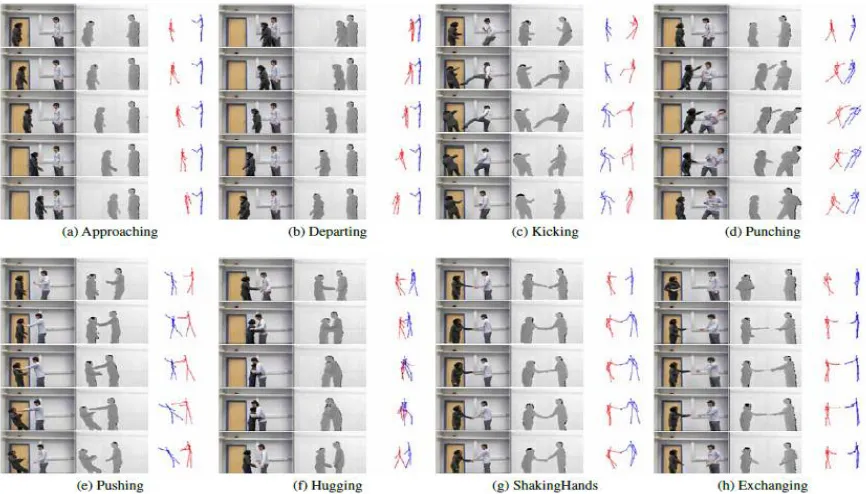
We collect two person interactions using the MicrosoftKinect sensor. We choose eight types of two-person interactions,motivated by the activity classes from, including:Approaching, departing, pushing, kicking, punching,exchanging objects, hugging, and shaking hands. Notethat all of these action categories have interactions betweenactors that differ from the categories performed by a singleactor independently. These action categories are challengingbecause they are not only non-periodic actions,but also have very similar body movements. For instance,‘exchanging object’ and ‘shaking hands’ contain commonbody movements, where both actors extend and then withdrawarms. Similarly, ‘pushing’ might be confused with‘punching’.All videos are recorded in the same laboratory environment.Seven participants performed activities and thedataset is composed 21 sets, where each set contains videosof a pair of different persons performing all eight interactions.Note that in most interactions, one person is actingand the other person is reacting. Each set contains one ortwo sequences per action category. The entire dataset has atotal of 300 interactions approximately.Both color image and depth map are 640 * 480 pixels.
Figure 1: Visualization of our interaction dataset. Each row per interaction contains a color image, a depth map, and extracted skeletons at the first, 25%, 50%, 75%, and the last frame of the entire sequence for each interaction: approaching, departing, kicking, punching, pushing, hugging, shaking hands, and exchanging. A
red skeleton indicates the person who is acting, and a blue skeleton indicates the person who is reacting.
Although the skeleton extraction from depth maps providesa rather accurate articulated human body, it containsnoisy and incorrect tracking. Especially, since the full-bodytracking by NITE middleware is less stable on fast and complexmotions, and occlusions, there often exist trackingfailures in our dataset. For example, the position of an armis stuck in Figure 1e and Figure 1a. The overall trackingis sometimes bad when a large amount of body parts oftwo persons overlap. More examples canbe found in the supplementary material.
IV. SUPPORT VECTOR MACHINE
SVM is a binary classifier to analyze the data and recognize the pattern for classification. The main goal is to design hyper plane that classifies all the training vectors in different classes. The aim is to determine a function ( )which obtainthe hyperplane. Hyper-plane separates two classes of data sets . The linear classifier is defines as the optimal separating hyper-plane.The data sets can be separated in two ways : linearly separated or nonlinearly separated.
The vectors are said to be optimally separated if they are separated without error and the distance between the two closest vector points is maximum.
For linear separable data sets, training vectors of different class of pairs ( , )
Where m =1,2,3,4 …, t
є
є { +1, -1}
The decision boundary is placed using maximal margin between the closest points. being a vector perpendicular median to the street. a be the unknown of to be placed in particular class according to the decision boundary.
And hyper plane (w. a) + c =0 with c as constant
For classification
( . ) + ≤ -1, ∀ =−
where ( . ) shows dot product of w and .
The inequalities if added i.e multiplying (1) and (2) with +1, −1, and .
suppose such that = 1 for +ve samples
= -1 for -ve samples
We get,
[ ( . ) + ]≥ 1
[( . ) + ]≥ 1
Therefore rearranging the above equations
( . ) + – 1 ≥ 0
for points into dataset to in the gutter i.e on the decision boundary
( . ) + – 1 = 0
The SVM classifier places the decision boundary by using maximal margin among all possible hyper planes. To maximize the M the margin between the hyper plane. ||w|| width of the street i.ehyperplane has to minimize . the unit vector for width is given as
Width = ( − ). ‖ ‖
‖ ‖is magnitude, , are the coordinates in the hyper plane
Dot product is scalar. To maximize, for coordinates (1,-1) the width = ‖ ‖ .
We can conclude, we need to max(‖ ‖) i.e min ‖ ‖ i.e min ‖ ‖ done for mathematical convenience.
When we use extremist i.e min and max with constraints like constant b , the problem is called quadratic optimization problem. Hence to solve it we need langrange function. Let the langrange multiplier be ,
a vector defining the boundary is w , is the input data vector points. C is scalar threshold value. be the obtained when function L is minimized w.r.t w, c and to get maximize value , we need to differentiate function L w.r.t w, c and equating it with zero shown in equation below:
= ‖ ‖ − ∑ [ ( . ) + – 1]
Rearranging the above equation,
=
i.e the linear sum of all the samples.
Here, there is an advantage of support vector machine over ANN with back propagation. In SVM there is one min solution only. Hence, in SVM local minima problem is solved. On other hand in back propagation ANN, there occur this local minima problem.
=− = 0
= 0
L function is changed to the dual Langrangian ( ) should be maximized with respect to non-negative. function is given as below
max = − 1
2
Equating the value of w in langrange function L, we get
= − 1
2
The above equation shows standard quadratic optimization problem. For dual optimization problem, the most suitable solution is with parameters w and c of hyperplanew.r.t . So the optimized hyperplane solution is given as:
( ) = ( . ) + ≥0
V. EXPERIMENTS
1. Experiments for Realtime interaction detection
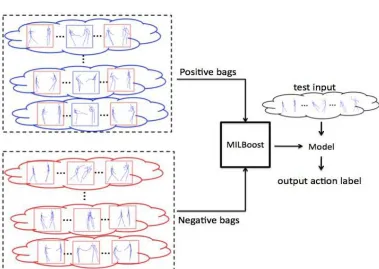
The features defined in Section 4.1 can be divided intothree groups: two joint features, two plane features, andtwo velocity features. We evaluate which group of featuresare the most appropriate for real-time two-person interactiondetection. 30 joints (i.e. 15 joints of each person) areused for joint features. Both plane features and velocity features are much higher dimensionvectors. For this reason, we choose ten markers Blue rectangles indicate true positive instances and redrectangles indicate true negative instances. If a positive baghas at least one instance is positive (i.e. actual kicking action),while a negative bag does not have any of kicking action.The MILBoost classifier outputs an action label givena test sequence.
very high dimension(i.e. 800 *W for plane and velocity, even higher fornormal velocity).All body-pose features are computed within W=3 (0.2seconds). To classify eight action categories, we trainSVMs in a one-vs-all fashion, and evaluation is done by5-fold cross validation, i.e. 4 folds are used for training,and 1 for testing. The dataset is composed by 21 sets oftwo actors. We randomly split the dataset into 5 folds of4-5 two-actor sets each. The partitioning of the datasetsinto folds is performed so that each two-actor set is guaranteedto appear only in training or only in testing. Table1 shows the real-time activity detection accuracy of eightcomplex human-human interactions from our dataset. Theresults are averaged over the 5 permutations and the parameterselection of SVMs is done by nested cross validationwith cost C 2 f0.01, 0.1, 1, 10, 100g. We also evaluatedwith a non-linear kernel for the SVM, but it yielded verylittle, if any, improvement for most of features since ourbody-pose features are high dimensional. The result showsjoint features result in higher detection accuracy than planefeatures and velocity features. We conclude that the geometricrelational body-pose feature based on Euclidean distancebetween joints captures the temporal and dynamic informationof body movement for complex human activities in thereal-time action detection scenario. Also, it is more stable with noisy full-body tracking than velocity features. Yaoet al. pointed out velocity features have the best accuracy or single activity recognition using clean motion capturedata with reduced skeleton (=13 joints). However, they also claimed that velocity features are not robust to noise byusing synthesized noisy skeleton. As we have seen in Section3, our dataset contains a significant amount of incorrecttracking and noise, which might explain the lower accuracy of velocity features. Note that the raw position feature usesthe position of all 30 joints at a frame. The low accuracy using the raw position feature means that the actions in thedataset are difficult to classify.
2. Experiments on Whole Action Sequence Classification
Figure 2: The overview of the ‘kicking’ MILBoost classifier.
VI. CONCLUSION
We have created a new dataset for two-person interaction using the Microsoft Kinectsensor including eight interactions, color-depth video and motion capture data ateach frame. Using this dataset, we have evaluated body-pose features motivated from 3D skeleton features for indexing and retrieval of motion capture data. Geometric relational features based on distance between all pairs of joints (i.e. joint features) outperformed other features for real-time interaction detection on noisy 3D skeleton data. Moreover, we have shown that the MIL Boost classifier outperforms SVMs if there exist irrelevant actions in the training data.
REFERENCES
[1] A. Nelson, “The UK approach to managing risk at passive level crossings,”in Proc. 7th Int. Symp. RailRoad-Highway Grade Crossing Res. Safety, 2002, pp. 1–11.
[2] E. Griffioen, “Improving level crossings using findings from human behaviour studies,” in Proc. 8th Int. Level Crossing Symp., Sheffield, U.K., 2004.
[3] [Online]. Available: http://www.uic.org/cdrom/2008/11_wcrr2008/pdf/G. 2.4.5.4.pdf
[4] L. Khoudour, M. Ghazel, F. Boukour, M. Heddebaut, and M. El-Koursi, “Towards safer level crossings: Existing recommendations, new applicable technologies and a proposed simulation model,” Eur. Transp. Res. Rev., vol. 1, no. 1, pp. 35–45, Mar. 2009.
[5] J. J. Garcia et al., “Efficient multisensory barrier for obstacle detection on railways,” IEEE Trans. Intell. Transp. Syst., vol. 11, no. 3, pp. 702– 713, Sep. 2010.
[6] E. Schnieder, R. Slovak, E. M. El Koursi, L. Tordai, and M. Woods, “A European contribution to level crossing safety,” in Proc. FOVUS, Stuttgart, Germany, Sep. 2008, pp. 222–228.
[7] Government’s IT Strategy Headquaters: New IT Reform Strategy, The Realization of Society, inWhichEveryone Can Benefit From IT, Anytime and Anywhere, Jan. 19 2006, 19.
[9] N. Fakhfakh et al., “Background subtraction and 3D localization of moving and stationary obstacles at level crossings,” in Proc. Int. Conf. Image Process. Theory, Tools Appl., Paris, France, 2010, pp. 72–78.
[10] A. Prioletti et al., “Part-based pedestrian detection and feature-based tracking for driver assistance: Real-time, robust algorithms, and evaluation,”
IEEE Trans. Intell. Transp. Syst., vol. 14, no. 3, pp. 72–74, Sep. 2013.
[11] B. U. Toreyin, A. E. Cetin, A. Aksay, and M. B. Akhan, “Moving object detection in wavelet compressed video,” Signal Process., Image Commun., vol. 20, no. 3, pp. 255–264, Mar. 2005.
[12] B. Han, D. Comaniciu, and L. S. Davis, “Sequential Kernel density approximation through mode propagation: Applications to background modeling,” in Proc. Asian Conf. Comput. Vis., Jan. 2004, pp. 818–823.
[13] N. M. Oliver, B. Rosario, and A. P. Pentland, “A Bayesian computer vision system for modeling human interactions,” IEEE Trans. Pattern Anal. Mach. Intell., vol. 22, no. 8, pp. 831–843, Aug. 2000.
[14] A. R. J. Francois, “Real-time multi-resolution blob tracking,” Univ. Southern California, Los Angeles, CA, USA, IRIS Tech. Rep. IRIS-04- 422, 2004.