DOI: 10.1534/genetics.105.050245
Genetic Interactions Between Nhp6 and Gcn5 With Mot1 and the Ccr4–Not
Complex That Regulate Binding of TATA-Binding Protein in
Saccharomyces cerevisiae
Debabrata Biswas, Yaxin Yu, Doyel Mitra and David J. Stillman
1Department of Pathology, University of Utah Health Sciences Center, Salt Lake City, Utah 84132 Manuscript received August 29, 2005
Accepted for publication October 20, 2005
ABSTRACT
Our previous work suggests that the Nhp6 HMGB protein stimulates RNA polymerase II transcription via the TATA-binding protein TBP and that Nhp6 functions in the same functional pathway as the Gcn5 histone acetyltransferase. In this report we examine the genetic relationship between Nhp6 and Gcn5 with the Mot1 and Ccr4–Not complexes, both of which have been implicated in regulating DNA binding by TBP. We find that combining either anhp6abor agcn5mutation withmot1,ccr4,not4, ornot5mutations results in lethality. Combiningspt15point mutations (in TBP) with eithermot1orccr4also results in either a growth defect or lethality. Several of these synthetic lethalities can be suppressed by overexpression of TFIIA, TBP, or Nhp6, suggesting that these genes facilitate formation of the TBP–TFIIA–DNA complex. The growth defect of anot5mutant can be suppressed by amot1mutant.HOgene expression is reduced bynhp6ab,gcn5, ormot1 mutations, and the additive decreases in HO mRNA levels in nhp6ab mot1 and gcn5 mot1 strains suggest different modes of action. Chromatin immunoprecipitation experiments show decreased binding of TBP to promoters inmot1mutants and a further decrease when combined with eithernhp6aborgcn5mutations.
T
RANSCRIPTIONAL activation by RNA polymerase II (pol II) requires the assembly of a complex of general transcription factors at a promoter (Hampsey1998; Dviret al.2001). It is believed that transcriptional
coactivators function by stimulating DNA binding by the general transcription factors TBP (TATA-binding protein), TFIIA, and TFIIB. Additionally, there are transcription factors that have been shown to negatively regulate bind-ing of TBP to promoter DNA (reviewed by Lee and
Young1998; reviewed by Pugh2000). Factors such as
TAF1 and NC2 interact with TBP and inhibit its activity (Goppeltet al.1996; Mermelsteinet al.1996; Baiet al.
1997; Kokuboet al.1998). In contrast, Mot1 can
disassoci-ate TBP from DNA (Aubleet al.1994), and the Ccr4–Not
complex may inhibit the recruitment of other general factors by TBP (Collart1996; Badarinarayanaet al.
2000). Additionally, two TBP molecules can dimerize to create a form that does not bind DNA (Coleman and
Pugh1997).
Mot1 is thought to inhibit transcription of certain genes by inhibiting TBP binding (for review see Pereira et al.2003).In vitro, the Mot1 protein binds to TBP–DNA complexes and uses the energy of ATP to dissociate TBP from the DNA (Auble et al. 1994; Darst et al. 2003).
Mot1 is an essential gene, and the fact thatmot1 muta-tions cause derepression of specific genes is consistent
with a proposed role as a negative regulator (Aubleet al.
1994). However, Mot1 also functions as a positive regu-lator of transcription, asmot1mutations reduce expres-sion of certain genes (Andrau et al. 2002; Dasgupta et al. 2002). There are strong genetic interactions be-tweenMOT1andSPT15(encoding TBP) and with other basal factors, including TOA1 and TOA2 (encoding TFIIA), SPT3, and the Ccr4–Not complex (Collart
1996; Madison and Winston 1997). It has been
sug-gested that Mot1 can stimulate transcription by inhib-iting the association of NC2, a TBP inhibitor, with promoters (Geisberg et al.2002) and that the Mot1–
TBP complex delivers TBP to TAF-independent genes (Gumbs et al. 2003). Additionally, Mot1 is required
for nucleosome remodeling at the GAL1 promoter (Topalidou et al. 2004). In normally growing cells,
Mot1 co-occupies promoters with TBP, but not with TFIIB, TFIIA, or TAFs (Geisbergand Struhl2004).
The Ccr4–Not complexes have multiple roles in gene regulation, including regulation of transcriptional ini-tiation, elongation, and mRNA degradation (for reviews see Collart 2003; for reviews see Denis and Chen
2003). Ccr4–Not has been implicated as both a positive and a negative regulator of transcription (Liuet al.1998),
and the Gcn4 DNA-binding activator can recruit Ccr4– Not to promoters (Swanson et al.2003). Some of the
genes encoding subunits of this protein complex have been found to interact both physically and genetically with TBP, TAFs, and regulators of TBP binding, and it has been suggested that Ccr4–Not represses transcription
1Corresponding author: Department of Pathology, University of Utah,
30 North 1900 E., Room 5C126 SOM, Salt Lake City, UT 84132-2501. E-mail: [email protected]
by inhibiting DNA binding by TBP (Collart 1996;
Badarinarayanaet al.2000; Lemaireand Collart2000;
Deluenet al.2002).
We have studied the regulation of the yeastHOgene, and our studies suggest that Gcn5 and Nhp6 function in parallel to activate expression of this gene (Yuet al.2000,
2003). Gcn5 is the histone acetyltransferase present in the yeast SAGA complex, and histone acetylation by Gcn5 is required for expression of many yeast genes (Sterner and Berger 2000). Nhp6 is related to the
HMGB family of small, abundant chromatin proteins that bend DNA sharply and modulate gene expression (Travers2003). Nhp6 is encoded by two genes,NHP6A
andNHP6B. No phenotype is seen innhp6aandnhp6b single mutants, while thenhp6a nhp6bdouble mutant (which we will describe asnhp6ab) is temperature sen-sitive for growth (Costiganet al.1994) and shows
tran-scriptional defects (Paull et al. 1996; Yu et al. 2000;
Fragiadakis et al. 2004). Nhp6 also functions with
Spt16 and Pob3, as part of the yeast FACT complex, to promote transcriptional elongation (Formosa et al.
2001), and Nhp6 is important for expression of the SNR6gene, transcribed by RNA polymerase III (Kruppa et al.2001; Lopezet al.2001; Martinet al.2001).
Our data suggest that Gcn5 and Nhp6 function to promote assembly of the TBP–TFIIA–DNA complex (Yuet al.2003; Biswaset al.2004; Erikssonet al.2004a).
Viable mutations affecting TBP or TFIIA (spt15 or toa2, respectively) are lethal in gcn5 or nhp6ab mutant strains. TBP overexpression suppresses the temperature-sensitive growth defect of nhp6ab strains and certain transcriptional defects of eithernhp6aborgcn5mutants.
Additionally, the gcn5 nhp6ab triple mutant displays a strong synthetic growth defect, but this phenotype can be suppressed by mutations in the SPT3 gene. Spt3, which is part of the SAGA complex with Gcn5 (Sterner et al.1999), interacts with TBP both physically and ge-netically (Eisenmannet al.1992). We find that anspt3
mutation can suppress a number ofgcn5andnhp6ab de-fects, including reduced HOexpression, temperature-sensitive growth, and synthetic lethality with TBP mutants. Chromatin immunoprecipitation experiments show that Spt3 regulates TBP bindingin vivo, inhibiting TBP binding to theHOpromoter while stimulating TBP binding toGAL1(Dudleyet al.1999; Yuet al.2003).
In this study we use genetic tools to examine the rela-tionship of Mot1 and Ccr4–Not to Gcn5 and Nhp6. Spt3, Mot1, and Ccr4–Not all regulate binding of TBP to DNA, andspt3mutations suppress manygcn5andnhp6ab de-fects. However, instead of suppression, we find synthetic lethal interactions between Mot1 and Ccr4–Not with Gcn5 and Nhp6. Multicopy suppression experiments sup-port a critical role of these factors in facilitating forma-tion of the TBP–TFIIA complex on DNA. Additive effects onHOgene transcription suggest that Mot1 functions differently from either Nhp6 or Gcn5. Chromatin im-munoprecipitation (ChIP) experiments show that TBP binding to promoters is reduced inmot1mutants, with an additive decrease when combined withnhp6aborgcn5.
MATERIALS AND METHODS
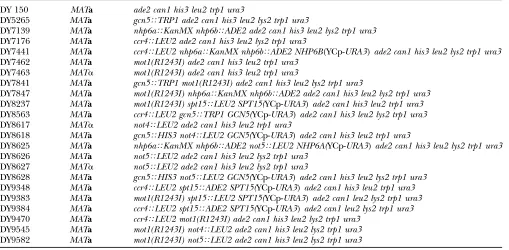
Strains and media:All yeast strains used are listed in Table 1 and are isogenic in the W303 background (Thomas and TABLE 1
Strain list
DY 150 MATa ade2 can1 his3 leu2 trp1 ura3
DY5265 MATa gcn5TTRP1 ade2 can1 his3 leu2 lys2 trp1 ura3
DY7139 MATa nhp6aTKanMX nhp6bTADE2 ade2 can1 his3 leu2 lys2 trp1 ura3
DY7176 MATa ccr4TLEU2 ade2 can1 his3 leu2 lys2 trp1 ura3
DY7441 MATa ccr4TLEU2 nhp6aTKanMX nhp6bTADE2 NHP6B(YCp-URA3)ade2 can1 his3 leu2 lys2 trp1 ura3
DY7462 MATa mot1(R1243I) ade2 can1 his3 leu2 trp1 ura3 DY7463 MATa mot1(R1243I) ade2 can1 his3 leu2 trp1 ura3
DY7841 MATa gcn5TTRP1 mot1(R1243I) ade2 can1 his3 leu2 lys2 trp1 ura3
DY7847 MATa mot1(R1243I) nhp6aTKanMX nhp6bTADE2 ade2 can1 his3 leu2 lys2 trp1 ura3
DY8237 MATa mot1(R1243I) spt15TLEU2 SPT15(YCp-URA3)ade2 can1 his3 leu2 trp1 ura3
DY8563 MATa ccr4TLEU2 gcn5TTRP1 GCN5(YCp-URA3)ade2 can1 his3 leu2 lys2 trp1 ura3
DY8617 MATa not4TLEU2 ade2 can1 his3 leu2 trp1 ura3
DY8618 MATa gcn5THIS3 not4TLEU2 GCN5(YCp-URA3)ade2 can1 his3 leu2 trp1 ura3
DY8625 MATa nhp6aTKanMX nhp6bTADE2 not5TLEU2 NHP6A(YCp-URA3)ade2 can1 his3 leu2 lys2 trp1 ura3
DY8626 MATa not5TLEU2 ade2 can1 his3 leu2 lys2 trp1 ura3
DY8627 MATa not5TLEU2 ade2 can1 his3 leu2 lys2 trp1 ura3
DY8628 MATa gcn5THIS3 not5TLEU2 GCN5(YCp-URA3)ade2 can1 his3 leu2 lys2 trp1 ura3
DY9348 MATa ccr4TLEU2 spt15TADE2 SPT15(YCp-URA3)ade2 can1 his3 leu2 trp1 ura3
DY9383 MATa mot1(R1243I) spt15TLEU2 SPT15(YCp-URA3)ade2 can1 leu2 lys2 trp1 ura3
DY9384 MATa ccr4TLEU2 spt15TADE2 SPT15(YCp-URA3)ade2 can1 leu2 lys2 trp1 ura3
DY9470 MATa ccr4TLEU2 mot1(R1243I) ade2 can1 his3 leu2 lys2 trp1 ura3
DY9545 MATa mot1(R1243I) not4TLEU2 ade2 can1 his3 leu2 lys2 trp1 ura3
Rothstein1989). Standard genetic methods were used for strain construction (Rothstein1991; Sherman1991). W303 strains with disruptions ingcn5,nhp6a, andnhp6bhave been described (Yuet al.2000, 2003) and themot1(R1243I) allele was identified in a screen for Sptÿ mutations ( Jiang and Stillman1996). Theccr4 disrupted strain was provided by Clyde Denis, and thenot4andnot5disrupted strains by Martine Collart. These strains were then crossed to generate the strains used here. Strain DY9384 was constructed by disrupting the LYS2gene in strain DY9348 with the D588lys2THIS3marker
swap plasmid (Vothet al.2003). Cells were grown at the indi-cated temperature in YEPD medium (Sherman1991), except where synthetic complete medium with 2% glucose supple-mented with adenine, uracil, and amino acids, as appropriate, but lacking essential components, was used to select for plas-mids. 5-FOA medium was prepared as described (Boekeet al. 1984).
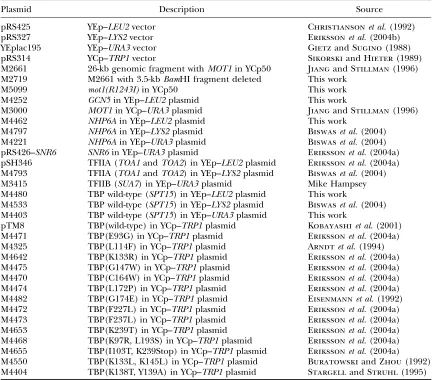
Plasmids:The multicopy plasmids used are listed in Table 2. Plasmid M4252 was constructed by moving a 1.8-kbSacI–XhoI fragment withGCN5from plasmid pRS315–GCN5(Marcus et al.1994) into pRS425 (Christiansonet al.1992). Plasmid M4462 was constructed by moving a 0.95-kbHindIII–SacI frag-ment withNHP6Afrom plasmid M4221 (Biswaset al.2004) into pRS325 (Sikorskiand Hieter1989). A 2.25-kbBamHI– PstI fragment withSPT15from pSH2223 (Yuet al.2003) was
cloned into YEplac195 (Gietzand Sugino1988) and pRS425 (Christiansonet al.1992), constructing M4403 and M4480, respectively. Plasmid M2661 was isolated from a YCp50 ge-nomic library as complementing the temperature-sensitive phenotype of themot1mutant (Jiang and Stillman1996), and M2719 was constructed from M2661 by deleting a 3.5-kb BamHI fragment within theMOT1gene. Themot1(R1243I) allele was cloned by transforming DY7463 [mot1(R1243I)] with plasmid M2719, which had been cleaved with SacI, yielding plasmid M5099, which was then sequenced.
RNA analysis:RNA levels were determined with S1 nuclease protection assays as described (Bhoiteand Stillman1998). The sequences of the S1 primers are as follows: CLN2, TAC AACCGCCCCAAGTTTTAGCAGCCAACCAGAGACAAGTAG CGACAACCAATTTGGCTTGGTCCCGTAACACGATTCTCG GTTCC; TBP (SPT15), ACGCATGATGACAGCAGCAAAACG CTTGGGGTTATATTCTGCATTACGGGCATGTAGCGCTTGA CA; TFIIB (SUA7), TCCTTGCCACTTCAGCACGTCTGCAAC CAATCAGTATGGATGCAGCCATTTATGAG; TFIIA (TOA1), ATCTGCTCCTTTTCCTTGCGGGTTTTTTCCACGTCCTCC TCCTTTTCCTCGTCGTCTTTCAAGAGT; and TFIIA (TOA2), GGAGGCGTCGCGGTGGCTGTCCTCAACAGTAACCTGACA ATTTTTTACGAATTTTC. TheHO,CMD1, and tRNA–Trp prim-ers have been described (Bhoite and Stillman1998; Ozer et al.1998).
TABLE 2
Plasmids
Plasmid Description Source
pRS425 YEp–LEU2vector Christiansonet al.(1992)
pRS327 YEp–LYS2vector Erikssonet al.(2004b)
YEplac195 YEp–URA3vector Gietzand Sugino(1988)
pRS314 YCp–TRP1vector Sikorskiand Hieter(1989)
M2661 26-kb genomic fragment withMOT1in YCp50 Jiangand Stillman(1996) M2719 M2661 with 3.5-kbBamHI fragment deleted This work
M5099 mot1(R1243I)in YCp50 This work
M4252 GCN5in YEp–LEU2plasmid This work
M3000 MOT1in YCp–URA3plasmid Jiangand Stillman(1996)
M4462 NHP6Ain YEp–LEU2plasmid This work
M4797 NHP6Ain YEp–LYS2plasmid Biswaset al.(2004) M4221 NHP6Ain YEp–URA3plasmid Biswaset al.(2004) pRS426–SNR6 SNR6in YEp–URA3plasmid Erikssonet al.(2004a) pSH346 TFIIA (TOA1andTOA2) in YEp–LEU2plasmid Erikssonet al.(2004a) M4793 TFIIA (TOA1andTOA2) in YEp–LYS2plasmid Biswaset al.(2004) M3415 TFIIB (SUA7) in YEp–URA3plasmid Mike Hampsey M4480 TBP wild-type (SPT15) in YEp–LEU2plasmid This work
M4533 TBP wild-type (SPT15) in YEp–LYS2plasmid Biswaset al.(2004) M4403 TBP wild-type (SPT15) in YEp–URA3plasmid This work
ChIP analysis: Chromatin immunoprecipitation was per-formed as described (Biswaset al.2005), with the PCR ampli-fications performed in triplicate. The sequences of the PCR primers are as follows:ELP3, TGCCGCTTTCATTGTTTAATC ATTTCACCTT and TCCATGACGAGCCATCTTTGTCAGGG; HXT4, TTAGTGGTGAAAAGCTTCAACACTGG and TTCAA AACCAAACCTTGATAAGAGGC; RPS5, AGGCTTAGTGGA GGTCTCACTGAA and GACTGGGGTGAATTCTTCAACAA; URA1, CCGAAGGTTATTTCACGA and CTGGCTGTCATGTT TGGT. The PCR primers forSER3and intragenic V (used as internal control) have been described (Biswaset al.2005).
RESULTS
Genetic interactions of Nhp6 and Gcn5 with Mot1: Deletion of theSPT3gene suppresses both temperature-sensitive growth and transcriptional defects caused by the absence of Nhp6 (Yuet al.2003). As Spt3 interacts
with TBP (Eisenmann et al. 1992), we wanted to ask
whether mutations in other factors that interact with TBP would suppress thenhp6abmutation. Mot1 has also been shown to interact with TBP, and Mot1 inhibits TBP bindingin vitro(Aubleet al.1994). Additionally, strong
genetic links have been established for Mot1 with both Spt3 and TBP (Collart1996; Madisonand Winston
1997).MOT1is an essential gene, but viable alleles have been identified (Abateet al.1990; Prelichand Winston
1993; Madisonand Winston1997; Darstet al.2003).
We isolated a viablemot1allele in a genetic screen ( Jiang
and Stillman1996). We cloned thismot1allele from the
genome by allele rescue with a gappedMOT1 plasmid (Rothstein1991) and sequenced the gene. The
muta-tion has an arginine-to-isoleucine substitumuta-tion at residue 1243. R1243 is highly conserved among Mot1 proteins, and when it is not arginine this position is usually lysine, also a basic amino acid. We crossed the mot1(R1243I) allele to a nhp6ab strain and isolated a nhp6a nhp6b mot1(R1243I) triple mutant. Instead of finding genetic suppression, we were surprised to find strong synthetic phenotypes. The nhp6ab mot1(R1243I) triple-mutant strain showed a strong growth defect at 25°and was lethal at 30°on YEPD medium (Figure 1A).
We next asked whether multicopy plasmids could suppress the growth defect (Figure 1B). As expected, theMOT1andNHP6Aplasmids complemented, but the YEp–TFIIA and YEp–GCN5 plasmids exacerbated the growth defect at 25°. However, at 30°, YEp–SNR6 or YEp–TBP strongly suppressed the growth defect, and YEp–TFIIB showed moderate suppression.nhp6ab mutants are defective in expressing SNR6, a pol III transcribed gene encoding the U6 splicing RNA (Lopez et al.2001; Martinet al. 2001). YEp–SNR6suppresses
the temperature-sensitive growth defect seen innhp6ab mutants, and it is suggested that decreasedSNR6RNA contributes to the poor growth at elevated temperatures (Kruppa et al. 2001). The suppression of the nhp6ab mot1(R1243I)synthetic lethality by YEp–TBP and YEp– TFIIB suggests that this mutant strain is defective in
building the TBP–TFIIB complex at promoters of pol II transcribed genes. It is less clear why overexpression of TFIIA or Gcn5 exacerbates the growth defect in the nhp6ab mot1(R1243I)strain.
We next looked for genetic interactions between GCN5 and MOT1, since Nhp6 and Gcn5 function in the same pathway for transcriptional activation of HO (Yuet al.2000). We constructed the gcn5 mot1(R1243I)
double mutant and found that it too has a strong growth defect at 25° and is nearly inviable at 30° on YEPD medium (Figure 2A). Interestingly, the growth of the nhp6a nhp6b mot1(R1243I)triple mutant at 25°is much worse than that for thegcn5 mot1(R1243I)double mu-tant. Figure 2B shows the effects of multicopy plasmids on growth of the gcn5 mot1(R1243I) strain. Note that while thegcn5 mot1(R1243I)strain is lethal on complete YEPD medium at 30°, it is able to grow, although poorly, on selective plates at 30°. Plasmids withMOT1orGCN5 complemented, as expected, while multicopy plasmids with TFIIA, TFIIB, orSNR6did not affect growth of the gcn5 mot1(R1243I) strain (data not shown). Interest-ingly, overexpression of TBP or Nhp6 significantly ex-acerbated the growth defect of the gcn5 mot1(R1243I) mutant at 30°, supporting the idea that Gcn5 and Mot1 play an active role in regulating TBP binding.
We note that the multicopy suppression results are quite different, with YEp–TBP suppressing thenhp6ab mot1(R1243I) mutant but exacerbating the growth de-fect in thegcn5 mot1(R1243I)mutant. This suggests that the defects caused by the nhp6ab deletion and the mot1(R1243I)mutation are quite different.
regulating transcriptional initiation, elongation, and mRNA degradation (Denisand Chen2003). A number
of experiments have shown that Ccr4–Not represses tran-scription through direct contacts with TBP, inhibiting TBP binding to DNA (Collart1996; Badarinarayana et al. 2000; Lemaire and Collart 2000; Deluen et al.2002). We therefore performed genetic crosses to determine whether a ccr4 mutation might suppress nhp6aborgcn5defects. In the first cross we were unable to recover a viablenhp6ab ccr4spore. To verify this ap-parent synthetic lethality, we constructed anhp6aD/1 nhp6bD/1 ccr4D/1 triply heterozygous diploid strain and transformed it with a YCp–URA3–NHP6Aplasmid. The diploids were induced to undergo meiosis, tetrads were dissected, and we isolated haploid strains with the nhp6a nhp6b ccr4genotype containing the YCp–URA3– NHP6Aplasmid. These strains were unable to grow on media containing 5-FOA (Figure 3A), indicating that the YCp–URA3–NHP6Aplasmid cannot be lost. We next asked whether multicopy plasmids could suppress this synthetic lethality. Fornhp6ab ccr4, the YEp–TBP plas-mid partially suppressed the synthetic lethality, but YEp– TFIIA did not (Figure 3A). This is an important result, as both Ccr4 and Nhp6 have roles in transcriptional initiation and elongation, but the suppression by TBP overexpression suggests that a defect in initiation contributes to the nhp6ab ccr4 synthetic lethality. We also determined thatccr4is synthetic lethal with agcn5 mutation. We constructed agcn5 ccr4strain, containing a YCp–URA3–GCN5plasmid, which is unable to grow on 5-FOA (Figure 3B). This synthetic lethality is partially suppressed by YEp–TFIIA, but not by YEp–TBP, YEp– TFIIB, or YEp–NHP6A(Figure 3B; data not shown).
In addition to regulating TBP binding, Ccr4 is the catalytic subunit of a cytoplasmic mRNA deadenylase
(Chenet al.2002; Tuckeret al.2002). Although the Not
proteins are associated with the cytoplasmic form of the Ccr4–Not complex, mutations in the NOT genes have only modest effects on the rate of deadenylation (Tuckeret al.2002), suggesting that the Not proteins
and Ccr4 may have important functional differences. We therefore asked whether there are genetic interac-tions between nhp6ab or gcn5 and not4 and not5. For example, a haploidnhp6a nhp6bstrain was crossed to a not5mutant, and the resulting diploid was transformed with a YCp–URA3–NHP6A plasmid. After sporulation and tetrad dissection, a nhp6ab not5 triple mutant with the YCp–URA3–NHP6Aplasmid was isolated. This strain was unable to grow on 5-FOA, demonstrating the synthetic lethality of nhp6ab withnot5. In this way we were able to show that thenhp6ab not4,nhp6ab not5,gcn5 not4, and gcn5 not5 mutant combinations were all synthetic lethal (Figure 4A; data not shown). Multicopy suppression experiments showed that YEp–TFIIA could suppress the gcn5 not5synthetic lethality (Figure 4B), but multicopy suppression was not seen with YEp– TFIIB, YEp–TBP, or YEp–NHP6A.
We observed synthetic lethality ofgcn5with all three members of the Ccr4–Not complex that we tested:ccr4, not4, andnot5. In contrast, Mailletet al.(2000) did not
observe synthetic lethality in gcn5 ccr4 or gcn5 not5 mutants and saw only a synthetic slow-growth defect in thegcn5 not4double mutant. We used W303 strains, while their studies utilized a different strain back-ground, and strain differences could be responsible for the different results.
Thenot5single mutant shows a growth defect at 30° and is unable to grow at the higher temperature of 33°. Thus, we asked whether overexpression of other factors Figure 3.—Genetic interactions ofCCR4withGCN5 and NHP6. (A) Thenhp6ab ccr4 synthetic lethality is suppressed by TBP overexpression. Strain DY7441 (nhp6ab ccr4 with a YCp–URA3–NHP6B plasmid) was transformed with the indi-cated LYS2 multicopy plasmids, and dilutions were plated at 30°for 2 days (complete) or for 6 days (5-FOA). (B) The gcn5 ccr4synthetic lethality is suppressed by TFIIA overexpres-sion. Strain DY8563 [(gcn5 ccr4) with a YCp–URA3–GCN5 plas-mid] was transformed with either YEp–TFIIA or the YEp–LYS2 vector, and dilutions were plated at 33°for 2 days (complete) or for 5 days (5-FOA).
affected growth of thenot5mutant. Thenot5strain was transformed with multicopy plasmids and then growth at various temperatures was assessed. While multicopy plasmids with TBP or TFIIA did not affect growth of thenot5mutant, YEp–TFIIB improved growth at 25°and partially suppressed the temperature-sensitive growth defect (Figure 4). In contrast, overexpression of Nhp6 exacerbated thenot5growth defect, even at 25°(Figure 4; data not shown). This exacerbation of thenot5growth defect by the multicopy plasmid withNHP6Areinforces the role of Nhp6 in RNA pol II transcription.
spt3 is synthetic lethal with mot1 or ccr4: Spt3 physically interacts with TBP, and Spt3 acts to either promote or inhibit TBP binding, depending on the promoter (Eisenmannet al. 1992; Dudleyet al.1999;
Belotserkovskaya et al. 2000; Bhaumik and Green
2002; Barbaricet al.2003; Yuet al.2003). Additionally,
we have observed that an spt3 mutation can suppress growth defects in both nhp6a nhp6b and gcn5 nhp6a nhp6bstrains (Yuet al.2003) and the synthetic lethality
of TBP mutants ingcn5ornhp6abstrains (Biswaset al.
2004; Eriksson et al. 2004a). On the basis of these
results, we tested whether anspt3gene disruption can suppress the synthetic lethality of amot1mutation with gcn5ornhp6ab. Amot1(R1243I)mutant was crossed to a
gcn5 spt3 strain, and we found that spt3 mot1(R1243I) double mutants are synthetic lethal, consistent with an earlier report using a different mot1 allele (Madison
and Winston1997). We also crossed themot1(R1243I)
mutant to a nhp6ab spt3 strain but we were unable to isolate amot1(R1243I) nhp6ab spt3strain. Thusspt3 can-not suppress these synthetic lethalities withmot1.
We next asked whetherspt3could suppress the syn-thetic lethality of a ccr4 mutation with either gcn5 or nhp6ab. In these crosses we did not recover any viable ccr4 spt3strains, irrespective of theGCN5orNHP6 ge-notype, suggesting that ccr4 and spt3 are synthetically lethal. To test this idea, we transformed a1/ccr41/spt3 heterozygous diploid strain with a YCp–URA3plasmid with eitherCCR4orSPT3, and haploidccr4 spt3 segre-gants with either YCp–URA3–CCR4or YCp–URA3–SPT3 were isolated. These haploid strains were unable to grow on 5-FOA, demonstrating theccr4 spt3synthetic lethal-ity. This result disagrees with that of Badarinarayana et al. (2000), who found the ccr4 spt3 double mutant viable in their strain background.
Synthetic lethality of TBP mutants with mot1 and ccr4: We recently conducted a screen to identify TBP mutants that are viable, but lethal in the absence of Nhp6 (Eriksson et al. 2004a). Many of these TBP
mutants are also lethal in agcn5mutant (Biswaset al.
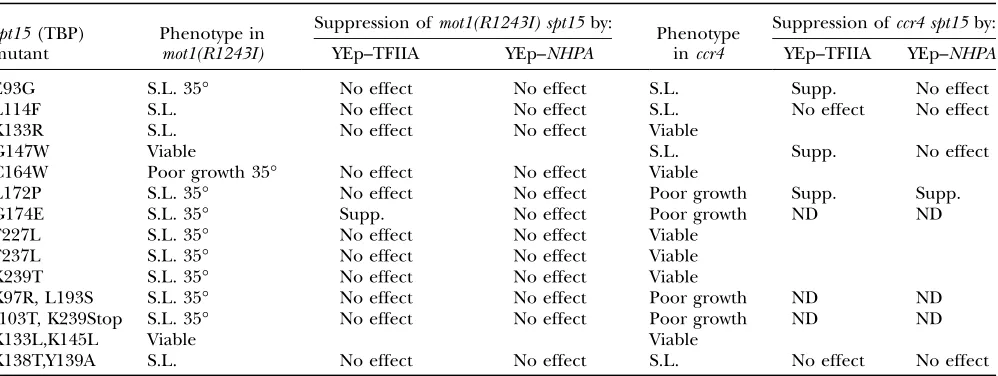
2004), and we decided to test whether mot1 or ccr4 mutations affected viability of these TBP mutants. We constructed amot1(R1243I) spt15Ddouble mutant, kept alive by the wild-typeSPT15(TBP) gene on a YCp–URA3 plasmid. This strain was transformed with 14 TBP mutants on YCp–TRP1 plasmids, and we used plasmid shuffling to assess the viability of themot1(R1243I) spt15 strains on 5-FOA media at 25°, 30°, and 35°, where the YCp–URA3—TBP (wild-type) plasmid must be lost for cells to grow (Table 3). Three TBP mutants were synthetic lethal with mot1(R1243I) at all temperatures tested, and 9 others either were synthetic lethal or showed very poor growth at 35°. All of these TBP mutants grew well at 35° in a MOT1 strain (data not shown). None of these mot1(R1243I) TBP synthetic interactions could be suppressed by a multicopy plas-mid with NHP6A (Table 3). However, the synthetic lethality at 35° between mot1(R1243I) and the G174E substitution in TBP [spt15(G174E)] could be sup-pressed by overexpression of TFIIA (Figure 5A ). Two conclusions result from these genetic experiments. First, most of these TBP mutants show a major growth defect when combined with mot1(R1243I). Second, overexpression of TFIIA can suppress themot1(R1243I) spt15(G174E) lethality, suggesting that Mot1 may con-tribute to formation of the TBP–TFIIA–DNA complex. We next constructed accr4 spt15double-deletion mu-tant with the wild-type SPT15 (TBP) gene on a YCp– URA3 plasmid. This strain was transformed with the same 14 TBP mutants and the ability of these trans-formants to grow at various temperatures on 5-FOA Figure4.—Genetic interactions ofNOTgenes withGCN5
andNHP6. (A) Anot5mutation is synthetic lethal withgcn5 and withnhp6, andnot4is synthetic lethal withgcn5. Dilutions of strains DY8618 (not4 gcn5), DY8628 (not5 gcn5), and DY8625 (not5 nhp6ab), each carrying a YCp–URA3 plasmid with eitherGCN5orNHP6A, were plated on the indicated me-dium at 25°for 3 days. (B) Thegcn5 not5synthetic lethality is suppressed by TFIIA overexpression. Strain DY8628 [(gcn5 not5) with a YCp–URA3–GCN5plasmid] was transformed with either YEp–TFIIA or the YEp–LYS2 vector and plated at 25°
without the wild-type TBP gene was assessed (Table 3). Four TBP mutants were synthetic lethal at all temper-atures in theccr4mutant, and four other TBP mutants showed poor growth at all temperatures in the ccr4 mutant. To assess multicopy suppression, theccr4 spt15 YCp–URA3TBP (wild-type) strain was transformed with the TBP mutants and YEp–TFIIA, YEp–NHP6A, or the YEp vector control. In several instances, overexpression of TFIIA or NHP6A suppressed the synthetic growth defects (Table 3; Figure 5B). For example, the ccr4 spt15(G147W) synthetic lethality is suppressed by YEp– TFIIA, and the ccr4 spt15(L172P) growth defect is
suppressed by overexpression of either TFIIA or NHP6A. The synthetic lethality between ccr4and TBP mutants, along with suppression by overexpression of TFIIA, strongly supports a role for Ccr4 either in facil-itating the interaction between TBP and TFIIA or in TBP binding at promoters.
Interestingly, the pattern of synthetic lethality is different for mot1(R1243I) and ccr4. For example, the K133R substitution in TBP [spt15(K133R)] is le-thal in mot1(R1243I) but viable in ccr4, while spt15 (G147W) shows an opposite pattern. This result sug-gests that Mot1 and Ccr4/Not have nonidentical roles in TABLE 3
Synthetic lethality of TBP mutants withmot1andccr4
spt15(TBP) mutant
Phenotype in mot1(R1243I)
Suppression ofmot1(R1243I) spt15by:
Phenotype inccr4
Suppression ofccr4 spt15by:
YEp–TFIIA YEp–NHPA YEp–TFIIA YEp–NHPA
E93G S.L. 35° No effect No effect S.L. Supp. No effect
L114F S.L. No effect No effect S.L. No effect No effect
K133R S.L. No effect No effect Viable
G147W Viable S.L. Supp. No effect
C164W Poor growth 35° No effect No effect Viable
L172P S.L. 35° No effect No effect Poor growth Supp. Supp.
G174E S.L. 35° Supp. No effect Poor growth ND ND
F227L S.L. 35° No effect No effect Viable
F237L S.L. 35° No effect No effect Viable
K239T S.L. 35° No effect No effect Viable
K97R, L193S S.L. 35° No effect No effect Poor growth ND ND
I103T, K239Stop S.L. 35° No effect No effect Poor growth ND ND
K133L,K145L Viable Viable
K138T,Y139A S.L. No effect No effect S.L. No effect No effect
S.L., synthetic lethal at all temperatures; S.L. 35°, viable at 25° and 30°, but lethal at 35°; Supp., suppression; ND, not determined.
regulating TBP. To test this idea, we crossed a mot1 (R1243I) mutant to three strains with mutations in CCR4, NOT4, or NOT5 and examined the growth of double-mutant strains. The ccr4 mot1(R1243I) double mutant shows a growth defect, compared to either single mutant (Figure 5C), and thenot4 mot1(R1243I) double mutant shows no additive effect (Figure 5D). The results with thenot5 mot1(R1243I)double mutant (Figure 5E) are quite striking. Thenot5 mutant is es-sentially unable to grow at 30°, but this growth defect is completely suppressed in thenot5 mot1(R1243I)double mutant. This suppression strongly argues that Mot1 and Ccr4/Not have quite different roles in transcriptional regulation.
Overexpression of basal transcription factors sup-presses some genetic defects involving nhp6, gcn5, mot1(R1243I),ccr4, andnot5(Figures 1–4). One expla-nation for these results is that expression of basal factors is reduced in these mutants, and thus overexpression suppresses growth defects. To address this question, we determined mRNA levels for TBP (SPT15 mRNA), TFIIB (SUA7mRNA), and TFIIA (two subunits, TOA1 andTOA2 mRNA). The results in Figure 6 show that these mutations innhp6,gcn5,mot1(R1243I),ccr4, and not5do not significantly affect mRNA levels for basal transcription factors.
Additive effects on HO expression in double mutants:As both Gcn5 and Nhp6 are required for full activation of the HO gene (Yuet al. 2003), we
deter-mined whether amot1(R1243I) mutation affected HO expression. HO mRNA levels are reduced to40% of wild type in themot1(R1243I)strain grown at 25°and reduced to 9% when grown at 30°(Figure 7A).HO is cell cycle regulated, and thus a defect in cell cycle
progression could reduce the fraction of cells in late G1,
when HO is expressed. To address this question, we also measuredCLN2mRNA levels;CLN2is expressed in late G1, coincident with HO. The mot1(R1243I) mutation
does not affectCLN2levels, and thus an alteration in the cell cycle does not cause the decreasedHOexpression. In contrast tomot1(R1243I), accr4 mutation does not affectHOexpression (data not shown).
On the basis of the additive growth defect in gcn5 mot1(R1243I) and nhp6a nhp6b mot1(R1243I) mutants, we looked for additive effects in transcriptional activa-tion atHO. Cells were grown at 25°, as some of the strains have severe growth defects at higher temperatures, and Figure6.—Basal factor expression is not affected by
mu-tants. RNA was prepared from strains DY150 (wild type), DY7176 (ccr4), DY8626 (not5), DY7139 (nhp6a), DY7463 [mot1 (R1243I)], and DY7847 [nhp6ab mot1(R1243I)] grown at 25°
and used for S1 nuclease protection assays to measure TBP (SPT15), TFIIB (SUA7), and TFIIA subunits one (TOA1) and two (TOA2) andCMD1(internal control) RNA levels.
Figure 7.—HO expression is reduced in mutant strains. (A) RNA was prepared from strains DY150 (wild type) and DY7462 [mot1(R1243I)] grown at either 25°or 30°and used for S1 nuclease protection assays to measure HO, CLN2, andCMD1(internal control) RNA levels. (B) RNA was pre-pared from strains DY150 (wild type), DY7463 [mot1(R1243I)], DY5265 (gcn5), DY7841 [gcn5 mot1(R1243I)], DY7139 (nhp6ab), and DY7847 [nhp6ab mot1(R1243I)] grown at 25°
RNA was isolated for S1 nuclease protection assays. As shown previously, HO expression is reduced in the nhp6abandgcn5strains (Figure 7B). Interestingly, there is an additive decrease inHOmRNA levels in thenhp6ab mot1(R1243I) triple mutant, compared to the nhp6ab and mot1(R1243I) strains. There is a similar additive
effect in the gcn5 mot1(R1243I) double mutant com-pared to the corresponding single mutants. These results are consistent with the idea that Nhp6, Gcn5, and Mot1 function through distinct mechanisms, al-though the effects may be on a common target. We have previously shown that the defect in HO expression in nhp6ab and gcn5 mutants can be suppressed by over-expression of TBP (Yuet al.2003).
Effects of mutations on TBP binding at promoters: We used ChIP assays to measure TBP binding to pro-moters in mutants. Cells were grown at 25°, shifted to 37° for 3 hr, and then treated with formaldehyde for crosslinking. After immunoprecipitation with anti-TBP antibody and reversal of crosslinks, TBP binding to various promoters was measured by real time PCR. As shown in Figure 8A, there is decreased TBP binding to the RPS5, HXT4, SER3, and URA1 promoters in the nhp6,gcn5, andmot1(R1243I) mutants. Othermot1 mutations have previously been shown to affect TBP binding toHXT4andURA1(Dasguptaet al.2005;van
Oevelenet al.2005). Importantly, not all promoters are
affected so strongly, for example,ELP3. When we look at the multiply mutant strains, such as nhp6ab mot1 (R1243I) and gcn5 mot1(R1243I), there are additive defects in TBP binding, although the additivity is modest. Overexpression of TBP suppresses the growth defect of nhp6ab mot1(R1243I) cells. We therefore examined TBP binding in nhp6ab mot1(R1243I) cells with the YEp–TBP plasmid (Figure 8B); the control for this experiment is the same strain with the YEp vector without an insert. TBP overexpression results in a sig-nificant increase in TBP binding at several promoters in these cells. These results support the idea that a defect in TBP binding to promoters contributes to the growth defect seen in these multiply mutant strains.
DISCUSSION
We have previously shown that the Nhp6 architectural transcription factor and the Gcn5 histone acetyltrans-ferase function in parallel pathways in activation of the yeastHOgene (Yuet al.2000), and our data suggest that
both Nhp6 and Gcn5 could affect DNA binding by TBP (Biswaset al.2004; Erikssonet al.2004a). To further
explore the roles of these factors, in this report we have examined the effect of combiningnhp6aborgcn5gene disruptions with mutations affecting known regulators of DNA binding by TBP. Both biochemical and genetic experiments show Mot1 regulates TBP binding to DNA, and the mot1(R1243I) allele is lethal when combined with eithernhp6aborgcn5. The Ccr4–Not complex has multiple roles in gene regulation, and genetic experi-ments suggest one role in regulating TBP binding. We tested gene disruptions affecting three members of the Ccr4–Not complex, ccr4, not4, and not5, and all three were synthetically lethal when combined with either Figure 8.—Mutations affect TBP binding to promoters.
nhp6abor gcn5. We have recently isolated point muta-tions in TBP that are viable in wild-type strains but lethal innhp6aborgcn5mutants (Biswaset al.2004; Eriksson et al.2004a). We have tested 14 of these TBP mutants in mot1orccr4mutants, and most of them show synthetic growth defects or lethality when combined withmot1or ccr4. Anot5mutation has a severe growth defect at 30°, but this is suppressed by amot1mutation. Interestingly, many of the synthetic lethal phenotypes described in this report can be suppressed by overexpression of TFIIA, suggesting that these various regulators all work to stimulate either TBP binding or the interaction of TBP and TFIIA with DNA.
In vitrostudies show that the Mot1 protein is able to remove TBP from binding sites, in an ATP-dependent fashion (Aubleet al.1994; Darstet al.2003), and that in vivoMot1 protein is present in a complex with TBP (Poon et al. 1994). Chromatin immunoprecipitation
experiments show that Mot1 associates with promoters (Andrauet al.2002; Dasguptaet al.2002) and that a mot1mutation affects TBP binding to promotersin vivo (Liet al.1999; Geisberget al.2002). Mot1 co-occupies
promoters with TBP, but not with TFIIB, TFIIA, or pol II under normal conditions, suggesting that Mot1 functions as a repressor (Geisbergand Struhl2004).
Expression profiling studies show thatmot1mutations reduce expression of some genes and derepress others (Andrau et al.2002; Dasgupta et al. 2002; Geisberg et al.2002), arguing that Mot1 functions as either an activator or a repressor at different promoters. However, Geisbergand Struhl(2004) show that when cells are
heat-shocked or stressed Mot1 does co-occupy pro-moters with TFIIB and RNA pol II, suggesting that these preinitiation complexes contain Mot1. They sug-gest the stress response resulting from thermal inacti-vation of mutant Mot1 indirectly causes decreased expression of some genes in the microarray studies. It is intriguing that under stress conditions Mot1 and TFIIA do not co-occupy promoters, suggesting that these preinitiation complexes contain Mot1 instead of TFIIA (Geisberg and Struhl 2004). Interestingly,
there are data suggesting that Mot1 and TFIIA have opposing effects bothin vivo andin vitro (Auble and
Hahn1993; Madisonand Winston1997; Chiccaet al.
1998). Finally, Dasguptaet al.(2005) recently showed
that TBP is bound to Mot1-activated genes following Mot1 inactivation, but other basal factors are not bound. This results suggests Mot1 mediates repression by dis-placing TBP from chromatin.
There are several ways to explain the observedmot1 nhp6ab andmot1 gcn5 synthetic lethalities. One expla-nation is that full Mot1 activity is required for efficient expression of specific genes during stress response, and either thenhp6aborgcn5mutations reduce expression of these genes. However, expression profiles ofnhp6ab andgcn5mutants do not show decreased expression of stress response genes (Lee et al. 2000; Moreira and
Holmberg 2000; our unpublished observations). We
favor another explanation where Mot1, Nhp6, and Gcn5 all function in the same pathway, that of affecting TBP binding to DNA at some genes. In support of this hy-pothesis, we note that themot1 nhp6absynthetic lethality is suppressed by TBP overexpression (Figure 1) and that themot1 gcn5defect is much worse when either TBP or Nhp6 is overexpressed (Figure 2). Additionally, the le-thality resulting from combining TBP point mutations with either mot1 or gcn5 can be suppressed by over-expression of TFIIA (Figure 5) (Biswas et al. 2004).
ChIP experiments show thatnhp6ab,gcn5, andmot1 mu-tations all lead to reduced TBP binding to promoters (Figure 8).
Genetic and biochemical studies suggest that the Ccr4–Not complex is a regulator of TBP binding, along with roles in transcriptional elongation and mRNA degradation. Mutations in different genes encoding subunits of Ccr4–Not have different phenotypes, sug-gesting that different subunits make contributions toward different functions (Collart2003). For
exam-ple, Ccr4 is part of the cytoplasmic mRNA deadenylase (Tuckeret al. 2001), and while ccr4mutations have a
major impact on deadenylation activity, notmutations have small effects on deadenylation (Tucker et al.
2002). Additionally, the Ccr4 protein, but not other members of the Ccr4–Not complex, is associated with the Paf1 complex that travels with elongating RNA polymerase (Chang et al. 1999). A ccr4 paf1 double
mutant is lethal, but combining any of thenotmutations with paf1 is viable (Chang et al. 1999; Maillet et al.
2000). Additionally, Not4 has been recently shown to be a ubiquitin ligase (Albertet al.2002), although further
work is needed to identify the targets of ubiquitylation and to determine how ubiquitylation affects transcrip-tional regulation.
The not mutations were isolated as global repres-sors that affected TBP binding at TATA-less promoters (Collartand Struhl1994). The Not1, Not2, and Not5
proteins physically interact with TBP or TAFs, the TBP-associated factors present in TFIID (Badarinarayana et al.2000; Lemaireand Collart2000; Sanderset al.
2002), and not4 and not5 mutations show synthetic lethality in combination with taf mutations (Lemaire
and Collart 2000). Additionally, not4 mutations
sup-press the transcriptional defect caused by Ty insertions into theHIS4promoter (Badarinarayanaet al.2000),
a phenotype also seen in spt15 (TBP), spt3, and mot1 mutants (Jiang and Stillman 1996; Madison and
Winston1997; Winstonand Sudarsanam1998).
Muta-tions in genes encoding the Ccr4–Not complex affect binding of TBP and TAF1 to promoters (Lenssenet al.
2005).
the synthetic lethality caused by combining accr4,not4, or a not5mutation with either gcn5 or nhp6abresults from a dysregulation of TBP binding. The fact that overexpression of TBP or TFIIA can suppress some of these synthetic lethalities supports this idea.
Both the Mot1 and the Ccr4/Not complex regulate TBP binding, but it is not clear whether they do so in the same or different pathways. We find that the ccr4 mot1(R1243I) double mutant shows a growth defect, and more significantly, mot1(R1243I) suppresses not5 growth defects. Thenot5mutant is unable to grow at 30°, but the not5 mot1(R1243I) double mutant does grow (Figure 5E). This suggests that the not5 mutant is defective in some aspect of transcriptional activation and that the mot1(R1243I) allele has properties that overcome this defect. We also note that thenot5growth defect can be partially suppressed by overexpression of TFIIB (Figure 4C). We suggest that the Mot1 and Ccr4/ Not complexes function in distinct pathways in regulat-ing TBP.
The Spt3 component of the SAGA complex interacts both physically and genetically with TBP (Eisenmann et al.1992). Spt3 is required for TBP recruitment to the GAL1andPHO5promotersin vivo(Dudleyet al.1999;
Barbaricet al.2003), but Spt3 inhibits TBP binding to
the HO promoter (Yuet al. 2003). spt3 and mot1 are
synthetically lethal, and this synthetic lethality can be suppressed by overexpression of TFIIA (Madison and
Winston 1997). Interestingly, both spt3 and mot1 are
synthetic lethal with substitutions in the Toa1 subunit of TFIIA (Madison and Winston 1997). Both Spt3 and
Mot1 are required for nucleosome remodeling at Gal4-dependent promoters (Topalidouet al.2004).
More-over, Spt3 is required for Mot1 to bind to the GAL1 promoter under inducing conditions, and Mot1 is sim-ilarly required for Spt3 binding (Topalidouet al.2004).
We note a number of synthetic lethalities or growth defects among these genes: mot1 spt3 (Madison and
Winston 1997), ccr4 spt3, andccr4 mot1. We attribute
these additive genetic defects to a common target, TBP. mot1mutations reduce TBP binding to certain pro-moters (Andrauet al.2002), while TBP binding to the INO1 promoter was unaffected by a mot1 mutation (Dasguptaet al.2005). We chose to study TBP binding
in strains with amot1mutation alone or in combination withgcn5andnhp6abmutations. Our results show that TBP binding at selected promoters is significantly reduced in amot1 mutant (Figure 8). TBP binding is further reduced, although modestly, when mot1 is combined with eithergcn5ornhp6ab. Themot1 nhp6ab strain shows reduced binding of basal transcription factors, and suppression of this defect by overexpression of TBP further supports our hypothesis that the mot1 and nhp6ab mutations cause defects in TBP binding. RNA analysis shows thatHOexpression is reduced in a mot1strain and is further reduced when combined with other mutations such asgcn5ornhp6ab(Figure 7).
An spt3 gene deletion suppresses several nhp6ab defects, including reduced HO expression, tempera-ture-sensitive growth, and synthetic lethality with TBP mutants (Yuet al.2003; Erikssonet al.2004a).spt3also
suppresses the synthetic lethality resulting from com-bininggcn5withnhp6aband the reducedHOexpression in a gcn5 mutant. Additionally, either a spt3 mutation or a TBP mutation that disrupts the TBP–Spt3 interac-tion can suppress the temperature sensitivity of not1-2 (Collart1996).
The genetic analyses involving TBP, TFIIA, Nhp6, Gcn5, Mot1, Ccr4–Not, and Spt3 show both synthetic lethality and genetic suppression. Taken together, these genetic interactions strongly support a role for these factors in regulating DNA binding of TBP and TFIIA. Further work, particularly at the biochemical level, will be needed to understand exactly how these factors regulate TBP–TFIIA binding to promoters.
We thank David Auble, Martine Collart, Clyde Denis, Steve Hahn, Mike Hampsey, and Tony Weil, who provided plasmids, strains, or antibodies. We also acknowledge Yiwei Jiang who constructed plasmid M2719. We thank David Auble and Clyde Denis for comments on the manuscript. This work was supported by a grant from the National Institutes of Health awarded to D.J.S.
LITERATURE CITED
Abate, C., D. Luk, R. Gentz, F. J. Rauscher, III and T. Curran,
1990 Expression and purification of the leucine zipper and DNA-binding domains of Fos and Jun: both Fos and Jun contact DNA directly. Proc. Natl. Acad. Sci. USA87:1032–1036. Albert, T. K., H. Hanzawa, Y. I. Legtenberg, M. J. de Ruwe,
F. A.van denHeuvelet al., 2002 Identification of a
ubiquitin-protein ligase subunit within the CCR4-NOT transcription re-pressor complex. EMBO J.21:355–364.
Andrau, J. C., C. J.vanOevelen, H. A.vanTeeffelen, P. A. Weil,
F. C. Holstegeet al., 2002 Mot1p is essential for TBP
recruit-ment to selected promoters during in vivo gene activation. EMBO J.21:5173–5183.
Arndt, K. M., C. R. Wobbe, S. Ricupero-Hovasse, K. Struhland
F. Winston, 1994 Equivalent mutations in the two repeats of
yeast TATA-binding protein confer distinct TATA recognition specificities. Mol. Cell. Biol.14:3719–3728.
Auble, D. T., and S. Hahn, 1993 An ATP-dependent inhibitor of
TBP binding to DNA. Genes Dev.7:844–856.
Auble, D. T., K. E. Hansen, C. G. Mueller, W. S. Lane, J. Thorner
et al., 1994 Mot1, a global repressor of RNA polymerase II tran-scription, inhibits TBP binding to DNA by an ATP-dependent mechanism. Genes Dev.8:1920–1934.
Badarinarayana, V., Y. C. Chiangand C. L. Denis, 2000
Func-tional interaction of CCR4-NOT proteins with TATAA-binding protein (TBP) and its associated factors in yeast. Genetics155:
1045–1054.
Bai, Y., G. M. Perez, J. M. Beechemand P. A. Weil, 1997
Structure-function analysis of TAF130: identification and characterization of a high-affinity TATA-binding protein interaction domain in the N terminus of yeast TAF(II)130. Mol. Cell. Biol. 17:
3081–3093.
Barbaric, S., H. Reinkeand W. Horz, 2003 Multiple
mechanisti-cally distinct functions of SAGA at the PHO5 promoter. Mol. Cell. Biol.23:3468–3476.
Belotserkovskaya, R., D. E. Sterner, M. Deng, M. H. Sayre, P. M.
Lieberman et al., 2000 Inhibition of TATA-binding protein
Bhaumik, S. R., and M. R. Green, 2002 Differential requirement of
SAGA components for recruitment of TATA-box-binding protein to promoters in vivo. Mol. Cell. Biol.22:7365–7371.
Bhoite, L. T., and D. J. Stillman, 1998 Residues in the Swi5 zinc
finger protein that mediate cooperative DNA-binding with the Pho2 homeodomain protein. Mol. Cell. Biol.18:6436–6446. Biswas, D., A. N. Imbalzano, P. Eriksson, Y. Yuand D. J. Stillman,
2004 Role for Nhp6, Gcn5, and the Swi/Snf complex in stimu-lating formation of the TATA-binding protein-TFIIA-DNA com-plex. Mol. Cell. Biol.24:8312–8321.
Biswas, D., Y. Yu, M. Prall, T. Formosa and D. J. Stillman,
2005 The yeast FACT complex has a role in transcriptional ini-tiation. Mol. Cell. Biol.25:5812–5822.
Boeke, J. D., F. LaCrouteand G. R. Fink, 1984 A positive selection for
mutants lacking orotidine-59-phosphate decarboxylase activity in yeast: 5-fluoro-orotic acid resistance. Mol. Gen. Genet.197:345–346. Buratowski, S., and H. Zhou, 1992 Transcription factor IID
mutants defective for interaction with transcription factor IIA. Science255:1130–1132.
Chang, M., D. French-Cornay, H. Y. Fan, H. Klein, C. L. Deniset al.,
1999 A complex containing RNA polymerase II, Paf1p, Cdc73p, Hpr1p, and Ccr4p plays a role in protein kinase C signaling. Mol. Cell. Biol.19:1056–1067.
Chen, J., Y. C. Chiangand C. L. Denis, 2002 CCR4, a 39-59poly(A)
RNA and ssDNA exonuclease, is the catalytic component of the cytoplasmic deadenylase. EMBO J.21:1414–1426.
Chicca, J. J., III, D. T. Aubleand B. F. Pugh, 1998 Cloning and
bio-chemical characterization of TAF-172, a human homolog of yeast Mot1. Mol. Cell. Biol.18:1701–1710.
Christianson, T. W., R. S. Sikorski, M. Dante, J. H. Sheroand
P. Hieter, 1992 Multifunctional yeast high-copy-number
shut-tle vectors. Gene110:119–122.
Coleman, R. A., and B. F. Pugh, 1997 Slow dimer dissociation of the
TATA binding protein dictates the kinetics of DNA binding. Proc. Natl. Acad. Sci. USA94:7221–7226.
Collart, M. A., 1996 TheNOT, SPT3, andMOT1genes functionally
interact to regulate transcription at core promoters. Mol. Cell. Biol.16:6668–6676.
Collart, M. A., 2003 Global control of gene expression in yeast by
the Ccr4-Not complex. Gene313:1–16.
Collart, M. A., and K. Struhl, 1994 NOT1/CDC39,NOT2/CDC36,
NOT3andNOT4encode a global-negative regulator of transcrip-tion that differentially affects TATA-element utilizatranscrip-tion. Genes Dev.8:525–537.
Costigan, C., D. Kolodrubetzand M. Snyder, 1994 NHP6Aand
NHP6B, which encode HMG1-like proteins, are candidates for downstream components of the yeast SLT2 mitogen-activated protein kinase pathway. Mol. Cell. Biol.14:2391–2403. Darst, R. P., A. Dasgupta, C. Zhu, J. Y. Hsu, A. Vroomet al.,
2003 Mot1 regulates the DNA binding activity of free TATA-binding protein in an ATP-dependent manner. J. Biol. Chem.
278:13216–13226.
Dasgupta, A., R. P. Darst, K. J. Martin, C. A. Afshariand D. T.
Auble, 2002 Mot1 activates and represses transcription by
direct, ATPase-dependent mechanisms. Proc. Natl. Acad. Sci. USA99:2666–2671.
Dasgupta, A., S. A. Juedes, R. O. Sprouse and D. T. Auble,
2005 Mot1-mediated control of transcription complex assembly and activity. EMBO J.24:1717–1729.
Deluen, C., N. James, L. Maillet, M. Molinete, G. Theileret al.,
2002 The Ccr4-Not complex and yTAF1 (yTaf(II)130p/yTa-f(II)145p) show physical and functional interactions. Mol. Cell. Biol.22:6735–6749.
Denis, C. L., and J. Chen, 2003 The CCR4-NOT complex plays
diverse roles in mRNA metabolism. Prog. Nucleic Acid Res. Mol. Biol.73:221–250.
Dudley, A. M., C. Rougeulle and F. Winston, 1999 The Spt
components of SAGA facilitate TBP binding to a promoter at a post-activator-binding step in vivo. Genes Dev.13:2940–2945. Dvir, A., J. W. Conawayand R. C. Conaway, 2001 Mechanism of
transcription initiation and promoter escape by RNA polymerase II. Curr. Opin. Genet. Dev.11:209–214.
Eisenmann, D. M., K. M. Arndt, S. L. Ricupero, J. W. Rooneyand
F. Winston, 1992 SPT3 interacts with TFIID to allow normal
transcription inSaccharomyces cerevisiae.Genes Dev.6:1319–1331.
Eriksson, P., D. Biswas, Y. Yu, J. M. Stewartand D. J. Stillman,
2004a TATA-binding protein mutants that are lethal in the absence of the Nhp6 high-mobility-group protein. Mol. Cell. Biol.24:6419–6429.
Eriksson, P., L. R. Thomas, A. Thorburn and D. J. Stillman,
2004b pRS yeast vectors with a LYS2 marker. BioTechniques
36:212–213.
Formosa, T., P. Eriksson, J. Wittmeyer, J. Ginn, Y. Yu et al.,
2001 Spt16-Pob3 and the HMG protein Nhp6 combine to form the nucleosome- binding factor SPN. EMBO J.20:3506–3517. Fragiadakis, G. S., D. Tzamariasand D. Alexandraki, 2004 Nhp6
facilitates Aft1 binding and Ssn6 recruitment, both essential for
FRE2transcriptional activation. EMBO J.23:333–342.
Geisberg, J. V., and K. Struhl, 2004 Cellular stress alters the
tran-scriptional properties of promoter-bound Mot1-TBP complexes. Mol. Cell14:479–489.
Geisberg, J. V., Z. Moqtaderi, L. Kurasand K. Struhl, 2002 Mot1
associates with transcriptionally active promoters and inhibits association of NC2 in Saccharomyces cerevisiae. Mol. Cell. Biol.
22:8122–8134.
Gietz, R. D., and A. Sugino, 1988 New yeast-Escherichia colishuttle
vectors constructed with in vitro mutagenized yeast genes lacking six-base pair restriction sites. Gene74:527–534.
Goppelt, A., G. Stelzer, F. Lottspeich and M. Meisterernst,
1996 A mechanism for repression of class II gene transcrip-tion through specific binding of NC2 to TBP-promoter com-plexes via heterodimeric histone fold domains. EMBO J. 15:
3105–3116.
Gumbs, O. H., A. M. Campbelland P. A. Weil, 2003 High-affinity
DNA binding by a Mot1p-TBP complex: implications for TAF-independent transcription. EMBO J.22:3131–3141.
Hampsey, M., 1998 Molecular genetics of the RNA polymerase II
general transcriptional machinery. Microbiol. Mol. Biol. Rev.
62:465–503.
Jiang, Y. W., and D. J. Stillman, 1996 Epigenetic effects on yeast
transcription caused by mutations in an actin-related protein present in the nucleus. Genes Dev.10:604–619.
Kobayashi, A., T. Miyake, Y. Ohyama, M. Kawaichiand T. Kokubo,
2001 Mutations in the TATA-binding protein, affecting tran-scriptional activation, show synthetic lethality with the TAF145 gene lacking the TAF N-terminal domain inSaccharomyces cerevi-siae.J. Biol. Chem.276:395–405.
Kokubo, T., M. J. Swanson, J. I. Nishikawa, A. G. Hinnebuschand
Y. Nakatani, 1998 The yeast TAF145 inhibitory domain and
TFIIA competitively bind to TATA-binding protein. Mol. Cell. Biol.18:1003–1012.
Kruppa, M., R. D. Moir, D. Kolodrubetz and I. M. Willis,
2001 Nhp6, an HMG1 protein, functions inSNR6transcription by RNA polymerase III inS. cerevisiae.Mol. Cell7:309–318. Lee, T. I., and R. A. Young, 1998 Regulation of gene expression by
TBP-associated proteins. Genes Dev.12:1398–1408.
Lee, T. I., H. C. Causton, F. C. Holstege, W. C. Shen, N. Hannett
et al., 2000 Redundant roles for the TFIID and SAGA com-plexes in global transcription. Nature405:701–704.
Lemaire, M., and M. A. Collart, 2000 The TATA-binding
protein-associated factor yTafII19p functionally interacts with compo-nents of the global transcriptional regulator Ccr4-Not complex and physically interacts with the Not5 subunit. J. Biol. Chem.
275:26925–26934.
Lenssen, E., N. James, I. Pedruzzi, F. Dubouloz, E. Cameroniet al.,
2005 The Ccr4-Not complex independently controls both Msn2-dependent transcriptional activation—via a newly identi-fied Glc7/Bud14 type I protein phosphatase module—and TFIID promoter distribution. Mol. Cell. Biol.25:488–498. Li, X. Y., A. Virbasius, X. Zhuand M. R. Green, 1999 Enhancement
of TBP binding by activators and general transcription factors. Nature399:605–609.
Liu, H. Y., V. Badarinarayana, D. C. Audino, J. Rappsilber,
M. Mann et al., 1998 The NOT proteins are part of the
CCR4 transcriptional complex and affect gene expression both positively and negatively. EMBO J.17:1096–1106.
Lopez, S., M. Livingstone-Zatchej, S. Jourdain, F. Thoma, A.
Sentenac et al., 2001 High-mobility-group proteins NHP6A
Madison, J. M., and F. Winston, 1997 Evidence that Spt3
function-ally interacts with Mot1, TFIIA, and TATA-binding protein to con-fer promoter-specific transcriptional control in Saccharomyces cerevisiae. Mol. Cell. Biol.17:287–295.
Maillet, L., C. Tu, Y. K. Hong, E. O. Shusterand M. A. Collart,
2000 The essential function of Not1 lies within the Ccr4-Not complex. J. Mol. Biol.303:131–143.
Marcus, G. A., N. Silverman, S. L. Berger, J. Horiuchiand L.
Guarente, 1994 Functional similarity and physical association
between GCN5 and ADA2: putative transcriptional adaptors. EMBO J.13:4807–4815.
Martin, M. P., V. L. Gerlachand D. A. Brow, 2001 A novel
up-stream RNA polymerase III promoter element becomes essential when the chromatin structure of the yeast U6 RNA gene is altered. Mol. Cell. Biol.21:6429–6439.
Mermelstein, F., K. Yeung, J. Cao, J. A. Inostroza, H. Erdjument
-Bromage et al., 1996 Requirement of a corepressor for
Dr1-mediated repression of transcription. Genes Dev.10:1033–1048. Moreira, J. M., and S. Holmberg, 2000 Chromatin-mediated
tran-scriptional regulation by the yeast architectural factors NHP6A and NHP6B. EMBO J.19:6804–6813.
Ozer, J., L. E. Lezina, J. Ewing, S. Audi and P. M. Lieberman,
1998 Association of transcription factor IIA with TATA binding protein is required for transcriptional activation of a subset of promoters and cell cycle progression inSaccharomyces cerevisiae.
Mol. Cell. Biol.18:2559–2570.
Paull, T. T., M. Careyand R. C. Johnson, 1996 Yeast HMG proteins
NHP6A/Bpotentiate promoter-specific transcriptional activation in vivo and assembly of preinitiation complexes in vitro. Genes Dev.10:2769–2781.
Pereira, L. A., M. P. Klejmanand H. T. Timmers, 2003 Roles for
BTAF1 and Mot1p in dynamics of TATA-binding protein and reg-ulation of RNA polymerase II transcription. Gene315:1–13. Poon, D., A. M. Campbell, Y. Baiand P. A. Weil, 1994 Yeast Taf170 is
encoded by MOT1 and exists in a TATA box-binding protein (TBP)-TBP-associated factor complex distinct from transcription factor IID. J. Biol. Chem.269:23135–23140.
Prelich, G., and F. Winston, 1993 Mutations that suppress the
de-letion of an upstream activating sequence in yeast: involvement of a protein kinase and histone H3 in repressing transcription
in vivo.Genetics135:665–676.
Pugh, B. F., 2000 Control of gene expression through regulation of
the TATA-binding protein. Gene255:1–14.
Rothstein, R., 1991 Targeting, disruption, replacement, and
al-lele rescue: integrative DNA transformation in yeast. Methods Enzymol.194:281–302.
Sanders, S. L., J. Jennings, A. Canutescu, A. J. Linkand P. A. Weil,
2002 Proteomics of the eukaryotic transcription machinery: identification of proteins associated with components of yeast TFIID by multidimensional mass spectrometry. Mol. Cell. Biol.
22:4723–4738.
Sherman, F., 1991 Getting started with yeast. Methods Enzymol.
194:1–21.
Sikorski, R. S., and P. Hieter, 1989 A system of shuttle vectors and
yeast host strains designed for efficient manipulation of DNA in
Saccharomyces cerevisiae.Genetics122:19–27.
Stargell, L. A., and K. Struhl, 1995 The TBP-TFIIA interaction in
the response to acidic activators in vivo. Science269:75–78. Sterner, D. E., and S. L. Berger, 2000 Acetylation of histones
and transcription-related factors. Microbiol. Mol. Biol. Rev.64:
435–459.
Sterner, D. E., P. A. Grant, S. M. Roberts, L. J. Duggan,
R. Belotserkovskayaet al., 1999 Functional organization of
the yeast SAGA complex: distinct components involved in struc-tural integrity, nucleosome acetylation, and TATA- binding pro-tein interaction. Mol. Cell. Biol.19:86–98.
Swanson, M. J., H. Qiu, L. Sumibcay, A. Krueger, S. J. Kim
et al., 2003 A multiplicity of coactivators is required by Gcn4p at individual promoters in vivo. Mol. Cell. Biol. 23: 2800– 2820.
Thomas, B. J., and R. Rothstein, 1989 Elevated recombination
rates in transcriptionally active DNA. Cell56:619–630. Topalidou, I., M. Papamichos-Chronakis, G. Thireos and D.
Tzamarias, 2004 Spt3 and Mot1 cooperate in nucleosome
remodeling independently of TBP recruitment. EMBO J. 23:
1943–1948.
Travers, A. A., 2003 Priming the nucleosome: A role for HMGB
proteins? EMBO Rep.4:131–136.
Tucker, M., M. A. Valencia-Sanchez, R. R. Staples, J. Chen, C. L.
Denis et al., 2001 The transcription factor associated Ccr4
and Caf1 proteins are components of the major cytoplasmic mRNA deadenylase in Saccharomyces cerevisiae. Cell 104:
377–386.
Tucker, M., R. R. Staples, M. A. Valencia-Sanchez, D. Muhlrad
and R. Parker, 2002 Ccr4p is the catalytic subunit of a
Ccr4p/Pop2p/Notp mRNA deadenylase complex in Saccharo-myces cerevisiae. EMBO J.21:1427–1436.
van Oevelen, C. J., H. A. van Teeffelen and H. T. Timmers,
2005 Differential requirement of SAGA subunits for Mot1p and Taf1p recruitment in gene activation. Mol. Cell. Biol.25:
4863–4872.
Voth, W. P., Y. W. Jiangand D. J. Stillman, 2003 New ‘marker swap’
plasmids for converting selectable markers on budding yeast gene disruptions and plasmids. Yeast20:985–993.
Winston, F., and P. Sudarsanam, 1998 The SAGA of Spt proteins
and transcriptional analysis in yeast: past, present, and future. Cold Spring Harbor Symp. Quant. Biol.63:553–561.
Yu, Y., P. Erikssonand D. J. Stillman, 2000 Architectural
transcrip-tion factors and the SAGA complex functranscrip-tion in parallel pathways to activate transcription. Mol. Cell. Biol.20:2350–2357. Yu, Y., P. Eriksson, L. T. Bhoiteand D. J. Stillman, 2003
Reg-ulation of TATA-binding protein binding by the SAGA complex and the Nhp6 high-mobility group protein. Mol. Cell. Biol.23:
1910–1921.