Comparative Study of Vibration Control of
Multi Storey Building with and Without
Isolation System
Mustafa Lokhandwala 1, Vishal B Patel 2 , Anshu Arya 3
P.G. Student, Department of Structural Engineering, Parul University, Vadodara, Gujarat, India1
Assistant Professor, Department of Structural Engineering, BVM Engineering College, V.V.Nagar, Gujarat, India2 Assistant Professor, Department of Civil Engineering, Parul University, Vadodara, Gujarat, India3
ABSTRACT: In the present paper two base isolation systems are analyzed and their seismic behavior is compared with reference to a multi-storey reinforced concrete building which has mass irregularity. The seismic response of a
multi-storey reinforced concrete (RC) building base isolated by Lead rubber bearing (LRB) and Friction pendulum isolator (FPI) , is compared with the seismic response of the same structure base isolated by a combination of LRB and FPI and Fixed base building .The purpose of the analysis is to highlight the structural response offered by the proposed combination of Lead rubber bearing and Friction pendulum base isolation system compared with their individual behaviour in the seismic protection of structures.
The seismic record of LACC NORTH is considered in the modeling and Time history analysis is performed in ETABS. Under the dynamic loading several parameters of RC building have been studied such as Base Shear, Story Drift, Story Displacement etc. The benefits of the presented composite base isolation system are shown to be appropriate in conferring a suitable seismic protection to multi-storey RC buildings even under extreme seismic events.
KEYWORDS: Base Isolation, Mass Irregularity,LRB, FPI, Time History, ETABS. I. INTRODUCTION
Over the years, isolation systems have proved a very effective technique for seismic fortification of building frames. D.Cancellara [1] says, The base isolation system technique can be applied by adopting two different strategies: the elongation of the time period and the limitation of the seismic shear force. The base isolation system strategy applied according to the elongation of the period is a well known strategy, frequently adopted since it is suitable to the majority of cases. Structures within this strategy the fundamental frequency of the structure is shifted away from the dominant frequencies of the earthquake ground motion.
In the present analysis the seismic behavior of a multi-storey Reinforced Concrete (RC) building having mass
irregularity is evaluated in presence of two different base isolation systems LRB and FPI. The application of this technology may keep the building to remain essentially elastic and thus ensure safety during large earthquakes as they decouples the structure from the horizontal components of the ground motion and reduces the possibility of resonance. This decoupling is achieved by increasing the flexibility of the system, together with appropriate damping by providing isolator at the basement level of the structure[2].
and can dissipate a large quantity of energy through the sliding on a curved surface.. The specific objective of the
present study are : (1) To investigate the response of the building under the combination of isolation system over the individual isolation system (2) To analyse the effect of isolation period on structural response.
II. RELATEDWORK A) Regular and Irregular Structures:
According to the Indian standard, the structure is structurally specified in regular or irregular form. In a regular structure there is no significant imbalance in planning, vertical configurations, or lateral force resistance systems. In irregular structure, according to IS-1893 (Part 1) 2002 has such important constraints like plan irregularities and vertical irregularities. To perform well in the earthquake, there are few main features in a building, i.e simple and regular configuration, and sufficient lateral strength, stiffness and ductility.
The failure of the structure mainly depends on the discontinuity in the mass of the structure, stiffness and geometry of the building. Mostly due to vertical irregularity structure possesses failure. To overcome this failure we use isolation system in the building which decouples the superstructure from substructure by which the structure resist the lateral force and gain adequate stability.
B) Lead Rubber Bearing and Friction Pendulum Isolator
In present work i design the Lead rubber bearing isolator and Friction pendulum isolator according to (UBC-97) and (IBC 2000). Donato Cancellara[4] considered two base isolation system in the analysis, the High Damping Rubber Bearing (HDRB) actuated in parallel with a Friction Slider (FS) and the Lead Rubber Bearing (LRB) also actuated in parallel with a Friction Slider (FS). I have taken the parallel system of Lead rubber bearing and Friction pendulum isolator in my analysis with mass irregularity in structure.
III.STRUCTURALPROPERTIESANDMODELING
AG+10 multi storey building with the plan dimensions of 30m x 30m have been adapted in the present work with 5
bays in both longitudinal and transverse directions respectively. The storey height of building up to 1st storey is 3m and above all storey is 3.5m.
A) Material properties -
Grade of concrete ( fck ) M-25
Grade of steel ( fy ) Fe-415
B) Section properties -
Beam 350mm x 500mm Coloumn 550mm x 550mm
C) Loading data -
Live load (1st floor) 10 kn/m2 Live load (up to 11th floor) 4 kn/m2
Floor finish 1.5 kn/m2
D) There are 5 models is taken in the analysis -
1) Building with Fixed base
2) Building with Lead rubber bearing isolator 3) Building with Friction pendulum isolator
4) Building with LRB at outer column and FPI at inner column 5) Building with FPI at outer column and LRB at inner column
IV. RESULTS AND DISCUSSION
All figures show the response of the building such as (Time period, Base shear, Story drift, Story displacement) incorporated with the different isolators such as LRB, FPI and combination of LRB and FPI with two different locations (1. LRB at outer columns & FPI at inner columns, 2. FPI at outer columns and LRB at inner columns) under seismic event of LACCNORTH.
A) Time Period
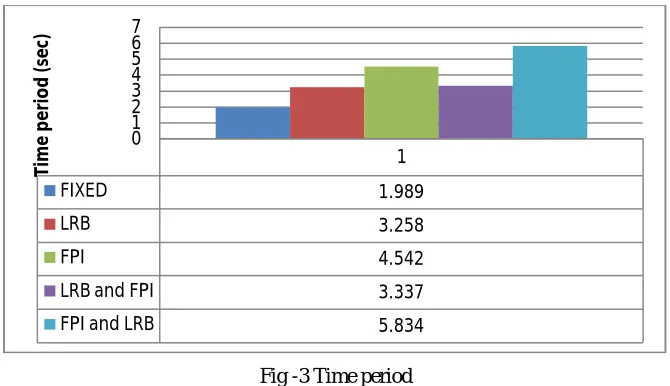
Fig -3 Time period
From Figure 3 It is observed that time period of the building increases more than 60% in all cases, but in case of FPI at outer column and LRB at inner column, time period increases more than double.
B) Base shear
1
FIXED 1.989
LRB 3.258
FPI 4.542
LRB and FPI 3.337
FPI and LRB 5.834
0 1 2 3 4 5 6 7 T im e p e ri o d ( se c) 1 FIXED 3600 LRB 875 FP 473
LRB and FP 845
Base shear reduces in all isolation system but in case of FPI and LRB it reduces enormously, more than 9 times of fixed base.
C) Story Drift
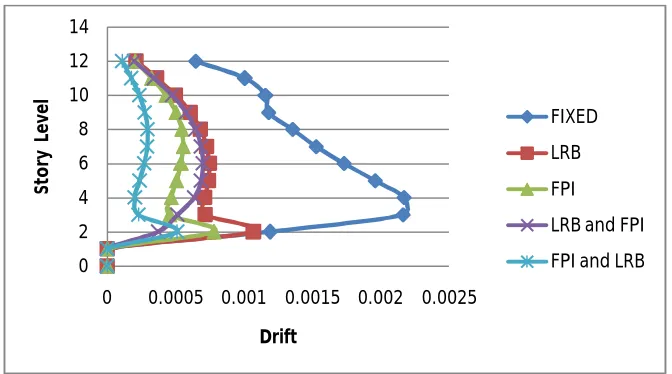
Fig - 5 Story Drift in X-direction
Fig - 6 Story Drift in Y- direction
From figure 5 and 6 it observed that at story level 2 story drift increases in all model because of mass irregularity exist in the building but in parallel system of FPI and LRB it decreases from 0.0028 to 0.00078.
0 2 4 6 8 10 12 14
0 0.0005 0.001 0.0015 0.002 0.0025
St
o
ry
L
ev
el
Drift
FIXED
LRB
FPI
LRB and FPI
FPI and LRB
0 2 4 6 8 10 12 14
0 0.001 0.002 0.003
St
o
ry
L
ev
e
l
Drift
FIXED
LRB
FPI
LRB and FPI
D) Maximum Story Displacement -
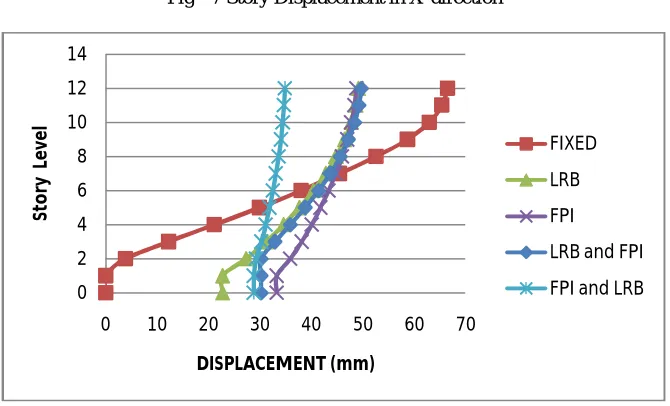
Fig - 7 Story Displacement in X-direction
Fig - 8 Story Displacement in Y-direction
Figure 7 and 8 shows the displacement of all stories, In all models at base level displacement increases as compared to fixed base building. But at top level it goes decreasing very fairly and in FPI and LRB system top displacement decreases from 69mm to 33mm.
0 2 4 6 8 10 12 14
0 10 20 30 40 50
St
o
ry
L
ev
el
DISPLACEMENT (mm)
FIXED
LRB
FPI
LRB and FPI
FPI and LRB
0 2 4 6 8 10 12 14
0 10 20 30 40 50 60 70
St
o
ry
L
e
ve
l
DISPLACEMENT (mm)
FIXED
LRB
FPI
LRB and FPI
but the parallel system of Friction pendulum isolator and Lead rubber bearing isolator( FPI at outer column and LRB at inner column) provide good rigidity to the structure specially in case of story displacement.
REFERENCES
[1] D. Cancellara and F. De Angelis, “A base isolation system for structures subject to extreme seismic events characterized by anomalous values of intensity and frequency content,” Compos. Struct., vol. 157, pp. 285–302, 2016.
[2] “Dynamics of structures: Theory and applications to earthquake engineering, 2nd edition,” Earthquake Spectra, vol. 17, no. 3. p. 549, 2001. [3] L. Landi, G. Grazi, and P. P. Diotallevi, “Comparison of different models for friction pendulum isolators in structures subjected to
horizontal and vertical ground motions,” Soil Dyn. Earthq. Eng., vol. 81, pp. 75–83, 2016.
[4] D. Cancellara and F. De Angelis, “Assessment and dynamic nonlinear analysis of different base isolation systems for a multi-storey RC building irregular in plan,” Comput. Struct., 2016.
[5] M. K. Sharbatdar, S. R. Hoseini Vaez, G. Ghodrati Amiri, and H. Naderpour, “Seismic response of base-isolated structures with LRB and FPS under near fault ground motions,” Procedia Eng., vol. 14, pp. 3245–3251, 2011.
[6] Bureau of Indian Standards, “IS 1893 (Part 1): 2002 Indian Standard Criteria for Earthquake Resistant Design of Structures Part 1 General Provisions and Buildings (Fifth Revision),” 2002.