Scholarship@Western
Scholarship@Western
Electronic Thesis and Dissertation Repository
4-19-2012 12:00 AM
Audio Mastering as Musical Practice
Audio Mastering as Musical Practice
Matt Shelvock
The University of Western Ontario Supervisor
Dr. Jay Hodgson
The University of Western Ontario Graduate Program in Music
A thesis submitted in partial fulfillment of the requirements for the degree in Master of Arts © Matt Shelvock 2012
Follow this and additional works at: https://ir.lib.uwo.ca/etd
Part of the Musicology Commons, Music Practice Commons, and the Other Music Commons
Recommended Citation Recommended Citation
Shelvock, Matt, "Audio Mastering as Musical Practice" (2012). Electronic Thesis and Dissertation Repository. 530.
https://ir.lib.uwo.ca/etd/530
AUDIO MASTERING AS MUSICAL PRACTICE
(Spine title: Audio Mastering as Musical Practice )
(Thesis format: Monograph)
By
Matt Shelvock
Graduate Program in Popular Music and Culture
A thesis submitted in partial fulfillment of the requirements for the degree of
Master of Arts
The School of Graduate and Postdoctoral Studies The University of Western Ontario
London, Ontario, Canada
THE UNIVERSITY OF WESTERN ONTARIO
SCHOOL OF GRADUATE AND POSTDOCTORAL STUDIES
CERTIFICATE OF EXAMINATION
Supervisor
______________________________ Dr. Jay Hodgson
Supervisory Committee
______________________________ Dr. Norma Coates
______________________________
Examiners
______________________________ Dr. Norma Coates
______________________________ Dr. Robert Toft
______________________________ Dr. Samuel E. Trosow
______________________________ Dr. Matt Stahl
The thesis by
Matthew Thomas Shelvock
entitled:
Audio Mastering as Musical Practice
is accepted in partial fulfillment of the requirements for the degree of
Master of Arts
Date__________________________ _______________________________
ABSTRACT
This thesis examines audio mastering as musical communication. Tasks including
loudness management, harmonic balance, denoising, phase alignment, monitoring, effects
application, and administrative responsibilities are of central importance to mastering
engineers. With the exception of administrative responsibilities, each of these tasks
significantly shapes a record’s aesthetic character and physical makeup. These
contributions – the final creative steps before an album’s release – demonstrate the
mastering engineer’s role as a collaborative auteur in recorded musical communications.
KEYWORDS
ACKNOWLEDGEMENTS
Recording Practice, although an emerging field, is very near-and-dear to my heart.
Despite being a kid who endlessly tinkered with (often haphazard) recording equipment, I
would not have believed anyone who told me I would eventually embark on this project. I
would like to thank Dr. Jay Hodgson, my advisor, for introducing me to the formal study
of Recording Practice and providing me with years of mentorship and instruction. Jay’s
continued support has taught me that Recording Practice is, in fact, musical
communication and that tracking engineers, mix engineers, mastering engineers, and
other recordists perform tasks which cannot be omitted from the study of popular music.
Recording practice is, in essence, composition. Without Jay’s guidance and support this
thesis would not have been possible.
I would also like to thank Norma Coates for being a source of knowledge, help,
and guidance over a number of years at this institution. Thank-you for entertaining my
compulsive need to participate in class.
Thank-you to my defence committee, Dr. Robert Toft, Dr. Norma Coates, and Dr.
Samuel Trosow. I am grateful for your contributions and thought provoking questions.
I would finally like to thank my parents, Jill and Tom, for encouraging me to only
study that which I am passionate about. Thank-you for saving me from enrolling in the
natural sciences, thus preserving my soul. Thank-you, as well, for your ongoing support
TABLE OF CONTENTS
Title Page………..i
Certificate of Examination………...…ii
Abstract………...iii
Acknowledgements……….…iv
Table of Contents……….…v
Chapter One: Introduction………...1
Chapter Two: Mastering- Beginning to End………..14
Chapter Three: Mastering and Authorship……….50
Chapter Four: Future Directions………58
Interview: Mastering Engineer Russ Hepworth-Sawyer………...62
CHAPTER ONE
INTRODUCTION
Mastering is a crucial recording practice.1 In fact, everything that occurs during
the record-making process is subject to mastering. However, very little is known, let
alone written, about mastering as a musical procedure.2 This is surprising, especially
since mastering exerts a total influence on the overall dynamic and spectral balance of
recorded musical communications. 3
So far as I am aware, this thesis is first to seek to rectify this lacuna. In what
follows, I will describe the mastering process in concrete musical detail, and situate it
vis-a-vis ongoing debates in the field of popular music studies, specifically, concerning the
musical functions of signal processing.
This thesis will explain the significance of the mastering process to Recording
Practice at large. I will explain where mastering fits within the broader communications
paradigm of making and hearing recordings, and in so doing, I will also: (i) historicize the
mastering process; (ii) inventory the precise duties associated with audio mastering; (iii)
explain these duties vis-à-vis psychoacoustics; and (iv) consider the challenges analytic
1
Consideration of remastering is beyond the scope of this thesis. I intend to research it at a later date.
2
awareness of mastering presents to prevailing concepts of Recording Practice in
contemporary popular music studies. This chapter introduces the broad contours of the
following study. I intend to examine points (ii) through (iv) in greater detail in the
following chapters.
Chapter Two will provide a detailed inventory of musical procedures intrinsic to
the mastering process. In Understanding Records, Jay Hodgson (2010) delineates the
following as responsibilities of the mastering engineer:
• “tuning” the mastering environment (managing sound reflections, absorption, diffusion, and low-end frequency content);
• engaging in appropriate monitoring practice (calibrating and managing frequency and dynamic levels, and phase coherence);
• sequencing, spacing, and fading (referring to the order of tracks on an album, the space between each track, and fade-outs during song endings, respectively);
• equalization (“surgical,” which focus on specific EQ bands, and “global,” which apply to large regions and, sometimes, entire tracks);
• managing perceived “loudness”; and, finally,
• optimizing masters for various formats (24-bit to 16-bit concerns in digital recording, etc.).
I intend to examine each of these “responsibilities” in greater detail. To do this, I will
report on findings from a survey of manuals written by professional mastering engineers
like Bob Katz and Bob Ludwig, interviews personally conducted with professional
mastering engineers, and observation of numerous mastering sessions.
Once I have established the technique of mastering, I will then situate that
technique vis-à-vis ongoing debates within the field of popular music studies at large,
concerning musical authorship. In Chapter Three, then, I will explain mastering as
a creative practice, one which is equally communicative as, say, songwriting or
performance. This view runs counter to the established conception of mastering as a mere
“quality control,” designed to ensure optimal average amplitude. Doing this, in turn, will
allow me to establish the mastering engineer as an important creative partner in
record-making, one who enjoys equal communicative agency with songwriters, performers,
producers, and mix–and audio–engineers.
Finally, in Chapter Four, I will summarise my findings, and consider future
directions for continuing research. I intend for my research to provide a sound academic
basis for later studies of record–making, undertaken from both technical and cultural–
analytic perspectives. Current popular music studies lack a detailed account of the
mastering process; in fact, most research on Recording Practice fails to mention
mastering at all. My study will thus rectify this gap in knowledge and, in so doing, begin
a long overdue conversation about what mastering is and what it achieves on a
fundamentally musical level. It is my ultimate hope that this will provide concrete data
for future studies of Recording Practice slanted toward understanding what mastering —
and, thus, what mastering engineers —contribute to modern musical communications at
large.
Literature Review
Before continuing, I should first briefly address my proposed study to broader
ongoing debates concerning Recording Practice. As noted, as the final stage of
has failed to substantially register in academic research on record-making and record
reception.4 As such, it makes sense to examine a few representative studies of Recording
Practice at large in this review, to generate a clear view of this lacuna. I will focus on
work by Simon Zagorski-Thomas (2010), Albin Zak (2001), Peter Doyle (2006) and
Theodore Gracyk (1995).
In “The Musicology of Record Production” (2010), Simon Zagorski-Thomas
proposes that record production itself should be studied as a subset of musicology, where
interaction with other musical categories must occur. He argues that a musicological
approach to studying the recording process must include a discussion of instrumental
performances and arrangement, for instance. What may be most pertinent for the current
study, however, is Zagorski-Thomas’ assertion that recording technology should be
discussed from both historical and practical points-of-view. In other words,
Zagorski-Thomas argues that developments in recording technology have had meaningful aesthetic
ramifications on the sound characteristics of recorded music, and, thus, that technology
deserves scrutiny as a communicative agent in Recording Practice. However, he
ultimately fails to consider developments in mastering technology and practice. This is an
especially glaring absence given that all uses of recording technology during record
making are filtered through the mastering process before they are ever heard by fans, and
that mastering is now perhaps the most significant shaping factor in the final dynamic and
spectral balance of recorded musical communications.
Like Zagorski-Thomas, Albin Zak (2001) is clearly interested in establishing the
musical ramifications of recording technology and technique. Zak (2001, 12) explains
4
that “presenting a transparent representation of some natural acoustic reality was never
the point” of recording practice, as a recorded album is intended to be a musical event
in-and-of itself (of course, one might wonder how this assertion would hold up next to ‘live’
records). As such, record reception now follows numerous evaluative criteria developed
specifically for listening to music via sound reproduction (Zak: 2001, 22). Zak contends
that recordists carefully construct each element of a record to interpolate various generic
and semiotic associations. He delineates five categories of these “associations”: (i)
musical performance; (ii) timbre; (iii) echo; (iv) ambience; and (v) texture (Zak: 2001,
49).
Zak ultimately neglects the mastering process in his study of “making records”
and “cutting tracks”, and the profound influence it exerts over the final sound of records.
Each of his five categories are indeed mediated through audio mastering, which makes its
absence from The Poetics of Rock all the more curious. Mastering arguably uses material
shaped through tracking and mixing to create all of the timbres, ambiences and textures
heard on a record. Zak (2001, 85) defines “timbre,” for instance, as the “sonic colour”
produced by a track’s arrangement, instrumentation, and equipment choices. He separates
timbre from texture insofar as texture refers to the way a track’s disparate timbral
elements combine. Timbres have clear generic references, and choosing timbres can be
understood as a means for record producers to market songs to particular demographics.
In this way, Zak continues, recorded music can be understood to engage listeners through
both physical and rhetorical associations. “Physical associations” refer to the physical
structure. “Rhetorical associations,” on the other hand, relate those physical associations
to broader cultural schema for decoding musical communications (Zak 2001, 62).
Audio mastering shapes both the rhetorical and physical properties of recorded
music. My study will thus complicate far more than negate Zak’s model. For example,
early mastering engineers often reduced the low frequency content before transferring a
mix to vinyl, to prevent the record needle from “skipping-the-groove” on home record
players (Hodgson 2010). In this case, mastering engineers transformed the physical
properties of records even as, in so doing, they completely altered their rhetorical
implications (consider what Tricia Rose (1994) has to say about the significance of low
frequency content on late-1980s and early-1990s hip hop records, for instance). Music
released during this “early” era sounds completely different from modern releases, in
large part due to this meagre low-end.
Peter Doyle’s Echo andReverb: Fabricating Space in Popular Music Recording
1900-1960 discusses homologies between: (i) sounds treated with echo/reverb in mono
productions released before 1960; and (ii) various culturally situated physical territories.
In other words, Doyle (2006, 31) investigates the “spatial semiotics operating in popular
music recordings” released before 1960. As noted with Zak above, an album’s ambience
(both natural and artificial) is finalized during mastering. Doyle, however, provides only
a very a cursory consideration of the role signal processing, and microphone practice,
play in establishing the “acoustic territories” he ultimately examines records as entry to,
and, the mastering process fails to register in his analysis at all.
While Doyle does glancingly consider differences between artificial and natural
techniques sound, nor does he explain how they are produced. Put differently, the
discussion of technology which Zagorski-Thomas (2010) insists is crucial to
understanding the aesthetics of recorded musical communications is notably absent in
Doyle’s (2006) account. After all, if echo and reverb produce semiotic associations with
culturally situated physical spaces — or if echo and reverb play a role in situating those
spaces — it follows that audible differences in echo and reverb, as instantiated through
different technologies and techniques, should play a crucial role in establishing those
associations.
In Rhythm and Noise: An Aesthetics of Rock (1995), Theodore Gracyk establishes
the recording process as an integral formal element of rock aesthetics. For Gracyk, rock
records embody the art and craft of popular music, and he advocates that the art of
production should be a central concern in the study of rock. He acknowledges the
complexities of the recording process, and works to describe recorded sounds as well as
how they are crafted in the studio. The subject of mastering again fails to register in
Gracyk’s work, however. He does acknowledge the mastering process in a discussion on
John Fogerty, though. Upon listening to Duan Eddy’s “Movin’ and Groovin’” (1958),
Fogerty claims to have been drawn to the overall “big” sound of the record rather than the
specifics of the composition. Fogerty claims that there is a certain “edge” to the album
which causes “Movin’ and Groovin’” to stand out amongst other albums of the period.
This “edge,” as Gracyk defines it, is the result of tape saturation emphasised during
transfer of the album from tape to disc. However, this remains the only substantive
discussion of mastering in the book, and it is clearly lacking in concrete detail. It follows,
conceptions of popular musical authorship must also be interrogated both legally and
philosophically. 5
5
Mastering: A Brief Historical Summary
Audio mastering, in its current form as a post production practice, was far from
conception in the days when 78 rpm records were the standard recording media. Records
were printed directly from prototype to a master stamper which was used for duplication.
Current studio techniques such as EQ or other types of processing were not yet common
practice during the days of early recording media. These early mono records were tracked
by diligently placing a microphone so as to produce the highest ‘fidelity’ reproduction.
An early pseudo-mastering engineer, known as the “transfer engineer”, became
necessary with the widespread introduction of the analog tape in 1948. The tape engineer
is responsible for, quite simply, transferring recorded audio from tape to vinyl. Once a
vinyl master was created, it could be sent away for duplication. The transfer engineer’s
duties expanded with the inception of stereo sound. No longer were they only responsible
for transferring recorded audio, they were also tasked with improving fidelity. Transfer
engineers engaged in minor global equalizations and other processing during the transfer
process. Specialized consoles were built during the 1950s to aid the transfer engineer in
producing high quality work. It became crucial for transfer engineers to make decisions
which were both technical and aesthetic in nature, and the designation “transfer engineer”
was eventually replaced with “mastering engineer.” If the source tape was too heavy in
bass frequencies, for example, the low end would have to be attenuated to ensure that the
Throughout the 1980s, with numerous advances in sound technology the
mastering engineer’s responsibilities increased further. Today, mastering engineers
continue to be responsible for transferring recorded material onto a final medium from
which duplicates are created. I have already summarized the most fundamental mastering
duties, and I will examine them in detail in the following chapter. For now, it will suffice
to note that each of these duties – tuning, monitoring practice, sequencing, equalization,
loudness management, and format optimization – are areas which concern musical taste.
For instance sequencing, spacing, and fading; equalization; and subjective loudness
management are three areas which concern musical taste directly. If one was to use a
normalization algorithm on each song individually on a rock album the resultant sound
would have both slow ballads and high energy songs at the same perceived loudness.6
Listeners would understand this as a transgressive artistic choice. Alternatively, if an
entire album is normalized at once, each song will increase by the same number of dBs
and the resulting effect has quiet songs relationally more quiet than loud songs. Loudness
management and equalization are also significant determinants in producing sonic effects
which are subjectively described as “punchy,” “bright/dark,” “crushed,” etc.
Human perception of sound differs from sound as it exists in its physical state. Our ears
do not translate direct acoustic energy into nerve impulses for the brain to decipher.
Loudness management is a crucial task for mastering engineers. Different types of
songs, genres, and other taste formations within recorded music demand specific
practices concerning loudness management. Given that psychoacoustic phenomena are
impacted greatly through perceived loudness, especially pitch, timbre, and duration, it is
6
signal-necessary to understand the mastering engineer’s role in record production.7 Indeed, the
art of record production cannot be understood without considering the mastering process.
Audio mastering is shrouded with mystery in both the professional music world
and academia. As it stands, mastering is understood to be the “dark art” within the realm
of Recording Practice. This fact is strange given the importance of mastering as the final
creative and technical step before an album is duplicated or distributed. In a personally
conducted interview with Russ Hepworth Sawyer, a celebrated mastering engineer based
in Northern England, he explains:
I do believe people face [mastering] with questions such as: “Do [mastering engineers] really do that much?”
“How important is it?”
From my perspective, I don’t really see mastering as a dark art. If Ray Staff was here, he may have a different perspective because he has, for example, learned how to cut vinyl from scratch and is the only person to have cut 2.5 sides from one piece of vinyl as far as I’m aware. That takes utter skill, and he is a true
craftsman. To me, that’s where the “dark art” of mastering lies: trying to make things as loud as possible on vinyl without breaking the head and without breaking people’s needles.
Over the last 20 or 30 years mastering has become a craft of a different kind. It’s now a creative practice rather than a process of simply changing from one format to another. Originally, the mastering engineer oversaw the process of transferring audio from tape to vinyl, and was expected to make sure that nothing went wrong. They did, however, have to change the tonality of the recording in order to transfer effectively. Now, one goes to a mastering engineer for different purposes, which encompass a wide array of things we have to do now in order to make sure the album sounds good.
Mastering technique is even intrinsic in establishing genre. French electro-house
music, for example, is compressed via the mastering process in order to maximize
average amplitude and reduce dynamic range on purpose. Furthermore, this music will be
7
Further research concerning psychoacoustics can be found in the following: Cook, Perry. 2001. Music, cognition, and computerized sound: an introduction to psychoacoustics; Deva, Chaitanya. 1967.
mastered with an ideal listening environment in mind: the club. The mastering engineer
will maximize the bass frequencies, for which large club-venue subwoofer speakers are
ideally suited. Alternatively, mastering engineer Nancy Matter contends that mid-range is
more important for punk music, due to the inherent harshness this frequency range tends
to evoke in listeners (in Gallagher 2008, 34). Audio mastering technique, as it concerns
loudness, compression, equalization, sequencing, and format optimization, is of primary
concern in the realm of taste and genre, and can only be fruitfully understood as a
creative practice.
Clearly much more research needs to be done on mastering, if only to clarify to
analysts of popular music that it is, indeed, an integral component of that communications
paradigm. In the following study I will establish that all recording practice is subject to
mastering, and that mastering plays the crucial role of determining the audible character
of recorded musical communications. How exactly does it do this, though? And, once I
have established this, what challenges will awareness of the process present to ongoing
debates concerning the musical functions of signal processing? It is my ultimate hope that
my thesis will answer these two questions, or, at least, that it begins the process of
CHAPTER TWO
MASTERING: BEGINNING TO END
In this chapter I will identify the tasks performed by mastering engineers. These
include administrative tasks, phase alignment, denoising, harmonic balancing,
loudness/compression, monitoring practice, and the application of effects.
Administrative Tasks
During mastering, professional mastering engineers perform a number of
administrative tasks. These tasks are mostly intended to ensure satisfactory reproduction
of the source material, as well as logging/tracking for royalty purposes. Project-based
mastering, however, may not require the same level of administrative rigour(Gallagher
2008, 286). Professional engineers are responsible for comprehensive logging of
equipment/plug-ins and appropriate setting-values, PQ codes, managing output formats
(CD-DA/DDP, digital release), quality control and error management, and sometimes
coding ISRC data.
A mastering engineer’s logs are important should a project need to be revisted at a
later date. A client may, for example, ask for revisions to be made to a master years after
its initial release. At Bob Katz’s Digital Domain mastering house, each log contains
“monitor gain, mastering engineer’s comments, and the settings of the processors” (2007,
23). Comments may include client requests, comparative notes to a reference track, notes
tracks), notes on how the resultant master sounds (bright, punchy, fat, loud), and other
pertinent information.
Where a mastering engineer’s logs are intended to be used for his/herself at a later
date, PQ logging is intended for the CD duplication plant. The designation “P” indicates
the beginning of tracks, where the “Q” subcode designates length of the track (and album
timing).
Mastering engineers are also responsible for output formats. A master may be
delivered to the CD duplication plant as either a DA hard copy or a DDP file.
CD-DA masters should be vacuum sealed and delivered with the utmost care as damage to the
disc can result in duplication errors. If the master is damaged, all duplicated copies will
contain the same error. Even a single fingerprint may cause unwanted results. Disc
Description Protocol (DDP) image files, on the other hand, are a more reliable means of
delivering a master for duplication. DDP files are usually sent via an ftp server to the
duplication plant, containing a subset of four different files: image.dat, ddpid, ddpms, and
sd. The image.dat file carries the audio “image” to be written onto disc via laser. The
other 3 files carry “administrative” information such as PQ codes and other data (Katz
2007, 32).
Critical quality control listening should be performed on the final master before
duplication occurs. Ideally, this will be done by a separate engineer to ensure that the
primary engineer has not adjusted his/her listening to suit disfigured balances. Quality
control listening should be done with headphones in order to closely scrutinize the final
product for clicks, pops, and other intermittent distortions. Moreover, on loudspeakers
requirement for playback over headphones. If unacceptable clicks or pops are present on
the master, or if such “dropouts” occur, it may be necessary to revisit the original mix and
create a new master before duplication can occur.
Phase Alignment
Mastering engineers are responsible for ensuring balance within the stereo image
of a project. The left and right channels must play back audio through monitors at the
same level of perceived loudness. If this criterion is not met, the mastering session will
proceed with a distorted stereo image and the resultant master will be faulty. It is
important that the engineer uses his/her ears to scrutinize the phase coherence of a given
project rather than metering implements, as Bob Katz explains:
Music feels much better when the stereo balance is ‘locked in,’ which can be as small as a 0.2 dB level adjustment in one channel. It is generally unhelpful to use meters to judge channel balance because at any moment in time, one channel will likely measure higher than the other. I’ve seen songs where one channel’s meter (peak or VU) is consistently a dB or so higher than the other, but the balance sounds exactly correct. Since lead vocals are usually centered, this is a good guide, but there are always exceptions. Proper balance should be determined by ear. (Katz 2007, 205)
To ensure acceptable phase alignment, many engineers begin mastering sessions using
mono playback. If the stereo image drifts left or right there is a phase issue between the
Example 1: Improper Phase Alignment Simulation
Example 1 simulates the sound of an inaccurate stereo field. When
played on any standard listening device the resultant sound will
feature a noticeable volume boost in the right channel. This is
intended to simulate unbalanced phase alignment. As
demonstrated, an unbalanced stereo field can be disorienting. At 55
seconds, when the speed fade occurs, the phase issue is corrected.
Example 2: Phase Cancellation
Example 2 demonstrates phase cancellation. Approximately 8
second into the track there is a sudden drop in the lead vocal. This
issue cannot be corrected through mastering, and has to be sent back
De-noising
De-noising is the process by which mastering engineers remove unwanted noise
from a final mix. Some noises (crackles, hiss, hum, etc) are simply overlooked by the mix
engineer and should be removed, where others may be crucial to the aesthetic of the
album. Bob Katz surveys two categories under which noises fall in mastering: continuous
and impulsive (Katz 2007, 139). Impulsive noise refers to intermittent noises, such as
crackles, pops, and other auditory ticks. Continuous noise can be further broken down
into tonal and broadband noises. Tonal noise carries a fundamental frequency, and often
manifests as buzz (higher harmonics) or hum (lower harmonics) as an effect of
electromagnetic interference during tracking. Broadband noises, on the other hand, refer
to white noise, pink noise, rumble, and hiss(Katz 2007, 139). The recent prominence of
the project studio paradigm requires mastering engineers to especially attentive to
unwanted noise as Katz explains:
Project studio mixing rooms are not as quiet as professional studios. Air
conditioners rumble, airflow noise, and fans in computers, cover up noises in the mix. Regardless, the mix engineer should be concentrating on other things besides whether the singer produced a mouth tic. Consequently, when the mix arrives at the quiet mastering suite, we notice problems that escaped the mix engineer - click track leakage, electrical noises, guitar amp buzz, preamp hiss or noises made by the musicians during the decay of the song. We use our experience to decide if these are tolerable problems or if they need to be fixed. (Katz 2007, 140)
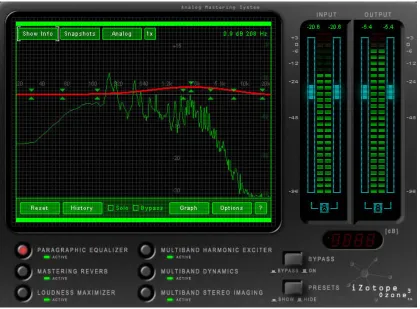
Surgical EQ (see Figure 2.01) manipulations can either help remove unwanted
noise or at least attenuate its volume. Surgical equalization refers to the practice of
carefully boosting or cutting narrow frequency bands in order to remove offensive noise
(Hodgson 2010, 210). Often times, however, important musical information may be
employ the use of downward expansion, which effectively works in the opposite way of a
compressor. Compression used during mixing and mastering can inadvertently increase
the volume of unwanted noise, hence why expansion is employed. Katz explains that if
compression caused the issue, un-compressing via expansion can be a viable solution,
and “as little as 1 to 4 dB of reduction in a narrow band centered around 3-5 kHz can be
very effective” (Katz 2007, 142). Expanders work via a similar principle to compression,
but to the opposite effect. When input signal gain is lower than a user-defined threshold,
the expander causes audio to become quieter (Hodgson 2010, 212). In this way quiet
segments become quieter and loud sections become louder, thus increasing the overall
dynamic range. When applying expansion, it is important to work in small increments. If
one does not slowly adjust expander settings, there is a risk of introducing artefacts or
reducing ambience.
Apart from manually removing noise via EQ and downward expansion, there are
automatic tools available to engineers as well. Declickers (see Figure 2.02) and distortion
removal software both do exactly what their names imply: remove clicks and distortion,
respectively. If a declicker is applied too generously, the resulting sound may be
distorted. This is particularly common in high frequency instruments such as the trumpet
(Katz 2007, 143). Distortion removal software (sometimes called a decrackler or
descratcher) works by replacing audible distortion with a fragment of the original sound
in its non-distorted form.
Figure 2.02 The Weiss DNA-1 is a denoiser, declicker, and decrackler. It works
De-noising solutions are not perfect, and must be used with caution. It is unlikely
that any single noise-reduction approach will result in a satisfactory master. Rather, a
combination of approaches is usually the most plausible solution. Engineers must be
aware that de-noising can introduce new undesirable noises into a track. Such artefacts
can include “comb-filtering, swishing or phasing noises (known semi-affectionately as
space monkeys), [and] low level thumps and pops” (Katz 2007, 144). It is also common
to lose important track information through de-noising. For example, reverb often slowly
decays into that which may be interpreted as “noise” by a de-noising algorithm.
De-noising also may potentially reduce high-end frequency response of a track (Katz 2007,
144). The presence of certain noises, especially high-end continuous noise such as hiss,
can be perceived by the listener as intrinsic to the track’s high-end frequency content. If
this noise is removed, the overall psychoacoustic effect can be a diminution of perceived
volume within the track. As managing loudness is an integral part of a mastering
engineer’s work, a drop in perceived volume could be undesirable. In this case it may be
appropriate to use EQ to restore the lost frequency information. It must be stated,
however, that certain tonal information will be lost and the overall sound character may
Example 3: Denoising (resonance)
Example 3 features a track with an offensive resonance which must be removed.
Notch filtering was employed to target the offending frequency at 600 Hz. The
accompanying track contains, first, the audio with the offending resonance. At
approximately 1 second into the track, I have isolated the noise in order to make
it distinct. At approximately 5 seconds into the track I have applied notch
filtering which entails utilizing single band equalization cuts.
Example 4: Denoising (crackle)
Example 4 demonstrates the sound of unwanted crackling within an audio track.
An automatic decrackler was used, which employs a “thumbprint” of the
undesirable noise in order to cancel the crackle via “spectral subtraction.” The
noise has been removed approximately 15 seconds into the track, at the speed
Bob Katz suggests the following order of operations when attempting to de-noise
a track:
• First [treat] any tonal artefacts that stand out (eg. Hum, buzz) using a simple or complex filter, followed by
• Declicking, first automatic, then manual to deal with any remnants not caught by automatic declicking
• Decrackling (which can also remove some remnant clicks)
• “de-distortioning” [which may be the same as decrackling, depending on processors used]
• broadband denoising.
• Finally, overall program equalization, filtering, other processing if needed (Katz 2007, 146)
Harmonic Balance
EQ may be applied in a surgical manner, as explained in the previous section, or
with a more global approach. Global equalizations refer those EQ manipulations which
are intended to improve a track’s spectral balance. Jay Hodgson (2010, 212) explains that
many commercial masters feature a similar spectral balance:
Specifically, most commercial records feature a flat, or almost flat, midrange from about 60 Hz to 2-8 kHz, which can be flanked on either side by surprisingly steep roll-offs. Rock, pop, jazz, and folk records, for instance, almost always feature what engineers call a “symphonic tonal balance.” Tracks mastered for these markets typically present a more-or-less neutral (flat) midrange, flanked, on either side, by steep roll-offs, beginning at about 40-60 Hz and 3-7 kHz respectively.
It is up to the mastering engineer to decide how to treat an album’s spectral balance, and
environment. Furthermore, global equalizations must be employed with the utmost care
as certain elements may lose aesthetic appeal through engaging various cuts and boosts.
Example 5: Example of Symphonic Tonal Balance
Example 5 demonstrates what engineers refer to as a “symphonic
tonal balance” versus a more neutral tonal balance. The first audio
clip has been manipulated via EQ to achieve this neutral balance.
The second clip has been manipulated via EQ to feature a flat or
“neutral” mid-range with gain reductions at 60 Hz (and below) and
Bernie Grundman (in Owsinski 2008, 43) offers the following advice pertaining to
spectral balance:
One of the things that is really hard is when the recording isn’t uniform. What I mean by uniform is that all of the elements don’t have a similar character in the frequency spectrum. In other words, if a whole bunch of elements are dull and then just a couple of elements are bright, then it’s not uniform. And that’s the hardest thing to EQ because sometimes you’ll have just one element, like a hi-hat, that’s nice and bright and crisp and clean, and everything else is muffled. That is a terrible situation because it’s very hard to do anything with the rest of the recording without affecting the hi-hat.
As most mastering efforts are global in scope, as opposed to the specificity and directness
allowed by mixing, subtle adjustments to equipment tends to yield more aesthetically
pleasing results.
To begin the equalization process, some engineers prefer to begin by examining a
track’s midrange frequency content in order to emphasize vocals. The 500 Hz-1kHz
range is where most of the vocal’s “thickness” resides, and around 3.5 kHz is where one
can enhance vocal intelligibility (Gallagher 2008, 200). Engineers must be cautious when
tampering with midrange frequencies as other important elements, such as guitars and
snare drums, also reside in this range. Too much gain in the 2.5 kHz range may afford too
much “harshness” to a track, for example.
Example 6: Harmonic Balance (“Muddiness”)
Example 6 demonstrates how low end frequency content can be reduced to
increase both perceived loudness and clarity. At approximately 29 seconds
in, muddiness is reduced through the application of EQ to attenuate low end
frequencies within the track.
High-end frequency content must also be addressed by the engineer. High
frequencies demonstrate the highest propensity towards subjective loudness, in terms of
psychoacoustic perception. For this reason, modern masters tend to sound very bright in
order to maximize perceived volume. If a track does not sound sufficiently “bright,” one
can employ a harmonic exciter. Where EQ increases the gain of a particular frequency
band, a harmonic exciter “boosts the harmonics of fundamental tones in the input
spectrum, adding emphasis to only consonant high-frequencies” (Hodgson 2010, 215).
While engineers may, at times, accentuate midrange frequencies, there are times
when a small attenuation in this area (ie. roughly 200 Hz to 2 kHz) may increase
perceived loudness. The “smile-curve” approach to EQ is one example of this
phenomenon. Human hearing tends to afford an emphasis to mid-range frequency
content, even when this range is subdued. At louder volumes, however, midrange
frequency content becomes less prominent to the human ear, and low and high
frequencies become more prominent. Paul White (2003) explains, “our perceptual
frequency curve changes at different levels…Low and high frequencies predominate over
the midrange at high SPLs.” This application of the smile curve is intended to simulate
human hearing at a high volume (Hodgson 2010, 215).
Example 7: The smile curve
Example 7 demonstrates the equalization technique of applying a “smile
curve.” This smile curve was achieved by reducing gain in the 900 Hz to
1.7 kHz region, and applying slight boosts to both low end and high end
frequencies. This change in EQ occurs approximately 3 seconds into the
Loudness/Compression
Mastering engineers are responsible for managing the perceived loudness of a
recording. Integral to this process is dynamics processing (i.e. compression/limiting).
Throughout the years records have progressively become louder, giving rise to what is
referred to as the “loudness wars.” Engineers are expected to treat commercial records in
such a way that favours loudness over musical dynamics. This is due largely to the fact
that, as Bob Katz explains, the louder of two records tends to sound “better” (Katz 2007,
168). The competitive practice of manufacturing loud albums, however, dates back to the
1950s (Owsinski 2008, 24). This practice continues today as current records are much
louder than in the past. Records now, on average, are about +18 dbFS louder than in 1980
(Katz 2007, 168). As Ray Staff has pointed out, 0 dB has become a target rather than a
warning on modern peak meters during mastering (Hepworth-Sawyer 2009,251). Digital
recording allows for peak normalization which makes the “target” of 0 dB easier to
achieve. Utilizing a fuller peak in this way allows for a better signal-to-noise ratio, but
also dramatically increases volume. In comparison to analog, Katz (2007, 169). explains,
In the days of the LP, the variation in intrinsic loudness of pop recordings was much more consistent, perhaps within as little as 4 dB. Even at the peak of the vinyl loudness race, I could put on a Simon and Garfunkel LP, or even a Led Zeppelin, and follow that with an audiophile direct-to-disc recording, barely having to adjust the monitor control to satisfy my ears
The switch to digital recording, however, did not immediately result in frenzied
experiments in loudness. The loudness of compact discs was initially more comparable to
vinyl. Katz (2007, 169) continues,
In the earliest days of compact disc, before the digital loudness race began, many mastering engineers would dub analog tapes with 0 VU set to -20 dBFS, and leave the headroom to the natural crest factor of the recording. It was not thought
much more consistent. However, the inventors of the digital system abandoned the VU meter, which opened Pandora’s Box. And so the average level began to move up and up.
Greg Milner identifies 1994 as the year in which “there was no turning back” concerning
loudness wars, which hit fever-pitch in 1999. Some professionals called this “the year of
the square wave,” insinuating that albums are now mastered at such high volume that all
dynamics are lost (Milner 2009, 280-81).
If digital recording systems all peak at full-scale (0 dBFS), the question must be
asked: how does one make a recording sound louder? After all, certain genres require
loud masters in order to be competitive. Mastering engineers increase loudness through
compression techniques which increase average amplitude. Compression must be applied
in such a way that a recording’s peaks are reduced, allowing for extra “make-up” gain to
be applied. This increase of the overall average amplitude translates to louder sounding
records.
To do this, [engineers] compress what they master, and then apply a generous amount of “make-up” gain. If engineers want to boost a track which already peaks at full scale (0 dBFS) for three more decibels of loudness, for instance, they must first compress its dynamic range by - 3 dBFS. Only then can they apply +3 dBFS of make-up gain and, in the process, raise its average amplitude by +3 dBFS. (Hodgson 2010, 218)
Example 8: Inboard compression, moderate
Example 8 has been treated with compression and “make-up” gain on an inboard
application. Dynamics have not been lost as a result of using only moderate
Example 9: Outboard compression, moderate
Example 9 has been treated with compression and “make-up” gain on an outboard
application. Dynamics have not been lost as a result of using only moderate
compression.
Example 10: Inboard compression, strong
Example 10 has been treated with compression and “make-up” gain on an inboard
application. Perceived loudness is noticeably higher on this track.
Example 11: Outboard compression, strong
Example 11 has been treated with compression and “make-up” gain on an
outboard application. Dynamics have not been lost as a result of using only
An engineer may be given a mix which, for example, features a loud snare drum.
If the snare drum peaks too far above the rest of the waveform, and barring any Mid-Side
work, a compressor will have to be applied in order to raise the average amplitude of the
entire track. One viable approach to compression in this situation is to use fast “attack”
and “release” times. This ensures that the compressor will attenuate the signal quickly,
then “let go” of the signal quickly as well, allowing it to return to its normal state. Using
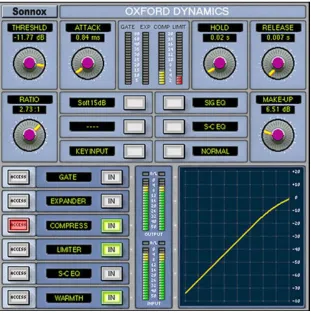
a moderate compression ratio, such as 3:1, will cause the compressor (see Figure 2.03) to
change the level of the signal 1 dB for every 3 dB of level change.8 The overall effect of
the compressed signal should be very subtle when auditioned against the original signal,
due to the fast attack/release times and moderate compression ratio used. At this point,
the mastering engineer is free to increase the gain on the compressor by +3 dB to make
up for the 3 dB of lost dynamic range of the track. This will ensure that there is no
clipping, as the peaks will have been reduced.
8
Figure 2.03. Oxford Dynamics by Sonnox, a popular choice for in-the-box compression
Another alternative for managing peaks is to use automation. By simply using a
DAW’s (Digital Audio Workspace) built-in volume automation, peaks can be controlled
via reducing level at desired points. This could prove to be an arduous task for an entire
album (or track) worth of material, especially if the offending element is a snare drum as
per the previous example. In that particular case, an engineer would have to automate the
track’s level downwards every time the snare was present on the recording. Automation
can, however, still be useful within a track or album which features a few prominent
peaks. The engineer then has the option to apply compression in order to take care of any
remaining peaks contained within the source material(Gallagher 2008, 211). Once peaks
have been manually tamed, the engineer is free to increase the overall level of the track.
Clipping, while often avoided, is another technique which can increase the
loudness of a track. Clipping must be used with discretion and is often genre specific.
Most mastering engineers agree that clipping for less than 26 ms will not produce
discernable distortion. That said, it is not uncommon in hip hop or house music to have
clipping audible throughout. The album Californication, for example, by Red Hot Chili
Peppers provides us with an example of audio clipping in the rock context. On clipping,
Paul White (2003) explains:
Clipping must be used cautiously. Careless usage may result in records which are
unlistenable due to over-distorting.
Example 12: Clipping
Example 12 features short sections of clipping in order to increase
perceived loudness of the track. Clipping was induced through gain
boosts used in tandem with compression (used to apply “make-up”
Where clipping and peak limiting are undesirable due to the propensity for each
technique to “colour” an audio track, parallel compression may be a valuable tool.
Parallel compression works on the psychoacoustic principle that the ear is more forgiving
of the upward compression of quiet passages than downward compression of loud
passages (Katz 2007, 133). The basic approach of parallel compression is to mix a
compressed signal with the original uncompressed signal. Katz identifies two types of
parallel compression: transparent parallel compression and attitude parallel compression.
The overall effect of transparent parallel compression can sound similar to using
automation to manage loudness peaks. It also causes fewer tonal shifts and little-to-no
loss of transient detail (Katz 2007, 134). Katz (2007, 133-4) recommends the following
compressor settings for transparent parallel compression:
• Threshold: -50 dBFS
• Attack time: 1ms (less if possible)
• Ratio: 2:1 or 2.5:1
• Release time: 250-350 ms
• Crest factor: set to “peak”
• Output level/make-up gain: adjusted taste (subtle compression can be achieved between -15 through -5 dB)
Attitude parallel compression uses compressor settings which add “punch without
damaging the loud peaks” (Katz 2007, 134). Mid-range frequency content tends to be
accentuated through this compression style, which can be useful when mastering rock
music. To achieve the extra punch that attitude parallel compression can produce, Katz
• Threshold: set to between 1-7 dB of gain reduction9
• Attack time: medium (start with 125 ms and adjust as necessary)
• Ratio: to taste
• Release time: set to work in tandem with the attack time
• Output level/make-up gain: to taste, rarely past -6 dB
Russ Hepworth-Sawyer also employs the parallel compression method as a staple in
his practice. Interestingly, he avoids the use of outboard gear in the signal chain. He
explains,
“I work completely in parallel. I begin by putting up two copies of the stereo file, and then phase-locking them. Multi band compression, and compression, just doesn’t quite do what I need it to do, especially as the Loudness Wars become increasingly a nightmare. Using this parallel limiting technique is my way of trying to sneak loudness in through the back door. This way, I’m not interjecting compression into the music, but rather effecting only one of the channels. One channel will either be left alone, or in the case where I’ll receive a track with only 2-3 dB of room between RMS and peak – which actually does happen- I’ll use a decompressor which works sort of like an expander within Pyramix.
The 4 total tracks, coming from 2 stereo tracks, are each merged into a left and right channel. From here I can effect or EQ each channel as required. Recently I worked on a project featuring a sax/guitar jazz duo. The sax was bleeding out of the right hand side -far too loud for the left channel- and I was able to EQ one instrument and not the other, adjust levels, etc in order to fix the balance.
Next in the signal chain is an MS-encoder which is crucial for making the center image really pump or de-pump as required. You can also add sort of ethereal air to the sides, if you want to. From here, I have the option to send the signal out to other gear, but I don’t tend to use a lot of analog kit. The ability to be able to recall presets easily makes digital equipment more crucial to how I work. I can work on more sessions in a day and go back and forth between different projects given the ability to store presets. As I mentioned earlier, it’s nice to be able to go back to a project with a fresh set of ears.”
Monitoring Practice
Each of the previously mentioned (non-administrative) tasks rely on the use of
monitors. The most important criteria in monitor selection are frequency width and
neutrality. If an engineer attempts to use a monitoring system which yields neither a flat
nor wide frequency response, the resultant master may yield an unwanted frequency bias.
Engineers such as Bob Katz explain the analogous relationship of monitors to
microscopes as follows (2007, 83):
The major goal of a professional mastering studio is to make subjective judgements as objectively as possible. What enables this to be done most successfully is the intelligent use of an accurate, high resolution monitoring system. A high resolution monitor system is the mastering engineer’s audio microscope, the scientific tool which enables the subtle processing decisions required by the art.
Inaccurate speakers, or speakers which deliver a biased frequency response, will result in
masters which compensate for said bias. If an inaccurate monitor set enacts a sharp peak
at 1 kHz, for example, an engineer might use equalization to needlessly reduce this false
midrange boost.
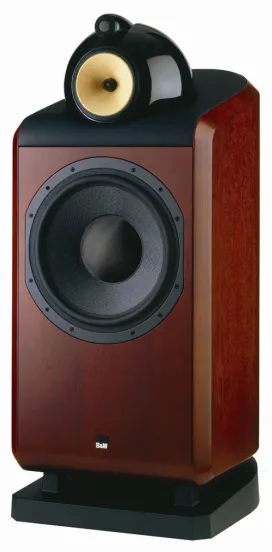
Inaccurate monitors (see Figure 2.04) do serve a purpose, however. It is common
practice for engineers to use smaller speakers, or speakers with a limited frequency
response, as a reference for “real world” listeners. Audiophiles with high quality stereo
systems account for a small percentage of music listeners, therefore it is often crucial to
reference with sub par speakers. Some engineers, such as Bob Ludwig (in Owsinski
One reason I’ve always tried to get the very best speaker I can is I’ve found that when something sounds really right on an accurate speaker, it tends to sound right on a wide variety of speakers. I’ve never been a big fan of trying to get things to sound right only on an NS-10M.
Katz agrees, conceding that real-world monitors should be used now-and-again to
“double check” masters, rather than as a benchmark (Katz 2007, 86). Those engineers
who use high resolution monitors (see Figure 2.05) exclusively (or nearly exclusively)
argue that high resolution monitors provide balanced, neutral audio replication, thus
providing a reference experience which is somewhat “average.”10 Many engineers,
however, still prefer a system where both high resolution monitors and “real world”
monitors are employed.
Figure 2.05. B&W 801D: an example of high end monitors for mastering
10
Some mastering engineers have also begun to monitor with an additional
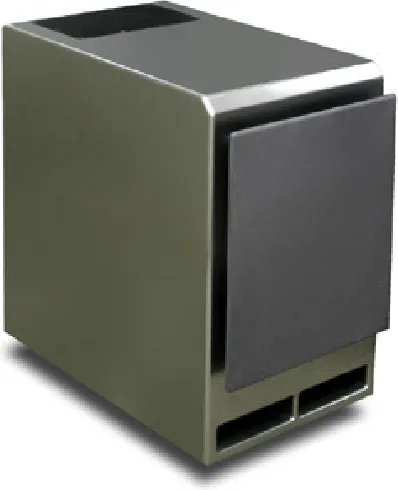
subwoofer (see Figure 2.06), employing either a single or stereo pair. Subwoofers have
become increasingly common in both audiophile and casual home-listening
environments, as well as at live events. Using a stereo pair of subwoofers is said to
replicate the ambience of a live event, where subwoofers are always placed on either side
of a stage, thought it is rare for a mastering studio to have more than one subwoofer in
operation at any given time (Owsinski 2008, 20).11 It is common practice, after all, for
engineers to place low end frequency content in mono, making stereo separation
unnecessary in many cases.
Figure 2.06The Wilson Watch Dog is an example of a high quality subwoofer.
Bobby Owskinski (2008, 20) gives the following advice concerning subwoofer
placement:
• Place the subwoofer in the engineer’s listening position behind the console
• Feed pink noise only into the subwoofer at the desired reference level. (Eight-five dB SPL should do it, but the level isn’t critical)
• Walk around the room near your main monitor speakers until you find the spot where the bass is the loudest. That’s the spot to place the sub. For more level, move it toward the back wall or corner, but be careful because this could provide a peak at only one frequency. You’re looking for the smoothest response possible (which may not be possible without the aid of a qualified acoustic consultant).
Effects
Occasionally, mastering engineers will be called upon to add “effects,” or
non-transparent processing, to a track. A client may feel, for example, that there is less reverb
present than necessary on the final copy of a master. Bob Ludwig explains that reverb can
also assist in covering up difficult edits in order to make an engineer’s touch more
invisible (Owsinski 2008, 47). Another use for reverb is to give coherence to the
imagined space of a track. The subtle application of reverb (see Figure 2.07) to an entir
track can have a unifying effect (Gallagher 2008, 212).
Mastering engineers occasionally take advantage of the Haas effect (see Example
9), which states that echoes which occur between 10-40 milliseconds after the original
source are perceived to be fused with the source sound (Katz 2007, 234). If a recording
was captured in a dead room with poor early reflections, the Haas effect can create an
illusion of space which seems less artificial than longer reverb/echoes (past 40
milliseconds). If useful early reflections already exist within a track, units such as the TC
Electronics VSS4 feature a “decrease” function which minimizes the creation of synthetic
early reflections (Katz 2007, 235).
Example 13: Haas Effect
Example 13 has been treated in order to simulate the Haas effect.
Reverb, if used at all, is applied late in the mastering process (post
compression/limiting). It is generally undesirable to apply reverb before compression as
compression can increase the volume of reverb dramatically.
Example 14: Reverb
Example 14 features the application of reverb. At 18 seconds into the
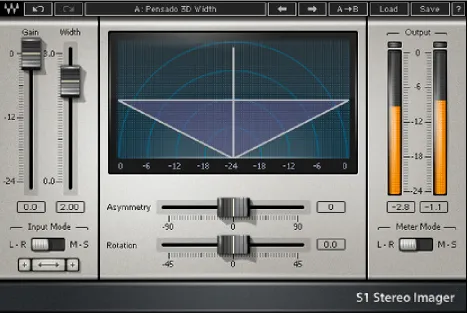
Stereo widening plug-ins may also be employed during the mastering process,
such as the Waves S1 Imager (see Figure 2.08). These types of plug-ins work
psycho-acoustically to affect one’s sense of space within the stereo field. Engineers must be
judicious with the application of stereo-widening plug-ins, or the resultant sound may
cause unwanted phase-cancellation effects (Gallagher 2008, 214). Furthermore, hobbyists
on online forums have found that stereo-widening can cause one’s mix or master to sound
accurate only in ideal listening environments. An ideal listening environment, in this
case, would be any listening environment wherein equidistance between both the
speakers and the listener is achieved, forming an equilateral triangle.
Stereo-imaging effects can also work in tandem with EQ, compression and reverb.
Mid-Side (MS) effects (see Figure 2.08) work by allowing engineers to alter the
amplitude, equalization and dynamic range of either the center of the stereo image or the
sides of a stereo image. In other words, MS effects allow engineers to apply EQ,
compression, and reverb spatially through effecting the middle or side(s) stereo images
separately. A mastering engineer could, for example, cause a vocal to sound more
distinct within a mix by boosting the lower mid frequencies (or presence) in the M
channel only. According to Bob Katz, this should cause the center vocal to be louder with
less detriment to other instruments (Katz 2007, 212).
Example 16: Mid-Side Encoding
Example 16 demonstrates Mid-Side equalization through boosting all
frequencies over 1 kHz in the side channels. The overall effect is greater
perceived loudness due to increased mid and high frequencies. This change
Figure 2.09. iZotope’s Ozone features both EQ and compression with Mid-Side
capabilities
MS Compression (see Example 12) can be used judiciously to tame peaks within
a mix. If instruments are competing with the lead vocal volume, an engineer could use
MS compression to combat instrument levels at the sides of the stereo field. Similarly,
MS Reverb (see Example 13) can satisfy clients who require more reverb added to the
lead vocal would sound more reverberant. Alternatively, applying more reverb to the S
channel would cause more reverb to be present on the instruments.
Example 17: MS Compression
Example 17 uses Mid-Side encoding to compress the side channels. The change occurs
approximately 3 seconds in. The overall effect is less dramatic than applying direct
Example 18: MS EQ
Example 18 features the application of Mid-Side EQ in order to bring out transient detail
Case Study
“Get Ready” by Domsky
Example 19: Original Mix
Example 19 is an “unmastered” mix Domsky’s track entitled “Get Ready.” There
is a noticeable lack of volume, punch, transient detail, and low end frequency
content in this example. The proceeding examples attempt to shape “Get Ready”
into a genre-competitive master.
Example 20: Master 1
Example 20 features 1 of 4 “in-the-box” masters of “Get Ready.” While
noticeably louder than the original mix, this master is the quietest of the 4.
Increased transient detail can be heard, especially in the side channels. Mid-side
compression and EQ were used almost exclusively, with the addition of an
Example 21: Master 2
Example 21 was mastered via the same method as Master 1 with increased
midrange and slightly less low end.
Example 22: Master 3
Example 22 is an “unmastered” mix of Domsky’s track entitled “Get Ready.”
There is a noticeable lack of volume, punch, transient detail, and low end in this
version of the track. Each of the following audio examples feature strategies
which intend to make the track genre competitive.
Example 23: Master 4
Example 23 is the loudest of the 4 masters. This was achieved by using extra
Example 24: Outboard Master 1
Example 24 was mastered using a nickel based transformer on an outboard
preamp. The nickel preamp results in a sound which is both punchy and
abundant with low end frequency content.
Example 25: Outboard Master 2
Example 25 was mastered using a steel based transformer. The resultant sound is
less aggressive than the nickel master.
Example 26: Outboard Master 3
Example 26 was mastered using the discrete op-amp setting. The resultant
master is slightly quieter than the others, and exhibits a more even harmonic
CHAPTER THREE
MASTERING AND AUTHORSHIP
An understanding of the mastering process can enrich current viewpoints
concerning authorship in popular music. The record-making process is integral to the
aesthetic of popular music, and constitutes much of its creative labour (Gracyk 1995,
xiv). However, even the most fundamental recording techniques are absent from most
musicological research. Recording practice is, in fact, musical technique. It is a mastering
engineer’s duty to apply his or her final authorial input before a CD undergoes
duplication.12 In this chapter, I intend to explore the authorial role of the mastering
engineer by (a) first demonstrating how recording practice constitutes musical
communication, (b) briefly exploring the role of the author drawing from
interdisciplinary criticism, and (c) positing some of the creative actions of the mastering
engineer as co-authorial in scope.
In fact, detailed studies on recording practice may be scarce within musicological
research due to a confusion of text versus context. Brackett (1995, 18) explains, in the
past, musicologists were understood to study “texts,” where sociologists were thought to
study “contexts”. This divide between musicology and sociology became less clear as
some musicologists began to consider how context may shape, and shape our
understanding of, text. Even still, text (musical score) is most often afforded separate
consideration from its contextual situation.
12
As Recording Practice begins to figure more prominently in musicological study,
researchers are faced with a challenging question: do the particulars of recording practice
constitute text or something other than text?13 A great deal of research examines
contextual elements of recording in popular music,14 and yet others examine only
notatable elements of a recording (i.e., pitch relations, song forms, etc), but the processes
and aesthetic regimes employed by recordists themselves are either absent or treated in a
cursory manor in the vast majority of research.
For pop music, given its implicit connection to recording media,
“notation-centric” approaches to textual analysis are incomplete. Analytic frameworks built around
standard notational practice tend to favour complex pitch relations over other musical
qualities such as timbre (Brackett 1995, 28). When applied to popular music, this type of
analytic model often fails to account for the idiom’s complexities. Part of the reason for
this deficiency is a difference in compositional intent and creative media: axiomatically,
classical composers write scores, and pop musicians make records. Moreover, recorded
classical performances are designed to communicate transparency, creating the illusion of
an unmediated document of a performance. Thus, notation-based analytic frameworks are
13
Brackett’s study does not propose an answer to this question. The particulars of recording practice are noticeably absent from his proposed analytic frameworks.
14
Doyle, Peter. 2005. Echo And Reverb: Fabricating Space in Popular Music Recording,
1900-1960 ; Frith, Simon. 1996. Performing Rites: On the Value of Popular Music.; Barker and Taylor. 2007. Faking it: The Quest for Authenticity in Popular Music; Walser, Robert. 1993. Running with the Devil: Power, Gender, and Madness in Heavy Metal; Waksman, Steve. 2009. This Ain't the Summer of Love :Conflict and Crossover in Heavy Metal and Punk; Szatmary, David P. 1996. Rockin’ in Time: A Social History of Rock and Roll; Frith, Simon, et al. 1993. Sound and Vision; Purcell, Natalie J. 2003.
DeathMetal Music :The Passion and Politics of a Subculture; Weinstein, Deena. 2000. Heavy Metal :The Music and its Culture; Frith, Simon. 1978. The Sociology of Rock; Brackett, David. 1995. Interpreting Popular Music; Sterne, Jonathan. 2003. The Audible Past: Cultural Origins of Sound Reproduction; Jones, Steve. 1992. Rock Formation: Music, Technology, and Mass Communication; McRobbie and Frith. 1978.