Direct Investment in Services
A Theoretical and Empirical Investigation with a Particular
Emphasis on Retailing
Inaugural-Dissertation
zur Erlangung des Grades
Doctor oeconomiae publicae (Dr. oec. publ.)
an der Ludwig-Maximilians-Universität München
2011
vorgelegt von
Henrike Lindemann
Referent:
Prof. Dr. Carsten Eckel
Korreferent:
Prof. Dr. Monika Schnitzer
First and foremost I wish to thank my advisor Carsten Eckel. His passion for international
trade theory and the theory of the multinational enterprise have inspired me. His academic
guidance and continuous support during the preparation of my dissertation have been
invaluable. I am also grateful to Monika Schnitzer for kindly agreeing to become my
second advisor as well as for her helpful comments on my research projects, and to Gabriel
Felbermayr for joining my dissertation committee.
I am deeply indebted to my co-author Martina Engemann. Her academic skills,
profession-alism, and her friendship have set a benchmark shaping my understanding of teamwork. I
have also benefited from numerous fruitful discussions with my fellow PhD candidates at
the Munich Graduate School of Economics as well as conference and seminar participants.
Among them, Anna Gumpert, Caspar Siegert, Sebastian Strasser, and Piers Trepper
de-serve special mention. Further, I thank my colleagues Yu-Ri Chung and Michael Irlacher
at the Seminar für Außenwirtschaftstheorie und -politik. They have always been of great
support academically and personally. Also, I gratefully acknowledge the research support
provided by our student assistants, Stefanie Baumgartner and Franziska Ehm.
Financial aid by the German Research Foundation (DFG) under grant number EC 216/5
is gratefully acknowledged. Part of this thesis has been written during visits to the
Research Center of the Deutsche Bundesbank. I thank the institution for its hospitality
as well as the possibility to work with the Microdatabase Direct Investment (MiDi).
My deepest gratitude goes to my family and friends near and far. Your love and invariable
faith in me throughout my academic journey never failed to elate me.
Preface 1
1 On the Differences between FDI in Services and in Manufacturing 10
1.1 Introduction . . . 10
1.2 Summary Statistics . . . 15
1.2.1 General Overview . . . 15
1.2.2 Importance of Wholesale FDI . . . 15
1.2.3 Skill Differences . . . 16
1.2.4 Host-Country Differences . . . 17
1.2.5 Core Competences of Countries . . . 19
1.3 Data Description . . . 21
1.4 Empirical Strategy . . . 23
1.5 Results . . . 26
1.5.1 Extensive Margin . . . 26
1.5.2 Intensive Margin . . . 35
1.5.3 Robustness Checks . . . 40
1.6 Conclusion . . . 43
A Appendix of Tables . . . 45
2 Retail FDI 48 2.1 Introduction . . . 48
2.2 A Partial Equilibrium Model of Retail FDI . . . 51
2.2.1 Autarky . . . 52
2.2.2 The One-Way FDI Equilibrium . . . 54
2.3 To FDI or not to FDI? . . . 57
2.3.2 Competition, Market Size and Productivity . . . 60
2.4 Reciprocal FDI and Strategic FDI . . . 63
2.4.1 The Symmetric Setting . . . 63
2.4.2 Market Entry . . . 64
2.4.3 Strategic Market Entry . . . 65
2.5 Conclusion . . . 68
B Mathematical Appendix . . . 70
B.1 Trade Costs . . . 70
B.2 Competition Parameter . . . 71
B.3 Market Size and Productivity . . . 72
B.4 Strategic FDI . . . 72
3 Retail MNEs: Trojan Horses or Gateways to Trade? 75 3.1 Introduction . . . 75
3.2 A Partial Equilibrium Model of Trojan Horses, Upgrading, and Gateways . 80 3.2.1 Autarky in the Emerging Economy . . . 81
3.2.2 Retail Entry . . . 82
3.3 Consequences of Retail FDI . . . 88
3.3.1 Trojan Horse Effect . . . 89
3.3.2 Upgrading Effect . . . 90
3.3.3 Gateway Effect . . . 92
3.3.4 Overall Effect . . . 93
3.4 Welfare . . . 94
3.5 Import Tariffs . . . 96
3.6 Conclusion . . . 103
C Mathematical Appendix . . . 105
C.1 Outside Option . . . 105
C.2 Comparison Cases . . . 106
C.3 Import Tariffs and Profits . . . 107
C.4 Import Tariffs and Quantities . . . 108
1.1 Extensive Margin: Estimation Results I . . . 28
1.2 Extensive Margin: Estimation Results II . . . 30
1.3 Extensive Margin: Estimation Results III . . . 31
1.4 Extensive Margin: Estimation Results IV . . . 33
1.5 Intensive Margin: Estimation Results I . . . 36
1.6 Intensive Margin: Estimation Results II . . . 38
1.7 Intensive Margin: Estimation Results III . . . 39
1.8 Intensive Margin: Estimation Results IV . . . 41
1.9 List of Countries in the Estimation Sample . . . 45
1.10 Extensive Margin: Impact of Parent Sector . . . 46
1.11 Intensive Margin: Selection Model vs. Two-Part Model . . . 47
1.1 German Outward FDI (all affiliates) . . . 15
1.2 Distribution of Affiliate Sectors . . . 18
1.3 Distribution of Affiliate Sectors in Low, Lower-Middle and Upper-Middle Income Countries . . . 18
1.4 Distribution of Affiliate Sectors in High-Income OECD and Non-OECD Countries . . . 19
2.1 Three Threshold Values of t . . . 59
2.2 Retail Market Structures and Trade Costs . . . 67
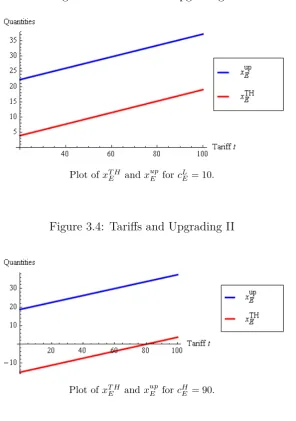
3.1 Tariffs and the Trojan Horse I . . . 98
3.2 Tariffs and the Trojan Horse II . . . 98
3.3 Tariffs and Upgrading I . . . 100
3.4 Tariffs and Upgrading II . . . 100
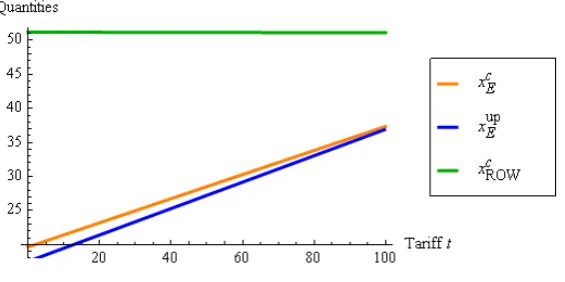
3.5 Tariffs and the Gateway I . . . 102
In 2010, cross-border trade in services accounted for 20 percent of world trade. In addition,
in 2005, more than 60 percent of world-wide inward foreign direct investment (FDI) stocks
could be attributed to the service sector compared to 30 percent to the manufacturing
sector. Moreover, between 2009 and 2011, the service sector accounted for approximately
one third of international assets of the top 5,000 non-financial multinational enterprises
(MNEs) (UNCTAD, 2007, 2009, 2011a). Despite the economic importance of international
trade in services in general and of FDI in services in particular, there is little we know
about the determinants of the location choice for a firm’s affiliate in the service sector.
At the same time, FDI in manufacturing is a thoroughly explored field.
Today, we are familiar with market-seeking horizontal FDI (HFDI) in manufacturing
attracted by high host-country GDP, efficiency-seeking vertical FDI (VFDI) looking for
low factor costs, and the more complex form of export-platform FDI. With regard to HFDI
economists have been asking the question, under which circumstances a firm seeking to
serve a foreign market will find it profitable to establish a foreign affiliate in that market
(thus incurring fixed investment costs) instead of exporting its goods to the same market
(thus bearing the variable distance costs). In case of VFDI the question economists seek
to answer is why a firm striving to minimize its production costs chooses one country as
a production location over another. Export-platform FDI, finally, exploits the proximity
of a particular production location to export to markets in third countries. Common to
all of these forms of FDI is the general notion that FDI, while expensive in terms of the
fixed cost of establishing a production site abroad, enables a firm to generate economies
of scale by spreading headquarter costs over multiple affiliates, and to retain control over
(1981) in his eclectic paradigm of ownership, location and internalization advantages.
Services are somewhat different in these respects: first of all, many of them such as retail
services, or after-sales services simply are not tradable per se. Hence, providing these services in another country is only possible through FDI. Second, the fixed cost of
estab-lishing a foreign service affiliate is conceivably lower than that of a new production site.
An example could be the establishment of a consulting firm’s office versus a production
plant requiring elaborate machinery. Therefore, an important question to pose in this
context is, e.g., whether the traditional theories on manufacturing FDI also apply to the
service sector. More precisely, do the same host-country characteristics that determine a
manufacturing firm’s affiliate location decision also apply to the location decision for a
service affiliate? When seeking to answer the latter question one has to take into account
the pronounced heterogeneity within the service sector. The World Trade Organisation
identifies a total of twelve distinct service sectors, among which are business services
(such as engineering, real estate, IT, etc.), distribution services (e.g., wholesale and retail
trade), financial services (such as banking and insurance), and construction and transport
services (WTO, 1991).
Among these different sectors, wholesale services have started to catch the attention of
researchers in international economics as FDI in this sector has become a sizable
phe-nomenon. In 2009, 7.2 percent of world inward FDI stocks were in the wholesale and
retail sector (ITC, 2011, and own calculations). Recent research has explored the
mo-tivations for wholesale FDI conducted by manufacturing firms in terms of parent-firm
characteristics (e.g., Akerman, 2010; Bernard et al., 2010b; Felbermayr & Jung, 2009;
Krautheim, 2010). Retail services are related to wholesale services in that retail firms
typically do not produce the final goods they sell but rather contract with vertically
non-integrated suppliers. The Organisation for Economic Cooperation and Development
(OECD) defines retailing as “... a form of trade in which goods are mainly purchased and
resold to the consumer or end-user, generally in small quantities and in the state in which
they were purchased (or following minor transformations)” (OECD, 2011a). Wholesale
and retail services differ in the sense that wholesale agents do not interact directly with
consumers but rather supply retailers who then sell the final goods in smaller quantities.
service if we abstract away from mail-order shopping or e-commerce. As such, a retailer
has to be ‘on the ground’ in order to serve consumers who typically neither buy goods
at the factory door nor produce clothing, groceries, etc. themselves. Therefore, when a
retail firm seeks to serve a foreign market it has to be through direct investment. It is
precisely these specificities of retail firms, i.e., their direct contact to consumers as well
as the non-tradability of their services, which turn them into appealing research objects.
Retailing is a sizable sector in economic terms. In 2005, total global retail sales amounted
to US$ 9780 billion, which is about four times the German GDP in the same year
(Daw-son, 2007; OECD, 2011b). This figure includes sales on both, domestic and on foreign
markets. The internationalization of retail firms via the opening of foreign affiliates has
been observed since the early 1990s, and in 2008, the top 250 retail companies generated
22.9 percent of their total sales through foreign operations (Deloitte, 2010). And indeed,
purchasing furniture at IKEA (of Sweden) or clothing at Zara (of Spain) in various
coun-tries around the world has become mundane. At the same time, the face of retail markets
(at least in industrialized countries) has changed. Instead of a large number of small
businesses (e.g., the traditional ‘mom-and-pop’ stores) most retail sub-sectors today are
dominated by a decreasing number of ever larger companies operating retail outlets in
numerous countries. The drivers of this internationalization are of both, the ‘push’ and
the ‘pull’ type. Push factors include the consolidation in the retail sector, which gives
large retail firms increasing degrees of market power in the vertical supply chain,
sat-urated home markets, restrictive legal provisions concerning access to and operation in
established retail markets, but also technological innovations such as the computerization
of supply and distribution systems. Examples of pull factors include the continuous
liber-alization of the world trading system, which reduces the cost of operating stores in foreign
markets, and the emergence of new markets in transformation and developing economies
that have relaxed their legislation prohibiting foreign market entry but are also
charac-terized by a growing consumer base with a demand for modern retail formats (as opposed
to the aforementioned mom-and-pop stores as well as street vendors, wet markets etc.).
Modern retail firms have not only exported their formats to industrialized countries but
also increasingly to emerging economies in regions such as South America, (South) East
urbanization have been conducive to this development (Reardon, 2005). The entry of
retail firms has raised concerns among the governments of the destination countries as
they fear that small farmers and processors could be crowded out because they are not
equipped to meet the competition and requirements from the entrant retailers (Reardon &
Gulati, 2008). At the same time, modern retailers can present opportunities to farmers and
processors by transferring technology to them, granting them access to their distribution
networks, and giving them access to higher value markets. In addition, production for
the retail sector as well as the retail activities themselves impact employment, and the
availability of more efficiently produced goods as well as increased competition in the
retail sector drive down consumer prices — an unambiguously positive effect of retail
FDI. Therefore, the a priori effect of retail FDI on welfare in general and on the supply sector in a destination country in particular is unclear.
Based on the stylized facts presented above, there are three questions that I seek to
answer in the three chapters of this dissertation: first, how do the determinants of the FDI
location choice differ between manufacturing and service affiliates? Second, which factors
are conducive or obstructive to retail FDI? And third, when a retail firm has decided to
conduct FDI in an emerging economy, what are the ramifications for the manufacturing
sector in the destination country? The remainder of this preface consists of an overview of
the chapters, in which I highlight the contributions to the literature and the main results.
In Chapter 1, which is joint work with Martina Engemann, we seek to answer the question
of whether the same FDI location determinants for manufacturing affiliates also apply to
the service sector. FDI is conducted for different reasons (market access or cost-reduction),
and in different sectors (manufacturing and services). Each type is potentially motivated
by different host-country characteristics. Nevertheless, while empirical researchers have
distinguished between horizontal and vertical FDI they have failed to make the same
dis-tinction between manufacturing and service FDI. We argue, however, that it is precisely
the inherent differences between services and manufacturing that have led to blurry
em-pirical results for the determinants of the FDI location decision in the past. We therefore
strive to fill this gap.
multina-tionals and their foreign affiliates provided by the Deutsche Bundesbank in the
Micro-Database Direct Investment (MiDi) (Deutsche Bundesbank, 2011). We add data on a
number of host country characteristics, which we consider to be relevant for the location
decision. Indeed, our summary statistics as well as regression analyses indicate that there
are no differences in the conduciveness of host-country characteristics when we
distin-guish between HFDI and VFDI. For example, horizontal affiliates are as concentrated in
high-income economies as vertical affiliates, which is counter-intuitive with respect to the
cost-saving motive of VFDI. However, drawing the distinction between services and
man-ufacturing we see that service affiliates are more concentrated in high-income economies
than manufacturing affiliates.
Our subsequent two-part estimation of the extensive and intensive margin of FDI yields
interesting results: an increase in the host country’s average wages has a statistically
significantly negative effect on VFDI and on HFDI. At the same time, higher host-country
GDP increases the investment probability of both types. This is not in line with the
predictions of traditional theories on VFDI and HFDI. Conversely, we find that while
average wages in the host country have a negative and statistically significant effect on
manufacturing FDI, they are insignificant for service FDI. Institutional variables such
as the protection of intellectual property rights or contract enforcement matter for the
location decision in case of service FDI but not for manufacturing FDI. Moreover, we also
estimate the coefficients of the same set of covariates (except for the exclusion restriction)
for the intensive margin of FDI. There is again no difference between HFDI and VFDI
while there exist significant differences between the determinants of the amount invested
in the manufacturing and in the service sector. All of these results hold for a number of
robustness checks. One possible explanation may be given by the fact that manufacturing
and service firms differ in terms of the skill level of the required work force. Indeed, our
summary statistics show that, on average, service affiliates are more high-skill intensive
than manufacturing affiliates, which may lead to different location-choice determinants.
At the same time, service affiliates are more concentrated in high-income OECD countries
than manufacturing affiliates. Hence, one may hypothesize that skill-intensive sectors
consider the education-level of a country’s workforce as being of greater importance than
Our study is the first attempt to explore the differences between manufacturing and
ser-vice FDI location decisions using a firm-level dataset. The empirical findings indicate that
manufacturing and service FDI are indeed driven by divergent factors. The main result is
that factor costs in terms of average host-country wages are statistically negatively
signif-icant for manufacturing FDI but insignifsignif-icant for service FDI. This finding may explain
why past research on VFDI that failed to distinguish between services and manufacturing
sectors has mostly produced blurry results.
Chapter 2, which is joint work with Prof. Dr. Carsten Eckel, explores the determinants
of FDI in the retail sector in a two-country partial equilibrium framework. Several
schol-ars have recognized the non-negligible role of retail firms, especially in the context of
the effects of trade liberalization on welfare when retailing as an intermediary between
producers and consumers is taken into account (e.g., Eckel, 2009; Raff & Schmitt, 2009a;
Richardson, 2004). However, we are the first to construct a model of retail FDI. There
exists strong stylized evidence of the continuous consolidation in the retail sector, which
has turned formerly stand-alone national retail firms into companies operating
interna-tional chains of stores giving them a mounting degree of market power (e.g., Competition
Commission, 2000).
We account for this fact by assuming full bargaining power on the retailer’s part vis-à-vis
the producers of final goods. Combined with the assumption of supplier prices being
responsive to the quantity produced (e.g., due to economies of scale in the production
of these goods) this is one of the key features of our model. Accordingly, the retailer’s
bargaining power allows him to push supplier prices down to average costs. Further,
we include trade costs which accrue to the retailer who, after having invested abroad, is
assumed to still procure his entire product range from the home-country supplier. Once
a retail firm has invested in a foreign country we observe a duopoly and, thus, include an
exogenous parameter measuring the degree of competitiveness of a given retail market,
which also influences a retailer’s market-entry decision. Furthermore, we assume that
retailers incur variable costs of distribution whose inverse may be interpreted as a measure
of productivity, which also determines the profitability of international expansion. Finally,
country’s retail market size and examine its impact on retail FDI.
The comparative statics with respect to these parameters yield very rich results: an
increase in trade costs is, per construction, unambiguously detrimental to the investment
decision since they increase a retailer’s marginal costs of provision on the foreign market.
However, there are levels of trade costs for which a retail company finds it profitable to
invest abroad despite the fact that it makes losses on the foreign market. This is due
to lower supplier prices in the home country which offset the losses. The effect of an
increase in the intensity of competition (e.g., due to an exogenous change in competition
policy) on the profitability of entry into a retail market depends on the relative size of
the retail rivals measured in terms of their sales quantities on that market. The larger
the difference in quantities, the more an increase in the degree of competition tends to
benefit the relatively large retail firm. It will sell even more on the foreign market because
the larger quantity translates into a lower supplier and final goods price and, hence, the
more the firm tends to find foreign investment profitable. Also, retailers headquartered in
larger home markets as well as retailers with lower distribution costs (i.e., more efficient
retailers) tend to find FDI profitable. The latter result is in line with findings of other
studies that relate the international growth of a retail chain in terms of the number of
stores to technological improvements (e.g., Basker & Hoang, 2011). In conjunction with
the intensity of competition we are able to show that retailers headquartered in larger
home-markets as well as more productive retailers tend to benefit from an increase in
competition and, thus, tend to find expansion via FDI profitable. Finally, our investigation
yields the interesting result that retail FDI may contain a first-mover advantage: in our
two-country setting, a retail firm may actually foreclose entry into its home market when
it is the first to conduct FDI in the foreign market.
Our results may be informative to policy makers seeking to shape their country’s
reg-ulatory provisions with regard to market competition: on the one hand, antitrust laws
aiming at an increase in competition in a given retail market may actually be
detrimen-tal for smaller business while the already large retail firms receive incentives to invest
abroad, can quote lower prices and, thus, extend their market shares. On the other hand,
our results with regard to strategic market entry may enable national governments in
not receive (more) foreign entry even if it is considered desirable. In addition, albeit not
part of the formal analysis, it is conceivable that foreign retail investment could augment
consumer welfare in terms of lower prices and an increased number of goods varieties.
In Chapter 3, I theoretically analyze the impact of retail FDI on the host-country
manu-facturing (i.e., supply) sector. In fact, retailers may be both, ‘friends’ and ‘foes’ to local
manufacturers. They are foes in the sense that they may act as “Trojan horses” (Reardon
et al., 2007, p. 416), i.e., they pose a competitive threat to local manufacturers as they
import foreign goods and, thus, crowd out local varieties. At the same time, a retailer may
be a local manufacturer’s benefactor in that he may provide financial assistance for
in-vestments into production technology or could teach him how to comply with quality and
efficiency standards (i.e., undertake technological upgrading). In addition, once the goods
produced by local manufacturers comply with the retailer’s standards they may find their
way into his international distribution network, hence creating a gateway which spurs
exports and gives access to higher-value markets. Obviously, this topic is particularly
relevant for emerging economies lagging behind in terms of the best available technology
and integration into the world economy. A vast amount of anecdotal evidence supports
the notions of import competition, upgrading, and export gateways (e.g., Reardon et al.,
2007; Coe & Wrigley, 2007; Minten et al., 2009). The fear of the Trojan horse effect of
retail FDI has brought the subject to the policy agenda of international organizations
such as the United Nations Conference on Trade and Development (UNCTAD, 2004) or
the OECD (Nordås et al., 2008). However, in the economics literature there seem to be
no theoretical approaches formalizing these perceptions which would enable us to better
evaluate the impacts of retail FDI on the host economy. Hence, I am the first to analyze
in a partial equilibrium framework the tradeoff between the Trojan horse effect of retail
FDI and the efficiency increasing effect of technological upgrading as well as the effect of
increased exports through a retailer’s international distribution network.
In the partial equilibrium framework I account for larger retailers’ buyer power, for
tech-nological differences between home and host country of the entrant retailer, and also for
the availability of import tariffs as a policy option. My analytical results show that in
the local manufacturer and outweighs the other effects. In terms of production
quanti-ties, however, the overall effect is not as clear-cut: while the Trojan horse effect reduces
the quantity produced, the upgrading and gateway effect both increase production. In
a discussion of the potential impacts on welfare I note inter alia that higher production quantities may be interpreted in terms of positive effects on employment as was shown
by Bjorvatn & Eckel (2006). In a next step, I examine the impact of import tariffs, which
a government may impose in case it is afraid of the Trojan horse effect becoming too
strong. As the comparative statics yield ambiguous analytical results I employ numerical
exercises to gain an understanding of the repercussions of import tariffs. In terms of the
Trojan horse effect, I find that tariffs reduce the import competition. The protective effect
is stronger the less local and imported varieties are differentiated. The positive upgrading
effect is reduced by the imposition of tariffs. The protective effect of tariffs is larger the
higher the initial marginal cost of the manufacturer. Finally, the gateway effect of retail
FDI is diminished by the levying of import tariffs — even more so when the export market
is relatively large.
My model may inform governments deciding whether to open their country’s retail market
to foreign entry as well as their decision about the imposition of import tariffs. For
example, the well-known infant industry argument would be in favor of import tariffs as
they can protect an economic sector while it is still gaining competitive strength. Also,
the imposition of tariffs generates government revenue, which could be used to subsidize
investments by local manufacturers improving their productive capacities. However, tariffs
imposed on imports brought in by retailers may eventually avert retail FDI altogether.
This could also impede technological upgrading, the potential positive employment effects,
reduce the product varieties available to consumers, and create an anti-competitive retail
market environment which tends to increase consumer prices. Therefore, as is ever so
often the case in economics, this decision is subject to thorough weighting of options and
consequences, perhaps even more so in case of an emerging economy.
All three chapters of this dissertation are self-contained and include their own
On the Differences between FDI in
Services and in Manufacturing
0
1.1
Introduction
The service sector plays an important role in global foreign direct investment (FDI). In
2005, more than 60 percent of worldwide inward FDI stock could be attributed to the
service sector compared to 30 percent in the manufacturing sector (UNCTAD, 2007).1
However, until recently most studies on FDI have focused only on the manufacturing
sector (see Blonigen, 2005, for a review of the literature). In addition, the traditional
distinction between horizontal FDI (HFDI) and vertical FDI (VFDI) is hard to detect
in empirical studies (see Blonigen, 2005). Traditional theories explain HFDI by
market-seeking motives (e.g., Markusen, 1984). In order to serve a larger market a firm replicates
its home-country activity in a foreign country. VFDI is explained by cost-saving motives
(e.g., Helpman, 1984). Due to the availability of modern communication technologies
and lower transport costs a firm is able to fragment its vertical production process and
off-shore part of the production to countries with lower factor costs. Hence, diverging
0
This chapter is based on joint work with Martina Engemann. It was partly written during visits of the authors at the research centre of the Deutsche Bundesbank. The hospitality of the Bundesbank, the kind support of the staff as well as access to its Microdatabase Direct investment (MiDi) (Deutsche Bundesbank, 2011) are gratefully acknowledged.
1In 2010, the share of service FDI amounts to 30 percent. This is because service FDI decreased
host-country characteristics should determine the location decision of each type of FDI.
However, most empirical studies have failed to find evidence of VFDI. Exceptions are
Hanson et al. (2005) and Feinberg & Keane (2001, 2006) who argue that the cost-saving
motivation only seems to hold for a few particular manufacturing sectors.
We acknowledge this fact and argue that the real difference in the determinants of FDI
location decisions stems from differences between manufacturing and service affiliates.
Failing to take this divergence into account or to treat services separately might have
led to the blurry results that were produced by earlier studies (e.g., Eicher et al., 2011).
We argue that different country characteristics matter for the manufacturing and the
service sector as these sectors also differ in several respects. First, some services simply
cannot be traded such that the decision between whether to export a service or to conduct
FDI does not apply. Retail services are a good example of such non-tradable services.
Second, the fixed costs of establishing a foreign affiliate may differ dramatically between
the service and the manufacturing sector. Take, for example, the cost of establishing
an entire production site including machines, logistics, etc. versus the cost of setting up
a lawyer’s office. Therefore, we argue that theories on manufacturing FDI may not be
applicable to service FDI. For example, we raise the question of whether the traditional
theory explaining vertical FDI by Helpman (1984) also applies to the service sector. More
precisely, do host-country average wages matter for the FDI location decision in the service
sector? And if they do, can we also detect differences in the determinants of FDI for
different service sub-sectors?
In order to analyze the differences between service and manufacturing FDI we use
firm-level data on the universe of German multinationals and their economic activities abroad,
which is provided by the Deutsche Bundesbank in the Micro-Database Direct Investment
(MiDi). This is a panel dataset for the years of 1996 to 2009 of which we use the years
1999 to 2008. German parents owning a foreign affiliate are required by law to report
information to the Deutsche Bundesbank on the sector, legal form as well as the number
of employees and balance sheet information of the foreign affiliate (Lipponer, 2009). We
estimate the impact of various country characteristics on the decision where to locate FDI
Our summary statistics and the estimation results show that there is no difference in
the determinants of the FDI location decision between HFDI and VFDI. Note at this
point that earlier studies have applied something that can be described as “backward”
identification strategies to distinguish between VFDI and HFDI: if an affiliate is set up in
a low-wage country relative to the home country, it is assumed to be VFDI and vice versa
for HFDI. We, however, are able to a priori distinguish between the two types of FDI. HFDI is identified when both, parent and affiliate have the same sectoral categorization,
VFDI when the classifications differ. In doing so we follow Alfaro & Charlton (2009).
Instead, we find significant differences in the determinants of manufacturing and service
FDI. For manufacturing FDI average wages do have a significantly negative impact on
the location decision whereas for services they do not matter. Furthermore, institutional
variables such as the protection of property rights and legal contract enforcement influence
the service FDI location decision but not the location decision in manufacturing. Taking
the heterogeneity of the service sector into account we separately analyze the wholesale
sector and the business service sector. For these two sectors we also find different
country-level determinants. In particular, we observe the average wage being important for the
wholesale sector but playing no role for the business service sector. This may be explained
by skill differences, namely the wholesale sector being low-skill intensive and the business
service sector employing mainly highly skilled persons. In addition, we also estimate the
impact of country characteristics on the amount invested in different countries conditional
on a firm already having decided to invest. Here, the results are very similar to the ones
for the extensive margin. Again, we find that there is no difference in the determinants
of HFDI and VFDI. However, the amount invested in services is driven by other factors
than the amount invested in manufacturing: just as for the extensive margin, higher
host-country wages decrease manufacturing FDI but do not matter for service FDI, and
intellectual property right protection attracts larger amounts of investment in services
but not in manufacturing.
These findings provide opportunities for policy makers. In the public debate, FDI becomes
an issue once a plant is relocated to a low-wage country because of the fear of job-losses
in the previous host country. A recent example is the Finnish mobile phone company
Romania in favor of Asia (Financial Times Deutschland, 2011). Both relocations have
most likely been driven by lower factor costs in the destination country. However, we
find that the location choice of service FDI is not driven by a country’s average wages.
Hence, high-income economies could be advised to focus on attracting service FDI rather
than trying to compete with low-wage countries in attracting manufacturing firms via
subsidies.
Studies of FDI in the service sector are a very recent strand within the vast body of
literature on FDI. The ones most related to ours use either firm-level or industry-level
data and can be grouped into three rough areas: first, studies testing the applicability
of existing FDI theories to FDI in services; second, studies making a general distinction
between FDI in manufacturing and in services while taking third-country effects into
account; third, theories looking for differences between manufacturing and service FDI
but using industry-level data.
In the first strand, Markusen & Strand (2009), for example, adapt the
knowledge-capital-model of Markusen (1998) to the business service sector. In contrast to them, we do not
only focus on one specific service sector but analyze the difference between service and
manufacturing FDI in general. Kelle et al. (2010) test whether the self-selection
mecha-nism of Helpman et al. (2004) (the most productive firms conduct FDI, less productive
firms export, and the least productive firms are only active domestically) can also be
found for the service sector. Combining the MiDi data on German outward FDI with
data on service exports from the Deutsche Bundesbank they find that the same sorting
pattern holds for service firms. Wagner (2011) uses data collected by the German Federal
Statistical Office on business services to examine the same question. He finds that less productive service firms tend to conduct FDI while more productive firms export ser-vices.2 We do not focus on the exports-versus-FDI decision, which only applies to HFDI,
but on the FDI decision in general. In addition, we do not consider firm characteristics
but concentrate on country characteristics determining the location choice, and we do
find differences for manufacturing and service affiliates.
2This is in line with the theoretical predictions of Patnaik et al. (2010) derived for the case of
In the second strand of literature, Guillin (2011) investigates differences in the FDI
mo-tivations between goods and services taking third-country effects into account. Using
data provided by the U.S. Bureau of Economic Analysis (BEA) she does not find much
variation in the motivations for FDI across activities but rather across regions: vertical
motives are most prevalent in both, services and manufacturing, for the location choice
in non-OECD regions. In OECD countries, however, it is mostly horizontal FDI motives
that dominate the location choice for both, service and manufacturing affiliates.
Simi-larly, in a study on service FDI in space Davies & Guillin (2011) find that across different
measures of distance, the traditional determinants of outbound FDI activity remain valid
for services. They “backwardly” identify VFDI through the signs on the covariates in
their regressions. E.g., negatively significant average wages are interpreted as evidence
for VFDI. We, however, are able to directly identify HFDI and VFDI via the NACE
sectoral classifications as explained earlier. In contrast to Guillin (2011) and Davies &
Guillin (2011) we do not apply a spatial approach and we find that VFDI is as
concen-trated in high-income economies as HFDI. Moreover, we find that the determinants of the
FDI decision do not differ between the two types, while they differ between manufacturing
and service affiliates.
In the third strand, there are studies by, e.g., Kolstad & Villanger (2008) and Ramasamy
& Yeung (2010). Both use industry-level data to examine the determinants of FDI in
services. Neither one of these studies finds differences in the determinants of the location
decision for FDI in services compared to FDI in manufacturing. Conversely, using
firm-level data we do find such divergences.
The remainder of this chapter is organized as follows. In Section 2 we present summary
statistics to gain a first impression of the data, and elicit potential differences between
service and manufacturing FDI. In Section 3 the dataset it described. Section 4 explains
our empirical strategy, and in Section 5 we present our estimation results as well as the
1.2
Summary Statistics
1.2.1
General Overview
Using our firm-level data on German outward FDI we observe 47 percent of service parents
and 53 percent of manufacturing parents. Figure 1.1 shows that, interestingly, service
parents mainly have service affiliates (87 percent), and only 12 percent are manufacturing
affiliates. Manufacturing parents, however, establish in 50 percent of the cases service
affiliates and 50 percent manufacturing affiliates. Given that a service parent has a service
affiliate 57 percent is HFDI, and 43 percent is VFDI.3 Considering manufacturing parents
with manufacturing affiliates, 79 percent is horizontal, and 21 percent is vertical FDI.
Furthermore, 9 percent of all firms owning affiliates have them in both, the service and
the manufacturing sector. This share is higher for manufacturing parents (14 percent)
than for service parents (3 percent).
Service Parents Manufacturing Parents Service Affiliate Man. Affiliate Service Affiliate Man. Affiliate
Hor. Ver. Ver. Ver. Ver. Hor.
47% 53%
87% 12%
57% 43%
50% 50%
79% 21%
Figure 1.1: German Outward FDI (all affiliates)
1.2.2
Importance of Wholesale FDI
The aforementioned numbers already suggest significant differences between FDI activities
in services and in manufacturing. Exploiting further the richness of the data at hand we
see that wholesale is, by far, the most important service affiliate sector of manufacturing
parents: 80 percent of all manufacturing parents that have affiliates in the service sector
have a wholesale affiliate. The most important parent sectors are the manufacture of
machinery and equipment (30 percent), the manufacture of medical, precision and optical
3Note again that HFDI is identified when both, parent and affiliate have the same sectoral
instruments (12 percent), and the manufacture of chemicals and chemical products (10
percent). In all of these sectors we observe firms with wholesale affiliates. In order to
be able to better evaluate the magnitude of this fact we exclude all wholesale affiliates
from our data and compare the shares again. Without wholesale affiliates manufacturing
parents only have in 12 percent of the cases a service affiliate. Instead, they have mostly
manufacturing affiliates. These shares resemble the ones of service parents with service
or manufacturing affiliates. This underlines the importance of wholesale FDI, which can
be interpreted as export-supporting FDI (e.g., Krautheim, 2010). It is export-supporting
in that it provides the service of intermediation between the producer of a good (located
in one country) and the buyer of that good (located in another country) (Bernard et al.,
2010b). As such, cross-border wholesale activities are market-seeking and, thus, in case
of a foreign investment should be classified as HFDI.
Furthermore, focusing on service parents having manufacturing affiliates reveals that the
most important parent sector is again the wholesale sector with nearly 65 percent. German
wholesale parents have affiliates in the sectors of the manufacture of metal products,
rubber and plastics, and chemicals and chemical products. In addition, within the service
sector the wholesale sector is the most important parent sector for both, HFDI and VFDI,
and it is also an important affiliate sector.
1.2.3
Skill Differences
In addition to the sectoral differences with respect to FDI activities the service and the
manufacturing sector also differ in the skill-intensity of the required workforce. In order
to see this in our data we categorize the different sectors at the NACE Revision 1.1
two-digit level according to the Eurostat categorization using the sectoral approach (Eurostat,
2011).4 Accordingly, we observe that excluding wholesale affiliates, which are considered
as less knowledge-intensive, service affiliates are on average more skill-intensive than
man-ufacturing affiliates: roughly 80 percent of service affiliates and approximately 50 percent
of manufacturing affiliates are high-skill intensive. However, including wholesale affiliates
4The sectoral approach is an aggregation of the manufacturing industries according to technological
the share of high-skill service affiliates amounts to only 30 percent.
These differences in skill-intensities may lead to different location choices. We
hypothe-size that skill-intensive sectors may consider the education-level of a countries’ workforce
as being of equal or of even greater importance than average wages (our proxy for
vari-able production costs). Hence, for vertical service FDI skill-seeking considerations may
dominate cost-saving ones.
1.2.4
Host-Country Differences
The summary statistics in the previous section have shown that manufacturing and service
parents as well as their affiliates differ in some respects. These differences may then lead
to diverging location choices. We examine the destination countries in order to gain some
further intuition for the determinants of the FDI location decision, and whether they vary
between service and manufacturing FDI. First, we categorize the economies according to
their GDP per capita using the World Bank classification of country incomes (World
Bank, 2011). According to this classification 16 percent of all countries are low-income
countries, 26 percent are lower-middle income countries, 25 percent are upper-middle
income countries, and 33 percent are high-income countries. We observe that service
affiliates are more concentrated in the high-income OECD countries than
manufactur-ing affiliates. Roughly 80 percent of service affiliates are located in high-income OECD
countries compared to approximately 70 percent of manufacturing affiliates. The share
of horizontal service affiliates in high-income OECD countries amounts to 85 percent but
even for vertical service affiliates the share is 83 percent for those with service parents
and 77 percent for those with manufacturing parents.
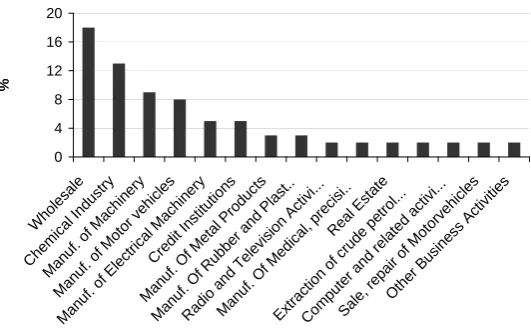
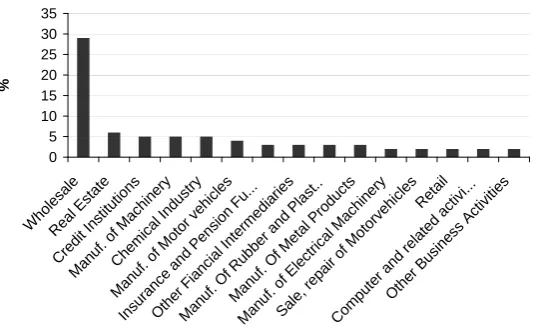
In Figure 1.2 we depict the distribution of affiliate sectors for all destination countries.
First of all, the extraordinary role of the wholesale sector becomes obvious again.
Fur-thermore, the importance of analyzing service FDI is also highlighted as nine of the 15
most important affiliate sectors are service sectors. In Figure 1.3 we only focus on low,
lower-middle and upper-middle income countries. For these countries the dominant role
of the wholesale sector, though still the most important affiliate sector, is significantly
indi-0 5 10 15 20 25 30 Who lesa le Che mic
al In dust
ry
Man uf. o
f M achi
nery
Cre dit I
nstit utio
ns
Rea l Est
ate
Man uf. o
f M otor veh icle s Man uf. O
f Rub ber a
nd P la...
Man uf. O
f M etal Pro duct s Insu ranc
e an d P
ensi on F
...
Man uf. O
f Ele ctric
al M ach.
..
Oth er Fi
nanc ial I
nter med
i...
Sal e, re
pair of M
otor vehi
cles
Com pute
r and rela
ted activ
...
Oth er B
usin ess Act iviti es Ret ail %
Figure 1.2: Distribution of Affiliate Sectors
cate that the cost-saving argument for vertical FDI through lower host-country wages is
relevant for manufacturing FDI but not for service FDI. Conversely, service FDI is much
more concentrated in high-income countries as can be seen in Figure 1.4. There, the three
most important affiliate sectors are the service sectors wholesale, real estate, and credit
institutions. 0 4 8 12 16 20 Who lesa le
Chemical In dustry
Man uf. o
f Machin ery
Man uf. o
f Motor vehicles
Man uf. o f Electri cal Machinery Cre dit In stitution s Man uf. O f Metal Pro ducts Man uf. O
f Rubber and Plast..
Radi o and
Television Activi...
Man uf. O
f Medical, precisi.. Real
Estate
Ext ractio
n of crude pe
trol...
Computer and related activi...Sale, rep air o
f Motor vehicles
Othe r Busine
ss A ctiv
ities
%
Figure 1.3: Distribution of Affiliate Sectors in Low, Lower-Middle and Upper-Middle
Income Countries
As the bulk of FDI goes to OECD countries we also introduce a within-OECD
catego-rization of country-incomes intolow,middle, andhigh according to their GDP per capita. This allows us to highlight differences in the location decision within the group of
high-income OECD countries. Even among these countries we observe a similar pattern as
high-income OECD countries compared to approximately 60 percent of the manufacturing affiliates. 0 5 10 15 20 25 30 35 Who lesa le Real Estate Cre dit In stitution s Man uf. o
f Machin ery
Chemical In dustry
Man uf. o
f M otor vehicles
Insurance and Pension F u...
Othe r Fianc
ial In term
ediaries
Man uf. O
f Rubber and Plast.. Man uf. O f Metal Pro ducts Man uf. o f Electri cal Machinery
Sale, rep air o
f Motor vehiclesR
etail
Computer and related activi... Othe
r Busine ss A
ctiv ities
%
Figure 1.4: Distribution of Affiliate Sectors in High-Income OECD and Non-OECD
Coun-tries
Returning to the classical distinction between vertical and horizontal FDI, one would
ex-pect horizontal FDI to be more concentrated in the high-income countries due to
market-seeking motivations while finding vertical FDI to be less concentrated in high-income
economies due to the cost-saving argument. This pattern can, however, not be found in
our data. Vertical FDI is as concentrated in high-income countries as horizontal FDI.
Instead, the divergence between the theoretical predictions and our findings seems to be
driven by the different affiliate sectors.
1.2.5
Core Competences of Countries
The pronounced concentration of service FDI in high-income countries may be driven by
the fact that these countries generally have a more developed service sector. Conversely,
the fact that manufacturing FDI is less concentrated in high-income countries may be
the case because lower-income countries are still more specialized in the manufacturing
sector. Therefore, we also look at the relation between a country’s core competence and
the inward FDI it attracts.
We measure the core competence according to an economic sector’s share of GDP using
and of 30 percent of GDP for the manufacturing sector. According to this definition, 75
percent of the countries considered have a core competence in the service sector and 49
percent have a core competence in the manufacturing sector.5 Due to data limitations we
cannot construct a measure of core competence on a more disaggregated level. Therefore,
we have to rely on the differentiation between primary, secondary and tertiary sector
where we only use the latter two.
Subsequently, we see that service FDI is more concentrated in high-income countries given
that these have a core competence in the service sector. In contrast, manufacturing FDI
is less concentrated in high-income countries given that these have a core competence in
manufacturing. These results may be driven by the fact that all countries with a core
competence in the service sector are mostly high-income countries, whereas for countries
with a core competence in the manufacturing sector the share of lower-income countries
is considerably higher.
This fact may also explain the large differences in average wages between countries with
a core competence in the manufacturing sector and countries with a core competence in
the service sector. The monthly average wage for countries with a core competence in
the service sector amounts to US$ 1387 on average. This is a lot higher than the wage in
countries with a core competence in the manufacturing sector, where it lies at US$ 977.
Given these wage differences, the theory on VFDI tells us that high average wages should
make the countries with a core competence in the service sector less attractive as a location
for FDI. Thus, we may conclude that the fact that service FDI is more concentrated in
high-income countries may be driven by their specialization in the service sector. Similarly,
manufacturing FDI being less concentrated in high-income countries can be explained by
the relatively high frequency of lower income countries having a core competence in the
manufacturing sector.
5Note that on average the service and the manufacturing sector in the countries covered by the data
1.3
Data Description
We use firm-level data on the universe of German multinationals and their activity abroad,
which is provided by the Deutsche Bundesbank in the Micro-Database Direct Investment
(MiDi). This is a panel dataset for the years of 1996 to 2009 of which we consider the
years 1999 to 2008. As the reporting thresholds have changed over this period of time,
we consider all firms which hold 50 percent or more of the shares or voting rights of a
foreign enterprise with a balance sheet total of more than 3 million Euro.6 These firms are
legally required to report to the Deutsche Bundesbank information on the sector, legal
form as well as the number of employees and balance sheet information of the foreign
affiliate (Lipponer, 2009). Our sample comprises a total of 4273 parent firms holding
foreign affiliates in at least one of the 132 host countries and in at least one of the years
from 1999 to 2008. Of these parent firms, 3242 have no wholesale affiliate versus 1774 that
do. The countries included in our estimation sample are listed in Table 1.9 in Appendix
A. With these we cover 74 percent of total German outward FDI activities.7
In order to identify the different determinants of the FDI location decision for firms in
the different sectors, and for the different types of FDI we add several host country
char-acteristics to the MiDi-Data. There exist many studies on the determinants of bilateral
FDI using country-level data, which control for various country characteristics. In order
to choose our controls we drew upon the studies by Blonigen & Piger (2011) and Eicher
et al. (2011), who use Bayesian Model Averaging in order to find robust FDI determinants.
These include GDP-related measures, geography measures, endowment measures, and
in-stitutional variables. For the GDP-related measures we include GDP per capita. As a geography measure we use a country’sremoteness. This variable measures the distance of the host country from all other countries in the world weighted by those other countries’
share of world GDP. It may capture export-platform motives where a firm invests in a
country to export to other surrounding countries (Ekholm et al., 2007).8 Moreover, to
6We also deflate the balance sheet total to make the data comparable over time.
7Unfortunately, due to data limitations with respect to country characteristics, the regression sample
does not comprise,inter alia, the destination countries France, Switzerland, or the Netherlands.
account for a country’s endowment with human capital, we addaverage years of schooling for male and female persons aged older than 25 years from the Barro & Lee (2010) table of
educational attainment. This data is available every five years between 1950 and 2010. In
order to be able to use the data for our panel analysis, starting with 1995 we replace the
missing two years before and after the year for which the data is available with the value
of that year. We include average years of schooling in order to account for skill-seeking
vertical FDI, which we assume to be of particular importance for service affiliates.9 In
addition, we include monthly average wages as a factor-cost measure. The wage dataset was prepared by Harsch & Kleinert (2011) making use of the October Inquiry database
of the International Labor Organization (ILO). Average wages shall capture traditional
cost-saving motives for vertical FDI. To control for a country’s institutional environment
we include the variablerule of law, which measures contract enforceability and protection of intellectual property rights, and a variable for corruption control. We also include a variable measuring the percentage of fixed broadband internet subscribers since we con-sider this type of infrastructure to be particularly relevant for services. As several studies
have already stressed tax evasion motives for FDI, we also add countries’ statutory tax rate (see, e.g., de Mooij & Ederveen, 2003, for a review). We obtain the tax rates from the European Tax Handbook (van Boeijen Ostaszewska, 2011) as well as the Global
Corpo-rate Tax Handbook (Gutiérrez et al., 2011). Further, we construct a control variable core competence indicating whether there is a match between the sector of an affiliate and the sector in a destination country (manufacturing or service) that is relatively economically
important. Note again that the service and the manufacturing sector are considered to
be economically important when their share is greater or equal to 50 percent or greater or
equal to 30 percent of GDP, respectively. We include this control to test whether affiliates
in services and manufacturing tend to be attracted by a relative degree of specialization in
one of the two sectors. Finally, in order to control for the conventional fixed cost of setting
up a foreign affiliate, we include the variable market entry. It is an index computed in 5-year intervals since 1970 and annually since 2000. The latest update is published in the
2011 Economic Freedom of the World annual report (Gwartney et al., 2011). It measures
9We are aware of the fact that average years of schooling are only an imperfect measure of human
the performance of countries in terms of the cost of starting a new business. As such, it
captures the time (measured in days) necessary to comply with regulations when starting
a limited liability company, money costs of the fees paid to regulatory authorities
(mea-sured as a share of per-capita income), and funds that must be deposited into a company
bank account (measured as a share of per-capita income).
1.4
Empirical Strategy
The analysis of FDI involves two intriguing questions: first, which country characteristics
determine where an affiliate is located? Second, which country-characteristics determine
how much a parent firm decides to invest in a particular country? Hence, we estimate
the extensive margin as a binary choice model and the intensive margin conditional on
the investment having taken place. We use a two-part model, which allows us to
es-timate both margins separately. It assumes that conditional on a set of covariates the
mechanisms determining the location decision and the amount invested are independent.
Therefore, we inflate the dataset such that each firm can invest in each country in each
year. Consequently, we have a lot of zeros in our dataset. Leung & Yu (1996) argue that
two-part models are more appropriate than selection models if many zeros are observed
in the participation decision.
Letyijt be the outcome of firm i in host country j in yeart (i= 1, ..., N, j = 1, ..., J and
t= 1, ..., T). The two-part model for yijt is then given by
f(yijt|.) =
(
P r(Iijt = 0|zjt−1, αi) if yijt = 0, P r(Iijt= 1|.)f(yijt|Iijt= 1,xjt−1, αi) if yijt >0.
(1.1)
Iijt is a binary indicator variable taking on the value 1 if a firmiholds an affiliate in host
countryjin yeartand 0 otherwise. zjt is a vector of country-specific explanatory variables
including an exclusion restriction, xjt ⊂ zjt is a vector of country-specific explanatory
variables not including the exclusion restriction and αi is a time-invariant firm-specific
effect. We control for countries’ statutory tax rates, average years of schooling, GDP,
yearly average wages, market entry costs, the percentage share of internet subscribers,
competence, the measure of corruption control and rule of law. Further, we control for
firm fixed effects. The costs of starting a business in a country serve as our exclusion
restriction. We argue that it determines the market-entry decision. However, as these
costs are sunk, once a firm has entered a country the costs of starting a business should
not influence how much to invest in the country.
We estimate the extensive margin by specifying P r(Iijt = 1|.) as a linear probability
model (LPM) and as a probit. Using the linear probability model allows us to control for
firm fixed effects by employing the within transformation. Note that this does not work in the probit model. However, we can also control for firm fixed effects by inserting the
respective means of all covariates (following Mundlak, 1978; Chamberlain, 1980), which
Chamberlain (1980) called a random effects probit model.10 We cannot just include firm dummies in the probit model as all coefficients would be biased due to the incidental
parameters problem (Wooldridge, 2010).
Unfortunately, we cannot include country fixed effects as we do not have enough variation
in our country characteristics over time. However, we do think that we include the most
important country characteristics such that the probability of an omitted variables bias
due to unobserved country characteristics is sufficiently low. Furthermore, we include all
country characteristics lagged once. First, this acknowledges the duration of an investment
decision. From the point when the firm considers investing up to the actual effectuation of
the investment it will probably take about a year. Therefore, the country characteristics
at the time when the firm decides about the investment should matter, and not at the
time of the realization of the investment. Second, using lags ensures that there are no
year-specific shocks influencing both, the country’s characteristics as well as the firm’s
investment in the country.11
The intensive margin of FDI, f(yijt|Iijt = 1,xjt−1, αi), is estimated using OLS. Similar
to the LPM estimating the extensive margin we again control for firm fixed effects by
applying thewithin transformation. We use standard errors clustered at the country-level for the estimation of both, the extensive and the intensive margin of the investment.
10We do not use a fixed effects logit model as the average partial effects cannot be estimated using
this method (Wooldridge, 2010).
11As a robustness check we have also included year dummies in our specification. This does not change
Hence, we account for the fact that the error terms will probably be correlated within a
country but not across countries. Cameron & Miller (2010) have pointed out that
cluster-robust inference asymptotics are based on the assumption that the number of clusters
goes to infinity. In our sample we have 45 clusters. Therefore, we also use bootstrap
standard errors proposed by Cameron & Miller (2010) as a finite-sample adjustment.
The assumption that conditional on a set of covariates the mechanisms determining the
location decision and the amount invested are independent is quite restrictive. Hence, we
also use a selection model to estimate the extensive and intensive margin jointly. Due to
the panel structure of our data and as we seek to incorporate firm fixed effects we cannot
use a standard Heckman selection model. Instead, we apply the procedure proposed by
Wooldridge (1995). First, we estimate a binary choice model using standard probit for
each year of our time period.
P r(yij|zj) = Φ(zjγ) for each t= 1999,2000, ...,2008 (1.2)
where zj includes the exclusion restriction market entry costs. Note that to be in
ac-cordance with the extensive margin of the two-part model we also use the lags of the
explanatory variables in the cross-sectional probit regressions. Using the ensuing
esti-mation results we compute the value of the inverse Mills ratio for each year and each
firm-country-observation ij, i.e.,
ˆ mij =
φ(zjˆγ)
Φ(zjˆγ)
for each t= 1999,2000, ...,2008. (1.3)
Second, we estimate the intensive margin using a fixed effects estimation and by adding
the inverse Mills ratios as regressors. This yields the estimation equation
yijt=ξ0+βxjt−1+ρmˆijt+αi+ηijt. (1.4)
The standard errors are again clustered at the country level. In order to test whether we
can use the two-part model or whether we have to control for selection, we need to
com-pare the coefficients of the intensive margin resulting from the two estimation procedures
them again by using seemingly unrelated regressions (SUR). Finally, we conduct a
Chow-test to compare the coefficients of the two regressions (not regarding the Mills ratios in
the selection model) (Chow, 1960). Using the Chow-test we can determine whether the
coefficients are significantly different from each other and we can tell if controlling for
selection does influence the results. The results are reported in Section 1.5.3.
1.5
Results
1.5.1
Extensive Margin
Horizontal versus Vertical FDI
The classical distinction in the FDI literature is made between horizontal and vertical
FDI. HFDI is driven by market-seeking motivations and can be seen as a substitute to
exporting (Markusen, 1984; Brainard, 1993). Therefore, one would expect firms to invest
in high-income countries. VFDI is driven by cost-saving motivations, where firms invest in
low-wage countries (Helpman, 1984). Accordingly, we first estimate the location decision
for HFDI and VFDI separately. We identify HFDI as those affiliates which are in the
same sector as the parent and VFDI as those affiliates which are in a different sector as
the parent according to the NACE Rev 1.1 classification at the 3-digit level (Alfaro &
Charlton, 2009).12 We expect GDP to play an important role for horizontal FDI while
for vertical FDI the average wage should have a negative effect on a firm’s investment
probability with respect to a potential host country.
In Table 1.1 we report the results of the LPM and random effects probit estimation for
HDFI and VFDI. For the probit estimation we always report the average marginal effects.
Columns 1 and 2 show the results for HFDI and columns 3 and 4 show the results for VFDI.
Note that due to the special role of the wholesale sector we exclude wholesale affiliates.
Wholesale affiliates owned by manufacturing firms, for example, would be classified as
12Note that all of the regressions were also conducted with bootstrap standard errors as suggested by
VFDI. However, the literature on wholesale FDI (or export-supporting FDI) suggests
that the determinants differ from those of traditional VFDI because it should be treated
as a type of (horizontal) trade (e.g., Bernard et al., 2010b).
In the LPM as well as in the probit model GDP is positively significant for both, HFDI
and VFDI while the average wage is negatively significant for either type of FDI. This is
counter-intuitive to what traditional theory teaches us. Further, a destination country’s
remoteness is found to be detrimental again for both types of FDI. This likely captures the
fact that among the parent firms conducting VFDI and HFDI are also some that conduct
FDI for more complex reasons such as the aforementioned export-platform motive. The
market-entry costs also reduce the investment probability for both types of FDI, yet only
in the probit regression. Thus, we cannot find robust differences between HFDI and VFDI.
Exceptions are the share of internet subscribers in a destination country which is positively
significant for vertical FDI in the probit estimation. The match between affiliate sector
and a potential host-country’s dominant sector, i.e., core comp., is positively significant
for VFDI. It may be positive for VFDI (which seeks an efficiency-enhancing production
location) since it could mean that there is a certain degree of expertise in that sector.
The other country characteristics do not make a difference for the FDI location decision,
neither for HFDI nor for VFDI. Overall, these results are in line with our summary
statistics where we observed that VFDI is as concentrated in high-income countries as
HFDI. Also, Blonigen (2005) stresses that many empirical studies of the determinants of
FDI have failed to find support for the traditional theory of VFDI.
Manufacturing versus Service FDI
Since the distinction between HFDI and VFDI has not produced satisfactory results,
we test our hypothesis that the real difference in the determinants of the FDI location
decision lies in the differences between manufacturing and service affiliates. Columns 1
and 2 of Table 1.2 report the results for service FDI and columns 3 and 4 contain the
results for manufacturing FDI. Wholesale affiliates are not considered in the estimation.13
Again we find GDP to be positively significant both for service and manufacturing FDI.