Available Online at www.ijcsmc.com
International Journal of Computer Science and Mobile Computing
A Monthly Journal of Computer Science and Information Technology
ISSN 2320–088X
IJCSMC, Vol. 3, Issue. 9, September 2014, pg.732 – 740
RESEARCH ARTICLE
REAL TIME SYSTEM FOR
DETERMINATION OF
DRINKING WATER QUALITY
B. MENAKA DEVI, N. AMMU ABIRAMI
Dept. Electronics and Communication Engineering, Sri Eshwar College of Engineering, Kinathukadavu [email protected], [email protected]
Abstract- Clean drinking water is important for health and well being of all humans. Assessment of quality of water in large water distribution systems involves taking of random water samples and testing it in laboratories. Since this process is time consuming and requires man power, this paper presents an approach to determine the quality of water automatically using low cost and in-pipe sensors. Here an array of sensor node is developed to assess the quality of water. Algorithms are developed for fusing the data collected by the sensors. ZigBee transceiver and GSM transmitters are used to transmit the collected data to the server. This paper also provides the techniques to resolve water contamination.
Index terms- water quality assessment, in-pipe sensors, sensor network, ZigBee transceiver, GSM transmitter
I. Introduction
As most of the diseases are spreading through water, clean drinking water is the most important resource for the well being of human being. Nowadays, due to limited water resources, ageing infrastructure, increased population and decreased attention towards safeguarding, there is a need for on-line in-pipe water quality monitoring systems.
This paper proposes the idea of monitoring the quality if water using low cost multiple sensors. Here an array of sensors is used to monitor the quality of water. The information collected by the sensors is transmitted to the main server through ZigBee transmitter and also the GSM is used for transmitting the message to mobile phones.
ZigBee has been developed to meet the growing demand for capable wireless networking between numerous devices. In industries, ZigBee is used for next generation automated manufacturing. This increased level of communication permits finely-tuned remote monitoring and manipulation systems. In the consumer market, ZigBee is being used for everything from linking low-power household devices such as smoke alarms to a central housing control unit, to centralized light controls. The maximum range of operation for ZigBee devices is 250 feet (76m). This paper also proposes the techniques to resolve the contaminants present in water.
The remaining parts of this paper is organized as section II survey of related works, section III proposed method, section IV result analysis and section V conclusion.
II. Survey of Related Works
The initial version of this article has appeared in [2]. In that paper, they presented an improved hardware platform and developed a new advanced contamination event detection algorithm and provided experimental results of this algorithm in the presence of real biological contamination. Only limited number of on-line, reagent-free water monitoring Systems are commercially available, but these Systems are bulky and costly to use in large environments.
A number of multi-parametric sensor arrays have been developed and presented in the literature based on various sensor technologies. A recent review on multi-parametric sensors for water quality is given in [3]. An array of chemical Sensors for water quality monitoring based on thick-film technology is discussed in [4], [5] and [6], [7], these sensors are very low cost, they have limited lifetime and require a conventional glass reference electrode to operate accurately.
Several water monitoring Microsystems have been developed for large scale water monitoring based on wireless sensor networks (WSNs) technology. In [8] a sensor node is developed for monitoring salinity in ground waters as well as the water temperature in surface waters. [11], [12], deals with development of WSN and an energy harvesting system to monitor nitrate, ammonium and chloride levels in rivers and lakes.
A survey on energy harvesting for WSNs is provided in [13] and [15]. In [16] a WSN is proposed to monitor hydraulic parameters in order to detect events such as leaks, pipe bursts. A cost effective multi sensor probe for monitoring chlorine, conductivity and pressure without any event detection algorithms has been proposed by Endetec [17] in 2012. Finally, [1] low cost sensor network is formed to detect the quality of water using event detection algorithm. Other data validation methodologies are given in [9] and references therein.
III. Proposed Work
The organizations like World Health Organization (WHO), EU, USEPA has set the standards for drinking water quality parameters and indicate which microbiological, chemical and indicator parameters must be monitored and tested regularly in order to protect the health of the consumers and to make sure the water is clean.
The developed system monitors both the biological contaminations and chemical contaminants that are present in water and it also resolves those contaminants.
3.1 Block Diagram
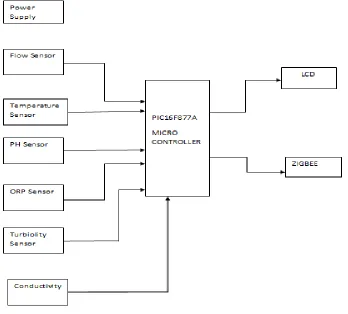
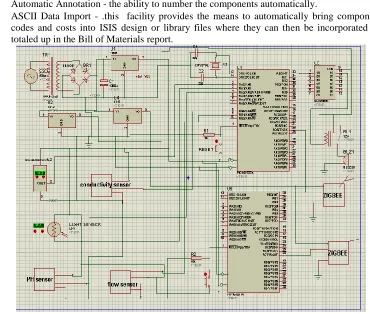
This block diagram consists of power supply section, GSM, ZigBee, microcontroller, MAX232driver, LCD, Flow Sensor, Conductivity Sensor, Temperature Sensor, pH Sensor, ORP sensor and Turbidity Sensor. The GSM board has a valid SIM card with a sufficient recharge amount to make outgoing calls. The circuits powered by +5v Dc.
Fig 1: Transmitter Section
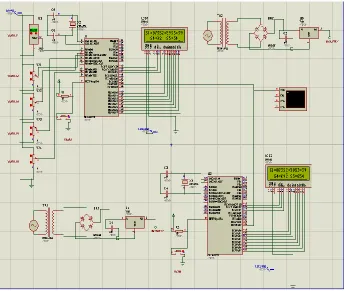
The Receiver Section consists of Power supply section, Microcontroller, LCD, MAX RS 232, ZigBee, Server Computer and GSM Module.
3.2 Hardware Description
3.2.1 Power Supply
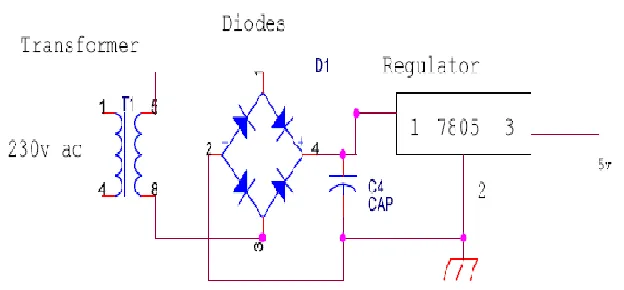
Power supply unit consists of following units: Step down transformer, Rectifier unit, Input filter, Regulator unit and Output filter.
Fig 3: Power Supply
The Step down Transformer is used to step down the main supply voltage from 230V AC to lower value. The Rectifier circuit is used to convert the AC voltage into its corresponding DC voltage. The most important and simple device used in Rectifier circuit is the diode. Capacitors are used as filter. The ripples from the DC voltage are removed and pure DC voltage is obtained. And also these capacitors are used to reduce the harmonics of the input voltage. Regulator regulates the output voltage to be always constant. The output voltage is maintained irrespective of the fluctuations in the input AC voltage. The Filter circuit is often fixed after the Regulator circuit. Capacitor is most often used as filter. The principle of the capacitor is to charge and discharge. It charges during the positive half cycle of the AC voltage and discharges during the negative half cycle. So it allows only AC voltage and does not allow the DC voltage. This filter is fixed after the Regulator circuit to filter any of the possibly found ripples in the output received finally.
3.2.2 Microcontroller
PIC is a family of Harvard architecture microcontrollers made by Microchip Technology, derived from the PIC1640 originally developed by General Instrument's Microelectronics Division. The name PIC initially referred to "Peripheral Interface Controller". PIC‟s are popular with developers and hobbyists alike due to their low cost, wide availability, large user base, extensive collection of application notes, availability of low cost or free development tools, and serial programming capability.
Core architecture:
The PIC architecture is distinctively minimalist. It is characterized by the following features:
Separate code and data spaces (Harvard architecture)
A small number of fixed length instructions
A single accumulator (W), the use of which (as source operand) is implied (i.e. is not encoded in the opcode)
All RAM locations function as registers as both source and/or destination of math and other functions.
Unlike most other CPUs, there is no distinction between memory space and register space because the RAM serves the job of both memory and registers, and the RAM is usually just referred to as the register file or simply as the registers
3.2.3 Sensors
A Sensor is a device, which responds to an input quantity by generating a functionally related output usually in the form of an electrical or optical signal. The Sensors used are Flow Sensor, Conductivity Sensor, and Temperature Sensor, pH Sensor, ORP sensor and Turbidity Sensor. The LM35 series are precision integrated-circuit temperature sensors, whose output voltage is linearly proportional to the Celsius (Centigrade) temperature. The LM35 thus has an advantage over linear temperature sensors calibrated in° Kelvin, as the user is not required to subtract a large constant voltage from its output to obtain convenient Centigrade scaling.
The LM35 does not require any external calibration or trimming to provide typical accuracies of ±1/4°Cat room temperature and ±3/4°C over a full -55 to +150°Ctemperature range. Low cost is assured by trimming and calibration at the wafer level.
3.2.4 Liquid Crystal Display
Liquid crystal display (LCD) has material which combines the properties of both liquid and crystals. They have a temperature range within which the molecules are almost as mobile as they would be in a liquid, but are grouped together in an order form similar to a crystal.
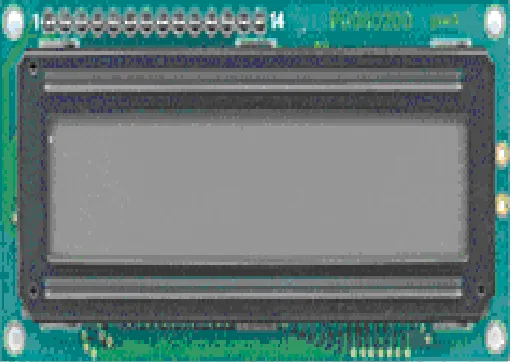
Fig 4: LCD Display
More microcontroller devices are using 'smart LCD' displays to output visual information. The following discussion covers the connection of a Hitachi LCD display to a PIC microcontroller. LCD displays designed around Hitachi's LCD HD44780 module, are inexpensive, easy to use, and it is even possible to produce a readout using the 8 x 80 pixels of the display. Hitachi LCD displays have a standard ASCII set of characters plus Japanese, Greek and mathematical symbols.
3.2.5 GSM
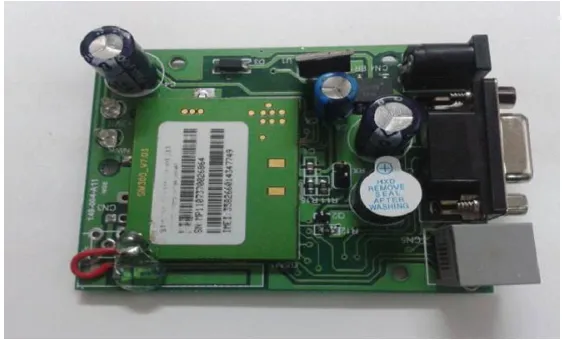
The GSM modem is a specialized type of modem which accepts a SIM card operates on a subscriber‟s mobile number over a network, just like a cellular phone. It is a cell phone without display. Modem sim300 is a tri band GSM/GPRS engine that works on EGSM900MHz, DCS1800MHz and PCS1900MHz frequencies. GSM Modem is RS232-logic level compatible, i.e., it takes-3v to -15v as logic high and +3v to +15 as logic low.MAX232 is used to convert TTL into RS232 logic level converter used between the microcontroller and the GSM board. The signal at pin 11 of the microcontroller is sent to the GSM modem through pin 11 of max232.this signal is received at pin2 (RX) of the GSM modem. The GSM modem transmits the signal from pin3 (TX) to the microcontroller through MAX232, which is received at pin 10 of IC1.
Fig 5: GSM
3.2.6 ZigBee
ZigBee is the set of specification built around the IEEE 802.15.4 wireless protocol. The IEEE is the Institute of Electrical and Electronics Engineers. The 802 group is the section of the IEEE involved in Information technology Telecommunications and information exchange between systems—Local and metropolitan area networks including mid-sized networks. Group 15.4 deals specifically with wireless networking (Wireless Medium Access Control (MAC) and Physical Layer (PHY) Specifications for Low-Rate Wireless Personal Area Networks (WPANs) technologies.
ZigBee is evocative of the invisible webs of connections existing in a fully wireless environment. The standard itself is regulated by a group known as the ZigBee Alliance, with over 150 members worldwide. While Bluetooth focuses on connectivity between large packet user devices, such as laptops, phones, and major peripherals, ZigBee is designed to provide highly efficient connectivity between small packet devices. As a result of its simplified operations, which are one to two full orders of magnitude less complex than a comparable Bluetooth device, pricing for ZigBee devices is extremely competitive, with full nodes available for a fraction of the cost of a Bluetooth node.
IV. Simulation
4.1 Proteus
over twelve years of research and development and has been proven by thousands of users worldwide. The strength of its architecture has allowed us to integrate first conventional graph based simulation and now - with PROTEUS VSM - interactive circuit simulation into the design environment. For the first time ever it is possible to draw a complete circuit for a micro-controller based system and then test it interactively, all from within the same piece of software. Meanwhile, ISIS retains a host of features aimed at the PCB designer, so that the same design can be exported for production with ARES or other PCB layout software.
For the educational user and engineering author, ISIS also excels at producing attractive schematics like you see in the magazines. It provides total control of drawing appearance in terms of line widths, fill styles, colors and fonts. In addition, a system of templates allows you to define a „house style‟ and to copy the appearance of one drawing to another.
Other general features include:
Runs on Windows 2k and XP.
Automatic wire routing and dot placement/removal.
Powerful tools for selecting objects and assigning their properties.
Total support for buses including component pins, inter-sheet terminals, module ports and wires.
Bill of Materials and Electrical Rules Check reports.
Net list outputs to suit all popular PCB layout tools.
For the „power user‟, ISIS incorporates a number of features which aid in the management of large designs. Indeed, a number of our customers have used it to produce designs containing many thousands of components.
Hierarchical design with support for parameterized component values on sub-circuits.
Design Global Annotation allowing multiple instances of a sub-circuit to have different component references.
Automatic Annotation - the ability to number the components automatically.
V. Result
Fig 7: Simulated output
VI. Conclusion
In this paper, the implementation of several on-line in pipe sensors that are used to determine the contamination of water has been discussed and the results were produced. Here the low cost sensors are used and hence the implementation cost for this system is getting reduced. Moreover, efficient algorithms are also being used here to co-ordinate the information collected by the sensors and hence there is no data loss and also the efficiency of transmission is increased. The information collected by the sensors are sent to the main server so that the in case of any contamination, the information will be passed to the authority as well as the common people can see how far the water being used by us is clean. The message will also be sent to the mobile phones through GSM incase of any emergency.
References
[1] Theofanis P. Lambrou, Christos C. Anastasiou, Christos G. Panayiotou, and Marios M. Polycarpou “A Low-Cost Sensor Network for Real Time Monitoring and Contamination Detection in Drinking Water Distribution Systems” IEEE SENSORS JOURNAL, VOL.77, NO. 8, pp 2765-2772, April 2014.
[2] T.P. Lambrou, C.G. Panayiotou and C.C. Anastasiou, “A Low-Cost System for Real Time Monitoring and Assessment of Potable Water Quality at Consumer Sites”, in IEEE Sensors journal, pp 28-31 Oct 2012. [3] S. Zhuiykov, “Solid-state sensors monitoring parameters of water quality for the next generation of wireless sensor networks”, Sensors and Actuators B: Chemical, Volume 161, Issue 1, pp 1-20, 2012.
[5] J. Atkinson, John, M. Glanc,M. Prakorbjanya, M. Sophocleous, R. Sion and E. Garcia-Breijo, “Thick film screen printed environmental and chemical sensor array reference electrodes suitable for subterranean and subaqueous deployments”, Microelectronics International, 30, 92-98, 2013.
[6] R. Martinez Manez, J. Soto, E. Garcia Breijo, J. Ibanez Civera, E. Gadea Morant, “System for determining water quality with thick-film multisensor,” IEEE Electron Devices 2005.
[7] R. Martinez-Manez, J. Soto, E. Garca-Breijo, L. Gil, J. Ibanez, E. Gadea, “A multisensor in thick-film technology for water quality control”, Sensors and Actuators A: Physical, Volume 120, Issue 2, 2005.
[8] P. Corke, T. Wark, R. Jurdak, H. Wen, P. Valencia, D. Moore, “Environmental Wireless Sensor Networks”, Proceedings of the IEEE , vol.98, no.11, pp.1903-1917, Nov. 2010.
[9] A. Jonathan, M. Housh, L. Perelman and A. Ostfeld “A dynamic thresholds scheme for contaminant event detection in water distribution systems”, in Water research, vol. 47, no. 5,pp. 1899-1908, 2013.
[10] C. Jimenez-Jorquera, J. Orozco and A. Baldi, ISFET Based “Microsensors for Environmental Monitoring”, in Sensors, vol.10, pp. 61-83, 2010.
[11] J.V Capella, A. Bonastre, R. Ors and M. Peris, “A Wireless Sensor Network approach for distributed in-line chemical analysis of water”, in Talanta, vol. 80, no. 5, pp. 1789-1798, 2010.
[12] J.V Capella, A. Bonastre, R. Ors and M. Peris, “In line river monitoring of nitrate concentration by means of a Wireless Sensor Network with energy harvesting”, in Sensors and Actuators B: Chemical, vol.177, pp. 419-427, 2013.
[14] S. Sudevalayam and P. Kulkarni, “Energy harvesting sensor nodes: Survey and implications”, in IEEE Communications Surveys & Tutorials, vol.13, no. 3, pp. 443-461, 2013.
[15] G. Tuna and K. Gulez, “Energy harvesting techniques for industrial wireless sensor networks”, in Industrial Wireless Sensor Networks: Applications, Protocols, Standards, and Products, CRC Press, 2013. [16] A. Whittle, M. Allen, A. Preis, M. Iqbal, “Sensor networks for monitoring and control of water distribution systems”, in the 6th Conference on Structural Health Monitoring of Intelligent Infrastructure, 2013.