
DOI: 10.1051/epjconf/20122200008 C
Owned by the authors, published by EDP Sciences, 2012
Symmetry considerations in structural phase transitions
J.M. Perez-Mato, M.I. Aroyo and D. Orobengoa
Departamento Física de la Materia Condensada, Facultad de Ciencia y Tecnología, Universidad del País Vasco, Apto. 644, 48080 Bilbao, Spain
Abstract. The most important symmetry arguments to be considered in the analysis of structural phase transitions are reviewed. A practical approach is used, with the discussion of many examples. In particular, we stress the straightforward application of computer tools freely available in internet to solve these symmetry-related problems. We focus on programs available on the Bilbao Crystallographic Server (www.cryst.ehu.es), but also the use of some programs from the ISOTROPYsite (stokes.byu.edu/isotropy.html) is discussed.
1. INTRODUCTION
The application of group theory to the investigation of structural phase transitions goes back to the work of Landau (see [1] and references therein) and remains since then a fundamental part of any serious study of solid-solid phase transitions having some kind of symmetry break. If a certain solid phase can be related with some phase of higher symmetry (real or virtual), a systematic use of the group-subgroup relation between the space groups of the two phases is the clue for understanding or predicting its fundamental properties. Essentially, the structural degrees of freedom and the tensor properties can be classified according to irreducible representations (irreps) of the space group of the parent high-symmetry phase, and some particular irrep(s) can be identified as active, in the sense of being the irrep(s) of the degrees of freedom that are responsible for the stabilization of the phase and for the observed symmetry break [2]. This permits to separate in the crystal primary and secondary features, which have rather different thermodynamic behavior and respond differently to external perturbations. In general a consistent use of symmetry arguments can be the key for solving various problems in the research of phase transitions, as for instance: determination of possible symmetries in a phase diagram, ferroic properties, identification of fundamental and marginal degrees of freedom, detection of hidden structural correlations, reduction of the effective number of atomic positional parameters in structural refinements, quantitative comparison of structures with the same or different space group symmetries, systematic characterization of thermal behavior, rationalization of phase diagrams in families of compounds, etc.
The first step in the symmetry characterization of a structural phase transition is to identify the two space groups involved, group-subgroup related, which describe the symmetries of the parent and the low-symmetry phase. Often it is difficult to identify the space group of the low-symmetry phase, while the parent symmetry is wellknown. Sometimes the reverse situation can happen. As we will see below, it is sufficient to possess a minimal experimental information about the lattice change in the transition to be able to limit drastically the possible symmetries of the investigated phase. A second and equally important step is the identification of the active irrep, i.e. the irrep corresponding to the symmetry of the agent that is driving the stabilization of the low-symmetry phase. These two steps are strongly correlated. From the knowledge of the two space groups, the presence of one or several active irreps can be assessed. On the other hand, even without knowing the space group of a phase one can
have from comparative studies some guess of its active irrep, and from this knowledge the possible symmetries of the low-symmetry phase can be limited to a small set of space groups. A more elaborate but very powerful use of group theory within the field is the description of distorted structures in terms of symmetry-adapted modes. The symmetry-mode decomposition of a low-symmetry phase brings in general a unique insight into the transition mechanism governing the phase stabilization.
In the following we discuss the basic symmetry considerations outlined above, and by means of several examples, we show how computer tools available in internet, in particular some of those present on the Bilbao Crystallographic Server [3,4] at http://www.cryst.ehu.es can help to get adequate and rapid solutions to some of the most basic symmetry problems one can encounter when investigating a structural phase transition. We finish with a brief introduction, by means of a new example, to the possibilities that the recent program AMPLIMODES [5] opens for the symmetry-mode analysis of any displacive distorted structure.
2. NOT ALL SYMMETRY-BREAKS ARE EQUALLY PROBABLE. ISOTROPY SUBGROUPS
The Landau theory of symmetry-breaking structural phase transitions (see chapter by Toledano) is based on the basic postulate that the symmetry break taking place in such transitions is due to the condensation (i.e. the change from zero to a non-zero amplitude) of one or a set of collective degrees of freedom that transform according to a single irreducible representation (irrep) of the space group of the high-symmetry phase (the so-called active irrep). These amplitudes{Qi,i=1,. . .,n}that become
spontaneously non-zero in the low-symmetry phase, constitute the so-called order parameter, and the n-dimensional irrep describing its transformation properties is usually called the active irrep of the transition [1,2,6].
Although Landau theory may not reproduce accurately the thermodynamic behavior close to the transition points, its symmetry aspects and resulting restrictions are of much general validity. Its basic postulate of a single active irrep is fulfilled in most group-subgroup phase transitions, even if they are discontinuous (for which its validity is not ensured). That the symmetry change in a transition is fully determined by a single active irrep, independently of the condensation of other degrees of freedom, is a very restrictive condition, which can be very powerful in the analysis and prediction of the structural and symmetry properties. In many cases we know the space group of the high-symmetry phase and the active irrep, and we want to know the possible symmetries of the low symmetry phase that the identified order parameter can produce. This reduces to the mathematical problem of determining the so-called isotropy subgroups associated to this specific irrep [7].
Let us callG the space group of the high-symmetry phase, andthe (n-dimensional) active irrep for a certain low-symmetry phase, and let be Q=(Q1,. . .,Qn) the n-dimensional order parameter
transforming according to the irrep. By definition, if an operationg of the space groupGis applied to the low-symmetry distorted structure, the amplitudes Q=(Q1,. . .,Qn) will change/transform
according to the irrep:
T(g)Q=Q (2.1)
where the T(g) is then×nmatrix associated by the irrepto the operationgofG. The system will keep the operationg among its symmetry operations, i.e.gwill belong to the low-symmetry space group of the distorted phase, if the system is undistinguishable after the operation is applied, i.e. Q=Q. Hence, all possible space groups, H(subgroups ofG), for the low-symmetry phase, resulting from an active irrep , can be obtained from the condition that the space group operationsh belonging toHshould fulfill:
The possible subgroups of G, H, that can satisfy this invariance equation, and therefore be the symmetry of a distorted phase withas active irrep, are called isotropy subgroups (for the irrep ) [7].
The lost operationsg, such that:
T(g)Q=Q=Q (2.3)
transform the structure into configurations which are distinguishable from the original one, but energetically equivalent, and represent domain-related structures [8].
In the case of a 1-dim irrep, eq. (2.2) is rather trivial, and only a single isotropy subgroup exists. It is formed by all operations ofGfor which T(g)=1. The symmetry of the low-symmetry phase is therefore fully determined by the 1-dim irrep, and very simple to derive.
Let us consider for instance the example of a material havingI4/mmmsymmetry and consider the possible phase transitions/symmetry breaks that the material can suffer, without changing its unit cell, i.e. without loosing any lattice translation. By definition, the matrix T(E, l) associated with a lattice translation (E, l) by an irrepis a diagonal matrix of the form (E is here the identity operation):
T(E, l)=
exp(ik1·l) ·
· ·
·
exp(iks·l)
;
where{k1,. . ., ks}are the wave vectors of the star of the irrep [2]. Therefore, according to eq. (2.2), if
we want all lattice translations (E, l) be maintained in the isotropy subgroup, the wave vectors kishould
be zero, i.e. the active irrep should have null wave vector, or in other words correspond to the pointof the Brillouin zone.
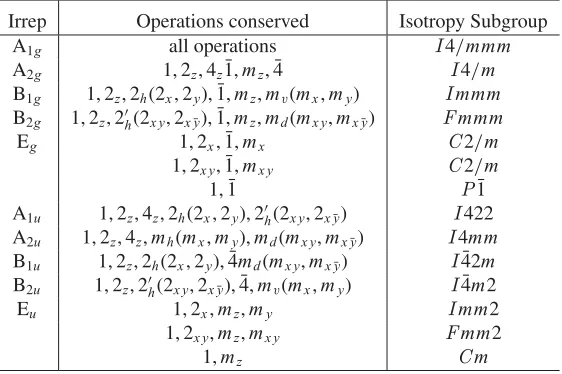
The irreps of a space group at the Brillouin zone center are equivalent to those of the corresponding point group. The lattice translations have associated identity operators. We can then obtain the irreps of I4/mmmat thepoint by looking at the irreps of the point group 4/mmm(see Figure1). They can for instance be obtained usingPOINTon the Bilbao Server [4]. To determine the space groups resulting from each 1-dim irrep acting as active irrep, we have just to keep the operations with character 1. Table1summarizes the result. The irrep A1gis trivial and does not break the symmetry. We have taken
into account that the columns in Figure1correspond to conjugacy classes with several operations. Note that the lattice is labelled asF in the case of the irrep B2g, despite that the lattice is not changed, because
in this case the operations of the orthorhombic groupmmmare defined along the diagonal directions on the planexyof the tetragonalI lattice. TheI lattice described in a unit cell with (110) and (¯110) as basic translations becomes anF lattice.
The last column of the table in Figure 1, headed with ‘functions’, contains useful additional information. It lists functions of the coordinatesx,y,zof a polar vector, or the coordinates Jx,Jy and
Jz, of an axial vector, that transform according to the corresponding irrep. For instance, the product
xytransforms according to the irrep B2g. But a shear strainxy of the crystal transforms as a function
xy. Therefore a shear strainxyis a crystal magnitude transforming according to B2g, and could be the
order parameter for a phase transitionI4/mmm−→Fmmm, which would be then a proper ferroelastic transition, with a switchable spontaneous strain.
In general, irreps of dimension n >1 have more than one isotropy subgroup depending on the direction taken by the order parameter Q within its n-dimensional space. In our example, we have two 2-dim irreps, Eg and Eu. Let us consider the irrep Eg, whose matrices can be chosen in the form
Figure 1. Character table of the irreps of the point group 4/mmm.
Table 1. Isotropy subgroups ofI4/mmmfor irreps with k=0. For 2-dimensional irreps only one of the equivalent possible isotropy subgroups is indicated.
Irrep Operations conserved Isotropy Subgroup
A1g all operations I4/mmm
A2g 1, 2z, 4z¯1,mz, ¯4 I4/m
B1g 1, 2z, 2h(2x, 2y), ¯1,mz,mv(mx,my) Immm
B2g 1, 2z, 2h(2xy, 2xy¯), ¯1,mz,md(mxy,mxy¯) Fmmm
Eg 1, 2x, ¯1,mx C2/m
1, 2xy, ¯1,mxy C2/m
1, ¯1 P¯1
A1u 1, 2z, 4z, 2h(2x, 2y), 2h(2xy, 2xy¯) I422
A2u 1, 2z, 4z,mh(mx,my),md(mxy,mxy¯) I4mm
B1u 1, 2z, 2h(2x, 2y), ¯4md(mxy,mxy¯) I¯42m
B2u 1, 2z, 2h(2xy, 2xy¯), ¯4,mv(mx,my) I¯4m2
Eu 1, 2x,mz,my Imm2
1, 2xy,mz,mxy Fmm2
1,mz Cm
the inversion ¯1 has associated the identity matrix, operationsgand ¯1·ghave the same matrix. Identity and inversion will always fulfill eq. (2.2) and operations 2z,mz, 4+z, ¯4+z, 4−z and ¯4−z will never fulfill it,
independently of the direction of Q. The conservation of the other operations, according to eq. (2.2) depends on the direction of Q. For instance if we consider that the Eg order parameter is of the form
(0,Q), i.e. takes the direction (0, 1) in the irrep space, 2x andmx will be conserved in the distorted
structure, and the resulting isotropy subgroup isC2/m11.
Table 2. Matrices of the irrep Egof the point group 4/mmmfor a certain choice of the basis in the irrep space.
1, ¯1 2z,mz 4+z, ¯4+z 4−z, ¯4−z 2x,mx 2y,my 2xy,mxy 2xy¯,mxy¯
Eg
1 0 0 1
−1 0 0−1
0−1
1 0
0 1 −1 0
−1 0 0 1
1 0 0−1
0−1 −1 0
0 1 1 0
Table 3. Isotropy subgroups of the irrep EgofI4/mmm, depending on the direction of the order parameter within the irrep space. For each subgroup its conventional basis is indicated in terms of the basis (a, b, c) ofI4/mmm. For completeness the null origin shift between the two unit cells is also listed. The conventional setting with the monoclinic unique axis along theb-direction is used.
Direction Operations Space group
(0, 1) 1, 2x, ¯1,mx C2/m(−b−c, a, c; 0 0 0)
(1, 0) 1, 2y, ¯1,my C2/m(−a−c, b, c; 0 0 0)
(1, 1) 1, 2xy, ¯1,mxy C2/m(a+b+c, a+b, c; 0 0 0)
(−1, 1) 1, 2xy¯, ¯1,mxy¯ C2/m(a+b+c,−a+b, c; 0 0 0)
arbitrary 1, ¯1 P¯1(a, b,12(a+b+c); 0 0 0)
a conventional setting, theI centred unit cell must be transformed to aCcentred cell for the monoclinic space groups and to a primitive unit cell for the triclinic one. The lattice however does not change, it is only expressed in a conventional unit cell consistent with the direction of the monoclinic axis.
The directions (0, 1) and (1, 0) for the order parameter are equivalent: they correspond to domain related directions. The four equivalent order parameter values obtained by applying the matrices of the lost operations are{(Q, 0), (0,Q), (−Q, 0), (0,−Q)}. In mathematical terms, this means that the isotropy subgroups corresponding to the order parameter directions (0, 1) and (1, 0) belong to the same conjugacy class. In general the number of domain-related configurations is equal to the index of the subgroup (4 in this case). Similarly for the solutions of type (1, 1), there are four equivalent order parameter directions {(a,a), (−a,a), (−a,−a), (a,−a)}.
We have then three possible non-equivalent isotropy subgroups for the irrep Eg, which are not
equivalent:C2/m(with monoclinic axis alongxory),C2/m(with monoclinic axis along the oblique directions (110) or (1¯10)) and P¯1. With a similar analysis for Eu we can complete the set of
non-equivalent isotropy subgroups ofI4/mmmfor irreps with k=0 (see Table1). We have therefore only 13 possible symmetries for the low-symmetry structure that maintain the crystal lattice and comply with the Landau postulate. It is interesting to compare this set of isotropy subgroups with the set of all possible subgroups ofI4/mmmthat maintain the lattice. These latter can be readily obtained with the programCELLSUBof the Bilbao Crystallographic Server [3].
2.1 The programCELLSUB
This program lists all possible subgroups of a given space group for a givenk-index (ork-indices smaller than a certain value). The program lists first the space group types, and then, for each space group type, it can distinguish the different conjugacy classes. The k-index ik is the ‘klassengleiche’ index, and
indicates the multiplication factor relating the volume of the primitive cell of the subgroup with respect to the primitive cell of the original structure. Thus,ik=1 implies conservation of the primitive unit cell,
and therefore of the whole lattice.
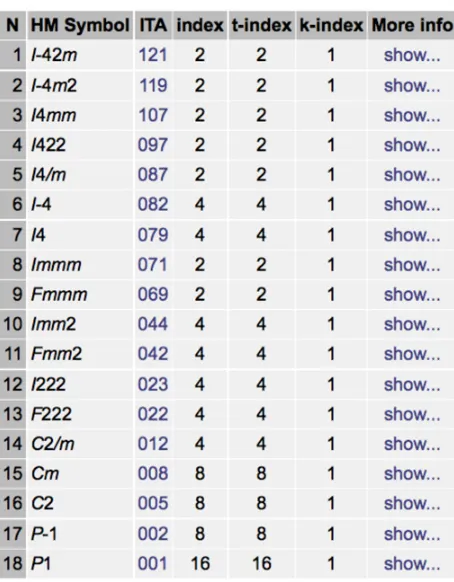
The list of subgroups of I4/mmmwithik=1 as given by CELLSUBis reproduced in Figure2.
Figure 2. Subgroup types ofI4/mmmwithik=1, as given byCELLSUB.
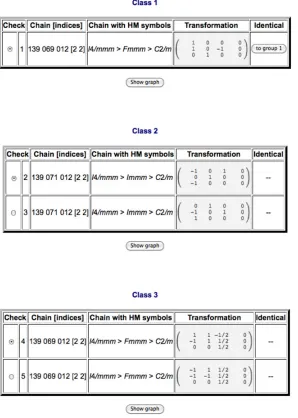
i.e. the set of non-equivalent subgroups belonging to this space group type. Figure3is a screenshot of this second output for subgroups of typeC2/m.
According to Figure 3, there are 3 conjugacy classes of space groups of type C2/m. Classes 2 and 3 in the list correspond to the two non-equivalent isotropy subgroups discussed above as isotropy subgroups. On the other hand, class 1 has the monoclinic axis along thez direction of the tetragonal setting, and it is therefore not an isotropy subgroup (Note that the ordering and numbering of the classes done by the program is not fixed. Different program runs may order the classes differently).
Inspecting the classes for all subgroup types, one can assess that the number of non-equivalent subgroups withik=1 is 26, while the number of non-equivalent isotropy subgroups listed in Table1
is only 13. Therefore, not all subgroups ofI4/mmmcompatible with its lattice can be reached through a phase transition with a single active irrep. The Landau postulate restricts considerably the number of possible distinct symmetries.
Figure 3. Output ofCELLSUBindicating the different conjugacy classes of subgroups ofI4/mmmof typeC2/m with indexik=1.
condensation of the two order parameters, and therefore an intermediate phase is most likely (see below for an example).
Table 4. Isotropy subgroups ofPm¯3mfor irrep R+4. In this table, the triad in the third column indicates for each
space group the restricted direction (one of a set of equivalent ones) of the order parameter in its 3-dim space, in the representation basis used in [11].
Isotropy subgroups Basis Direction Compound
I4/mcm (a+b,−a+b, 2c; 0 0 0) (a, 0, 0) SrZrO3
Imma (a+c, 2b,−a+c; 0 0 0) (a,a, 0) SrZrO3
R¯3c −a+b,−b+c, 2a+2b+2c; (0 0 0) (a,a,a) CeAlO3
C2/m (−2c, 2b, a+c; 012 12) (a,b, 0) BaPbO3
C2/c (−a+2b−c,−a+c, a+c; 012 12) (a,a,b) LaCoO3
P¯1 b+c, a+c, a+b; (0 0 0) (a,b,c)
Let us consider for instance the example of the perovskites. Perovskites are known to have often an intrinsic instability due to the softness of three degenerate rigid unit modes (modes tilting the octahedral framework and keeping the BX6 octahedra approximately rigid), which transform according to the
3-dim irrep R4+ of the parent symmetryPm¯3m[9]. The isotropy subgroups ofPm¯3mfor irrep R4+ are indicated in Table 4. For each of the possible isotropy subgroups, we have listed one perovskite compound that is known to have this symmetry in one particular phase. One can see that any of the possible symmetries is realized in some perovskite compound, except the lowest one, which corresponds to an arbitrary direction of the order parameter.
There are perovskites, as CeAlO3, where the following phase transition sequence takes place as
temperature is increased [10]:
I4/mcm−→Imma−→R¯3c−→Pm¯3m
Thus, the system is changing the direction of its R+4 order parameter from one phase to the next, through phase transitions, yielding symmetries given by different isotropy subgroups listed in Table4.
The determination by hand of the isotropy subgroups for a given irrep is time consuming and tedious. Fortunately, the isotropy subgroups of the 230 space groups are listed for irreps corresponding to special points of the Brillouin zone in [7], or they can be obtained automatically using the program ISOTROPY[11], or some other programs, also available in (http://stokes.byu.edu/isotropy.html). The use of ISOTROPY requires getting familiar with some specific program commands. A more direct form to get the information about possible isotropy subgroups for a given irrep is to run the associated programs INVARIANTS or ISODISTORT [12], which are more user-friendly, and can be executed by filling some self-evident menus. These two programs list the isotropy subgroups of a chosen irrep as a preliminary result. The information is more complete inISODISTORT, but running this program, requires the introduction of some structure for the high-symmetry phase (one can introduce a false one, since a specific structure is not required for deriving the list of isotropy subgroups).
3. MORE ON THE POSSIBLE SYMMETRY OF A DISTORTED PHASE
In many practical cases, we do not know the active irrep of the transition, but we may know some specific conditions on the symmetry of the distorted phase coming from experimental observation. These conditions can be sufficient for deriving a limited set of possible space groupsH, and possible active irreps.
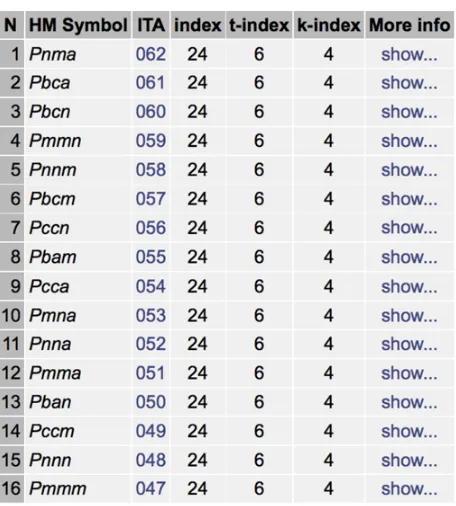
Figure 4. Subgroups (types) ofFm¯3mwith point groupmmm,ik=4 and no centring, as given byCELLSUB.
relationsaandb≈ac/
√
2, whilec≈2ac(acthe cell parameter of the cubic phase), but its space group,
and therefore its structure could not be determined [14]. Obviously, if we can restrict the symmetry to a minimal set of possible/probable space groups, we could have a better chance for succeeding in the interpretation and analysis of the diffraction diagram of this phase.
We can start by determining all possible primitive orthorhombic subgroups ofFm¯3m, fulfilling the unit cell relation that has been observed. We can again use for that the programCELLSUBprovided that we know thek-index of the subgroup we are searching. This index can be derived in a straightforward manner comparing the volumes of the primitive unit cells of the two space groups. For Fm¯3m, it is a3
c/4, while in the orthorhombic phase is ac3. This means, the orthorhombic space group keeps only
1
4 of the lattice translations, or in other words the primitive orthorhombic unit cell contains 4 formula
units, while theFm¯3mstructure only one. Henceik=4. The point group of the searched orthorhombic
space groups can be 222,mm2 ormmm. To simplify the example, we are going to assume that the point group symmetry is maximal, i.e.mmm(but we could proceed similarly with the other two possible point groups).
Restricted toik=4, point groupmmm, and no centring,CELLSUBlists a quite long list of subgroups
ofFm¯3mthat is reproduced in Figure4. But not all of them will have unit cell parameters consistent with the experimental values. By clicking on ‘show’ we get the different non-equivalent classes of subgroups of this type and the transformation matrix relating its conventional basis with the one of the cubic group. For instance, forPbca, there is a single class. Its transformation matrix is (−b,−c, a; 000) or equivalent ones. Hence, its cell parameters coincide with those of the cubic cell. Therefore this space group can be discarded. On the other hand, if we consider subgroups of typePnma, there are four classes ofPnma subgroups, with one of the classes having as transformation (2b,12(a+c),12(a−c);14 34 12) or equivalent. The parameters of thePnma orthorhombic cell for this class are thereforea=2ac,b=c=ac/
Table 5. Possible centrosymmetric orthorhombic subgroups of Fm¯3mfulfilling the lattice metrics observed in the orthorhombic phase of fullerene-cubane crystals. The third column indicates the resulting Wyckoff splitting for the two sites occupied by the centres of the fullerene and cubane molecules. The fourth column shows the corresponding active irrep of the order parameter, in the case that the subgroup is an isotropy subgroup. The third and fourth columns are results obtained withSYMMODES.
subgroup Basis Splitting of Active irrep
4a, 4borbits
Pnma 2a,12(b+c),12(−b+c);34 14 0 4c, 4c (0,12, 0)DT5 Pmmn 1
2(a−b), 1
2(a+b), 2c; 1 4 0
3
4 2a+2a, 2a+2a
-Pccn 12(a−b),12(a+b), 2c;14 0 34 4c, 4c
-Pmma 2a,12(b+c),12(−b+c);21 0 0 2a+2f, 2e+2d (0,12, 0)DT5 Pccm 12(a−b),12(a+b), 2c; 0 0 0 2e+2b, 2a+2h -Pmmm 12(a−b),12(a+b), 2c; 0 0 0 2q+1f +1h, 1a+2t+1c
-Inspecting the classes for all the subgroups in the list, it is straightforward to conclude that only six symmetries, namelyPnma,Pmmn,Pccn,Pmma,PccmandPmmm, with transformations matrices listed in Table5, are consistent with the experimental observation. It is interesting to compare this table with the analysis done in [17]. The method employed in that work, rather indirect, overlooked thePnma andPmmnsubgroups, and only four of the six possible space groups were derived.
The list in Table 5 could be further reduced if we assumed that the searched symmetry should correspond to an isotropy subgroup, i.e. a single active irrep must explain the corresponding symmetry break. But this leads into a new type of problem, which we treat in more detail in the following section.
4. THE INVERSE LANDAU PROBLEM. SECONDARY SPONTANEOUS VARIABLES
The most important information required for the characterization of a group-subgroup phase transition is the identification of its active irrep. This is the so-called inverse Landau problem. In most cases the knowledge of the high and low space groups is sufficient to identify the active irrep. There are however cases where several different irreps can yield the same symmetry break, and in this case only a detailed decomposition of the structural change into irrep components can elucidate which is the prevailing symmetry component, and determine in this way the active irrep. In any of the two cases, the first step is to derive the possible irreps that have the observed space group of the low-symmetry phase as an isotropy subgroup. The websiteISOTROPY(stokes.byu.edu/isotropy.html) includes the program COPL [15], which does this identification, and also provides the irreps of all additional spontaneous secondary variables. In the Bilbao Crystallographic Server, the programSYMMODES, which in fact internally uses an adapted version of COPL (kindly provided by H. T. Stokes), can also give this information as a by-product.
Table 6. Irreps compatible with the symmetry breakI4/mmm−→C2/m(−b−c, a, c; 000) obtained with the programCOPL[15].
Irrep Dir Isotropy Subgroup Size
GM1+ (a) 139I4/mmm 1
GM2+ (a) 71Immm 1
GM5+ (a, 0) 12C2/m 1
C2/m Immm I4/mmm
Figure 5. Graph of maximal subgroups connecting the space groupI4/mmmand its subgroupC2/m(−b−c, a, c; 000) (or equivalent), obtained with SUBGROUPGRAPH(to obtain this graph one has to choose the correct
conjugacy class among the three classes given by the program).
which is a supergroup ofH. Let us consider the following simple case: I4/mmm−→C2/m(−b−c, a, c; 000)
From the example discussed above, we know that the active irrep for this symmetry change is Eg
(k=0). Table6shows the output ofCOPL(stokes.byu.edu/isotropy.html) for this symmetry change. The program lists a set of irreps, a ‘direction’ or subspace within the irrep space and their isotropy subgroup. The final column headed ‘size’ indicates the multiplication of the primitive unit cell of the corresponding isotropy subgroup relative to the parent high-symmetry space group (i.e. the klassengleiche indexik). We
have then the irrep GM5+ as the active irrep with the observed symmetry as isotropy subgroup, and then a secondary irrep GM2+ with an isotropy subgroupImmm, which necessarily must be a supergroup of C2/m. In addition, the trivial irrep GM1+ always appears as possible symmetry of secondary variables that are allowed to have non-zero values both at the distorted phase, and also at the parent phase. The label GM is being used to indicate that they are irreps at the Brillouin zone centre (Gamma point), which do not break the translational symmetry. GM5+ must be the irrep labelled Eg while GM2+ should be
the irrep labelled as B1g, cf. Section21.
The reason for the existence of secondary spontaneous quantities transforming according to the irrep B1gbecomes obvious if we use the programsSUBGROUPGRAPH[3,16] orCELLSUBto construct the
graph of maximal subgroups connecting the two end space groups. This is shown in Figure5. The group Immm, which is the isotropy subgroup of B1g, is indeed a supergroup ofC2/m. Therefore, variables
with symmetry properties given by B1g are compatible with the symmetry of the distorted phase, and
therefore can be non-zero in this phase. They will be secondary spontaneous variables. Figure 1 indicates that x2−y2 and (xz,yz) transform according to B
1g and Eg, respectively.
This means that the shear strain components (xz,yz) have the symmetry properties of the active
irrep, and could in principle be identified with the order parameter of the transition, while the strain
1The computer-adapted irrep labels used byCOPLand ISOTROPYdiffer from those used in some programs of the Bilbao
difference (xx−yy) transforms according to B1g. Being zero in the parent phase, (xx−yy) becomes
spontaneous, as a secondary variable, in the C2/m phase. We have then a proper or pseudoproper ferroelastic transition (i.e. some strain component(s) has(have) the symmetry of the order parameter), and we expect the softness at the transition of the stiffness coefficients corresponding toxzandyz, i.e.
the elastic constantsC55andC66. The shear strainyz(direction (0, 1) in Eg) should become spontaneous
in the C2/m phase, deviating the monoclinic angle from 90◦, as a primary order parameter effect. [Equivalently we could consider the domain related distortion withxz(direction (1, 0) in Eg)]. On the
other hand, the quantity (xx−yy) is zero in the parent phase (cell parameters a andb are equal),
while in theC2/mphase (xx−yy) =0 (cell parameteraandbbecome different), but as a secondary
(weaker) effect.
As the index ofC2/mis 4, four equivalent domain-related structures must exist. These domains should be distinguishable by the value of the order parameter (see eq. (2.3) above). From the structure having a spontaneous shear strainyz =◦and zero shear strainxz: (0,◦), we obtain the values of the
spontaneous shear strainsxzandyzin the other domains applying lost symmetry operations according
to the matrices listed in Table 2: (2z, 000)→(0,−◦), (4−z, 000)→(◦, 0), (4+z, 000)→(−◦, 0).
Therefore, the primary spontaneous monoclinic strain can have opposite values in different domains, and can also have two different orientations with respect to the parent tetragonal phase, corresponding to the monoclinic axis being alongx ory, as listed in Table3. On the other hand, the secondary spontaneous strain (xx−yy) does not distinguish some of these domains, having the same value in domain pairs:
(2z, 000)→(xx−yy), (4−z, 000)→ −(xx−yy), (4+z, 000)→ −(xx−yy).
In general, the multistability and switching properties of a low-symmetry phase including the establishment and characterization of all possible domains can be determined if the symmetry of both the parent high-symmetry phase and the one of the distorted phase are known. The point groups of the two space groups, the so-called ferroic species, define the ferroic properties of the low-symmetry phase.
4.1 The programSYMMODES
The program SYMMODES [18] is designed to provide a basis of symmetry-adapted displacive modes for describing any displacive distortion relating a group-subgroup-related pair of phases. These modes, which are allowed to condense in the distorted phase can be primary (with their symmetry given by the active irrep) and secondary (with their symmetry given by secondary irreps having isotropy subgroups containing the observed space group). The program has been developed in collaboration with H. T. Stokes (Brigham Young University), and uses internally an adapted version of the programCOPL mentioned above.
For each allowed irrep (either active/primary or secondary), and restricted to the required irrep subspace,SYMMODESlists a complete set of symmetry-adapted displacive modes for the Wyckoff orbit types chosen by the user. The program only requires as initial input the space group types of the high and low symmetry phase,GandH, and their index. The program then determines all the different classes of subgroups H of G, and the user has to choose the one relevant for the problem. A direct link to SUBGROUPGRAPHto obtain the graph of minimal subgroups is also available.
Once the relevant class of subgroupsHis decided, the user chooses the set of Wyckoff positions, for which the basis of symmetry-adapted modes is desired. Note that the choice of unit cell for the
Figure 6. Output ofSYMMODESfor the pairI4/mmm−→C2/m(−b−c, a, c; 000) and the Wyckoff positions 8i.
are allowed for 8isites in the distorted structures, in agreement with Table6. The table also indicates (in parenthesis) the number of symmetry-modes that exists for each irrep. The output then lists for each irrep the corresponding isotropy subgroup with its transformation matrix, the eventual restriction on the direction within the irrep space (this is the data headed as ‘order parameter’), and a set of linearly independent modes having this irrep as symmetry.
The form of the modes in Figure 6 is given as a column of triads indicating the correlated displacements of the atoms of the Wyckoff orbit extended to the primitive unit cell of the distorted phase. As the distorted phase in our example has the same primitive unit cell (ik=1) as the parent
phase, the set of listed atomic positions is limited to 4. The other atoms in the structure belonging to the same orbit are related by lattice translations to those listed in the output and their mode displacements will have the same displacements. The components of the atomic displacements describing the modes are given in the setting of the parent structure. Modes are not normalized and, in the case of existing several modes for the same irrep, they are not necessarily orthogonalized.
Figure 7. Detailed splitting of orbits 8i for the symmetry break I4/mmm−→C2/m(−b−c, a, c; 000) as obtained bySYMMODES.
From Figure6 one expects that the atoms 8i of type (0,x, 0) in theI4/mmmstructure and their related ones by the I centring will suffer displacements along thec axis much stronger than along the y axis, the only two directions allowed (always working in the tetragonal setting), because thez -displacements correspond to the primary mode with the symmetry of the active irrep, and will be in principle related with the transition mechanism. The atoms with positions (x, 0, 0) and the related ones by theI centring, on the other hand, will only have secondary displacements along thex-direction, that maintain the symmetry relation among them.
SYMMODESalso allows examining the splitting of the Wyckoff orbit due to the symmetry decrease, by means of a link to the programWYCKSPLIT[3,19] of the server. The table shown in Figure7shows the corresponding output for an 8iorbit. The last column in Figure7describes the generic positions of the two splitted orbits in the subgroup basis, while the third column indicates the corresponding position in the higherI4/mmmstructure in the same basis. One can see that the first four positions forming the 4g1
orbit do not really break the tetragonal symmetry; their only allowed variation of they component (in the subgroup basis) is also compatible with the tetragonal space group. On the other hand, the other four positions forming the 4i1 orbit introduce an additional degree of freedom by breaking the correlation
between thex andzcomponents (in the subgroup basis). The number of symmetry free components in the two orbits is 3. This should coincide with the number of distinct modes listed in Figure6. The number of modes is equal to the number of degrees of freedom for the 8iatomic positions in the subgroup, and this is the number of free parameters in the resulting Wyckoff orbits in the subgroup symmetry.
SYMMODEScan for instance be used to see that from the six space groups listed in Table5, only the groupsPnmaandPmmaare isotropy subgroups ofFm¯3mand a single active irrep can be identified (this has been indicated in the fourth column of the table).
5. SYMMETRY-MODE DECOMPOSITION OF DISTORTED STRUCTURES. THE PROGRAM AMPLIMODES
The natural language to deal with the static frozen distortions present in displacively distorted structures is the one of modes. Modes are collective correlated atomic displacements fulfilling certain symmetry properties. Structural distortions in distorted structures can be decomposed into contributions of modes with different symmetries given by irreps of the parent space group. One can then distinguish primary and secondary (induced) distortions, which will have in general quite different weights in the structure, and will respond differently to external perturbations. In general, the use of symmetry-adapted modes in the description of distorted structures introduces a natural physical hierarchy among the structural parameters. This can be useful not only for investigating the physical mechanisms that stabilize these phases, but also for pure crystallographic purposes. The set of structural parameters used in a mode description of a distorted phase will in general be better adapted for a controlled refinement of the structure, or for instance for comparative studies between different materials or for ab-initio calculations. For a review of the applications of the symmetry-mode approach in structural problems see [20]. AMPLIMODES[5] is a computer program available on the Bilbao Crystallographic Server that can perform the symmetry-mode analysis of any distorted structure of displacive type. The analysis consists in decomposing the symmetry-breaking distortion present in the distorted structure into contributions from different symmetry-adapted modes. Given the high- and the low-symmetry structures, AMPLIMODES determines the atomic displacements that relate them, defines a basis of symmetry-adapted modes, and calculates the amplitudes and polarization vectors of the distortion modes of different symmetry (different irrep) frozen in the structure. The program uses a mode parameterization that is as close as possible to the crystallographic conventions, using an asymmetric unit of the low-symmetry structure for describing modes and distortions.AMPLIMODESuses internallySYMMODESto produce the basis of symmetry-adapted modes to be used in the decomposition of the structural distortion, but instead of describing the modes in the high-symmetry setting, it works in the setting of the subgroup. A detailed account of the mathematical formalism and parameterization of the program can be found in [5].
In order to see the possibilities of the program the simplest approach is to see in detail an example. Let us consider the structure of SrMnO3at 100 K that has been recently reported in [21]. Above 350 K
this compound is known to have hexagonal symmetry with space groupP63/mmc, while below this
temperature a slight distortion happens and the structure is orthorhombic, with space groupC2221,
i.e. a subgroup ofP63/mmcrelated by the transformation (a, a+2b, c; 000). The structures of these
two phases were determined from powder diffraction data (combining both neutron and synchrotron data). The orthorhombic phase is metrically hexagonal with no appreciable orthorhombic strain, and a powder diffraction refinement in these circumstances is bound to be especially problematic. Thus, the refinement of the orthorhombic phase was done introducing some constraints that reduced the number of free positional atomic parameters. The number of linear constraints explicitly mentioned in the article were five, which in principle would reduce the number of positional degrees of freedom from 13 to 8.
The reason for the specific constraints that were used in the structural model were not explained in the article. An analysis of the structure with AMPLIMODES makes clear the physical basis of this constrained refinement but also shows some shortcomings of the specific constraints that were used. The application of the program only requires as input the structures of the two phases and the basis transformation relating them. This is sufficient to produce the symmetry-mode decomposition of the C2221 structure, which is summarized in Table7. One can see that the 13-dimensional configuration
space of theC2221 distortion can be divided in 4 subspaces corresponding to four distinct irreps at
Table 7. Summary of the symmetry-mode decomposition of theC2221structure of SrMnO3reported in [21] with
respect to theP63/mmcstructure at 350 K. The table indicates the amplitudes in Å of the different irrep distortions
allowed by symmetry, indicating for each irrep, its wave vector, label, direction within the irrep space, isotropy subgroup and dimension of the distortion subspace.
Isotropy
k-vector Irrep Direction Subgroup Dimension Amplitude (Å)
(0,0,0) GM1+ (a) P63/mmc 2 0.04
(0,0,0) GM5+ (−0.500a,−0866a) Cmcm 4 0.00
(0,0,0) GM1− (a) P6322 1 0.00
(0,0,0) GM5− (a,0) C2221 6 0.39
C2221
Cmcm P6322
P63/mmc
Figure 8. Graph of maximal subgroups connecting the parent space groupP63/mmcand the symmetryC2221of
SrMnO3.
subspace within theC2221configuration space. From the amplitudes of the different symmetry-adapted
distortions one can see that the refined structure is described by only a distortion corresponding to the active irrep GM5− (plus a very weak GM1 + distortion, compatible with the parent P63/mmc
symmetry). The secondary distortions of symmetry GM5+ and GM1−, which correspond to five additional degrees of freedom compatible with supergroups of C2221 (see Figure 8), have zero
amplitudes. The five linear constraints used in the refinement of the atomic positions seem therefore to correspond to the fixing of these two secondary distortions to zero. We expect indeed in a group-subgroup phase transition that the primary distortion corresponding to the active irrep is dominant. The condensation of the other irrep distortions, being a secondary effect, have often amplitudes one order of magnitude smaller. If a decrease of the number of refinable parameters is critical for a successful refinement, it is then a clever approach to set to zero these secondary irrep distortions. This has certainly been done in this structure refinement, but if we look in detail to the output ofAMPLIMODES, we will see that some of the contraints are only indirectly producing the fixing to zero of the secondary distortions and have been combined with an unjustified additional constraint of the primary distortion GM5−.
Table8shows the so-called ‘reference structure’ used by the program. It is the parentP63/mmc
structure described in the lower space groupC2221. The asymmetric unit defined in this Table is the
one that the program uses to describe all the symmetry-modes. A set of displacements of the atoms within this asymmetric unit (expressed in relative units) is sufficient to describe any symmetry-mode compatible with theC2221symmetry. In general,AMPLIMODESgives the symmetry-modes normalized
Table 8. Reference structure for the irrep distortions in theC2221phase of SrMnO3.
Space groupC2221a =5.461Åb=9.4587Åc=9.093Å
Wyckoff
Atom positions Coordinates
Sr1 4a 0.000000 0.000000 0.000000
Sr2 4b 0.000000 0.333333 0.250000
Mn1 8c 0.000000 0.333333 0.612640
O1 4a 0.500000 0.000000 0.000000
O1_2 8c 0.750000 0.250000 0.000000
O2 8c 0.772130 0.409290 0.750000
O2_2 4b 0.000000 0.181420 0.750000
Figure 9. GM1-symmetry mode allowed in theC2221phase of SrMnO3(figure done with FullProf Studio [23]).
Figure 9depicts the only existing mode of GM1- symmetry, which in principle could be present in theC2221distortion. It corresponds to antiphase rotations around thecaxis of the oxygen triangles
formed by O1 and O1_2 atoms, on the columns of oxygen octahedra. This mode involves specific correlated displacements of the O1 and O1_2 atoms along the x and along the x andy directions of the orthorhombic setting, respectively, which decrease the symmetry to P6322, a supergroup of
C2221. However, the only explicit constraint introduced for these atoms in [21] was to fix to zero
the y displacement of the O1_2 atom. This is clearly not equivalent to setting to zero the GM1-distortion, since not only GM1- can contribute to the y displacement of the O1_2 atom, but also the GM5−distortion. Two of the basis modes of symmetry GM5−used byAMPLIMODES (modes 3 and 5 in Table 9) include y-displacements of the O1_2 atom. Therefore the cancelling of the GM1-distortion in the refined structure must have been achieved by introducing some additional restriction in the possible form of the GM5−distortion. This becomes evident inspecting the GM5−distortion derived byAMPLIMODES. The GM5−distortion, which multiplied by the amplitude of 0.39 and added to the reference structure given in Table8essentially describes the reportedC2221structure, is given in
Table 9. The six basis modes corresponding to the irrep GM5−used in AMPLIMODES to describe the GM5− distortion present in theC2221structure of SrMnO3. Displacements are normalized to 1Å within aC2221primitive
unit cell, and are described in relative units with respect to the conventional C2221 unit cell of the reference
structure.
Atom x y z
Mode 1 (Sr1) Sr1 0.129483 0.000000 0.000000 Mode 2 (Mn1) Mn1 0.091558 0.000000 0.000000
Mode 3 (O1) O1 0.105722 0.000000 0.000000
O1_2 0.026431 −0.026431 0.000000
Mode 4 (O1) O1 0.000000 0.000000 0.000000
O1_2 0.000000 0.000000 0.054987
Mode 5 (O1) O1 0.000000 0.000000 0.000000
O1_2 −0.079292 −0.026431 0.000000 Mode 6 (O1) O1 0.000000 0.000000 −0.054987 O1_2 0.000000 0.000000 0.000000
Figure 10. Polarization vector in an arbitrary scale of the GM5− distortion that describes the refinedC2221
structure of SrMnO3(figure done with FullProf Studio [23]).
mode described in Table10has only five distinct parameters, since thex-displacement of the atoms O1 and O1_2 are equal. This equality is not forced by the GM5−symmetry. In fact, one can see in Table9 that alsoy-displacements of the atom O1_2 would be symmetry allowed. Hence the GM5−distortion was somehow constrained in the refinement of this structure. The decomposition of the distortion into the six basis modes, also indicated in Table 10, shows that the modes 3 and 5 of Table 9 have exactly the same amplitude, making the O1_2y-displacement zero. This also forces the equality of the x-displacements of the O1 and O1_2.
The refinement of theC2221 structure of SrMnO3 seems therefore to have been performed with
Table 10. Normalized polarization vector of the GM5− distortion present in theC2221 structure of SrMnO3.
Displacements are in relative units (normalization to 1Å of all displacements within a reference primitive unit cell). This corresponds to a 6-dimensional vector with components (0.1893,−0.3429, 0.5119, 0.3946,−0.5119, −0.4085) in the basis of the 6 modes indicated in Table 9. Note the exact opposite values of the components corresponding to modes 3 and 5, which make null theydisplacement of O1_2.
atom x y z
Sr1 0.0245 0.0000 0.0000 Sr2 0.0000 0.0000 0.0000 Mn1 −0.0314 0.0000 0.0000
O1 0.0541 0.0000 0.0000
O1_2 0.0541 0.0000 0.0217
O2 0.0000 0.0000 0.0225
O2_2 0.0000 0.0000 0.0000
of the atomic coordinates or forcing simple relations among them, the secondary distortions summing five degrees of freedom could be set to zero, but this method also indirectly introduced a constraint of the primary distortion, which has no apparent justification. The linear constraint equivalent to fixing to zero the GM1- mode, without constraining the form of the GM5−distortion would have required to introduce a linear relation between three atomic coordinates, namely thex,y coordinates of O1_2 and thexcoordinate of O1.
The controlled switching off (or on) of distortions associated to specific irreps, in particular those corresponding to secondary distortions, in the refinement of distorted structures, can now be done automatically usingFullProf[22] combined withAMPLIMODES. In collaboration with J. Rodriguez-Carvajal we have included inAMPLIMODESan option, which creates a special output file to be directly used byFullProf. By this means,FullProfcan now use in the refinement process the amplitudes of the basis of symmetry modes defined byAMPLIMODESas refinable positional parameters, alternative to the atomic coordinates. In general, the expected hierarchy among the distortions of different symmetry and the essential invariance of their polarization vectors can make very advantageous a direct refinement of the amplitudes of a basis of symmetry modes, as collective coordinates, instead of the usual individual atomic coordinates. The significance of the weak distortions associated with secondary modes can be monitored and if necessary fixed to zero. The combined use ofAMPLIMODES andFullProfcan also be used to visualize and generate figures of the distortion modes, and of the basis of symmetry-adapted modes.
6. STRUCTURAL PHASE TRANSITIONS WITH SEVERAL ACTIVE IRREPS
There are some symmetry breaks that do not fulfill the Landau postulate of having a single active irrep. In other words, the symmetry reduction cannot be explained by a single irrep, as the symmetry of the distorted phase is not an isotropy subgroup of the parent space group. If the transition is discontinuous or first order, there are mechanisms that can explain the breaking of the Landau postulate and predict the simultaneous condensation of two irreps. However, these situations are rare, and some plausible explanation for such cases that one should check carefully, is the possibility that the condensation of the two active irreps is in fact stepwise and an intermediate phase has been overlooked.
Independently of the existence or not of an intermediate phase, the existence of two active irreps implies a scenario, where several degrees of freedom of the structure are unstable in the high-symmetry configuration. This is bound to produce rich phase diagrams. Let us consider the example of the Aurivillius compound SrBi2Ta2O9 [24]. The compound is known to have a tetragonal
I4/mmmphase at high-temperatures with Z=2, and at room temperature crystallizes in the subgroup Cmc21 c, a−b, a+b;14,14, 0
Figure 11. Graph of maximal subgroups connecting the space group I4/mmm and its subgroup Cmc21
c, a−b, a+b;1 4,
1 4, 0
(or equivalent). Note that the groupCmca(N. 64) is labelledCmcein the new convention of the 5th edition of the International Tables for Crystallography, Vol. A [25].
of the intermediate subgroups relating this group-subgroup pair (note that there are twoCmc21classes
with the same type of cell transformation, and only distinguishable by the origin shift. So one has to take care of choosing the correct one).
For each of the subgroups, we have indicated in Figure11the corresponding active irrep, if existing. The graph shows then that all subgroups are isotropy subgroups for some irrep, except for the observed symmetry. The room temperature phase requires therefore several active irreps. How many? Just two. The effective symmetry resulting from the presence of two of the distortions is the intersection of the two corresponding isotropy subgroups, and this is given in the graph by their first common subgroup. Hence, it is sufficient to consider any pair of the distortions−5, X−3 and X+2, to reach the symmetry Cmc21. Only the irrep +4 cannot be relevant for producing the observed symmetryCmc21, i.e. its
addition to any of the other ones, does not decrease further the symmetry.
We have therefore three possible irreps among which two must be the active ones. Symmetry considerations cannot go further. Only a quantitative analysis of the structure, ab-initio calculations, or the thermal behavior of the system can indicate which of the three irreps are really the active irreps in this specific case. The distortions having the symmetry of the active irrep are expected to have larger amplitudes, and be the ones that are more unstable in the high-symmetry configuration. For instance, a decomposition of theCmc21 structure of SrBi2Ta2O9 in terms of symmetry-modes, done
withAMPLIMODES(see Section5), shows that the distortions of symmetry−5 and X−3 have much larger amplitude than the one for the irrep X+2. Furthermore, the X−3 distortion is significantly larger than the −
5. Therefore we can identify X−3 and−5 as the active irreps. The additional X+2 spontaneous distortion
present in the experimental structure can be considered a secondary effect, basically induced by the presence of the other two primary distortion modes [24].
As theX−3 distortion is the largest one we expect it to be the one that thermalizes to zero value at higher temperature, and therefore we can infer that an intermediate phase with symmetryCmcmis highly probable, corresponding to the presence of only this active irrep. Indeed this intermediate phase has been observed. The symmetry of the other primary distortion5−corresponds to the irrep label Eu
is then the mechanism that causes the loss of the inversion centre and the ferroelectric properties of the room temperature phase.
7. CONCLUSIONS
We have briefly outlined some basic symmetry issues that underlie the analysis and understanding of the properties of solid-solid phase transitions having group-subgroup relations. In particular we have shown how representation analysis can be systematically applied, introducing a powerful framework for the study of both the physical and the structural properties of the distorted phases. We have shown by means of several examples, how this symmetry analysis can be done using computer tools freely available in internet. The use of these tools is straightforward and does not require a deep knowledge of group theory.
In many ways, the investigation of structural phase transitions by means of representation analysis is analogous to the representation analysis commonly employed in the study of magnetic transitions and magnetic structures, and has similar advantages. However, in the case of structural phase transitions, the application of group representation theory has somewhat a higher degree of complexity as it has to be combined necessarily with ordinary space group symmetry arguments. This has probably hampered a generalization of its use. Hopefully the newly available computer tools discussed here will help to change this situation.
This work has been supported by the Spanish Ministry of Science and Innovation (project MAT2008-05839) and the Basque Government (project IT-282-07).
References
[1] L. D. Landau & E. M. Lifshitz. Statistical Physics. (Oxford: Pergamon Press, 1969).
[2] Y. Izyumov & V. Syromyatnikov, V. (1990). Phase transitions and crystal symmetry. (Dordrecht: Kluwer Academic Publishers, 1990).
[3] M. I. Aroyo, J. M. Perez-Mato, C. Capillas, E. Kroumova, S. Ivantchev, G. Madariaga, A. Kirov & H. Wondratschek, Z. Kristallogr. 221, 15-27 (2006).
[4] M. I. Aroyo, A. Kirov, C. Capillas, J. M. Perez-Mato & H. Wondratschek, Acta Cryst. A62, 115-128 (2006).
[5] D. Orobengoa, C. Capillas, M. I. Aroyo & J. M. Perez-Mato, J. Appl. Cryst., 42, 820–833 (2009). [6] J. C. Toledano & P. Toledano. The Landau Theory of Phase Transitions. (Singapore: World
Scientific, 1987).
[7] H. T. Stokes & D. M. Hatch. Isotropy subgroups of the 230 crystallographic space groups. (Singapore: World Scientific, 1988).
[8] V. Janovec & J. Privratska, J. (2003). 3.4. Domain Structures in International Tables for Crystallography, vol. D (Dordrecht: Kluwer Academic Publishers, 2003).
[9] C. J. Howard & H. T. Stokes. Acta Cryst. B 54, 782–789 (1998). [10] P. Tomaszewski. Phase Transitions, 38(3, Part B), 127–220 (1992).
[11] H. T. Stokes & D. M. Hatch. (2002).ISOTROPYDepartment of Physics and Astronomy Bringham Young University, Provo, USA. (http://stokes.byu.edu/isotropy.html)
[12] B. J. Campbell, H. T. Stokes, D. E. Tanner & D. M. Hatch. J. Appl. Cryst. 39 607 (2006). [13] S. Pekker et al. Nature Mat. 4, 764 (2005).
[14] N. M. Nernes et al. J. Phys. Chem. B 113, 2042 (2009) [15] H. T. Stokes & D. M. Hatch. J. Appl. Cryst., 35, 379 (2002).
[17] A. B. Harris, arXiv: 0902.2388v1 [cond-mat.mtrl-sci] (http://arxiv.org/abs/0902.2388v1). [18] C. Capillas, E. Kroumova, M. I. Aroyo, J. M. Perez-Mato, H. T. Stokes & D. M. Hatch, J. Appl.
Cryst., 36, 953–954 (2003).
[19] E. Kroumova, M. I. Aroyo, J. M. Perez-Mato, J. Appl. Cryst. 31 646 (1998). [20] J. M. Perez-Mato, D. Orobengoa, M. I. Aroyo, Acta Cryst. A 66, 558–590 (2010).
[21] A. Daoud-Aladine, C. Martin, L. C. Chapon, M. Hervieu, K. S. Knight, M. Brunelli & P. G. Radaelli, Phys. Rev. B 75 104417 (2007).
[22] J. Rodríguez-Carvajal, Phys. B Condens. Matter, 192, 55 (1993). The programs of the FullProf Suite and their corresponding documentation can be obtained from the Web at http://www.ill.eu/sites/fullprof/.
[23] L. C. Chapon & J. Rodríguez-Carvajal, 2005 unpublished. FullProf Studio is a program of the FullProf Suite the most recent version is freely available in the site given in [22].
[24] J. M. Perez-Mato, M. I. Aroyo, A. García, P. Blaha, K. Schwarz, J. Schweifer & K. Parlinski. Phys. Rev. B 70(21), 214111 (2004).

![Table 6. Irreps compatible with the symmetry break I 4/mmm −→ C2/m(−b − c, a, c; 000) obtained with theprogram COPL [15].](https://thumb-us.123doks.com/thumbv2/123dok_us/8085915.1349384/11.595.199.385.142.331/table-irreps-compatible-symmetry-break-obtained-theprogram-copl.webp)


![Table 7. Summary of the symmetry-mode decomposition of therespect to theallowed by symmetry, indicating for each irrep, its wave vector, label, direction within the irrep space, isotropy C2221 structure of SrMnO3 reported in [21] with P63/mmc structure at](https://thumb-us.123doks.com/thumbv2/123dok_us/8085915.1349384/16.595.128.479.170.419/decomposition-therespect-theallowed-indicating-direction-isotropy-structure-structure.webp)
![Figure 9. GM1-symmetry mode allowed in the C2221 phase of SrMnO3 (figure done with FullProf Studio [23]).](https://thumb-us.123doks.com/thumbv2/123dok_us/8085915.1349384/17.595.169.417.157.498/figure-symmetry-allowed-phase-srmno-gure-fullprof-studio.webp)
