REVIEW ON UTILIZATION OFMODIFIED RED MUD BY
ORGANIC MODIFIER IN COMPOSITE MATERIAL
Prof. Minal Dani
1, Jay Borad
2, Riddhi Shukla
31Asst.Prof. Metallurgy Department, Government Engineering College Gandhinagr, Gujarat, (India) 2,3Metallurgy Department, Government Engineering College, Gandhinagar , Gujarat,(India)
ABSTRACT
Red mud is a solid waste residue of the digestion of bauxite ores with caustic soda (NaOH) for alumina production (Bayer‘s process). It is compound form of metallic oxide-bearing impurities in solid form. For extraction of the aluminum, red mud is a major industrial disposal problem. It mainly contains elements components such as Fe2O3,
Al2O3, SiO2, CaO, Na2O and TiO2 etc. This review paper gives a summary on the comprehensive utilization on red
mud globally. Extensive work has been done by a lot of researchers to develop various economics ways for the utilization of red mud for the past decades. Red mud has good reinforcing property as filler material, by using this red mud as the filler, particulate reinforced polyester composite have been develop. Red Mud can be used for manufacturing of composites material in polymer matrix such as PVA with excellent anti-aging property and cheap thermal stabilizer. By utilization of red mud in manufacturing composites, pilling of huge stock of red mud can be minimizing. It is recently developed important engineering material. It is expected that the present work will result in industrial as well as social benefits for the nation
Keywords -Composites, Polymer Matrix, Red Mud, Bayer’s Process, Bauxite Ore
I INTRODUCTION
Red mud is a by-product of alumina production (Bayer’s process).[1] It is a reddish-brown colored solid waste produced during the physical and chemical processing of bauxite ore. Bauxite(Al2O3 .xH2O) is composed of
Aluminum hydroxide minerals, including primarily Gibbsite [Al(OH)3], Boehmite [γ-AlO(OH)] and Diaspore
[α-AlO(OH)] and other compounds such as Hematite [Fe2O3], Goethite [FeO(OH)], Quartz [SiO2], Rutile/Anatase
[TiO2] and Kaolinite Al2Si2O5(OH)4] [2]. The red mud can be divided into Bayer process red mud, sintering
cause contamination of ground water. Further disposal of large quantities of Red mud dumped increasing problems of storage occupying a lot of space[6].The Dike beach at the Ajkai Timfoldgyar Zrt alumina plant in Hungary [4] is warning us to pay enough attention to the comprehensive treatment of the red mud. The comprehensive utilization of red mud can be divided into the following aspects.
Recovery of Fe, Al, Na and rare earth elements like Sc, Y, La, Ti, V in red mud.
Reuse of red mud as cement production and other construction materials like brick, glass and aerated concrete block.
Utilization of red mud as road base material and filling material in mining application of red mud to absorb heavy metal ions like Cu 2+ , Zn 2+ , Ni 2+ , Cd 2+ , and nonmetallic ions and molecules.
Application of red mud can absorb heavy metal ions in the soil and SO2 in the waste gas [6].II. MATERIAL: RED MUD
There are different aluminum production processes for different bauxite ores that subsequently produce different types of red muds. Red mud is mainly composed of coarse sand and fine particles of mud. Its composition, property and phase vary with the origin of the bauxite and the alumina production process and will change over time when stocked. The amount of alkali in red mud fluid is about 2 to 3 g/L (calculated by Na2O), which results in a pH value
between 13 and 14.
Chemical analysis shows that red mud contains Si, Al, Fe, Ca, Ti, Na as well as an
array of minor elements namely K, Cr, V, Ba, Cu, Mn, Pb, Zn, P, F, S, As, and etc.
Red mud can be used as a potentialfiller material in polymer matrix composites. It has marginal effects on the mechanical properties such as hardness and tensile strength of the composites. The compatibility of red mud particles with polymer resin is fairly good [11].Chemical and Mineral Compositions of Red Mud
SR
NO
RED MUD COMPOSITION
1
Fe2O3 30-60%2
Al2O3 10-20%3
SiO2 3-50%4
Na2O 2-10%5
CaO 2-8%6
TiO2 Trace-25%Permeability test
is carried out as per the IS: 2720 (Part XVII). The coefficient of permeability of the red
mud specimen is found out using falling head method. Coefficient of permeability was found to be
5.786e-7cm/s.
Triaxial Compression test
is best suited for clayey soil. The sample having size of 38mm dia. x 76mm
height. After applying confining pressure (e.g. 0.5, 1.0 or 1.5 kg/cm2) deviator stress is applied till failure.
Having minimum two readings Mohr’s stress circles are plotted. A line tangent to the Mohr’s circles is
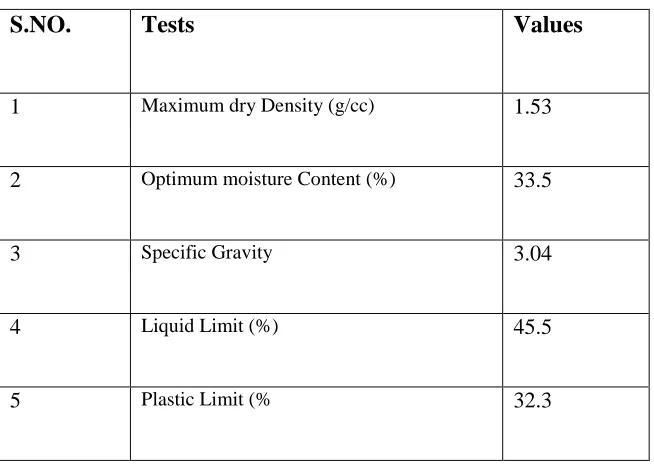
failure envelope and shear parameters: Cohesion and Angle of Internal Friction. Results are shown in the
table 1
Strength and physical parameters of red mud
S.NO.
Tests
Values
1
Maximum dry Density (g/cc)1.53
2
Optimum moisture Content (%)33.5
3
Specific Gravity3.04
4
Liquid Limit (%)45.5
5
Plastic Limit (%32.3
Unconfined Compressive strength:
The samples of sizes 38 mm diameter and height of 76 mm were
prepared by static compaction method to achieve maximum dry density at their optimum moisture
contents. Unconfined compressive strength tests were conducted at a strain rate of 1.25 mm/min.
California bearing ratio test:
The sample of nearly 4.5 to 5 kg was compacted in a mould of volume
2250cc with 5 layers and 56 blows were given for each layer. For soaked CBR value, the different sample
of identical size is prepared and kept soaking for 4 days with the surcharge. This test was conducted as
2.2 Utilization of Red Mud
Among the uses standing out, are those reported on the utilization of red mud for building materials production such as cement, bricks, roofing tiles and glass-ceramics . The bulk production of building materials could eliminate the disposal problem. Red mud is considered as a raw material for production of these materials. [10].
2.3 Red mud as filler material
For PVC, red mud is not only filler that has a reinforcing effect, but is also an efficient and cheap thermal stabilizer, providing the filled PVC products with an excellent anti-aging property.
Its lifetime is 2 to 3 times that of ordinary PVC products. At the same time, the fluidity of red mud is better than other fillers, which makes it plastic with good processing properties
And the red mud PVC composite plastics have fire retardant property, and can be made into red mud plastic solar water heaters and plastic construction profile.
Comparison of Nano fillers to red mud
Nano Fillers
Red Mud
Low reinforcing property compare to red mud. High reinforcing property compare to other nano fillers.
Low homogeneous dispersion High homogeneous dispersion
Weak Chemical Bonding Strong chemical bonding
High Cost Low Cost
2.4 Importance of red mud in production of polymer based composites
The use of layered inorganic fillers has been a common practice in the plastics industry to improve the properties of thermoplastics. The effects of filler on the material properties of composite materials depend strongly on its particle size, shape, aggregate size, surface characteristics, and degree of dispersion. Polymer composites prepared in combination with an organic component as a matrix and an inorganic component as filler on the nano scale [12] have additional advantages, such as the possibility of obtaining a material that has the advantages of both organic materials (e.g., light weight, flexibility, good moldability) and inorganic materials (e.g., high strength, heat stability)[13]. Low volume additions (≤5%) of nano particles of layered red mud provide property enhancements with respect to the neat resin that are comparable to those achieved by conventional loadings (15-40%) of traditional fillers. Red mud (nanofiller) is a major waste material obtained during the production of alumina from bauxite by the Bayer’s process. It comprises of silicates and oxides of iron, aluminum, sodium, calcium and titanium, along with
avenues of red mud utilization are more or less known but none of them have so far proved to be economically viable or commercially feasible.
Thermoplastics have a big potential for applications in the industry as well as in construction, electrical applications and food packaging. One of the few disadvantages associated with the use of nano fillers, is their high cost. The present research work has been undertaken with an objective to explore the use of red mud as a reinforcing material as a low cost option. This is due to the fact that red mud alone contains all these reinforcement elements and is plentifully available.
In mechanical reinforcement major issues are the homogeneous dispersion of nano fillers in the polymeric matrix and the developments of chemical bonding or strong interaction at the nanofiller-matrix interface. In this study we have used organically modified red mud for better homogeneous dispersion as well as enhanced material properties. The focus of this research was to experimentally characterize the two polymer nano composite systems and investigate the role of modification of filler in their behavior. Modified Red mud nano particles were dispersed in poly vinyl alcohol (PVA) and poly hydroxy ether of bisphenol-A (Ph) matrices.
• The conventional solvent casting technique was employed to generate polymer nanocomposites. Red mud was
treated with boric acid and phosphomolybdic acid to develop the acidic functional groups or active oxygen, resulting in the better dispersion of the red mud into the polymer matrices. Red mud was also organically modified with the oligomers of aniline formaldehyde, for better interaction between the filler and the polymer matrices. The particle size of the modified red mud was determined by field emission scanning electron microscopy (FESEM). The as-synthesized composite films were typically characterized by FTIR spectroscopy and X-Ray Diffraction. The morphological image of the composite materials was studied by scanning electron microscopy (SEM) and the dispersion of the modified fillers within the matrix was studied by transmission electron microscopy (TEM).The thermal properties measured by thermo gravimetric analysis (TGA) showed enhanced thermal stability of a series of composite materials. The differential scanning calorimetric (DSC) showed increase in glass transition temperature and crystallization of the composite films. The physical topography of the composite materials was studied by Atomic Force Microscopy (AFM).
hydroxyl groups. This is commonly achieved using the presence of catalytic quantities of alkali such as sodium hydroxide (which, since it acts only as a catalyst, should not in theory remain in the final product). The extent of hydrolysis will determine the amount of residual acetyl groups and this in turn apparently affect the viscosity characteristics.[ Ray & Bousmina ,2005] PVA exists only as a polymer; a monomer has not yet been isolated, so the chemical structure is described in Fig.2
•The PVA concentration in an aqueous solution is determined by the type of application. However, at concentrations
greater than 10 wt%, the viscosity of the aqueous solution at room temperature is such that pouring becomes difficult. In addition to its solubility, PVA is also appreciated for its good mechanical properties in the dry state, resistance to common solvents, barrier effect in dry atmospheres, possibility of food contact for suitable grades, biodegradability. Some of the physical properties of PVA are as presented in below table
Properties Values
Appearance White to cream granular powder
Density 1.23-1.30 g/cm3
Thermal stability Gradual discoloration above 100
oC;
darkens rapidly above 150 oC; rapid decomposition above 200
oC.
Coefficients of thermal expansion 7-8 x 10⁻⁵/ oC Thermal conductivity 0.2 W/m.k
Yield Stress 40-50 MPa
Elongation at break 100-200%
Melting point 230 oC for fully hydrolysed grades 180-190 for partially hydrolysed grades
Glass transition temperature 75-85 oC
•PVA can be plasticized and processed by casting, dipping, injection and extrusion. (Biron, 2007). The main
Films for packing chemicals, fertilizers, herbicides, disinfectants, dyes, colorants, scalars, cosmetics etc.
Release films for composite molding.
Solvent resistant tubes and pipes.
Membranes for pumps carrying petroleum or chemical products Trade names: Elvanol, Polyviol, Mowiol, Rhodoviol. The commercial name of poly (hydroxy ether) of bisphenol A is Phenoxy, and as a thermoplastic polymer it possesses many excellent properties such as (Zhang et al., 2002)
Good chemical stability
Excellent matrix material for producing polymer nanocomposites
Thermal stability
Tractability
Transparency•The poly (hydroxy ether of bisphenol A) (phenoxy (Ph)) has been revealed as a polymeric matrix able to intercalate
in, and partially exfoliate a commercial organically modified montmorillonite. Dispersion was attributed to chemical interactions between the Ph and the inorganic clay (Fornes et al., 2004). Poly (hydroxy ether of bisphenol A) (Ph) based polymer nanocomposites (PN) reinforced with a layered red mud with acidic and organic modifications were prepared by conventional solvent casting technique. The best dispersion occurred in the PN where the interactions between the functional groups of the polymer matrix and those of the organic substitution of the red mud appeared to be the highest. The modulus increase is an indirect but quantitative measurement of the attained dispersion level.
2.5 Modification of red mud by organic modifier
The organic modification of red mud was done by the following two steps:
1) Freshly prepared Aniline Hydrochloride is mixed with red mud with a magnetic stirrer. 2) Formaldehyde is then added drop by drop to the mixture with intense stirring action.
(Figure 1)
III MECHANISM
Figure 2 shows the mechanism and condensation reaction between substituted aniline and formaldehyde. After
substitution of the metal cation, condensation reaction occurs between the substituted amine group with extra
hydrogen and the formaldehyde molecule to form water as a byproduct. Thus the organic entity enters the space
between the silicate layers thus providing a suitable site for binding the polymer. When this filler is mixed with the
polymer, the polymer chains are attracted due to the presence of the organic species at the interlayer spaces, and thus
get intercalated in between the layers, which have about nanometer size openings. The reaction mechanism can be
Condensation reaction between substituted aniline and formaldehyde
(Figure 3)
Figure 3 Mechanism and Condensation reaction showing Organic Modification of Red Mud.
IV CONCLUSION
As the compatibility of red mud particles with polyester resin is fairly good, an industrial waste can be
used as a potential filler material to produce cost effective polyester matrix composites. The content of red
mud in the composite determines the mechanical properties such as hardness, density and tensile strength
of the composites.
Although nano fillers are available but red mud is the developing best material as a filler with its good
bonding strength and homogeneous dispersion and low cost.
Environmental problems solution and stock piling is also reduced by red mud in adjacent product with low
cost.
V ACKNOWLEDGEMENT
• We are very thankful to Pro.Minal S. Dani, who gave us a golden opportunity to perform this task thorough
the work and give best from her side.
REFRENCES
[1] http://okopoliszklaszter.hu/download/eloadasok/icemt_2011.05.24_02.janos.szepvolgyi.pdf
[2] Mineral Photos—Aluminum & Bauxite Homepage. Available online: http://www.mii.org/Minerals/photoal.html (accessed on 2 July 2012).
[3]. Renfortha, P.; Mayesb, W.M.; Jarvisc, A.P.; Burked, I.T.; Manningc, D.C.; GruizeScience, K.Contaminant mobility and carbon sequestration downstream of the Ajka (Hungary) red mud spill:The effects of gypsum dosing. Sci. Total Environ. 2012, 421–422, 253–259.
http://redmud.org/wp-content/uploads/2013/09/The-advancement-and-developing-of-red-mud-utilization-in-[6]. Paramguru, R.K., Rath, P.C., Misra, V.N., „Trends in red mud utilization - A review‟, Miner. Process Extr. Metal. Rev. 26(1), (2005), 1-29.
[7]. www.google.nl/patents/US4161465 [8].50张以河.pdf
http://www.cugb.edu.cn/upload/20600/papers_upload/50%E5%BC%A0%E4%BB%A5%E6%B2%B3.pdf [9]. A.H. Bhat, H.P.S. Abdul Khalil and A. K. Banthia (2011). Thermoplastic Polymer based Modified Red Mud
Composites Materials, Advances in Composite Materials - Ecodesign and Analysis, Dr. Brahim Attaf (Ed.),ISBN: 978-953-307-150-3, InTech, Available from: http://www.intechopen.com/books/advances-in- compositematerials-Ecodesign-and-analysis/thermoplastic-polymer-based-modified-red-mud-composites-materials
[10].Neutralization and utilization of red mud for its better waste management .pdf [11].http://dx.doi.org/10.1177/0731684408092453
[12] Huang, H H.; Orler, B.; Wilkes, G L. (1987). Structure-property behavior of new hybrid Materials incorporating oligomeric species into sol-gel glasses. 3. Effect of acid content, tetraethoxy silane content, and molecular weight of ply (dimethylsiloxane), Macromolecules, 20, 1322.
[13] Shao, C.; Kim, H-Y; Gong, J.; Ding, B.; Lee, D-R.; Park, S-J. (2003). Fiber mats of poly vinyl Alcohol silica composite via electrospinning, Materials Letters, 57(9-10),1579-1584.
[14] Chen, H.L. Wu, L.G; Tan, J; Zhu, C.L.; (2000). PVA membrane filled β-cyclodextrin for Separation of isomeric xylenes by pervaporation. Chemical Engineering Journal, 78 (2-3), 159-164.
[15] Horii,F; Hu,S; Ito,T; Odani,H; Kitamaru.R, (1992).Cross-polarization/magic-angle-spinning Carbon-13 NMR study of solid structure and hydrogen bonding of poly vinyl Alcohol films with different tacticities, Polymer, , 33(11), 2299-2306.
[16] Peppas, N.A; Merrill, E.W, (1977). Development of semi crystalline poly(vinyl alcohol) hydrogels for biomedical applications, Journal of Biomedical Materials Research, 11(3), 423-34