End-to-End Verifiable Elections in the Standard Model
∗Aggelos Kiayias†‡, Thomas Zacharias‡, and Bingsheng Zhang‡ Dept. of Informatics and Telecommunications,
National and Kapodistrian University of Athens, Greece {aggelos, thzacharias, bzhang}@di.uoa.gr
April 17, 2015
Abstract
We present the cryptographic implementation of “DEMOS”, a new e-voting system that is end-to-end verifiablein the standard model, i.e., without any additional “setup” assumption or access to a random oracle (RO). Previously known end-to-end verifiable e-voting systems required such additional assumptions (specifically, either the existence of a “randomness beacon” or were only shown secure in the RO model). In order to analyze our scheme, we also provide a modeling of end-to-end verifiability as well as privacy and receipt-freeness that encompasses previous definitions in the form of two concise attack games.
Our scheme satisfies end-to-end verifiabilityinformation theoreticallyin the standard model and privacy/receipt-freeness under a computational assumption (subexponential Decisional Diffie Hel-man). In our construction, we utilize a number of techniques used for the first time in the context of e-voting schemes that include utilizing randomness from bit-fixing sources, zero-knowledge proofs with imperfect verifier randomness and complexity leveraging.
1
Introduction
In an end-to-end (E2E) verifiable election system, voters have the ability to verify that their vote was properly cast, recorded and tallied into the election result. Intuitively, the security property that an E2E verifiable election intends to capture is the ability of the voters to detect a maliciouselection authority that tries to misrepresent the election outcome. E2E verifiability is a strong level of security for election systems that has been widely accepted as a fundamental requirement for their adoption, see e.g., [43].
In more details, E2E verifiability mandates that the voter can obtain a receipt at the end of the ballot casting procedure that can allow her to verify that her vote was (i) cast as intended, (ii) recorded as cast, and (iii) tallied as recorded. Furthermore, any external third party should be able to verify that the election procedure is executed properly. In fact, it is imperative that the receipts in an E2E system are delegatable i.e., the voter may delegate the task of verifiability to any interested third party, for instance an international organization of the voters’ choosing that aggregates the task of verification. This requirement, as well as the fact that it should be infeasible for the voter to use her receipt as a proof of the way she voted (this is necessary to deter vote-selling/buying), make the design of end-to-end verifiable systems a challenging problem.
All known e-voting systems that offer E2E verifiability provide it under some setup assumption or in the random oracle (RO) model. Notably, E2E verifiability can beargued(note that it is never formally
∗
The authors are ordered alphabetically and the third author is the corresponding author. †
Research was supported by ERC project CODAMODA. ‡
proven before) for Helios [1] in the RO model while for Remotegrity1[49] in the model where a trusted party (a “randomness beacon”) provides a stream of unbiased and unpredictable random coins. More general approaches for defining auditable multiparty computation (MPC) have recently been proposed [3] and also rely on a setup assumption such as a CRS.
A critical shortcoming of using setup assumptions for establishing E2E verifiability in e-voting is the fact that the voters will be required to make a “leap of faith” and accept the setup assumption in order to accept the election result. This can be an unfortunate state of affairs: since the election authority (EA) cannot unequivocally convince the voters that the election is correct, then the election outcome can be always subject to dispute.
Our Results. Motivated by the above, we design a new e-voting system that we can prove E2E ver-ifiable information theoreticallyin the standard model, i.e., without any setup assumption except the existence of a bulletin board (BB) which provides a consistent view of the election transcript. Our result is further strengthened by the fact that we make the absolute minimal assumptions on the computation capabilities of the voters: voters are merely modeled as finite statetransducersand thus are incapable of performing any cryptographic operation during ballot-casting (note the auditing stage after the election would require the capability of cryptographic operations but they can be performed at any time, in the post-election stage).
To accomodate the analysis of our system we provide a model for E2E verifiability and voter privacy/receipt-freeness. Our model for E2E verifiability is inspired from input-indistinguishable com-putation of Micali, Pass and Rosen [39] since in their setting they are also faced with proving security for multiparty computation in the standard model (note however they do not deal with E2E verifiabil-ity/auditability in their setting). In our modeling, the election system involves three types of entities, the votersV1, . . . , Vn, the election authority (EA), and the bulletin board (BB) whose only role is to provide storage for the election transcript for the purpose of verification. Voters submit their votes by engaging in the ballot casting protocol to the EA and they are not allowed to interact with each other. Our defini-tion of end-to-end verifiability considers a very powerful adversary that is computadefini-tionally unbounded andcompletelycontrols the EA. On the other hand, BB is completely passive and is only writeable by the EA and readable by anyone. The definition is satisfied, if and only if the adversary is incapable of evading being detected when it manipulates the election result as long as a number of voters perform the verifiability procedure honestly. Voter privacy on the other hand, considers an adversary that has full access to all the the voters’ receipts, views of the ballot casting protocol as well as it may control of a number of malicious voters. For any election tally, the adversary should be incapable of distinguishing the way honest voters vote.
Our construction cherry picks ideas put forth in previous works, specifically, code-voting and double ballots from [13, 14], but also introduces a number of novel elements that enable us to prove E2E verifiability in the standard model. In order to achieve verifiability, our system utilizes a novel ZK proof for candidate encoding correctness and collects coins from the voters to form the challenge (specifically, a single random coin per voter). Given that the majority of voters cannot be assumed to be properly following the protocol, the sequence of voter contributed randomness is a particularly “weak source” that cannot be used for arguing the integrity of the election in a direct way — as we argue it is a very weak source akin to adaptive bit-fixing sources [38]. We then show (i) how it is possible to perform our ZK proof with a verifier that has imperfect randomness (just a min-entropy source), (ii) how to produce a (sufficiently long) sequence of min-entropy challenge from the random bits contributed by the voters. The tools that are important in our construction include a generalization of the Schwartz-Zippel lemma [46, 50] for imperfect randomness and a suitable strategy for dividing the coins of the voters so that the entropy is not lost due to the adversarial strategy of the EA (who also controls a number of voters). Using these techniques we design a novel ZK protocol and we prove unconditionally end-to-end verifiability for our scheme. For voter privacy, we utilize complexity leveraging to construct a simulator that is capable of reducing a voter privacy attack to a subexponential DDH distinguisher and hence our
1Note that Remotegrity itself is only a “front-end” type of system. It will be E2E verifiable if combined with Scantegrity-II
system offers privacy and receipt-freeness under a computational assumption.
In summary, our e-voting system is the first construction achieving the properties E2E verifiabil-ity and voter privacy/receipt-freeness in the standard model. Furthermore, we prove E2E verifiabilverifiabil-ity information theoretically assuming the voters are computationally restricted transducers that hence are incapable of performing any cryptographic operation during ballot casting. The only assumptions we make are subexponential Decisional Diffie Hellman assumption (for voter privacy/receipt-freeness) and a consistent bulletin board board. We remark that a consistent bulletin board can be easily seen to be a tight condition since without it, it is easy to verify that E2E verifiability of the election cannot be achieved: by controlling the BB, an adversarial EA can distribute voters to their own separate “islands” where within each one the voters will have their own verifiable view of an election result that can be -in reality - completely skewed. Implement-ing a consistent bullet-in board is beyond our scope, however we note that it can be achieved in the standard model using Byzantine agrement (BA) (for BA, see e.g., [26]) by assuming secure channels between any pair of parties. In fact, recently, it is shown that one can achieve BA efficiently even without secure channels in a completely anonymous setting [27] hence removing the requirement for pairwise secure channels (but note that this latter work relies on proofs of work modeled in the RO model).
Why previously known techniques do not work. To motivate further our approach it is worth-while to emphasize in which way previous works fail to attain end-to-end verifiability in the standard model. Helios, culminates a long line of previous schemes that employ homomorphic type of voting, cf. [18,23, 33] and utilizes the Benaloh challenge [5] as the fundamental mechanism to attain verifiability. Helios by design requires the voter to utilize a voter supporting device to prepare a ciphertext and after an indeterminate number of trials, the voter will cast the produced ciphertext. Such ciphertexts are to be homomorphically tallied and thus they should be accompanied by a proof of proper computation. While such proofs are easy to construct based on e.g., [21], they can only be argued interactively (which is insufficient in our setting since a corrupt EA together with a corrupt voter may cook up a malformed proof that is indistinguishable from a proper one) or using a NIZK [10]. This latter approach is taken in Helios where a RO-based NIZK is utilized. In case the RO is dropped in favor of a standard model NIZK, security would be impossible in our model as NIZK’s require a common reference string (CRS) and this is unavailable in the standard model; if the CRS is setup by the EA then in case it is malicious it will know and exploit the trapdoor; on the other hand, the voters are not interacting with each other and hence cannot setup the CRS by employing an MPC protocol. It follows that obtaining E2E verifiability in the standard model is impossible to overcome for Helios or any other similar existing scheme. On the other hand, in the case of Remotegrity/Scantegrityncoins need to be obtained from the randomness beacon in order to prove the result correct. It is easy to verify that the system is insecure in terms of end-to-end verifiability in case the randomness beacon is biased. As before, the only parties active are the EA and the voters who cannot implement a randomness beacon that is required in the construction. In light of the above, our construction offers a new paradigm in e-voting design: the randomness for the verification of the election can be collected distributively from the voters. Given that such randomness is by nature very weak (humans are very bad “randomness generators” and even worse malicious voters may collaborate with the election authority to cancel the honest voters’ random bits) we show how suitable cryptographic techniques that deal with imperfect randomness can be employed to prove security.
Distributing the Election Authority. In our security model, we consider the EA as a single entity that is malicious in the verifiability game and honest in the privacy game. In practice one may want to distribute the EA to a number of “trustees” that collectively implement the EA functionality to improve the resiliency of the privacy property. While this is not a prime focus of our work (which centers on verifiability), it is feasible to design an efficient threshold protocol for implementing the EA. Note that our notion of voter privacy and receipt freeness can be easily extended to allow corrupted sub-authorities. Other required properties of election systems. Our work by no means solves the complete set of desired requirements that are needed in an election system. Our voter-privacy definition implies receipt-freeness, i.e., provided that the voter receives the voter secret-key over an untappable channel2, the voter
2
cannot convince any third party about the way she voted. Nevertheless, this does not imply coercion resistance as the voter may still be forced to divulge the voter secret prior to her ballot-casting (this does not violate voter privacy - it just prevents the voter from actually using the system and enables the adversary to vote on the voter’s behalf). There are techniques that can be used to increase coercion resistance for internet-voting (e.g., those of [31,17] and others) and they are compatible with our con-struction. We leave the integration of these techniques with information theoretic E2E verifiability for future work. Similarly, usability aspects are not within our current scope; nevertheless, we stress that we have implemented our system for 1-out-of-melections and we have used it in real-world experiments3. Related work. In [12], Chaum suggested for the first time that anonymous communication can lead to voting systems withindividual verifiability, i.e., the voters can verify that their votes were counted correctly. In [45], Sako and Killian introduce explicitly the notion ofuniversal verifiability, that is, the ability for anyone to verify that the election result derives from the cast votes. Universal verifiability is also defined by Juels, Catalano and Jakobsson in [31] in the computational model assuming a trusted setup. Kremer, Ryan and Smyth [34] introduced symbolic definitions for individual and universal verifi-ability in the context of applied pi calculus. A formal definition of universal verifiverifi-ability is also provided by Chevallier-Mameset al.in [16].
End-to-end verifiability in the sense of cast-as-intended, recorded-as-cast, tallied-as-recorded was an outcome of the works of Chaum [14] and Neff [42]. The novelty was the generation of receipts that could be used for simple voter verification while achieving privacy. The term of E2E verifiability (more precisely, E2E integrity) also appeared in [20]. Marneffe, Pereira and Quisquater presented an ideal-world definition for election systems in [24] without explicitly considering verifiability as a property of the ideal world. In [43], Popoveniuc et al. proposed a definition of E2E verifiability via a list of properties.
K¨usters, Truderung and Vogt [35] introduced symbolic and computational definitions of verifiability parameterized by a goal and an adversarial environment. In [37], the same authors showed that individual verifiability and universal verifiability are not sufficient to guarantee the “global” verifiability of an e-voting system. A number of other e-e-voting systems in the cryptographic setting that do not explicitly deal with E2E verifiability include [19,7,22,23].
Benaloh and Fischer [19] provided a computational definition of privacy as the property that any coalition of malicious voters cannot distinguish between any two vote assignments coming from a subset of honest voters that have the same partial tally. Receipt-freeness has been first studied by Benaloh and Tuinstra [6] and described as the property of an e-voting system to generate fake voter transcripts that are indistinguishable from genuine transcripts. Following this logic, in our voter privacy/receipt-freenes definition, we require simulation-based indistiguishability of the views of the voters when they engage in the ballot-casting stage. Chevallier-Mames et al. [16] introduced definitions for unconditional of privacy and receipt-freeness and showed incompatibility results of universal verifiability with each of these two properties.
Formal definitions for privacy and receipt-freeness have been proposed in the context of applied pi calculus [25] and the universal composability model [29,41]. In [37], the level of privacy of an e-voting system is measured w.r.t. to the observation power the adversary has in a protocol run, via a definition which is close to the Dolev-Yao model.
In [8], Bernhardet al. proposed a game-based notion of ballot privacy and study the privacy of Helios. In their model, an adversary that chooses a fixed voteE, cannot distinguish a bulletin board that contains ballots for real votes from a bulletin board that contains ballots forE. Their definition was extended by Bernhard, Pereira and Warinschi [9] by allowing the adversary to statically corrupt election authorities. Both these definitions, although they imply a strong inditinguishability property, do not consider freeness. We note that our game-based definition captures both privacy and receipt-freeness while restricted to a single EA (and it can easily be extended by including a set of trustees that the adversary may corrupt).
secrets or using non-committing encryption [4] achieves untappability.
3
As we have mentioned previously, modelling coercion resistance is out of the scope of this work. We refer the reader to [31,25,48,36] for formal definitions of coercion resistance in the cryptographic, symbolic and universal composability model.
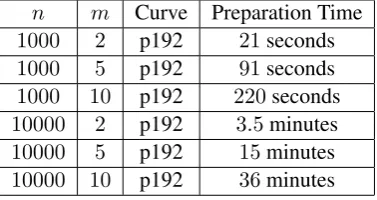
Organization. In Section2, we introduce the syntax and define the correctness, E2E verifibiality and voter privacy/receipt freeness of an e-voting system. In Section3, we present at length the construction of our e-voting system, including a detailed description of all tools that are applied. In Section4, we prove the E2E verifibiality and voter privacy/receipt freeness of our e-voting system in the security framework of Section2. In Section5, we provide an overview of the implementation of our system for 1-out-of-melections along with election preparation time benchmarks.
2
E-voting Systems
2.1 Preliminaries
We useλas the security parameter. Associated with an e-voting system, we also consider two other parameters, the number of votersnand number of candidatesmwhich are both thought as polynomial functions of λ. Let Π be an e-voting system, where P = {P1, ..., Pm} is the set of candidates and V ={V1, ..., Vn}is the set of voters. We denote byU ⊆2Pthe collection of subsets of candidates that the voters are allowed to choose to vote for (which may include a “blank” option too). The candidate selectionU`of voterV`is an element inU.
LetP∗ be the set of vectors of candidate selections of arbitrary length. Letf be theelection evalu-ation functionfromP∗to the setZm+ so thatf(U1, . . . ,Un)is equal to anm-vector whosei-th location is equal to the number of timesPiwas chosen in the candidate selectionsU1, . . . ,Un.
The entities involved in an e-voting systemΠ, are the votersV1, . . . , V`, theelection authority (EA) and theBulletin Board (BB).
2.2 Syntax and Correctness
An e-voting systemΠis a quintuple of algorithms and protocolshSetup,Cast,Tally,Result,Verifyi specified as follows:
• The algorithmSetup(1λ,P,V,U)is executed by the EA and generates a master secret keymsk,
Π’s public parametersPub(which includeP,V,U) and the voters’ secretss1, . . . , sn. EA has a state,stwhich is initialized asmsk. In addition, it posts an initial public transcriptτ = Pubon the BB.
• The interactive protocolCastis between three parties, the voterV`, the BB and the EA.V` has input(Pub, s`,U`), EA has inputmskand BB has inputτ. EA updates its statestand BB updates the public transcriptτ. Upon successful termination, the voterV`receives a receiptα`. We denote byview`the view of the voterV`in the protocolCast.
• The interactive protocol Tally with common inputPub is executed by the EA and the BB on inputsmsk, τ respectively. Upon successful termination, the BB updates the public transcriptτ.
• The algorithmResult(τ)outputs the resultRτ for the election or returns⊥in case such result is undefined.
• The algorithmVerify(τ, α)outputs a value in{0,1}, whereαis a voter receipt (that corresponds to the voter’s output from theCastprotocol).
whole) this is completely immaterial. Hence, for simplicity in the syntax above we consider EA a single entity. In our construction the EA may also be distributed. We defer the details for how this may be done to the full version of the paper.
Definition 1 (Correctness) The e-voting systemΠhas (perfect)correctness, if for any honest execution ofΠthat results in a public transcriptτ where the votersV1, . . . , Vncast votes for optionsU1, . . . ,Un and received receiptsα1, . . . , αn, it holds that
Result(τ) =f(U1, . . . ,Un)and ∧n
`=1(Verify(τ, α`) = 1).
2.3 E2E Verifiability
In order to define E2E verifiability formally, we introduce a suitable notation; given that candidate selections are elements of a set ofmchoices, we may encode them asm-bit strings, where the bit in the i-th position is 1 if and only if candidatePiis selected. Further, we may aggregate the election results as the list with the number of votes each candidate has received, thus the output of theResultalgorithm is a vector inZm+. In this case, a result is feasible if and only if the sum of all its coordinates is no greater than the number of voters.
In our formalization of the E2E verifiability, we postulate the existence of avote extractoralgorithm E (not necessarily running in polynomial-time) that explains the election transcript: namely, it receives input of the form(τ, A)whereτ is an election transcript and A = {α`}`∈V˜ is a set ofCastprotocol receipts. ByV˜, we denote the set of honest voters that voted successfully. Given such input, E will compute n− |V|˜ vectors hU`iV
`∈V\V˜ in {0,1}
m (which correspond to the choices of all the voters
outside ofV) that can be either a candidate selection if the voter has voted adversarially or a zero vector˜ if the voter has not voted successfully;E returns the symbol⊥in case such values cannot be defined. In the special case where all voters are honest and have voted successfully (i.e.,V˜ =V),Ereturns no value (outputs the empty set). The purpose of theE algorithm will be to capture the setting when the election transcriptτ contains (in potentially encoded form) a set of well-formed actual votes.
Using the above notion, we will be capable to express the actual result encoded in an election tran-script. Next, we want to formally express a measure ofdeviationfrom the actual election result (as such deviation is the objective of the adversary in an E2E verifiability attack). Some preliminary notions will be needed. In order to express formally the deviation the adversary aims at, it is natural to equip the space of results with ametric. We use the metric derived by the 1-norm,k · k1 scaled to half, i.e.,
d1 :Zm+ ×Zm+ −→ Rwithd1(w, w0) = 12 · kw−w0k1 = 12 ·Pni=1|wi−wi0|wherewi, w0iis thei-th coordinate ofw, w0 respectively.
Consider R ∈ Zm
+ be the election results that correspond to the true voter intent of nvoters, and R0∈Zm
+ be the published election results. Denote bymax(U), the maximum cardinality of an element inU. Two encodings of candidate selections are withinmax(U)distance, so intuitively, if the adversary wants to present R0 as the result of the election, it may do that by manipulating the votes of at least
d1(R, R0)/max(U)voters.
We define next the E2E Verifiability game,GAE2E−Int,E,d,θ , between the adversaryAand a challengerC using a voter extractorE, that takes as input the security parameter,λ, the number of candidates,mand the number of voters,n.
will win the game provided that allθhonest voters that completed theCastprotocol successfully will also audit the result successfully but the deviation of the tally is at leastd; the adversary will also win in case the extractor fails to produce the candidate selection of the dishonest voters (butθhonest voters still verify correctly). The attack game is specified in detail in Figure1.
E2E Verifiability GameGAE2E,E,d,θ−Ver(1λ, m, n)
1. Achooses a list of candidatesP = {P1, ..., Pm}, a set of votersV = {V1, ..., Vn}and the set of allowed candidate selectionsU. It providesCwith the setsP,V,U along with informationPuband voter credentials{s`}`∈[n]. Throughout the game,Cplays the role of the BB.
2. The adversaryAand the challengerCengages in an interaction whereAschedules theCastprotocols of all voters. For each voterV`,Acan either completely control the voter or allowCto operate on their behalf, in which caseAprovides a candidate selectionU`toC. Then,Cengages with the adversary
Ain theCastprotocol so thatAplays the role of EA. Provided the protocol terminates successfully,
Cobtains the receiptα`on behalf ofV`.
LetV˜ be the set of honest voters (i.e., those controlled byC) that terminated successfully.
3. Finally,Aposts the election transcriptτto the BB.
The game returns a bit which is1if and only if the following conditions hold true:
(i). |V| ≥˜ θ, (i.e., at leastθhonest voters terminated).
(ii). ∀`∈[n] :ifV`∈V˜, thenVerify(τ, α`) = 1(i.e., the voters inV˜verify their ballot successfully). and either one of the following two conditions:
(iii-a). If⊥ 6=hU`iV`∈V\V˜ ← E(τ,{α`}V`∈V˜), then
d1(Result(τ), f(hU1, . . . ,Uni))≥d. (iii-b). ⊥ ← E(τ,{α`}V`∈V˜).
Figure 1: The E2E Verifiability Game between the challenger C and the adversaryA using the vote extractorE.
Definition 2 (E2E-Verifiability) Let0 < < 1andn, m, d, θ ∈Nwithd > 0and0 < θ ≤ n. The election protocolΠw.r.t. the election functionf achievesE2E verifiabilitywith error, for a number of at leastθhonest successful voters and tally deviationdif there exists a (not necessarily polynomial-time) vote-extractorEsuch that for any adversaryA:
Pr[GAE2E−Ver,E,d,θ (1λ, m, n) = 1]≤.
In plain words, Definition 2suggests that an E2E verifiable e-voting system, provides an “official explanation” of adversarial votes via the vote extractorE, such that if at leastθvoters verify the result, then any adversary that attempts to manipulate the election tally (that includes the honest votes and the official explanation of the adversarial votes) by a shift ofdvotes will get caught except from some (sup-posedly small) probability.
votes of the honest voters they produce a result that does not deviate from the published result according to thed1(·,·)metric. Note that our vote extractor may require super-polynomial time (in the same way that the set of good runsγ may have a membership test of super-polynomial complexity). We remark that the use of a super-polynomial extractor to define properly the inputs of the malicious participants and hence the soundness of a multiparty protocol is not novel to our work. For example see, Micali, Pass and Rosen [39] where they used a similar construct to prove security of their general multiparty computation protocol.
2.4 Voter Privacy (including Receipt-Freeness)
The definition of voter privacy concerns the actions that may be taken by the adversary to break the privacy and learn some information about the candidate selections of the honest voters. We specify the goal of the adversary in a very general way. In particular, for an attack against voter privacy to succeed, we ask that there is an election result, for which the adversary is capable of distinguishing how the honest voters voted while it has access to (i) the actual receipts that the voters obtained after ballot-casting as well as (ii) a set of protocol views that are consistent with all the honest voters’ views in theCast protocol instances they participated (and the adversary has observed).
Observe that any system that is secure against such an attack scenario would possess also “receipt-freeness”, i.e., voters cannot prove how they voted by showing the receipt they obtain from theCast protocol or even presenting their view in the Cast protocol. Given that in the privacy definition we allow the adversary to observe the view of the voter in theCastprotocol, we need to allow the voter to be able to “lie” about her view in this protocol (otherwise an attack could be trivially mounted). Note that this would require the voter input to the Cast protocol to be delivered via an untappable channel; in particular, the adversary should not have any side-channel information about the voter’s secretss1, . . . , sn.
We formally define the voter privacy of an election via aVoter Privacy/Receipt-freenessgame, de-noted by GAt-priv,S , that is played between an adversary A and a challenger C, that takes as input the security parameter,λ, the number of voters,n, and the number of candidates,m, as described in Fig-ure2and returns1or0depending on whether the adversary wins. An important feature of the game is the existence of an efficient “voter simulator”Sthat provides a simulated view of the voter in theCast protocol. Intuitively, this simulator captures the way the voter can lie about her candidate selection in theCast protocol in case she is coerced to present her view after she completes the ballot-casting procedure.
Overview of the gameGAt-priv,S (1λ, n, m). The adversary starts by selecting the voters and candidates for given parameters n, m. It also determines the allowed ways to vote. The challenger flips a coin b(that will change its behavior during the course of the game) and will perform the Setupprotocol. Subsequently, the adversary will schedule allCastprotocols selecting which voters it prefers to corrupt and which ones it prefers to allow to vote honestly. The adversary is allowed to corrupt at mosttvoters. The voters that remain uncorrupted are operated by the challenger and they are given two candidate selections to choose. The challenger will select which of the two candidate selections the voter will use in theCastprotocol according to the bitb. The adversary will also receive the receipt that is obtained by each voter as well as either the actual view of each voter during theCast protocol, ifb = 0, or a simulatedview, ifb= 1(this addresses the receipt-freeness aspect). Upon completion of ballot-casting, the challenger executes theTally protocol and posts the election result. Subsequently the adversary will attempt to guessb. The attack is successful provided that the adversary has corrupted up totvoters, the election tally is the same with respect to the two alternatives provided for each honest voter by the adversary and the adversary manages to guess the challenger’s bitb. The game is presented in more detail in figure2.
Voter Privacy/Receipt-freeness GameGAt-,privS (1λ, n, m)
1. Aon input1λ, n, m, chooses a list of candidatesP ={P
1, ..., Pm}, a set of votersV ={V1, ..., Vn}, and the set of allowed candidate selectionsU. It providesCthe setsP,V, andU.
2. C flips a coin b ∈ {0,1} and performs the Setup protocol on input (1λ,P,V,U) to obtain
msk, s1, . . . , sn,Pub; it providesAwithPub.
3. The adversaryAand the challengerCengage in an interaction whereAschedules theCastprotocols of all voters which may run concurrently. For each voterV` ∈ V, the adversary chooses whetherV` is corrupted:
• IfV`is corrupted, thenCprovidess`toA, and then they engage in aCastprotocol whereA plays the role ofV`andCplays the role of EA and BB.
• IfV` is not corrupted,Aprovides two candidate selectionshU`0,U 1
`ito the challengerC. C operates onV`’s behalf, usingU`bas theV`’s input. The adversaryAis allowed to observe the network trace of theCastprotocol whereCplays the roles ofV`, EA, and BB. When theCast protocol terminates, the challengerCprovides toA: (i) the receiptα`thatV`obtains from the protocol, and (ii) ifb= 0, the current view of the internal state of the voterV`,view`, that the challenger obtains from theCastexecution, or ifb= 1, a simulated view of the internal state ofV`produced byS(view`).
4. Cperforms theTallyprotocol playing the role of EA and BB.Ais allowed to observe the network trace of that protocol.
5. Finally,Ausing all information collected above (including the contents of the BB) outputs a bitb∗. Denote the set of corrupted voters asVcorrand the set of honest voters asV˜ =V \ Vcorr. The game returns a bit which is1if and only if the following hold true:
(i). b=b∗(i.e., the adversary guessesbcorrectly).
(ii). |Vcorr| ≤t(i.e., the number of corrupted voters is bounded byt). (iii). f(hU0
`iV`∈V˜) =f(hU 1
`iV`∈V˜)(i.e., the election result w.r.t. the set of voters ˜
Vdoes not leakb).
Figure 2: The Voter-privacy/Receipt-freeness game
voter simulatorSsuch that for any PPT adversaryA:
Pr[G
A,S t-priv(1
λ, n, m) = 1]−1/2
=negl(λ).
Remark. Our game-based voter privacy/receipt-freeness definition is close in spirit to witness indistin-guishability of interactive proof systems. Namely, the adversary’s challenge is to distinguish between two possible lists of candidate selections (the witnesses) that produce the same tally when restricted to just the honest voters. A potentially stronger privacy requirement would be a simulation-based formula-tion (akin to zero-knowledge in interactive proof systems) e.g., as the one suggested for ballot privacy in [9]. The definition of [9] is incomparable to ours because even though it is simulation-based and it cap-tures malicious behavior of a subset of multiple trustees, it does not consider receipt-freeness. Note that our definition can be easily extended to the setting of multiple trustees (that the adversary may corrupt up to a threshold).
3
Presentation of Our e-Voting System
submission of a random coin flip that will be used to produce the challenge for theΣprotocol. Voters will receive a receipt as their local output from the ballot-casting protocol that can be used for auditing the election result. In the third and final stage, the EA produces the tally of the election and completes theΣprotocol by publishing openings to commitments as well as other necessary information needed for verification. The verification step can take place at any time after the completion of the process using a collection of at least one receipt from the ballot-casting stage.
In our system, the voter implementation during the ballot-casting stage is expressed as a probabilistic transducer (see e.g., [30]) with a communication tape that has a number of states polynomial in the number of candidatesm(and independent to other parameters such asn, λ). Given that such a machine is severely limited in the computational sense, in order to achieve ballot casting we utilize a code-voting approach (cf. [13]): the EA corresponds vote-codes to commitments posted in the BB, and voters cast their vote by simply sending to the EA the vote-code that they prefer. The commitments have an additive homomorphic property, hence it is possible to tally the result by homomorphically processing them and opening the resulting “tally commitment”. The proof that we use in order to ensure verifiability is a conjunction of a cut-and-choose proof with a Σ proof that a committed value belongs to a set. The challenge needed for theΣproof will be extracted by applying a suitable extraction mechanism to the coin flips of the voter transducers that are collected by the EA.
In Sections3.1,3.2,3.3and3.4, we provide a detailed description of the tools that we apply for the construction of our system, i.e., (i) the homomorphic commitment scheme, (ii) a generalization of the Schwartz-Zippel lemma for imperfect randomness, (iii) theΣprotocol and (iv) the challenge extraction mechanism, respectively. We describe our e-voting system in Section3.5and prove its correctness in Section3.6. For the better understanding of our system, we provide a toy example in Section3.7.
3.1 Perfectly Binding Commitment
To achieve integrity against computationally unbounded adversaries, we have to use a perfectly binding commitment scheme. Moreover, our system requires such a commitment scheme to be additively homo-morphic to facilitate the tally and audit process. In this work, we instantiate the commitment scheme with lifted ElGamal over elliptic curves. We use elliptic curve domain parametersParam := (p, a, b, g, q)
generated by the curve generator G(1λ), consisting of a prime p that specify the finite field
Fp, two elementsa, b∈Fp that specify an elliptic curveE(Fp)defined by the equation: E :y2 =x3+ax+b
(modp) , a base pointg = (xg, yg)on E(Fp), and a primeq which is the order ofg. We denote the cyclic group generated byg asG, and it is assumed that the DDH assumption holds overG. More
specifically, our commitment scheme consists of the following algorithms:
• Gen(Param,1λ): picksx←
Zq, setsh:=gx, and outputsck:= (Param, h).
• Comck(m;r): outputsc:= (gr, gmhr).
• Verck(c;m;r): outputsacceptifc= (gr, gmhr); otherwise, outputsreject.
It is obvious that the above commitment scheme is perfectly binding and computationally hiding under the DDH assumption, i.e. for any PPT adversaryA, we have that the advantage
Advhide(A) :=
Pr
Param← G(1λ);ck←Gen(Param,1λ); (m0, m1)← A(Param,ck);b← {0,1}; r←Zq:A(Comck(mb;r)) =b
−1/2
is negligible inλ. The commitment scheme is additively homomorphic. Namely,
3.2 Schwartz-Zippel (min-entropy variant)
We need a min-entropy variant of the Schwartz-Zippel lemma, to check the equality of two univariate polynomialsf1, f2, i.e. testf1(x)−f2(x) = 0for randomx
D
←Zq. The probability that the test passes
is at most max(d1,d2)
2κ if f1 6= f2, wheredi is the degree of fi fori ∈ {1,2}. We state the following lemma without proof (a proof will be provided in the full version).
Lemma 1 (min-entropy Schwartz-Zippel) Letf(x)be a non-zero univariate polynomial of degreed overZq. LetDbe a probability distribution onZqsuch thatH∞(D) ≥κ. The probability off(x) = 0 for a randomly chosenx←D Zqis at most 2dκ.
3.3 AΣProtocol for Candidate Encoding Correctness
In order to present theΣprotocol with clarity, we outline some necessary excerpts of the description of our system that will be explained in detail in Section3.5.
LetN =n+ 1, wherenis the number of voters. Each voter is given a ballot that consists of two equivalent parts that contain a list ofmvote-codes corresponding to the list candidates{P1, . . . , Pm}. The voter will flip a coin to choose the part she is going to use for voting. At theSetupphase, each ballot is posted to the BB in committed form. Namely, it consists of two sets of commitments E`,j(a) for a ∈ {0,1}, ` = 1, . . . , n, j = 1, . . . , m, and each set commits to a permutation of the encoded candidates, where candidatePjis encoded asNj−1.
We emphasize that it is not necessary to prove that each set of the commitments commits to a permutation of the encoded candidatesN0, . . . , Nm−1 in an1-out-of-melection. This is due to two facts: (i) EA will open one of the two sets of commitments according to the corresponding voter’s coin a` (the set that corresponds to the unused ballot part); therefore, a malicious EA will be caught with probability1/2by each honest voter if any of the committed sets is not a permutation of the encoded candidates or is an inconsistent permutation of the encoded candidates w.r.t. the one on the voter’s ballot. (ii) Even if we ensure that the set of the commitments commits to a permutation of the encoded candidates, it does not imply that the permutation is consistent to the one on the voter’s ballot. In an
1-out-of-melection, only one of the commitments will be used for tally, and thus proving that the set of the commitments commits to an unknown permutation of the encoded candidates can only provide the guarantee that the tallied commitment commits to an encoded candidate. Note that this guarantee is important; otherwise, given that we perform homomorphic tallying, it may be feasible for a cheating EA to introduce a large deviation to the actual tally result via a single inconsistent ballot; for instance, EA may commit to10000·Nj−1 for somej∈[m]. Hence, we want the EA to show that each commitment commits to one of Nj−1 for j ∈ [m]. 4 We can formalize the correctness of a single commitment
problem as follows. Given commitments E, the prover wants to convince the verifier that he knows r ∈ Zq such that E = Comck(Ni;r) andi ∈ [0, m−1]. Let i, r be the prover’s private input, and w.l.o.g. we assumemis a perfect power of2. For general cases, say2e−1 ≤m≤2e, we can show the conjunctioni∈[0,2e]∧(i+ 2e−m)∈[0,2e]. OurΣProtocol is described in Fig.3.
Theorem 1 LetN >0be a public integer. Given common inputE∈G×G, the protocol described in Fig.3is aΣprotocol for knowledge ofi∈N, r∈Zqsuch thatE=Comck(Ni;r),i∈[0, m−1]that is perfectly complete, statistically sound with soundness error2−κ+1+log logmwhen the verifier’s challenge has min-entropy κ and computationally zero-knowledge with distinguishing advantage Advzk(A) ≤
logm·Advhide(A)for any PPT adversaryA.
4
P(i, r):
Definebjsuch thati=Pj=0logm−1bj2j. Pick
• tj, zj, yj, rj, wj, fj ←Zqforj∈[0,logm−1]. Compute the following commitments:
• Forj∈[0,logm−1],
– Bj=Comck(bj;rj);Tj=Comck(tj;zj); – Yj =Comck((1−bj)tj;yj);
– Wj=Comck(wj;fj).
DefineAj, aj, rj0 such thatAj =BN
2j−1
j ·Comck(1; 0) = Comck(aj;rj0), forj ∈ [0,logm−1]. Define{βj, γj}
logm
j=0 such that
Qlogm−1
j=0 (ajX+wj) =P logm
j=0 βjXj andQ logm−1
j=0 (rj0X+fj) =
Plogm
j=0 γjX
j. (Note that for efficiency reasons, the prover needs to choose the{r
j}logj=0m−1such that
γlogm=rin previous step.)
• Forj∈[0,logm−1],Dj =Comck(βj;γj).
Returnφ1={Bj, Tj, Yj, Wj, Dj} logm−1 j=0 and
stateφ={tj, zj, yj, rj, bj, wj, fj} logm−1 j=0 .
P →V: Sendφ1.
V →P: Sendρ←Zq.
P(stateφ): Compute the following answers: • Forj∈[0,logm−1],
– t0
j=bjρ+tj, zj0 =rjρ+zj, y0j=−yj−rjt0j; – wj0 =ajρ+wj, fj0 =r0jρ+fj;
Setφ2=
t0j, zj0, y0j, wj0, fj0 logm−1
j=0 .
P →V: sendφ2
V(E, φ1, ρ, φ2): Accept the proof (i.e. outputaccept) if and only if • Forj∈[0,logm−1],
– Bjρ·Tj =Comck(t0j, zj0), – (Comck(1; 0)/Bj)t
0
j/Yj =Comck(0;y0 j); – Aρj·Wj=Comck(wj0, fj0);
• EρlogmQlogm−1 j=0 D
ρj
j =Comck(Q
logm−1 j=0 w
0
j;
Qlogm−1
j=0 f
0
j);
Figure 3: TheΣProtocol for Ballot Correctness
Proof:It is straightforward to check that protocol in Fig.3achieves perfect completeness.
In terms of statistical soundness, the protocol verifies two facts. Namely, (i){Bj}j∈[0,logm−1] com-mits to either0or1, and (ii) E commits toNPlogj=0m−1bj2j = Ni, whereb
j is the opening ofBj. To check the first fact, for each committedbjthe protocol builds the degree1polynomial
g1(X) = (1−bj)(bjX+t) +c0 = (1−bj)bjX+c00
probabilityPr[(1−bj)bj 6= 0]≤2−κ. Hence, with at least1−2−κprobability(1−bj)bj = 0, which impliesbj ∈ {0,1}. To check the second fact, the protocol first computesAj =BN
2j−1
j ·Comck(1; 0) homomorphically. Letaj be the opening ofAj. It is easy to see thataj = N2
j
ifbj = 1, aj = 1 if
bj = 0, thus it holds thataj =bjN2 j
+ 1−bj =Nbj2 j
. So that the protocol just needs to verify thatE commits to the product ofaj’s. The verifier checks equality between two degreelogmpolynomials
g2(X) = logm−1
Y
j=0
(ajX+wj) = logm
X
j=0
βjXj andg20(X) =uXlogm+ logm−1
X
j=0
β∗jXj
whereu is the opening ofE andβj∗ which is the opening of Dj and are provided by the (potentially malicious) prover. By min-entropy Schwartz-Zippel lemma, ifH∞(ρ) ≥ κ and g2(ρ) = g20(ρ), the probabilityPr[u = βlogm] ≥ 1− log2κm. Hence, we haveu = N
Plogm−1
j=0 bj2j with at least 1− logm
2κ probability conditioned on the fact (i). Given that allb0, . . . , blogm−1 need to be shown in {0,1} the entire proof is statistically sound with probability(1−2−κ)logm(1−log2κm)≥1−logm·2−κ+1.
Our protocol satisfies special soundness, i.e. there exists an extractor that can extracti∈N, r∈Zq if the prover is able to complete the protocol twice with the sameφ1but two distinct challenges (we omit the construction of the extractor).
To show special honest verifier zero-knowledge property, we now construct a simulator that on input
ˆ
ρ∈Zqcan output a transcript that is indistinguishable from the real one. The simulator randomly picks
b0, . . . , blogm−1 ← {0,1}and generates
n
tj, zj, yj, rj, Bj, Tj, Yj, t0j, z0j, y0j, wj, fj, Wj, w0j, fj0
ologm−1
j=0 according to the protocol description. It then generates{Dj}logj=1m−1 according to the protocol and set
D0 =Comck( logm−1
Y
j=0 w0j;
logm−1
Y
j=0
fj0)/(Eρˆlogm logm−1
Y
j=1
Dρjˆj) .
Subsequentely, the simulator setsφˆ1 ={Bj, Tj, Yj, Wj, Dj}logj=0m−1andφˆ2 =
n
t0j, zj0, yj0, w0j, fj0ologm−1
j=0 , and it outputs( ˆφ1,ρ,ˆ φˆ2). First of all, it is obvious that all the verification equations hold. Secondly, the distribution of all the variables inφˆ2are uniformly random, which is identical to that of a real transcript. Moreover, if the adversary can distinguish the simulatedφˆ1 from that of a real transcript, she must be able to distinguish at least one of the fake{Bj}logj=0m−1. By hybrid argument, we have for any PPT adversaryA, the advantage to distinguish the simulated proof isAdvzk(A)≤logm·Advhide(A). 2
3.4 Producing the Verifier’s Challenges
order in the ballot casting stage, the sourcea can be viewed as anadaptive bit-fixing source [38]; in such case, we can employ the deterministic extractor construction framework from [32] which applies a deterministic low influence function on segments of the source. The majority function is proven to be an optimal low influence function thus in this way we obtain a deterministic extractor that generates the challenge. However, this adversarial setting is not realistic in practice as ballot casting might be scheduled adversarially. Nevertheless, we emphasise that even using a non-oblivious bit-fixing source, Kamp and Zuckerman showed that at mostn/`bits can be extracted when`out ofnbits are fixed [32]. This result implies that if a deterministic extractor is used to generateΘ(λ)random bits, then this will restrict the percentage of corrupted voters to be belowΘ(λ1)which might also be not a realistic expecta-tion in practice. An alternative approach may use a condenser as opposed to an extractor. Randomized condensers with a small/constant seed space have been put forth see e.g. [2,44]; using such a tool one may iterate over all possible seeds and thus be assured that one of the seeds will allow the condenser to produce a sufficiently random challenge. For instance, Baraket al.[2] proposed a basic 2-bit seed condensercon:{0,1}n→ ({0,1}n/3)4such that for everyδ-sourceXwith0< δ <0.9, at least one of the 4 output blocks ofcon(X)is a(δ+ Ω(δ2))-source. Based on the composing lemma (Lemma 5.5 [2]), we can iteratively apply the condenser to achieve any desired constant rate. Given ac-coin condenserCon : {0,1}n 7→ ({0,1}`)c, in order to produce a good challenge, by definition, it should hold thatc·` > n, which means that the condenser will producecblocks, one of which is guaranteed to be sufficiently random. However as we observe below, we can utilize ZK amplification to obtain essentially the same result as with ac-coin condenser while sacrificing very little entropy from the weak source. We explain our technique next.
Let{0,1}`Σ be the challenge space, where`
Σ =blogqcandqis the order of the underlying group used in theΣprotocol. Assume n/k ≤ `Σ for somek ∈ Z+. We evenly partition the voters’ coins
aintokblocks, denoted bya1, . . . ,ak. For each blockai, the EA should prove the correctness of the ballots using a separateΣprotocol withai as its challenge. The verifier only accepts the EA’s proof if alltheΣprotocols are valid. The theorem below shows that the soundness error of thisk-times repeated
Σprotocol drops exponentially withθ−k(log logm+ 1).
Theorem 2 Denotea= (a1, . . . ,ak), and supposeH∞(a) =θ. For all adversarial proverA, we have that
(m, n, k, θ) = Pr
ck←Gen(Param,1λ); (E, x, r,{φ1,i}ki=1)← A(Param,ck); {φ2,i}ki=1 ← A(a1, . . . ,ak) :Verck(E;x;r) =accept ∧ x6∈
N0, . . . , Nm−1 ∧ ∀i∈[k], V(E, φ1,i,ai, φ2,i) =accept
≤2klog logm−θ+k.
Proof:According to Theorem1, for each challengeai, theΣprotocol described in Fig.3is statistically sound with soundness error logm·2−H∞(ai)+1. Hence, for each challengeai, i ∈ [k], the probabil-ity Verck(E;x;r) = accept ∧ x 6∈
n0, . . . , nm−1 ∧ V(E, φ1,i,ai, φ2,i) = accept is at most
2log logm−H∞(ai)+1. Therefore, we have the overall soundness error
(m, n, k, θ) = Pr
ck←Gen(Param,1λ); (E, x, r,{φ1,i}ki=1)← A(Param,ck); {φ2,i}ki=1 ← A(a1, . . . ,ak) :Verck(E;x;r) =accept ∧ x6∈
n0, . . . , nm−1 ∧ ∀i∈[k], V(E, φ1,i,ai, φ2,i) =accept
≤ k
Y
i=1
2log logm−H∞(ai)+1= 2klog logm−Pki=1H∞(ai)+k= 2klog logm−H∞(a)+k.
2
3.5 Description of our e-voting system
Σ-protocol that are applied in our system, are the ones presented at length in sections3.1and3.3 respec-tively.
Setup(1λ,P = {P1, . . . , Pm},V = {V1, . . . , Vn},U = {{P1}, . . . ,{Pm}}). Let(Gen,Com,Ver) be the PPT algorithms that constitute the perfectly binding, computationally hiding and additively ho-momorphic commitment scheme presented in Section3.1. The EA runsGen(Param,1λ)to generate the commitment keyck. Then, for`∈[n], EA executes the following steps:
(i). It selects a unique label for the`-th double ballot denoted bytag`.
(ii). It selects random permutationsπ(0)` , π`(1) over[m]. The use ofπ(0)` (reps. π`(1)) is to shuffle the
order that the (vote-code, candidate) pairs in the parts(0)` (resp. s(1)` ) of thedouble ballots`will be posted on the BB (in committed form), in order to support privacy.
(iii). Forj ∈ [m], it selects unique vote-codes C`,j(0), C`,j(1) ← Zq, whereq is the size of the group of
the commitment scheme5. The vote-codeC`,j(0)(resp.C`,j(1)) is the one that will be associated with
candidatePjin parts (0)
` (resp.s (1) ` ) ofs`.
(iv). Fora∈ {0,1}, it prepares the ballot parts`(a)=nPj, C`,j(a)
o
j∈[m]and generates the ballot s`=
tag`, s(0)` , s(1)` .
(v). Forj∈[m], it computesj0 =π`(a)(j)and
• Fora∈ {0,1}(whereaindicates the parts`(a)ofs`), it chooses randomnesst`,j(a)0 ←Zqand
computes thevote-code commitmentforC`,j(a)0:
U`,j(a)0 =Comck C`,j(a)0;t (a) `,j0
.
• For a ∈ {0,1}, it chooses randomnessr`,j(a)0 ← Zq and computes the encoded candidate commitmentforPj0:
E`,j(a)0 =Comck (n+ 1)j 0−1
;r`,j(a)0
,
where(n+ 1)j0−1is theencodingof candidatePj0. This encoding is selected to ensure the correctness of our system, as we show in Theorem3.
• Fora ∈ {0,1}, EA prepares pre-audit dataφ(1a,`,j) 0 to be used for verifying thatE (a) `,j0 is a commitment to a valid encoding from the set (n+ 1)0, . . . ,(n+ 1)m−1 at the verifica-tion phase. In addiverifica-tion, it maintains prover statestate(φ,`,ja) 0. Bothφ
(a)
1,`,j0 andstate (a) φ,`,j0 are described in theΣ-protocol shown in Figure3(first move) of Section3.3.
(vi). Pub` =
tag`,n(U`,j(a)0, E (a) `,j0, φ
(a) 1,`,j0)
oa∈{0,1}
j∈[m]
is the public information w.r.t. s`. It is indexed
by tag` and contains the ballot information for both parts in committed form, as well as the respective pre-audit data. The information that refers to the (vote-code, candidate) pair(C`,j(a)0, Pj0)
is tabulated in thej-th location of the part that is associated withs(`a).
5For simplicity in presentation, we commit to the vote-codes using the homomorphic commitment scheme of Section
The public information that EA generates is
Pub = (ck,P,U,{Pub`}`∈[n]) . The secret key of EA is
msk={Pub`, s`, msk`,stateφ,`}`∈[n] ,
where we denotemsk`=
n
(C`,j(a), t(`,ja), π`(a)(j) =j0, r(`,ja))oa
∈{0,1}
j∈[m] andstateφ,` =
n
state(φ,`,ja) 0
oa∈{0,1}
j∈[m] . TheCastprotocol. On input(Pub, s`,U`), voterV`flips a coina` ← {0,1}and picks parts
(a`) ` to vote and parts(`a`)for audit. LetPj`be the candidate thatV`is going to vote for, i.e.,U` ={Pj`}. Then, V`selects to submitC
(a`)
`,j`, which is the vote-code that corresponds toPj` in parts (a`)
` . Next, V` casts the voteψ` =
tag`, a`, C`,j(a`)`
. The EA receives the vote and updates its statestby appendingψ`. The
receiptα`ofV`is the voteψ`and the parts (1−a`)
` used for audit.
TheTally(Pub)protocol. LetV˜ be the set of the voters that have voted successfully.
• For each V` ∈ V, the EA uses˜ (tag`, a`) from ψ` to recover the respective audit information
s(1−a`)
` froms`. Then, it sends to BB the list
n (ψ`, s
(1−a`)
` )
o
V`∈V˜
. It also opens all the vote-code
commitments,
n
U`,j(a)
oa∈{0,1}
`∈[n],j∈[m], by sending the list of pairs
n
(C`,j(a), t(`,ja))
oa∈{0,1}
`∈[n],j∈[m]to the BB. • The EA, for everyψ`corresponding to aV`∈V˜:
(i). locates the decommitted vote-codeC`that matches the cast vote-codeC`,j(a`)`. Then, it marks the vote-codeC`as ‘voted’ and adds the corresponding commitmentE`,j(a`)0
` into the set Etally
(initially empty). Recall thatj`0 =π`(a`)(j`).
(ii). adds all the commitments{E`,j(1−a`)}j∈[m]that correspond to the vote-codes ins(1−` a`)into the setEopen(initially empty).
When finalised, Etally includes the collection of votes that will be counted (homomorphically) andEopen includes the information that will be used for verifying ballot correctness. After this happens, EA posts to the BB the list of marked vote-codes along withEtallyandEopen.
• The EA produces and posts to the BB all theverifier’s challenges{ρE}E∈Etallyof theΣ-protocols
for the validity of the commitments in Etally, as determined in Figure 3 (second move). The extraction of the challenges is done via the randomness contributed by the voters’ coin-flips. The extraction method that is used is described in Section3.4.
• The EA prepares and posts to the BB all thepost-audit data{φ2,E}E∈Etally of theΣ-protocols for
verifying the validity of the commitments inEtally, as determined in Figure3(third move). Thus, for each commitment inEtallythere is a triple of pre-audit data, challenge and post-audit data that form acompleteΣproof of a valid commitment to some encoded candidate.
• EA performs homomorphic tally by computing Esum = QE∈EtallyE and preparing (T, R) as
• In the end of the process, BB contains the list of the marked vote-codes, as well as
Pub,
n
(C`,j(a), t(`,ja))
oa∈{0,1}
`∈[n],j∈[m], Etally, Esum,(T, R)
,
(Open,Eopen),{ρE}E∈Etally,{φ2,E}E∈Etally.
Result(τ). The election resultRτ is derived by the following decoding algorithm:
SetX←T; Forj= 1, . . . , m: •xj ←Xmod (n+ 1); •X ←(X−xj)/(n+ 1); Returnhx1, . . . , xmi;
The correctness of the algorithm (and our system) is shown in Theorem3.
Verify(τ, α). Initially,αis parsed as tag, a, C, s(1−a). The algorithm returns1only if the following checks are valid:
(i). All committed information inτ is associated with nballots indexed under different tags and no two vote-codes under the same tag are marked as ‘voted’.
(ii). LetCˆ be a vote-code that appears in partsˆ(ˆa) of some ballot and has been marked as ‘voted’ . Then, only the committed information for the other partsˆ(1−ˆa)of this ballot has been opened.
(iii). All the completeΣproofs that are associated with commitments inEtallyare valid.
(iv). Esum=QE∈EtallyE.
(v). All the openings of the commitments are valid.
(vi). tagequals sometag`inτ for some`∈[n]and it holds thata=a`.
(vii). The vote-code that is marked as ‘voted’ and is associated totag`isCwhere`is as in item (vi).
(viii). The correspondence of candidate encodings to vote-codes revealed in the opening of the commit-ments{(U`,j(1−a`), E`,j(1−a`))}j∈[m]where`is as in item (vi), is equal to the one defined ins(1−a).
3.6 Correctness of our e-voting system
We prove the correctness of our system in the following theorem. In the remaining of the paper, we assume thatn·(n+ 1)m−1 < q.
Theorem 3 Letq be the size of the group for the commitment scheme described in Section3.1and as-sume thatn·(n+1)m−1 < q. Then, the e-voting system described in Section3.5has perfect correctness. Proof:It is straightforward that in a honest execution where the information is consistently tabulated, all verifications are successful, by the correctness of the commitment scheme and the completeness of the
Σ-protocol that are used. Thus, it suffices to show the correctness of theResult(·)algorithm.
We denote byPj`the candidate that the voterV`has selected, i.e.U` ={Pj`}. The encoding ofPj` is(n+ 1)j`−1, therefore we have that
Esum=
Y
`∈[n]
Due to the binding and homomorphic properties, the latter implies that if the candidatesP1, . . . , Pm have been votedt1, . . . , tmtimes respectively, thenEsumis opened toT =Pjm=1tj·(n+ 1)j−1 modq. We observe thatT ≤n·(n+ 1)m−1 < q(allnvoters vote for candidatePm). Therefore,T modq =T, i.e.Esumis opened to the actual result,ht1, . . . , tmi. Moreover, since0≤t1, . . . , tm ≤n, we have that
ti =timod (n+ 1), for alli. By induction, we will show that the outputhx1, . . . , xmiof theResult algorithm equals toht1, . . . , tmi, which completes the proof.
• Forj = 1, we have that
x1 =T mod (n+ 1) = m
X
i=1
ti·(n+ 1)i−1mod (n+ 1) =
=t1mod (n+ 1) + (n+ 1)· m
X
i=2
ti·(n+ 1)i−2mod (n+ 1) =t1.
• For2≤j ≤m, ifxi =tifor everyi < j, then, by the description of the decoding algorithm
xj =
T−P
1≤i<jxi·(n+ 1)i −1
(n+ 1)j−1 mod (n+ 1) =
=
Pm
i=1ti·(n+ 1)i−1−P1≤i<jti·(n+ 1)i−1
(n+ 1)j−1 mod (n+ 1) =
= P
j≤i≤mti·(n+ 1)i−1
(n+ 1)j−1 mod (n+ 1) =
=tj mod (n+ 1) +
X
0<k≤m−j
tj+k·(n+ 1)kmod (n+ 1) =tj.
2
3.7 Example of our e-Voting System
For the better understanding of our e-voting system, we provide a toy example of a referendum where P1= YES,P2 = NOare the candidates andV consists of three votersV1, V2, V3. Our goal is to famil-iarize the reader with the functionality of our system so, for simplicity, we deviate from the description in Section3.5by not includingΣ-protocol proofs.
EA generates the vote-codes for the ballotss1,s2 ands3ofV1, V2 andV3as
(C1(0),1 = 27935, C1(0),2 = 75218, C1(1),1 = 84439, C1(1),2 = 77396),
(C2(0),1 = 58729, C2(0),2 = 45343, C2(1),1 = 14582, C2(1),2 = 93484),
(C3(0),1 = 52658, C3(0),2 = 65864, C3(1),1 = 84373, C3(1),2 = 49251)
respectively. The double ballots s1, s2, s3 are labelled by the tags 101,102,103respectively and are formed as follows:
101
27935 YES
75218 NO
84439 YES
77396 NO
102
58729 YES
45343 NO
14582 YES
93484 NO
103
52658 YES
65864 NO
84373 YES
49251 NO
Next, it chooses whether the commitments of the vote-code and candidate pairs are going to be ordered in the BB as they are in the ballot part, or swapped. For example, assume that for the ballots1, EA chooses to leave the order in ballot part (0) intact and to swap the pairs in ballot part (1). Then, the information posted in the BB fors1would have the following form:
101
Comck(27935;t(0)1,1) Comck(1;r1(0),1)
Comck(75218;t(0)1,2) Comck(4;r1(0),2)
Comck(77396;t (1)
1,2) Comck(4;r (1) 1,2)
Comck(84439;t(1)1,1) Comck(1;r1(1),1)
Suppose that V1 votes for NO using ballot part (1), V2 votes for YES using ballot part (1) and V3 votes for YES using ballot part (0). Then, the votes cast by V1, V2 and V3 are (101,1,77396),
(102,1,14582)and(103,0,52568)respectively. The receipts that the voters receive are
(101,1,77396)
27935 YES
75218 NO
(102,1,14582)
58729 YES
45343 NO
(103,0,52568)
84373 YES
49251 NO
The coins thatV1, V2 andV3 have flipped, area1 = 1, a2 = 1anda3 = 0respectively. Hence, we get internal randomness,(1,1,0), of 3 bits (which would be the “weak source” of randomness used for the extraction of the challenge of the Σprotocols). After the voting ends, EA opens the vote-code com-mitments, marks the cast vote-codes77396,14582and52658and includes the corresponding encoded candidate commitments Comck(4;r1(1),2), Comck(1;r2(1),1)and Comck(1;r(0)3,1) in the tally set. Next, EA performs homomorphic tally, by computing the product of the above encoded candidate commitments as
Esum=Comck(4;r (1)
1,2)·Comck(1;r (1)
2,1)·Comck(1;r (0)
3,1) =Comck(6;r (1) 1,2+r
(1) 2,1+r
(0) 3,1).
Then, EA publishesEsum, along with the opening ofEsumat value(6;r1(1),2+r (1) 2,1+r
(0)
3,1). The result is derived by computingx1 = 6 mod 4 = 2andx2 = ((6−x1)/4) mod 4 = 1, which is interpreted as two votes for YES and one for NO.
In the verification phase, the EA opens the commitments in the ballot parts that the voters selected for auditing. For example,V1would check the consistency of her receipt with audit information in the BB, as illustrated below
101
27935 YES (1, r(0)1,1) Comck(1;r1(0),1)
75218 NO (4, r(0)1,2) Comck(4;r1(0),2)
77396 VOTED Comck(4;r1(1),2)
84439 Comck(1;r1(1),1)
Encodings
YES 1
NO 4
4
Security of Our e-Voting System
In this section, we prove the security of our system in the definitional framework presented in Sec-tions2.4and2.3.
4.1 E2E Verifiability of Our e-Voting System
We prove that our e-voting system achieves E2E verifiability information theoretically in the standard model. We follow the notation in Figure1and the description in3.5.
Theorem 4 Letnbe the number of all voters andmbe the number of candidates. Letqbe the size of the group for the commitment scheme described in Section3.1. The e-voting system described in3.5 achieves E2E verifiability information theoretically with error(1/2)d+(m, n,dn/blogqce, θ−1)), whereθ is the number of honest successful voters,dis the tally deviation that the adversary wants to achieve and(m, n,dn/blogqce, θ−1)is the soundness error of theΣprotocol performed by the EA given in Theorem2.
Proof:Without loss of generality (w.l.o.g.), we assume that in any adversarial execution as described in the E2E verifiability gameGAE2E−Ver,E,d,θ (1λ, m, n), exactlynballots are tabulated onτ underndifferent tags and all vote-codes are marked as ‘voted’ correspond to different tags (if such deviations happen the transcript is immediately rejected). In the same spirit, we assume there is no double ballot that both parts have been opened and that all double ballots for honest voters inV˜are well-formed, otherwise they would not engage in theCastprotocol. Finally, we recall that the adversary cannot modify the history of the transcript since it does not have control over the BB. As a first step, we construct a vote extractor Efor our system as follows:
Construction of the vote extractor. E has inputτ and the set of receipts{α`}V`∈V˜, where
˜
V is the
set of the honest voters that voted successfully. Lett≤ |V|˜ be the number of different tags that appear in{α`}V`∈V˜6. IfResult(τ) =⊥(i.e., the transcript is not meaningful), thenE outputs⊥. Otherwise, E (arbitrarily) arranges the voters inV \V˜ and the tags not included in{α`}V`∈V˜ ashV`Ei`∈[n−|V|]˜ and htagE`i`∈[n−t]respectively. Next, for every`∈[n− |V|˜ ]:
1. If there is no marked as ‘voted’ vote-code that is associated with tagE`, then E setsU`E = ∅ (encoded as the zero vector) which is interpreted as an abort for voterV`E.
2. If there is a ‘voted’ vote-code C`,j(a) that is associated withtagE`, thenE brute-force opens the respective encoded candidate commitmentE`,j(a) to a valueOpen`(recall the commitment is per-fectly binding). IfOpen`is a valid encoding (i.e.Open`∈ {(n+ 1)0,(n+ 1)1, . . . ,(n+ 1)m−1}) of a candidatePE
`, thenE setsU`E ={P`E}. Otherwise, it outputs⊥. Finally, E outputshUE
` iV`E∈V\V˜. Note that ift < |V|, then the remaining tags˜ tagEn−|V|+1˜ , . . . ,tag E n−t are ignored byE.
Based on the above vote extractor, we will prove the E2E verifiability of our scheme. Assume an adversaryAthat wins the gameGAE2E−Ver,E,d,θ (1λ, m, n). Namely,Abreaks E2E verifiability by allowing at leastθhonest successful voters and achieving tally deviationd. Since there is at least one honest voter that performs verification (θ >0), w.l.o.g. we assume thatAalways outputs meaningful transcripts.
Let F be the event that there exists a committed value in τ which is marked to be counted and invalid (i.e., it is inEtallybut it is not a commitment to some candidate encoding). Since condition (i) of
6This implies that the ballot audit for all voters inV˜focuses on a list ofttabulated ballots on the BB. Thus, an adversary
GAE2E−Ver,E,d,θ (1λ, m, n)holds, we have that there are at leastθhonest voters. However, the soundness error of theΣ- protocol is going to be affected by the fact that the invalid commitment is in a specific ballot part. The min entropy of all the coins given the fact that the adversary knows the coin of the invalid commitment in order to win, is at least the min entropy of all the coins minus 1 bit (i.e., the entropy of that bit). Therefore, by applying Theorem2for min entropy equal toθ−1, we have that eachΣprotocol has soundness error(m, n,dn/blogqce, θ−1). Hence, the probability that a committed value is invalid while verification accepts is no more than(m, n,dn/blogqce, θ−1). Since there is at least one honest voter that verifies, we conclude that
Pr[GAE2E−Ver,E,d,θ (1λ, m, n) = 1∧F]≤(m, n,dn/blogqce, θ−1). (1) Assume that F does not occur. Thus, all marked committed values inEtally correspond to a valid candidate encoding. This implies that (a) the maximum deviation per marked commitment thatAmay achieve is 1 (the vote is counted for a candidate other than the intended one) and (b)Edoes not output⊥ (it returns a vectorhUE
`iV`E∈V\V˜), soAwins because (i),(ii) and (iii-a) hold. The auditor can verify that Esumis equal to the homomorphic commitmentQE∈EtallyE. Due to the perfect binding of the
commit-ment scheme, the tallyf(hU`EiVE
`∈V\V˜)that
Eestimates as non-honest votes, is correctly included in the
adversarial result that derives from the opening(T, R)ofEsum. Thus, the deviation from the intended result thatAachieves, derives only by miscounting the honest votes. This may be achieved byAin two different possible ways:
1. Modification attacks:modify the committed information as compared with the one in an honest voter’s ballot (e.g., alter the vote-code and candidate correspondence). The deviation achieved by this type of attack is at most 1.
2. Clash attacks: instructrhonest voters whose ballots are indexed under the same tag to vote so that the votes of anyr−1out of theservoters are all different than some fixedr−1committed votes that are ignored byE(either cast by corrupted voters or initially injected inτ byA). Allr voters verify the correct counting of their votes by auditing the same information on the BB and hence miss the injected votes that produce the tally deviation. The deviation achieved by this type of attack isr−1.
In the case where all ballot information is committed consistently on the BB without being deleted or replaced, the adversary can only perform a combination of these two attacks on the honest voters. Indeed, if all honestly cast votes are in one-to-one correspondence with the correct encoded candidate commitments, then the perfect binding property ensures that the opening of the homomorphic tally matches the intended result.
Let V˜1, . . . ,V˜t be the partition of V˜ s.t. each of these subsets consists of honest voters that their receipts (hence their ballots) are indexed under the same tag. These subsets are created adaptively, according to the strategy ofA, under the constraint that|V| ≥˜ θ. Note that there are|V| −˜ tignored tags in vote extraction, whileP
i∈[t](|V˜i| −1) = |V| −˜ t. This implies that the adversary can perform clash attacks in all these subsets, with maximum possible deviation. We will prove that given thatF does not occur, the success probability ofAis no more than(1/2)d, whatever its strategy might be.
We observe that in order forAto win, all voters inVi must have the same receipt, or else inconsis-tencies will cause verification to fail. To achieve this,Amust instruct the voters from the same subset to vote so that they all cast the same vote-code (otherwise two marked vote-codes under the same tag should appear) and create the corresponding audit ballot part identically for each auditing voter. In detail, in order forAto win, the following must hold for eachV˜i,i∈[t]: