INDIGENOUS PLANT SOURCE PROVIDE POTENTIAL ANTI
*Suriyavathana,
Department of Biochemistry, Periyar University, Salem
ARTICLE INFO ABSTRACT
Alkaloids, from the natural sources are commonly used in medicine for their medicinal properties; agriculture in the form of pesticides based on their toxicity. They are present in natural sources, or biologically synthesized from amino acids. Alkaloid, quinoline; are extensively used for various purposes as preparation of dyes, production of specialty
used as therapeutic candidates. Toddalia aculeata
the compounds extracted from source, quinoline derivatives are obtained. Structural variations present and binding, are studied based on interaction with protein target. Comparison is done among commonly used anti
thermodynamically, based on the overall stability and intermolecular interactions, in complexes.
Copyright © 2015 Suriyavathana and Vidhya. This is an open access article distributed under the Creat unrestricted use, distribution, and reproduction in any medium, provided the original work is properly cited.
INTRODUCTION
Plants form the primary source of resources, for existence of life on earth. Directly or indirectly, they support all life forms; in the food chain. Dependency on plants have extended, from mere existence of life, to protection of life. Plant products, the secondary metabolites produced as part of plant metabolism, helps them gain long-term survival skills, offer advantage in signal transduction or mutual competition. Indigenous plant varieties are identified, as a source of such metabolites, which have a beneficial role in defense and long
animals including humans. Ethnobotanical information obtained from plants obtained from Yercaud Hills, identified 90 species of plants spread among 44 families, useful as sources of medicinal compounds. (Senthilkumar
Plant resources explored from Kolli hills of Eastern Ghats of Tamil Nadu, India (Francis Xavier et al
species that show ethnomedicinal properties. Toddalia monotypic genus of flowering plants, which belong to citrus family, includes such ethnomedicinal variety of plants, being explored for their medicinal values (Toddalia
species from Toddalia, Toddalia aculeata; has been studied for the presence of secondary metabolites, which give medicinal benefits; to serve longevity and well-being of life.
*Corresponding author: Suriyavathana,M.
Department of Biochemistry, Periyar University, Salem Tamilnadu, India.
ISSN: 0975-833X
Vol.
Article History: Received 13th August, 2015 Received in revised form 22nd September, 2015 Accepted 19th October, 2015 Published online 30th November,2015
Key words:
Alkaloids, Thermodynamic, Anti-inflammatory, Antibiotic, Indigenous.
Citation: Suriyavathana,M. and Vidhya, M. 2015. “ Journal of Current Research, 7, (11), 22159-22163
RESEARCH ARTICLE
INDIGENOUS PLANT SOURCE PROVIDE POTENTIAL ANTI-INFLAMMATORY COMPOUNDS
Suriyavathana,
M. and Vidhya, M.
of Biochemistry, Periyar University, Salem-11, Tamilnadu, India
ABSTRACT
Alkaloids, from the natural sources are commonly used in medicine for their medicinal properties; agriculture in the form of pesticides based on their toxicity. They are present in natural sources, or biologically synthesized from amino acids. Alkaloid, quinoline; are extensively used for various purposes as preparation of dyes, production of specialty chemicals, and has derivatives which are used as therapeutic candidates. Quinoline derivatives are identified from an indigenous plant variety Toddalia aculeata obtained from Kolli hills, in central Tamil Nadu, Namakkal
the compounds extracted from source, quinoline derivatives are obtained. Structural variations present and binding, are studied based on interaction with protein target. Comparison is done among commonly used anti-inflammatory, antibiotic drugs. The result was found to be comparable thermodynamically, based on the overall stability and intermolecular interactions, in complexes.
is an open access article distributed under the Creative Commons Att use, distribution, and reproduction in any medium, provided the original work is properly cited.
Plants form the primary source of resources, for existence of life on earth. Directly or indirectly, they support all life forms; in the food chain. Dependency on plants have extended, from mere existence of life, to protection of life. Plant products, the secondary metabolites produced as part of plant metabolism, term survival skills, offer advantage in signal transduction or mutual competition. Indigenous plant varieties are identified, as a source of such metabolites, which eneficial role in defense and long-term survival of animals including humans. Ethnobotanical information obtained from plants obtained from Yercaud Hills, identified 90 species of plants spread among 44 families, useful as
Senthilkumar et al., 2013)
Plant resources explored from Kolli hills of Eastern Ghats of
et al., 2011); identify
species that show ethnomedicinal properties. Toddalia, a monotypic genus of flowering plants, which belong to citrus family, includes such ethnomedicinal variety of plants, being
Toddalia, 2014). One such
; has been studied for presence of secondary metabolites, which give medicinal
being of life.
Department of Biochemistry, Periyar University, Salem-11,
Molecular interactions are focussed upon to find the medicinal properties of compounds from these sources. (http://www.weizmann.ac.il /plants/aharoni/PlantMetabolome Course/June192007.pdf)
Alkaloids, the low molecular weight nitrogenous compounds, present in many plant species, known to serve in providing defense against herbivores and pathogens, were identified. Quinoline, an alkaloid, contain hetrocyclic aromatic organic compounds. They are obtained from divergent sources as plants, animal, fungal or microbial sources as derivatives of quinolines. (Nuat Duoc lieu 2012;
These derivatives are used as potential therapeutic agents, also due to their low cytotoxicity exhibited.
Akranth Marella et al., 2013)
Alkaloid derivatives were identified and extracted, f
aculeata collected from Kolli Hills, Namakkal, Tamil Nadu.
The plant material obtained from disease free part of branches, were subjected to phytochemical analysis, to find the alkaloid derivatives available, in the source. Qualitative and Quantitative estimation was done to identify the secondary metabolites.
Qualitative analysis of the plant extract of
indicated presence of alkaloids, in all the various extracts as aqueous, methanolic and the ethanolic extracts, taken from plant. Quantitative analysis of the extracts, indicated the
International Journal of Current Research
Vol. 7, Issue, 11, pp.22159-22163, November, 2015
INTERNATIONAL
2015. “Indigenous plant source provide potential anti-inflammatory compounds 22163.
INFLAMMATORY COMPOUNDS
11, Tamilnadu, India
Alkaloids, from the natural sources are commonly used in medicine for their medicinal properties; agriculture in the form of pesticides based on their toxicity. They are present in natural sources, or biologically synthesized from amino acids. Alkaloid, quinoline; are extensively used for various chemicals, and has derivatives which are Quinoline derivatives are identified from an indigenous plant variety obtained from Kolli hills, in central Tamil Nadu, Namakkal district of India. Using the compounds extracted from source, quinoline derivatives are obtained. Structural variations present and binding, are studied based on interaction with protein target. Comparison is done among tibiotic drugs. The result was found to be comparable thermodynamically, based on the overall stability and intermolecular interactions, in complexes.
ive Commons Attribution License, which permits
Molecular interactions are focussed upon to find the medicinal properties of compounds from these sources. http://www.weizmann.ac.il /plants/aharoni/PlantMetabolome
Alkaloids, the low molecular weight nitrogenous compounds, t in many plant species, known to serve in providing defense against herbivores and pathogens, were identified. Quinoline, an alkaloid, contain hetrocyclic aromatic organic compounds. They are obtained from divergent sources as crobial sources as derivatives of
Nuat Duoc lieu 2012; Stephan Heeb et al., 2011)
These derivatives are used as potential therapeutic agents, also due to their low cytotoxicity exhibited. (The Alkaloids, 2008;
Alkaloid derivatives were identified and extracted, from T. lli Hills, Namakkal, Tamil Nadu. The plant material obtained from disease free part of branches, were subjected to phytochemical analysis, to find the alkaloid s available, in the source. Qualitative and Quantitative estimation was done to identify the secondary
Qualitative analysis of the plant extract of T. aculeata, indicated presence of alkaloids, in all the various extracts as olic and the ethanolic extracts, taken from plant. Quantitative analysis of the extracts, indicated the
INTERNATIONAL JOURNAL OF CURRENT RESEARCH
presence of higher amount of alkaloids in comparison to steroids or tannins or flavonoids. Subsequent analysis of the compounds have led to identification of alkaloid derivatives. Among the alkaloids, quinoline derivatives were identified. These were used, to analyze their binding properties, against another heterocyclic quinoline derivate which belong to quinoline carboxylic acid, a fluoroquinolone anti-infective agent, Ciprofloxacin. Ciprofloxacin, has been recognized for its anti-inflammatory effects, (http://www.drugbank.ca) in Chronic rhinosinusitis (CRS) as observed from its effects on nasal inflammation, induced by S. aureus Newman. The effects of the compound was found comparable with the anti-inflammatory effect, exhibited by two other compounds: Prednisolone and Clarithromycin, which are used pharmacologically for their anti-inflammatory effects. (Sachse
et al., 2008) The enzyme target for this compound Cytochrome
P450 was taken from RCSB. (http://www.rcsb.org/pdb/home/ home.do) The structure of quinoline derivatives identified from
T. aculeata, were modeled (http://www.chemspider.com;
http://davapc1.bioch.dundee.ac.uk/cgi-bin/prodrg/run.html); and subjected to insilico analysis. Their interactions were studied, in comparison to compounds that have proven anti-inflammatory effects (http://www.chemspider.com) with the target of Ciprofloxacin- Cytochrome P450 3A4. Cytochrome P 450 (CYP) plays a significant role in metabolism of many drugs including nonsteroidal anti-inflammatory drugs (NSAIDs). The inhibition of CYP enzymes were found to lead to a subsequent increase in concentrations of NSAIDs. (
Ville-Veikko Hynninen, 2008; Zakia Bibi, 2008) Studies show,
quinoline derivatives obtained from T. aculeata, exhibit stable interactions with CYP 3A4, in comparison to other compounds as Ciprofloxacin, Prednisolone and Clarithromycin.
MATERIALS AND METHODS
a. Extraction and identification of plant secondary metabolites
The study was carried out using plant materials isolated from T.
aculeata, obtained indigenously from Kolli hills. (Francis
Xavier et al., 2011) Explants were prepared from healthy
disease free branches. Developed callus samples were added with liquid nitrogen at room temperature, and prepared as fine powder. The powdered material was extracted using methanol, ethanol and distilled water in the ratio 1:100 for phytochemical analysis, and 1:10 of methanolic extract for compound isolation, using soxhlet extraction. Solid mass of extract was prepared, after removing water by evaporation.
Qualitative screening, to find bioactive compounds present in the plant extract, taken through Peach & Tracey method (1995) revealed presence of secondary metabolites, including alkaloids, flavonoids, resins, glycosides, phenol, tannin, saponin and steroids were studied.
The results, indicated presence of alkaloids, flavonoids, phenols in all three solvent extracts. Subsequent quantitative analysis for identification, included Harborne (1973), Cameron
et al. (1993), Zak's method, Folin Dennis method, Sadasivam
& Manickam (1995) method for establishing presence of total
alkaloids, flavonoids, steroids, tannins and total phenols.
(Keerthana, 2014) Results obtained from methanolic extract
(mean ± SD), indicated high amount of total phenolics level and alkaloids. Their subsequent values in the ethanolic and aqueous extract were also found to be higher, in comparison to levels obtained for steroid, tannins and flavonoids. Quantitative estimation reveal, presence of good measure of alkaloids, phenols, present in methanolic callus extract of T.
aculeata.
The methonolic extract, subjected to column chromatography over silica gel. The fractions, collected based on increasing the polarity of acetone; were examined for presence of alkaloid, to find the main active fractions. The fractions were examined through TLC, for compound purification. These active fractions, obtained from silica gel column chromatography, merged and separated again using silica gel column chromatography in different solvent systems; were subjected to compound screening analysis. The active constituents obtained from the fractions were analyzed, using HPLC, Liquid Chromatography - Mass Spectrometry (LC-MS) and 1H, 13C NMR. (Keerthana, 2014)
The HPLC and HPTLC results, expressed high intensity of phyto potential phenolic compounds, in T. aculeata. LC-MS method revealed compounds in selected active fraction, through comparison of mass spectral pattern and retention time, with that of the standard samples. Compounds identified included, alkaloids as Dehydrocoreximine, N, N- dimethylanomurine and l, 7-methoxy-2H-1-benzopyran-2-one. The data from fractions obtained, through mass spectrum and NMR analysis of compounds, when matched with the Nation Institute of Standards and Technology (NIST) library, confirmed presence of eight compounds, including Eleutherinoside, l, 7-methoxy-2H-1-benzopyran-2-one, N- methyl-4-hydroxy-6,7-methoxy-3-(2,3-epoxy-3-methylbutyl)-1H-quinolin-2-one, 3-(2,3- dihydroxy- 3- methylbutyl) -4,7 dimethoxy -1-methyl-1H-quinolin-2-one, Dehydrocoreximine, N, N-dimethylanomurine, dehydrodiscretine, hexacosanoic acid.
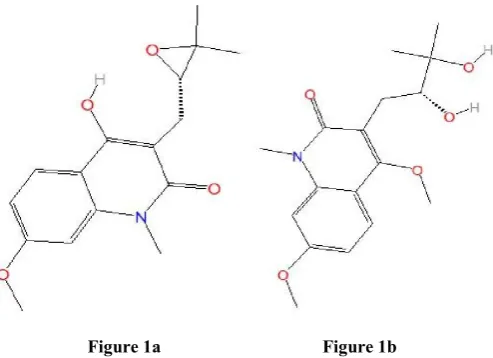
On the basis of NMR analysis, the two unknown compounds identified as derivatives of quinolines which were the compounds of interest in this study were:
N-methyl-4-hydroxy-7-methoxy-3-(2,3-epoxy-3-methylbutyl)-1H-quinolin-2-one
3-(2,3-Dihydroxy-3-methylbutyl)-4,7-dimethoxy-1- methyl-1H-quinolin-2-one
b. Modelling and structure optimization of quinoline derivatives from Toddalia aculeata
The structure of compounds were modelled, based on placement of atoms and groups in the molecule, as determined by the structure obtained, from NMR analysis of the compounds. Sketches, of chemical structures of the models, were used based on the coordinates obtained. (http://www.chemspider.com/Chemical-Structure.21376716. html; http://www.chemspider.com/Chemical-Structure.9870 182.html) The models of structures, prepared using PRODRG
energy minimised structures for the quinoline derivatives were taken. (Figure 1) Quinoline derivatives contained 16 and 17 carbon respectively, with nitrogen in the hetrocyclic ring.
Figure 1a Figure 1b
Figure 1. Quinoline compounds obtained from Toddalia aculeata a) compound1 b) compound 2 Insilico analysis of compounds
obtained from Toddalia aculeate
The coordinates of quinoline derivatives, extracted from
T. aculeata, were taken in their three dimensional (3D) '.pdb'
format. The atomic coordinate information, for the structures of compounds as Ciprofloxacin, Clarithromycin, Prednisolone; were obtained from Drugbank (2014) and their respective three dimensional models were prepared. Metabolic target
(Drugbank, 2014), was obtained from RCSB (PDBID: 1WOE)
(RCSB, 2014), and target coordinates were isolated from the
bound ligands. The structures of ligands and target obtained, were docked based on shape and electrostatics. The rotational conformations, in terms of rotating the Interface Residue away from the z-axis and onto different angular positions (icosahedral tessellation sample points) about each protein's origin, was not restrained, and the single Range Angle criterion for each protein, was kept at 180 degree for both protein and ligands. This was expected, to give most flexible of interaction between the protein and the ligand molecule, and find best optimized structures, from the complexes obtained.
Only angular samples that fall within the Range Angle cone, are used for the docking search. Step size criterion was kept at range 7.5 for both the interacting molecules, and the best docking conformation was taken, from among the 100 atomic conformations of the complex obtained. The optimized structures, thus obtained through docking using HEX (2014), were taken for further analysis. Docked structures obtained, were analyzed for their interactions based on total energy, and non-bonded interactions between receptor and the ligands. Interface interactions based on the interaction energies of the target, with different therapeutically used small molecules and quinoline derivatives obtained from T. aculeata, were taken, compared and discriminated, to find the stability in their interactions. (PEARLS, 2014)
RESULTS AND DISCUSSION
T. aculeata plant samples obtained indigenously were taken,
and compounds from branches extracted and the secondary metabolites, identified and used in this study. Qualitative and quantitative analysis showed the presence of alkaloids, in all different solution extracts, in abundance. Analysis also revealed, presence of two derivatives of quinoline,
a. N-methyl-4-hydroxy-7-methoxy-3-(2,3-epoxy-3-methyl butyl)-1H-quinolin-2-one (metabolite 1)
b. 3-(2,3-Dihydroxy-3-methylbutyl)-4,7-dimethoxy-1- methyl-1H-quinolin-2-one (metabolite 2).
[image:3.595.47.554.565.637.2]Quinoline derivatives are known to offer many pharmacological benefits, due to their anticancer, antimycobacterial, antimicrobial, anticonvulsant, antiinflamatory and cardiovascular activities. The all-atom model of their chemical structures were prepared. The structural models were used, to study their binding properties in comparison to Ciprofloxacin (an antimicrobial carboxyfluoroqu in oline). Ciprofloxacin (C17H18FN3O3) was found to be exhibiting comparable pharmacological properties in comparison to Clarithromycin (C38H69NO13) and Prednisolone (C21H28O5) based on their anti-inflammatoryy effects against Chronic rhinosinusitis (CRS), a nasal inflammation induced by S. aureus Newman.
Table 1. Molecular properties of compounds docked with the energy of optimized ligand-receptor complex
Ciprofloxacin Clarithromycin Prednisolone T. aculeata Metabolite 1 T. aculeata Metabolite 2
Etotal(KJ/mol): -325.11 -372.96 -245.00 -264.41 -238.24
Avg. Mass(Da) 331.341 747.953 360.444 289.326 321.368
Density(g/cm3)* 1.5±0.1 1.2±0.1 1.3±0.1 1.3±0.0 1.3±0.0
H bond donors* 2 4 3 1 2
H bond acceptors* 6 14 5 5 6
Free rotating bonds* 5 12 2 4 7
*Predicted by ACD labs using Percepta Platform - PhysChem Module (Chemspider database)
Docking of compounds to target Cytochrome P450
The metabolites 1 and 2 represented as C16H19NO4 and C17H23NO5 respectively, obtained from T. aculeata were successfully docked with the given target, and they exhibited stable interaction. The energy values were compared, complexes analyzed, and the most stable conformational coordinates were taken for each ligand interacting with the target. (Table 1)
Analysis of Ligand-Receptor complexes
The optimized structures of the ligand-receptor complexes were analyzed, for their intermolecular interactions. (Table 2) Non-bonded interactions were studied, that much affects the stability of interaction, through their contribution to total energy of interactions. Intermolecular hydrogen bonds formed, were found stable. The compounds exhibited favourable van der Waal energy and energetic contribution to total energy, enhanced formation of stable complexes. The conformational flexibility was found to be relatively sturdy as observed, during comparison with conformational entropy, exhibited by the other compounds taken. Their low conformational flexibility is expected to lead to an increase in stability of the complex intramolecular interactions.
Conclusion
The indigenous variety of the plant, T. aculeata from Kolli hills, provide rich source of secondary metabolites, as alkaloids, with ethnomedicinal properties. The compounds extracted, and derivatives of quinolines were identified, from the plant source. Comparative analysis was done for their interactions, with a given target that is actively involved in drug metabolism, with respect to other anti-inflammatory compounds. This comparison, showed stable interactions, as exhibited by the pharmacologically proven anti-inflammatory compounds. This study, indicates the use of quinoline derivatives obtained from T. aculeata, as a possible alternative for treatment of inflammatory diseases. However, the pharmacological properties of these compounds, subjected to further investigation, would advance their use, as an alternate cure for diseases.
Acknowledgement
The resources and support provided for the study by Department of Science and Technology, INDIA at Biomolecular Computation Laboratory, SERC(BIC), IISc, Bangalore is greatly acknowledged.
The support and generosity for carrying out part of the study at Biomolecular Computational Laboratory, SERC, IISc, Bangalore is thankfully acknowledged.
The opportunity provided to undertake the research work by Dept. of Biochemistry, Periyar University, Salem is acknowledged with gratitude.
REFERENCES
Akranth Marella et al. 2013. Quinoline: A versatile heterocyclic; Saudi Pharmaceutical Journal, Vol. 21, Issue 1, Pages 1–12.
Chemspider; chemical structure database., Accessed on: 28/06/2014. url: http://www.chemspider.com/
CSID: 21376716., Accessed on: 25/06/2014. url: http://www. chemspider.com/Chemical-Structure. 21376716.html CSID: 9870182., Accessed on: 25/06/2014. url:
http://www.chemspider.com/Chemical-Structure. 9870182. html
DRUGBANK; Accessed on:22/06/2014.url: http://www.drugbank.ca/(DB00537, DB01211, DBMET 00627)
DRUGBANK; CYP; Accessed on: 24/06/2014.url: http://www.drugbank.ca/biodb/bio_entities/BE0002638 Francis Xavier T, Freda Rose A, Dhivyaa M. 2011.
Ethnomedicinal survey of Malayali tribes in Kolli hills of Eastern Ghats of Tamil Nadu, India, Ind J Trad Knowl., 10(3): 559–562
HEX SERVER; Accessed on: 19/07/2014. url: http://hexserver.loria.fr/
Keerthana G. M. 2014. Optimization of callus induction, phytochemical characterization and anti-inflammatory effect of Toddalia aculeata from Kolli Hills- Tamil Nadu; Doctoral Dissertation, Department of Biochemistry, Periyar University, Salem- 636 011, Tamil Nadu, India., (2014). Nuat Duoc lieu 2012. Quinoline Alkaloids, July 10, Accessed
on: 17/06/2014. url: http://www.epharmacognosy.com/ 2012/07/quinoline-alkaloids.html
PEARLS: Program of Energetic Analysis of Receptor Ligand System, Bioinformatics & Drug Design group (BIDD); Accessed on: 19/07/2014. url: http://ang.cz3.nus.edu.sg/ cgi-bin/prog/rune.pl
PRODRG., The GlycoBioChem PRODRG2 Server., Accessed on: 12/08/2014. url: http://davapc1.bioch.dundee.ac. uk/cgi-bin/prodrg/run.html
RCSB, An Information Portal to Biological Macromolecular Structures., Accessed on: 28/06/2014. url: http://www. rcsb.org/pdb/home/home.do;
Sachse F, C von Eiff, K Becker, C Rudack 2008. Anti-inflammatory effects of ciprofloxacin in S.aureus Newman induced nasal inflammation in vitro, J Inflamm (Lond). 5: 11
Schüttelkopf A W, D M F van Aalten, 2004. "PRODRG: a tool for high-throughput crystallography of protein-ligand complexes", Acta Crystallogr D60, 1355–1363
Senthilkumar K, V Aravindhan, A Rajendran 2013. Ethnobotanical Survey of Medicinal Plants Used by
Malayali Tribes in Yercaud Hills of Eastern Ghats, India.,
Vol. 13, 2.
Stephan Heeb J. et al. 2011. Quinolones: from antibiotics to autoinducers, FEMS Microbiol Rev 35, 247–274, Accessed on: 12/07/2014. url: http://www.ncbi.nlm.nih.gov/ pmc/articles/PMC3053476/
Suresh Kumar, Sandhya Bava and Himanshu Gupta., Biological Activities of Quinoline Derivatives.,
Mini-Reviews in Medicinal Chemistry., Volume 9, Issue 14.,
DOI: 10.2174/138955709791012247.
The Alkaloids, Department of Plant and Environmental Sciences, Weizmann Institute of Science, Accessed on: 18/06/2014. url: http://www.weizmann.ac.il/plants/ aharoni/PlantMetabolomeCourse/June192007.pdf
Toddalia, Accessed on: 22/09/2014., url: http://en.wikipedia. org/wiki/Toddalia.
Ville-Veikko Hynninen 2008. Effects of cytochrome P450 enzyme inhibitors on the pharmacokinetics of nonsteroidal anti-inflammatory drugs and venlafaxine
Zakia Bibi 2008. Role of cytochrome P450 in drug interactions, Nutrition & Metabolism, 5:27 doi:10.1186/1743-7075-5-27