PERFORMANCE EVALUATION OF A VISUAL
CRYPTOGRAPHY USING HALFTONE IMAGES
1
Ms. Simpy Gurditta,
2Mrs.Silvi Thakral
1
Student,
2Faculty, Department of Computer Science and Engineering,
MITM, Jevra, Hisar (India)
ABSTRACT
Visual Cryptography is a secret sharing scheme which uses images distributed as shares such that, when the shares are superimposed, a hidden secret image is revealed. In extended visual cryptography, the shares images are constructed to contain meaningful cover images, thereby providing opportunities for integrating visual cryptography and biometric security techniques. In this paper, we propose a method for processing halftone images that improves the quality of the shares images and the recovered secret image in an extended visual cryptography scheme for which size of the shares images and the recovered image is the same as for the original halftone secret image. The resulting scheme maintains the perfect security of the original extended
visual crypto grapy approach.
Keywords: Cryptography, Image Processing, Visual Cryptography, Secret Sharing.
I. INTRODUCTION
Visual Crypto grapy (VC), first proposed in 1994 by Nair and Shamir [1],is a secret sharing scheme, based on
black-and-white or binary image. Secret image are divided into sharing images which on their own, reveal no
information of the original secret. Shares may be distributed to various parties so that only by collaborating with
an appropriate number of other parties, can the resulting combined shares reveal the secret image. Recovery of
the secret can be done by superimposing the share images and hence, the decoding process requires no special
hardware or software and can be simply done by the human eye. Visual cryptography is of particular interest for
security applications based on biometrics [2]. For example, biometric information in the form of facial,
fingerprint and signature images can be kept secret by portioning into shares, which can be distributed for safety
to a number of parties. The secret image can then recovered when all parties release their share images which
are then recombined. A basic 2-out-of-2 or (2, 2) visual cryptography scheme produces 2 share images from an
original image and must Stack both shares to reproduce the original image. More, generally a (k,n) scheme
produces n shares, but only requires combine k shares to recover the secret image. To preserve the aspect ratio
for the recovered secret image for a (2, 2) scheme each pixel in the original image can be replace din the
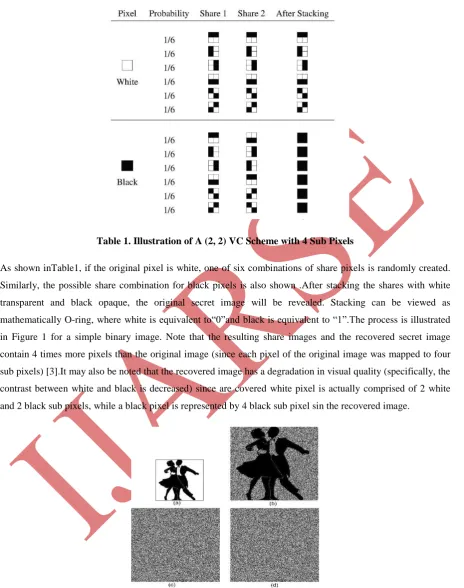
Table 1. Illustration of A (2, 2) VC Scheme with 4 Sub Pixels
As shown inTable1, if the original pixel is white, one of six combinations of share pixels is randomly created.
Similarly, the possible share combination for black pixels is also shown .After stacking the shares with white
transparent and black opaque, the original secret image will be revealed. Stacking can be viewed as
mathematically O-ring, where white is equivalent to“0”and black is equivalent to “1”.The process is illustrated
in Figure 1 for a simple binary image. Note that the resulting share images and the recovered secret image
contain 4 times more pixels than the original image (since each pixel of the original image was mapped to four
sub pixels) [3].It may also be noted that the recovered image has a degradation in visual quality (specifically, the
contrast between white and black is decreased) since are covered white pixel is actually comprised of 2 white
and 2 black sub pixels, while a black pixel is represented by 4 black sub pixel sin the recovered image.
Fig 1 Example Of A (2,2) VC Scheme With 4 Sub Pixels.(A) Secret Dancers Image,(B) Reconstructed
It is also obvious that, while the shares appear to be random (and , in fact, can be shown to contain no
informational content that can be used to recover the original secret image on their own), the shares also have no
interesting content that could be used to carry other information (such as biometric image) that might be helpful
in a security context. For example, if a share image could be selected to be the fingerprint of the share folder,
this could be useful in authenticating a user’s right to hold that share when the parties meet to combine their
share image to reveal the secret. In 1996, Ateniese Blonde and Stinson [4] proposed extended visual
cryptography (EVC) schemes that can construct meaningful share images. The (2, 2) EVC scheme proposed in
[4] required expansion of one pixel in the original image to 4 pixels which can then be selected to produce the
required images for each share. It can be shown that the resulting scheme is, in fact, also perfectly secure, and in
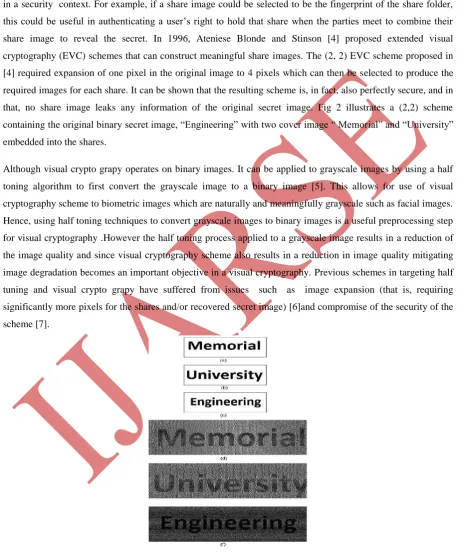
that, no share image leaks any information of the original secret image. Fig 2 illustrates a (2,2) scheme
containing the original binary secret image, “Engineering” with two cover image “ Memorial” and “University”
embedded into the shares.
Although visual crypto grapy operates on binary images. It can be applied to grayscale images by using a half
toning algorithm to first convert the grayscale image to a binary image [5]. This allows for use of visual
cryptography scheme to biometric images which are naturally and meaningfully grayscale such as facial images.
Hence, using half toning techniques to convert grayscale images to binary images is a useful preprocessing step
for visual cryptography .However the half toning process applied to a grayscale image results in a reduction of
the image quality and since visual cryptography scheme also results in a reduction in image quality mitigating
image degradation becomes an important objective in a visual cryptography. Previous schemes in targeting half
tuning and visual crypto grapy have suffered from issues such as image expansion (that is, requiring
significantly more pixels for the shares and/or recovered secret image) [6]and compromise of the security of the
scheme [7].
Fig 2. Example Of (2,2) EVC Scheme (A) First Cover Image,(B) Second Cover Image,(C) Secret
The objective of their search out lined in this paper is to derive a secure (2,2)extended visual crypto grapy scheme, which does not require more pixels in the shares and recovered image than the original secret image
and yet preserves good quality image for both the shares and the recovered image. Our proposed scheme
maintains the perfect security of the basic EVC scheme [4].
II. PREPOSING HALFTONE IMAGES
In this section, we consider the application of visual crypto grapy to gray scale images by first converting the
images to a binary image using a half toning algorithm. After creating a half tone image, in order to preserve the
image size when applying visual crypto grapy and extended visual cryptography, simple method scan be
applied. For example, a basic, secure method that is easy to implement is based on a block-wise approach to
pre-processing the binary half tone image prior to applying visual crypto grapy [8]. In this paper, were far to this
basic approach as simple block replacement (SBR).The SBR scheme considers groups of four pixels from the
half tone secret image in one2×2 block, referred and block and generates the shares block by block (rather than
pixel by pixel).As each secret block with four pixels encodes in to two secret shares each containing four pixels,
the size of there - constructed image is the same as the original secret image after stacking the two shares
together. In this technique, all the secret blocks in an image need to be processed before visual cryptography
encoding and each secret block is replaced by the corresponding predetermined candidate, which is a block with
4 white pixels (a white block) or a block with 4 black pixels(a black block).
The block replacement process in the SBR pre-processing scheme is based on a number of black and white
pixels in each secret block. If the number of black pixels in a secret block is larger than or equal to 2, the secret
block converts to a black block. If the number of black pixels in a secret block is less than or equalto1, it is
converted to a white block. This step produces a new secret image which contains only white and black blocks.
The image obtained from this step is referred to as a processed secret image. The processed image is now ready
to be used as a secret image in visual crypto grapy scheme and secret additional VC or EVC.
The SBR approach is straight forward and is very effective for unprocessed binary secret images which have
large numbers of all white and all black blocks. However, for halftone images, with high variability in the
distribution of black and white pixels within each secret block, the resulting processed secret image is generally
poor, being darker than the original image, with poor contrast, causing the loss of many fine detail sin the
images. In our experiments applied to EVC, we shall see these effects in Figure5.
III. AN IMPROVED PRE-PROCESSING SCHEME
We now present a novel and effective method for replacing the candidate blocks of a half tone secret image,
which we refer to as the balanced block replacement (BBR) method. The novel as pectin is approach is to
perform the block replacement such that there is a better balance of white and black in the processed secret
as candidate blocks. In the BBR approach, we balance white and black in the processed image by assigning
some candidate blocks to black and others to white. Although we have discovered that doing the candidate block
assignment randomly to black or white improves the visual quality of the processed secret image, even better
visual results can be achieve during an intelligent block replacement approach that considers the characteristic
so the original image in determining whether a candidate block should be assigned to black or white. The block
replacement approach proposed here tries to keep the local ratio of black to white pixels in the processed image
close to the local ratio of black to white pixels in the original half tone secret image. Therefore, the resulting
recovered image is closer in quality to the original gray scale image.
3.1 General Description of Scheme
The preparation of a gray scale image for use in visual crypto grapy in voles 3 steps. The first step is the
transformation of a gray scale image into a half tone image and portioning the half tone image in to non-over
lapping blocks of 2×2pixels. Then, the half tone image is divided into a number of over lapping squares of four
2×2 blocks. Each grouping of 4 blocks is referred to as a cluster. In the second step, the number of black pixels
in each cluster from the half tone image are counted and saved in a template. This number is the threes hold
value for that cluster. The step then classifies all the secret blocks containing 1 black (resp. white) pixel. If the
secret block contains1black (resp. white) pixel, it is converted to a white (resp. black) block. The image obtained
from this step is referred to as the initial processed image.
The third step starts from the first block in the top left of the first cluster of the initial processed image. The
processing of the blocks in each cluster starts from the top left block, and then moves from left to right and top
to bottom in raster for- mat. When the first candidate block in a cluster is identified, the numbers of black pixels
in the cluster are counted. The idea is to keep the number of black and white pixels in each cluster of the initial
processed image as close as possible to the corresponding threshold value from the cluster of the original half
tone image. Therefore the number of black pixels in the case of changing the candidate block to a black or white
block is computed and is compared to the threshold value that was derived for the same cluster in the original
half tone image. If the corresponding candidate block converts to a black block, 2 pixels will be added to the
number of black pixels in a cluster and if the candidate block turns to white block,2
Black pixels will be deducted from a cluster. The conversion is based on the smallest difference between the
thres hold and the number of black pixels in the image being processed. If changing the candidate blocks to
black makes this difference smaller, the candidate block is converted to a black block. Similarly, if turning the
candidate block is converted to a black block. Similarly, if turning the candidate block to white makes this
difference smaller, the block converts to a white block. In the case that turning the candidate to black or white
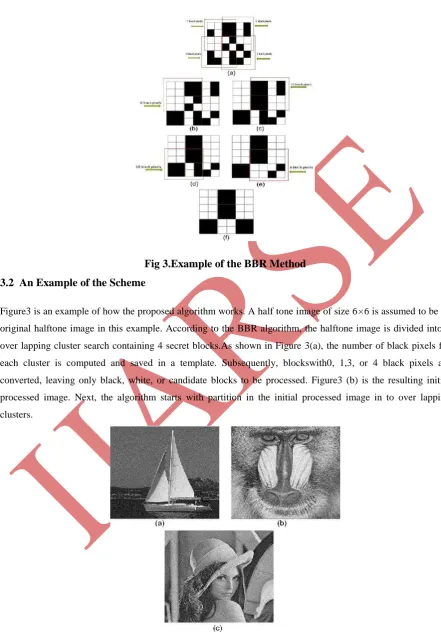
Fig 3.Example of the BBR Method
3.2 An Example of the Scheme
Figure3 is an example of how the proposed algorithm works. A half tone image of size 6×6 is assumed to be an
original halftone image in this example. According to the BBR algorithm, the halftone image is divided into 4
over lapping cluster search containing 4 secret blocks.As shown in Figure 3(a), the number of black pixels for
each cluster is computed and saved in a template. Subsequently, blockswith0, 1,3, or 4 black pixels are
converted, leaving only black, white, or candidate blocks to be processed. Figure3 (b) is the resulting initial
processed image. Next, the algorithm starts with partition in the initial processed image in to over lapping
clusters.
Figure3 (b) illustrates the first cluster in an initial image; this clustercontains1candidate block and 6 black
pixels. According to the algorithm, the thres hold value is 7 forth is cluster and we want to replace the candidate
block in a way that the number of black pixels in the cluster will be very close to 7. It is obvious that if we
change the block to a black block, the number of black pixels will be 8 and if we turn it to a white block, the
number of black pixels in this cluster will reduce to 4.Therefore; the block will be replaced with a black block.
This procedure is repeated for the next 3clustersandthefinal processed image is shown in Figure 4
IV. APPLICATION TO EXTENDED VC
As previously noted, an extended VC scheme adds a meaningful cover image in each share. Although image
expansion is necessary to exactly preserve the information from the pixels of the original secret image in the
recovered secret image, we can use either the basic preprocessing scheme, SBR of section 2 or the more
advanced BBR method of section3 to ensure that the share and recovered image use the same number of pixels
as the original halftone secret image. Of course, the trade off in such an approach is a decline in image quality.
In this section, we examine the application of the preprocessing schemes to construct a (2, 2) EVC scheme
without image size expansion. In doing so, we take three halftone images as inputs. The first two image are
considered to be meaningful cover images and third image is the secret image. One of the block replacement
algorithms converts the three input images into the processed images. A processed image contains white and
black block sand can be used as an input secret image in any visual cryptography encoding process. After
producing the three processed images by appropriate method. The two shares are generated according to the
EVC encoding process specified in [4]. The secret image is recovered by stacking the two shares together. It
should be noted that our non-expansion EVC scheme is as secure as the scheme introduced in [4]. As the new
scheme does not change the share generation approach.
In order to check the validity of the proposed scheme and also evaluate the effects of the block replacement
algorithms on the visual quality of the cover images and the recovered image, we have conducted a visual
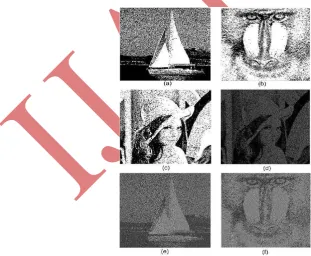
experiment. As depicted in Figure4,the half tone boat and the half tone baboon, both of size 512×512, are
consider red to be two cover images and halftone Lena with the same size as the cover images is assumed to be
a secret image. These halftone images are created from the original gray scale images using the Floyd-Steinberg
half toning technique [5].
Figure5 shows the results of using the SBR pre-processing method in an EVC scheme. As expected, the and
there covered secret image have the same size as the original halftone images; however, compared with the
original halftone images, the shares and the recovered image have a visual quality that is very poor with a severe
darkening effect.
Figure 6 demonstrates the effect of using the BBR method in the EVC scheme. A significant improvement can
be observed in the visual quality of the two shares and reconstructed image in comparison to the SBR method.
For example, in the recovered secret image, Lena, improved detail in the hair is clearly visible in Figure6 (d)
Figure6(e),in comparison to the result for SBR of Figure5(e).Similarly, the share image of the baboon shows
improved clarity around the eyes for the BBR result versus the SBR result.
Fig 5 Experimental Results Of SBR Method Applied To EVC: (A) Processed Boat, (B)Processed
Baboon,(C) Processed Lena,(D) Reconstructed Lena,(E) First Cover Image,(F) Second Cover Image.
Fig 6: Experimental Results Of EVC With BBR Method Applied To EVC(A) Processed
Boat,(B)Processed Baboon,(C) Processed Lena,(D) Reconstructed Lena,(E) First Cover Image,(F) Second
V. CONCLUSION
In this paper, we have explored extended visual cryptography without expansion. We have shown that using an
intelligent preprocessing of halftone images based on the characteristics of the original secret image, we are
unable to produce good quality images in the shares and the recovered image. Note that other applications can
also benefit from the preprocessing approach, such as multiple image visual cryptography which hides multiple
images in shares [9].
REFERENCES
[1] M. Naor and A. Shamir, “Visual crypto grapy”, in EU- ROCRYPT’94Proceedings, Lecture Notesin
Computer Science, Springer-Verlag, vol.950, pp. 1-12,1995.
[2] A. Ross and A.A. Othman, “Visual Crypto grapy for Biometric Privacy” IEEE Transactions on
Information Forensic sand Security, vol.6, no. 1, pp. 70-81,2011.
[3] N. Askari, C. Moloney and H.M. Heys, “A Novel Visual Secret Sharing Scheme Without Image Size
Expansion”, IEEE Canadian Conference on Electrical and Computer Engineering (CCECE), Montreal,
pp.1-4,2012.
[4] G. Ateniese, C. Blundo, A. De Santisand D.R. Stinson, “Extended Capabilities for Visual Crypto grapy”,
theoretical Computer Science, vol.250, pp.143-161,2001.
[5] R.W. Floyd and L. Steinberg ,“An Adaptive Algorithm for Gray Scale .In proceeding of the society for
information Display, vol.17, no.2 pp 75-77, 1976.
[6] Z. Zhou, G.R. Arce, and G. Di Crescenzo, “Halftone Visual Crypto grapy”, IEEE Transactions on Image
Processing, vol. 15, no. 8, pp. 2441-2451,2006.
[7] M. Nakajima and Y. Yamaguchi, Extended Visual Crypto grapy for Natural Images, in Proceedings of
WSCG, pp. 303-310, 2002.
[8] C.L. Chou, “A Watermarking Technique Based on Non- expansible Visual Cryptography”, Thesis,
Department of Information Management, National University, Tai- wan, 2002.
[9] C.C. Wu and L. H. Chen, “A Study on Visual Crypto grapy”, Thesis, Institute of Computer and