© 2014, IJCSMC All Rights Reserved 336 Available Online atwww.ijcsmc.com
International Journal of Computer Science and Mobile Computing
A Monthly Journal of Computer Science and Information Technology
ISSN 2320–088X
IJCSMC, Vol. 3, Issue. 3, March 2014, pg.336 – 343
RESEARCH ARTICLE
GENERATION OF SECURITY TEST
TO FIND INJECTION ATTACKS BY
CODE REVIEW
N. Parthiban
1, R. Ravi
2, Dr. Beulah Shekhar
3 1PG Scholar, Department of Network Engineering, Francis Xavier Engineering College, Tirunelveli, Tamil Nadu State, India
2
Professor & Head, Department of Computer Science and Engineering, Francis Xavier Engineering College, Tirunelveli, Tamil Nadu State, India
3
Associate Professor, Department of Criminology and Criminal Justice, Manonmaniam Sundaranar University, Tirunelveli, Tamil Nadu State, India
1
[email protected], 2 [email protected], 3 [email protected]
Abstract- Security Testing is much important in Software Development to find the vulnerabilities while developing the product. In this paper I presented a method to find the injection vulnerabilities. Vulnerability is a security weakness or it is a hole in the product which is not fixed while developing the software. Normally Hackers hack the software by finding these vulnerabilities and cause data loss or severe damage to the entire product. Injection is one of the most dangerous attacks among much vulnerability which is placed in number one in the top 10 web application vulnerabilities by OWASP. This paper presents how to find these vulnerabilities using Code Review Testing technique. These implementations are used for only educational purpose. It is a crime if you apply these to any website without getting any permission from the owner. If crime is proved, he will be punished under Information Technology (Amendmen) Act, 2008, Section 43(a) read with section 66 is applicable.
Keywords: Injection; Security Testing; SQL Injection; HTML Script Injection; Dynamic Evaluation Injection
I.
INTRODUCTION
1.1 Injection
© 2014, IJCSMC All Rights Reserved 337
The injection attacks classified into the following types, they are,
o SQL Injection
o HTML Script Injection
o Dynamic Evaluation Injection
o Remote File Injection
These are the attacks which happen when the attacker sends malicious input to the application. The vulnerability in the code has been identified by supplying the malicious input to the code by tester. The behavior of the code will be monitored based on the output of the application. Normally the code would execute when the tester sends the actual input. But the code also executes the malicious input too. Based on the malicious input, the execution of the application causes damage to the entire application.
SQL Injection - SQL Injection happens when the code generates the dynamic SQL Query. Dynamic SQL
queries are generated when the user enters the input at run time. Instead of correct input, when the user enter the malicious input the dynamic query executes the malicious operation. It causes data loss or severe damage to the application. This vulnerability is easily identified by monitoring the dynamic generation of SQL code.
HTML Script Injection - Web browsers parse the HTML Script and provide the output as document page
from the web server. The web server provides the HTML page as requested from the user. The user can click the HTML Link to go to the other page. The hackers put the HTML code which cause malicious operation into the application. When the victim clicks the link, their Session ID might be stolen.
Dynamic Evaluation Injection - Many operations works based on the input given by the user at run time.
But what happens when the attacker gives the unauthorized malicious input to the operation which makes the evaluation dynamically?
Remote File Injection - Remote File Injection is implemented by the attacker by modifying the original file with the malicious file in the Web application.II.
METHODS
Many Techniques used to find the Vulnerabilities in the Web Applications. They are,
i. Manual Process ii. Thread Model iii. Code Review iv. Penetration Testing
© 2014, IJCSMC All Rights Reserved 338
III.
IMPLEMENTING INJECTION ATTACKS
First of all, we need a web application to implement those attacks. So I created the E-Banking Web Application. Fig.1 shows the operations of the E-banking Web Application.
Fig1 E-Banking Web Application
By using Code Review Testing Technique, we have to analyze the source code for the vulnerabilities. Code Review technique is applied while developing the software product.
3.1 FINDING SQL INJECTION VULNERABILITY
Mostly many web applications have the authentication to the users for accessing those services. Our application also has the authentication to allow only the registered users. For example, In Fig 2, our code for the authentication is as follows,
Fig 2 Dynamic Generation of SQL Query
© 2014, IJCSMC All Rights Reserved 339
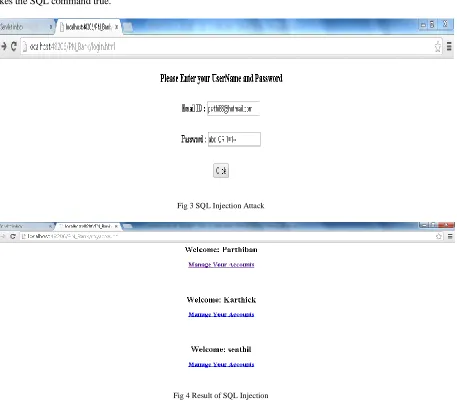
Because 1=1 is always true. The operation is done by the „OR‟ SQL Command. It is the logical operation which makes the SQL command true.
Fig 3 SQL Injection Attack
Fig 4 Result of SQL Injection
In Fig 4, While executing the username „[email protected]‟ with the password „abc‟ OR 1=1--‟, the code displays all the users from the database.
3.2 Finding Html Script Injection
© 2014, IJCSMC All Rights Reserved 340 Fig 5 Review Page
From this, the attacker sends the malicious link with the fascinating title like „Offer‟ and Hurry. If the victim clicks the link, the malicious page could steal the session ID or do any other harmful operations to the victim.
Fig 6 HTML Script Injection
Fig 6 shows one message to the victim from the review page. When the victim clicks the „More Details....‟ he dragged to the malicious website to steal the session id.
Fig 7 Result of HTML Script Injection
© 2014, IJCSMC All Rights Reserved 341
3.3 Dynamic Evaluation Injection
When the application calculates the output at the runtime, the attacker can send their own input to make the
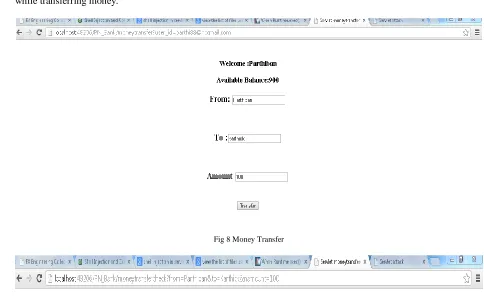
malicious operations. For example, when our E-Banking Web Application sends the money from one user to another user, the attacker can modify which user can send and which user can receive. Fig 8 shows the Dynamic Evaluation while transferring money.
Fig 8 Money Transfer
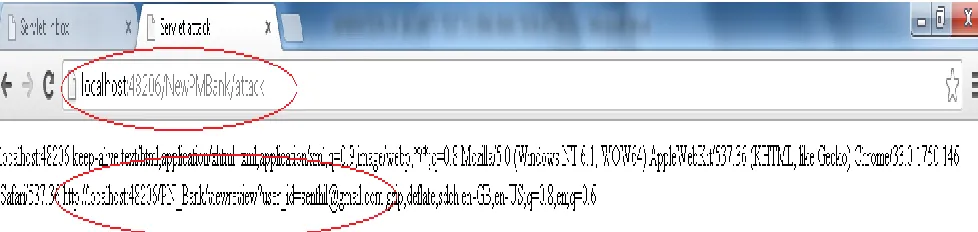
Fig 9 HTTP Request shows the operation.
In Fig 9, The address bar from the browser shows the internal operation and the variables used for operation. This is flaw from bad coding. Because when we send the sensitive information from the browser to server, we should not use the HTTP GET method.
Now the attacker can get the link from the browser History, and modifies the sender or receiver from the browser address bar. If the attacker modifies the sender from „Parthiban‟ to „Senthil‟ this application still works and sends the money 100 from Senthil to Karthick. We don‟t need to know the Senthil Account Password, but we must know the account name of the sender. Fig 10 shows the result of Dynamic Evaluation Injection
© 2014, IJCSMC All Rights Reserved 342 3.4 Finding Remote File Injection Vulnerability
When the server sends the file to the client through HTTP Protocol, Remote File Injection is Possible. In our E-banking Example, our Branch addresses are stored in file. When the client tries to access the branch address, the html file which contains the address has sent to the client.
Fig 11 Reason for Remote File Injection
In Fig 11 , the browser address bar contains the file name „branchoffice.html‟ which is going to execute when the user clicks the „Other Branches‟ link. The attacker uses this link and uses his own file which is going to execute in the server. Fig 9 shows the result of File Injection Vulnerability.
Fig 12 Result of Remote File Injection
The attacker uses his own file „http://localhost:48206/NewPMBank/serveraccess‟ to execute into the E-Banking Server. Fig 12 shows the result of Remote File Injection.
IV.
CONCLUSION
© 2014, IJCSMC All Rights Reserved 343
REFERENCES
[1] Dianxiang Xu, Michael Sanford, Lijo Thomas, Daniel Woodraska and Weifeng Xu “ Automated Security Test Generation with Formal Threat Models” IEEE Trans. On Dependable and Secure Computing, Vol.9, No.4, July/August 2012
[2] Elizabeth Fong and Vadim Okun “ Web Application Scanners: Definitions and Functions” Proc. Of 40th Inter. Conf. 2007
[3] Chia-Mei Chen, Wan-Yi Tsai and Hsaio-Chung Lin “Anomaly Behavior Analysis for Web Page Inspection” Intr. Conf on Networks & Communications 2009
[4] Avinash Kumar Singh and Sangita Roy “ A Network Based Vulnerability Scanner for Detecting SQLI Attacks in Web Applications Int‟l Conf On Recent Advances in Information Technology RAIT 2012
[5] https://www.owasp.org/index.php/Main_Page
[6] https://www.owasp.org/index.php/Category:OWASP_Top_Ten_Project
[7] http://www.csi-india.org/
ABOUT THE AUTHORS
N. Parthiban was born in 1988. He is currently a student of Francis Xavier College of engineering and technology, Tirunelveli. He is doing his masters in Network engineering. He received his bachelors in Computer Science and Engineering from Shri Andal Alagar College of engineering and technology in 2010. His area of interest is network security and his subject of interest is Security Testing.
R. Ravi is an Editor in International Journal of Security and its Applications (South Korea). He is presently working as a Professor & Head and Research Centre Head, Department of Computer Science and Engineering, Francis Xavier Engineering College, Tirunelveli. He completed his B.E in Computer Science and Engineering from Thiagarajar College of engineering, Madurai in the year 1994 and M.E in Computer Science and Engineering from Jadavpur Government research University, Kolkatta. He has 18 years of experience in teaching as Professor and Head of department in various colleges. He published 12 International Journals, 1 National Journal. His areas of interest are Virtual Private networks, Networks, Natural Language Processing and Cyber security.