Available Online atwww.ijcsmc.com
International Journal of Computer Science and Mobile Computing
A Monthly Journal of Computer Science and Information Technology
ISSN 2320–088X
IJCSMC, Vol. 4, Issue. 5, May 2015, pg.598 – 607
RESEARCH ARTICLE
Implementation of DSSS System using Chaotic
Sequence using MATLAB and VHDL
Ambika
1, Vanita Kaba
2¹ECE Department & GECW, Visveswaraya Technological University, India ²ECE Department & Godutai Engineering College for Women, India
1 [email protected]; 2 [email protected]
Abstract— In spread spectrum systems, pseudo-random (PN) sequences are used to spread the data bits. There are various type of PN sequences are available with good correlation properties, most of which are generated by Linear Feedback Shift Register (LFSR). In this paper we describe the generation pseudo chaotic sequences (PCS) and conventional PN sequences and its correlation properties. Here, pseudo-chaotic sequences are generated with different initial values and its autocorrelation, cross correlation properties evaluated. The BER performance of PCS sequence is compared with the conventional PN sequences. DSSS system is implemented both in MATLAB and VHDL language.
Keywords— ―Chaos‖, ―Chaotic system‖, ―Spread spectrum‖, ―Correlation‖, ―BER‖
I. INTRODUCTION
In telecommunications and radio communication spread-spectrum (SS) techniques are the methods by which a signal generated with a particular bandwidth is deliberately spread in the frequency domain, resulting in a signal with a wider bandwidth. The band spread is accomplished by utilizing a “code” called binary pseudo noise (PN) sequence which is independent of the data and a synchronized reception with the code at the receiver is used for de-spreading and data recovery.Spread spectrum techniques provides high security and susceptibility to interference from other parties. Now a day spread spectrum techniques are being used in variety of commercial applications such as mobile and wireless communication. Performance of direct sequence spread spectrum (DSSS) system depends on the spreading sequence used [1]. Spreading sequences used should have minimum cross correlation and very good auto correlation properties. Most commonly used PN sequences are m-sequence and gold sequence.The ability to predict future sequence is nevertheless possible though difficult. Therefore transmission is not completely secured. The number of sequences generated by linear feedback shift registers (LFSR) may be insufficient for wideband ds-ss with
a very large number of users. In addition,
LFSR techniques provide limited flexibility in incorporating security into multiple user systems. The use of chaotic sequences as spreading sequence is because of its sensitivity to initial conditions and has characteristics similar to random noise.
Section II explains chaotic sequence. Section III describes the proposed system. Section IV explains results obtained and section V gives the conclusion.
II. CHAOTICSEQUENCE
dependence upon its initial condition and parameter. Chaotic signals can be used in communication. Chaotic sequences have been adopted instead of random ones and very interestingly used in many applications such as secure transmission, natural phenomena modeling, neural networks, and nonlinear circuits. Also in, chaotic time series were used in DNA computing procedures. The choice of chaotic sequences is justified theoretically by their unpredictability, i.e., by their spread-spectrum characteristic.
III.PROPOSEDSYSTEM
Chaotic system or chaos is behaviour between rigid regularity and randomness based on pure chance. Chaotic systems provide a rich mechanism for signal design and generation, with potential applications to communications and signal processing [3]. Because chaotic signals are typically broadband, noise-like, and difficult to predict, because of long periodicity, it provides very high security and is capable of handling many users .The highlight of this paper is the PCS Generator, which generates a pseudo-chaotic PN sequence with good cross-correlation and auto-correlation properties that is well suited for DS-SS system [3].
A. DSSS System
The most common type of spread spectrum that is used nowadays is Direct Sequence Spread Spectrum
(DSSS) because of its simplicity and ease of implementation. The major spread spectrums differ in a way they
encode with PN sequence. In DSSS, information that has to be transmitted is divided into small pieces; each of
this is allocated to a frequency channel across the spectrum.
In DSSS system the message bits are multiplied by spreading codes to obtain spreaded signal.
Spreading the message provides security for transmitting signal making it difficult to demodulate for the
unknown user who is unknown of spreading code. This spreaded signal is modulated and transmitted. The
transmitted signal is demodulated and despreaded using spreading sequence to recover original sequence
.
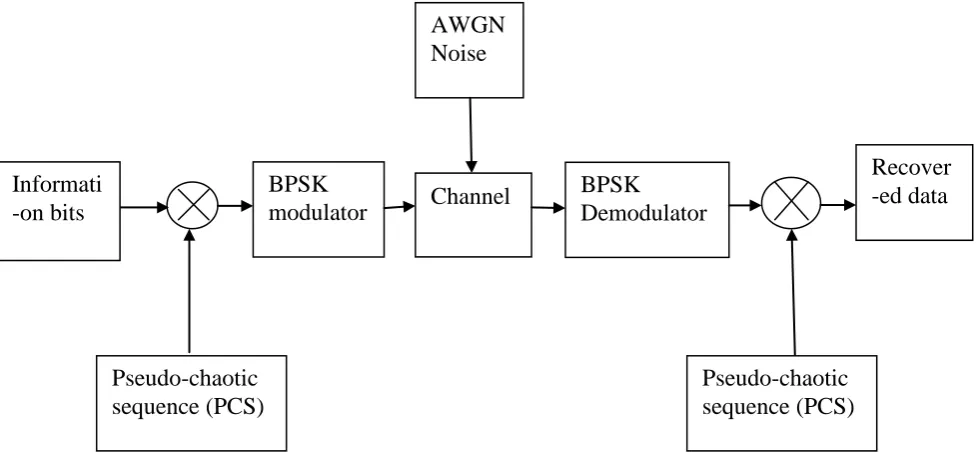
Thefunctional blocks of a DSSS communication system are illustrated in fig 1. The information bits are divided into
small pieces and each of them is allocated a frequency channel across the spectrum. These information bits are
then multiplied by pseudo-Chaotic sequences to obtain spreaded sequence. The spreaded sequence occupies
wide bandwidth. The spreaded sequence is BPSK modulated and transmitted via channel. The channel is
modeled as an AWGN channel. The demodulator performs the reverse operation and extracts the information
bits from the received modulated signal which is corrupted by the noise. The demodulator produces the
sequences that are the estimates of the information bits.
B. BPSK modulation and demodulation
BPSK modulation is widely used in DSSS system because of its simplicity and it is most robust of all
PSK techniques. It uses two phases 00 and 1800. In order to generate BPSK signal binary sequence must be represented in polar form. The BPSK modulation and demodulation is illustrated in fig 2 and 3 respectively. The
BPSK modulator circuit is very simple. The binary sequence is multiplied sinusoidal signal to obtain BPSK
signal.
Fig 2 BPSK modulator
In the receiver part, the BPSK modulated signal is multiplied by sinusoidal signal and then it is passed
through integrator and decision circuit to obtain message signal.
Fig 3 BPSK demodulator
C. PCS Generation
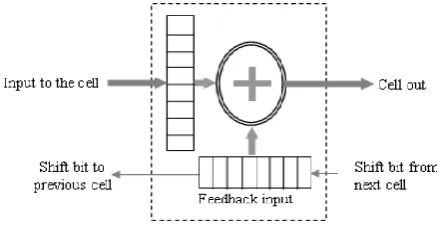
Basic NLFSR cell consist of two 8 bit programmable register and a xor gate. The contents of registers
are xored to obtain cell out.
Fig 4 Basic NLFSR cell
Binary PSK
signal
Oscillator(sin2πft
Spreaded
signal
Product
modulator
Oscillator
(sin2πf
ct)
BPSK
signal
Product
modulator
Integrator
Decision
circuit
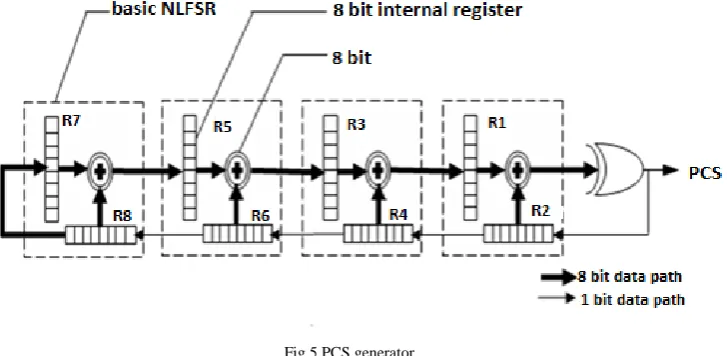
PCS generator consists of a cascade of four basic cells with two 8-bit programmable registers each.
Each of the register is loaded with initial contents. Contents of R7 and R8, R5 and R6, R4 and R3, R1 and
R2 are xored. If the xor of R1 and R2 have even number of 1’s then PCS is 1 else it is 0. The generated PCS
is fed to feedback register. For each iteration the feedback register are shifted one place to the left. Any
length of sequence can be obtained using this architecture.
Fig 5 PCS generator
IV.RESULTS The following results are obtained with given below initial conditions:
First initial conditions R1=1 1 1 1 1 1 1 0 R2=1 1 1 1 1 1 0 1 R3=1 1 1 1 1 1 0 0 R4=1 1 1 1 1 0 1 1 R5=1 1 1 1 1 0 1 0 R6=1 1 1 1 1 0 0 1 R7=1 1 1 1 1 0 0 0 R8=1 1 1 1 0 1 1 1
Second initial conditions R1=1 1 1 1 1 1 1 0 R2=1 1 1 1 1 1 0 1 R3=1 1 1 1 1 1 0 0 R4=1 1 0 0 1 0 1 1 R5=1 1 1 1 1 0 1 0
R6=1 1 1 1 1 0 0 1 R7=1 1 1 1 1 0 0 0 R8=1 1 1 1 0 1 1 0
A. MATLAB simulation results
0 5 10 15 20 25 30 35 -1
0 1
pcs sequence generated using first initial condition
0 5 10 15 20 25 30 35 -1
0 1
pcs sequence generated using second initial condition
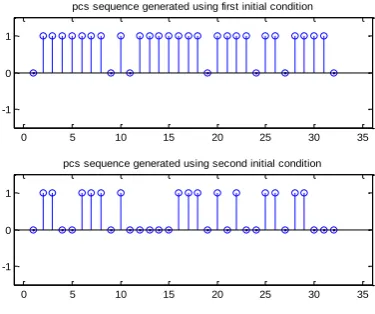
Fig 6 PCS generated by taking two diferent initial conditions
Autocorrelation is obtained by taking product of a sequence and its shifted version. Fig 7 shows the autocorrelation plot obtained by PCS. It can be seen that the correlation has maximum value at the origin and its minimum at all other places. Hence the autocorrelation is good.
Fig 7 Autocorrelation of PCS
Maximum length (M) sequence and Gold sequences are mostly used PN sequences. They have properties similar to that of white noise. They lack security due to the fact that they are available in limited number. PCS overcome this advantage of PN sequences because of its sensitive nature to initial condition. Fig 8 shows the different sequences obtained by MATLAB simulation.
Fig 9 shows the comparison of autocorrelation of PCS, m-sequence and gold sequence. It can be seen that all the sequences have maximum value at 0. But PCS have minimum value at all other places compared to other PN sequences. Hence PCS has best autocorrelation property.
Fig 9 MATLAB simulation showing autocorrelation plots of different sequences
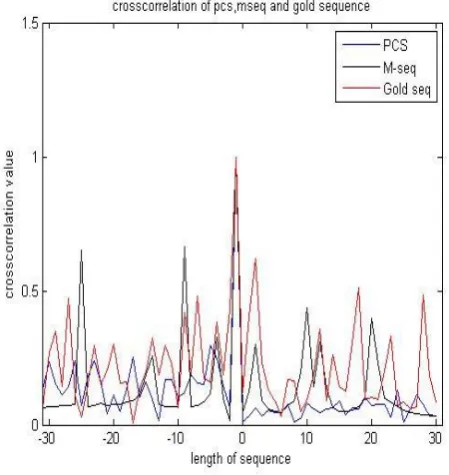
Fig 10 shows the comparison of the cross correlation of different sequences. It can be seen from the graph that PCS have minimum cross correlation compared to conventional PN sequences.
Fig 10 MATLAB simulation showing cross correlation plots of different sequences
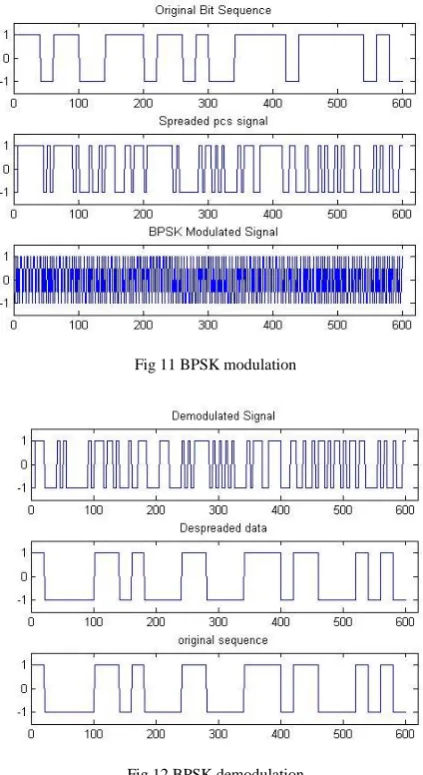
Fig 11 BPSK modulation
Fig 12 BPSK demodulation
Fig 13shows the BER simulation results of various sequences. PCS have improved BER than other sequences.
B. VHDL Simulation Results
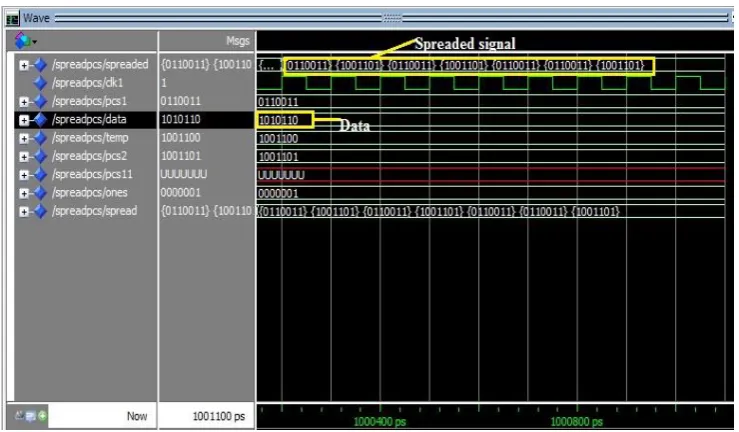
The results obtained by implementing DSSS system using VHDL are shown in this section. Fig 14 and 15 shows PCS generated by different initial condition and fig 16 shows the spreaded signal.
Fig 14 PCS obtained using first initial condition
Fig 15 PCS obtained using second initial condition
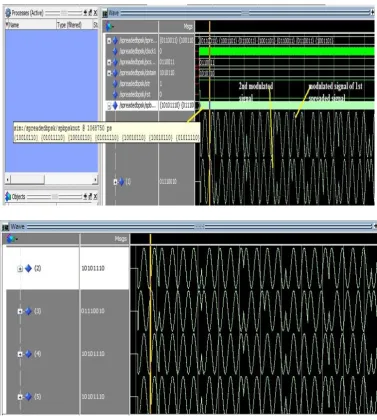
Fig 17 shows the BPSK modulated and demodulated signal.
Fig 17 BPSK modulated and demodulated signal
V. CONCLUSION
The PCS generator in this paper is sensitive to initial conditions and can be randomly selected to produce pseudo-chaotic sequence with good correlation properties. Large number of PCS can be generated using same amount of memory when compared to conventional PN sequences. Pseudo-chaotic PN sequences proved better correlation properties than conventional m-sequences and hence can be used for DS-SS. They provide an high level of security and low-probability of interception. BER of PCS have improved performance than the gold and M-sequence. DSSS system is easily implemented using both MATLAB and VHDL language.
REFERENCES
[1] Implementation of chaos on DSSSS by don terrori
[2] Analysis of chaotic sequence as an alternative to pseudo-random in ds-cdma Sneha Venkateswar, Gargi Rajadhyaksha, Jinal Shah
[3]An FPGA Implementation of a Pseudo-Chaotic Direct Sequence Spread Spectrum (DS-SS) Communication System by Mahalinga V. Mandi ∗, Ramesh S, Santhosh Kulal, Santosh Kumar S, Dileep D, Yajnesh Padiyar Dept. of E & C Engg, Dr. Ambedkar Institute of Technology, Bangalore, Karnataka, India
[5]Chaotic Spread-Spectrum Communication Using Discrete-Time Synchronization Wang Hai and Hu
Jiandong (Department of Telecommunications Engineering, Beijing University of Posts and
Telecommunications, Beijing 100088, P. R. China)
[7] G.Heidari-Bateni, C.D.McGillem: Chaotic sequences for spread spectrum: An alternative to PN-sequences. Proc. IEEE ICWC-92437C440(1992)
[8] G.Heidari-Bateni, C.D.McGillem: A chaotic direct sequence spread spectrumcommunication Systems IEEE Trans.Commun.42(3):1524-1527(1994)
[9] Su Myat Htut,Sadasivan Puthusserypady: A Novel CDP DS/SS system with 2-Dimensional Ikeda map chaotic sequence. Proc. of IEEE Int. Symposium on Personal, Indoor and Mobile Radio communication. 2734-2738(2003)
[10] Y. Soobul, K.Chady, Harry C.S Rughoopath: Digital chaotic coding and modulation in CDMA. Proc of IEEE Africon 841-846 (2002)
[11] D. Leon, S.Balkir,M.W.Hoffman, l. C. Perez:Pseudo-chaotic PN sequence generators circuits for SS communication. Proc. of IEE-Circuits Dev. Syst.151(6):543-550(2004)